
Fifteen futures prop firms name Quantower on their own sites or help centers (checked on 10 Oct 2026), including Apex Trader Funding, My Funded Futures, Tradeify, Lucid Trading and Topstep. Most connect Quantower through a Rithmic login, Topstep connects it with TopstepX credentials, and Alpha Futures and Funded Futures Network let you pick Quantower when you buy. Six more firms that earlier versions of this list included did not name Quantower when we checked, so they are listed separately at the end.
Key Highlights:
- Top Firms Supporting Quantower: Tradeify, My Funded Futures, Apex Trader Funding, Lucid Trading, and more.
- Integration Types: Most firms connect through Rithmic; Topstep connects Quantower with TopstepX credentials, and Funded Futures Network includes a Quantower licence.
- Account Sizes & Profit Splits: Most firms offer $25,000 to $150,000 accounts, with profit splits typically between 80% and 90%. Apex pays 100% of requested payouts.
- Trading Instruments: Supported instruments focus on futures, including E-mini S&P 500 (ES), Nasdaq 100 (NQ), and Crude Oil (CL).
For U.S.-based traders, firms like MFFU, Tradeify, and Apex Trader Funding offer competitive plans and documented Quantower support. Newer firms such as Lucid Trading and Traders Launch also list it. If you're a Quantower user, confirm the connection with the firm and consider a VPS like QuantVPS for the lowest latency and uninterrupted trading.
Quick Comparison Table:
| Firm Name | Year Founded | Integration Type | Account Sizes | Profit Split | Trading Instruments |
|---|---|---|---|---|---|
| Apex Trader Funding | 2021 | Rithmic | $25K-$150K | 100% of requested payouts | US Futures |
| My Funded Futures | 2023 | Supported platform (see MFFU guide) | $25K-$150K | 90/10 Rapid; 80/20 Builder and Pro | US Futures |
| Tradeify | 2024 | Rithmic | $25K-$150K | 90/10 (80/20 Elite Live) | US Futures |
| Lucid Trading | 2025 | Rithmic | $25K-$150K | 90/10 | US Futures |
For a full breakdown of all 15 firms, their features, and integration details, read on.
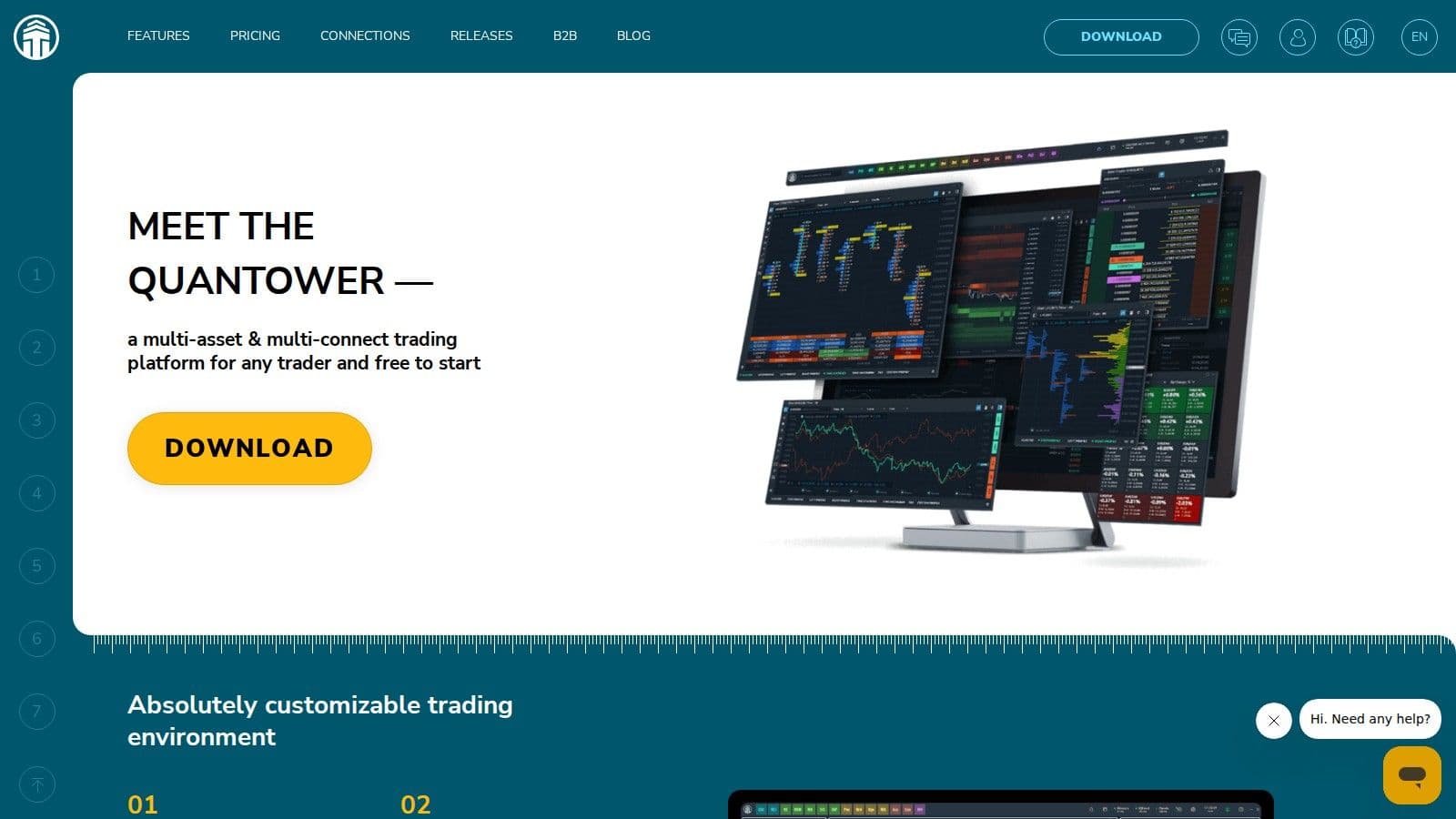
How Quantower Works with Prop Firms
Quantower connects to proprietary trading firms using three main integration methods: direct platform support, Rithmic connectivity, and Project X connections. Each method offers a unique setup, catering to different trading strategies and needs. These pathways also play a role in how data is handled and how risk management systems are implemented.
Direct integration is the simplest option. Topstep, for example, lets Quantower log in with TopstepX credentials (no API access needed) and includes Quantower's Premium Feature Bundle at no extra cost.
The Rithmic route is widely used by most Quantower-compatible prop firms. Rithmic acts as a bridge, connecting trading platforms to exchanges and brokers. Firms such as Take Profit Trader, Apex Trader Funding, TradeDay and Tradeify offer Quantower through Rithmic. Traders can activate Rithmic's data feed and execution services to use Quantower.
Project X connections offer another way to connect. Topstep's Quantower connection, for example, runs on ProjectX through the TopstepX server.
In the U.S., traders typically focus on futures contracts like the E-mini S&P 500 (ES), Nasdaq 100 (NQ), Russell 2000 (RTY), and Dow Jones (YM). Additional futures in energy, agriculture, and currencies are also supported.
Account requirements vary across firms, but most require traders to complete an evaluation phase to qualify for live funded accounts. During this phase, traders use demo accounts that simulate real market conditions. After passing, traders may receive funded accounts ranging from $25,000 to $300,000 in buying power, depending on the firm's offerings and the trader's performance.
Setting up Quantower requires a stable, low-latency internet connection and, ideally, a dedicated trading machine or VPS. Firms provide specific connection parameters, which should be tested in a paper trading environment before live trading begins.
Real-time market data is critical for Quantower’s advanced features like charting and order flow analysis. Firms using Rithmic often include data subscriptions, while direct integrations may require traders to arrange data separately.
Risk management systems are built into the integration between Quantower and prop firms. These automated systems monitor trading activity in real-time, keeping track of daily loss limits, position sizes, and restricted trading practices. Violations can lead to immediate account restrictions or termination, so it’s crucial for traders to understand each firm's risk rules before trading live.
U.S. traders should also confirm that the firm they choose complies with state-specific regulations, as some international firms may face restrictions based on local laws.
1. Apex Trader Funding
Key terms (checked October 2026): one-time evaluation fee for 25K, 50K, 100K or 150K accounts (50K list price $249 Intraday or $590 EOD on 10 Oct 2026, often cut with coupons; no monthly billing); one-time PA activation fee, or a No Activation Fee evaluation at a higher upfront price; $2,000 end-of-day or intraday trailing drawdown on 50K; EOD evaluations have a $1,000 daily loss limit on 50K, Intraday evaluations have none; no consistency rule in the evaluation; 100% payout split, with payouts after 5 qualifying days ($500 minimum, 50% consistency, up to 6 payouts per account); Rithmic, Tradovate and WealthCharts (NinjaTrader via Rithmic, TradingView via Tradovate); no straight-to-funded option.
Launched in 2021, Apex Trader Funding works with Quantower through Rithmic connectivity. To get started, open RTrader Pro, select 'Apex' in the system settings, and make sure you're using Quantower version 1.126.13 or higher for a reliable connection to Apex's Rithmic feed. If you're new to the platform, you'll need to complete two agreements and classify yourself as 'NON-PROFESSIONAL' for market data access. For step-by-step guidance, see Apex's "Connection Guide Link for Quantower and Rithmic" help article.
Apex says it offers limited support for Quantower, so connection problems go to Quantower support.
2. My Funded Futures
Key terms (checked October 2026): one-time plans with no activation fee: Rapid, Rapid EOD, Builder and Pro (new monthly plans were discontinued on August 25, 2026; Flex and other older plans are legacy); 50K Builder $153 and 50K Pro $265 at list price ($92 and $159 with the 40% promotion running in October 2026); $2,000 end-of-day max loss on 50K evaluations (Rapid sim-funded accounts then use an intraday trailing drawdown); Builder has a $1,000 soft daily loss limit on 50K, Rapid and Pro have none; evaluation consistency 50% on Rapid and Pro, 30% on Rapid EOD and none on Builder (Builder applies 50% per sim-funded payout cycle); 90/10 split on Rapid and Rapid EOD, 80/20 on Builder and Pro; Rapid and Rapid EOD pay daily, Builder every 48 hours, Pro every 14 days; NinjaTrader, Tradovate, TradingView, Quantower, Volumetrica, DeepChart and ATAS; positions are closed automatically at 4:10 PM ET; no straight-to-funded option.
Launched in 2023, My Funded Futures lists Quantower among its supported platforms, alongside NinjaTrader, Tradovate, TradingView, Volumetrica, DeepChart and ATAS.
Integration Type
Check MFFU's Quantower connection guide for the connection your account uses before you set up the platform.
3. Tradeify
Key terms (checked October 2026): one-time fees and no activation fee; 50K prices: Growth $145, Select $165, Lightning Funded (no evaluation) $492; sizes 25K to 150K; $2,000 end-of-day trailing drawdown on 50K; Growth has a $1,250 daily loss limit on 50K, Select evaluations have none; 40% consistency in Select evaluations, 35% for Growth payouts and 20% to 30% for Lightning payouts; 90/10 split on simulated funded accounts; Select Daily pays daily, Growth after 5 qualifying days; Tradovate, NinjaTrader, TradingView, Tradesea, Quantower, Sierra Chart, R|Trader and WealthCharts; straight-to-funded option: Lightning Funded.
Founded in 2024 in the United States, Tradeify supports Quantower through its Rithmic connection, alongside Tradesea, Sierra Chart and R|Trader; Tradovate, NinjaTrader and TradingView run on its Tradovate connection.
Trading Instruments Supported
Tradeify provides access to a diverse range of trading instruments across major exchanges, including CME, COMEX, NYMEX, CBOT, and EUREX. Here's a closer look at what they offer:
- Equity Index Futures: Tradeify supports popular contracts like the E‑Mini S&P 500 (ES), E‑Mini NASDAQ (NQ), E‑Mini Dow (YM), and E‑Mini Russell (RTY). For European markets, traders can access the DAX (FDAX) and Euro Stoxx 50 (FESX).
- Bond Futures: Options include Euro‑Bund (FGBL) and Euro‑Bobl (FGBM).
- Commodity Futures: Tradeify covers Crude Oil (CL), Natural Gas (NG), RBOB Gasoline (RB), and agricultural products such as Corn (ZC), Soybeans (ZS), Wheat (ZW), Live Cattle (LE), and Lean Hogs (HE).
- Micro Futures: For traders with smaller account sizes, Tradeify offers Micro E‑Mini S&P 500 (MES), Micro E‑Mini NASDAQ (MNQ), and E‑Micro Gold (MGC).
This extensive range of instruments ensures that Tradeify caters to traders of all experience levels and account sizes, providing opportunities across various markets.
Uptime
99.999% uptime. Built for 24/7 trading reliability.
Your VPS runs in Tier IV datacenters with redundant power and network, monitored 24/7 on site.
See the uptime SLA







From $29.99/mo · Windows or Linux
4. Lucid Trading
Key terms (checked October 2026): one-time fees with no monthly subscription and no activation fee (prices shown at checkout); LucidFlex, LucidPro and LucidDirect accounts from 25K to 150K; $2,000 end-of-day max loss on 50K; LucidFlex has an optional daily loss limit and LucidPro a $1,200 soft limit on 50K; 50% consistency in the LucidFlex evaluation and 40% for LucidPro payouts; 90/10 split; no fixed payout window, $500 minimum, paid within 2 business days; NinjaTrader, Tradovate, TradingView, Quantower, MotiveWave, Tradesea, Sierra Chart, Bookmap and other Rithmic platforms; straight-to-funded option: LucidDirect.
Year Established
Lucid Trading made its debut in 2025, kicking things off with an early partnership with Quantower. This collaboration set the stage for a smooth integration with Quantower's platform right from the start.
Integration Type
Lucid Trading connects with Quantower through the Rithmic data feed for LucidFlex, LucidPro and LucidDirect accounts, and its platforms page lists Quantower as a Lucid partner. Rithmic carries the market data and orders, while Quantower is the front end, with detailed market depth, customizable charts and order tools.
Trading Instruments Supported
Lucid Trading specializes in futures contracts, focusing on key CME instruments like ES (E-mini S&P 500), NQ (E-mini Nasdaq), YM (E-mini Dow), CL (Crude Oil), and GC (Gold). It doesn’t extend its services to forex, stocks, or cryptocurrency trading.
Account Types
Lucid offers LucidFlex, LucidPro and LucidDirect accounts in 25K, 50K, 100K and 150K sizes, with one-time fees, no activation fee and a 90/10 split; LucidDirect skips the evaluation.
5. Bulenox
Key terms (checked October 2026): one-time payments: Qualification $145, $175, $215 or $325 (25K to 150K) plus a Master activation fee ($148 on 50K), Momentum $94 to $358 with no activation fee, or Fast Track $338 to $788, which skips qualification; $2,500 drawdown on 50K, either trailing in real time (no daily loss limit) or end-of-day with a daily loss limit; no minimum days or consistency rule in Qualification; 100% of the first $10,000, then 90%; daily payouts on Fast Track and Momentum accounts; Rithmic platforms only; straight-to-funded option: Fast Track.
History and Milestones
Bulenox has made a name for itself in the prop trading world, marking a significant achievement on February 26, 2025. This milestone came when Quantower enabled a dedicated Rithmic connection, simplifying access to funded accounts for traders.
Integration Type
After this achievement, Bulenox adopted dual integration methods, similar to other firms working with Quantower. Traders can connect to Quantower through two options:
- Rithmic: This method uses the R | TRADER interface with designated servers, such as Rithmic Paper Trading Chicago for demo accounts.
- ProjectX: Bulenox's current pricing and help pages list Rithmic connections only, so confirm with Bulenox whether a ProjectX connection is still offered.
Bulenox's FAQ lists Quantower among its more than 20 supported platforms, with NinjaTrader, R|Trader Pro, Sierra Chart, MultiCharts and ATAS (checked on 10 Oct 2026).
Trading Instruments Supported
Bulenox specializes in futures trading across key asset classes, including stock indices and precious metals. These offerings align with Quantower's platform, which supports both futures and options trading when connected via Rithmic.
Account Sizes and Profit Splits
Bulenox provides a variety of Qualification Accounts with straightforward terms and competitive pricing:
- $25,000 Account: Allows up to 3 contracts, with a $1,500 profit target and a $1,500 maximum drawdown. Price: $145 one-time.
- $50,000 Account: Supports up to 7 contracts, with a $3,000 profit target and a $2,500 drawdown limit. Price: $175 one-time.
- $100,000 Account: Permits up to 12 contracts, with a $6,000 profit target and a $3,000 maximum drawdown. Price: $215 one-time.
- $150,000 Account: Permits up to 15 contracts, with a $9,000 profit target and a $4,500 maximum drawdown. Price: $325 one-time.
6. Take Profit Trader
Key terms (checked October 2026): monthly Test subscription in 25K, 50K, 75K, 100K and 150K sizes (Take Profit Trader says Test fees are at most $360 a month); one-time $130 PRO activation fee; $2,000 end-of-day trailing drawdown on the 50K Test (the funded PRO account uses an intraday trailing drawdown); no daily loss limit; at least 3 trading days, with your best day under 50% of total profit; 80/20 split in PRO and 90/10 in the live PRO+ account; PRO withdrawals available from day one; 14 platforms including NinjaTrader, Tradovate, TradingView and Quantower; no straight-to-funded option.
Launched in 2021, Take Profit Trader lists Quantower among its Rithmic platforms; NinjaTrader, TradingView and Tradovate run on its CQG feed.
Integration Type
Take Profit Trader leverages Rithmic connectivity to provide a smooth and efficient experience for Quantower users. This setup ensures dependable market data and precise order execution.
7. Topstep
Key terms (checked October 2026): Trading Combine in 50K, 100K and 150K sizes for $49, $99 or $199 a month plus a $149 activation fee per Express Funded Account, or $95, $149 or $229 a month with no activation fee; $2,000 Maximum Loss Limit on 50K that trails the end-of-day balance; optional $1,000 daily loss limit; your best day must stay under 55% of the profit target; 90/10 split; Express Funded payouts after 5 winning days of $150+ (or 3 days on the Consistency path); TopstepX is the only trading platform for new accounts, and Quantower logs in with TopstepX credentials; no straight-to-funded option.
Founded in 2012, Topstep has established itself as a prominent name in the futures trading world. Its help center says "TopstepX™ is the only available trading platform", and Quantower is the third-party platform it still documents: "Quantower connects through TopstepX credentials. No API access needed." Quantower via TopstepX is available for the Trading Combine and Express Funded Account only (checked on 10 Oct 2026).
Integration Type
Topstep integrates with Quantower through the TopstepX server. Topstep accounts receive Quantower's Premium Feature Bundle (DOM Surface, TPO chart, volume analysis tools and charting) at no extra cost, though Level 2 data is needed for full access and tools such as Market Replay and Strategy Manager are not included.
Trading Instruments Supported
Topstep focuses on CME Group futures contracts, including popular options like Crude Oil and the E-mini S&P 500.
Account Sizes and Profit Splits
Topstep offers three account tiers: $50,000, $100,000, and $150,000. The profit split is 90/10. Trading Combine fees start at $49 a month for the 50K account plus a $149 activation fee per Express Funded Account, or $95 a month with no activation fee.
Evaluation Process and Educational Support
Topstep uses a one-step evaluation, the Trading Combine, with a $3,000 profit target on 50K and a rule that your best day must stay at or below 55% of the profit target. Traders also get educational resources such as coaching and daily market analysis. These tools are designed to help traders sharpen their skills and improve performance.
8. TradeDay
Key terms (checked October 2026): monthly evaluations with no activation fee in 25K to 150K sizes; 50K list prices are $131 a month (Quick Pay, Intraday), $175 (Quick Pay, End of Day) and $189 (Fast Pass), often discounted; $2,000 drawdown on 50K; no daily loss limit; evaluation consistency 30% (Quick Pay) or 45% (Fast Pass); Quick Pay splits profit 50/50 below $4,000 and 80/20 above it, Fast Pass pays 80/20 and Funded Live 90/10; Quick Pay payouts from day one ($250 minimum), Fast Pass after 5 profitable days; Tradovate and Rithmic connections (NinjaTrader, TradingView, Jigsaw, Quantower); no straight-to-funded option.
TradeDay, introduced in 2020 in the United States, connects with Quantower using a Rithmic data feed. For step-by-step instructions, you can check out the detailed guide available in their help center.
9. Elite Trader Funding
Key terms (checked on 10 Oct 2026): six plans (1 Step, Direct To Funded, Static, Diamond Hands, End of Day and Fast Track) in $10,000 to $150,000 sizes; keep up to 100% of $150,000 in lifetime simulated profit; same-day payout approval, with caps from $1,500 to $5,000 per payout depending on the plan; one-time activation fees from $157 on plans that charge one, and none on Direct To Funded; a limited-time sale of 85% off non-Fast Track evaluations was running when we checked.
Elite Trader Funding's help center has a guide called "Connecting your Rithmic account to QuanTower", so Quantower runs on its Rithmic accounts. Its homepage says top performers are invited to LIVE ELITE, where they trade real capital.
10. Earn2Trade
Key terms (checked on 10 Oct 2026): Trader Career Path (TCP25, TCP50 and TCP100 at $150, $190 and $350 a month) and Gauntlet Mini ($50K to $200K, from $170 a month); 50% off any evaluation in its anniversary offer to Oct 18, 2026; Gauntlet Mini traders keep 50% of withdrawals under $2,250 and 80% above; weekly payouts; no minimum trading days.
Earn2Trade's help center has a guide called "How to Connect Rithmic to QuanTower?", so Quantower runs on its Rithmic data. You choose Rithmic, BlackArrow or NinjaTrader at checkout.
11. Alpha Futures
Key terms (checked on 10 Oct 2026): one-step evaluations on Zero, Standard and Advanced plans, plus Direct accounts that start without an evaluation (25K to 150K Direct Qualified accounts for $349 to $859 one-time); an end-of-day trailing Maximum Loss Limit on every plan; evaluation consistency of none (Zero), 50% (Standard) or 40% (Advanced), and 20% on Direct; a 90% performance split; codes ALPHA40 (40% off Zero) and ALPHA50 (50% off Standard, Advanced and Direct).
Alpha Futures says it "supports AlphaTrader, TradingView through Plus500 connectivity, WealthCharts, Quantower and DeepChart." You pick Quantower when you buy an evaluation, and the firm notes that "platform choice is locked at purchase."
12. Goat Funded Futures
Key terms (checked on 10 Oct 2026): GOAT Daily, Flex, EOD, 1-Day Pass, Instant Classic and Instant Lite accounts; GOAT Daily one-time fees of $178, $238, $378 and $538 for 25K to 150K ($89 to $269 with the AUTUMN50 code) and no activation fee; 40% consistency in the GOAT Daily evaluation; a default 90/10 split, and Instant Classic keeps 100% of the first $10,000; payouts in 2 business days or an extra $500.
Goat Funded Futures lists Quantower first among its platforms, next to Deepmap, NinjaTrader Prop, Tradovate Prop, Deepcharts, TickBlaze and ATAS.
13. Funded Futures Network
Key terms (checked on 10 Oct 2026): MAX Standard (5 days to pass) and STEADY (2 days to pass) one-time evaluations; MAX Standard costs $148, $178, $348, $408 and $658 for 25K to 250K; the 50K has a $3,000 target, a $2,000 end-of-day drawdown, a $1,250 daily loss limit, 40% consistency and no activation fee; 80% split in the funded account and up to 90/10 in Live Funded; same-day payouts with a $500 minimum.
Funded Futures Network says each account "includes a license for a preferred trading platform, Onyx or Quantower (FundX)", and every account comes with its own Rithmic login.
14. Traders Launch
Key terms (checked on 10 Oct 2026): one-step futures evaluations of $100K, $200K and $300K for $159, $299 and $599 one-time with an 80% split (a 60% split option is also listed); $1,000, $2,000 and $3,000 end-of-day drawdowns that lock at the starting balance; no consistency rules once funded, no activation fees, and daily payouts with no payout caps.
Traders Launch's FAQ lists three platforms: "TradingView (browser-based, no download), Volumetrica (desktop and web), and Quantower (desktop)." The same FAQ explains how to log in to Quantower.
Order flow
Built for scalpers. Heatmaps on dedicated resources.
Order-flow heatmaps and DOM ladders run on dedicated CPU, memory and NVMe, so your charts keep responding during volatility.
See the dedicated hardwareFrom $29.99/mo · Windows or Linux
15. Uprofit
Key terms (checked on 10 Oct 2026): Day 2.0 program (Day Soft and Day Flex) in 10K, 50K, 100K and 150K sizes; monthly list prices of $49, $130, $193 and $327, shown at $29, $78, $116 and $196 with 40% off applied; 50% consistency; no activation fee; funding traders since 2019.
Uprofit recommends Rithmic as its data feed, and its platform table says Rithmic "is compatible with most trading screens including NinjaTrader, Quantower, ATAS, and Multicharts." Confirm the Quantower setup with Uprofit before you buy.
Firms That Don't Name Quantower Yet
These six firms were in earlier versions of this list but did not name Quantower on their own sites or help centers (checked on 10 Oct 2026). Several connect through Rithmic, which Quantower supports, so ask the firm whether your account type works with Quantower before you buy.
Day Traders
Key terms (checked October 2026): evaluations, Static accounts, Straight to Sim Funded (S2F) and Straight to Live (S2L); its pricing page lists evaluations from $55, Static from $40, S2F from $222 and S2L from $179 on Rithmic, with Pro activation fees billed separately; the 50K S2F account has a $2,500 end-of-day drawdown and a $1,250 daily loss limit; evaluations use a 50% consistency rule; 100% simulated profit split on Pro and S2F accounts; payouts every 8 qualifying days (Pro) or 10 (S2F), $500 minimum; browser-based ArcTrader platform with TradingView charts and Rithmic connectivity.
Day Traders' current platform is ArcTrader, a browser-based platform with TradingView charts, and its accounts connect through Rithmic. Earlier versions of its help center connected Quantower through Project X, so confirm with Day Traders that this still applies to your account.
BluSky Trading
Key terms (checked October 2026): evaluation plans (Launch, Propel, Premium, Static and Orbit) billed every 30 days, for example $497 for the 100K Launch plan plus a $99 Launch fee after you pass (other prices are shown at checkout); end-of-day trailing drawdown and no daily loss limit in evaluations; consistency 50% (Launch), 34% (Propel, Premium, Static) or none (Orbit); 90/10 split; daily payouts Monday to Friday once funded; Tradovate, Tradesea, Rithmic, Deepcharts, NinjaTrader, Tickblaze and BlackArrow; straight-to-funded options: Instant Funded and Direct 2 Funded.
BluSky Trading's evaluation rules reference Rithmic (R|Trader Pro) and Tradovate connections, and its platform list includes Tradovate, Tradesea, Rithmic, Deepcharts, NinjaTrader, Tickblaze, BlackArrow and Volumetrica, but not Quantower.
Phidias Propfirm
Key terms (checked October 2026): Express to Live (25K to 150K, one-time from $277, $650 static drawdown on 50K, no minimum days) or Fundamental and Premium (50K to 150K, $2,500 end-of-day trailing drawdown on 50K); no daily loss limit; 30% consistency on funded CASH accounts; Fundamental pays 80% after 10 qualifying days, Premium starts at 75% and reaches 100% from the fifth payout, after 5 qualifying days; Phidias says 90% of payouts are processed in under 30 minutes and all within 24 hours; Rithmic, Tradovate, NinjaTrader, TradingView and DeepCharts; no straight-to-funded option.
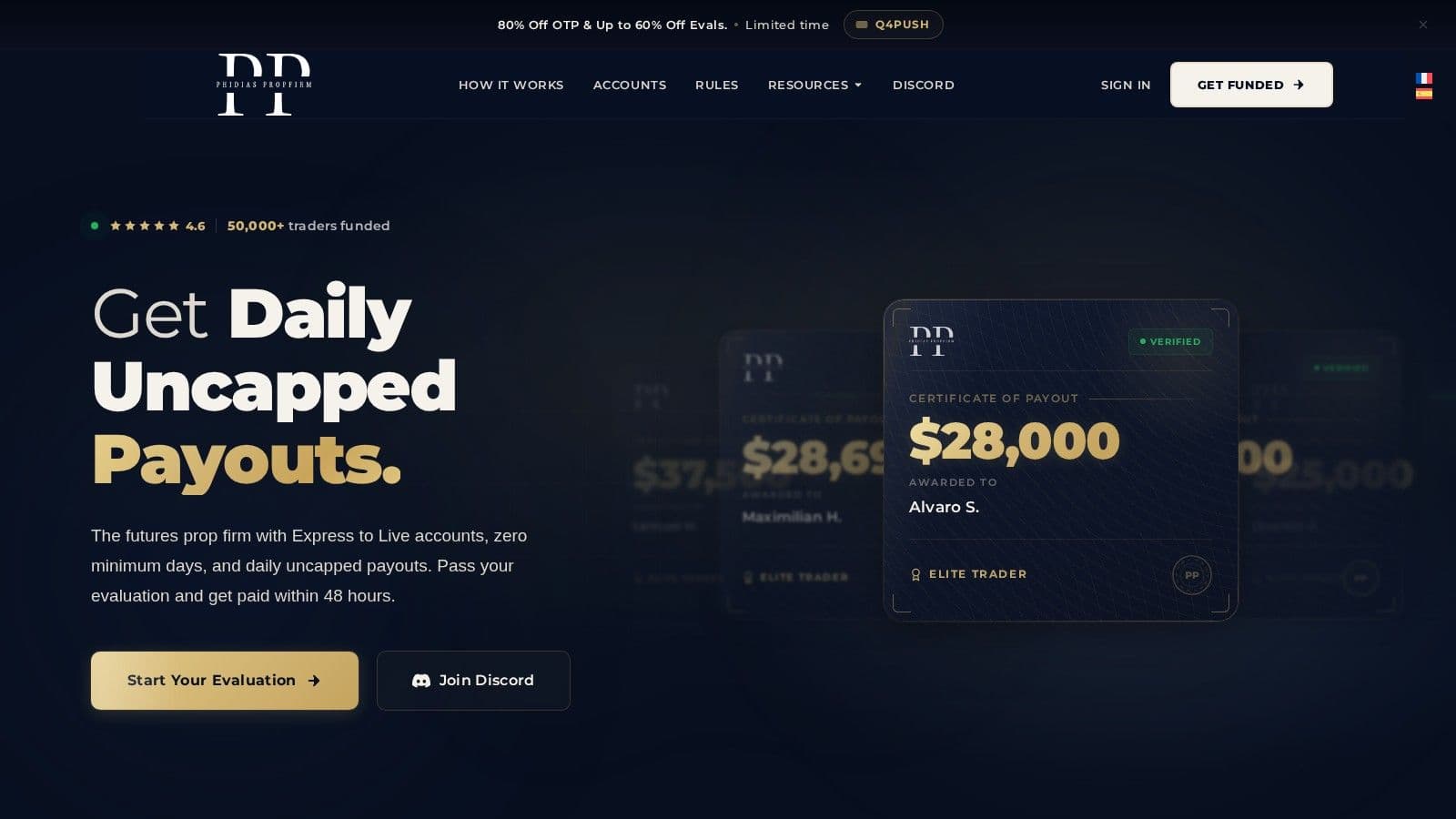
Phidias Propfirm sells Express to Live accounts (25K to 150K, live account after you pass, no minimum days), Fundamental accounts (50K to 150K, positions closed daily) and Premium accounts (50K to 150K, overnight and over-week holds allowed). It lists Rithmic (CME Group data) and dxFeed (EUREX data) feeds, with NinjaTrader, Tradovate and DeepCharts as named platforms. Its site does not name Quantower, so confirm with Phidias that Quantower works on your account before you buy.
The Futures Desk
Key terms (checked October 2026): a one-step simulated assessment, then a live account at a regulated FCM; no activation or funded fees; static or end-of-day drawdown; no consistency rule once funded; daily payouts Monday to Friday, uncapped after the buffer; account sizes, assessment prices and the profit split are not listed on its homepage.
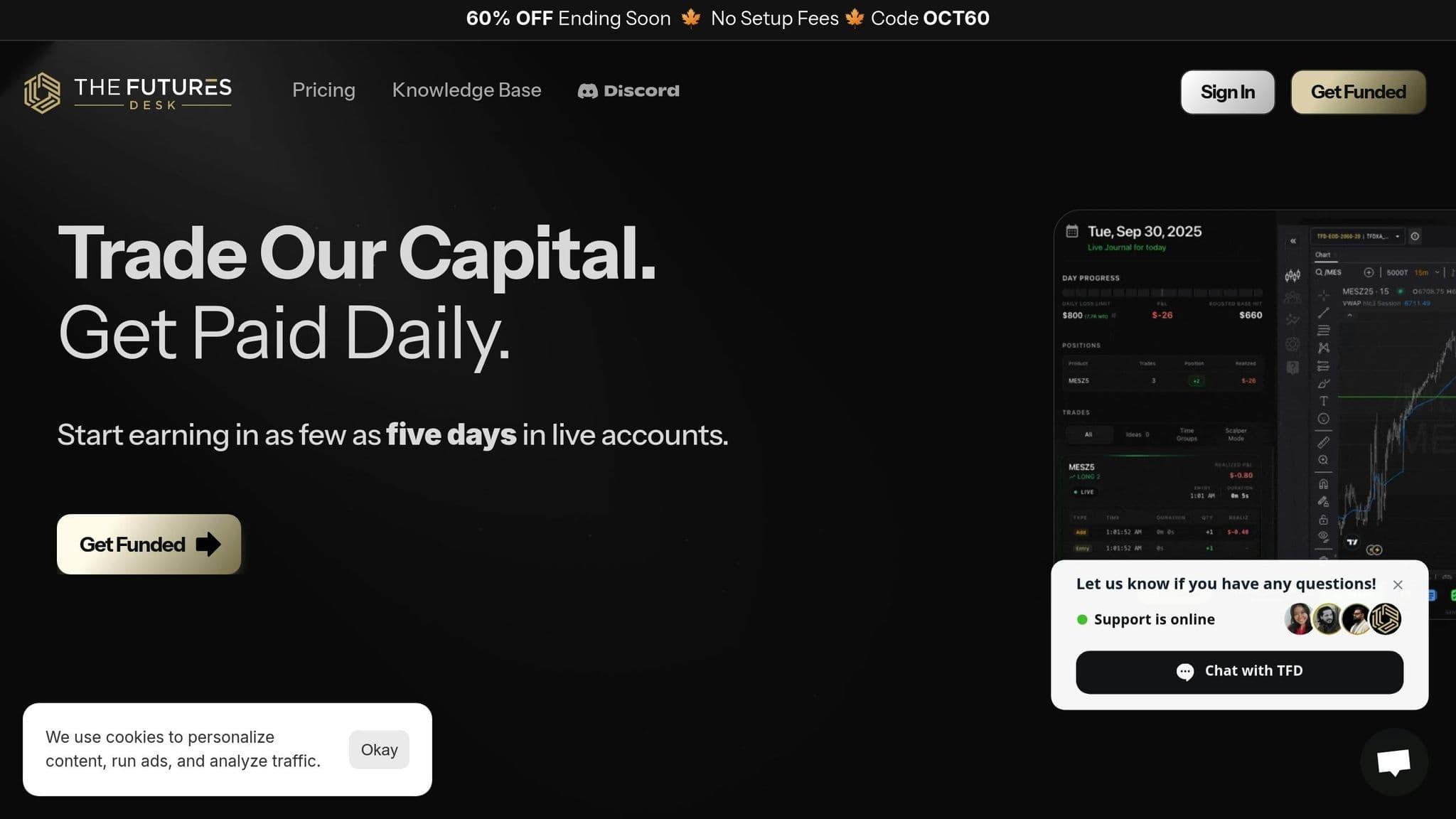
The Futures Desk runs a one-step simulated assessment, then moves traders to live accounts at regulated FCMs (Dorman or Plus500) through Topstep Brokerage LLC, with access to CME Group products such as ES and NQ. Its homepage does not name supported platforms or a data feed, and it shows one firm rather than separate UK and US offerings, so confirm Quantower support with the firm before you sign up.
Legends Trading
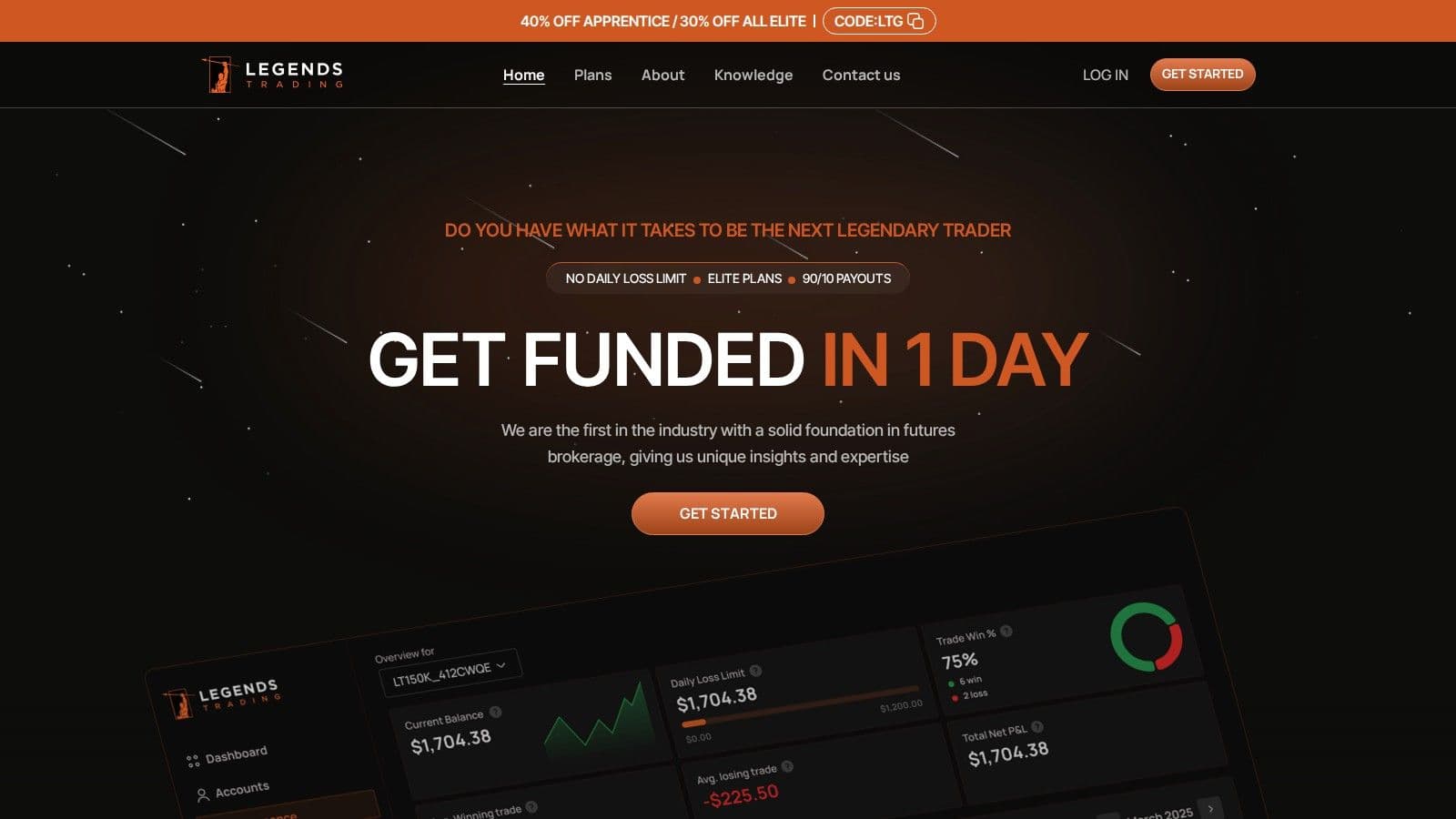
Key terms (checked on 10 Oct 2026): Apprentice accounts billed monthly ($59, $107 and $138 for 50K, 100K and 150K, plus a $59, $77 or $89 activation fee) and one-time Elite accounts ($119, $151, $227 and $347 for 25K to 150K, no activation fee); end-of-day trailing drawdown and no daily loss limit; no consistency rule in the Apprentice evaluation and 40% on Elite; 90/10 split, with a move to live funded after the second payout; payouts up to twice a month; a 40% discount with the code LTG was running when we checked.
Legends Trading's homepage does not name Quantower or its other platforms, and its knowledge base did not load when we checked, so confirm Quantower support with the firm before you buy.
Purdia Capital
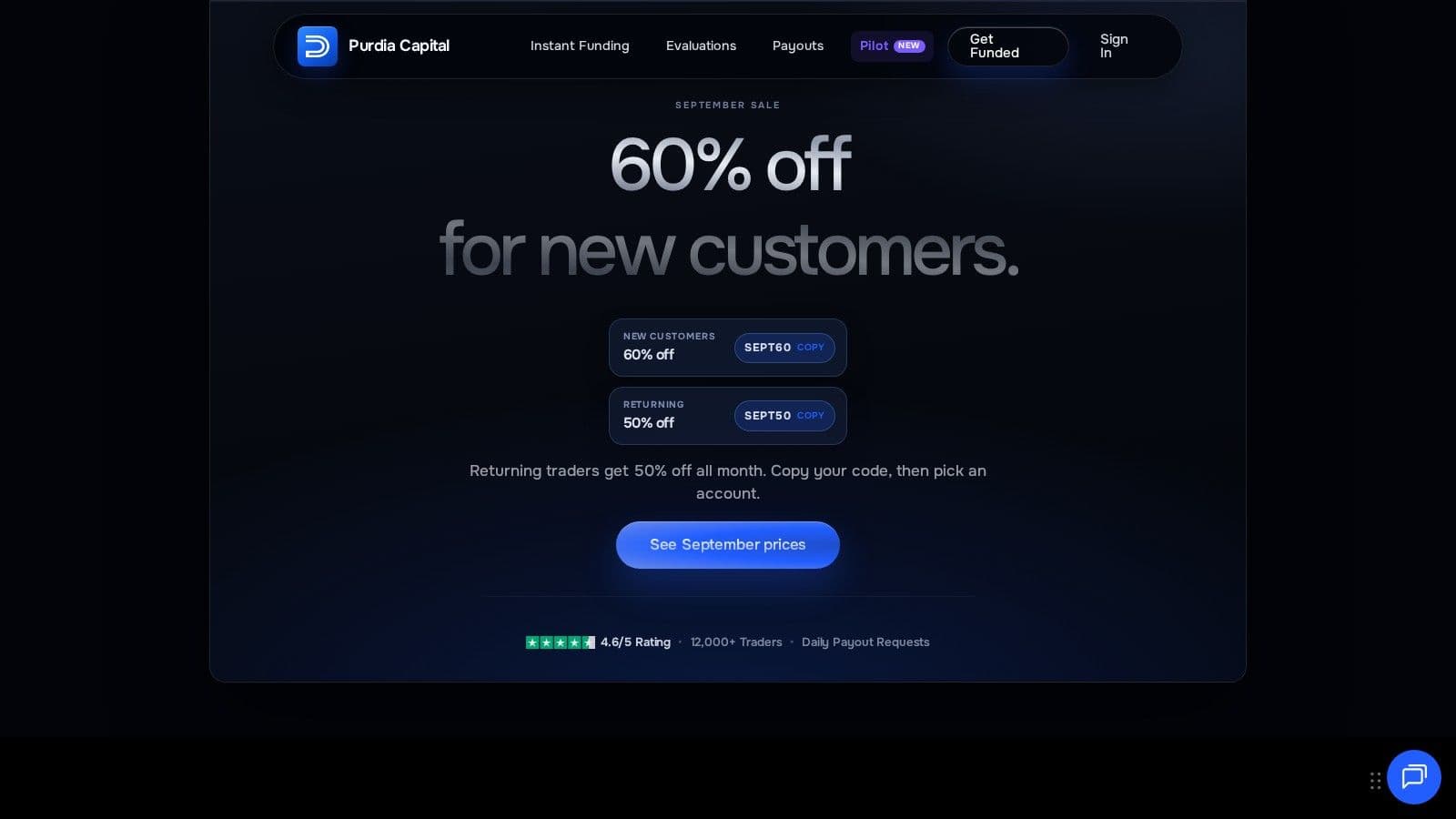
Purdia Capital joined the futures prop trading scene in 2024. Some reviews mention Rithmic connectivity, but its own site does not confirm Quantower support, so contact Purdia Capital directly before committing.
Quick Comparison Chart
Here’s a chart of the 15 firms that name Quantower, with how each one connects, account sizes, profit splits and an example price (checked on 10 Oct 2026; prices are list prices before coupons unless stated):
| Firm Name | Quantower connection | Account Sizes | Profit Split | Example price |
|---|---|---|---|---|
| Apex Trader Funding | Rithmic (limited Apex support) | $25,000 to $150,000 | 100% of approved payouts | 50K: $249 Intraday or $590 EOD, one-time |
| My Funded Futures | Listed platform (see MFFU guide) | $25,000 to $150,000 | 90/10 Rapid; 80/20 Builder and Pro | 50K Builder $153 one-time ($92 with promotion) |
| Tradeify | Rithmic | $25,000 to $150,000 | 90/10 | 50K Growth $145, Select $165, one-time |
| Lucid Trading | Rithmic | $25,000 to $150,000 | 90/10 | Shown at checkout |
| Bulenox | Rithmic | $25,000 to $150,000 | 100% of first $10,000, then 90% | 50K Qualification $175 one-time, plus activation |
| Take Profit Trader | Rithmic | $25,000 to $150,000 | 80/20 PRO; 90/10 PRO+ | Monthly; a failed Test costs at most $360 |
| Topstep | TopstepX credentials (ProjectX) | $50,000 to $150,000 | 90/10 | 50K $49 a month plus $149 activation, or $95 a month |
| TradeDay | Rithmic | $25,000 to $150,000 | Quick Pay 50/50 to $4,000 then 80/20; Live 90/10 | 50K Quick Pay Intraday $131 a month |
| Elite Trader Funding | Rithmic | $10,000 to $150,000 | Up to 100% of $150,000 lifetime sim profit | Shown at checkout |
| Earn2Trade | Rithmic | $25,000 to $200,000 | 50% or 80% by withdrawal size | TCP25 $150 a month; GAU50 $170 a month |
| Alpha Futures | Chosen at purchase | $25,000 to $150,000 (Direct) | 90% | 50K Direct Qualified $519 one-time |
| Goat Funded Futures | Listed platform | $25,000 to $150,000 | 90/10 (100% of first $10,000 on Instant Classic) | 50K GOAT Daily $238 one-time ($119 with AUTUMN50) |
| Funded Futures Network | Quantower licence included (FundX) | $25,000 to $250,000 | 80% funded; up to 90/10 live | 50K MAX Standard $178 one-time |
| Traders Launch | Quantower desktop | $100,000 to $300,000 | 80% (60% option) | 100K $159 one-time |
| Uprofit | Rithmic (Quantower named as compatible) | $10,000 to $150,000 | Not stated on its homepage | 50K Day 2.0 $130 a month ($78 with 40% off applied) |
Key Insights
Integration Trends:
The majority of firms rely on Rithmic for integration, ensuring smooth access to CME Group futures like the E-mini S&P 500 and Crude Oil. Notably, Topstep connects Quantower through TopstepX (ProjectX) rather than Rithmic.
Account Sizes and Profit Splits:
Most firms provide account sizes between $25,000 and $150,000, with profit splits of 80% to 90%. Apex pays 100% of approved payouts, Bulenox 100% of the first $10,000, and Traders Launch and Funded Futures Network go up to $300,000 and $250,000 accounts.
Reliability and Longevity:
Established firms, such as Topstep (founded in 2012) and Take Profit Trader (launched in 2021), often enjoy stronger reputations for transparency and reliable payouts. Topstep, in particular, is well-known for its educational resources and flexible timeframes.
Cautionary Note:
Day Traders, BluSky Trading, Phidias Propfirm, The Futures Desk, Legends Trading and Purdia Capital did not name Quantower on their own sites (checked on 10 Oct 2026), so check with the firm before buying.
Firms Without Quantower Support
While many major prop firms support Quantower, FundedNext Futures does not list it. Knowing about these gaps can help traders make informed decisions and avoid unnecessary complications. Here’s a closer look at the firms without verified Quantower support.
FundedNext Futures does not list Quantower as a supported platform on its official website. Instead, the firm highlights Tradovate, NinjaTrader, and TradingView as its compatible platforms. This lack of Quantower support seems tied to the absence of Rithmic connectivity within the firm’s offerings. Some third-party review sites have mistakenly included Quantower in their lists of supported platforms, which has led to confusion. Without Rithmic as a data feed option, traders are restricted to the platforms explicitly supported by FundedNext Futures.
Adjusting to Platform Limitations
For traders who have invested significant time in customizing their Quantower setup - whether through indicators or specific trading strategies - shifting to a different platform can pose challenges. Adapting to new charting tools and order management systems often involves a learning curve, which might affect trading performance during the transition.
Why These Gaps Exist
The absence of Quantower support in these firms boils down to business priorities and resource allocation. For instance, FundedNext Futures appears to focus its efforts on integrating platforms like Tradovate, suggesting that expanding platform compatibility isn’t a current priority.
To avoid potential headaches, always verify platform compatibility directly through a firm’s official website or customer support channels. Relying on third-party reviews can sometimes lead to outdated or incorrect information, so taking a few extra minutes to confirm details can save you from unexpected surprises.
VPS Hosting for Quantower Trading
Using a Virtual Private Server (VPS) to run Quantower can significantly improve your trading experience. A VPS ensures constant connectivity, protecting you from issues like power outages, internet disruptions, or hardware failures that could lead to missed trades. With a VPS, your trading platform operates 24/7 in a professional data center, reducing downtime and hardware risks. This level of reliability matters for the funded accounts that prop trading firms offer, where one missed exit can end an evaluation.
When trading with firms like Topstep or Apex Trader Funding, ultra-low latency helps, because every millisecond counts. QuantVPS's Chicago servers reach CME in 0.52ms on its published route, much closer than a typical home connection. That matters most for scalping or automated trading, where Quantower's advanced order management tools shine.
A VPS also offers global accessibility. When traveling or working from a different location, you can access your Quantower setup from anywhere with an internet connection. This flexibility ensures your charts, indicators, and trading strategies are always within reach through remote desktop access.
Automatic off-site backups run on every VPS plan. QuantVPS backs up the server that holds your Quantower configurations, custom indicators, and trading templates, so your setup can be restored quickly if needed instead of rebuilding weeks of careful work.
For traders running algorithmic strategies, a VPS provides dedicated resources, preventing the performance issues that can arise on shared systems. Automated scripts execute smoothly without competing for CPU power, ensuring precise timing for systematic trades.
Security is another major advantage. QuantVPS includes always-on DDoS protection with advanced filtering, plus firewalls, on every server, and runs with 99.999% uptime, about 26 seconds of downtime a month. This matters when managing funded accounts, where both reliability and security are non-negotiable.
Setup is straightforward, with many providers offering pre-configured Windows Server environments that work with trading platforms. The monthly cost is a small price to pay for the lowest latency and the reliability of a professional VPS.
Conclusion
Choosing the right Quantower-compatible prop firm comes down to matching your trading style with the firm's platform requirements. Fifteen firms, including Topstep, Take Profit Trader, Apex, TradeDay, Tradeify, Lucid, Alpha Futures and Funded Futures Network, name Quantower on their own sites, mostly through Rithmic. Topstep connects Quantower through TopstepX and includes Quantower's Premium Feature Bundle at no extra cost.
When deciding, focus on key factors like account size, profit targets, drawdown limits, and platform fees. Different firms cater to varying risk levels - Take Profit Trader and Apex Trader Funding are good examples - so it's essential to assess your capital needs upfront to avoid costly mismatches.
Your trading infrastructure matters just as much as the firm you choose. Quantower’s advanced tools, like order management and charting, perform best with stable connectivity and low latency. Using a dedicated VPS can help you avoid connectivity issues that might impact your funded account progress.
Stick to verified firms with official setup guides or clear platform support. Avoid unverified options until they confirm Rithmic compatibility or list Quantower as a supported platform. This ensures a smoother experience and minimizes unnecessary risks.
If you're just starting, consider firms with smaller accounts and realistic profit targets. Topstep and TradeDay are excellent entry points, while seasoned traders might lean toward larger account options from Apex Trader Funding or Traders Launch. Pairing the right firm with a professional hosting setup can significantly enhance your trading consistency.
Connecting Quantower to your prop firm
Before buying an evaluation, confirm on the firm's site which connection it uses for Quantower (Rithmic, Tradovate or TopstepX) and whether the platform licence is included. Test the connection on the firm's demo or trial account first. From Chicago, a Quantower VPS for prop traders reaches CME in 0.52ms on QuantVPS's published route.
FAQs
How does using Quantower with Rithmic or Project X affect trading performance and latency?
The connection between Quantower, Rithmic, and Project X is built to boost trading performance by delivering fast, reliable data feeds and smooth order execution. Rithmic offers low-latency infrastructure, providing accurate market data and quick order routing, which is especially valuable for active traders and scalpers. On the other hand, Project X focuses on simplifying connectivity, creating a trading experience for users of platforms like Quantower.
While your results may depend on factors like your internet speed and trading strategy, these integrations are widely used for their low latency and reliability. To get the most out of this setup, make sure it aligns with the recommended configurations from your broker or prop firm.
What should U.S.-based traders consider when selecting a prop firm compatible with Quantower?
When choosing a prop firm that works with Quantower, U.S.-based traders should focus on firms that either offer direct integration with Quantower or support connections through Rithmic, a widely-used method. It’s also important to check the firm's platform support and setup guides to ensure everything runs smoothly.
Firms that name Quantower on their own sites or help centers include Apex Trader Funding, My Funded Futures, Tradeify, Lucid Trading, Bulenox, Take Profit Trader, Topstep, TradeDay, Elite Trader Funding, Earn2Trade, Alpha Futures, Goat Funded Futures, Funded Futures Network, Traders Launch and Uprofit. Day Traders, BluSky Trading, Phidias Propfirm, The Futures Desk, Legends Trading and Purdia Capital did not name Quantower on the pages we checked (checked on 10 Oct 2026), so confirm with them first. Always consult the firm's documentation for detailed instructions and compatibility details.
Why should Quantower users consider using a VPS, and how does it improve trading reliability and latency?
A Virtual Private Server (VPS) hosts Quantower on a remote computer. One of the biggest perks is a stable and fast internet connection, which helps avoid disruptions caused by local network issues. For traders who depend on real-time data, this stability is crucial.
Another major benefit is the low-latency connection to trading servers. A server close to the exchange gives you the lowest latency, which helps in fast-moving markets. Plus, hosting your trading platform on a VPS allows your strategies to run around the clock without needing your personal computer to stay on. Even during power outages or hardware malfunctions, your trading operations remain uninterrupted. For those aiming for a reliable and efficient trading setup, a VPS is a solid choice.


