
Funded options trading accounts let you trade options with a firm's capital instead of your own money, in exchange for a share of the profits. Few prop firms fund options today: Maverick Trading (65% to 90% profit split, firm capital from $25,000) and T3 Trading Group (licensed traders, negotiated payouts) do, while most challenge-based prop firms fund futures, forex or CFDs and do not list options. Check before you pay a fee; every fact below was checked on 10 Oct 2026.
Two firms fund options traders:
- Maverick Trading: options-focused since 1997, with a 65% to 90% split and firm capital from $25,000 to $1,000,000 or more.
- T3 Trading Group: SEC-registered broker-dealer whose licensed traders trade equities, options and futures.
Six alternatives that options traders often compare fund other markets, not options:
- Savius LLC: now a futures prop firm (Instant Funded and a 1-step evaluation, up to $300K); options are not listed.
- Lux Trading Firm: scales accounts to $10M with an 80% split; its July 2026 symbol list has forex, indices, crypto and stock CFDs but no options.
- Elite Trader Funding: futures evaluations and up to 100% of $150,000 in lifetime sim-funded profit; options are not listed.
- BluSky Trading: futures plans with a 90/10 split and daily payouts; options are not listed.
- FTMO: forex and CFD firm with an 80% to 90% split; no options product.
- Funded Trading Plus: forex and CFD firm with an 80% to 90% split and scaling to $2.5M; no options product.
Quick Comparison
Figures from each firm's own site, checked on 10 Oct 2026.
| Firm | Max Funding | Profit Split | Evaluation Type | Options Trading |
|---|---|---|---|---|
| Maverick Trading | $1,000,000+ (from $25,000) | 65% to 90% | Qualification program | Yes: stock and index options |
| T3 Trading Group | Scalable buying power | Negotiated | SIE and Series 57 licenses | Yes: multi-leg and spread trading with approval |
| Savius LLC | Up to $300,000 | Up to 90% | Instant Funded or 1-step | No: CME futures |
| Lux Trading Firm | Up to $10M | 80% | 1-step evaluation or Instant | No: CFDs only |
| Elite Trader Funding | Up to $150,000 | Up to 100% (sim-funded) | Six evaluation types | No: futures only |
| BluSky Trading | Up to $200,000 | 90/10 | Launch, Propel, Orbit or Instant | No: futures (stock plans listed separately) |
| FTMO | Up to $2M (scaling) | 80% to 90% | 1-Step or 2-Step | No options product |
| Funded Trading Plus | Up to $2.5M (scaling) | 80% to 90% | Instant, 1-Step or 2-Step | No options product |
Only Maverick Trading and T3 Trading Group fund options trading directly. The other six are included because options traders often compare them, but you would be trading futures, forex or CFDs there.
Firms That Fund Options Traders
Maverick Trading and T3 Trading Group are the two firms here that let you trade options with firm capital.
1. Maverick Trading
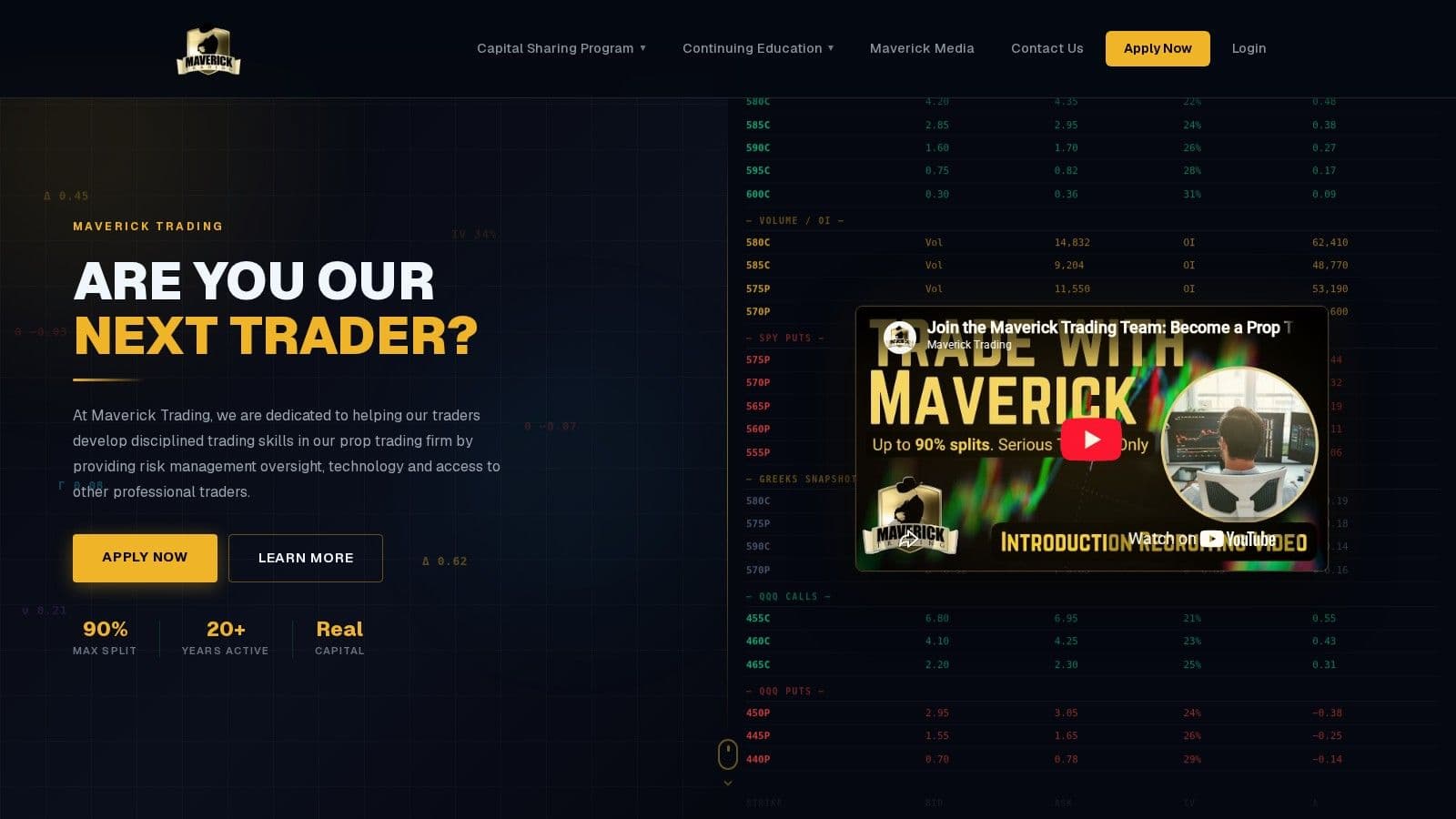
Maverick Trading is an options prop firm that has traded since 1997, and it backs traders who pass its qualification program with firm capital. Traders keep 65% to 90% of the profits they generate, as independent contractors rather than employees.
Funding Capital Limits
Maverick says traders gain access to firm capital "from $25,000 initially to millions", and its capital tiers run from $25,000 to $1,000,000 or more. Capital grows with trading performance, retained profits and the size of the trader's risk deposit.
Costs: each trader pays a $199 desk fee and posts a trading bond before live trading; Maverick says full cost details are in its application.
Profit Split Percentages
Maverick Trading pays a 65% to 90% split. Monthly profits are calculated per options period and paid on the 1st of the following month.
Options-Focused Features
Traders must pass tests on position sizing and risk management in the stock and options market, then follow a personalized, rule-based trading plan. A trader and coach monitors each new trader's demo account before live trading.
Evaluation Process Flexibility
Maverick's qualification program includes more than 1,000 hours of video on demand, a verification program of tests and a monitored demo period. Remote trading is supported, so traders do not need to work from an office.
2. T3 Trading Group
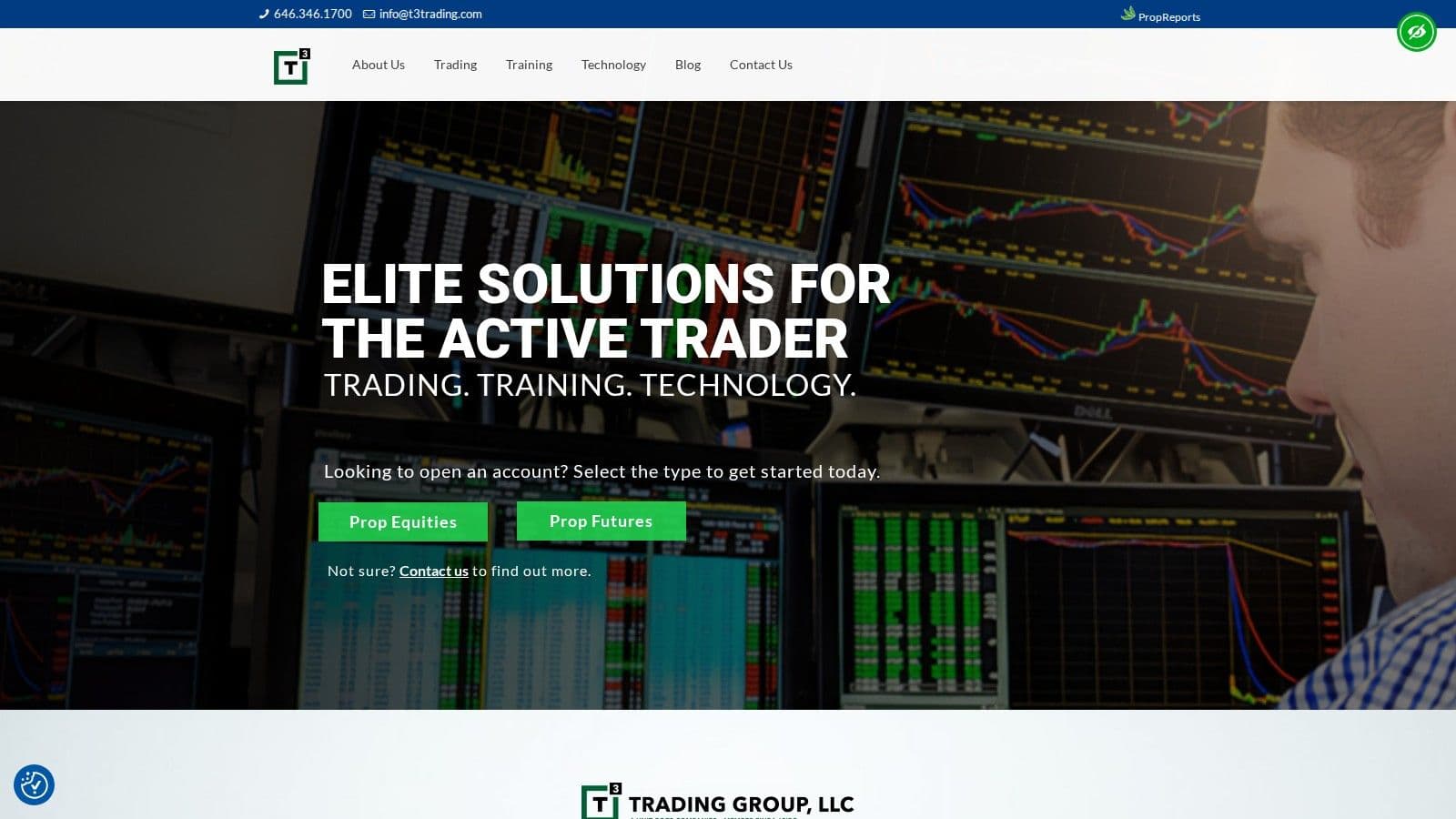
T3 Trading Group is an SEC-registered broker-dealer and a member of FINRA/SIPC. Its proprietary traders trade equities, options and futures, with low-latency connections and support for algorithmic strategies.
Uptime
99.999% uptime. Built for 24/7 trading reliability.
Your VPS runs in Tier IV datacenters with redundant power and network, monitored 24/7 on site.
See the uptime SLA







From $29.99/mo · Windows or Linux
Funding Capital Limits
T3 does not sell fixed account sizes. Traders either make a "first loss" capital contribution to begin trading or, with a profitable track record, may be considered for full funding by the firm.
Profit Split Percentages
T3 does not publish a fixed profit split; payout and cost structures are agreed with each trader.
Options-Focused Features
T3 allows options for both hedging and speculation, including multiple legs and spread trading, with compliance and risk approval. Traders also get the Virtual Trading Floor® and market commentary through T3 Live.
Evaluation Process Flexibility
Instead of a demo challenge, T3 requires an active SIE and Series 57 license to trade firm capital, and it sponsors qualified candidates to take the exams.
Alternatives for Options Traders
These six firms do not fund options. Each one funds futures, forex or CFDs, so you would be trading a different market there.
3. Savius LLC
What it funds: CME Group futures, through Instant Funded Evolution accounts and a 1-step evaluation, with accounts up to $300,000. Options are not listed.
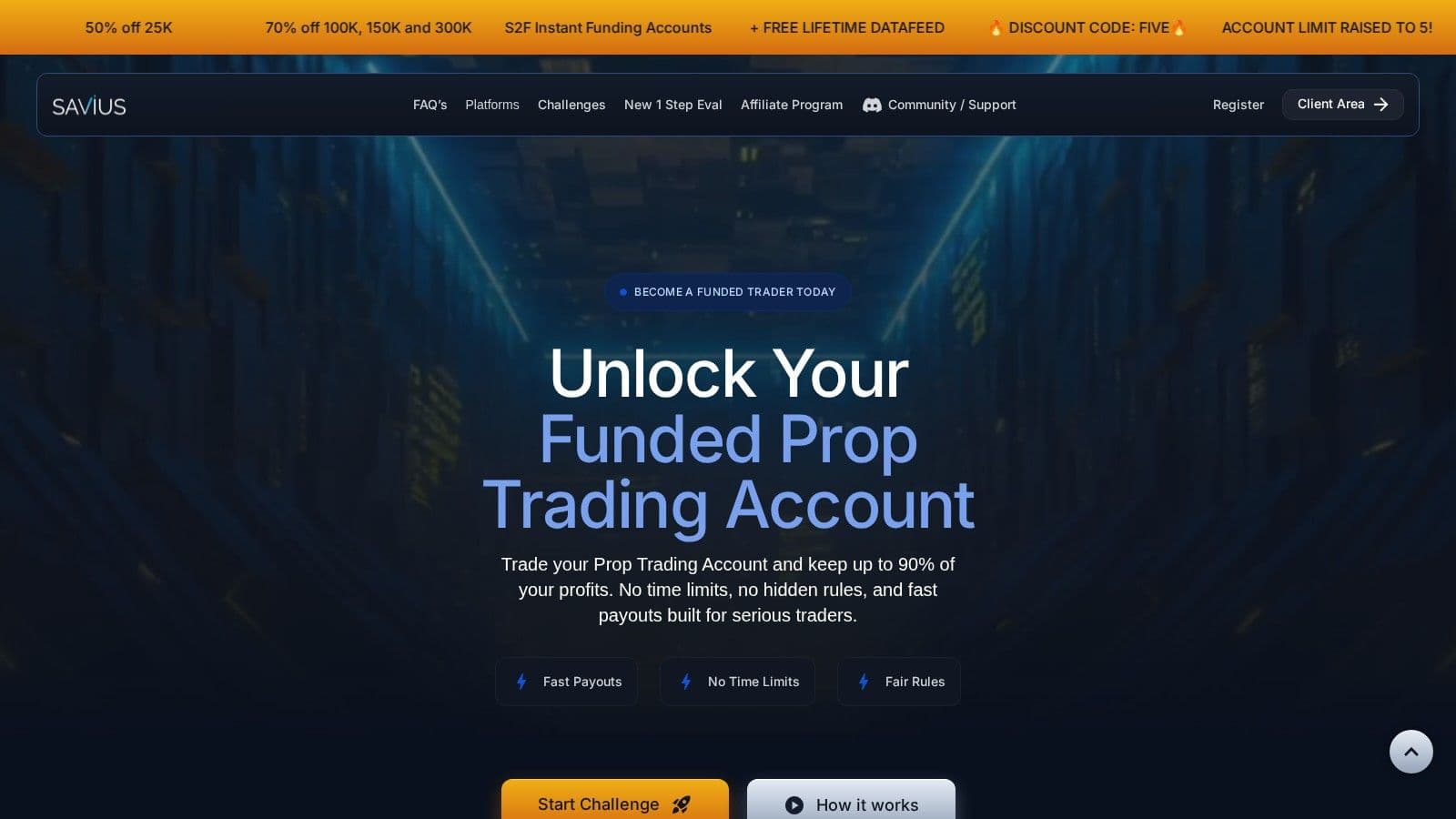
Savius, founded in 2013, is now a futures prop firm for CME Group markets; its current site and FAQ do not list options trading. It sells Instant Funded Evolution accounts and a new 1-step evaluation, with accounts up to $300,000.
Funding Capital Limits
The 1-step evaluation has a 6% profit target and launch prices of $79 to $119 for $50,000 and $100,000 accounts with a fixed or trailing drawdown (checked on 10 Oct 2026). The activation fee after passing is $0.
Profit Split Percentages
Savius advertises up to a 90% split. On the 1-step evaluation the split rises through three checkpoints (80%, 85% and 90%), and Live accounts pay 80/20 (Instant Funded Evolution) or 90/10 (evaluation path) with bi-weekly payouts.
Evaluation Process Flexibility
Savius licenses DeepChart by Volumetrica Trading, ATAS and Quantower. From the second month, traders pay $90 a month for CME Group real-time data.
4. Lux Trading Firm
What it funds: forex, index, crypto and single-stock CFDs, through 1-Step evaluations and INSTA accounts, scaling up to $10,000,000. Options are not on its symbol list.

Lux Trading Firm funds CFD traders and scales accounts up to $10,000,000, with an 80% profit split. Its July 2026 symbol list covers forex, indices, crypto and single-stock CFDs, with no options, so it is not a route to a funded options account today.
Funding Capital Limits
Lux sells 1-Step evaluations at £199 for $100,000, £449 for $400,000 and £999 for $1,000,000, with the fee refunded after you pass (checked on 10 Oct 2026). INSTA accounts skip the evaluation: £299 for $100,000 and £699 for $400,000.
Profit Split and Risk Management
Funded traders keep 80% of the profits they generate.
Evaluation Process Flexibility
Lux runs every evaluation as a single step. Traders trade on Match-Trader, or connect an account at another broker or prop firm and copy trades to their Lux account.
"At Lux Trading, every evaluation account follows a 1-Step Evaluation. You complete a single trading evaluation by reaching the profit target on a demo account while staying within risk limits." – Lux Trading Firm
5. Elite Trader Funding
What it funds: futures, through six evaluation types with accounts from $10,000 to $150,000. Options are not offered.
Key terms (checked on 10 Oct 2026): futures only; six evaluation types (1 Step, End of Day, Static, Fast Track, Diamond Hands and Direct to Funded); accounts from $10,000 to $150,000; evaluations from $47; traders keep up to 100% of $150,000 in lifetime sim-funded profit; TradingView, NinjaTrader, Rithmic, Tradovate and Tickblaze. If you trade from TradingView charts, a VPS for TradingView webhooks keeps your alerts running when your PC is off.
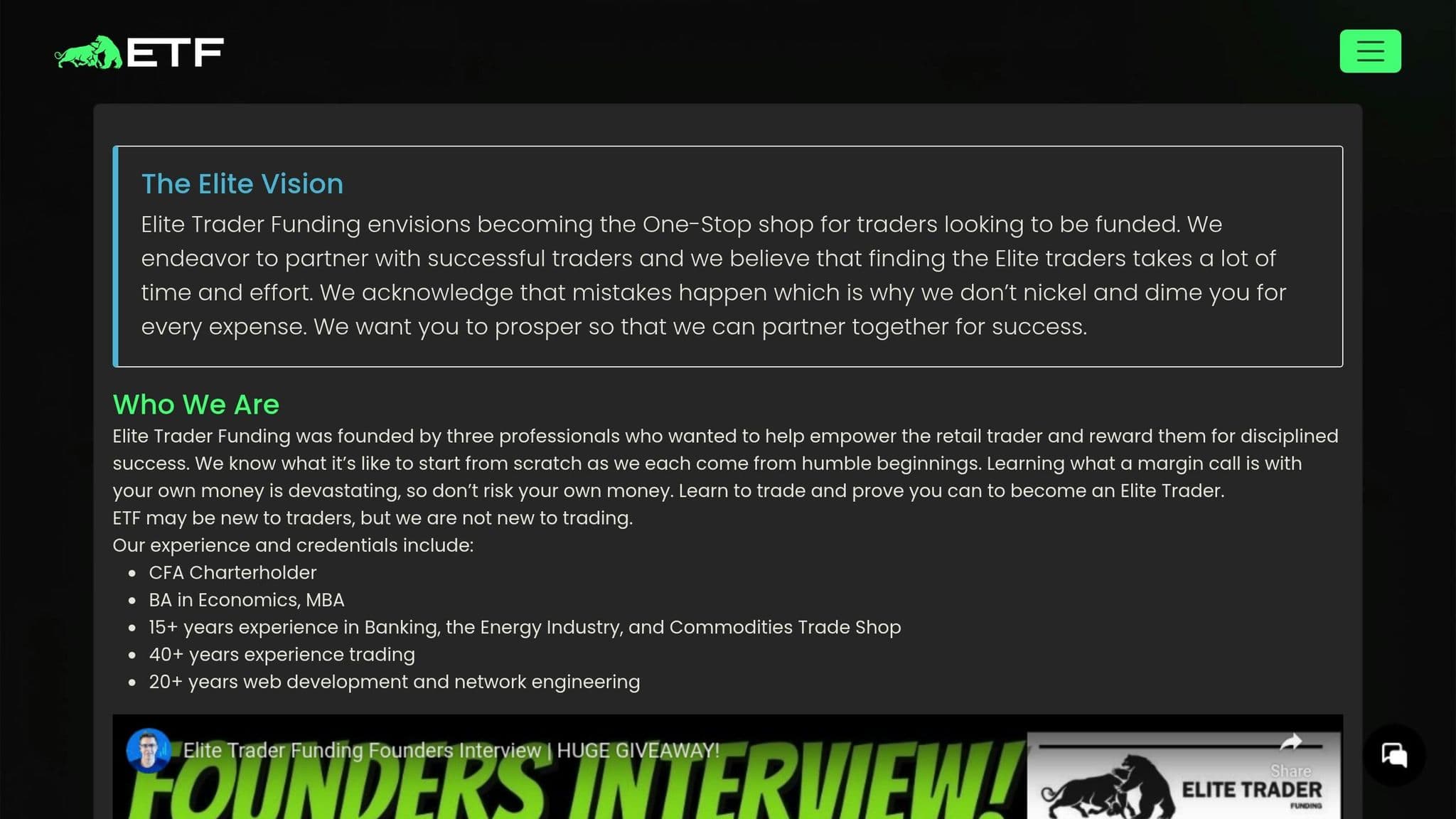
Elite Trader Funding is a futures prop firm that says it has paid out more than $13 million. Its site lists futures evaluations on TradingView, NinjaTrader, Rithmic, Tradovate and Tickblaze and does not offer options, so options traders would be trading futures here.
Funding Capital Limits
Traders can choose accounts from $10,000 to $150,000. Lifetime sim-funded profits are capped at $150,000, and top performers can be invited to LIVE ELITE, where they trade real capital.
Profit Split Percentages
Elite Trader Funding says traders keep up to 100% of up to $150,000 in lifetime sim-funded profit.
Evaluation Process Flexibility
The firm offers six evaluation models: 1 Step, End of Day, Static, Fast Track, Diamond Hands and Direct to Funded. Static evaluations use a minimum balance that never trails, and Fast Track is billed monthly after the first period.
6. BluSky Trading
What it funds: futures, through Launch, Propel, Orbit and Instant Funding plans of $50,000 to $200,000, with stock plans listed separately. Options are not listed.
Key terms (checked on 10 Oct 2026): futures plans in Launch, Propel, Orbit and Instant Funding modes; $50,000, $100,000 and $200,000 Static balances; for example $59 per 30 days for the $50,000 Launch plan plus $99 at Launch; end-of-day trailing drawdown; 90/10 split; daily payouts Monday to Friday once funded.
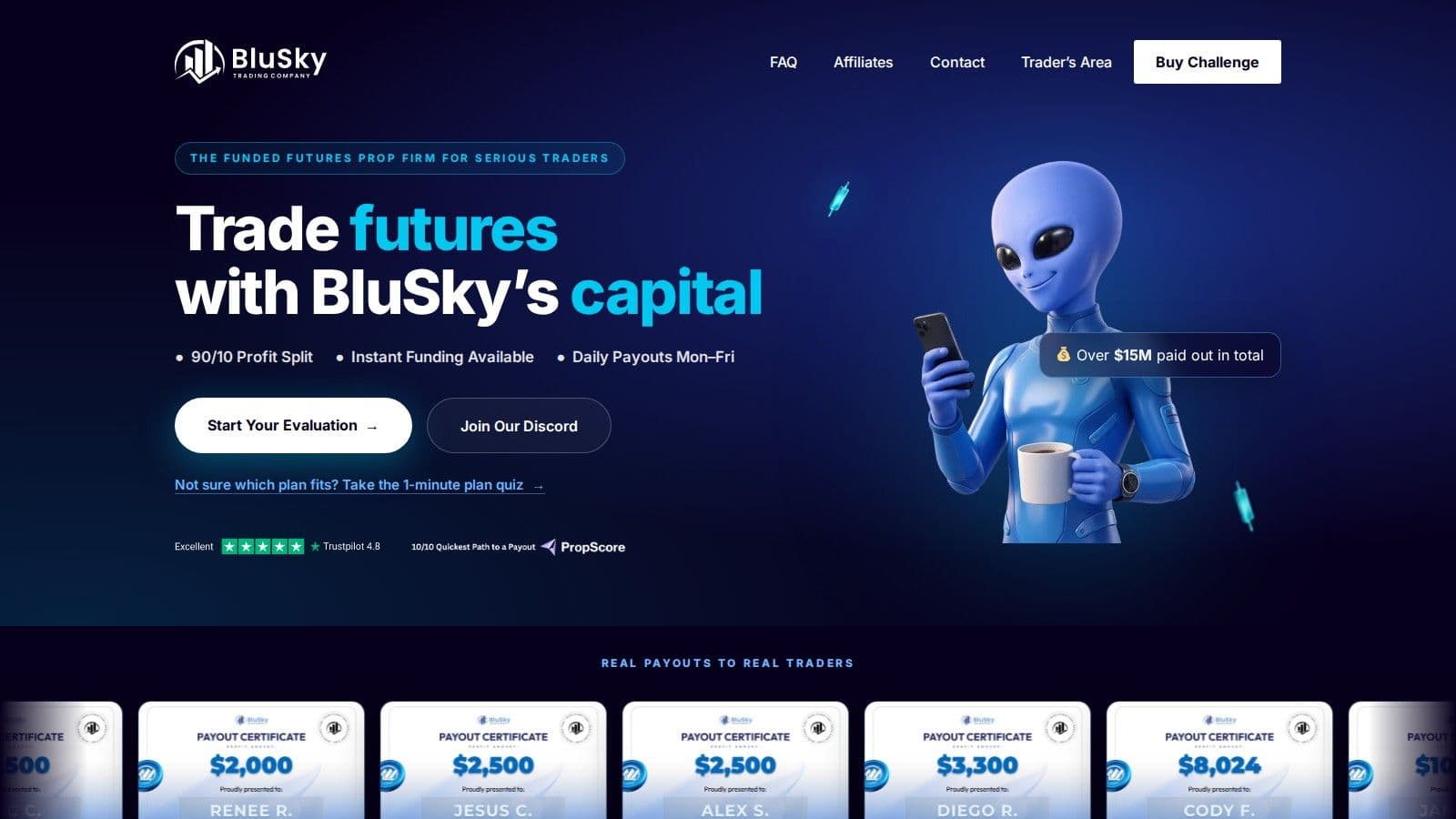
BluSky Trading is a futures prop firm, and its pricing table also has a separate Stocks tab; options trading is not listed. BluSky says it has paid out more than $15 million.
Order flow
Built for scalpers. Heatmaps on dedicated resources.
Order-flow heatmaps and DOM ladders run on dedicated CPU, memory and NVMe, so your charts keep responding during volatility.
See the dedicated hardwareFrom $29.99/mo · Windows or Linux
Funding Capital Limits
Futures balances are $50,000, $100,000 and $200,000 (Static). On the $50,000 Launch plan, the profit goal is $3,000 with a $2,000 end-of-day trailing drawdown and a 50% consistency rule.
Profit Split Percentages
The standard split is 90/10 in favor of traders. Funded payouts are available daily, Monday through Friday, above the buffer, with a $500 minimum on the $50,000 Launch plan.
Evaluation Process Flexibility
Launch, Propel and Orbit need 2, 3 and 1 trading days respectively, and Instant Funding skips the evaluation. Plans are billed every 30 days.
7. FTMO
What it funds: forex and CFDs, through 1-Step and 2-Step Challenges from $10,000 to $200,000, plus a separate FTMO Futures program. There is no options product.

FTMO, a well-known name in forex and CFD trading, does not offer an options product. With more than $650 million paid out in rewards, it has a strong reputation, and it also runs a separate FTMO Futures program.
Funding Capital Limits
FTMO offers account sizes from $10,000 to $200,000. Its Scaling Plan adds 25% to the balance every 4 months, up to $2,000,000 across all accounts. The 2-Step Challenge costs from $99 for $10,000 to $1,249 for $200,000 (checked on 10 Oct 2026), and the fee is refunded with the first reward.
Profit Split Percentages
FTMO pays 80% on the 2-Step (up to 90% through scaling) and 90% on the 1-Step. The 2-Step needs a 10% profit target in the first phase and 5% in the second; the 1-Step has a single 10% target. There is no time limit to complete either.
Evaluation Process Flexibility
FTMO supports MT4, MT5, cTrader and TradingView.
"1-Step FTMO Challenge can take you to your FTMO Account in a single step. It evaluates your trading approach through transparent Trading Objectives designed to confirm consistency and risk control." – FTMO
8. Funded Trading Plus
What it funds: forex and CFDs, through Instant, 1-Step Express and 2-Step Classic programs, with scaling to $2.5 million. There is no options product.

Funded Trading Plus is a forex and CFD prop firm and does not offer options. It sells Instant, 1-Step Express and 2-Step Classic programs, and accounts can scale to $2.5 million.
Funding Capital Limits
Challenge prices run up to $549 (list) for a $100,000 account, and Instant Funding up to $4,499 for $100,000 (checked on 10 Oct 2026). Withdrawals have a $50 minimum on Instant and 1-Step Express, and 1% of the starting balance on 2-Step Classic.
Profit Split Percentages
Traders start at 80%, rising to 90% after 20% profit on the funded account; a 90% split from the start is a paid add-on. Instant and 1-Step accounts can request payouts from day one and then every 7 days, while 2-Step accounts can withdraw 10 days after account creation and then every 10 days.
Evaluation Process Flexibility
The 2-Step Classic has a 7% target in each phase, a 4% daily drawdown and an 8% static maximum drawdown. 1-Step Express has a 10% target, a 4% daily limit and a 6% trailing maximum, and Instant has no target with a 6% daily and 6% trailing maximum. Accounts must place a trade at least every 30 days to stay active.
Which Firms Actually Allow Options?
Of the 8 firms in this guide, only Maverick Trading and T3 Trading Group let you trade options with firm capital. Maverick trains and funds options traders through its qualification program, and T3 lets licensed traders run options strategies, including spreads, with risk approval.
Savius, Elite Trader Funding and BluSky fund futures, and Lux, FTMO and Funded Trading Plus fund forex and CFDs. If you trade options and want a challenge-based account, pick one of these only if you are ready to trade a different market.
Conclusion
Choosing the right funded options trading account starts with one question: does the firm fund options at all? Maverick Trading and T3 Trading Group do, with mentorship and licensing requirements; challenge-based firms like Elite Trader Funding or BluSky Trading fund futures instead.
Make sure to confirm that a firm supports options at all. Maverick Trading trains traders in the stock and options market, and T3 allows multi-leg options with approval, while the futures and CFD firms in this list do not offer options. Avoid paying evaluation fees for instruments a firm doesn't support.
A solid risk management plan is critical. Familiarize yourself with each firm's drawdown policies to ensure you're prepared for their requirements.
"The drawdown is the single biggest reason why traders fail. It's a mechanism to ensure you manage risk tightly." – LiquidityFinder
Take advantage of free trials to test platforms, review payout schedules, and watch out for hidden fees. Also, consider scaling opportunities; some firms provide clear paths to grow from $100,000 to $200,000+ with consistent performance. By focusing on these factors, you can identify the firm that aligns with your goals and trading style, setting yourself up for success through steady, disciplined performance.
If you would rather trade options with your own money, compare options brokers for your own capital instead. Traders who run TradeStation for that can use a TradeStation VPS, which comes with 24/7 US-based support and a 14-day money-back guarantee.
FAQs
Are funded options trading accounts real money or simulated?
It depends on the firm. Most evaluation-based firms, such as Elite Trader Funding, FTMO and BluSky Trading, use simulated accounts, while firms such as T3 Trading Group give licensed traders access to firm capital in live markets. This setup allows them to manage risk while representing the firm's interests.
What drawdown rule matters most for options traders?
The maximum allowable drawdown percentage is a key rule for options traders. It helps manage risk and keeps traders within the firm's set limits. This guideline helps enforce trading discipline while safeguarding both the trader's and the firm's capital.
How do I confirm a prop firm actually supports my options strategy?
Before committing to a prop firm for your options trading strategy, it's crucial to do some homework. Start by carefully reading their official materials and rules to see if options trading is explicitly allowed. Pay close attention to any restrictions they might have on strategies such as spreads or naked options.
If you're unsure, reach out to their support team for clarification about how your specific strategy fits within their framework. Additionally, take a close look at their risk management policies. This can give you a better understanding of whether their guidelines align with the way you plan to trade.


