Hedge fund managers oversee investment strategies, risk management, and operations for hedge funds, often tying their earnings directly to fund performance. They typically earn through a "2 and 20" model - 2% of managed assets and 20% of profits. With hedge funds managing over $4.5 trillion globally as of 2024, these managers play a key role in financial markets by improving pricing accuracy and providing liquidity.
Key Takeaways:
- Role: Develop and execute investment strategies, manage risks, and handle investor relations.
- Skills: Financial modeling, programming (Python, SQL), and decision-making under pressure.
- Path: Start in investment banking, equity research, or quantitative fields; progress from analyst to manager.
- Education: Bachelor's in finance, economics, or STEM fields; CFA certification is highly respected.
- Compensation: Entry-level analysts earn $150K–$300K annually; top managers can make millions.
Becoming a hedge fund manager requires strong market knowledge, technical skills, and years of experience. Networking, internships, and certifications are critical steps to breaking into this competitive field.
The Role of a Hedge Fund Manager
Key Responsibilities
Hedge fund managers are at the helm of crafting and implementing investment strategies, whether they focus on global macro trends, event-driven opportunities, or quantitative approaches. Their work requires precision and discipline to ensure strategies are executed effectively.
One of their most important tasks is position sizing - deciding how much capital to allocate to each investment. This involves weighing factors like conviction in the idea, market liquidity, correlations between positions, and the potential downside risk.
In addition to investment decisions, managers oversee the fund's operations. This includes leading teams, managing relationships with brokers, handling regulatory filings (such as SEC Form 13F, Form ADV, and Form PF), and maintaining strong communication with investors. Many managers, especially those who own their funds, also juggle responsibilities like fundraising and ensuring compliance.
While big-picture strategy is a significant part of the role, the daily grind also plays a huge part in shaping what hedge fund managers do.
Day-to-Day Activities
A typical day for a hedge fund manager often begins early, with a review of overnight market developments and pre-market data. As the trading day unfolds, they closely monitor positions, adjusting exposures as needed to respond to market movements.
Afternoons are usually dedicated to deeper analysis. This can include reviewing portfolio performance, meeting with analysts to discuss new ideas, and updating critical risk metrics like Value at Risk (VaR) and exposure levels. It's a demanding role, with many managers clocking in 60–80 hours of work each week.
The specific day-to-day tasks can vary depending on the size and structure of the hedge fund. Smaller funds often require managers to wear multiple hats, while larger organizations have more specialized roles, as outlined below.
Where Hedge Fund Managers Fit in the Org Chart
In smaller or newer hedge funds, the manager often takes on multiple responsibilities, from researching and trading to overseeing risk and handling investor communications. As funds grow, the organizational structure becomes more specialized, with distinct roles for different functions.
Here’s a breakdown of common roles within a hedge fund and their focus areas:
| Role | Primary Focus | Typical Total Compensation (2026) |
|---|---|---|
| Fund Manager / CIO | Investment philosophy, senior hiring, investor relations | Varies widely (ownership stake) |
| Portfolio Manager | Capital allocation, P&L responsibility, risk management | $1M – $10M+ |
| Senior Analyst | Sector research, idea generation, position defense | $350K – $700K |
| Risk Manager | Drawdown limits, exposure monitoring | $200K – $500K |
| Operations / Middle Office | Trade reconciliation, fund accounting | $100K – $200K |
In large multi-strategy platforms like Citadel and Millennium Management, which is projected to manage around $570 billion in assets under management (AUM) by 2026, the structure is even more dispersed. These firms operate through independent portfolio manager teams, often referred to as "pods." Each pod has its own risk budget and operates semi-independently under the umbrella of the larger organization. In this setup, the hedge fund manager acts more like a CEO, focusing on hiring top talent, setting risk parameters, and allocating capital across pods rather than making individual trade decisions.
For those aiming to become hedge fund managers, understanding these organizational dynamics is key to navigating their career paths effectively.
Core Skills and Qualifications
Educational Requirements
Hedge fund managers often start their journey with a bachelor's degree in fields like finance, economics, mathematics, computer science, or engineering. These areas provide the analytical groundwork needed for the role. For those aiming at quantitative or systematic funds, an advanced degree - such as a Master's or PhD in mathematics, statistics, physics, or financial engineering - is generally considered a must.

Run 24/7 while you sleep. Keep bots, platforms, and trade copiers online on a dedicated VPS.
Low-latency VPS hosting for your trading platform.
 CHINYC
 LON
LONFrom $59.99/mo


 CHI/CME futuresNYC/US marketsLON/FX EAs
 DUB/Polymarket
 AMS/EU FX
 FRA/Central EU
 TYO/APAC crypto
Interestingly, an MBA doesn't carry as much weight in hedge funds as it does in investment banking. It can, however, be helpful for those transitioning into the industry mid-career or for individuals who didn't attend a top-tier undergraduate institution. Here's a breakdown of typical educational paths and prior experience for key hedge fund roles:
| Role | Typical Education | Common Prior Experience |
|---|---|---|
| Fundamental Analyst | Bachelor's in Finance/Economics | Investment Banking, Equity Research |
| Quantitative Researcher | PhD in Math, Physics, or CS | Academia, Data Science |
| Portfolio Manager | MBA or Bachelor's + Track Record | Senior Analyst, Sector Specialist |
| Trader | Bachelor's in Finance/STEM | Execution Desk, Bank Trading |
While education is a vital starting point, the ability to develop technical expertise and sharp decision-making skills is equally important.
Skills You Need to Succeed
Certain technical skills are non-negotiable. Proficiency in financial modeling and valuation is critical - you’ll need to build earnings models, forecast cash flows, and conduct analyses like DCF (Discounted Cash Flow) or comparable company evaluations to identify mispriced assets. For quant roles, expertise in programming languages like Python, database management with SQL, and statistical testing is indispensable.
Beyond technical know-how, success in hedge funds hinges on the ability to act decisively under pressure. Markets can shift in seconds, and staying objective during volatility - without letting emotions cloud judgment - is a skill that separates the best from the rest. Intellectual honesty also plays a key role: recognizing when a thesis is flawed and pivoting quickly, rather than stubbornly holding on, is a hallmark of top managers.
Another crucial skill? Communication. Whether you’re pitching investment ideas to a portfolio manager or explaining losses to investors, the ability to distill complex analysis into straightforward language gives you a clear edge.
Certifications and Training Programs
To demonstrate and refine these skills, certifications and structured training programs can be invaluable. The CFA (Chartered Financial Analyst) designation is widely regarded as the gold standard in investment management, with over 200,000 charterholders globally. Covering topics like valuation, derivatives, ethics, and portfolio management, the CFA curriculum aligns closely with hedge fund responsibilities. However, it’s a serious commitment - each level demands about 300 hours of study, and earning the charter requires 4,000 hours of qualified work experience over at least 36 months. Costs, including study materials and possible retakes, typically range between $7,000 and $9,500.
"You can hire people with an MBA, but you don't necessarily know that one MBA is the same as another MBA. Whereas if you hire investment professionals with a CFA, you absolutely have confidence at the level of qualification." - CFA Institute
For those specifically targeting trading or capital markets roles, the CMSA® (Capital Markets & Securities Analyst) certification offers focused training in equities, fixed income, derivatives, and risk management. Additionally, structured programs like the Point72 Academy (offering a $125,000 base salary during a 10-month cycle) and the Citadel Associate Program (with first-year compensation ranging from $216,000 to $325,000) provide alternative entry points into hedge funds, bypassing the traditional investment banking route.
Career Path to Becoming a Hedge Fund Manager
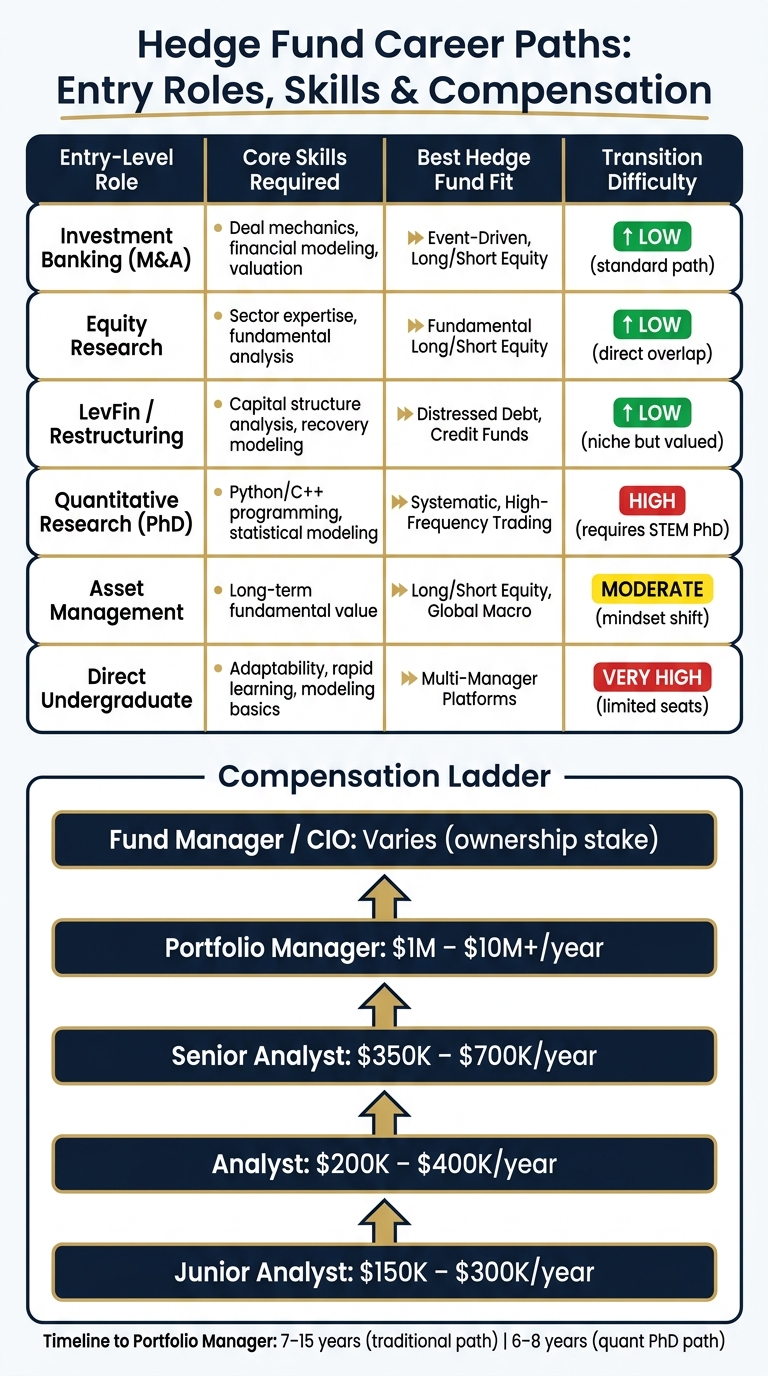
Hedge Fund Career Paths: Entry Roles, Skills & Compensation
Entry-Level Roles and Career Progression
Most hedge fund managers kick off their careers in fields like investment banking, equity research, or quantitative research.
Investment banking is a particularly common starting point, especially for those aiming to join fundamental funds. Analysts in areas like mergers and acquisitions (M&A), leveraged finance, or restructuring spend two years honing their skills in financial modeling and deal mechanics - expertise that event-driven and distressed credit funds actively seek. Similarly, equity research is a natural fit, as sell-side analysts focus on building financial models and analyzing specific companies, which aligns well with the work of hedge fund analysts.
Once inside a hedge fund, career progression typically follows a structured path: Junior Analyst, Analyst, Senior Analyst, and eventually Portfolio Manager. This journey usually takes between 7 and 15 years, depending on individual performance and the type of fund. A pivotal moment in this trajectory is earning a "sleeve" or "carve-out", where senior analysts manage a small portion of the fund's capital to demonstrate their investment skills.
"The hedge fund career path has one clear destination: portfolio manager." - Coastal Haven Partners
Compensation reflects this progression. Junior analysts can earn between $150,000 and $300,000 annually, while senior analysts may see salaries ranging from $350,000 to $700,000. This traditional path contrasts sharply with the limited opportunities available for direct hires from college.
Going Directly from College to a Hedge Fund
While uncommon, some multi-manager platforms - like Citadel, Point72, Balyasny, and D.E. Shaw - recruit undergraduates directly, skipping the typical investment banking stint.
These roles are incredibly competitive. For example, Millennium's program reportedly accepts only about 40 candidates out of over 50,000 applicants - an acceptance rate of just 0.08%. Similarly, Bridgewater's Investment Associate program has an acceptance rate below 1%. Across the industry, there are fewer than 100 junior-year summer analyst roles at firms with formal undergraduate programs.
Recruitment for these coveted positions often begins as early as December of a student's sophomore year. Some firms, such as Dodge & Cox, even use national stock pitch competitions to identify top candidates, fast-tracking finalists to final-round interviews. For quantitative roles, entry-level salaries at top firms like D.E. Shaw and Two Sigma range from $250,000 to $350,000 for new graduates.
Comparing Career Paths into Hedge Funds
Each entry path into hedge funds aligns with specific fund types and demands unique skills. Choosing the right path early on - and sticking to it - can significantly impact long-term success.
"Hedge fund recruiting rewards genuine public markets passion over deal execution skills." - IB Interview Questions
Here's a comparison of common entry paths:
| Entry-Level Role | Core Skills Required | Best Hedge Fund Fit | Transition Difficulty |
|---|---|---|---|
| Investment Banking (M&A) | Deal mechanics, financial modeling, valuation | Event-Driven, Long/Short Equity | Low - standard path |
| Equity Research | Sector expertise, fundamental analysis | Fundamental Long/Short Equity | Low - direct overlap |
| LevFin / Restructuring | Capital structure analysis, recovery modeling | Distressed Debt, Credit Funds | Low - niche but valued |
| Quantitative Research (PhD) | Python/C++ programming, statistical modeling | Systematic, High-Frequency Trading algorithms | High - requires STEM PhD |
| Asset Management | Long-term fundamental value | Long/Short Equity, Global Macro | Moderate - mindset shift |
| Direct Undergraduate | Adaptability, rapid learning, modeling basics | Multi-Manager Platforms | Very High - limited seats |
Unlike private equity, hedge fund hiring is less structured and more relationship-driven, making networking and timing crucial for breaking into the industry.
How to Build the Right Experience
Practical experience is the cornerstone of success in hedge fund management. While theoretical knowledge and networking are vital, hands-on experience and technical skills often make candidates stand out.
Building Market Knowledge
Managing a hedge fund requires more than just academic credentials - it demands a thorough understanding of the market. This includes analyzing earnings reports, tracking interest rate decisions, studying macroeconomic indicators, and linking global events to specific stock or sector movements.
A critical skill for top candidates is the ability to identify when a research finding evolves into an actionable investment idea. As Kelly Bailey, a writer at the Corporate Finance Institute, explains:
"One of the most important parts of hedge fund work is knowing the difference between an interesting research finding and an investable opportunity."
This ability hinges on timing - understanding what the market has already priced in and identifying a catalyst that could drive a position. Firms like Balyasny use timed case studies, such as 4-hour simulation exercises, to help candidates refine their investment theses.
Once you've developed strong market insights, the next step is leveraging internships and building a professional network.
Internships and Networking
Hedge fund internships are scarce and highly competitive, with key programs announced early in the recruitment cycle. For example, most Summer 2027 internships will begin accepting applications in Spring or Summer 2026, with top-tier firms completing their hiring processes well in advance.
The table below outlines some of the most accessible structured programs and their entry points:
Stay online and closer to execution. Choose a VPS location for CME futures, New York markets, London FX, API trading, and more.
Host your platform near the market route that matters.
CHINYCLONFrom $59.99/mo
CHI/CME futuresNYC/US marketsLON/FX EAsDUB/PolymarketAMS/EU FXFRA/Central EUTYO/APAC crypto| Firm | Program | Est. Seats | Key Entry Point |
|---|---|---|---|
| Citadel | Associate Program | 10–12 | Cognitive tests & conceptual investing rounds |
| Point72 | Point72 Academy | ~30 | 8-week program designed for full-time conversion |
| Dodge & Cox | Investment Associate Internship | ~11 | National Stock Pitch Competition |
| Balyasny | Catalyst Program | Single digits | Stock pitch competitions & 4-hour case study |
Sophomores aiming to gain an edge should consider "Insight Programs" like Discover Citadel. These programs allow students to build relationships with firms well before formal recruiting begins. Networking is equally critical, and specialist recruiters like Dynamics Search Partners, Glocap, and Whitney Group can open doors to roles that are rarely advertised publicly.
Technical and Analytical Skills
After building market knowledge and networking, sharpening technical skills is the next priority. For fundamental analysts, mastering Excel-based financial modeling is essential. Quantitative roles, on the other hand, require proficiency in programming languages like Python, SQL, and C++.
Being able to articulate and defend your investment thesis succinctly - ideally in under three minutes - is another key skill. A solid thesis should start with a single-sentence summary, supported by 2–3 evidence-based drivers, and include a brief hedge or pair trade for balance. As one IB Vine member who secured a 2027 summer analyst role noted:
"If someone is asking you 'where are you different from the street?' - your thesis isn't simple enough."
For candidates targeting quant roles, investing 3–6 months in practicing probability puzzles, mental math, and live coding challenges is essential. These skills are frequently tested in interviews at firms like D.E. Shaw and Two Sigma.
Tools, Infrastructure, and Risk Management
Once key responsibilities and career paths are defined, the next step is understanding the infrastructure that enables hedge fund managers to implement strategies and manage risk effectively. From analyzing markets to executing trades and ensuring regulatory compliance, having the right tools and systems in place is essential.
Financial Tools and Platforms
The Bloomberg Terminal is a go-to resource for market data, news, and analytics. Hedge fund managers rely on it daily for tasks like portfolio management, bond pricing, and equity screening. Tools such as Bloomberg PORT offer risk and performance analytics, while BQuant allows quantitative analysts to conduct programmatic data analysis within the Bloomberg ecosystem.
In addition to Bloomberg, integrated management platforms streamline the complexities of running multi-asset funds. TS Imagine's RiskSmart+ consolidates order management, portfolio tracking, and risk analytics into one system. It supports over 10 asset classes, 100+ global markets, and 19,000+ pricing curves. Kevin Chang, COO of Y-Intercept, highlighted the importance of such technology:
"Ensuring our business can scale, minimize operational risk and safeguard our investors' asset is vitally important, which is why we are excited to be deploying TS Imagine's advanced technology."
Another widely adopted platform is Broadridge, which provides unified workflows for equities, fixed income, FX, and derivatives.
While these platforms are critical for analysis, effective trade execution systems are equally important.
Trading Infrastructure Requirements
Analytical tools are just one piece of the puzzle. The infrastructure that ensures trades reach the market efficiently is just as vital. Trading-optimized VPS hosting minimizes latency and ensures uninterrupted operations. Unlike standard cloud hosting, which can introduce delays of 50–200ms, trading-specific VPS solutions use direct fiber-optic connections to exchange matching engines. For instance, QuantVPS delivers latency of less than 0.52ms to the CME Group's matching engines in Chicago. Even a slight reduction in latency - 0.3 to 0.5ms - can translate to savings of $50–savings of $50–$100 per week in slippage costs00 per week in slippage costs.
Local desktops come with risks like power outages, ISP failures, and hardware malfunctions. A trading VPS, on the other hand, operates 24/7 on enterprise-grade hardware, often with AMD Ryzen or EPYC processors and NVMe storage. These systems typically guarantee 99.999% uptime, which equates to less than five minutes of downtime annually. Managers can also run multiple platforms, such as NinjaTrader, MetaTrader 4/5, or TradeStation, within a single hosted environment, simplifying the management of multi-strategy operations.
"Most traders don't lose money because of bad strategies - they lose because of bad infrastructure." - QuantVPS Review
Once execution speed and reliability are secured, robust risk controls come into play to ensure compliance and mitigate losses.
Risk Controls and Compliance
Modern hedge funds require risk systems that go far beyond simple stop-loss mechanisms. Real-time calculations for metrics like Value at Risk (VaR), Conditional VaR (CVaR), Greeks, betas, and correlations are now standard. These tools allow managers to conduct stress testing and model potential drawdowns in real time.
Pre-trade compliance (PTC) tools are another critical component. These systems enforce trading restrictions at the account or user level before any orders are submitted, ensuring trades comply with strict guidelines. Automated reporting systems further simplify regulatory requirements by integrating with SEC, CFTC, and other global compliance frameworks. This automation reduces reliance on manual oversight and keeps funds audit-ready. For fund-of-funds structures, shadow accounting adds an extra layer of verification, offering independent checks on fund administrators and supporting multi-currency cash flow projections.
Conclusion
Key Takeaways
Hedge fund management is a demanding field that requires persistence and delivering consistent results. As of Q3 2025, the global hedge fund industry oversees around $5 trillion in assets. Competition for roles at top firms is intense, with acceptance rates at elite programs falling below 0.1%.
Your career trajectory in the industry largely depends on your background. For example, PhD-level quantitative researchers may reach the Portfolio Manager role within 6–8 years, while those coming from traditional equity research roles might take 12–18 years or more. Regardless of the path, your performance will always outweigh the length of your tenure.
"A documented history of investment ideas - a pitch book, a public blog, or a strong record at a prior fund - is often more persuasive than credentials alone." - Steve Fleming, Wall Street Careers
These insights provide a foundation for the actionable steps needed to succeed in hedge fund management.
Next Steps for Aspiring Managers
The next steps in your journey will depend on your unique skills and experience. For those with a background in banking or equity research, focusing on fundamental funds is a logical move. Alternatively, if you excel in mathematics, statistics, or computer science, quant-focused firms such as D.E. Shaw or Two Sigma may be a better fit.
Building technical expertise is essential. Learning Python, SQL, and financial modeling, as well as pursuing certifications like the CFA or CMSA, demonstrates your commitment to the field. Publishing your research - whether on GitHub or a personal blog - can also provide recruiters with concrete proof of your abilities. Additionally, investing in high-quality trading infrastructure can help reduce slippage costs and minimize operational risks.
To advance your career, consider working with specialist recruiters like Dynamics Search Partners or Glocap for lateral opportunities. Stay on top of recruiting timelines, as applications for Summer 2027 internships at Tier 1 firms are expected to open as early as Spring or Summer 2026. Every step you take, whether refining skills or improving operations, strengthens your position in this highly competitive industry.
FAQs
What’s the difference between a hedge fund manager and a portfolio manager?
Hedge fund managers and portfolio managers both play key roles in managing investments, but their strategies and goals set them apart. Hedge fund managers often employ bold strategies, such as using leverage and derivatives, to generate absolute returns. Their primary audience tends to be high-net-worth individuals and institutional clients seeking high-risk, high-reward opportunities.
Portfolio managers, on the other hand, take a more measured approach. They focus on creating diversified portfolios designed to deliver steady returns relative to a benchmark. This approach is generally more conservative and caters to a broader audience, including retail investors and institutions.
Additionally, the two roles differ in their compensation structures and the regulatory frameworks they operate within, reflecting the contrasting nature of their investment philosophies.
How do hedge fund managers actually get paid in the U.S.?
Hedge fund managers in the U.S. usually earn their income from two main sources: management fees and performance fees. Management fees are typically around 1-2% of the total assets under management, while performance fees often account for 20% of the profits that exceed a set benchmark. On top of that, they may receive bonuses or profit-sharing arrangements, which are directly linked to how well the fund performs.
What’s the fastest realistic path to becoming a hedge fund manager?
The quickest way to become a portfolio manager often starts with a role as a quantitative researcher at a systematic fund. From there, professionals typically advance to senior positions before stepping into a portfolio manager role, usually within 6 to 8 years. Another route includes joining structured academy programs at multi-manager firms. These programs provide training and fast-tracked promotions, potentially leading to a portfolio manager position in 8 to 10 years. For those with a PhD in a STEM field, the transition into quantitative research roles can be even smoother, as it highlights strong technical skills and research expertise.