
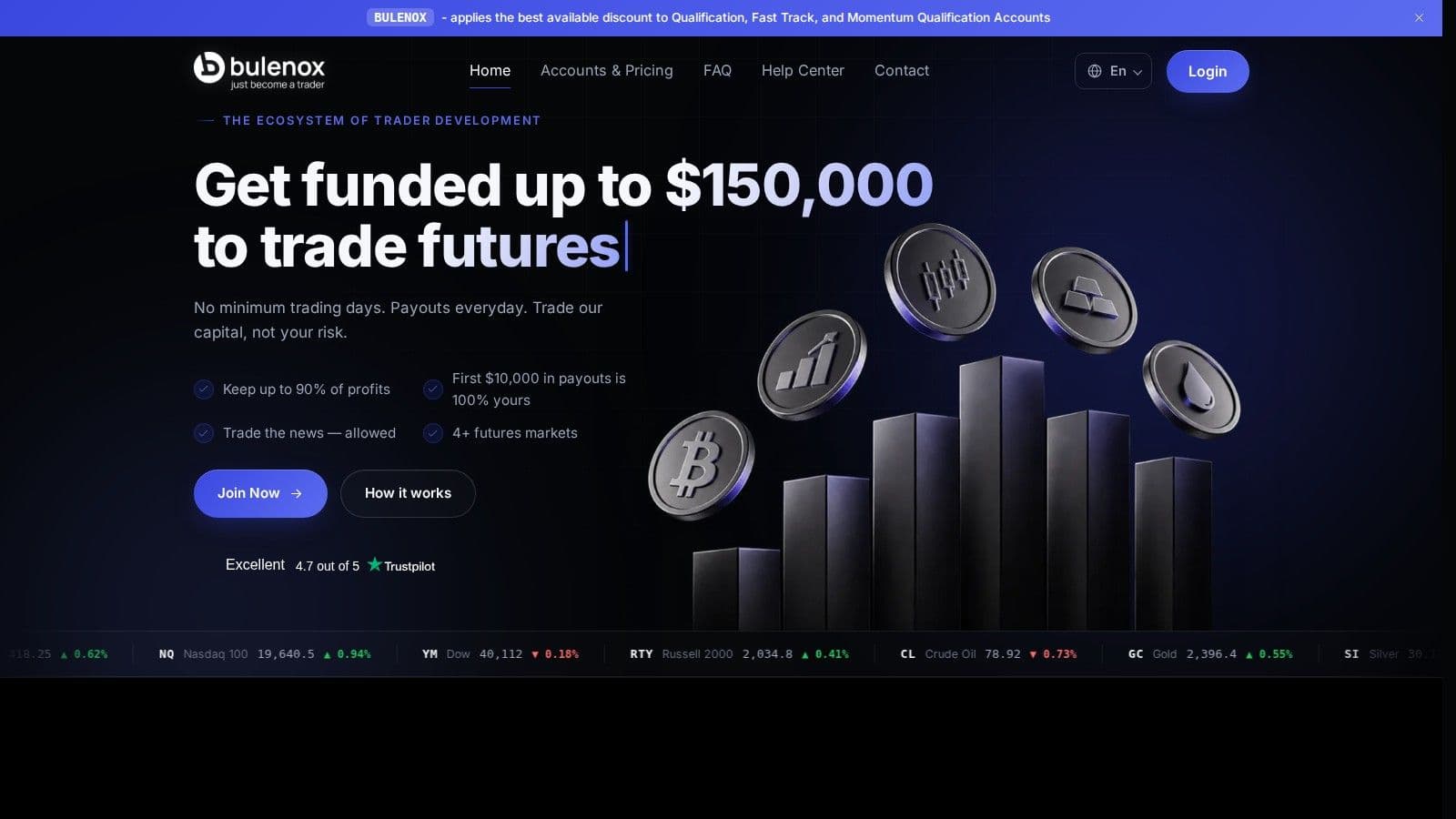
Bulenox Trading offers a structured prop trading platform with account options for different skill levels and trading goals. Traders can start with a Qualification Account, buy a Fast Track account that skips qualification, or choose Momentum, where one payment covers the evaluation and the Momentum Master activation. Bulenox may later move consistent Master traders to a live Funded Account. Key features include:
- Account Types: Qualification, Fast Track and Momentum paths, each leading to a Master-level account; live Funded Accounts are offered at Bulenox's discretion.
- Scaling Options: Choose between No Scaling (real-time drawdown) and EOD Scaling (end-of-day drawdown adjustments).
- Funding Costs: Every path is a one-time payment with no recurring charges; the standard Qualification path adds a one-time Master activation fee ($143-$498), while Fast Track and Momentum have no activation fee.
- Risk Management: Daily loss limits and strict trading rules to protect accounts.
- Payouts: You keep 100% of the first $10,000 in profits, then 90%.
Bulenox emphasizes risk management, scalability, and clear funding structures, making it suitable for both new and experienced traders. Pairing the right account type with a solid tech setup can streamline your trading experience.
Bulenox Trading Account Types
Bulenox organizes its program into three purchase paths (Qualification, Fast Track and Momentum), each leading to a Master-level account. Each stage comes with its own set of rules and benefits. Let’s break down the details of these account types and how they scale.
Qualification Account
The Qualification Account is the standard starting path, but it is one of three: Fast Track and Momentum skip it. This phase is all about proving your trading skills and ability to manage risk. To move forward, you’ll need to hit specific profit targets while adhering to strict guidelines. There is no consistency rule and no minimum number of trading days in Qualification; you need to hit the profit target without breaching the drawdown, and Bulenox reviews the account before the Master Account is opened.
Master Account
Once you’ve passed the qualification phase, you’ll gain access to the Master Account. This account is not live capital; payouts are real, and Bulenox may later invite consistent traders to a live Funded Account. Your performance here directly determines your earnings, as payouts are tied to your trading results. The focus remains on maintaining steady returns while managing risk effectively.
No Scaling vs. EOD Scaling Accounts
Beyond account levels, Bulenox offers two scaling structures that influence how risk and capital are managed: No Scaling and EOD Scaling.
- No Scaling Accounts: These accounts use a trailing drawdown system. Essentially, your loss limit adjusts in real time as you reach new profit peaks. This setup works well for traders who prefer fixed positions and rely heavily on precise stop-loss strategies.
- EOD Scaling Accounts: With these accounts, drawdowns are calculated only at the end of the trading day. This offers more flexibility, as your buying power dynamically adjusts based on daily profits. However, if you hit a fixed loss limit, trading is paused for the rest of the day to prevent further losses.
The choice between these structures plays a significant role in shaping your funding approach and risk management strategies, as explored in later sections.
Uptime
99.999% uptime. Built for 24/7 trading reliability.
Your VPS runs in Tier IV datacenters with redundant power and network, monitored 24/7 on site.
See the uptime SLA







From $29.99/mo · Windows or Linux
Account Features Comparison
Understanding the features of each account is key to aligning with your trading goals and risk tolerance. Bulenox Trading provides a variety of account sizes, each with different fee structures, profit-sharing options, and risk management tools for both beginner and seasoned traders.
Main Account Features
Bulenox offers account tiers with differing activation fees and profit-sharing arrangements. The profit split is the same on every path: 100% of the first $10,000, then 90%.
For drawdown mechanisms, the accounts are designed to cater to different trading styles. No Scaling accounts use a trailing drawdown system, which adjusts limits as profits hit new peaks. On the other hand, EOD Scaling accounts calculate drawdown limits only at the end of the trading day, providing an alternative way to manage intra-day risks.
As account sizes increase, so do contract limits. This flexibility supports a wide range of trading strategies, from high-speed scalping to more deliberate, long-term trades.
Account Types Comparison Overview
Each account tier comes with its own set of features, including activation fees, profit splits, daily loss limits, total drawdown thresholds, and contract limits. While higher-tier accounts require a larger upfront investment, they also provide enhanced trading benefits and greater flexibility.
Here are the limits for each account size on Bulenox’s pricing page and help center (checked on 10 Oct 2026):
| Account Size | Profit Target | Max Drawdown (Qualification) | Max Drawdown (Fast Track, Momentum) | Max Contracts | Daily Loss Limit (EOD option only) |
|---|---|---|---|---|---|
| $25,000 | $1,500 | $1,500 | Up to $1,000 | 3 | $500 |
| $50,000 | $3,000 | $2,500 | Up to $2,250 | 7 | $1,100 |
| $100,000 | $6,000 | $3,000 | Up to $4,000 | 12 | $2,200 |
| $150,000 | $9,000 | $4,500 | Up to $5,500 | 15 | $3,300 |
On Fast Track, the profit target column is the first payout goal, since there is no qualification stage. The daily loss limits are from the Qualification and Master rules, and the Trailing drawdown option has no daily loss limit.
Risk management is a constant across all tiers. Daily loss limits are fixed dollar amounts that apply only on the End-of-Day drawdown option (the Trailing option has none), and hitting one pauses trading for the session rather than closing the account. These safeguards, combined with scaled features, allow traders to adopt strategies and funding approaches that suit their individual needs.
Next, we’ll examine how these features impact account funding and associated costs.
Funding Options and Costs
Bulenox Trading keeps its funding process simple and upfront. Every path is a one-time payment with no recurring monthly charges. Only the Qualification path adds a one-time Master activation fee after you pass; Fast Track and Momentum have no activation fee.
How to Fund Your Account
Funding your account is straightforward. Choose the account size that suits your needs and complete a one-time payment using a secure checkout system. All transactions are processed in U.S. dollars, ensuring a smooth and safe experience. Once your payment is confirmed, your account is activated right away.
Cost Breakdown by Account Size
The activation fees for Bulenox Trading accounts are tiered based on the account size you select. Current one-time prices for $25K/$50K/$100K/$150K are $145/$175/$215/$325 for Qualification, $338/$488/$648/$788 for Fast Track and $94/$143/$248/$358 for Momentum; the standard Master activation fee is $143/$148/$248/$498. Larger accounts come with higher activation fees, reflecting the increased account value.
| Account Size | Qualification | Master Activation (Qualification only) | Fast Track | Momentum |
|---|---|---|---|---|
| $25,000 | $145 | $143 | $338 | $94 |
| $50,000 | $175 | $148 | $488 | $143 |
| $100,000 | $215 | $248 | $648 | $248 |
| $150,000 | $325 | $498 | $788 | $358 |
All prices are one-time payments in U.S. dollars, checked on 10 Oct 2026.
Trading Rules, Payouts, and Risk Management
Bulenox Trading has established clear guidelines to help traders manage risk and maintain control over their accounts.
Order flow
Built for scalpers. Heatmaps on dedicated resources.
Order-flow heatmaps and DOM ladders run on dedicated CPU, memory and NVMe, so your charts keep responding during volatility.
See the dedicated hardwareFrom $29.99/mo · Windows or Linux
Trading Rules
Traders must close all positions by 3:59 PM CT each day; on the End-of-Day drawdown option there is also a fixed daily loss limit that pauses trading for the session. If the daily loss limit is hit, trading is automatically paused for the rest of the day. This approach helps prevent impulsive decisions during volatile market swings.
Maintaining consistency is key. Monitoring trade sizes in relation to account balances is emphasized to build a sustainable trading approach over time.
These rules create a foundation for a structured and disciplined payout system.
Payout Process
Bulenox uses a profit-sharing model to reward traders who follow its trading and risk protocols. The profit split does not change with performance: you keep 100% of the first $10,000, then 90%. Early profits are distributed without additional commission fees, encouraging steady growth.
Standard Master payouts are processed weekly on Wednesdays once you have 10 trading days in the period, pass the 40% best-day rule and keep the safety reserve (checked on 10 Oct 2026). Fast Track and Momentum have their own payout rules, and Bulenox lists their payouts as processed the same day. However, any breach of trading rules could impact a trader’s eligibility for payouts, reinforcing the importance of staying within the guidelines.
This payout structure is closely tied to the company’s broader risk management policies.
Risk Management Rules
Risk management is at the heart of Bulenox’s trading framework. Real-time drawdown monitoring and strict limits on position sizes ensure that no single trade can dramatically impact the account’s overall value. Regular reviews of trading activity further ensure that profits come from well-thought-out strategies rather than high-risk gambles.
These measures promote disciplined trading habits while safeguarding accounts from significant losses.
Choosing Your Bulenox Account and Funding Option
When deciding on the right Bulenox account, it’s important to weigh your trading experience, available capital, and long-term goals.
For newer traders, Qualification Accounts are often a good starting point, offering a chance to test strategies and build skills. On the other hand, seasoned traders with a strong track record in risk management might prefer Fast Track, which skips qualification, or Momentum, where one payment covers the evaluation and the Momentum Master. Whether you go with No Scaling or EOD Scaling will depend on your preferred approach to managing risk.
Funding costs are another factor to keep in mind. Smaller accounts are great for testing strategies with less capital at stake, while larger accounts bring higher risks but also greater potential rewards.
Don’t overlook your technology setup in the budgeting process. Pairing the right account size with reliable hosting can make the evaluation process smoother and help you stay funded.
Your risk tolerance should ultimately guide your decision. Many traders start with smaller, more cautious accounts to gain confidence and adapt to Bulenox’s trading environment. As they grow more comfortable and refine their strategies, they gradually move to accounts with higher exposure. Starting small can be a smart way to ease into the system while minimizing risk.
FAQs
What’s the difference between No Scaling and EOD Scaling accounts at Bulenox Trading, and how do they affect risk management?
No Scaling and EOD Scaling accounts at Bulenox Trading approach drawdowns and contract limits in distinct ways, shaping how traders manage risk.
In No Scaling accounts, the drawdown adjusts in real-time with your account balance, meaning it "trails" your performance. These accounts also enforce a fixed cap on the number of contracts you can trade, keeping your exposure consistent. On the other hand, EOD Scaling accounts calculate drawdowns at the end of each trading day. They also feature a dynamic scaling plan, which allows you to increase your contract size as your profits grow.
These differences play a big role in risk management. With No Scaling accounts, you need to keep a close eye on your drawdown throughout the day to avoid hitting the limit. Meanwhile, EOD Scaling accounts offer a more predictable risk framework since the drawdown is calculated daily. While the dynamic scaling feature in EOD accounts can boost your earning potential, it also introduces more risk as larger contract sizes amplify both gains and losses.
How does the profit-sharing model work for Master Accounts at Bulenox Trading, and what affects the percentage split?
Bulenox Trading's Master Accounts operate on a simple and transparent profit-sharing system. Traders get to keep 100% of their first $10,000 in profits. Once they surpass this amount, a profit-sharing split kicks in, with traders receiving 90% of the earnings and Bulenox retaining 10%.
This fixed percentage split ensures traders keep the lion’s share of their profits while benefiting from Bulenox’s support. It’s a setup that rewards performance while maintaining a balanced partnership.


