
Want to know how Elite Trader Funding payouts work? Here's the quick breakdown:
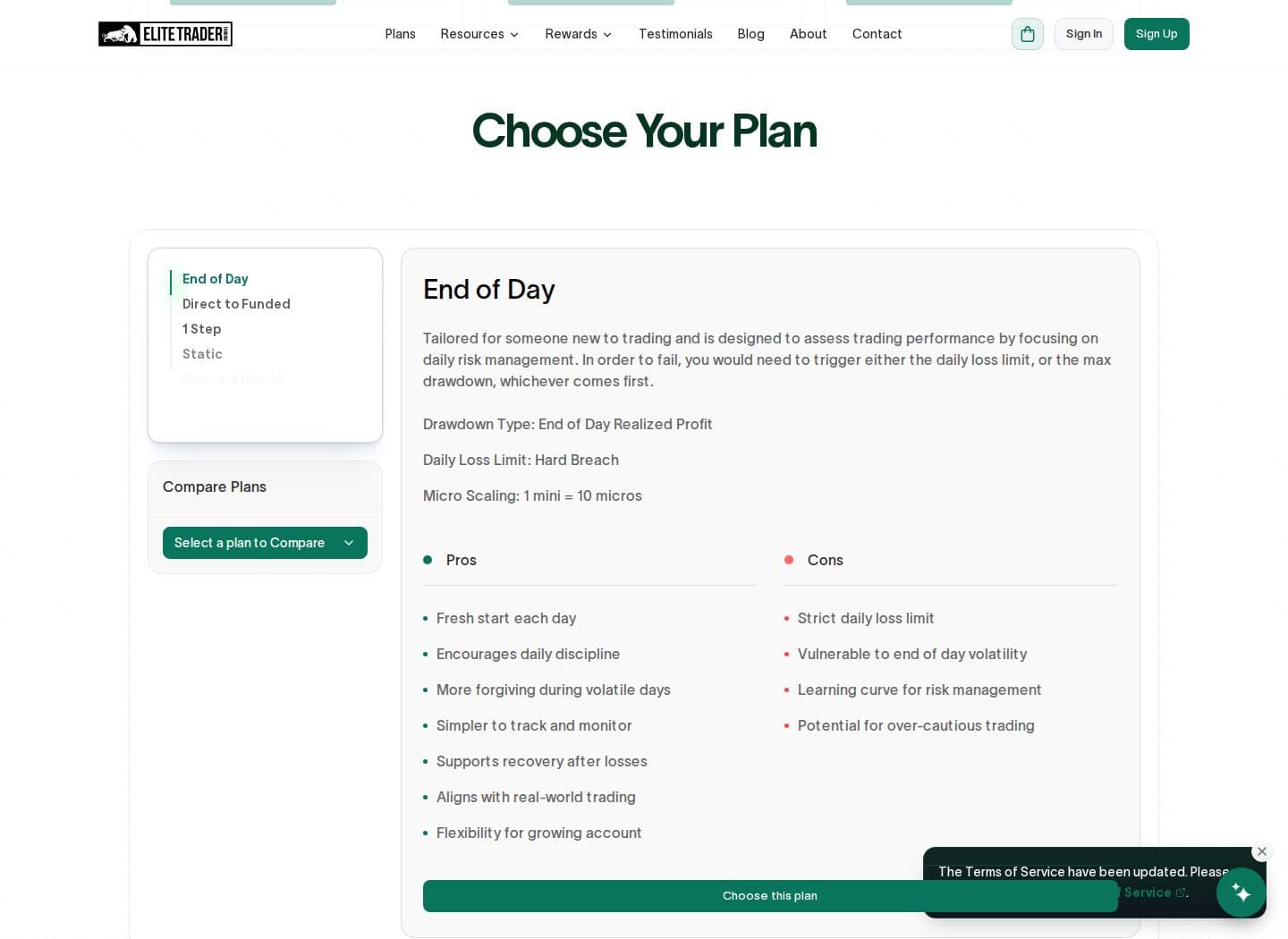
Source: https://elitetraderfunding.app, October 2026
- Profit Split: You keep 100% of the first $12,500 in profits, then 90% of any additional earnings.
- Payout Caps (Every Cycle): Limited withdrawals based on account size and cycle (e.g., $1,750 max for $100,000 accounts in the first cycle, rising to $2,500 from the fourth cycle).
- Safety Net: Realized profits must equal your account’s maximum drawdown + $100 before withdrawals.
- Active Trading Days: 8 for the first payout and 10 for each later cycle. For evaluations bought on or after October 2, 2026, a day counts if it makes at least $250 realized profit and 30% of your best day ($200 and 23% for older evaluations).
- Consistency Rule: No single trading day can exceed 40% of total profits for older accounts.
- Payout Timing: Payout requests are approved daily, with a 48-business-hour approval guarantee ($1,000 extra if ETF misses it).
Quick Tip: To maximize payouts, focus on consistent daily profits, meet active trading day requirements, and avoid exceeding drawdown limits.
Read on for a step-by-step guide, payout examples, and strategies to boost your earnings.

How Payouts Work and Profit Splits
Elite Trader Funding uses a straightforward, tiered payout system designed to reward traders for consistent performance across multiple funded accounts. Below, we’ll break down how profit splits, drawdown methods, and key thresholds work to ensure traders can maximize their payouts.
Profit Sharing: How It Works
The profit-sharing structure is designed to benefit traders significantly. Here’s how it works:
- You keep 100% of the first $12,500 in realized profits. This amount is calculated per trader - not per account.
- Once you surpass the $12,500 mark, the profit split adjusts to 90% in your favor for any additional earnings.
Here’s an example: If you earn $20,000 in total profits, you’ll receive the full $12,500 from the first tier. Then, for the remaining $7,500, you’ll keep 90% (or $6,750). This brings your total payout to $19,250.
Static vs. Trailing Drawdowns
Understanding the two types of drawdowns offered is essential, as they directly influence risk management and payout eligibility. Elite Trader Funding provides both static and trailing drawdown options, catering to different trading approaches.
- Static Drawdown: This type of drawdown sets a fixed loss limit based on your account’s starting balance, regardless of any growth. For instance, with a $100,000 account and a 10% static drawdown, your maximum allowable loss remains $10,000, even if your account grows to $120,000 or beyond.
- Trailing Drawdown: This method adjusts as your account reaches new equity highs, giving you more flexibility. For example, if your $100,000 account grows to $120,000, a 10% trailing drawdown would raise your loss limit to $108,000 (10% below the new peak). If your account later increases to $130,000, the drawdown limit would adjust to $117,000.
Static drawdowns encourage disciplined trading early on but can feel limiting as your account grows. Trailing drawdowns, on the other hand, reward account growth by offering more breathing room to manage trades and safeguard profits.
Profit Calculations and Safety Net Rules
Elite Trader Funding calculates eligible profits based on realized gains - only closed positions count toward your payouts and meeting account thresholds. For a comparison with another futures firm, see our guide to Nexgen ProTrader payout requirements.
One key concept is the Safety Net, a threshold you must meet before requesting a payout. To establish this Safety Net, your realized profits must equal your account’s maximum drawdown plus $100. For example, with a $100,000 account and a $3,000 drawdown, your account value must reach $103,100 to meet this requirement. Once established, the Safety Net locks in a minimum account balance of $100,100. During your first three payout cycles, funds within this buffer cannot be withdrawn, ensuring account stability and discouraging risky trading behaviors.
Another important rule is the Active Trading Days requirement. For evaluations bought on or after October 2, 2026, a day counts only if it earns at least $250 in realized profit and at least 30% of your best day’s profit (for example, $300 if your best day was $1,000). Older evaluations use $200 and 23%. ETF's current rules list a $250 minimum for newer evaluations and $200 for older ones. This system encourages steady performance over sporadic, high-risk trades.
Payout Eligibility Requirements
To qualify for withdrawals, traders must meet specific criteria related to active trading days and profit consistency. These rules are designed to promote steady trading habits and safeguard account stability. Below, we break down the key requirements for payout eligibility.
Uptime
99.999% uptime. Built for 24/7 trading reliability.
Your VPS runs in Tier IV datacenters with redundant power and network, monitored 24/7 on site.
See the uptime SLA







From $29.99/mo · Windows or Linux
Active Trading Day Requirements
The first step toward payout eligibility is completing the required number of Active Trading Days. On Static, EOD, Diamond Hands and 1-Step plans you need 8 Active Trading Days for the first payout and 10 for each later cycle; Direct-to-Funded accounts need 5 to 20 depending on size.
For evaluations bought on or after October 2, 2026, a day counts as an Active Trading Day if it earns at least $250 in realized profit and at least 30% of your best day's profit (for example, $300 if your best day was $1,000). Older evaluations use $200 and 23%.
Sunday evening and Monday trading sessions are treated as a single trading day. Keep this in mind when planning your trading schedule.
A platform that stays connected makes it easier to log those Active Trading Days, Sunday evening opens included.
40% Consistency Rule Explained
Profit consistency is another critical factor for payout eligibility. The 40% Consistency Rule ensures traders don’t rely too heavily on a single high-profit day. This rule applies specifically to Elite Sim-Funded accounts purchased before August 1, 2024. According to the rule, your most profitable trading day cannot account for more than 40% of your total realized profits when requesting a withdrawal.
The calculation is simple: (Best Day P&L ÷ Total P&L) × 100 = Percentage of P&L.
Here’s an example: A trader earns $37,000 in total profits over 15 active trading days, with their best day producing $10,000. The calculation is ($10,000 ÷ $37,000) × 100 = 27%. Since 27% is under the 40% threshold, the trader qualifies for a payout.
Now, imagine the same trader after just five trading days, with $14,000 in total profits and the same $10,000 best day. This time, ($10,000 ÷ $14,000) × 100 = 71.42%. Since this exceeds 40%, the trader must continue trading to increase their total profits and lower the percentage.
If your best day’s profit exceeds 40% of your total, the solution is straightforward: keep trading consistently. As your overall profits grow, the percentage will naturally decrease, bringing you closer to eligibility.
Account Size and Safety Net Requirements
Beyond trading days and profit consistency, traders must also meet Safety Net requirements. The Safety Net is achieved when your realized profits equal your maximum drawdown plus $100. Once this is established, your account’s minimum allowable balance becomes your initial starting balance plus $100. Falling below this threshold results in account closure - except for Static accounts.
Static accounts follow different rules. Their drawdown limit remains fixed at the original static minimum balance. For instance:
- A $10,000 Static account requires a $9,600 minimum balance.
- A $25,000 Static account requires $24,100.
- A $50,000 Static account requires $48,000.
For the first three payout cycles, withdrawals cannot include any funds within the Safety Net buffer. This restriction encourages careful trading and helps maintain the account’s funded status.
The "Request Payout" button will only become available on your dashboard once you’ve completed the Active Trading Days requirement and established your Safety Net. This automated feature ensures traders meet all criteria before initiating a withdrawal, promoting compliance and account stability.
Step-by-Step Payout Process
Now that we've covered the eligibility rules, let's walk through the payout process. Once you're eligible, the steps are simple. Elite Trader Funding has designed the system to make withdrawals quick and hassle-free, while still ensuring proper oversight through audits.
Requesting Payouts Through the Dashboard
To start, head over to your Trader Dashboard. If your account meets the eligibility requirements, you'll see a "REQUEST PAYOUT" button.
Log in, navigate to the Dashboard, and enter the amount you'd like to withdraw. Be sure your withdrawal doesn’t drop your balance below the minimum threshold (initial balance + $100), or your account will be liquidated. Once you've entered the amount, click "Review Request" to submit it. After submitting, stop trading immediately - any activity during the payout request window won’t count as an Active Trading Day.
If you run into any issues or notice discrepancies while submitting your request, reach out to ETF Support by submitting a ticket for help.
Account Review and Approval Process
When you submit a payout request, it kicks off an audit of your trading activity to confirm you’re following the firm’s rules. This review usually takes up to 24 hours.
Elite Trader Funding approves payout requests daily and guarantees approval (or a LIVE ELITE transition) within 48 business hours, excluding weekends and U.S. bank holidays; if it misses that window it pays an extra $1,000. For Live Elite accounts, payouts are processed daily from Monday through Friday, starting at 3:00 PM EST (excluding holidays). If you submit your request before 10:00 AM EST, it may be processed the same day at 3:00 PM EST.
During the review, keep your trading paused. Once your request is approved, you’ll get an email confirmation letting you know you can resume trading in the next session. After that, you can choose your preferred payment method and check the expected processing time.
Payment Methods and Timing
Elite Trader Funding uses Rise (Riseworks.io) to process all payments. Before receiving funds, you’ll need to complete the Know Your Customer (KYC) verification and, if required, accept an invitation to join the Rise network. The onboarding process involves creating an account, verifying your email and identity, and linking a bank account or online wallet.
Here are the available payment options:
| Payment Method | Description | Processing Time |
|---|---|---|
| USDC on Coinbase | Instant transfer via Arbitrum blockchain | Instant |
| Blockchain Wallet | USDC or ERC20 tokens to your Ethereum wallet | Less than 1 hour |
| USD International Transfer | Bank transfers to ABA/SWIFT/IBAN accounts | 1-3 days |
For the fastest access to funds, the USDC on Coinbase option offers instant transfers directly to your Coinbase account. If you’re comfortable with cryptocurrency, using a blockchain wallet is another quick option, with payments arriving in under an hour. For those who prefer traditional banking, international bank transfers are available, but they typically take 1-3 days.
Keep in mind that payout requests are approved daily under the 48-business-hour guarantee, which excludes weekends and U.S. bank holidays. Timing your requests to fit these windows can help you avoid unnecessary delays.
Payout Restrictions and Limits
Elite Trader Funding provides flexible payout options, but there are several rules in place that can affect how and when you withdraw your earnings. These restrictions are designed to ensure compliance and maintain account stability. By understanding these limitations ahead of time, you can plan your trading strategy and avoid any surprises or delays.
First 3 Payout Caps
Elite Trader Funding limits how much you can withdraw in every payout cycle, no matter how much profit you've made. The cap rises over the first four cycles and then stays at the fourth-cycle level.
The limits vary depending on your account size and increase with each payout cycle:
| Funding Amount | 1st Payout (8 ATD) | 2nd (10 ATD) | 3rd (10 ATD) | 4th+ (10 ATD) |
|---|---|---|---|---|
| $10,000 | $100 - $500 | $100 - $500 | $100 - $500 | $100 - $1,000 |
| $25,000 | $100 - $750 | $100 - $1,000 | $100 - $1,250 | $100 - $1,500 |
| $50,000 | $100 - $1,250 | $100 - $1,500 | $100 - $1,750 | $100 - $2,000 |
| $100,000 | $100 - $1,750 | $100 - $2,000 | $100 - $2,250 | $100 - $2,500 |
| $150,000 | $100 - $2,250 | $100 - $2,500 | $100 - $2,750 | $100 - $3,000 |
| $250,000 | $100 - $2,750 | $100 - $2,750 | $100 - $3,000 | $100 - $3,000 |
For instance, if you have a $100,000 account and earn $5,000 before your first payout, that payout is capped at $1,750. The rest stays in the account for later cycles. Caps continue from the fourth cycle onward ($2,500 per payout on a $100,000 account).
Additionally, you have the option to make smaller withdrawals within each cycle. Daily withdrawals are permitted in increments as low as $100, as long as you don’t exceed the cycle’s maximum limit. Beyond these caps, other factors like geographic and legal restrictions may also influence your withdrawal process.
Order flow
Built for scalpers. Heatmaps on dedicated resources.
Order-flow heatmaps and DOM ladders run on dedicated CPU, memory and NVMe, so your charts keep responding during volatility.
See the dedicated hardwareFrom $29.99/mo · Windows or Linux
Geographic and Legal Restrictions
Elite Trader Funding adheres to U.S. regulations, which can restrict payouts for traders in certain countries. For example, traders residing in nations on the Office of Foreign Assets Control (OFAC) Sanctioned Countries list - such as Cuba, Iran, North Korea, Myanmar, and Syria - may not be eligible for funding or withdrawals.
Payment processing can also present challenges. Providers like Rise (Riseworks.io) may not process transactions in certain regions, even if those traders aren’t subject to OFAC restrictions.
Since these restrictions can change, it’s essential to check Elite Trader Funding’s website or terms of service regularly for the most up-to-date information. Alongside these legal considerations, your account balance must meet specific requirements before withdrawals are approved.
Post-Withdrawal Balance Requirements
Every withdrawal must leave your account with at least your starting balance plus $100. For example, if you opened a $50,000 account, your balance cannot drop below $50,100 after a withdrawal. Failing to meet this threshold could result in account liquidation.
Once you reach the Safety Net threshold, the rules differ slightly depending on your account type. For static accounts, the minimum balance stays fixed. For trailing accounts, the minimum adjusts based on unrealized profits.
Consider a $50,000 Elite account with a $2,000 maximum drawdown, setting the minimum balance at $48,000. If you earn $1,000 in unrealized profits, the minimum balance increases to $49,000. Once you achieve $2,100 in realized profits, the Safety Net activates, and the minimum balance becomes $50,100.
These requirements apply to every withdrawal, so it’s crucial to monitor your balance and ensure it stays above the minimum threshold to maintain your funded account.
How to Maximize Your Payouts
Boosting your earnings with Elite Trader Funding requires a smart approach that balances consistent daily profits, careful risk management, and effective use of multiple accounts.
Daily Profit Management for Steady Results
The 40% consistency rule emphasizes spreading profits evenly across trading days. Instead of chasing massive wins followed by flat sessions, aim for steady, manageable gains each day.
Set realistic daily profit targets based on your account size and monthly goals. For instance, if you’re working with a $100,000 account and aiming for $3,000 in monthly profits, aim for about $150 per trading day. This helps avoid uneven performance that could hurt your overall results.
Pay attention to market conditions. If you spot a high-probability setup, consider splitting your position across several days rather than going all-in at once. This keeps your daily profits balanced and reduces the risk of overexposure. Additionally, adjust your trade sizes as needed to lock in profits and minimize potential losses.
Position Sizing to Manage Risk
Getting your position sizes right is key to limiting drawdowns while maximizing profit potential. A good rule of thumb is the 2% rule: never risk more than 2% of your account balance on a single trade. For example, with a $50,000 account, cap your risk at $1,000 per trade.
Let’s break it down: Say you’re trading TSLA at $225 with a stop-loss at $195, creating a $30 per share risk. If your maximum risk is $500 (2% of a $25,000 account), you can safely buy about 16 shares, keeping your total position at $3,600 while limiting potential losses to $480.
Position sizing also helps you maintain consistent risk across trades. Adjust your sizes based on market volatility. For example, when the VIX climbs above 25 or during earnings season, reduce your typical position size by 25–50% to account for larger price swings. Conversely, during calmer periods, you can slightly increase your position sizes. This dynamic approach ensures your risk stays controlled while giving you the flexibility to adapt.
Multi-Account Strategies for Higher Payouts
Using multiple accounts can spread your risk and help you cash out more often. Assign different strategies to each account - for example, one for day trading, another for swing trading, and a third for scalping. This diversification reduces risk and allows you to take advantage of various market conditions.
In October 2024, TradersPost introduced tools to automate trades across multiple prop firm accounts simultaneously. This made it easier for traders to stay within each firm’s rules while overcoming the limitations of individual accounts.
To keep track of everything, use spreadsheets or specialized software to monitor each account’s performance. Watch for drawdown or consistency limits, and track your progress toward payout eligibility. If you’re trading large positions, consider dividing them across accounts - for example, splitting a 10-lot position into 4-3-3 - to reduce the risk to any single account.
Finally, don’t forget to factor in the costs of managing multiple accounts. These extra fees can add up, so make sure your combined profits are enough to cover them and still leave you with a healthy payout.
Key Points for Elite Trader Funding Payouts
Here’s a concise breakdown of the main rules governing Elite Trader Funding payouts:
- Safety Net: Once your profit reaches your drawdown amount plus $100, your minimum balance moves up to your starting balance plus $100 (for example, $100,100 on a $100,000 account).
- Active Trading Days: For evaluations bought on or after October 2, 2026, a day needs at least $250 in realized profit and 30% of your best day ($200 and 23% for older evaluations).
- Consistency Rule: For accounts purchased before August 1, 2024, your best trading day cannot account for more than 40% of your total profits.
The profit split is straightforward: you receive 100% of the first $12,500 in profits and 90% of any additional gains. You need 8 Active Trading Days for the first payout and 10 for each later cycle.
Payout requests are approved daily, and ETF guarantees approval within 48 business hours (excluding weekends and U.S. bank holidays) or pays an extra $1,000.
Withdrawal limits depend on your account size and cycle. For example, a $100,000 account allows up to $1,750 in the first cycle, $2,000 in the second, $2,250 in the third, and $2,500 per payout from the fourth cycle onward. However, during the first three payout cycles, withdrawals from the Safety Net are not permitted.
FAQs
How can traders ensure they meet the Active Trading Days requirement to qualify for payouts?
To qualify for payouts by meeting the Active Trading Days requirement, consistency and planning are key. Make it a habit to trade regularly and ensure you hit the minimum number of active trading days set by your firm. For instance, some firms might ask for at least 8 active trading days, with a portion of those days showing even modest profits.
Setting realistic daily trading goals can keep you on track. By aiming for manageable profit targets each day, you can ensure your trading activity aligns with the firm’s eligibility rules. Additionally, timing your sessions to align with peak market hours can increase your chances of meeting the required active days within the payout period.
Keep a close eye on your performance to ensure you’re meeting all payout conditions, including profit thresholds and active day requirements. Staying disciplined and organized will make the process much smoother and help you qualify for payouts without unnecessary stress.
What are static and trailing drawdowns, and how do they impact trader payouts and risk management?
Static drawdowns set a fixed loss limit on your trading account, ensuring you don’t surpass a specific level of risk. In contrast, trailing drawdowns adjust as your account reaches new high balances. This setup helps protect your profits but requires close attention since the limit moves along with your gains.
Both static and trailing drawdowns play a key role in managing risk and determining your eligibility for payouts. If you exceed these limits, you could lose the chance to receive payouts. Understanding how they work and managing them wisely is crucial for maximizing your earning potential within the Elite Trader Funding program.
What are the advantages of managing multiple accounts with Elite Trader Funding, and how can traders use them to increase their payouts?
Managing multiple accounts with Elite Trader Funding offers traders some clear benefits. It provides access to more trading capital, allows for the diversification of strategies, and opens up opportunities to maximize payouts. By leveraging multiple accounts, traders can make the most of different payout structures that vary depending on account size, ultimately boosting overall earnings.
To get the most out of multiple accounts, it’s smart to assign specific strategies to each account based on its size and risk tolerance. Trade copiers streamline execution across accounts, reduce manual errors and save time. Regularly reviewing performance and tweaking strategies as needed is also crucial for staying on track and achieving the best possible results. With thoughtful planning and consistent management, multiple accounts can become a key driver of trading success.


