
The best VPS for trading puts your platform in a data center close to your exchange or broker, keeps it running around the clock, and states its uptime, backup and DDoS terms in writing. We compared 13 providers on those points: QuantVPS, 8 other trading VPS providers and 4 general clouds, with prices checked on 10 Oct 2026.
Quick Comparison Table
| Provider | Best for | Locations | Entry price (monthly billing) | Uptime wording | Backups | DDoS protection | Checked |
|---|---|---|---|---|---|---|---|
| QuantVPS | Futures, NinjaTrader and bots near CME | Chicago, New York, London, Dublin, Amsterdam, Frankfurt, Tokyo, Singapore | $29.99 (VPS Starter); $39.99 (VPS Starter+, Ryzen) | 99.999% uptime SLA | Automatic off-site, every VPS plan | Always-on, included | 10 Oct 2026 |
| Beeks Group | Traders who want an institutional provider | London, New York, Chicago, Frankfurt, Tokyo, Hong Kong | £32 excl. VAT (Bronze); Windows +£13 | Not stated | Not stated | Not stated | 10 Oct 2026 |
| TradingFXVPS | Forex EAs on broker cross-connects | New York, London, Amsterdam, Frankfurt, Chicago, Hong Kong, Singapore, Tokyo | $25 (HFT Standard); $17.50/month billed yearly | "99.99% uptime guarantee" | 4x weekly, off-site | Included | 10 Oct 2026 |
| ForexVPS.net | MT4 and MT5 traders who want many cities | 22 stated, incl. New York (Equinix NY4), London, Chicago, Tokyo | $40 (Core); $28.80/month billed yearly | "100% uptime guarantee"; SLA applies below 99.99% | Automated weekly, included | Included on every plan | 10 Oct 2026 |
| AWS (EC2) | Self-managed bots and code | Chicago and New York City Local Zones; London region | $28.62 Windows, $15.18 Linux (t3.small, billed per second) | 99.5% single instance; 99.99% region-level | Paid snapshots | Shield Standard, no extra cost | 10 Oct 2026 |
| ChartVPS | Ryzen 9 9950X VPS with large NVMe storage | Chicago, New York, London, Frankfurt, Singapore, Tokyo, Dallas | $50 (Alpha Mark-1) | "99.99% measured uptime + 100% SLA"; 99.9% contractual | Daily snapshot, included | Included on every plan | 10 Oct 2026 |
| Vultr | Self-managed servers billed hourly | 33 regions, incl. Chicago, New York Area, London | $26 with Windows (1 vCPU, 2GB) | "100% uptime guarantee" (SLA) | +20% of the base fee | $10/month add-on | 10 Oct 2026 |
| NYC Servers | Forex in Equinix NY4, LD4 and TY3 | NY4, LD4, TY3, SG1, HK1, DUB1 (no Chicago) | $25 (Basic VPS) | 100% during market trading hours | $10/month weekly add-on | Not stated as included | 10 Oct 2026 |
| Ninja Mobile Trader | NinjaTrader near CME | Chicago; New York and London (on request, per its FAQ) | $59 (Small) | "100% Uptime"; SLA: 99.999% transit | Not stated | Included on Fully Managed VPS | 10 Oct 2026 |
| OVHcloud | Low-cost VPS outside Chicago | 19 data center cities, incl. Vint Hill (VA) and London (Erith); no Chicago | $5.35 (VPS-1, Linux only); $19.60 with Windows (VPS-2) | 99.9% SLA | Daily backup included | Included | 10 Oct 2026 |
| Kamatera | Custom-sized cloud servers | 21 data centers, incl. Chicago, New York, London | $4 (Linux); Windows from $46 | 99.95% (marketing); 99.9% (SLA document) | Paid add-on | Mentioned on its Chicago page; included or paid not stated | 10 Oct 2026 |
| FXVM | Low-cost MT4 and MT5 hosting | 16 cities, incl. London (Equinix LD4), New York (Equinix NY4), Chicago | $15 (Virtual Desktop, one platform); $25 (Lite VPS) | "100% Uptime Guarantee"; SLA applies below 99.99% | Automatic, included | Included | 10 Oct 2026 |
| MyForexVPS | Budget MT4 and MT5 hosting | New York, London, Amsterdam, Singapore | $14.99 regular (Silver) | 99.99% (SLA) | Not included | Not stated | 10 Oct 2026 |
Prices checked on each provider's website on 10 Oct 2026. Prices are for monthly billing unless marked; yearly prices are shown separately, and sale prices and promo codes are left out. Beeks prices are in pounds excluding VAT.
Choose a VPS based on your trading strategy, broker location, and budget. Proximity to exchanges and reliable infrastructure are critical for consistent performance in fast-moving markets.
1. QuantVPS
QuantVPS is a trading VPS built for futures, forex and prediction-market traders. Pick your platform at checkout, such as NinjaTrader, Sierra Chart, Tradovate or MT5, and it arrives pre-installed. It suits traders who want a Windows desktop close to CME in Chicago, or close to forex brokers in New York or London.
- Processor: AMD Ryzen 9 9950X on Performance plans; AMD EPYC on Standard plans. Cores and memory are reserved for your VPS.
- Entry plan: VPS Starter (Standard), $29.99/month: 2 AMD EPYC cores, 4GB DDR4, 50GB NVMe. The Performance entry, VPS Starter+, is $39.99/month: 2 Ryzen cores, 4GB DDR5, 50GB NVMe.
- Reference plan: VPS Lite+, $79.99/month: 4 Ryzen 9 9950X cores, 8GB DDR5, 75GB NVMe. The Standard VPS Lite (4 EPYC cores, 8GB DDR4) is $59.99/month.
- Close to the major venues: Chicago 0.52ms to CME; New York for NY4 forex brokers and US stocks and options; London (LD4) for forex. Eight locations in total: Chicago, New York, London, Dublin (for Polymarket), Amsterdam, Frankfurt, Tokyo and Singapore.
- Uptime: 99.999% uptime, which allows about 26 seconds of downtime a month.
- Backups: automatic off-site backups on every VPS plan, Standard and Performance. Dedicated servers use RAID 1 storage.
- DDoS protection: always-on DDoS protection with advanced filtering, plus firewalls, on every server.
- Windows and refunds: Windows Server 2025 is the default Windows setup, Windows Server 2022 is also offered, and Ubuntu 24.04 or 22.04 is available for Linux. Every plan has a 14-day money-back guarantee; annual billing saves 20%, and rates are locked for 3+ years.
The screenshot shows Performance plans, which start at $39.99 per month.
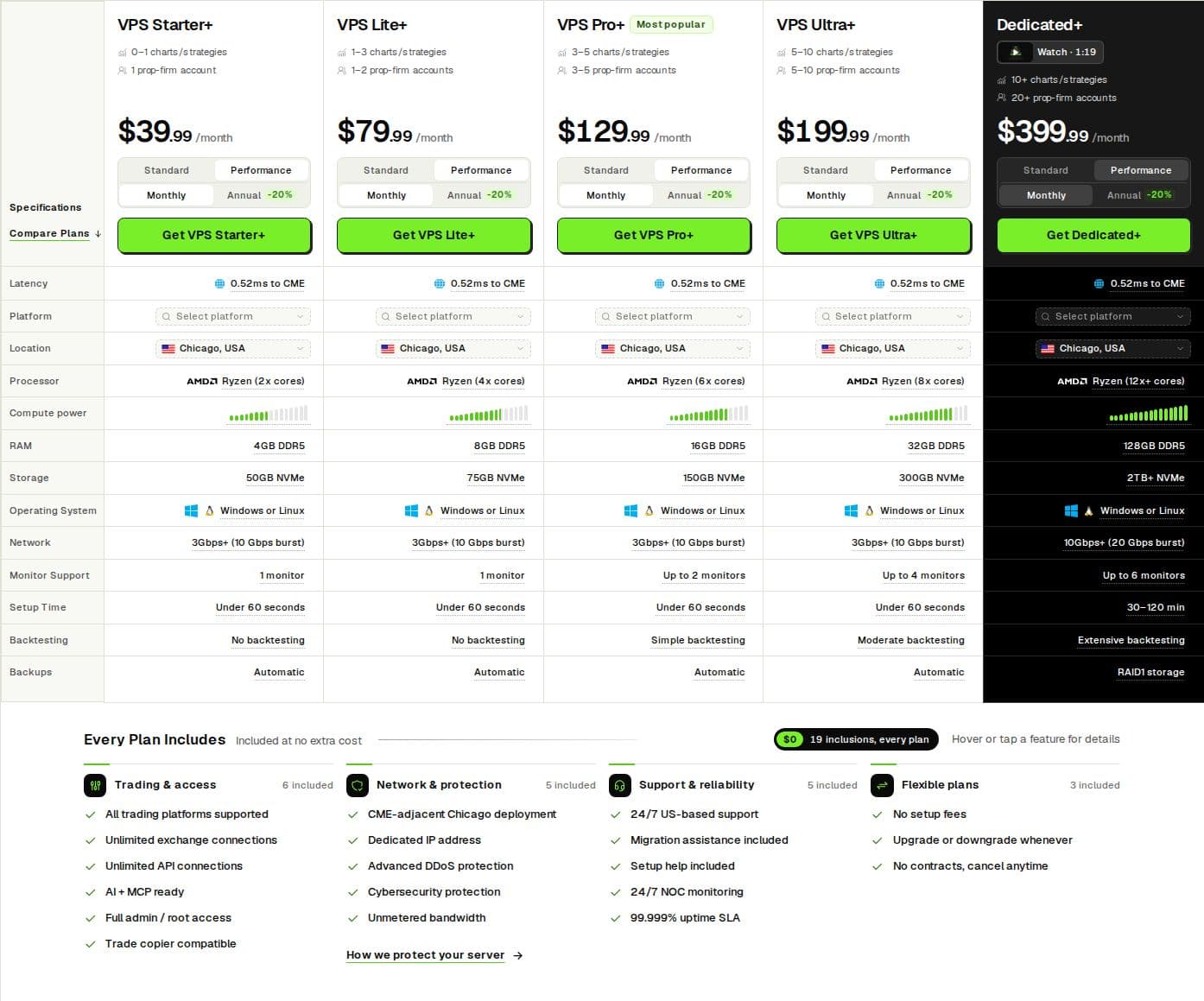
Source: quantvps.com/pricing, October 2026
2. Beeks Group
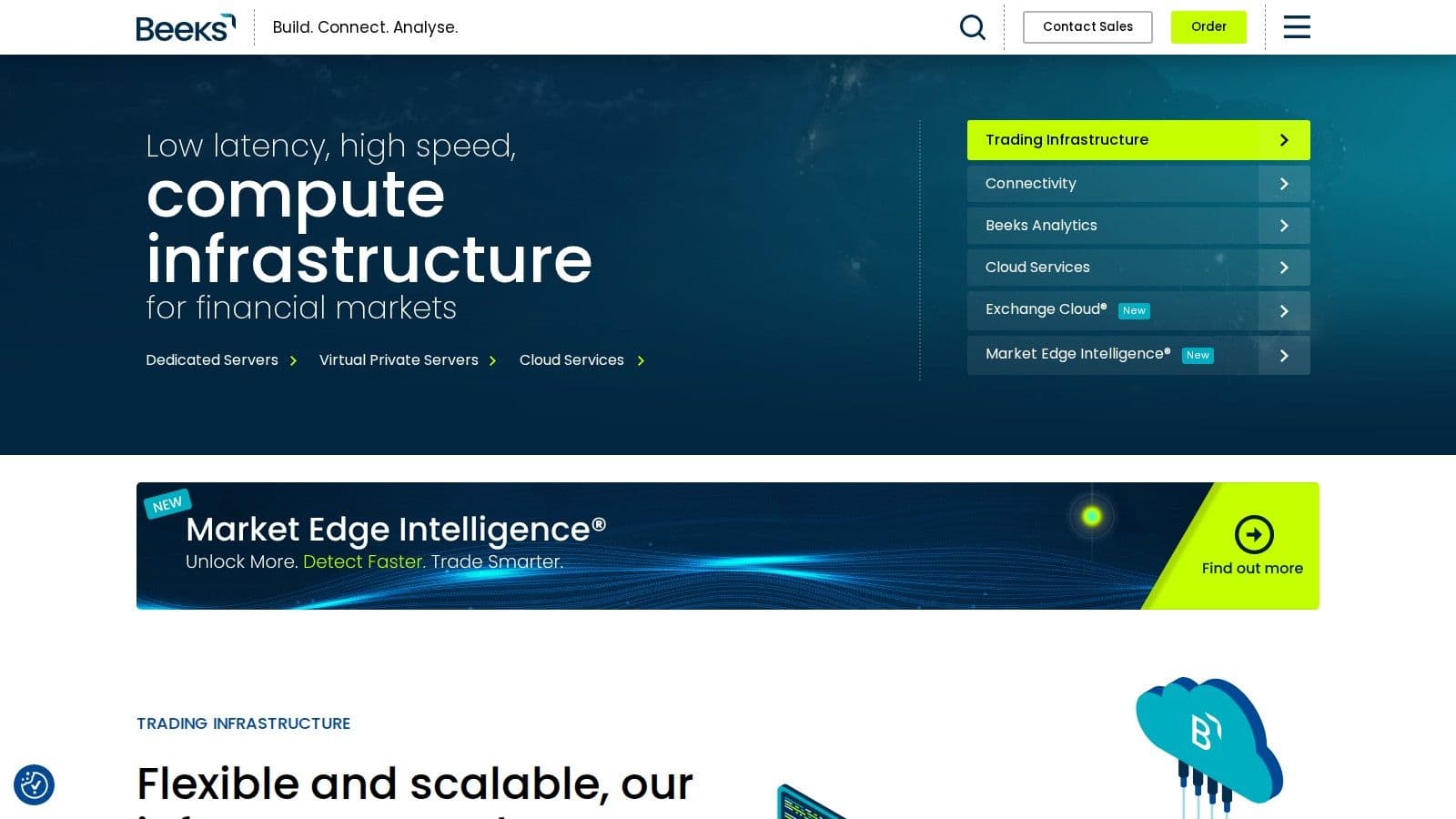
Beeks Group is an institutional trading infrastructure company that also sells retail VPS plans for MT4 and cTrader. It suits traders who want a provider that also runs exchange-side infrastructure, and who are happy to pay in pounds.
- Processor: model not stated. Each VPS has its own CPU, RAM and storage.
- Entry plan: Bronze, £32/month excluding VAT on beeksgroup.com (£31 in its VPS store): 1 vCPU, 2,560MB RAM, 30GB SSD. Windows Server 2022 adds £13/month in the store.
- Plan closest to QuantVPS Lite+: Gold, £100/month excluding VAT (£97 in the store): 4 vCPU, 6,656MB RAM, 75GB SSD.
- Locations: London, New York, Chicago, Frankfurt, Tokyo and Hong Kong (VPS store). No latency figure is published for the VPS product.
- Uptime: not stated for the VPS product.
- Backups: not stated.
- DDoS protection: not stated.
- Windows and refunds: Windows Server 2022 at +£13/month or Ubuntu 24 at no charge; trial and refund terms not stated.
Where Beeks Group beats QuantVPS: it cites SOC2 and ISO27001 certifications, offers a managed VPS service, and has a Hong Kong VPS location.
Uptime
99.999% uptime. Built for 24/7 trading reliability.
Your VPS runs in Tier IV datacenters with redundant power and network, monitored 24/7 on site.
See the uptime SLA





From $29.99/mo · Windows or Linux
3. TradingFXVPS
TradingFXVPS is a forex VPS provider that sells cross-connects to broker servers. It suits forex EA traders who want sub-millisecond routes to specific brokers and are willing to pay yearly for the lowest price.
- Processor: AMD Ryzen 9 at 4.3 GHz (model not named); dedicated or shared cores not stated.
- Entry plan: HFT Standard, $25/month on monthly billing, or $17.50/month billed yearly ($210): 1 core, 2GB DDR5, 30GB NVMe.
- Plan closest to QuantVPS Lite+: the 4-core plan, $90/month on monthly billing, or $63.75/month billed yearly ($765): 4 cores, 8GB DDR5, 50GB NVMe.
- Locations: New York, London, Amsterdam, Frankfurt, Chicago, Hong Kong, Singapore and Tokyo. It states "Cross-connection latency 0.3ms onwards" to brokers and CME futures latency "as low as 0.5ms".
- Uptime: "SLA: 99.99% uptime guarantee"; no service credits stated.
- Backups: "4x Weekly Backups Stored Off-Site" on VPS plans; its terms say keeping backups is the customer's responsibility.
- DDoS protection: included on every VPS.
- Windows and refunds: Windows 2019 or 2022 listed per plan; $3.99 seven-day trial; 30-day money-back guarantee on VPS for first-time customers.
Where TradingFXVPS beats QuantVPS: lower prices on yearly billing, a Hong Kong location, and a paid trial plus a 30-day money-back guarantee. On monthly billing its 4-core plan costs more than VPS Lite+.
4. ForexVPS.net
ForexVPS.net is a forex VPS provider for MT4, MT5 and cTrader traders. It suits traders who need a server in a city QuantVPS doesn't cover, since it lists 22 locations.
- Processor: model not stated; dedicated or shared cores not stated for VPS plans.
- Entry plan: Core, $40/month list price, or $28.80/month billed yearly ($345.60): 2 cores, 4GB RAM, 100GB storage.
- Plan closest to QuantVPS Lite+: Prime, $80/month list price: 6 cores, 8GB RAM, 200GB storage.
- Locations: 22 stated, including New York (Equinix NY4), London, Chicago, Amsterdam, Tokyo, Frankfurt and Singapore. It states "1ms low latency to Forex Brokers" and gives no exchange latency figure.
- Uptime: plan cards say "100% uptime guarantee"; the SLA applies if service drops below 99.99% a month.
- Backups: automated weekly backups included on all VPS plans.
- DDoS protection: included on every plan (volumetric and L4 protocol-based).
- Windows and refunds: Windows Server 2025, 2022 or 2019 on all plans; 14-day money-back guarantee on VPS plans, no free trial stated.
Where ForexVPS.net beats QuantVPS: more locations (22 against 8), more storage per plan, and a free trade copier and trading analytics with its VPS plans. If ForexVPS.net is on your shortlist, our guide to ForexVPS alternatives compares other providers side by side.
5. Amazon Web Services (AWS)
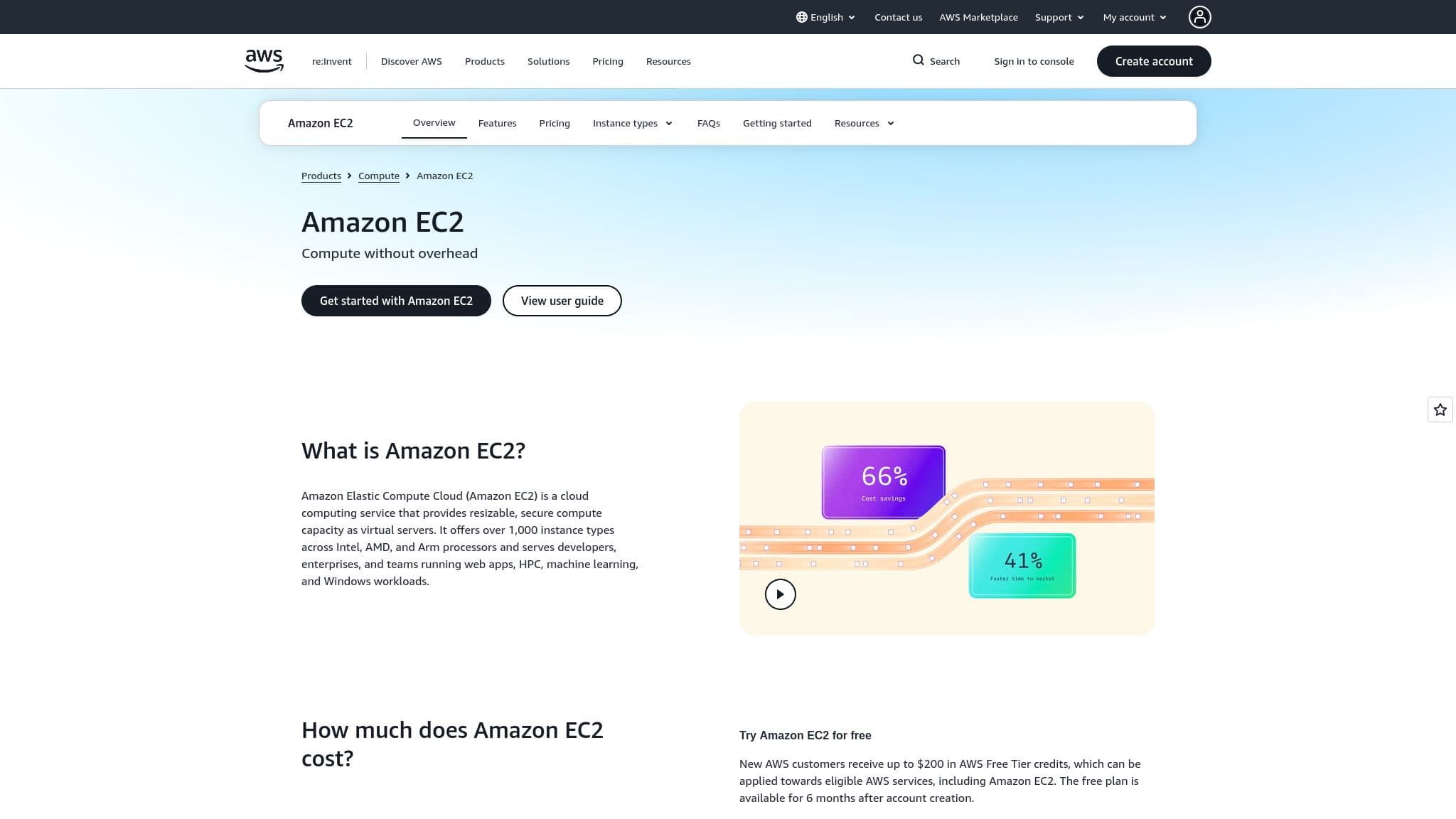
AWS EC2 is a general cloud, not a trading VPS: no trading platform comes pre-installed, and you set up Windows, the platform and backups yourself. It suits traders who run their own code or bots. AWS bills per second, and Windows instances cost more than Linux ones. Its nearest point to CME is the Chicago Local Zone; for LD4 it is the Europe (London) region.
- Processor: depends on the instance; t3.small uses Intel Xeon Platinum 8000 series with burstable vCPUs.
- Entry plan: t3.small in US East (N. Virginia), $28.62/month with Windows or $15.18/month with Linux (hourly rate x 730 hours): 2 burstable vCPU, 2GiB RAM, storage billed separately.
- Plan closest to QuantVPS Lite+: c7i-flex.xlarge, $251.40/month with Windows or $123.79/month with Linux: 4 vCPU, 8GiB RAM, storage billed separately.
- Locations: Chicago and New York City (New Jersey) Local Zones, which AWS says let trading apps run "within one millisecond of trading venues", plus the Europe (London) region and many more.
- Uptime: 99.5% for a single instance; 99.99% region-level for instances across two or more zones.
- Backups: not included; EBS snapshots are paid.
- DDoS protection: AWS Shield Standard at no extra cost; Shield Advanced costs $3,000 a month.
- Windows and refunds: Windows is licence-included at Windows rates; up to $200 in Free Tier credits for new customers; refund terms not stated.
Where AWS beats QuantVPS: per-second billing, a lower Linux entry price, and Local Zones in 17 US cities.
6. ChartVPS
ChartVPS is a trading VPS provider for futures and forex platforms, with AMD Ryzen 9 9950X VPS plans, GPU plans and dedicated servers. It suits traders who keep tick data, recordings or large databases on the server, since each of its VPS plans comes with more NVMe storage than the matching QuantVPS plan.
- Processor: AMD Ryzen 9 9950X on its Alpha VPS plans; dedicated or shared cores not stated.
- Entry plan: Alpha Mark-1, $50/month: 2 cores, 4GB DDR5, 128GB Gen4 NVMe ($550 billed yearly).
- Plan closest to QuantVPS Lite+: Alpha Mark-2, $80/month: 3 cores, 8GB DDR5, 256GB Gen4 NVMe.
- Locations: Chicago, New York, London, Frankfurt, Singapore, Tokyo and Dallas, with Hong Kong listed as coming soon. It advertises typical Chicago to CME latency of 0 to 1ms.
- Uptime: its homepage states "99.99% measured uptime + 100% SLA", and its uptime page names a 99.9% contractual monthly commitment.
- Backups: one automated daily full-system snapshot included; extra backup capacity costs 20% of the plan price.
- DDoS protection: included on every plan, with always-on Layer 3, 4 and 7 filtering.
- Windows and refunds: Windows Server 2025 included by default; fees are generally non-refundable under its terms.
Where ChartVPS beats QuantVPS: more NVMe storage on every Alpha plan, GPU plans (Gamma, from $100/month) that QuantVPS does not list, a Dallas location, and a lower dedicated server entry price (Delta SE at $250/month). Our ChartVPS review compares its plans with QuantVPS in more detail.
7. Vultr
Vultr is a general cloud with hourly billing, not a trading VPS: no trading platform comes pre-installed, and the Windows licence costs extra. It suits developers who want a self-managed server they can start and stop. Its nearest region to CME is Chicago, Illinois.
- Processor: Regular Performance plans use previous-generation Intel CPUs on shared resources; Optimized Cloud Compute uses dedicated AMD EPYC vCPUs.
- Entry plan: Regular Performance 1 vCPU, 2GB RAM, 55GB SSD: $10/month plus a $16/month Windows licence, so $26/month with Windows. Linux plans start at $2.50/month (IPv6 only).
- Plan closest to QuantVPS Lite+: Regular Performance 4 vCPU, 8GB RAM, 160GB SSD: $40/month on Linux, or $104/month with the $64 Windows licence.
- Locations: 33 regions, including Chicago, New York Area, London, Amsterdam, Frankfurt, Tokyo and Singapore. No exchange latency figure.
- Uptime: "Vultr offers a 100% uptime guarantee" on network and host node, with credits on request.
- Backups: paid add-on; automatic backups add 20% to the base fee.
- DDoS protection: paid add-on, $10/month per instance.
- Windows and refunds: Windows Server 2016 to 2025, licence extra; no refunds for services.
Where Vultr beats QuantVPS: 33 regions, hourly billing, a cheaper Windows entry plan, and a 100% SLA on paper.
8. NYC Servers
NYC Servers (NYCServers) is a forex VPS provider with servers in Equinix data centers used by forex brokers. It suits MT4 and MT5 traders whose broker sits in NY4, LD4 or TY3; it has no Chicago location for CME.
- Processor: AMD EPYC (model per plan not stated); dedicated or shared cores not stated.
- Entry plan: Basic VPS, $25/month on monthly billing, or $20.83/month billed yearly ($250): 2 cores, 2GB DDR5, 60GB NVMe.
- Plan closest to QuantVPS Lite+: Professional VPS, $60/month on monthly billing, or $50/month billed yearly ($600): 4 cores, 8GB DDR5, 100GB NVMe.
- Locations: New York (NY4), London (LD4), Tokyo (TY3), Singapore (SG1), Hong Kong (HK1) and Dublin (DUB1). It states "1ms latency to top brokers in NY4, LD4 & TY3 datacenters".
- Uptime: its SLA promises 100% availability during market trading hours, with credits from 10% of the monthly charge.
- Backups: not included; an optional backup service costs $10/month, taken weekly on Saturday.
- DDoS protection: not stated as included; its terms reserve the right to null route an IP under DDoS attack.
- Windows and refunds: Windows Server 2022 or Ubuntu 24.04, with Windows licensing included; 14-day full refund on VPS orders, one per account.
Where NYC Servers beats QuantVPS: its 4-core, 8GB plan costs less than VPS Lite+ and has more storage, and it has a Hong Kong location.
DDoS protection
Always-on DDoS protection with advanced filtering. On every plan.
Always-on mitigation filters attack traffic at the network edge. Every plan includes a dedicated IP and unmetered bandwidth for the trading environment.
See every security layerFrom $29.99/mo · Windows or Linux
9. Ninja Mobile Trader
Ninja Mobile Trader is a VPS provider for NinjaTrader and other futures platforms, with its main servers in downtown Chicago. It suits futures traders who want a Chicago server for NinjaTrader. For plan-by-plan detail, see Ninja Mobile Trader compared with QuantVPS.
- Processor: AMD Ryzen (model not stated) on dedicated hardware, with DDR5 RAM.
- Entry plan: Small, $59/month, or $47.20/month with annual prepay: 2 AMD Ryzen cores, 3.5GB RAM, 50GB NVMe.
- Plan closest to QuantVPS Lite+: Medium, $89/month: 3 AMD Ryzen cores, 8GB RAM, 100GB NVMe.
- Locations: Chicago, New York City and London; its FAQ says New York City and London are available on request. It states "<1ms latency to CME, Tradovate, Rithmic, and all Prop Firms".
- Uptime: homepage says "100% Uptime"; its SLA promises 99.999% uninterrupted transit to the internet a month.
- Backups: not stated.
- DDoS protection: "Automatic DDoS protection on Fully Managed VPS".
- Windows and refunds: Windows Server 2022 licence included with all subscriptions; no official trial, and a strict no-refund policy.
Where Ninja Mobile Trader beats QuantVPS: it states the Windows licence is included, its 8GB plan has more storage, and its dedicated server (Pro, $199/month) costs less than QuantVPS Dedicated+.
10. OVHcloud
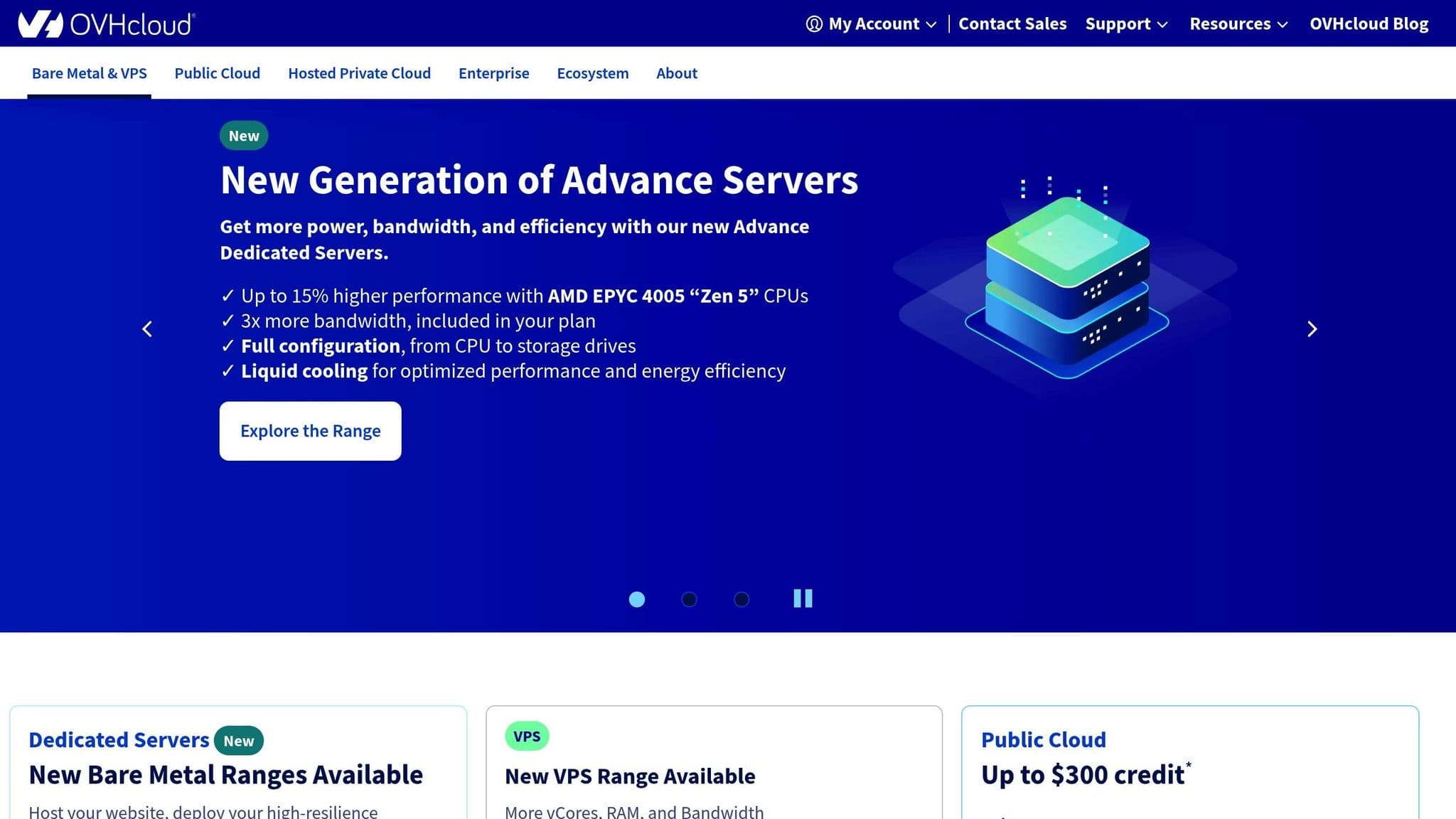
OVHcloud is a general cloud and hosting company with low-cost VPS plans. It suits traders who want a cheap server and don't need Chicago: it has no Chicago location, and its New York Local Zone runs Linux only, so Windows platforms need its Vint Hill, Virginia data center or another region.
- Processor: model not stated; dedicated or shared cores not stated.
- Entry plan: VPS-1, $5.35/month with no commitment ($4.54/month on a 12-month commitment): 2 vCores, 4GB RAM, 40GB NVMe. Linux only.
- Plan closest to QuantVPS Lite+: VPS-2, $10/month with no commitment, or $19.60/month with Windows Server 2025: 4 vCores, 8GB RAM, 75GB NVMe.
- Locations: 19 data center cities, including Vint Hill (Virginia), Beauharnois, London (Erith) and Frankfurt. No exchange latency figure.
- Uptime: 99.9% SLA.
- Backups: a daily backup is included; a premium backup costs extra.
- DDoS protection: included.
- Windows and refunds: Windows Server 2025 is $9.60/month extra on VPS-2 and isn't offered on VPS-1; trial and refund terms not stated.
Where OVHcloud beats QuantVPS: far lower prices, more data center cities, and unlimited traffic on its VPS plans.
11. Kamatera
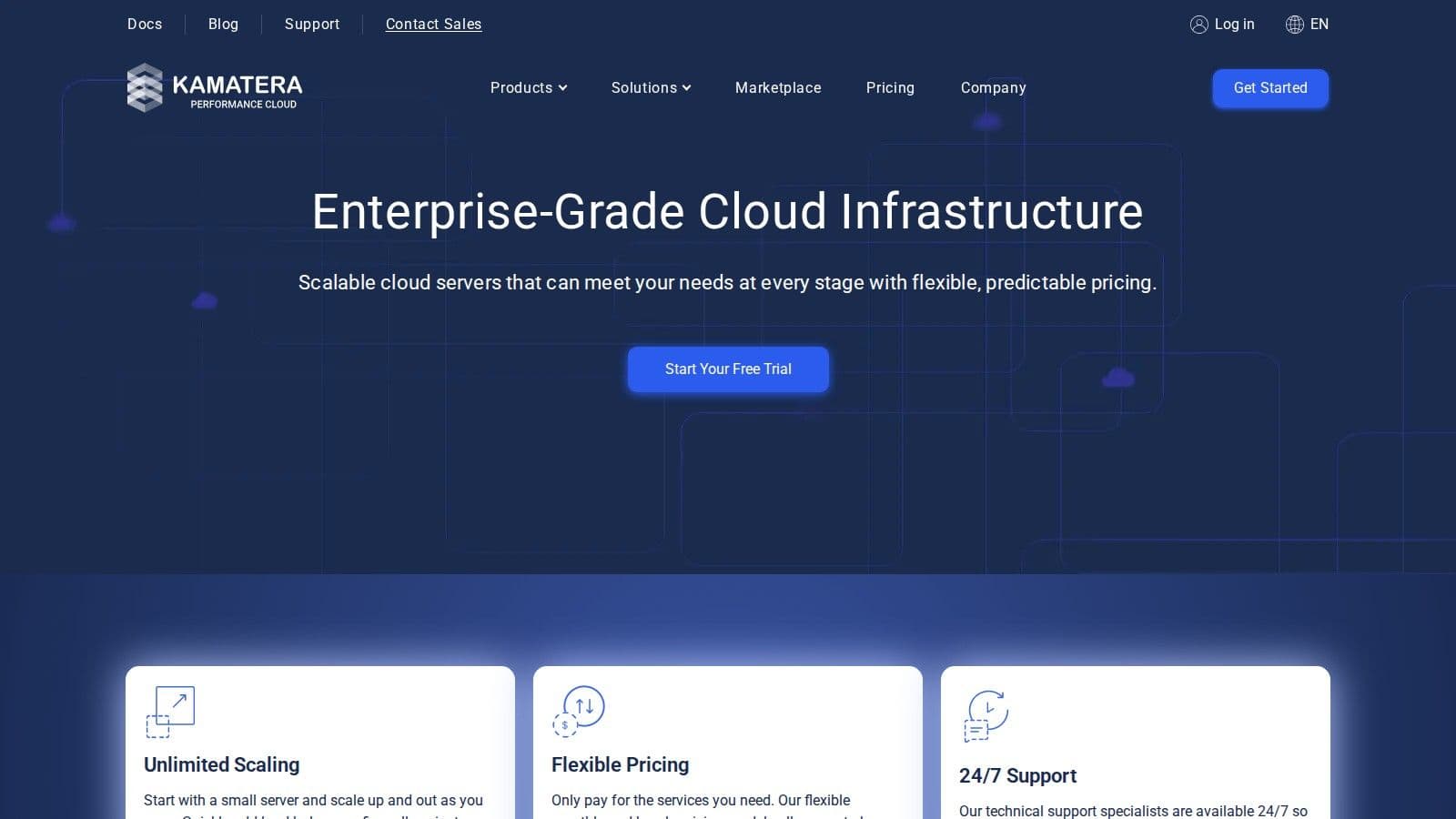
Kamatera is a general cloud with custom-sized servers and hourly or monthly billing. It suits traders who want to size a server exactly and test it on a free trial first. It has data centers in Chicago, New York and London.
- Processor: Intel Xeon. The $4 plan uses Type A (Availability) CPUs; on Type B, "CPU threads are dedicated with reserved resources guaranteed".
- Entry plan: $4/month: 1 vCPU, 1GB RAM, 20GB NVMe, Ubuntu. Its cheapest fixed Windows plan is $46/month (1 core, 2GB RAM).
- Plan closest to QuantVPS Lite+: Type B, 4 cores, 8GB RAM, 80GB NVMe with Windows Server 2022: $109/month ($90 with Ubuntu).
- Locations: 21 data centers, including Chicago, New York, London, Amsterdam, Frankfurt, Tokyo and Singapore. No exchange latency figure.
- Uptime: marketing pages say "99.95% uptime guarantee"; its SLA document says 99.9%.
- Backups: paid add-on (extended daily backup, +$6/month on the 4-core, 8GB server).
- DDoS protection: its Chicago page mentions DDoS protection; whether it is included or paid is not stated.
- Windows and refunds: Windows licence included in the price, which is higher than Linux; free 30-day trial worth up to $100 on one server; refund terms not stated.
Where Kamatera beats QuantVPS: 21 data centers against 8, a free 30-day trial, and a much lower Linux entry price.
12. FXVM
FXVM is a low-cost forex VPS provider run by the same company as ForexVPS.net. It suits traders who run one or two MT4 or MT5 terminals and want the lowest monthly price.
- Processor: not stated for VPS plans; the Virtual Desktop uses a shared Ryzen 7950X3D CPU.
- Entry plan: Virtual Desktop, $15/month list price: 1 shared CPU, 3GB RAM, 10GB NVMe, one MT4 or MT5 platform only. The cheapest full VPS is Lite VPS, $25/month: 2 cores, 1.5GB RAM, 60GB SSD.
- Plan closest to QuantVPS Lite+: no 4-core, 8GB plan is published. The largest fixed plan is Advanced VPS, $50/month: 2 cores, 4GB RAM, 90GB SSD.
- Locations: 16 cities for its VPS plans, including London (Equinix LD4), New York (Equinix NY4), Chicago, Amsterdam, Tokyo and Singapore. No exchange latency figure.
- Uptime: plan table says "100% Uptime Guarantee"; the SLA promises more than 99.99% a month, with a credit of 5% of the last payment per hour of downtime.
- Backups: automatic backups included on all VPS plans; frequency not stated.
- DDoS protection: included ("Firewall, Intrusion Detection and DDOS systems active 24/7").
- Windows and refunds: Windows Server included; $0.99 seven-day trial; 7-day money-back guarantee on VPS products.
Where FXVM beats QuantVPS: a much lower entry price, 16 cities against 8, a $0.99 trial and a published SLA credit formula. Our guide to FXVM alternatives compares it with seven other forex VPS providers.
13. MyForexVPS
MyForexVPS is a budget forex VPS provider for MT4, MT5 and other forex platforms. It suits traders on a tight budget whose broker is in New York, London, Amsterdam or Singapore.
- Processor: model not stated; it states "Dedicated CPU & RAM".
- Entry plan: Silver VPS, $14.99/month regular price: 2 cores, 2GB RAM, 50GB SSD.
- Plan closest to QuantVPS Lite+: Platinum VPS, $49.99/month regular price: 4 cores, 8GB RAM, 100GB SSD.
- Locations: New York (CoreSite NY1), London, Amsterdam and Singapore. It states latency "as low as 1ms" to major brokers.
- Uptime: its SLA promises more than 99.99% a month, with a credit of 5% of the last monthly payment per hour of downtime. Plan cards show 99.999%.
- Backups: not included in standard VPS plans.
- DDoS protection: not stated.
- Windows and refunds: Windows 2019 or 2022 on all plans; 7-day money-back guarantee from activation.
Where MyForexVPS beats QuantVPS: much lower prices, with a 4-core, 8GB plan at $49.99 against $79.99 for VPS Lite+.
Order flow
Built for scalpers. Heatmaps on dedicated resources.
Order-flow heatmaps and DOM ladders run on dedicated CPU, memory and NVMe, so your charts keep responding during volatility.
See the dedicated hardwareFrom $29.99/mo · Windows or Linux
How to choose a trading VPS
Choose the provider with a server in the same city as your exchange or broker, then compare uptime terms, backups and the monthly price on the same billing basis. The trading VPS providers give you a Windows desktop for your platform; the general clouds suit self-managed code. If you trade a funded account, see our pick of the best VPS for prop firm trading before you choose.
This video explains five checks to make when choosing a trading VPS.
Quick tip: Uptime guarantees often range from 99.9% (standard) to 99.999% (institutional-grade), with NVMe storage offering reduced data lag during peak usage. For traders relying on high-frequency strategies, latency under 1 ms is critical. Always verify your broker’s server location with a ping test. For example, if your broker operates out of Equinix NY4 in New York or LD4 in London, ensure your VPS is hosted in the same facility.
Conclusion
When choosing a VPS for trading, match it to your strategy and your broker's location. Proximity comes first: a server in Chicago sits close to CME's data center in Aurora, while a server in New York or London adds a long network route to every CME order.
Be mindful of uptime guarantees. A VPS with a 99.9% uptime SLA might still allow hours of downtime annually. For automated trading, aim for providers offering 99.99% to 100% uptime with maintenance scheduled during market closures.
For hardware, prioritize single‑core CPU speeds above 3.5 GHz over higher core counts, and opt for NVMe storage to efficiently process tick data without slowdowns.
Use short trials, such as FXVM's $0.99 seven-day trial or TradingFXVPS's $3.99 seven-day trial, to test performance during busy market hours. The ideal VPS combines proximity, uptime, and hardware to give you the reliability trading needs. MT4 and MT5 traders can see more forex VPS providers compared in our forex list. Bot builders can review VPS options for trading bots.
FAQs
How do I find my broker’s server location?
To find your broker’s server, start by checking their official website or the trading platform you’re using. Many brokers list their server locations there, and some platforms even allow you to view or select server locations directly in the settings. If you’re using a VPS, knowing the server’s location is crucial for minimizing latency - selecting a VPS close to your broker’s server can make a big difference. If you’re unsure, reach out to your broker’s support team for clarification, especially if you rely on low-latency trading strategies.
What latency should I aim for when trading?
For trading, aim to keep latency below 1 millisecond. This helps minimize slippage and ensures orders are executed faster. This level of speed is particularly important in high-frequency or highly volatile markets, where even a slight delay can make a big difference in results.
How much CPU and RAM do I need for my trading platform?
For CPU and RAM, what you’ll need largely depends on your trading strategies, the number of platforms or EAs you’re running, and your overall performance expectations. For most setups, a mid-range CPU like a Ryzen 5 paired with at least 8 GB of RAM will do the job just fine.
However, if you’re diving into high-frequency trading or running complex algorithms, you’ll want to step it up. In these cases, go for a Ryzen 7 or better and 16 GB or more of RAM to maintain stability and keep latency as low as possible. These upgrades can make a big difference when milliseconds count.


