Scalping is a high-speed trading strategy focused on making small, frequent profits by exploiting short-term price movements. It’s all about speed, precision, and discipline. Here’s what you need to know:
- Core Idea: Traders execute dozens or even hundreds of trades daily, targeting tiny price changes (e.g., $0.05–$0.20 per share or 5–15 pips in low-latency forex markets).
- Key Tools: Success requires real-time data feeds, low-latency trading platforms, and ultra-fast VPS hosting to minimize delays.
- Techniques: Popular methods include range trading, momentum scalping with EMA crossovers, and futures trading strategies like breakouts.
- Risk Management: Strict position sizing, stop-loss rules, and emotional control are critical to avoid losses.
- Challenges: Scalping demands intense focus, quick decision-making, and advanced trading systems to stay competitive.
This fast-paced approach thrives in liquid markets with tight spreads. But without the right tools and discipline, it’s easy to lose money. Let’s dive deeper into how scalping works and what it takes to succeed.
What Is Scalping and How Does It Work?
Scalping vs Day Trading vs Swing Trading: Key Differences Comparison
Scalping is a fast-paced trading approach that focuses on capturing tiny price movements - just a few cents per share or 5 to 15 pips in forex markets - by executing dozens or even hundreds of trades in a single day. Instead of banking on long-term market trends or major shifts, scalpers zero in on short-term opportunities like order flow imbalances, market microstructure, and the bid-ask spread to make small but frequent profits.
The process itself is fairly straightforward. Scalpers target highly liquid assets with narrow spreads, enter trades based on indicators like volume spikes or order book imbalances, and exit within seconds or minutes to lock in small gains. Tools like Level 2 quotes (which reveal order book depth) and "the tape" (time and sales data) help them monitor real-time market activity. To act quickly, they use hotkeys and one-click trading platforms for near-instant execution.
Speed is everything in scalping. With profit margins as slim as 0.1% to 0.3%, even a delay of a few seconds can mean entering a trade too late, wiping out the potential profit. Ideally, execution speeds should be under 100 milliseconds; anything over 1 second can seriously hurt performance. That’s why scalpers often use Direct Market Access (DMA), which allows them to bypass intermediaries and send orders straight to the exchange, ensuring the ultra-fast execution they need to succeed. This emphasis on speed and precision sets the stage for understanding scalping’s core principles.
Core Principles of Scalping
Scalping revolves around three key principles: frequent trades, small profit margins, and reliance on market liquidity. By spreading risk across numerous small trades, scalpers focus on overall profitability rather than the outcome of individual trades.
"The core argument for scalping is diversification across time: instead of one large directional bet per day, a scalper distributes risk across many small positions." - Daniel Harrington, Senior Trading Analyst, The Trading Mentor
Success hinges on statistical expectancy. For example, with a 1:1 risk-reward ratio, scalpers need a win rate above 55% just to cover costs like spreads. Many successful scalpers maintain win rates of 55% to 65%. They focus on highly liquid assets like EUR/USD, Apple, or Microsoft during peak trading hours to ensure tight spreads and minimal slippage. Additionally, short-term price patterns on popular forex pairs often show mean reversion during the London–New York overlap (13:00–17:00 UTC), providing opportunities for scalping. Achieving consistent profitability requires low-latency trading infrastructure to execute trades with precision.
How Scalping Differs from Other Trading Strategies
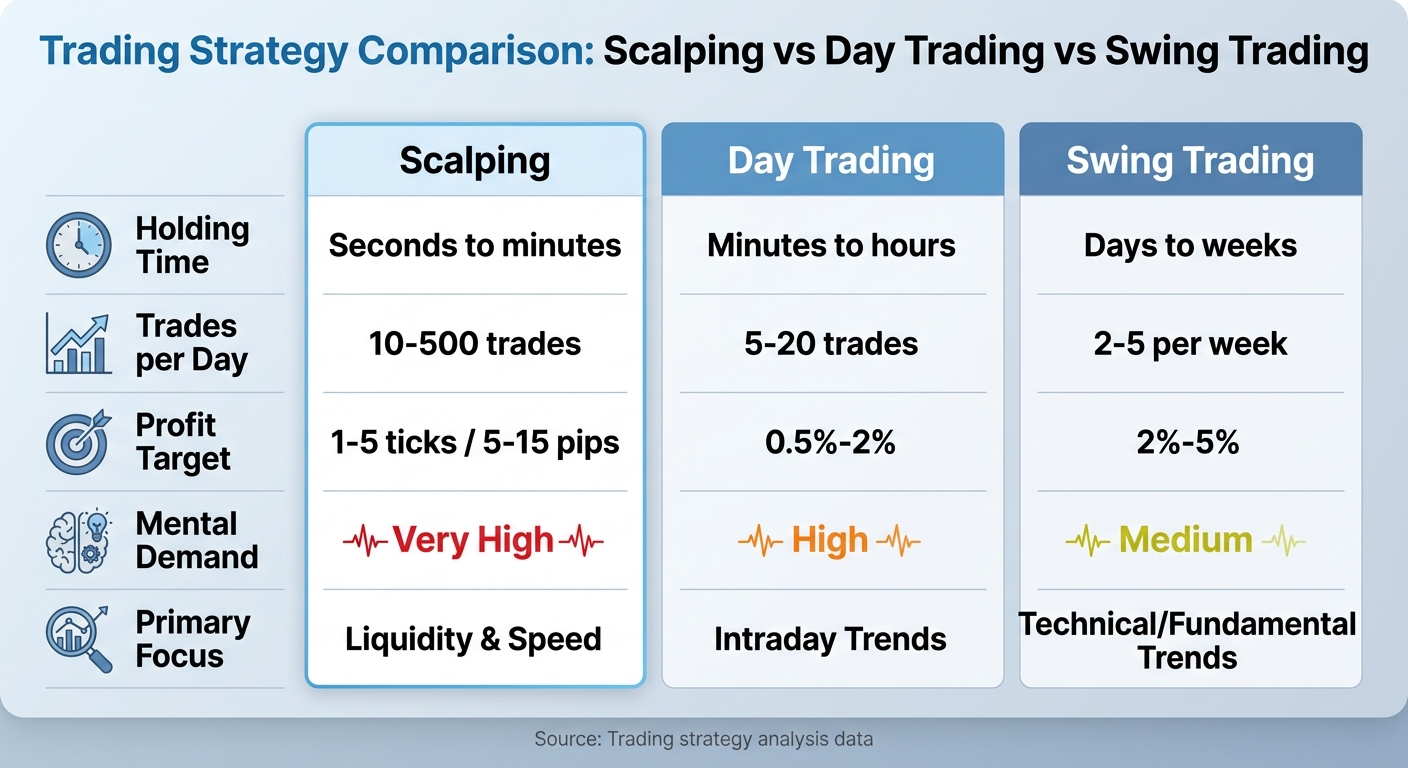
Scalping stands apart from day trading and swing trading due to its extremely short holding periods and high trade volume. While day traders might hold positions for minutes or hours and swing traders for days or weeks, scalpers operate on a much shorter timeline - seconds to minutes. Here’s how these strategies compare:
| Aspect | Scalping | Day Trading | Swing Trading |
|---|---|---|---|
| Holding Time | Seconds to minutes | Minutes to hours | Days to weeks |
| Trades per Day | 10–500 | 5–20 | 2–5 per week |
| Profit Target | 1–5 ticks / 5–15 pips | 0.5%–2% | 2%–5% |
| Mental Demand | Very High | High | Medium |
| Focus | Liquidity & Speed | Intraday Trends | Technical/Fundamental Trends |
One of the biggest differences is risk exposure. Scalpers limit market risk by holding positions for very short periods, reducing the chances of large, unexpected price swings. In contrast, day traders concentrate on intraday patterns, while swing traders combine technical and fundamental analysis over longer timeframes. Scalping also requires intense mental focus, with many traders noticing a decline in performance after 2 to 3 hours of continuous trading. Across all scalping methods, low-latency infrastructure is non-negotiable, as precision and speed are the backbone of this trading style.
Scalping Techniques and Indicators

Run 24/7 while you sleep. Keep bots, platforms, and trade copiers online on a dedicated VPS.
Low-latency VPS hosting for your trading platform.
 CHINYC
 LON
LONFrom $29.99/mo


 CHI/CME futuresNYC/US marketsLON/FX EAs
 DUB/Polymarket
 AMS/EU FX
 FRA/Central EU
 TYO/APAC crypto
Scalping relies on sharp, precise strategies tailored to different market scenarios. To succeed, traders need clear entry and exit rules, supported by at least two confirming indicators. This dual confirmation helps cut through market noise, especially on ultra-short timeframes like 1-minute or 3-minute charts.
Three main approaches - range trading, momentum scalping, and breakout scalping - are designed for specific market conditions. Range trading thrives in consolidation phases, momentum scalping captures short directional moves, and breakout scalping focuses on price surges past key levels. Picking the right strategy for the market’s behavior is essential. For instance, using a breakout method during a flat market or a range-based approach in a trending market can lead to losses.
Range Trading with Support and Resistance
Range trading works best in markets where prices bounce between clear support and resistance levels. Traders use Level 2 data to locate "Support Walls" (clusters of buy orders) and "Resistance Walls" (clusters of sell orders), then trade within these boundaries. A critical signal here is absorption - when large market orders hit a price level but fail to move it. For example, if heavy selling occurs near a support wall but the price holds steady, it might signal a buying opportunity. Exits should align with the price reaching the opposite boundary or losing momentum.
"Absorption occurs when a large volume of market orders are executed but fail to move the price significantly. This is the most powerful signal for a scalper because it reveals a hidden supply or demand." - QuantStrategy.io Team
The main risk? Getting caught in a breakout. If the price breaks a boundary with strong volume and doesn’t pull back, it’s often a sign of a market shift from consolidation to expansion. In such cases, exiting quickly helps minimize losses.
With range trading covered, let’s move to momentum-based strategies.
Momentum Scalping Using EMA Crossovers
Momentum scalping focuses on short-term price moves, using Exponential Moving Averages (EMAs) for quick trend detection. A popular setup involves a 20-EMA on the 5-minute chart to gauge the overall trend, paired with the 1-minute chart for precise entries. Long positions are taken when prices stay above the 20-EMA, while shorts are favored when prices dip below.
To confirm these entries, traders often use an RSI filter. For example, a long trade may be considered when RSI is between 40–55 and rising, while a short trade might work when RSI is between 45–60 and falling. Alternatively, traders watch for price pullbacks to the lower Bollinger Band during an uptrend (or the upper band in a downtrend) before it bounces back in the trend’s direction. Exits are triggered if the price crosses back through the 20-EMA or if the trade lingers for over eight minutes without hitting the target.
Breakout Scalping on Key Levels
Breakout scalping targets sharp price moves when the price breaks through key levels like previous highs, lows, or consolidation zones with increased volume. Distinguishing valid breakouts from false ones is vital. A valid breakout holds above or below a key level, while a false breakout (or "stop hunt") snaps back into the range after clearing liquidity.
To confirm a breakout, look for strong market orders that clear order book barriers and a noticeable spike in volume on the tape. For example, switching from time-based bars to volume bars in E-Mini S&P 500 futures trading has shown to improve execution and reduce extreme fills.
Timing is everything. A good entry might follow a break-and-retest of the level or a momentum surge where the price doesn’t immediately reverse. Scalpers aim for gains of 5–15 pips, adjusting for volatility. The biggest challenge is avoiding false breakouts. If the price breaches a level without a volume surge or shows hesitation on the tape, it’s better to skip the trade. This technique works best in high-liquidity, fast-moving markets, ensuring smoother execution and better results within the scalping framework.
Tools and Infrastructure for Scalping
When it comes to scalping, having the right tools and infrastructure is non-negotiable. Scalping relies on executing trades in milliseconds, where even the slightest delay can turn a winning trade into a loss. To achieve this speed and precision, three key components are essential: real-time data feeds, low-latency trading platforms, and ultra-low latency VPS hosting. These elements form the backbone of any successful scalping setup.
Real-Time Data Feeds
For scalpers, accurate, up-to-the-second data is critical. When aiming to capture just 3 to 10 pips per trade, a single pip lost due to data lag can wipe out 20% of your profit. Stale data doesn't just delay decisions - it can lead to costly execution errors. The solution lies in reducing tick-to-signal lag by consuming data feeds directly from the same data center as the exchange. For example, a professional NY4 Forex VPS can reduce price discrepancies to just 0.1%, with slippage as low as 0.1 pip. In contrast, home fiber connections often experience a 0.9% gap and up to 0.8 pip of slippage.
Data transmission speed also matters. Every 1,000 kilometers that data travels through fiber adds about 5 milliseconds of latency. Providers like Databento, Polygon.io, and dxFeed offer API-first feeds tailored for high-frequency trading. To further enhance performance, consider using WebSocket connections for real-time streaming and pair them with fast DNS services like Cloudflare (1.1.1.1) or Google (8.8.8.8). Once you’ve secured real-time data, the next step is ensuring your trading platform can process it instantly.
Low-Latency Trading Platforms
Execution platforms play a crucial role in scalping. Popular options like NinjaTrader 8, Sierra Chart, and MetaTrader 4/5 are designed to handle both automated and manual trading efficiently. These platforms perform best with high CPU speeds (3.0 GHz or higher) and NVMe SSDs, which help minimize slippage. Since most scalping platforms are optimized for single-threaded execution, hardware performance is a deciding factor.
Here’s a quick breakdown of recommended hardware based on trading style:
| Scalping Style | Recommended CPU | Recommended RAM |
|---|---|---|
| Manual (1-2 pairs) | 2 Dedicated Cores | 4 GB |
| Single EA Scalper | 2 Dedicated Cores | 4 GB |
| Multi-pair EA | 4 Dedicated Cores | 8 GB |
| HFT-style / Tick Scalping | 4+ Dedicated Cores | 8+ GB |
Network settings also matter. For example, disabling Nagle's algorithm (TcpNoDelay=1) prevents small TCP packet batching, which can introduce latency. Additionally, configuring Windows to prioritize background services ensures your trading engine gets the processing power it needs. You can further enhance your trading server performance by optimizing network connectivity and resource management. To eliminate delays further, a dedicated VPS environment is essential.
Ultra-Low Latency VPS Hosting with QuantVPS
Home internet connections simply can’t compete with dedicated VPS solutions when it comes to speed and reliability. A professional NY4 Forex VPS can achieve latencies as low as 0.8 milliseconds, compared to around 62 milliseconds on a home fiber connection. This difference significantly impacts execution quality, reducing order errors from 11 per 100 trades on home fiber to nearly zero on a dedicated VPS.
QuantVPS offers specialized hosting designed for high-frequency trading. Their services include dedicated CPU cores, NVMe SSD storage, and 1Gbps+ network connections with high burst capabilities. Robust DDoS protection ensures uninterrupted performance, even during peak trading hours. By strategically placing data centers near major financial hubs, QuantVPS enhances execution precision. Here’s how their data center locations align with key asset classes:
| Financial Center | Primary Data Center | Major Asset Class |
|---|---|---|
| Chicago | Equinix CH1/CH2/CH4 | CME Futures |
| New York | Equinix NY4/NY5 | US Equities & Forex |
| London | Equinix LD4/LD5 | European Forex |
| Frankfurt | Equinix FR2/FR5 | DAX & Eurex |
For optimal performance, always match your VPS location to your broker’s matching engine to achieve sub-millisecond latency. As Ace Zhuo, a fintech entrepreneur, explains:
"The difference between success and failure in HFT isn't strategy complexity or market knowledge – it's whether your orders reach the exchange 0.5 milliseconds before the next trader's."
Stay online and closer to execution. Choose a VPS location for CME futures, New York markets, London FX, API trading, and more.
Host your platform near the market route that matters.
CHINYCLONFrom $29.99/mo
CHI/CME futuresNYC/US marketsLON/FX EAsDUB/PolymarketAMS/EU FXFRA/Central EUTYO/APAC cryptoQuantVPS plans start at $59.99 per month for the VPS Lite package (4 cores, 8GB RAM, 70GB NVMe) and go up to $299.99 per month for a Dedicated Server (16+ cores, 128GB RAM, 2TB+ NVMe). All plans include a 100% uptime guarantee, automatic backups, and global accessibility, with multi-monitor support available on higher tiers. This infrastructure ensures your trading strategies remain active 24/7, even during market volatility or local power outages.
Reducing latency by just 1 millisecond can boost high-frequency trading strategy returns by 5–15% annually. With HFT now making up roughly 50% of equity trading volume as of late 2025, having the right tools and infrastructure is no longer optional - it’s a requirement for staying competitive.
Risk Management and Trading Discipline
Scalping demands strict risk control measures and unwavering mental discipline. Statistics show that 95% of day traders lose money within their first year, and only a minuscule 0.05% achieve consistent profitability beyond three years. What sets the successful few apart is their ability to manage risk effectively and maintain emotional control under pressure. These skills are the backbone of mastering the psychological challenges that come with scalping.
Position Sizing and Stop-Loss Strategies
One of the biggest pitfalls for traders is poor position sizing, which can quickly lead to account failure. While technology helps minimize execution delays, disciplined risk management is what prevents devastating losses.
"No area of scalping kills accounts faster than position sizing errors" - Daniel Harrington, Senior Trading Analyst, The Trading Mentor
A key principle in risk management is the 1% Rule - never risk more than 1% of your total trading capital on a single trade. For traders at proprietary firms, this threshold is often reduced to 0.25%–0.5%.
Here’s how to calculate your lot size:
Lot size = (Account Risk in $) ÷ (Stop Loss in pips × Pip Value)
For example, if you have a $10,000 account and aim to risk 1% ($100) with a 5-pip stop-loss at $10 per pip, your position size would be 2 standard lots. This formula ensures your risk remains consistent, no matter how tight or wide your stop-loss is.
When placing stop-losses, avoid arbitrary levels. Instead, position them just beyond recent swing lows or Bollinger Bands. Scalpers often use fixed stops of 3–5 pips for major forex pairs. Advanced traders might opt for liquidity-based stops, setting them just outside significant bid/ask clusters visible in the Depth of Market. If these liquidity walls are breached, it signals that the trade setup is no longer valid.
Time-based exits are another layer of protection. If a trade hasn’t hit its profit target within a set timeframe - usually 30 seconds to 8 minutes - close it automatically to avoid sudden market reversals. Once your first profit target is reached, moving your stop-loss to breakeven ensures that the rest of the position carries no additional risk.
To safeguard against emotional decision-making, set a daily loss limit of 3% of your account equity. This "hard stop" forces you to step away from trading after reaching the limit, helping you avoid the spiral of revenge trading. A study of 50,000 failed accounts found that 73% of traders ignored their own stop-loss rules more than 30% of the time, and 68% increased their position sizes after losing streaks.
| Risk-Reward Ratio | Break-Even Win Rate Required | Practical Application |
|---|---|---|
| 1:1 | >55% (after spreads) | High frequency, tight targets |
| 1:1.5 | ~42% | Balanced approach for scalpers |
| 1:2 | ~34% | Longer holds, higher reversal risk |
Emotional Control in High-Frequency Trading
Even with solid risk management, emotional control plays a critical role in scalping. High-frequency trading is inherently stressful, and prolonged sessions can impair decision-making. Data shows that win rates often drop from 58% during the first few trades of a session to just 38% after 21 or more trades.
The key to maintaining discipline isn’t sheer willpower - it’s creating an environment that enforces it. Use trading platforms that allow one-click execution with pre-set lot sizes and automated stop-loss/take-profit levels. This eliminates manual delays of 1–2 seconds, which can lead to hesitation or errors. Instead of analyzing every data point, focus on two or three key signals, like order book imbalances or specific volume patterns.
Limit your trading sessions to 90 minutes during high-liquidity periods and follow a three-loss rule to reset your mindset. Avoid trading within 5 minutes of major economic events, such as Non-Farm Payroll (NFP) or Consumer Price Index (CPI) releases, as spreads can widen dramatically, triggering tight stops instantly.
After each session, review your trade log - not just for profit and loss but also for execution quality. Ask yourself questions like, "Did I hesitate?" or "Did I chase a trade?" Identifying emotional triggers helps you refine your responses. Use market simulators and replay tools to practice recognizing patterns and building reflexive actions that bypass slower, fear-based decision-making.
"The distinction between a successful high-frequency scalper and a struggling amateur rarely lies solely in their analytical models. Instead, it resides in... managing fear and speed" - QuantStrategy.io Team
Conclusion
Scalping aims for small profits, typically between 3 and 10 pips per trade. However, the margins are so tight that even a 1-pip slippage can eat up 20% of the expected profit. This highlights how crucial it is to pair effective scalping strategies with flawless execution. The reality is harsh: 99% of scalpers either lose money or quit, often due to high trading costs, poor discipline, or inadequate trading setups.
Techniques like NinjaTrader indicators for EMA crossovers, analyzing order book imbalances, and breakout strategies can give traders an edge. But without the right infrastructure, that edge can quickly disappear due to slippage or latency issues. A dedicated VPS can help eliminate these inefficiencies by addressing problems like ISP congestion and hardware delays. QuantVPS, with servers located in key financial hubs like Equinix LD4 in London and NY4 in New York, offers sub-1ms latency and guarantees 100% uptime. This ensures traders avoid the nightmare of losing connection while holding open positions.
Ultimately, successful scalping requires more than just knowing the strategies. It demands strict risk management, emotional discipline, and reliable tools to execute trades without delays. QuantVPS offers plans starting at $59.99 per month, providing professional-grade hosting tailored for high-frequency trading needs.
FAQs
What markets are best for scalping?
The best markets for scalping are those that offer high liquidity, noticeable volatility, and narrow trading ranges. Common choices include indices such as the e-mini S&P 500, e-mini Nasdaq, and e-mini Dow. Traders also favor liquid forex pairs like EUR/USD and GBP/USD, along with commodities such as gold. These markets are ideal for quick trades, reduced slippage, and consistent, small profits - key elements for effective scalping.
How fast does my trade execution need to be?
In high-frequency scalping, executing trades needs to happen almost instantly - often in just milliseconds. Scalpers usually keep positions open for only a few seconds to a few minutes, completing anywhere from 10 to over 50 trades each day. Ultra-fast execution is critical, relying on low-latency systems and real-time data feeds. Without this speed, delays, missed opportunities, or slippage can seriously cut into profits in such a fast-paced trading environment.
How do I know if scalping fits my personality?
Scalping is best suited for those who thrive on quick decision-making, have unwavering discipline, and can stay laser-focused even under intense pressure. This approach demands sharp concentration, the ability to execute rapid trades, and effective stress management. If you find high-speed environments overwhelming or struggle to remain calm when things heat up, scalping might not be the right fit for you. Take a moment to evaluate whether you can handle these challenges before deciding if this trading style matches your strengths.