Want better control over your trades at the market close? Limit-On-Close (LOC) orders let you execute trades during the closing auction, but only if the price meets your set limit. Unlike Market-On-Close (MOC) orders, which prioritize execution at any price, LOC orders give you price protection while still tapping into the liquidity of the closing auction.
Key Points:
- What is an LOC Order? A type of limit order designed for the closing auction. It only executes if the auction price meets or improves upon your limit.
- Why Use LOC Orders? They help avoid unfavorable prices during volatile end-of-day trading, perfect for strategies like portfolio rebalancing or index tracking.
- Timing is Critical: Submission deadlines vary by exchange (e.g., 3:50 PM ET for NYSE). Orders are locked after the cutoff.
- Execution Priority: MOC orders execute first, followed by LOC orders that align with the auction price.
- Risk vs. Reward: LOC orders offer price control but aren’t guaranteed to execute if the limit isn’t met.
LOC orders are a smart tool for traders managing risk and aiming for precise execution during the closing auction. Keep reading to learn how they work, when to use them, and how tools like QuantVPS can optimize your strategy.
How Limit-On-Close Orders Work
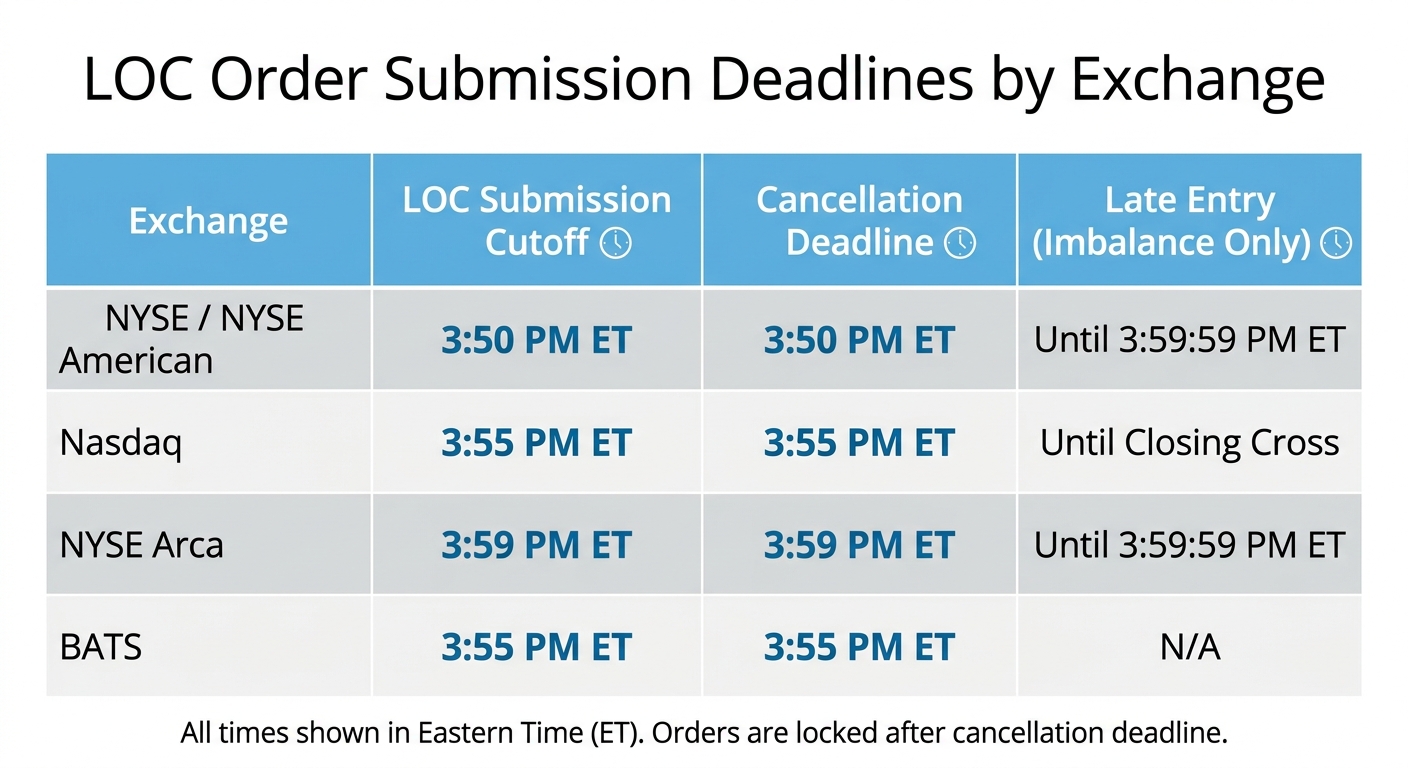
LOC Order Submission Cutoff Times by Exchange
LOC orders operate through three key phases: submission, auction matching, and execution - each governed by strict timing rules.
Placing an LOC Order
To place an LOC order, you need four essential details: the security symbol, the order side (buy or sell), the quantity to trade, and your limit price - the highest price you're willing to pay for a buy or the lowest you'll accept for a sell. Timing is critical. Submit your orders before these cutoffs: 3:50 PM ET for NYSE/NYSE American, 3:55 PM ET for Nasdaq/BATS, and 3:59 PM ET for NYSE Arca.
Once the submission window closes, a "Closing Freeze" begins, during which orders can't be canceled or modified unless you're offsetting an imbalance. If you're entering an offsetting order, keep an eye on imbalance windows or Level 2 feeds to gauge liquidity needs.
After submitting your order on time, the next step is the auction process, where execution is determined.
Execution During the Closing Auction
Once orders are submitted, the closing auction occurs at 4:00 PM ET, where the exchange matches all eligible orders at the Indicative Match Price - a price that maximizes trading volume. Your LOC order will only execute if the auction price meets your limit. For a buy order, the auction price must be at or below your limit; for a sell order, it must be at or above your limit.
Market-On-Close (MOC) orders have priority since they accept any price, followed by LOC orders that align with the auction price range. On the NYSE, LOC orders account for about 20% of total auction volume. Starting at the cutoff time (3:50 PM ET for NYSE), the Indicative Match Price is published every second, providing insight into the potential auction price - though by this point, you can no longer cancel your order. Execution confirmations typically arrive between 4:00 PM and 4:15 PM ET.
Rules and Restrictions
Exchanges enforce strict measures to ensure smooth auctions. For instance, Auction Collars limit how far the closing price can deviate from the current reference price, which might leave marketable LOC orders unfilled. The likelihood of execution depends on how competitive your limit price is. Research suggests setting a limit at 99.8% of the 3:00 PM reference price provides a 79% chance of execution.
| Exchange | LOC Submission Cutoff | Cancellation Deadline | Late Entry (Imbalance Only) |
|---|---|---|---|
| NYSE / NYSE American | 3:50 PM ET | 3:50 PM ET | Until 3:59:59 PM ET |
| Nasdaq | 3:55 PM ET | 3:55 PM ET | Until Closing Cross |
| NYSE Arca | 3:59 PM ET | 3:59 PM ET | Until 3:59:59 PM ET |
| BATS | 3:55 PM ET | 3:55 PM ET | N/A |
Once the cancellation deadline passes, your LOC order is locked in to avoid accidental trades. Unlike MOC orders, LOC orders are not guaranteed to execute - if the auction price doesn't meet your limit, the order simply expires unfilled.
LOC Orders vs. Other Order Types
Understanding the differences between Limit-On-Close (LOC) orders, Market-On-Close (MOC) orders, and standard limit orders is essential for choosing the right approach in various trading scenarios. Each type strikes a distinct balance between execution certainty and price control.
Comparing LOC, MOC, and Standard Limit Orders
MOC orders ensure execution at or near the closing price but come with no price protection. As Investopedia explains:

Run 24/7 while you sleep. Keep bots, platforms, and trade copiers online on a dedicated VPS.
Low-latency VPS hosting for your trading platform.
 CHINYC
 LON
LONFrom $29.99/mo


 CHI/CME futuresNYC/US marketsLON/FX EAs
 DUB/Polymarket
 AMS/EU FX
 FRA/Central EU
 TYO/APAC crypto
Although placing a market-on-close (MOC) order can guarantee that your buy or sell order will occur at the close of trading, it does not guarantee the price.
This lack of price control leaves traders vulnerable to end-of-day volatility. On the other hand, LOC orders provide full price control, executing only if the closing price meets or exceeds the specified limit. Standard limit orders also offer price control but can execute at any time during regular trading hours, unlike the auction-specific nature of LOC orders.
| Order Type | Execution Guarantee | Price Control | Best Use Case |
|---|---|---|---|
| Market-On-Close (MOC) | Guaranteed at or near the closing price | None; exposed to last-minute price swings | Exiting a position when execution is more important than price |
| Limit-On-Close (LOC) | Only if the closing price meets your limit | High; caps the buy price or floors the sell price | Portfolio rebalancing with strict price boundaries |
| Standard Limit Order | Only if the limit price is reached during regular hours | High; specifies an exact price or better | Targeting specific technical levels during intraday trading |
These distinctions play a key role in determining execution quality, particularly concerning slippage and volatility.
Reducing Slippage and Volatility Impact
Slippage - the difference between the expected execution price and the actual price - can become a costly issue, especially during volatile periods. For instance, in liquid futures markets like the E-mini S&P 500, slippage typically ranges from 0–1 tick during active trading. However, it can expand to 2–5 ticks during off-hours or in volatile closing periods. Given that a single tick in a full-size contract costs $250, these discrepancies can quickly add up, especially when leverage is involved.
LOC orders help minimize this risk by avoiding "walking the book", where large market orders consume liquidity at increasingly unfavorable prices in thin markets. By setting a price ceiling for buys or a floor for sells, LOC orders prevent negative slippage. However, this precision comes with the risk of non-execution if the closing auction price doesn't meet the limit. In favorable conditions, limit-based strategies can even lead to positive slippage, with 30% to 50% of orders benefiting from price improvement. This balance of control and execution precision makes LOC orders a valuable tool for managing end-of-day trading risks.
Better Precision for End-of-Day Strategies
For portfolio managers and index trackers, the official closing price often serves as a critical benchmark. LOC orders are specifically designed for participation in the closing auction, ensuring alignment with the official close used in NAV calculations and index settlements. While MOC orders are ideal for urgent exits, LOC orders are better suited for scenarios where benchmark tracking or portfolio rebalancing is the priority. They provide the precision needed to participate in the closing auction while guarding against extreme price swings caused by end-of-day imbalances. This makes them an essential tool for traders focused on executing strategies that mirror the official closing price, ensuring effective portfolio management.
Using LOC Orders in Different Trading Scenarios
LOC orders can be a versatile tool, tailored to fit various trading strategies and goals. Knowing when and how to use them can improve execution outcomes and help avoid unnecessary costs.
Day Trading: Locking in Profits with LOC Orders
Day traders often face a tough choice: use market orders and risk slippage or hold positions overnight and face potential gap risks. LOC orders provide a balanced alternative. They let you set a price floor for selling or a ceiling for buying, ensuring execution only if the closing auction matches your target price. This way, you can lock in profits without exposing yourself to unfavorable price movements.
The NYSE updates closing auction data, including imbalance side and quantity, every five seconds until the market closes at 4:00 p.m.. This real-time data is crucial for refining your strategy. For example, monitoring the indicative match price starting at 3:45 p.m. can help you decide if adjustments to your LOC order are needed as prices shift.
Beyond day trading, LOC orders are also valuable for broader portfolio strategies.
Portfolio Rebalancing and Index Tracking
LOC orders are particularly useful for portfolio managers aiming to rebalance or track indexes with precision. The closing auction is a pivotal moment for these activities, especially for passive index funds that must align with benchmarks at the end of the trading day. In 2024, U.S. exchanges handled $50 billion in notional volume during the closing auction, accounting for about 9% of the daily trading volume. This figure can spike to 20% during major events like rebalancing.
Take, for instance, the June 2024 Russell Reconstitution. This massive liquidity event saw the NYSE and Nasdaq trade $275 billion and $103 billion, respectively, in the final trading moments. For major stocks added to the Russell 1000 - such as Super Micro Computer (SMCI), MicroStrategy (MSTR), and Dell Technologies (DELL) - auction volume made up 34% of the total daily notional volume. As noted by BMLL:
Passive index funds... must rebalance their portfolios at the close on reconstitution day, making the auction the preferred point in time for executing large quantities with minimal tracking error.
By leveraging LOC orders, managers can tap into this concentrated liquidity while maintaining control over execution prices. This approach helps avoid unfavorable trades caused by sudden price gaps from large imbalances.
Futures Settlement Strategies
LOC-based strategies aren't just limited to equities - they also play a role in futures markets, offering unique settlement benefits. Futures traders often face challenges during settlement, particularly with U.S. Equity Index futures. Here, settlement prices are determined by a "Fixing Price" at 3:00 p.m. CT, even though trading continues until 4:00 p.m. CT. This timing mismatch can lead to tracking errors.
To mitigate this, the Trading At Settlement (TAS) facility allows traders to execute orders at the daily settlement price, adjusted by a spread. This provides greater price certainty. For example, when the CBOE Futures Exchange introduced TAS for VIX futures in November 2011, it quickly gained traction. Within its first year, TAS captured 10% of the volume, featuring a much tighter effective spread (0.0276 compared to 0.2040). TAS orders also tended to be significantly larger, making up 96% of the total trade size in certain contract months.
As the CBOE Futures Exchange explained:
TAS transactions are aimed at helping traders to even out end-of-day price exposures in VIX futures, by allowing users to hedge their VIX futures position throughout the trading day and receive greater price certainty relative to the daily settlement price.
For institutional traders managing large positions, TAS and similar LOC strategies offer a way to execute trades with greater precision and less market impact compared to traditional market orders. This ensures smarter, more efficient execution during critical market moments.
Can I Place a Limit Order After the Market Closes?
You already understand how LOC orders work and what separates them from their market-on-close counterparts. The practical question most traders hit next is timing: yes, you can place a limit order after the market closes. Most brokers accept orders outside regular trading hours, and those orders queue until the next eligible session or auction window opens.
When a trader places an LOC order, they specify a limit price at which they want the order to be executed. If the market price is at or better than the specified limit price at the close of the trading day, the order is executed at or near the closing price. If the market price is worse than the specified limit price, the order is not executed.
Pros and Cons of Limit-On-Close Orders
Pros
- Price Control: LOC orders allow traders to control the execution price of their trade. By specifying a limit price, traders can ensure their order is executed only if the closing price falls within a specified range, helping them avoid unfavorable price movements.
- Reduced Risk: By executing the trade at or near the closing price, traders can reduce the risk of price fluctuations during the trading day. This can be particularly useful for traders who are sensitive to market volatility.
- No Intraday Monitoring: LOC orders do not require intraday monitoring because they are executed automatically at the close of the trading day. This can be a convenient feature for traders who do not have the time or resources to monitor the markets during the day.
Cons
- No Guarantee of Execution: LOC orders are executed only if the closing price is at or above the specified limit price. If the closing price is worse than the limit price, the order is not executed. This means that there is no guarantee that the order will be executed.
- No Control Over Execution Time: Since LOC orders are executed at the close of the trading day, traders have no control over the exact execution time. This can be a disadvantage for traders who want to execute their trades at a specific time.
- Limited Availability: Not all brokers support LOC orders; traders should check with their broker before placing such orders. Additionally, LOC orders may not be suitable for all trading strategies, and traders should carefully consider the advantages and disadvantages before using them.
LOC Orders: Pros and Cons
| Aspect | Advantages | Limitations |
| Price Control | Lets you set a max buy/min sell price | May miss trades if prices move beyond the range |
| Execution Timing | Focuses on closing auction participation | Must be submitted before the cutoff time |
| Risk Management | Shields against end-of-day volatility | No guarantee the order will execute |
| Market Impact | Reduces disruption for large trades | Lower priority than Market-on-Close orders |
| Flexibility | Can be adjusted until the cutoff | Becomes locked after the cutoff time |
Limit-On-Close Order Examples
Here are some examples of limit-on-close (LOC) orders:
Stay online and closer to execution. Choose a VPS location for CME futures, New York markets, London FX, API trading, and more.
Host your platform near the market route that matters.
CHINYCLONFrom $29.99/mo
CHI/CME futuresNYC/US marketsLON/FX EAsDUB/PolymarketAMS/EU FXFRA/Central EUTYO/APAC crypto- A trader wants to buy 100 shares of XYZ stock, but only if the closing price is at or below $50. They place a LOC order with a limit price of $50. If the closing price of XYZ stock is at or below $50, the order is executed at or near the closing price.
- A trader wants to sell 200 shares of ABC stock only if the closing price is at or above $75. They place a LOC order with a limit price of $75. If the closing price of ABC stock is at or above $75, the order is executed at or near the closing price.
- A trader wants to sell 50 shares of DEF stock only if the closing price is within the $60 to $65 range. They place an LOC order with a price limit of $60 to $65. If the closing price of DEF stock falls within the specified range, the order is executed at or near that price.
These examples illustrate how traders can use LOC orders to control the execution price of their trades and ensure they execute only if the closing price falls within a specific range.
Limit-On-Close Order vs. Market-on-Close Order
LOC orders allow traders to specify a limit price at which they want their order to be executed. Traders using LOC orders aim to control the execution price of their trade and execute it only if the closing price is within a specific range.
MOC orders, on the other hand, are executed at the market’s closing price, and traders who use this type of order aim to execute their trades quickly and at the best available price at the close of the market.
LOC orders offer price control and reduced risk but with no guarantee of execution, while MOC orders offer guaranteed execution but with the potential for slippage.
If your LOC order does not fill because the closing price missed your limit, a trading VPS keeps your platform live and responsive so you can adjust, resubmit, or pivot to a different order type without missing the next opportunity due to connection drops or system lag. Precision at the close means nothing if your setup goes offline at the wrong moment.
Using QuantVPS for LOC Order Execution
When it comes to executing LOC (Limit-on-Close) orders, timing is everything. The closing auction window is tight, and even the slightest delay - just milliseconds - can mean missing your target price. That’s why having a reliable and fast infrastructure, like QuantVPS, is critical for success.
Low-Latency Execution for Time-Sensitive Orders
QuantVPS operates data centers in Chicago (near CME Group's matching engines) and New York (optimized for equities and options trading). This strategic placement cuts down transmission time to exchange matching engines, resulting in ultra-low latency of 0–1ms to major exchanges. Compare that to general cloud providers, which typically run at 5ms or more - a difference that can be game-changing during volatile closing auctions.
The system uses direct fiber-optic cross-connects to avoid unnecessary network delays. This means your LOC orders are processed in real time, even when exchanges are handling enormous volumes. The servers are equipped with AMD EPYC and Ryzen processors, NVMe SSDs, and high-speed RAM, ensuring they can handle the intense data flow during the final moments of trading. Network speeds of 1Gbps (steady) and 10Gbps (burst) further ensure smooth performance, no matter the market conditions.
Each server comes pre-configured with Windows Server 2022, optimized specifically for trading platforms. This setup allows you to execute LOC orders without any downtime or additional configuration.
With latency handled, the next step is choosing the right QuantVPS plan for your trading needs.
Choosing the Right QuantVPS Plan for LOC Strategies
The best VPS plan depends on your strategy's complexity and resource requirements. For simpler LOC strategies (1–2 charts), the VPS Lite plan is a budget-friendly option at $59.99/month (or $41.99/month with annual billing). It delivers <0.52ms latency, making it ideal for single-asset traders.
If you’re running multi-asset strategies with 3–4 charts, the VPS Pro plan at $99.99/month (or $69.99/month annually) offers 16GB of RAM, ensuring smooth data handling without lag.
For more demanding high-frequency or algorithmic strategies involving 5+ charts, the VPS Ultra plan ($189.99/month or $132.99/month annually) provides 24 cores to prevent CPU overload during heavy trading periods. Institutional traders or prop firms managing large portfolios should opt for the Dedicated plan, which costs $299.99/month (or $209.99/month annually). This plan offers 128GB of RAM and over 2TB of NVMe storage, delivering maximum resources for consistent performance.
| Strategy Complexity | Recommended Plan | Key Benefit for LOC Execution |
|---|---|---|
| Single Asset / 1–2 Charts | VPS Lite | Affordable with <0.52ms latency |
| Multi-Asset / 3–4 Charts | VPS Pro | 16GB RAM for handling multiple data feeds |
| High-Frequency / 5+ Charts | VPS Ultra | 24 cores to avoid CPU spikes at market close |
| Institutional / Prop Firm | Dedicated | Top-tier resources for seamless execution |
To maximize efficiency, select the Chicago data center for futures-based LOC orders and the New York data center for equities or options-based LOC orders. Annual billing can save you about 30% on costs, making it a smart choice for long-term strategies.
Reliability and Global Access
Speed is critical, but reliability is just as important during the closing auction. LOC orders require uninterrupted connectivity, and QuantVPS ensures your trading platforms stay online 24/7 - even if your local PC isn’t. This protects you from local internet outages or hardware failures at crucial moments.
All plans include enterprise-grade DDoS protection and advanced firewalls to keep your algorithms and trading data secure. Plus, you can access your VPS from anywhere - whether you’re on a Windows PC, Mac, iOS, or Android device - using encrypted RDP connections. This flexibility allows you to monitor and adjust your LOC orders from your desk or on the go.
With a 100% uptime guarantee, you can trust that your orders will reach the exchange without interruption, even during high-pressure closing auctions. That reliability gives you peace of mind, knowing your strategy will execute as planned.
Conclusion
Limit-On-Close (LOC) orders offer traders a way to secure price protection during the closing auction, which is often the most liquid time of the trading day. Unlike Market-On-Close orders that execute at the auction price regardless of market conditions, LOC orders only execute if the closing price meets or exceeds the limit you set. This makes them particularly useful for end-of-day strategies like portfolio rebalancing, index tracking, and futures settlement, where hitting the official closing price is essential.
That said, timing is everything with LOC orders. They must be submitted well before the market closes. Even a slight delay - just milliseconds - can mean missing the cutoff entirely. This is where having a strong infrastructure matters. QuantVPS, for instance, offers ultra-low latency of 0.52ms to CME Group from its Chicago datacenter, ensuring your orders reach the exchange on time.
Reliable connectivity is also non-negotiable when executing LOC orders. QuantVPS provides 24/7 operation with a 99.999% uptime guarantee. Whether you’re running a straightforward single-asset strategy on their VPS Lite plan or managing a complex institutional portfolio on a Dedicated server, their infrastructure is designed to handle high trading volumes without downtime or slippage. This ensures your strategies execute with precision from start to finish.
Key Takeaways
LOC orders blend the liquidity of the closing auction with the control of a predetermined limit, helping you avoid slippage and unpredictable price swings in the final minutes of trading. They are ideal for strategies that rely on official closing prices, where accuracy is critical. With QuantVPS's low-latency infrastructure, you can trust that your LOC orders will be executed securely and on time, maximizing the benefits of this order type.
Here are a few final tips to consider:
- Choose a datacenter that aligns with your asset class.
- Keep a buying power buffer to manage price fluctuations before the auction.
- Confirm that your broker supports LOC orders for your chosen asset class - note that these orders are usually unavailable in 24/7 markets like cryptocurrency.
With the right tools and preparation, LOC orders can be a dependable way to achieve more controlled and precise execution at market close.
FAQs
How do I pick a good LOC limit price?
To set an effective limit price for a Limit-On-Close (LOC) order, start by analyzing the stock’s recent closing prices. Aim to align your limit price with these trends or slightly improve upon them. For example, if the stock usually closes around $18.70, you might set your limit at $18.65 to increase the likelihood of execution. Be mindful of the stock’s volatility and your specific trading objectives to strike a balance between capturing opportunities and avoiding less favorable prices.
What happens if my LOC order doesn’t fill?
If your LOC (Limit-On-Close) order doesn’t get filled, it will be canceled. This occurs when the closing price doesn’t meet or exceed your specified limit price, preventing the order from executing.
Can I change or cancel an LOC order after the cutoff?
LOC orders can be canceled only for valid errors up until 3:50 p.m. ET. After this cutoff, cancellations are usually rejected unless specific exchange rules permit them. Make sure to review your exchange's policies to understand any possible exceptions.