Short selling flips the usual "buy low, sell high" approach, letting you profit from falling stock prices. Here’s how it works: you borrow shares, sell them at the current price, and aim to buy them back later at a lower price. But this strategy is risky, with potential for unlimited losses, margin calls, and borrowing fees. It’s used by hedge funds, institutional investors, and experienced traders, but not typically recommended for beginners.
Key points:
- How it works: Borrow shares → Sell at market price → Repurchase at a lower price → Return to lender.
- Costs: Margin accounts, borrowing fees (can exceed 100% annually), and dividend obligations.
- Risks: Unlimited losses if stock prices rise, short squeezes, and initial and maintenance margin requirements.
- Strategies: Speculative (betting on price drops), hedging (portfolio protection), and event-driven (targeting specific catalysts like earnings misses or bad news).
Risk management is essential. Use stop-loss orders, diversify positions, and monitor market conditions. Tools like QuantVPS can help by providing fast trade execution and reliable performance during volatile market conditions.
How Short Selling Works
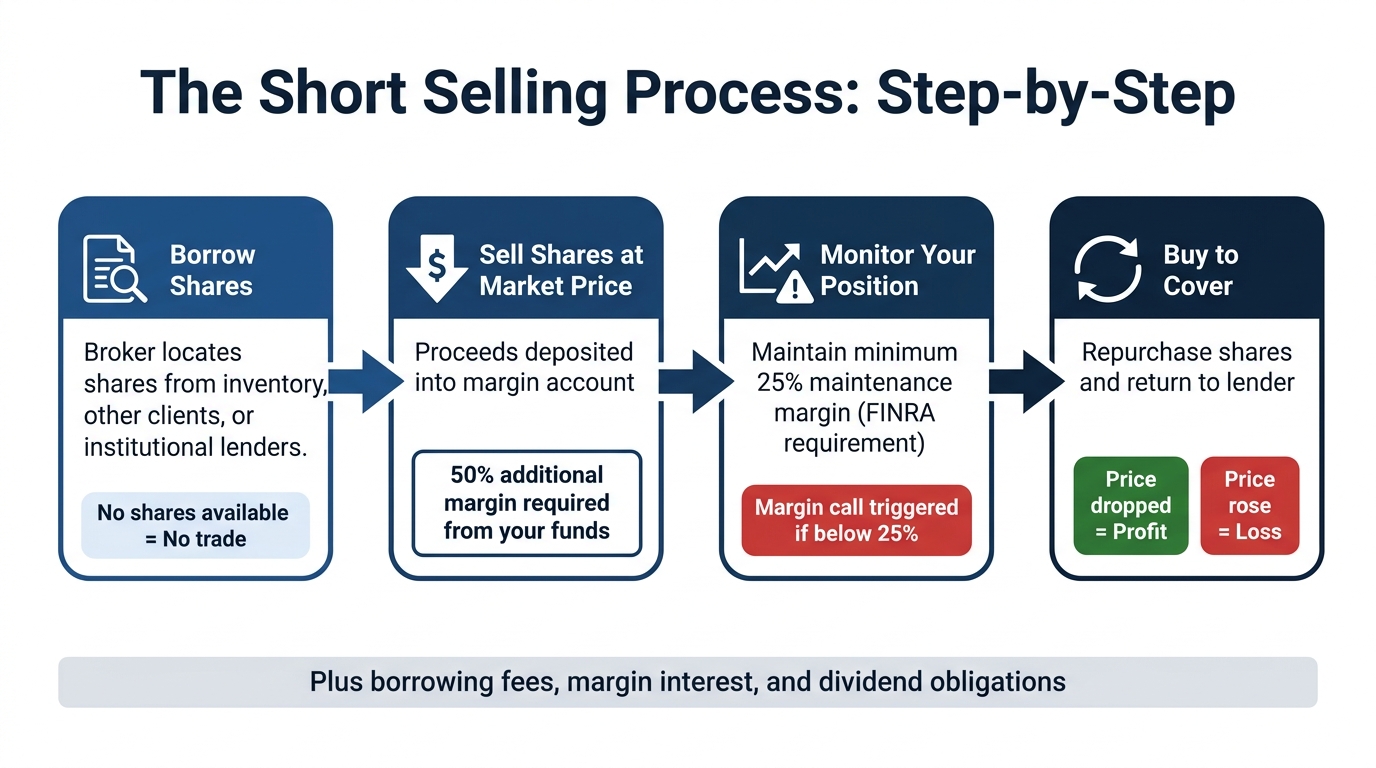
Short Selling Process: 4-Step Guide from Borrowing to Closing
Step-by-Step Process
Short selling involves a series of steps, starting with opening a margin account to borrow shares. Here's how it works:
- Borrow Shares: Your broker first needs to locate shares you can borrow. This involves checking their inventory, finding other clients willing to lend, or reaching out to institutional lenders. This behind-the-scenes process is essential - if no shares are available, the trade can’t proceed.
- Sell Shares at Market Price: Once the shares are secured, you sell them at the current market price. The proceeds from this sale are deposited into your margin account. Keep in mind, you'll need to meet margin requirements - this includes the sale proceeds plus an additional 50% margin from your own funds.
- Monitor Your Position: While the trade is active, you must maintain the required maintenance margin. FINRA mandates that at least 25% of the total value of the shorted shares be maintained at all times. If the stock price rises and your margin falls below this level, you’ll face a margin call, requiring you to deposit more funds.
- Close the Trade: To finish the trade, you place a "buy to cover" order, repurchasing the same number of shares on the market. These shares are then returned to the lender. If the stock price dropped, you keep the difference as profit. If it rose, you’ll pay the difference as a loss.
Below, we'll break this down further with two examples.
Example with Numbers
Let’s see how short selling plays out with concrete numbers.
Imagine you’re shorting 100 shares of a stock priced at $50 each. Here’s how two scenarios might unfold:
Profitable Trade: You borrow and sell 100 shares at $50, earning $5,000. Later, the stock drops to $40, and you buy back the shares for $4,000. Your gross profit is $1,000, not accounting for fees like margin interest or borrowing costs.
Losing Trade: You short the same 100 shares at $50, receiving $5,000. However, the stock price rises to $65. To close your position, you’ll need to spend $6,500 to repurchase the shares. This results in a $1,500 loss, plus any additional fees or interest.
| Scenario | Action | Price per Share | Total (100 Shares) | Result |
|---|---|---|---|---|
| Profitable Trade | Sell (Short) | $50 | $5,000 | Initial proceeds |
| Buy (Cover) | $40 | $4,000 | Cost to close | |
| Net Profit | $10 | $1,000 | Excluding fees | |
| Losing Trade | Sell (Short) | $50 | $5,000 | Initial proceeds |
| Buy (Cover) | $65 | $6,500 | Cost to close | |
| Net Loss | -$15 | -$1,500 | Excluding fees |
These calculations don’t include daily borrowing fees, which can vary widely - ranging from less than 1% to over 100% annually for stocks that are hard to borrow. Additionally, margin interest on the borrowed value adds to your costs. If the stock pays dividends while you’re short, you’ll also need to pay those dividends to the lender.
Short Selling Strategies
Traders typically rely on three main methods when shorting stocks. Each one aligns with specific market conditions, and knowing when to use them can significantly improve timing and manage risks effectively.

Run 24/7 while you sleep. Keep bots, platforms, and trade copiers online on a dedicated VPS.
Low-latency VPS hosting for your trading platform.
 CHINYC
 LON
LONFrom $29.99/mo


 CHI/CME futuresNYC/US marketsLON/FX EAs
 DUB/Polymarket
 AMS/EU FX
 FRA/Central EU
 TYO/APAC crypto
Speculative Short Selling
This strategy aims to profit from anticipated price drops. Traders often assess weakening fundamentals like declining revenue, rising expenses, or faltering competitive advantages. For technical traders, bearish signals like combining moving averages to identify the "death cross" - when the 50-day moving average dips below the 200-day moving average - can indicate downward momentum.
A notable example occurred in March 2026, when SoFi Technologies (SOFI) faced scrutiny after Muddy Waters Research accused the company of inflating its 2025 adjusted EBITDA figures. Following the report, short interest in SOFI surged by 18.3%. Even though the CEO attempted to restore confidence by purchasing $1.5 million worth of stock, SOFI's shares remained down roughly 40% year-to-date as of April 13, 2026.
Timing is everything in speculative short selling. As Martin Zweig, author of Winning on Wall Street, famously advised:
"The trend is your friend".
Instead of trying to pinpoint the exact peak of a stock's rise, seasoned traders often short during rallies within established downtrends. This approach allows for better entry prices. Targeting sectors already showing weakness is generally more effective than betting against strong upward trends.
While speculation is one use of short selling, it can also serve as a defensive tool.
Hedging with Short Selling
Hedging uses short positions as a form of portfolio insurance. For instance, if you're heavily invested in technology stocks but foresee short-term volatility in the sector, you might short a tech index or specific stocks to help offset potential losses. Hedge funds frequently use "long-short" strategies, balancing long and short positions to manage overall portfolio risk.
In this case, the goal isn't necessarily to profit from the short position but to mitigate losses elsewhere. Think of it like buying insurance: you hope not to need it, but it's there to protect you if the market takes a hit.
Short selling isn't just about broad market trends - it can also focus on specific events.
Event-Driven Short Selling
This strategy targets specific catalysts expected to drive stock prices lower. These triggers might include disappointing earnings, failed pharmaceutical trials, regulatory investigations, or negative economic news impacting an entire sector.
For example, in March 2026, Lyft Inc. (LYFT) experienced a sharp increase in short interest - up 18.3% - after weak February rider numbers and analyst downgrades. Adding to the pressure, competition from Waymo and Uber led to a 30% year-to-date decline in Lyft's share price by mid-April 2026, with 19.2% of outstanding shares sold short. This highlights how specific events can create short-term opportunities for traders, emphasizing the need for precise timing and risk management.
Here's a quick comparison of the three strategies:
| Strategy Type | Primary Goal | Typical Entry Signal |
|---|---|---|
| Speculative | Profit from price drops | Bearish technical patterns, slowing earnings |
| Hedging | Portfolio protection | Anticipated market or sector volatility |
| Event-Driven | Exploit specific events | Earnings misses, regulatory actions, bad news |
Event-driven short selling requires staying on top of company announcements and news that could move markets. The trick is to time your entry well - too early, and you’ll rack up borrowing costs while waiting; too late, and you risk missing the price drop altogether.
Risks of Short Selling
Short selling can be a lucrative strategy, but it comes with considerable risks. Unlike traditional stock investing, where losses are capped at the amount you invest, short selling carries the possibility of unlimited losses. This, combined with margin pressures and other factors, makes it a high-stakes endeavor that requires careful planning and management.
Unlimited Loss Potential
One of the most daunting risks of short selling is its potential for unlimited losses. When you buy a stock, the worst-case scenario is losing your entire investment if the stock's value drops to zero. But with short selling, there's no limit to how high a stock's price can climb, leaving you exposed to escalating losses. For example, if you short 100 shares at $50 and the stock skyrockets to $500, your loss would balloon to $45,000 - nine times your initial investment.
The GameStop (GME) saga in January 2021 is a textbook example of this risk. The stock soared from $18.84 on December 31, 2020, to an astonishing $325.00 by January 29, 2021. This 17-fold surge led to a staggering –1,625% return for short sellers, resulting in billions of dollars in losses for hedge funds.
Short Squeeze Risk
A short squeeze is another major hazard of short selling. It happens when a stock's price rises sharply, forcing short sellers to close their positions by buying back shares. This creates additional buying pressure, driving the price even higher. A striking example occurred in October 2008 when Volkswagen's stock surged from around €200 to over €1,000 within weeks. This spike followed Porsche's announcement that it controlled 74.1% of Volkswagen's shares, while government ownership accounted for roughly another 20%, leaving very few shares available for short sellers to cover their positions. The result? Volkswagen briefly became the most valuable company in the world during this squeeze.
Margin Requirements and Borrowing Costs
Short selling also involves strict margin requirements, which amplify the risks if the market moves against you. If the stock price rises, you may face a margin call, requiring you to deposit additional collateral. Falling below the maintenance margin - typically 25% to 30% of the stock's current market value - can trigger these calls, further compounding your losses.
On top of that, borrowing costs can eat into your profits. For stocks that are hard to borrow, interest rates can range from negligible amounts to over 100% annually. Additionally, if the company issues dividends during your short position, you'll need to pay those dividends to the original lender. These factors can quickly erode any potential gains.
Understanding these risks and having a robust risk management plan is crucial for anyone considering short selling. Without it, the downsides can easily outweigh the rewards.
Risk Management for Short Sellers
Short selling comes with its own set of challenges, including the potential for unlimited losses and margin calls. To protect your portfolio, it’s essential to have a solid risk management plan in place before initiating any trade.
Setting Stop-Loss Orders
A buy stop order is one of the most effective tools to limit losses. This type of order automatically triggers your broker to buy back shares and close your short position if the stock price reaches a specific level. Unlike mental stops, which rely on your judgment in high-pressure situations, a hard stop removes emotional decision-making from the equation.
For example, if you short a stock at $50, you could set a buy stop at $55 to cap your loss at $5 per share. However, keep in mind that stop orders aren't perfect - they can be affected by price gaps. If a stock jumps sharply, your order might execute at a price much higher than your stop level, leading to greater losses than planned.
Stay online and closer to execution. Choose a VPS location for CME futures, New York markets, London FX, API trading, and more.
Host your platform near the market route that matters.
CHINYCLONFrom $29.99/mo
CHI/CME futuresNYC/US marketsLON/FX EAsDUB/PolymarketAMS/EU FXFRA/Central EUTYO/APAC cryptoTo further manage risk, consider diversifying your trades and carefully sizing your positions.
Diversification and Position Sizing
A general rule of thumb is to risk only 1%–2% of your account balance on any single trade. To calculate how many shares to short, you can use this formula:
Shares = (Account Size × Risk Percentage per Trade) ÷ (Stop Price − Entry Price)
For instance, with a $100,000 account, risking 1% ($1,000) and a $5 stop-loss gap, you could short 200 shares. Diversification is equally important - avoid shorting multiple stocks within the same sector, as this could amplify losses if the sector performs unexpectedly well.
Monitoring Market Conditions
Effective risk management doesn't stop at setting orders and sizing positions. Staying aware of broader market conditions is equally important. Keep an eye on metrics like the Short Interest Ratio (SIR) and Days-to-Cover. A SIR exceeding 5–10 days may indicate a heightened risk of a short squeeze.
Timing also matters. Avoid opening short positions during periods of low liquidity, such as holidays or options expiration weeks, when price movements can be erratic. Be especially cautious with heavily publicized stocks that have high short interest, as these are prime targets for coordinated buying efforts fueled by social media attention.
Lastly, monitor borrow fees daily. For hard-to-borrow stocks, these fees can skyrocket from under 1% to over 100% annually, eating into your profits before you even close your position.
Using QuantVPS for Short Selling
Short selling requires impeccable timing - just a slight delay can turn potential profits into losses. With its high risks, this trading strategy benefits greatly from a platform like QuantVPS, which minimizes execution delays and helps mitigate risks. QuantVPS offers ultra-low latency (0–1ms), allowing traders to hit their target prices with precision. This speed becomes especially critical during volatile market conditions when minimize slippage to protect your profits before you can close a position.
The platform’s infrastructure is tailored for traders who prioritize reliability. QuantVPS places its servers in key financial hubs like Chicago (near CME), New York (NY4), and London (Equinix LD4). This strategic placement reduces the physical distance between your trade data and exchange matching engines. Unlike shared hosting, QuantVPS assigns dedicated CPU cores and memory to every user, ensuring consistent performance without interference from others. As of April 13, 2026, QuantVPS’s low-latency servers processed $12.08 billion in 24-hour trading volume.
Here’s a closer look at how QuantVPS enhances every aspect of short selling.
Low Latency for Fast Execution
QuantVPS delivers sub-millisecond latency (<0.52ms to CME), giving traders an edge, especially when executing event-driven short strategies. These strategies often rely on reacting to news or earnings reports within seconds. The dedicated infrastructure ensures your entry price holds steady, even during volatile market swings.
Automated tools are another key advantage. With QuantVPS, you can deploy bots to monitor bearish technical indicators - like a "death cross" - and execute short positions instantly. This automation frees you from constant monitoring, while the stable environment supports real-time risk management tools that track maintenance margin requirements (typically 25%). These tools help prevent forced liquidations during short squeezes.
These performance benefits are available across all QuantVPS plans, which are detailed below.
QuantVPS Plans Comparison
Selecting the right plan depends on your trading needs, including the number of charts or terminals you use. Here’s a breakdown of the Standard Plans (all plans include 1 Gbps+ network speed):
| Plan | Monthly Price | Annual Price | Cores | RAM | Storage | Trading Capacity |
|---|---|---|---|---|---|---|
| VPS Lite | $59.99 | $41.99/mo | 4 | 8 GB | 70 GB NVMe | 1–2 charts / 1–3 terminals |
| VPS Pro | $99.99 | $69.99/mo | 6 | 16 GB | 150 GB NVMe | 3–5 charts / 3–6 terminals |
| VPS Ultra | $189.99 | $132.99/mo | 24 | 64 GB | 500 GB NVMe | 5–7 charts / up to 4 monitors |
| Dedicated Server | $299.99 | $209.99/mo | 16+ | 128 GB | 2 TB+ NVMe | 7+ charts / up to 6 monitors |
All plans promise 99.999% uptime and latency under 0.52ms to CME. For traders handling multiple short selling strategies or operating under extreme market conditions, Performance Plans (+) provide enhanced stability. These plans start at $79.99/month for VPS Lite+ and go up to $399.99/month for Dedicated+.
Trading Platform Compatibility
QuantVPS integrates seamlessly with popular platforms like NinjaTrader, MetaTrader, and TradeStation. It also supports leading futures data feeds such as Rithmic, CQG, dxFeed, and IQFeed, ensuring access to real-time market data for informed decision-making. With Remote Desktop Protocol (RDP), you can monitor your short positions 24/7, even when you're away from your primary setup.
Conclusion
Short selling can be a powerful way to profit from falling stock prices, but it’s not for the risk-averse. Unlike traditional investing, where your losses are capped at the amount you invest, short selling exposes you to potentially unlimited losses. As economist John Maynard Keynes wisely noted:
"The market can remain irrational longer than you can remain solvent".
This strategy requires more than just market knowledge - it demands precise timing and disciplined risk management. Tools like stop-loss orders are critical for shielding yourself from massive losses during unexpected price surges or short squeezes. Keeping your margin well above FINRA’s 25% minimum helps manage volatility, and tracking metrics such as the days-to-cover ratio can alert you to stocks prone to squeezes. Whether you’re shorting stocks to capitalize on bearish trends or hedging against losses in a long portfolio, accounting for costs like margin interest, borrowing fees, and dividend obligations is essential to understanding your true profit margins.
In the fast-paced world of short selling, execution speed is another key factor. Millisecond delays can mean the difference between profit and loss. QuantVPS's low-latency infrastructure ensures that your orders are executed quickly, minimizing the risk of price reversals. Their advanced hardware also boosts performance, reducing slippage and improving execution prices - particularly valuable for traders managing multiple positions or complex hedging strategies.
While short selling carries considerable risks, combining a solid strategy, disciplined risk management, and cutting-edge technology like QuantVPS can give you a competitive edge. By mastering the mechanics, respecting the dangers, and leveraging reliable tools, you can approach short selling with greater precision and control.
FAQs
How do I know if a stock is hard to borrow?
To determine if a stock is considered hard to borrow, consult your brokerage or trading platform. Most platforms clearly mark these stocks and may apply higher borrowing fees or additional restrictions. Stocks in this category often have limited liquidity, increased short-selling risks, and the potential for lenders to recall the shares, which could disrupt your short-selling plans. Leverage the tools provided by your platform to check the borrowing status and understand the risks involved.
What triggers a margin call on a short position?
When the price of a shorted stock increases significantly, it can trigger a margin call. This happens when the account's equity falls below the broker's required margin level. To resolve this, the trader must either add more funds to the account or close the position to satisfy the margin requirement.
How can I spot a potential short squeeze early?
To spot a potential short squeeze early, keep an eye on stocks with high short interest (over 20% of the float) and limited float availability, as these suggest a high number of bets against the stock. Pay attention to rising borrowing costs and restricted borrow availability - both indicate increasing pressure on short sellers. Watch for triggers like significant news, earnings announcements, or social media chatter. Combine this with technical analysis, focusing on volume surges and momentum changes. Together, these signs can point to a possible short squeeze.