Trading success isn't just about strategy - your emotions play a huge role. The Market Physiology Chart outlines the emotional cycle traders experience during market ups and downs, from optimism to panic and recovery. Recognizing these phases helps you make better decisions, avoid emotional pitfalls, and improve long-term results.
Key Takeaways:
- Emotional Phases: Markets move through optimism, euphoria, fear, and recovery. Euphoria often signals peak risk, while despair can mark great buying opportunities.
- Psychological Biases: Loss aversion, confirmation bias, and herd mentality often lead to poor decisions like holding losses too long or chasing trends.
-
Strategies for Control:
- Stick to a trading plan with clear rules.
- Use risk management techniques like stop-loss limits.
- Track emotions with a journal and practice self-awareness.
- Leverage technology like automated trading systems to reduce emotional interference.
By understanding these emotional cycles and biases, you can trade with discipline and focus while avoiding impulsive mistakes.
The 5 Emotional Phases of a Market Cycle
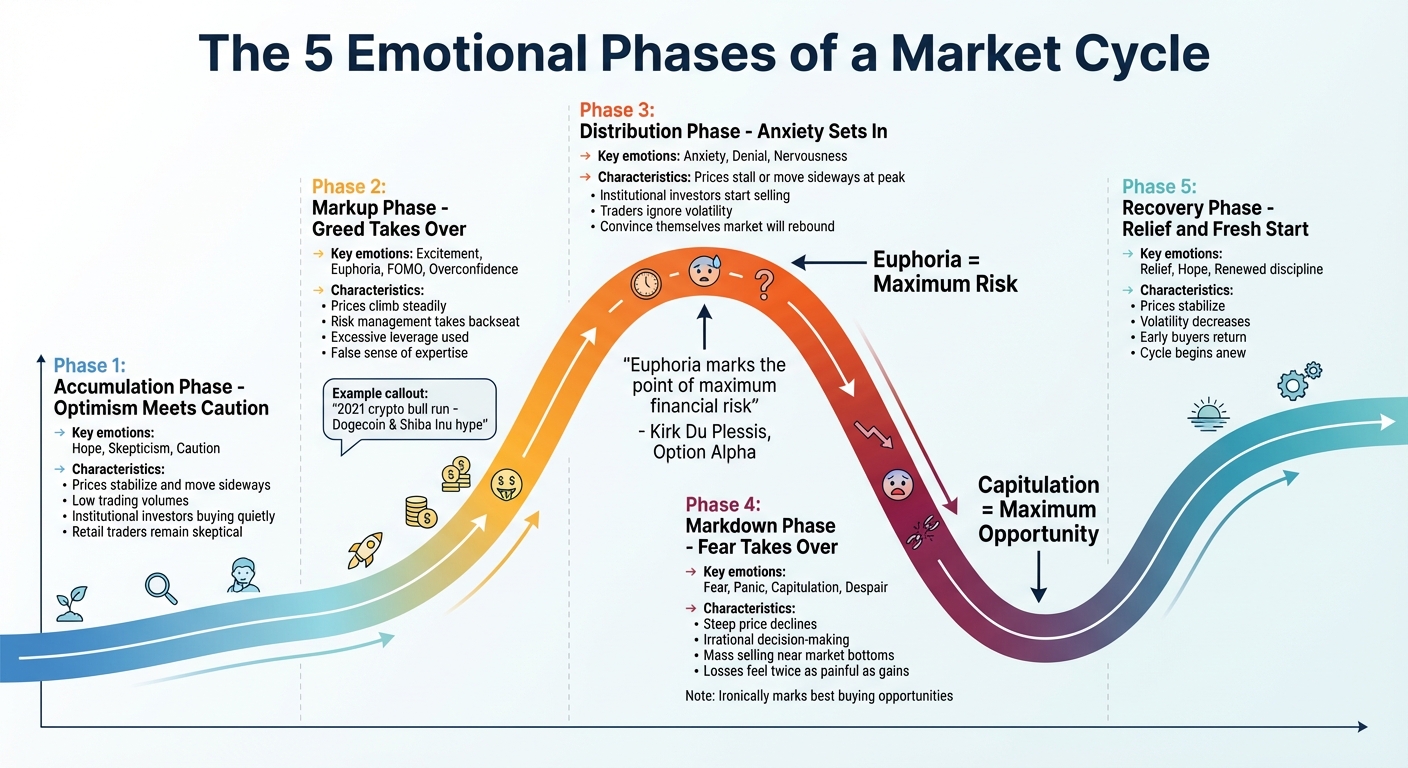
The 5 Emotional Phases of Market Cycles: From Optimism to Recovery
Market cycles follow a predictable emotional journey - from cautious optimism to euphoria, then panic, and eventually recovery. Recognizing where you stand in this cycle can help you sidestep common pitfalls and make better trading decisions. These phases also reveal the psychological patterns that often influence trader behavior.
Accumulation Phase: Optimism Meets Caution
This phase begins after a market bottom when prices stabilize and move sideways. Institutional investors and seasoned traders, often referred to as "smart money", start buying quietly while retail traders remain skeptical. Trading volumes are low, media coverage is minimal, and the broader public shows little interest. Early gains are often dismissed as fleeting. Slowly, a sense of hope starts to build, encouraging some to cautiously re-enter the market despite lingering doubts. This tentative optimism sets the stage for the more dramatic shifts of the next phase.
Markup Phase: Greed Takes Over
As prices climb steadily, cautious optimism gives way to excitement and, eventually, unchecked euphoria. This is the classic FOMO (Fear Of Missing Out) stage, where many traders throw caution to the wind. Risk management often takes a backseat as traders chase gains, sometimes using excessive leverage in the belief that prices will continue to soar.
The 2021 crypto bull run offers a clear example: retail investors poured into assets like Dogecoin and Shiba Inu, driven by FOMO and social media hype, even after prices had skyrocketed. Quick profits can create a false sense of expertise, leading to overconfidence.
"Euphoria marks the point of maximum financial risk but also maximum financial gain. Our investments turn into quick and easy profits, so we begin to ignore the basic concept of risk."
- Kirk Du Plessis, Founder, Option Alpha
While many revel in their newfound confidence, experienced traders quietly start to exit, preparing for the inevitable downturn.
Distribution Phase: Anxiety Sets In
At the market's peak, prices begin to stall or move sideways. Institutional investors start selling their holdings to the still-euphoric crowd. Early dips are often brushed off as minor corrections, but as the decline persists, anxiety creeps in. Traders start questioning their positions but often remain in denial, convincing themselves that the market will rebound soon.
"The denial period is marked by a sense of unacceptance. Many investors keep holding their losing positions, either because it's too late to sell or because they still believe that 'the market will come back soon.'"
- VasilyTrader, Education Editor

Run 24/7 while you sleep. Keep bots, platforms, and trade copiers online on a dedicated VPS.
Low-latency VPS hosting for your trading platform.
From $59.99/mo


This phase is particularly risky, as traders often ignore growing volatility and fail to adapt to changing market conditions.
Markdown Phase: Fear Takes Over
Steep declines trigger widespread panic. Losses feel far more painful than gains feel rewarding, activating emotional responses similar to those triggered by physical danger. Decision-making becomes irrational, driven by fear. In a state of capitulation, traders sell off their positions en masse, often near market bottoms, in a desperate attempt to minimize losses. Ironically, this is also when the market is often on the verge of recovery, leaving many retail traders sidelined when prices start climbing again.
Recovery Phase: Relief and a Fresh Start
After the market bottoms out, prices stabilize, and volatility decreases, bringing a sense of relief. As the market starts to show signs of recovery, hope returns. Early buyers begin to scoop up undervalued assets, and the cycle begins anew. This phase also offers a chance for traders to reflect on past mistakes and approach the market with renewed discipline.
3 Common Psychological Biases in Trading
Psychological biases can skew decision-making and heavily influence traders' reactions throughout different market phases. These mental shortcuts, while useful for quick decisions in survival scenarios, often work against long-term profitability in trading. Being aware of these biases is the first step toward managing them effectively.
Loss Aversion
For most traders, the pain of losing feels about twice as strong as the joy of an equal gain. This imbalance leads to what's known as the "disposition effect", where traders are 1.5 times more likely to sell a winning position than a losing one. The result? Many close out profitable trades too early while holding onto losing ones, disrupting the balance between risk and reward. This mindset often forces traders to aim for an unsustainably high win rate - around 65% to 75% - just to break even.
Common examples include moving your stop-loss further away to avoid locking in a loss or doubling down on a losing position, hoping for a reversal. These actions might feel like you're reducing risk, but they often increase exposure instead.
"Losses hurt roughly twice as much as equivalent gains feel good."
- Kahneman & Tversky
The disposition effect can reduce annual trading returns by an estimated 3% to 5%. Interestingly, research shows that financial losses activate the same brain areas associated with physical pain, which explains why overcoming this bias feels so difficult.
Confirmation Bias
Once a trade is placed, confirmation bias can lead traders to seek out information that supports their decision while ignoring anything that contradicts it. This tendency is amplified by platforms like Twitter and Discord, where traders often gravitate toward like-minded opinions. The result? An echo chamber that blinds traders to shifting market conditions.
A simple way to counter this bias is to challenge your assumptions before entering a trade. For instance, ask yourself, "If I had to short this position, what would my reasoning be?" Listing several reasons why your trade could fail can help you maintain a more balanced perspective.
Herd Mentality
Fear of missing out (FOMO) often pushes traders to follow the crowd, usually at the worst possible times. This behavior can lead to overbought markets at peaks and oversold markets at troughs, often disconnected from an asset's actual value.
Think back to the 2021 crypto bull run. Social media hype drove retail investors to pour into assets like Dogecoin and Shiba Inu, often at their peak prices. When the market turned, many panic-sold at significant losses. A study of 66,465 household brokerage accounts revealed that the most active traders - frequently influenced by herd behavior - earned an annual return of just 11.4%, compared to the market's 17.9%. This highlights how chasing trends often underperforms a disciplined, independent approach.
Biases and Their Impact
Each bias presents unique challenges to trading performance. Here's a quick look at how these biases affect your bottom line:
| Bias | Psychological Trigger | Impact on P&L |
|---|---|---|
| Loss Aversion | Fear of being "wrong" or feeling pain | Smaller average wins; larger average losses |
| Confirmation Bias | Need for internal consistency | Ignoring exit signals; staying in failing trades |
| Herd Mentality | FOMO (Fear of Missing Out) | Buying at market tops; selling at market bottoms |
These biases rarely operate in isolation. They often interact in what's called a "bias cascade." For example, overconfidence might lead to oversized positions, which then triggers loss aversion when the trade moves against you. This may be followed by confirmation bias as you rationalize holding onto the position. Both the emotional ups and downs of the market and these cognitive biases shape trading outcomes, making it crucial to use systematic approaches to minimize emotional decision-making. Recognizing these biases sets the stage for strategies that help maintain objectivity, as explored in the next section.
4 Strategies to Manage Trader Psychology
Understanding your biases is just the beginning; the real challenge lies in designing systems that keep emotions from influencing your trades. Research indicates that practices like journaling and systematically reviewing trades can boost profitability by 23%. Here are four focused strategies to help you make decisions that are more systematic and less emotional.
Develop a Trading Plan
A trading plan acts as your safety net during unpredictable markets. Think of it as a checklist that ensures you meet specific criteria - like entry points, position sizes, and stop-loss levels - before making any trade. This structure helps you avoid impulsive decisions when emotions run high.
Including circuit breakers in your plan can add another layer of protection. For instance, set daily loss limits (usually 2% to 3% of your account) and enforce rules like taking a one-hour break after three consecutive losses. Additionally, tagging trades with emotional labels such as "FOMO" (fear of missing out) or "Revenge" in your journal can help you track the financial impact of emotional mistakes and spot recurring patterns.
"The consistency you seek is in your mind, not in the markets."
Use Risk Management Techniques
Stay online and closer to execution. Choose a VPS location for CME futures, New York markets, London FX, API trading, and more.
Host your platform near the market route that matters.
From $59.99/mo
Professional traders often stick to risking 1% or less of their capital per trade. This approach minimizes the urge to increase position sizes out of overconfidence or desperation. Your stop-loss levels should be guided by market data - like technical invalidation points - not by what feels comfortable.
Following stop-loss rules strictly can reduce emotional reactions by up to 65%. By setting clear drawdown limits in advance and adhering to them, you establish boundaries that protect your decision-making process. If you hit your loss limit for the day, step away - no exceptions.
Aim for trades with asymmetric risk-to-reward ratios, where the potential gain outweighs the risk you’re taking. And instead of judging success solely on profitability, evaluate how well you followed your trading plan. This shift in focus builds discipline over time.
"Ninety-percent of any great trader is going to be the risk control."
- Paul Tudor Jones
Practice Self-Awareness
Pay attention to physical cues like rapid breathing or muscle tension - they’re often signs that stress is creeping in. When this happens, take a 10-minute break to reset.
Breathing exercises can help, too. Techniques like the "4-7-8" method (inhale for 4 seconds, hold for 7, exhale for 8) or box breathing (inhale, hold, exhale, and pause for 4 seconds each) can lower impulsive decision-making by up to 42%. These exercises help bring your nervous system back to a balanced state during high-pressure moments.
External factors also play a role in your trading discipline. Track things like sleep quality, stress levels, and caffeine intake alongside your trades. Patterns often emerge - for example, you might notice poorer performance on days when you didn’t sleep well or were distracted by social media.
Use Technology for Consistency
Technology can help remove emotions from your trades. Automated trading systems, for example, execute strategies based on preset rules, ensuring consistency no matter how you feel. Platforms like QuantVPS provide the infrastructure to run these strategies around the clock, so emotions don’t interfere with execution.
Digital trading journals are another powerful tool. By tracking metrics like Maximum Favorable Excursion (MFE) and Maximum Adverse Excursion (MAE), these journals provide data-driven insights into your trading behavior. They can reveal whether fear is causing you to exit trades too early or hope is making you hold onto losing positions for too long. Some platforms even use AI to highlight patterns, such as revenge trading after a loss, that might otherwise go unnoticed.
| Technology Tool | Benefit | Practical Application |
|---|---|---|
| Automated Trading/VPS | Removes execution bias | Executes strategies based on logic, not emotions. |
| Digital Trading Journal | Provides objective accountability | Tracks emotional mistakes like FOMO in dollar terms. |
| AI Trade Analysis | Identifies hidden patterns | Flags issues like performance drops tied to sleep. |
| Software Circuit Breakers | Prevents "tilt" | Locks accounts after hitting preset loss limits. |
The aim isn’t to eliminate emotions entirely - that’s impossible. Instead, the focus should be on building systems that operate independently of your emotional state. By following predefined rules, you can separate your feelings from your trading performance, allowing for more consistent results.
Conclusion
Key Takeaways
The chart highlights a recurring pattern in market behavior: euphoria signals peak risk, while capitulation often marks the best buying opportunities. These cycles persist because human psychology tends to stay consistent, regardless of changing market conditions. When confidence is at its highest - during euphoria - risk is also at its maximum. Conversely, the greatest opportunities arise during periods of despair, when many traders abandon the market entirely.
Your mindset plays a critical role in bridging the gap between a strong strategy and actual results. Even the most well-thought-out technical approach will falter without a solid psychological foundation. Research shows that overconfident traders, who tend to overtrade, underperform by 6.5% annually. Similarly, the "disposition effect" - holding onto losing trades while selling winners too quickly - can drag down returns by 3% to 5% each year. These inefficiencies add up significantly over time.
To succeed, traders must shift from emotional decision-making to a disciplined, process-driven approach. Track not just your profits and losses (P&L) but also your emotional states. For example, fear might push you to exit profitable trades too soon, while hope could trap you in losing positions longer than necessary. The goal isn’t to eliminate emotions entirely - that’s unrealistic - but to build systems that function independently of emotional swings. This highlights the need for a disciplined, systematic trading framework.
Final Thoughts
Achieving long-term success in trading demands self-awareness and a structured approach. Keeping a psychology journal can help you connect your emotional responses to your trading outcomes. Implementing "cool-off" periods after losses is another effective strategy, as studies show that trading immediately after emotional setbacks lowers win rates. Automated systems can further support this discipline by reducing the influence of emotions on your decision-making.
Adopting a contrarian mindset can also be a game-changer. For instance, recognize euphoria as a cue to tighten your risk exposure, while periods of despair could signal accumulation opportunities.
Technology offers valuable tools to maintain consistency. Automated platforms, like QuantVPS, allow you to execute strategies based on logic rather than emotion. These systems ensure your trading plan operates 24/7, unaffected by fear or greed. By combining these tools with a disciplined approach, you can align your trading process with market realities and build a foundation for steady performance - no matter the market cycle.
FAQs
How do I tell which market phase we’re in right now?
To understand the current market phase, pay close attention to trader emotions and behaviors, as these are key drivers of market cycles. For instance, signs of euphoria or irrational exuberance often signal a market peak, while fear and anxiety can hint at a downturn.
The Market Physiology Chart provides a useful framework by outlining emotional stages like optimism, excitement, fear, and denial. By studying these stages, traders can better assess whether the market is bullish, bearish, or shifting between the two. Combining this emotional analysis with technical indicators and sentiment data can offer a clearer picture of where the market stands.
What are the fastest ways to stop FOMO and panic selling?
When it comes to dealing with FOMO (fear of missing out) and panic selling, a few practical strategies can make a big difference. Start by developing a disciplined trading plan - one that outlines your goals, risk tolerance, and strategies ahead of time. This gives you a roadmap to follow, even when emotions run high.
Another helpful tactic is to use data to keep emotions in check. By tracking market trends and your own trading performance, you can rely on facts instead of feelings to guide your decisions. Additionally, setting personal triggers or circuit breakers - like predetermined sell or hold points - can stop you from making rash moves during volatile market swings.
Recognizing your psychological tendencies is also key. When you understand patterns like impulsive behavior or fear-driven reactions, it becomes easier to stick to your plan and stay focused, even when the market gets unpredictable.
Can I use automation without losing control of risk?
Automation can indeed play a key role in managing risk, especially when combined with strategies like stop-loss orders and position sizing. By executing trades based on clear, predefined rules, it helps reduce emotional influences like fear or greed that often cloud judgment. That said, regular oversight of these automated systems is crucial. Markets evolve, and ensuring your system adjusts accordingly is essential to maintain both efficiency and control over potential risks.