
Automated futures trading relies on APIs to connect your trading algorithms directly to brokers and exchanges. These tools enable real-time data access, order execution, and risk management without manual intervention. Choosing the right API can significantly impact your trading speed, reliability, and overall performance. Here's a quick summary of the top 10 APIs for 2026:
- Interactive Brokers API: Low-latency, global market access, supports multiple programming languages (Python, Java, C++, C#).
- CQG API: Web API and FIX access to more than forty exchanges, with streaming Level 1 and Level 2 data.
- Rithmic API: Known for ultra-low latency, with C++ and .NET libraries, a WebSocket protocol for any language and a co-located Diamond API.
- NinjaTrader API: Built on C# with advanced tools for technical analysis and backtesting.
- MetaTrader 5 API: MQL5-powered with multi-asset support, backtesting, and real-time execution.
- TradeStation API: A REST API with extensive historical data and stocks, options and futures access.
- Trading Technologies (TT) API: .NET and C++ SDKs plus FIX, global derivatives market access, and advanced strategy tools.
- QuantConnect API: Open-source framework for algorithmic trading with extensive historical data and broker integrations.
- TradingView API: Focuses on strategy design and testing via Pine Script but requires broker integration for live trading.
- Optimus Futures API: Broker-driven API integrations for domestic and international futures markets.
Each API offers unique features, including latency performance, market access, programming compatibility, and historical data. Pairing the right API with a reliable VPS gives your strategy the lowest latency to its broker and keeps it running when your own computer is off.
How to Choose an Automated Futures Trading API
Picking the right API for automated futures trading is a step that can significantly influence the effectiveness and reliability of your trading strategies. A poorly chosen API might lead to missed opportunities or costly mistakes. Here are the key factors to consider when making your decision.
Latency and execution speed are top priorities. In fast-moving markets like the E-mini S&P 500 or crude oil, where prices shift in milliseconds, your API must handle order transmission and market data retrieval with minimal delay. Opting for server-side execution can make a big difference. This setup runs your algorithm directly on infrastructure often located near brokers, reducing delays caused by local systems. It also minimizes the risk of local failures, ensuring trades are executed as planned and improving overall reliability.
Security and regulatory compliance are equally important, especially for U.S.-based traders managing significant investments. Look for platforms with a strong reputation for security and verify that they are regulated by multiple financial authorities. APIs backed by trusted clearing firms provide an added layer of assurance. Additionally, ensure the API supports secure data transmission and authentication protocols to safeguard your funds and personal information while staying compliant with U.S. regulations.
Platform compatibility and integration should not be overlooked. The API must integrate smoothly with your preferred trading platform, whether it’s NinjaTrader or MetaTrader 5. The same applies if you trade on the TradeStation platform. APIs with native broker integration are particularly appealing, as they simplify the implementation process and help avoid compatibility headaches.
1. Interactive Brokers API
Interactive Brokers offers a versatile, low-latency API designed for automated futures trading. With support for Python, Java, C++, and C#, it caters to developers with a variety of technical skills, making it a solid choice for building trading systems.
Latency and Performance
The API is built for speed. Orders are routed through a proprietary system designed to secure the best prices across multiple exchanges. For strategies that demand minimal delay, traders can deploy algorithms on co-located servers near exchange data centers or use standard VPS setups for reliable performance. The TWS API also streams real-time market data efficiently, a critical feature for strategies that rely on continuous price updates.
This architecture provides a strong foundation for accessing markets with precision.
Market Access (U.S. and Global Exchanges)
The low-latency performance extends to a wide range of markets. Interactive Brokers provides access to key U.S. futures exchanges, including those under CME, CBOT, NYMEX, and ICE, covering a diverse selection of futures contracts. Additionally, the API connects to international exchanges, allowing traders to explore global opportunities from a single account. Competitive trading commissions and flexible market data subscriptions make it easier to tailor services to specific trading needs.
Integration with Trading Platforms and VPS
The Interactive Brokers API works with popular algorithmic trading platforms such as QuantConnect and MultiCharts, as well as custom Python-based solutions. This ensures automated strategies remain closely aligned with real-time market movements. For those looking to reduce resource demands, the API Gateway offers a lightweight alternative to the full Trader Workstation platform while maintaining essential trading functions. Both REST and socket-based connections are supported, ensuring consistent and efficient performance.
Features for Algorithmic Trading (Data, Execution, Risk Management)
The API includes all the tools needed for automated futures trading. It supports key order types like market, limit, stop, and trailing stop orders, with pre-trade checks to ensure compliance with capital and position limits. Real-time portfolio monitoring allows algorithms to track positions, margin requirements, and profit/loss dynamically. Historical market data access further enables thorough backtesting of strategies. Comprehensive documentation and a paper trading environment provide additional resources for refining and testing algorithms. Together, these features give traders the control and precision needed to execute advanced automated strategies effectively.
2. CQG API
CQG is a well-known name in the futures and options markets, and it offers two groups of APIs (checked on 10 Oct 2026). Client APIs (Data, Trading and Charting) run alongside the CQG Integrated Client platform on the same machine and are open to individual users. Enterprise APIs, led by the Web API and FIX Connect, are built for firms serving many users.
Latency and Performance
CQG routes orders through co-located CQG Hosted Exchange Gateways, which give direct market access to more than forty-five exchanges. CQG does not publish a latency figure for its APIs, so measure round trips from your own server before you rely on a speed-sensitive strategy.
Market Access (U.S. and Global Exchanges)
CQG's consolidated market data feed draws on more than eighty-five sources. FIX Connect provides trade routing to more than forty exchanges worldwide, covering futures and fixed income cash markets.
Integration with Trading Platforms and VPS
The Web API sends Google protocol buffers over secure WebSockets, so it works from any programming language and any operating system. FIX Connect lets an existing OMS or algorithm route orders without a CQG front end, and CQG requires conformance testing in its simulated environment before live use. The Client APIs feed CQG data into external apps and other trading platforms.
Features for Algorithmic Trading
The Web API streams unfiltered Level 1 and Level 2 data and serves historical tick, intraday bar and daily bar data. It also handles order execution, account summaries, order history and post-trade analysis. On CQG's published monthly fee sheet, API Trading costs $245 a month and needs the CQG Trading package ($250), on top of the $595 CQG Integrated Client base package; API Streaming Data is $45 a month.
3. Rithmic API
Rithmic publishes three APIs that connect to the same R | Trade Execution Platform (checked on 10 Oct 2026). Here's a summary of their latency, market access, integration and features for algorithmic trading.
| Rithmic API | Languages and OS | Published typical latency | Best for |
|---|---|---|---|
| R | API+ | C++ (Windows, macOS, Linux) and .NET (Windows) | Under 1ms order handling | Desktop platforms and algorithmic systems |
| R | Protocol API | Any language and OS (WebSockets with Google Protocol Buffers) | Under 1ms order routing | Web, mobile and cloud apps |
| R | Diamond API | C and C++ on Linux, co-location required | Under 250 microseconds tick-to-trade | High-frequency trading and market making |
Order flow
Built for scalpers. Heatmaps on dedicated resources.
Order-flow heatmaps and DOM ladders run on dedicated CPU, memory and NVMe, so your charts keep responding during volatility.
See the dedicated hardware







From $29.99/mo · Windows or Linux
Latency and Performance
Rithmic's standard R | API+ operates at around 1 millisecond. The R | Diamond API uses Rithmic's Diamond Cutter technology for tick-to-trade latency typically under 250 microseconds, but it needs Linux, a dedicated co-located server and a compatible FCM.
Market Access
All three APIs give a normalized view of the exchanges Rithmic connects, including CME Group, EUREX and Nasdaq. You get live credentials through your FCM or broker, which also sets any API fees.
Integration and Deployment
Developers request a dev kit, build against the Rithmic Test system and then pass Rithmic's conformance review before connecting to production or Rithmic Paper Trading. Protocol-only developers can sign up online for a dev kit.
Features for Algorithmic Trading
Trailing stops, brackets and OCO orders run on Rithmic's servers, so they still fire if your client connection drops. Every API also offers custom bar types, symbol lookups and microsecond timestamps. Historical tick data goes back to December 2011, with a weekly limit of 40GB per user.
4. NinjaTrader API
The NinjaTrader API, built on NinjaScript, provides a framework for automated futures trading. Designed with a C# programming foundation, it supports advanced tools for technical analysis and algorithmic strategies.
Latency and Performance
For executing orders and processing real-time data, the API ensures reliability - an absolute must for time-sensitive trades. While NinjaTrader doesn't disclose specific latency metrics, its architecture is designed to handle multiple strategies across various markets simultaneously. This makes it a strong choice for running complex algorithms without requiring manual oversight. Its reliable performance ensures market connectivity for traders.
Market Access (U.S. and Global Exchanges)
NinjaTrader connects to leading U.S. futures exchanges through its integration with top brokers. Beyond futures, the platform also supports trading in stocks, forex, and cryptocurrencies, offering flexibility for traders exploring diverse opportunities. With direct access to futures data feeds, users can make well-informed automated trading decisions. Just be sure to confirm that your brokerage partner supports the specific futures markets you wish to trade. Our guide to linking NinjaTrader to an IBKR account shows how to use NinjaTrader with Interactive Brokers as the broker.
Integration with Trading Platforms and VPS
The NinjaScript API is powered by C# programming. For traders who need uninterrupted operation, deploying the platform on a Virtual Private Server (VPS) ensures continuous performance.
Pricing
NinjaTrader has three plans: Free, Monthly at $99 a month and Lifetime at a one-time $1,499, checked on 10 Oct 2026 on ninjatrader.com/pricing. The paid plans lower the commission per contract, and every plan includes free simulated trading, so you can test automated strategies before trading live.
| NinjaTrader plan | Plan fee | Commission per side (micro) | Commission per side (standard) |
|---|---|---|---|
| Free | $0 | $0.39 | $1.29 |
| Monthly | $99 a month | $0.29 | $0.99 |
| Lifetime | $1,499 one-time | $0.09 | $0.59 |
Exchange, clearing and NFA fees are extra on every plan.
Features for Algorithmic Trading (Data, Execution, and Backtesting)
NinjaTrader comes equipped with over 100 technical indicators and advanced charting tools, streamlining the process of developing trading strategies. These built-in features save time by reducing the need to code common indicators manually. The platform also includes a Market Replay feature, enabling traders to simulate historical market conditions and assess how their algorithms might have performed. Additionally, backtesting tools let users validate strategies using historical futures data.
To support users, NinjaTrader offers a range of resources, including tutorials, webinars, and direct customer service.
5. MetaTrader 5 API
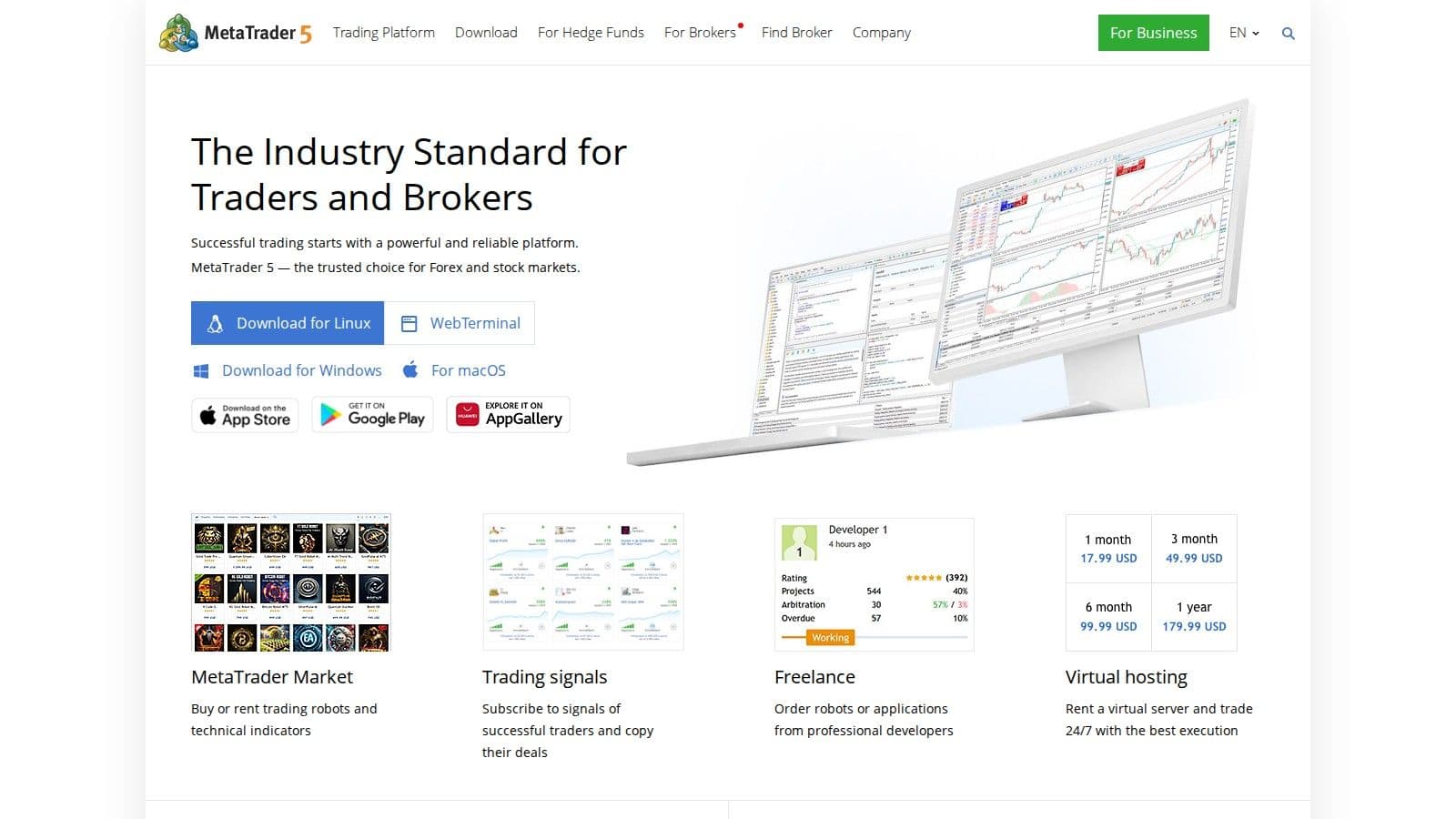
The MetaTrader 5 API brings automated futures trading to life through MQL5. While it started as a forex-focused platform, MetaTrader 5 now supports futures trading, offering flexibility for building automated strategies.
Latency and Performance
MetaTrader 5 is designed to handle market data and execute trades quickly, making it ideal for automated trading. Its architecture supports non-blocking operations, allowing algorithms to keep processing data even while waiting for order confirmations. This setup avoids delays during high trading volumes and ensures time-sensitive strategies can rely on real-time market data and solid broker connections. It’s a framework built to meet the demands of low-latency futures trading.
Market Access
MetaTrader 5 extends its reach to futures markets through broker partnerships. The specific contracts you can trade depend on your broker, but this multi-asset capability lets traders develop cross-market strategies. Tools like the built-in economic calendar also help automated systems factor in upcoming market events.
Integration with Trading Platforms and VPS
The MQL5 programming language powers automated trading on MetaTrader 5. If you’re familiar with C-style programming, you’ll find the syntax easy to grasp. The platform’s integrated MetaEditor IDE includes helpful features like code completion, debugging tools, and a testing environment. To ensure your strategies run continuously, you can deploy MetaTrader 5 on a VPS, ensuring reliable performance around the clock.
Features for Algorithmic Trading
MetaTrader 5 comes packed with tools for algorithmic trading. It provides access to multiple timeframes, built-in technical indicators, and charting tools, all of which simplify the development of trading logic. The Strategy Tester lets you validate and fine-tune strategies using historical data, and multi-threaded processing speeds up backtesting by utilizing multiple CPU cores.
For risk management, the API supports programming stop-loss and take-profit orders, along with dynamic position sizing based on factors like market volatility and account equity. The platform also allows hedging, enabling you to handle positions in opposite directions simultaneously.
Additionally, the MQL5 community marketplace offers a wide range of ready-made indicators, Expert Advisors, and utilities. Detailed reporting features provide key metrics like profit factor, drawdown, and win rate, giving you valuable insights into your trading performance.
6. TradeStation API
TradeStation's API is built to streamline automated futures trading with precision and efficiency. It combines advanced scripting tools with extensive market access, giving traders full control over their trading strategies.
Latency and Performance
With TradeStation's API, trades can be programmed and executed in just milliseconds across various asset classes. This ultra-fast performance, paired with comprehensive market access, ensures your strategies can operate across a wide range of futures contracts.
Market Access
TradeStation provides access to a diverse array of futures contracts, including stock indices, cryptocurrency futures, interest rates, metals, energy, agriculture, softs, and meats. Its historical data spans several years of market activity for both U.S. and Eurex contracts, making it an excellent tool for backtesting and refining trading strategies. Additionally, the platform offers intraday margin rates as low as 10% on certain contracts, helping traders optimize their capital.
Integration with Trading Platforms
The TradeStation API is a set of RESTful brokerage and market data services, so you can call it from any language that sends HTTP requests, such as Python or C#. EasyLanguage is a separate scripting language for strategies that run inside the TradeStation platform.
Features for Algorithmic Trading
TradeStation has been recognized by StockBrokers.com as "Best for active futures traders and API access". Its API offers powerful tools, low margin requirements, and extensive historical data, which are essential for creating and refining custom automated trading strategies. Beyond standard price data, the API grants access to order book details, time and sales data, and comprehensive contract specifications. These features provide the insights needed to develop algorithms capable of making well-informed decisions. The availability of historical data further enhances backtesting, allowing traders to validate their strategies before committing real capital.
7. Trading Technologies (TT) API
The Trading Technologies (TT) API is designed for professionals who demand top-notch performance and access to global markets. It's specifically designed to handle even the most complex automated futures trading strategies with extraordinary precision and speed.
Latency and Performance
For speed, the TT API delivers. TT offers a C++ SDK, the TT Core SDK, for low-latency applications, alongside a .NET SDK and FIX connections. That design matters for high-frequency trading strategies, where every microsecond can make a difference.
"Build low-latency C++ applications and deploy on colocated Linux servers for superior performance." - Trading Technologies, TT Core SDK
TT lets you deploy your own applications in its colocated data centers, near the exchanges, to minimize latency. The TT .NET SDK can run client-side or server-side, and futures brokers such as AMP Futures offer TT to their clients.
Market Access (U.S. and Global Exchanges)
Beyond its speed, the TT API provides extensive market access across the globe. It offers a normalized view of major derivatives markets and connects directly to leading U.S. exchanges like CME Group. This includes access to the Chicago Mercantile Exchange and The Board of Trade of the City of Chicago, covering a diverse range of asset classes such as interest rates, equity indices, cryptocurrency, agriculture, energy, precious metals, and foreign exchange futures and options.
One of the standout features is its ability to simplify development. Strategies developed for one market can be easily adapted to new exchanges without requiring significant code modifications. For example, in June 2025, CME Group 1-Ounce Gold (1OZ) Futures became available for live trading via platforms connected to CME Group, showcasing the API's ability to support new products on major exchanges. The API also maintains reliable connectivity with these exchanges, adapting to changes like the CME Group fee increase implemented on February 1, 2025.
Features for Algorithmic Trading
The TT API doesn’t just excel in performance and market access - it also simplifies the execution of trading strategies. Developers can bypass the complexities of building and maintaining exchange connectivity. Instead, they can focus on strategy development while leveraging TT's infrastructure.
"All APIs provide normalized interfaces for interacting with all TT-connected exchanges." - Trading Technologies, APIs page
The API works with TT's advanced Strategy Engine technology, which includes the Autospreader® Strategy Engine and Synthetic Strategy Engine. These tools enable proximity-based execution of custom spreads and synthetic orders, making it easier to implement sophisticated multi-leg strategies without the need to construct an entire execution framework from scratch.
Uptime
99.999% uptime. Built for 24/7 trading reliability.
Your VPS runs in Tier IV datacenters with redundant power and network, monitored 24/7 on site.
See the uptime SLAFrom $29.99/mo · Windows or Linux
8. QuantConnect API
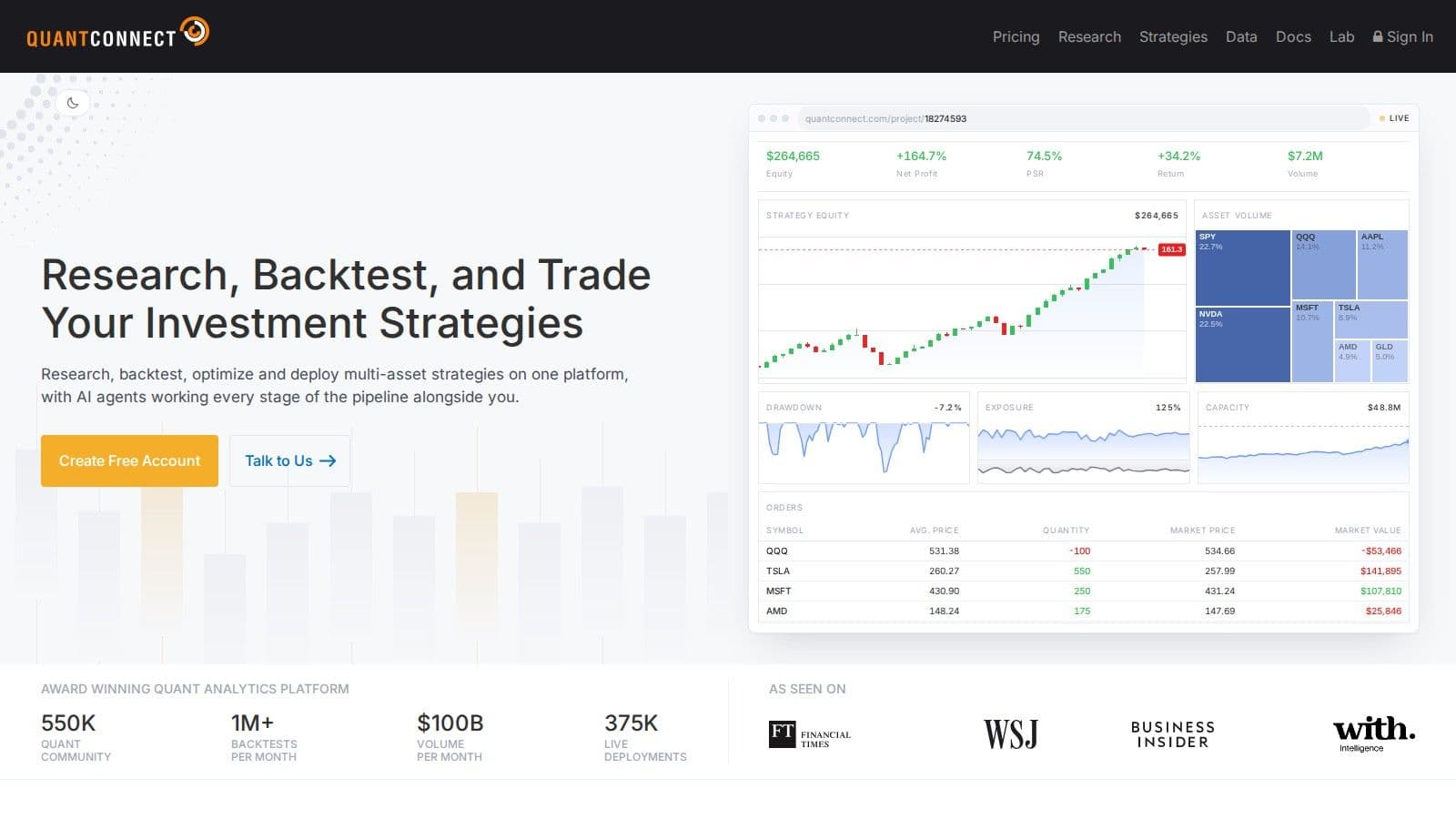
QuantConnect is a platform built with developers in mind, offering unmatched control for algorithmic trading. Unlike many proprietary systems, it operates on an open-source framework, giving users both transparency and flexibility in automated futures trading. This open model integrates smoothly with other APIs, maintaining a consistent emphasis on user control.
Features for Algorithmic Trading (Data, Execution, Risk Management)
QuantConnect is designed to support algorithm development across multiple programming languages, including Python, C#, and F#. This versatility allows traders to create diverse strategies for their needs.
One of its standout features is its extensive historical data library, which is essential for thorough backtesting. It covers US equities since 1998, the 70 most liquid US futures at tick to daily resolution since 2009, forex, CFDs and crypto.
QuantConnect's open-source Lean engine enables local development, providing full transparency into how strategies are executed. This is particularly useful for debugging or refining complex algorithms.
Market Access (U.S. and Global Exchanges)
QuantConnect connects users to global futures markets through broker integrations, offering institutional-grade access. You can test strategies across various asset classes with years of historical data at your disposal.
Through Interactive Brokers, the platform supports trading in a wide range of futures contracts, including equity indices, Micro E-minis, interest rates, cryptocurrencies, metals, energy, agriculture, currencies, and soft commodities.
Integration with Trading Platforms and VPS
QuantConnect's cloud-based infrastructure ensures that your algorithms run continuously, regardless of your local hardware. By operating in the cloud, your strategies remain active even if your personal computer goes offline.
Paid plans connect live and paper trading to brokers such as Interactive Brokers, TradeStation and Charles Schwab.
Pricing
QuantConnect offers a pricing model designed to accommodate traders at different levels. The free tier lets beginners explore the platform, while live and paper trading start with the Researcher plan at $84 a month ($888 billed yearly), checked on 10 Oct 2026. Additional costs may apply for extra computing power or specialized datasets, but the base pricing is designed to remain accessible for serious algorithmic traders.
For those diving into quantitative finance and high-frequency trading, LEAN can also run on-premises instead of in QuantConnect's cloud.
9. TradingView API

TradingView is a charting platform with its Pine Script language, making it a go-to for visually developing and backtesting custom trading strategies. Unlike standard execution APIs, TradingView focuses on strategy design and testing, offering traders a user-friendly environment to refine ideas before taking them live. A chart-driven strategy has a different starting point; the TradingView automation guide explains that alert-to-broker workflow.
Features for Algorithmic Trading (Data, Execution, Risk Management)
TradingView excels in visual strategy development, making it accessible even to those without extensive programming experience. Pine Script, its built-in scripting language, allows users to create and test custom strategies directly within the platform's charting interface. This visual approach simplifies algorithm design, offering a practical way to experiment and refine trading ideas.
The platform provides access to a wide array of market data, covering stocks, forex, cryptocurrencies, and futures. This extensive data library is perfect for backtesting strategies across various asset classes and timeframes, helping traders evaluate potential performance under different market conditions. However, TradingView itself does not execute trades. To bring your strategies to life, you'll need to integrate with a broker or third-party tool for live trading. In other words, while TradingView is excellent for crafting and testing strategies, actual execution requires an additional step.
Integration with Trading Platforms and VPS
TradingView's execution model operates locally, meaning your algorithms depend on your computer or a VPS (Virtual Private Server). This setup introduces certain risks tied to local system reliability. If your internet connection drops or your hardware encounters issues, your trade execution could be disrupted. For traders running time-sensitive strategies, such as those involving futures, this dependency on local infrastructure can present challenges. Proper preparation, like using a reliable VPS, can help mitigate these risks.
Additionally, TradingView supports broker integrations for executing trades based on its alerts. These integrations act as a bridge, triggering actions through your broker's system. However, this approach differs from the direct API access offered by platforms like Interactive Brokers, where execution is fully automated. With TradingView, the platform essentially serves as a signal generator, complementing more direct API solutions in automated trading. When TradingView webhooks feed the API client, a VPS for TradingView webhooks can keep that client running while you verify authentication, symbol mapping and rejected-order handling.
Pricing
TradingView offers a free plan with basic charting and strategy testing tools, making it accessible for beginners. For more advanced features, paid plans start at $14.95 per month, offering an affordable way to design and validate trading strategies without breaking the bank.
10. Optimus Futures API
Optimus Futures supports automated futures trading by integrating with third-party APIs, giving traders access to a wide range of domestic and international futures markets. This broker-focused setup allows users to tap into market data, execution tools, and risk management features offered by these API partners.
Market Access
Through its third-party integrations, Optimus Futures provides extensive market coverage. This broad access enables traders to design and implement algorithmic strategies for various market conditions and environments.
Integration with Trading Platforms and VPS
Optimus Futures prioritizes compatibility with leading trading platforms that work with third-party APIs. Many traders choose to run their automated strategies on a dedicated Virtual Private Server (VPS) to ensure smooth operations and minimize latency. This setup helps maintain fast and reliable performance, which is crucial for algorithmic trading.
Features for Algorithmic Trading
Traders using Optimus Futures can benefit from real-time market data, dependable order execution, and risk management tools. Specific performance metrics and fee details depend on the third-party provider and prevailing market conditions. For the most accurate and current information, traders should refer to Optimus Futures' official resources.
API Comparison Table
For automated futures trading, choosing the right API is all about finding the perfect match for your specific needs. The table below provides a detailed breakdown of 10 popular APIs, comparing their features across key factors that can influence your trading performance. Prices and API details checked on 10 Oct 2026.
| API | Programming Languages | Market Access | Latency | Real-Time Data | Historical Data | VPS Compatible | Security Features | Pricing |
|---|---|---|---|---|---|---|---|---|
| Interactive Brokers | Python, Java, C++, C#, R | Over 150 global markets, wide futures coverage | Fast execution, millisecond-level | Real-time data feeds | Extensive historical data | Yes | Two-factor authentication, encryption | Commission-based, market data fees vary |
| CQG | Any language (Web API), FIX | More than forty exchanges for trading, over eighty-five data sources | Not published; co-located exchange gateways | Level 1 and Level 2 streaming data | Historical tick, intraday and daily bars | Yes | Encrypted connections, secure authentication | Client API trading $245 a month plus platform fees; enterprise APIs on request |
| Rithmic | C++, .NET, any language (Protocol API) | CME Group, EUREX, Nasdaq and other connected exchanges | Under 1ms; under 250 microseconds with Diamond API | Real-time market data | Tick data since December 2011, 40GB weekly limit | Yes | Secure API keys, encrypted data transmission | Set by your FCM or broker |
| NinjaTrader | C#, NinjaScript | Futures, forex, stocks | Fast execution | Real-time quotes and charts | Backtesting with historical data | Yes | Secure login, encrypted connections | Free plan; Monthly $99 or Lifetime $1,499 |
| MetaTrader 5 | MQL5, Python, C++ | Stocks, forex, futures, crypto (via brokers) | Lightning-fast execution | Real-time price feeds | Built-in strategy tester with historical data | Yes | Encrypted data transfer, secure authentication | Free platform, broker fees apply |
| TradeStation | Any language via REST (Python, C#); EasyLanguage in the platform | Broad market coverage: indices, crypto, metals | Millisecond-level trade programming | Real-time streaming data | Extensive historical data for backtesting | Yes | Multi-factor authentication, encryption | Commission-based, platform fees may apply |
| Trading Technologies | C++, .NET, FIX, REST | Leading global derivatives markets | Low-latency C++ SDK on colocated servers | Real-time market and P&L monitoring | Historical data access | Yes | Advanced security protocols, encrypted connections | Enterprise pricing, contact for quotes |
| QuantConnect | C#, Python | Stocks, options, futures, forex datasets | Cloud-based execution | Real-time data feeds | Large historical databases across assets | Cloud-native | Secure cloud infrastructure, API authentication | Free tier available, paid plans for live trading |
| TradingView | Pine Script, webhooks | Multi-broker support for various markets | Varies by broker connection | Real-time charting and alerts | Historical market data (tick data via subscription) | Yes | Secure API keys, HTTPS encryption | Free basic plan, premium tiers for advanced features |
| Optimus Futures | Third-party API dependent | Domestic and international futures markets | Varies by provider | Real-time data via partners | Historical data through integrated platforms | Yes | Security depends on third-party provider | Commission-based, third-party API fees may apply |
The table captures the standout features of each API, but there’s more to consider when making your choice.
Latency is a key factor, especially for high-frequency trading strategies. If you need the lowest latency, Rithmic's co-located Diamond API publishes tick-to-trade times under 250 microseconds, and Trading Technologies offers a C++ SDK for colocated servers, both suited to institutional traders.
Market access is another critical consideration. Interactive Brokers leads the pack with access to over 150 global markets, offering unparalleled coverage for multi-exchange trading. Trading Technologies simplifies strategy deployment across different exchanges by providing a normalized view of global derivatives markets.
Programming language support can influence your decision based on your team’s expertise. Python is a widely supported language, available on platforms like Interactive Brokers, MetaTrader 5, TradeStation (through its REST API), and QuantConnect, while the CQG Web API and Rithmic Protocol API work from any language. For C# developers, NinjaTrader, TradeStation, Trading Technologies (.NET SDK), and QuantConnect are strong contenders. C++ support is also across several platforms, including Interactive Brokers, Rithmic, MetaTrader 5, and Trading Technologies.
Historical data is vital for backtesting strategies. Platforms like QuantConnect and TradeStation offer extensive datasets, allowing you to validate your strategies thoroughly before putting real money on the line.
Finally, pricing varies widely. Interactive Brokers and TradeStation charge commissions, CQG charges monthly API fees, and Rithmic access is priced through your FCM or broker. If you’re just starting, QuantConnect offers a free tier, and TradingView provides a basic free plan with optional premium upgrades. Be sure to account for additional costs like market data subscriptions, which can add up quickly if you’re trading across multiple exchanges.
The right API depends on balancing speed, market access, programming compatibility, and security to meet the demands of your trading strategy.
Running your futures API client
Start in the paper or simulation environment of the API you chose, and log every request and response so rejected orders are easy to trace. Plan for disconnects and the daily session reset in code rather than restarting by hand. A Chicago server for API trading bots puts the client 0.52ms from CME.
Conclusion
Selecting the right API for automated futures trading goes beyond just comparing features - it’s about choosing a tool that meets the speed and precision demands of today’s markets. The APIs discussed here, from Interactive Brokers to Trading Technologies, each offer distinct advantages. Whether your focus is on high-frequency trading, backtesting intricate algorithms, or managing positions across multiple markets, your API choice affects the execution and testing workflow.
To truly use the power of these APIs, pairing them with high-performance VPS hosting is crucial. Even the best API can falter without a strong infrastructure to back it up. A specialized VPS ensures ultra-low latency, reliable uptime, and stable connections, which are critical to keeping your trades running smoothly - even in volatile market conditions. When milliseconds can make or break a trade, a dependable VPS provides the lowest latency and uninterrupted performance needed to stay competitive.
Success hinges on the combination of a well-suited API and a reliable hosting solution. Take the time to assess your trading approach, the markets you target, and your technical needs. With the right API and hosting setup, you’ll be well-positioned to achieve consistent and efficient trading performance.
FAQs
What should I look for when selecting an API for automated futures trading?
When selecting an API for automated futures trading, prioritize reliability, security, and how easily it integrates with your trading platform. It's essential that the API supports the trading instruments you plan to use and provides strong customization capabilities to tailor your strategies effectively.
Consider additional features like backtesting tools to fine-tune your algorithms, responsive customer support to address any issues quickly, and a clear, transparent pricing structure that aligns with your budget. These elements are key to creating a trading experience and optimizing the efficiency of your automation setup.
Why is latency important for automated trading strategies, and which APIs are best for low-latency performance?
Latency is a key factor in the effectiveness of automated trading strategies. Even minor delays can result in missed opportunities or less optimal trade execution. In fast-moving markets or high-frequency trading, speed is everything - lower latency means quicker order processing, which can make all the difference.
Certain APIs are built with latency reduction in mind, offering server-side execution as a feature. This approach allows trading algorithms to operate directly on systems colocated with brokers, cutting down the time it takes for orders to reach the market. For traders who prioritize speed and accuracy, this setup provides an advantage.
Why do you need a high-performance VPS when using an API for automated futures trading?
Pairing a high-performance VPS with an API for automated futures trading is a smart move to boost speed, reliability, and overall efficiency in your trading setup. A VPS creates a stable, secure environment for running your trading algorithms around the clock, reducing the chances of downtime or interruptions caused by local hardware failures or internet connectivity issues.
One of the key advantages of using a VPS is its ability to deliver low-latency connections to trading servers. This is critical for executing trades quickly, especially in futures trading. Beyond speed, a high-performance VPS ensures your trading strategies operate, even when handling large datasets or performing complex calculations. Together, these features can sharpen your trading edge and help you stay competitive in the market.


