Quantitative investing uses data, mathematical models, and algorithms to make investment decisions, removing emotional biases from the process. This approach has grown with advancements in computing, allowing both institutions and individuals to analyze massive datasets and execute trades efficiently. Here's what you need to know:
- How It Works: Combines data, models, and rules to identify patterns and automate trades.
- Key Steps: Develop hypotheses, backtest strategies, manage risk, and execute trades using robust systems.
- Tools: Popular tools include Python for development, Zipline for backtesting, and low-latency trading infrastructure.
- Advantages: Reduces emotional decision-making, processes large datasets, and operates faster than manual methods.
- Challenges: Risks include overfitting, model failures in changing markets, and the need for technical expertise.
Quantitative investing has reshaped markets, offering opportunities for systematic, data-driven decision-making while requiring careful planning and execution.
Core Principles of Quantitative Investing
Key Elements of Quantitative Investing
Quantitative investing revolves around three interconnected pillars: data, models, and rules. Here's how they fit together:
- Data serves as the foundation, encompassing everything from price and volume to financial ratios or even unconventional inputs like satellite imagery.
- Models act as the analytical core, processing this data to uncover statistical patterns or edges.
- Rules are the actionable framework, outlining when to buy, how much to allocate, and when to sell.
The magic of this approach lies in its systematic nature. Data feeds into models, which generate signals that rules then translate into trades. Unlike traditional investing, which often leans on subjective judgment, this method eliminates emotional decision-making entirely.
"Quantitative trading isn't about replacing human judgment with computers - it's about combining human insight with computational power to identify patterns, test strategies systematically, and implement them with discipline." - TunedAlpha
Steps in the Quantitative Investment Process
The process of quantitative investing unfolds in a structured sequence, more akin to scientific research than conventional investing methods.
It all begins with a hypothesis - a testable idea based on theory or observed market behavior. For instance, you might hypothesize that "stocks with poor performance over the past year tend to rebound toward their historical averages." This hypothesis is then translated into a model and rigorously tested through backtesting, which evaluates how well the strategy would have performed using historical data.
Backtesting is critical for assessing a strategy's reliability. A widely accepted benchmark is a 90% confidence level, meaning the pattern must hold true in about 90 out of 100 historical scenarios before it’s considered actionable. Once validated, the strategy moves into portfolio construction, where capital is allocated according to specific rules, such as risk parity or factor-based weighting. Finally, the strategy is implemented through automated execution, with ongoing monitoring to adapt to market changes or detect model drift.
However, there are two common traps to watch out for:
- Survivorship bias: Testing only on companies still in existence, ignoring those that failed or were delisted.
- Look-ahead bias: Using data in backtests that wouldn't have been available at the time of the trade.
Understanding these steps highlights why precise tools and robust data are essential for success in quantitative investing.
Data and Tools Used in Quantitative Investing
Quantitative investors rely on a diverse array of data sources, generally falling into three categories:
- Market data: Includes price, volume, and detailed trade records.
- Fundamental data: Covers financial statements, earnings-per-share, and valuation metrics like P/E ratios.
- Alternative data: Draws from unconventional sources such as social media sentiment, Congressional trading activity, corporate flight tracking, and even Wikipedia pageviews.
For those starting out, free resources like the Federal Reserve Economic Data (FRED), which offers access to over 800,000 economic time series, or the Fama-French factor datasets, can be invaluable for initial research. Premium data services, such as Bloomberg Terminal, can cost thousands of dollars monthly but provide unmatched depth and breadth.

Run 24/7 while you sleep. Keep bots, platforms, and trade copiers online on a dedicated VPS.
Low-latency VPS hosting for your trading platform.
From $59.99/mo


When it comes to tools, Python dominates the landscape for research and strategy development, though R and MATLAB are also widely used. Below is a breakdown of tools commonly used for each component of quantitative investing:
| Component | Description | Common Tools |
|---|---|---|
| Data | Raw data | FRED, EODHD, Quiver Quantitative |
| Models | Mathematical models | Python, R, MATLAB |
| Backtesting | Historical simulation | Zipline, Alphalens, StrategyQuant |
| Execution | Automated order routing | Interactive Brokers API, Lightspeed Connect API |
| Infrastructure | Hosting and deployment | AWS, Google Cloud, Docker |
How Quantitative Strategies Work in Practice
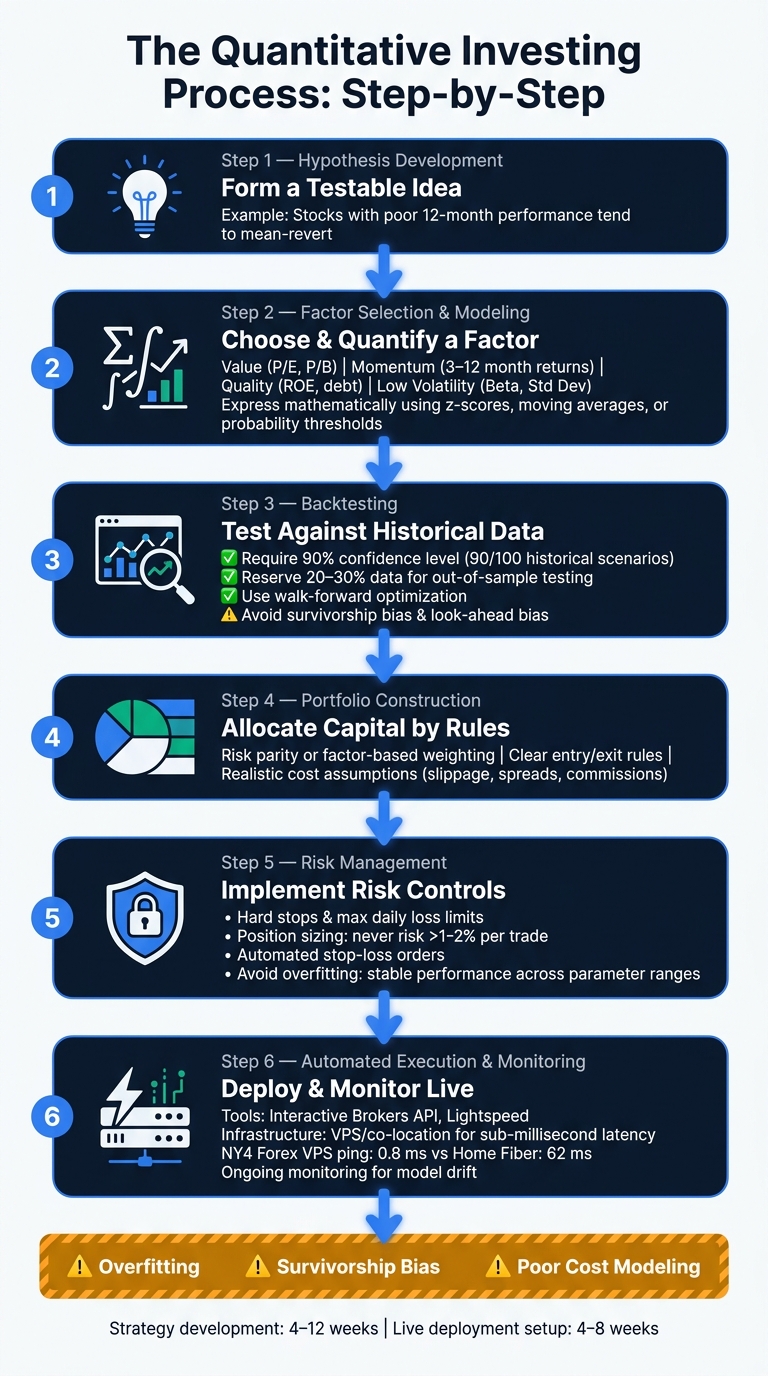
Quantitative Investing Process: From Hypothesis to Live Execution
This section delves into how quantitative strategies are built, tested, and applied in real-world trading environments, expanding on the principles outlined earlier.
Designing and Testing Strategies
At the core of every quantitative strategy are three interconnected components: the signal model, the risk model, and the execution model. Each of these layers must work seamlessly together, as a weakness in any one can jeopardize the entire system.
The process begins with identifying a factor, which is a measurable characteristic believed to predict future returns. Common factors include:
- Value: Metrics like Price-to-Earnings (P/E) ratios or Price-to-Book ratios.
- Momentum: Typically assessed through 3-to-12-month return windows.
- Quality: Indicators such as Return on Equity or debt levels.
- Low Volatility: Measured by Beta or standard deviation.
Once a factor is chosen, it’s expressed mathematically - using tools like z-scores, moving averages, or probability thresholds - and then tested against historical data, such as when you backtest on TradeStation.
A proper backtest requires clear entry and exit rules, realistic assumptions about costs, and clean, distortion-free data. Importantly, you should reserve 20–30% of historical data for out-of-sample testing, which remains untouched during the development phase. To further validate the strategy, use walk-forward optimization, which involves testing on rolling time windows. This ensures the strategy isn’t overly reliant on specific data and can adapt to different market conditions.
"The primary purpose of a backtest is falsification, not validation. A strategy that fails its backtest should be rejected. A strategy that passes its backtest has not been proven - it has survived the test." - Om Arora
Once the strategy design is solid, the focus shifts to integrating robust risk controls.
Managing Risk and Avoiding Common Pitfalls
Even the best-designed strategies require strong risk management to protect returns and minimize losses.
Automated measures like hard stops, maximum daily loss limits, and position sizing rules are critical. Manually overriding these systems can reintroduce emotional biases that quantitative investing seeks to eliminate.
Two common pitfalls to watch for are overfitting and poor cost modeling. Overfitting happens when a model is so finely tuned to historical data that it captures noise instead of meaningful patterns. If small tweaks in parameters drastically affect performance, the model is likely overfitted. Instead, aim for parameter ranges where performance remains stable.
Accurate cost modeling is equally important. Factors like slippage, bid-ask spreads, and commissions must be included in every backtest. For instance, a study found that a mere 5-to-10-second delay in execution caused a 14.4% annual performance drag - enough to turn a profitable strategy into a losing one.
Execution Quality and Infrastructure
Once a strategy is validated, its success hinges on execution quality. In fast-moving markets, even minor delays between signal generation and order execution can erode profits. This is where execution speed and stability play a critical role.
Co-location, which involves hosting trading software on servers near a broker’s matching engine, minimizes latency. The table below highlights how execution speed and infrastructure affect performance:
| Connection Type | Ping to Broker | Order Errors (per 100) | Slippage (EURUSD) |
|---|---|---|---|
| NY4 Forex VPS | 0.8 ms | 0–1 | 0.1 pip |
| Home Fiber | 62 ms | 11 | N/A |
For individual quants, a Virtual Private Server (VPS) offers a reliable, low-latency solution without the high costs of institutional infrastructure. A VPS hosted near a broker’s data center can achieve sub-millisecond ping times, significantly reducing order errors and slippage compared to a home fiber connection.
For example, a trader running a single automated strategy might opt for a plan like QuantVPS’s VPS Lite, which includes 4 cores, 8GB RAM, and a 1Gbps+ network, starting at $41.99/month when billed annually. For more demanding setups - such as running multiple strategies or high-frequency trading - upgrading to the VPS Ultra (24 cores, 64GB RAM) or a Dedicated Server (16+ cores, 128GB RAM, 10Gbps+ network) ensures the system remains fast and reliable. Missing a signal due to hardware limitations or connectivity issues can undermine months of work, making dependable infrastructure a non-negotiable part of the process.
Why Quantitative Investing Matters
Benefits of Quantitative Investing
One of the biggest strengths of quantitative investing is its reliance on data and rules, rather than emotions. By removing human biases like fear, greed, or overconfidence, it can help investors avoid costly mistakes. Research shows that emotional decision-making can reduce returns by as much as 3% annually for discretionary investors.
Another advantage is its ability to process massive amounts of information. Quantitative systems can analyze thousands of securities across global markets simultaneously, spotting opportunities that manual analysis would likely miss. Plus, with automated execution, these strategies can act on signals in milliseconds - far faster than any human team.
"The appeal of quantitative investing lies in its impartiality and the ability to backtest strategies before implementation." - Investopedia
Quantitative approaches are also more cost-efficient. They typically require fewer portfolio managers and less manual research, which reduces overhead expenses. This streamlined structure makes quantitative strategies leaner compared to traditional investment methods. However, while these benefits are compelling, they come with their own set of challenges.
Challenges and Limitations
Quantitative investing isn't without risks. One major issue is model risk - the danger that a strategy based on historical data may fail when market conditions change. A model designed for low-volatility markets, for example, might struggle in a high-volatility environment. Similarly, over-reliance on a single factor, like momentum or value, can lead to diminishing returns when too many funds chase the same signals.
Data integrity is another critical concern. Errors in historical databases - like using future information or excluding delisted securities - can make a strategy look better on paper than it performs in reality.
Building and maintaining quantitative systems also requires technical expertise and reliable infrastructure. Developing a strategy can take 4 to 12 weeks, and setting up the live deployment infrastructure adds another 4 to 8 weeks. Without these resources, even a well-designed strategy may falter.
Impact on Markets and Individual Traders
Stay online and closer to execution. Choose a VPS location for CME futures, New York markets, London FX, API trading, and more.
Host your platform near the market route that matters.
From $59.99/mo
Quantitative investing doesn’t just affect individual strategies; it has reshaped the broader market. Algorithms used in high-frequency trading, for instance, have improved liquidity and tightened bid-ask spreads, making prices more efficient for everyone.
But there’s a downside. The same risks that challenge individual strategies - like model risk and factor crowding - can create systemic issues when many funds operate on similar assumptions. In times of market stress, these models may react in unison, amplifying volatility. This highlights the need for rigorous stress-testing under extreme scenarios, not just normal conditions.
For individual traders, the rise of quantitative investing has been transformative. Thanks to affordable computing and open-source tools, strategies once reserved for elite hedge funds are now accessible to retail investors. Long/short equity hedge funds using quantitative methods, for example, posted three consecutive years of double-digit returns between 2023 and 2025. This success has drawn more retail participants into the space.
While the barriers to entry have lowered, success still hinges on having the right methodology, clean data, and robust infrastructure to execute strategies efficiently and without disruption.
Getting Started With Quantitative Investing
Skills and Knowledge You Need
To dive into quantitative investing, you'll need a strong grasp of mathematics, statistics, programming, and financial markets.
Start with the fundamentals: probability, linear algebra, and basic calculus. Statistics is equally critical - focus on areas like time series analysis, hypothesis testing, and understanding concepts such as volatility and normal distributions. These aren't just theoretical ideas; they're the core tools you'll use to build every strategy.
On the programming side, Python is your best starting point. It's widely used for data analysis and manipulation, making it a must-learn language for quantitative traders. Don't feel pressured to master every library immediately. Instead, get comfortable with the basics first - this will make learning advanced tools much easier.
"Quantitative trading research is much more closely aligned with scientific hypothesis testing and academic rigor than the 'usual' perception of investment bank traders." - QuantStart
Finally, financial knowledge ties everything together. Knowing how exchanges work, understanding the behavior of different asset classes, and grasping order execution mechanics are essential for designing strategies that succeed in live markets. Structured programs, like those from Quantra (QuantInsti), offer affordable and detailed learning paths.
Once you've built these foundational skills, you're ready to set up your technical environment.
Technical Setup for Quantitative Trading
A basic setup for quantitative trading includes tools for data access, development, backtesting, and execution.
You can start with free data sources, but as you progress, consider upgrading to cleaner, adjusted datasets. Here's a breakdown of the essential tools for each stage:
| Layer | Tools | Purpose |
|---|---|---|
| Development | Python, Jupyter Notebooks | Writing and analyzing strategies |
| Backtesting | Backtrader, Zipline, Blueshift | Testing strategies on historical data |
| Execution | Interactive Brokers, IBridgePy | Automating order placement |
| Infrastructure | VPS hosting | Ensuring 24/7 uptime and low latency |
A reliable infrastructure is key for executing data-driven strategies. Running everything on a personal computer can lead to interruptions whenever your machine restarts or your internet connection drops. A VPS (Virtual Private Server) solves this problem by keeping your strategies running continuously with minimal latency. For example, QuantVPS offers plans tailored for trading, starting at $41.99/month (billed annually) for their Lite plan, which includes 4 cores and 8 GB RAM - suitable for running 1–2 charts. For more demanding setups, their Dedicated Server plan offers 16+ cores, 128 GB RAM, and institutional-grade performance for $209.99/month (billed annually).
How to Build and Run Your First Strategy
With the right skills and tools in place, you’re ready to create your first trading strategy. Keep it simple to start. Strategies like a moving average crossover or RSI mean reversion are ideal for beginners.
In February 2026, R. Bhardwaj presented a beginner-friendly project using the SPY ETF: a 20/50-day moving average crossover backtested over 10 years of daily data. The process involved calculating the Sharpe ratio and maximum drawdown, followed by a 30-day paper trading period to validate the strategy before committing real capital.
This approach highlights the essence of quantitative investing - systematic, data-driven, and thoroughly tested. Begin with a clear hypothesis, then backtest it over 2–3 years of historical data. Be sure to include realistic transaction costs and slippage in your backtests; failing to do so can lead to strategies that look great in theory but fail in real-world conditions. Once you’re satisfied with the backtesting results, paper trade for at least 30 days or 50 trades before going live.
"Risk management matters more than entry signals." - R. Bhardwaj, Author, The Investor Story
A general rule to follow: never risk more than 1% to 2% of your total capital on a single trade. Use automated stop-loss orders and clear position-sizing rules to protect yourself from significant losses. This disciplined approach is what sets successful quantitative traders apart.
Conclusion
Quantitative investing, once the domain of elite hedge funds, has become accessible to individual investors. With the right mix of mathematical knowledge, coding expertise, and technical tools, individuals can now design and deploy systematic strategies that rival those used by institutional players.
At its heart, quantitative investing is all about replacing intuition with data and emotion with rules. As researcher Leo Mercanti explains:
"Quantitative investing is more than a passing trend - it's a fundamental shift in how markets are approached and analyzed."
This shift demands more than just well-designed models - it requires a dependable infrastructure. High-frequency trading, for instance, now makes up over 50% of equity trading activity, with trades being executed at speeds of up to 2,400 per minute. At such speeds, even minor latency issues can lead to significant losses. To avoid disruptions, deploying algorithms on the best VPS for algorithmic trading is crucial for seamless, 24/7 operation.
The consequences of overlooking robust systems are stark. Take the Knight Capital incident in August 2012: a software malfunction resulted in a $440 million loss in just 30 minutes. This serves as a powerful reminder of the importance of strong infrastructure, thorough testing, and vigilant oversight.
Whether you’re working with a basic moving average crossover or a sophisticated multi-factor model, success lies in systematic construction, rigorous testing, and investing in reliable tools. Combining precise models with dependable infrastructure is what defines the modern era of quantitative investing.
FAQs
How much historical data do I need to backtest a strategy?
When backtesting, it's generally recommended to use at least 3 to 5 years of historical data. This range helps capture a variety of market conditions, which can make your results more reliable. While using more data can offer deeper insights, it's important to ensure the data matches your strategy's goals and intended timeframe.
What’s the easiest way to avoid overfitting in my first model?
To prevent overfitting in your initial model, focus on using out-of-sample testing and walk-forward analysis. Start by dividing your dataset into training and testing sets, ensuring the model is evaluated on data it hasn't seen before. Walk-forward analysis takes this a step further by training the model on a rolling window of data and then testing it on the subsequent period. This approach helps your model focus on genuine market patterns rather than simply memorizing historical data, lowering the chances of overfitting.
Do I really need a VPS to run an automated trading strategy?
Using a VPS is an excellent choice for running automated trading strategies. It ensures faster trade execution, operates around the clock, and provides low-latency connectivity. These advantages are essential for algorithmic trading, as they help reduce delays and enhance performance in rapidly changing markets.