Managing foreign exchange (FX) risk is essential for businesses dealing with multiple currencies. Currency fluctuations can impact profits, cash flow, and competitiveness. To minimize these risks, companies use strategies like hedging, exposure mapping, and risk limits. Key tools include forward contracts, FX options, and currency swaps, which help stabilize outcomes and protect against unfavorable rate changes.
Key Takeaways:
- Types of FX risks: Transaction, translation, economic, and liquidity risks.
- Hedging tools: Forward contracts lock in rates, options provide flexibility, and swaps manage multiple cash flows.
- Risk management steps:
- Map exposures using a currency grid.
- Calculate net exposure (inflows vs. outflows).
- Set clear risk limits and hedge ratios.
- Use natural hedges and diversify currency exposure.
- Automation and infrastructure: Tools like QuantVPS ensure smooth execution, even during volatile markets.
By combining these methods, businesses can reduce earnings volatility by up to 23% and lower FX costs by 29%. The goal isn’t to eliminate risk but to manage it effectively and maintain financial stability.
Understanding and Measuring Foreign Exchange Exposure
To manage foreign exchange (FX) risk effectively, you first need to pinpoint where it impacts your business. This means identifying every point where foreign currency influences your cash flow, balance sheet, or competitive position. Without this clarity, any hedging strategy becomes little more than a gamble.
Mapping Your FX Flows
Start by creating a currency grid that captures all your revenues, costs, receivables, payables, debt, and intercompany loans. This will help you uncover both obvious and less apparent exposures.
Make sure to account for the main types of FX risks: transaction, translation, and economic risks. Don’t forget liquidity risk either - volatile markets can lead to sudden margin calls, potentially straining your working capital when you least expect it.
A useful technique here is time-bucketing: break down your currency flows into 0–30, 31–60, and 61–90 day intervals. This approach helps you prioritize immediate exposures while planning for future ones. Also, distinguish between committed flows (like signed contracts or confirmed purchase orders) and probabilistic flows (such as forecasted sales or pending bids). These categories carry different levels of certainty and should be hedged with tailored strategies.
"The most dangerous moment for an SMB's FX position is not the day rates move - it is the 40 days before, when unhedged receivables are accumulating silently in a currency that has already started shifting against you." - Deloitte Treasury & Finance Outlook, 2026
Once you’ve mapped out your flows, the next step is figuring out exactly what portion of your exposure requires hedging.
Calculating Your Net FX Exposure
Using your mapped flows, determine your net exposure by subtracting total outflows from total inflows for each currency. For example, if you’re receiving €10M from European clients but paying €8M to European suppliers, your net exposure is €2M long EUR. That €2M is the amount you need to hedge.
To understand the financial stakes, use sensitivity analysis to model income changes from currency moves of 5% to 10%. Combine this with Value at Risk (VaR) to estimate your maximum potential losses. These tools translate abstract FX risks into actionable dollar figures, which can directly inform your hedging strategies and risk limits.
The numbers speak for themselves: 64% of US small businesses report that currency fluctuations reduce profit margins by 2–5% annually. For mid-sized companies with revenues between $2M and $50M, FX exposure typically creates an annual cash flow gap of $95,000 to $280,000. A 10% swing in a major currency pair could erase an entire year’s operating margin for unhedged positions. Monitoring your net exposure by currency - ideally on a weekly basis - is your first line of defense against these risks.
Building a Currency Risk Management Plan
Once you've calculated your net exposure, the next step is creating a structured plan to manage currency risk. Without a clear, written policy, FX decisions often become reactive - usually at the worst times. A formal FX policy helps stabilize outcomes and reduces unpredictability. Start by defining specific risk limits and weaving these principles into your daily operations.

Run 24/7 while you sleep. Keep bots, platforms, and trade copiers online on a dedicated VPS.
Low-latency VPS hosting for your trading platform.
 CHINYC
 LON
LONFrom $59.99/mo


 CHI/CME futuresNYC/US marketsLON/FX EAs
 DUB/Polymarket
 AMS/EU FX
 FRA/Central EU
 TYO/APAC crypto
Setting Risk Limits and Objectives
An effective plan begins with setting clear boundaries for how much FX-related loss your business can handle. Instead of vague goals like "reduce currency risk", aim for measurable targets. For instance, you might decide to limit quarterly FX-driven revenue shifts to no more than $100,000.
Next, assign hedge ratios based on the type of exposure. For example:
- Hedge 80–100% of developed-market bond exposures.
- Hedge 30–50% of equity-linked exposures.
- Hedge 50–70% of emerging-market bonds, adjusting for volatility.
For recurring and predictable flows, such as monthly vendor payments in euros, natural hedges should be your first line of defense. This means aligning inflows and outflows in the same currency before considering financial instruments.
"Natural hedges are cheap but imperfect; operational tools work best for steady, predictable exposures." - CorpHedge
You should also establish rebalancing triggers in advance. One practical rule is to reassess and adjust positions when a currency pair moves outside a predefined range or when asset correlations change by more than 10%. This systematic approach removes emotional bias and ensures your hedging strategy stays aligned with market realities.
Embedding Risk Policies into Daily Workflows
A policy that sits in a PDF and gets reviewed once a year won’t cut it. Automate your FX risk management processes. Leverage AI-driven ERP systems for real-time updates on exposure, and separate responsibilities among treasury execution, accounting, and finance teams. Pull exposure data directly from invoices, payables, and intercompany loans as contracts are created. For automated trading, platforms like QuantVPS enable continuous execution and monitoring, even during off-hours or volatile market periods.
"The best hedge is often the one you can explain in one sentence to your CFO, board, or trading partner. If you need a five-minute explanation and a 30-slide deck to justify it, the structure is probably too complex." - Daniel Mercer, Senior Financial Risk Editor
Lastly, schedule a formal quarterly review of your policy. Markets evolve, and so do business needs. A hedge ratio that worked in January might be outdated by April. Dynamic strategies that adapt in real time tend to outperform static ones. In fact, hybrid approaches have been shown to lower FX beta by 30.5% and reduce overall hedging costs by 29%, compared to fixed-ratio programs. Regular reviews ensure your strategy remains effective and aligned with your goals.
Hedging Strategies and Instruments
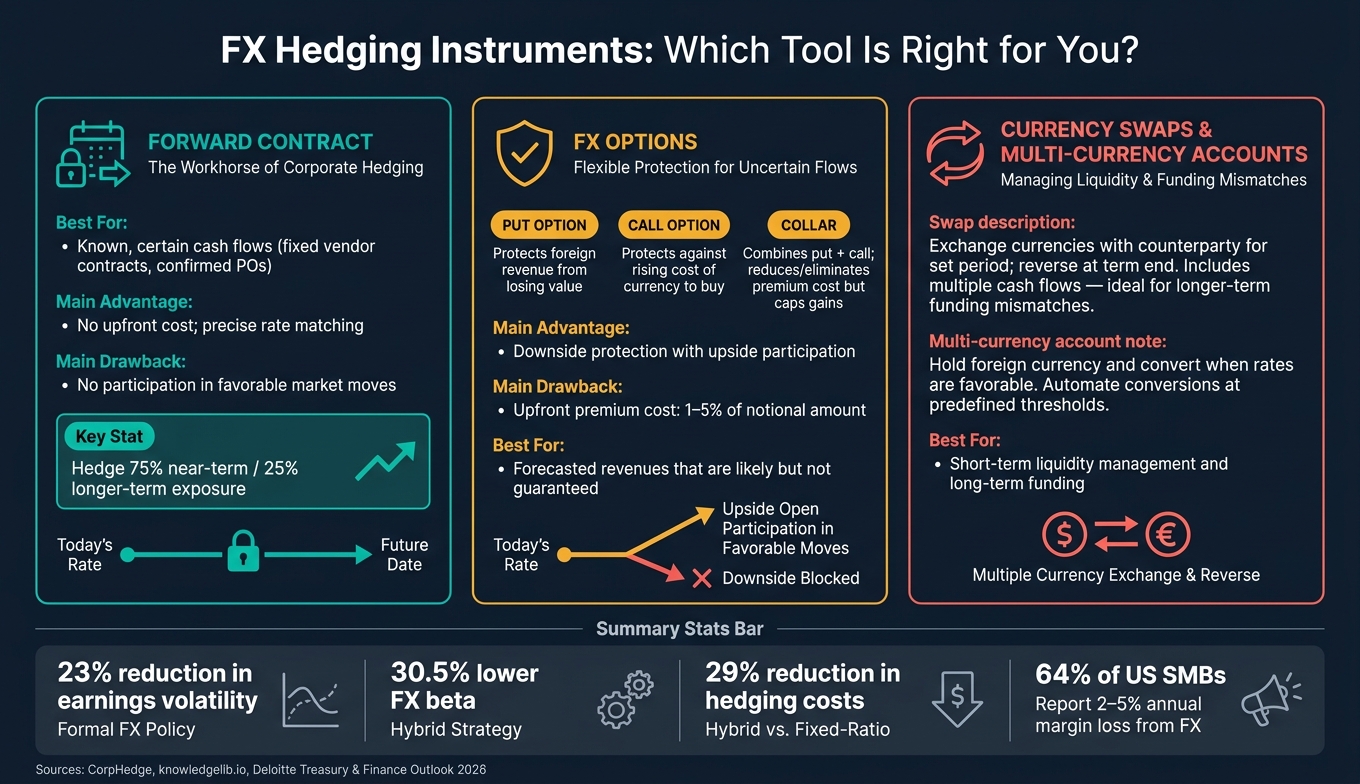
FX Hedging Instruments Compared: Forwards, Options & Swaps
Once your risk limits are established and integrated into daily operations, the next step is selecting the right tools to manage your hedges. For most businesses and traders, the most practical instruments include forward contracts, FX options, and currency swaps. Each serves a unique purpose, and understanding when to use each one can make a big difference.
Using Forward Contracts
A forward contract is an agreement between two parties to exchange a specific amount of currency at a predetermined rate on a future date. Essentially, it locks in today's exchange rate for a future transaction. These contracts are customizable, allowing you to align the settlement date and amount with your invoices or payables. This adaptability has earned forwards the nickname "workhorse" of corporate hedging.
However, locking in a rate comes with trade-offs. If the market moves favorably, you won't benefit. For instance, if you lock in EUR/USD at 1.08 and the dollar weakens to 1.12, you're still bound to the 1.08 rate. This trade-off is the cost of predictability. Forwards are ideal for managing highly certain cash flows, such as fixed vendor contracts, confirmed purchase orders, or legally binding payables.
A good approach is to adopt a rolling layered strategy: hedge around 75% of near-term exposure and 25% of longer-term exposure. Hedging 100% could be risky if cash flows change unexpectedly.
"The goal is not to eliminate FX risk but to reduce earnings volatility to an acceptable level at a proportional cost." - knowledgelib.io
For businesses with Forex algo trading systems, using a Forex VPS to manage forward contracts ensures continuous monitoring, even during market volatility or off-hours.
While forward contracts are great for locking in rates, FX options offer a more flexible approach for uncertain cash flows.
Using Options for Flexible Protection
FX options provide flexibility for managing currency risks when future exposures are less certain. These instruments give you the right - but not the obligation - to exchange currency at a set rate before or on a specific date. Unlike forwards, options allow you to benefit from favorable market movements. However, this flexibility comes with an upfront premium, typically 1%–5% of the notional amount.
- A put option protects against a currency you're receiving losing value, making it useful for foreign revenue.
- A call option protects against a currency you need to buy becoming more expensive.
- A collar combines both by purchasing a put and selling a call, which reduces or eliminates the premium cost but caps potential gains.
Here’s a quick comparison of these instruments to help you decide:
| Instrument | Best For | Main Advantage | Main Drawback |
|---|---|---|---|
| Forward Contract | Known, certain cash flows | No upfront cost; precise matching | No participation in favorable moves |
| FX Option | Uncertain forecasts or sales | Downside protection with upside kept | Upfront premium (1–5%) |
| Collar | Cost-conscious protection | Reduced or zero net premium | Caps potential gains |
Options are particularly useful for forecasted revenues that are likely but not guaranteed, such as pending contracts or seasonal sales. If the expected deal doesn’t materialize, you can simply let the option expire without being locked into an unfavorable transaction.
Using Currency Swaps and Multi-Currency Accounts
A currency swap involves exchanging currencies with a counterparty for a set period, followed by reversing the transaction at the end of the term. Unlike forward contracts, swaps include multiple cash flows throughout the agreement, making them suitable for managing both short-term liquidity and longer-term funding mismatches.
Multi-currency accounts can complement swaps by allowing you to hold foreign currency instead of converting it immediately. This gives you the flexibility to convert when exchange rates are more favorable. Multi-currency accounts are especially helpful for businesses with recurring inflows in various currencies. Using VPS-based execution, you can automate conversions when rates hit predefined thresholds.
Diversifying Currency Exposure and Strengthening Infrastructure
Diversifying Currency Exposure
Stay online and closer to execution. Choose a VPS location for CME futures, New York markets, London FX, API trading, and more.
Host your platform near the market route that matters.
CHINYCLONFrom $59.99/mo
CHI/CME futuresNYC/US marketsLON/FX EAsDUB/PolymarketAMS/EU FXFRA/Central EUTYO/APAC cryptoHedging tools like forwards and options work best when combined with a broader strategy of diversification. Relying heavily on a single currency for revenue or trading can be risky. By spreading operations across multiple currencies and regions, you can shield your position from the impact of sharp movements in any one currency.
Natural hedging is one approach, where revenues and expenses are matched in the same currency. While this method reduces the need for external instruments and keeps costs low, it’s not always perfect or comprehensive.
Another effective tool is netting. This involves consolidating payables and receivables across subsidiaries before engaging the market, which reduces gross exposure without any direct cost. Studies suggest that combining natural hedges with derivatives in a hybrid strategy can cut FX beta by 30.5% and reduce overall hedging expenses by 29%.
Here’s a breakdown of diversification methods and their pros and cons:
| Method | Best For | Advantage | Drawback |
|---|---|---|---|
| Natural Hedge | Companies with matching cash flows | Low cost; reduces exposure at the source | Often incomplete; operationally limited |
| Netting | Firms with multiple subsidiaries | Zero-cost gross exposure reduction | Requires centralized treasury coordination |
| Geographic Diversification | Multinational businesses | Lowers concentration risk across regions | Complex to manage and execute |
| Dynamic Hybrid | Companies with multi-currency exposure | Maximizes cost efficiency (29% savings) | High implementation complexity |
Additionally, diversifying counterparty relationships is essential. Relying on a single bank for hedging can leave you vulnerable if that institution faces liquidity issues during market stress. Building relationships with at least three major banks, along with alternative platforms, ensures you can execute your hedges even under challenging conditions.
A well-rounded currency exposure strategy works best when paired with a strong, reliable infrastructure.
Building Reliable Infrastructure and Operational Controls
Once you’ve diversified your currency exposure, the next step is ensuring you optimize your trading server performance to support it. Even the best strategies can fail if operational controls and systems aren’t up to par. For traders using automated systems, a server outage during a volatile market session can lead to missed stop-losses, unexecuted trades, and significant financial losses.
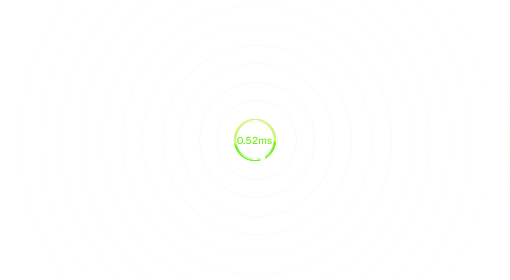
This is where a dedicated trading VPS becomes essential. For example, QuantVPS offers a verified round-trip latency of just 0.52ms to CME Group’s matching engines in Chicago. With a 99.999% uptime SLA, this translates to less than five minutes of downtime annually. On May 22, 2026, QuantVPS infrastructure supported $12.51 billion in futures trading volume over a single 24-hour period.
"Most traders don't lose money because of bad strategies - they lose because of bad infrastructure." - QuantVPS Review
Automated backups are another critical feature. They allow for quick recovery, so you’re back online in minutes, not hours. Pair this with dedicated IP addresses and multi-layered DDoS protection to secure your trading environment and avoid the resource limitations of shared hosting. Implementing version control systems, like Git, for your trading strategies adds an extra layer of security by tracking changes over time.
Monitoring, Backtesting, and Refining Your Strategies
A solid infrastructure sets the stage for continuous improvement. Currency risk management isn’t a “set it and forget it” process. Markets evolve, correlations shift, and strategies that worked last quarter might falter today. Regular monitoring - ideally on a weekly basis - helps ensure your hedges remain effective as market conditions change.
Backtesting is a key part of refining your approach. By running your strategies against historical data, you can identify potential weaknesses before committing real capital. Advanced simulation engines can model scenarios minute-by-minute, accounting for spreads, swap costs, and leverage. Stress testing for extreme events, such as sudden 10–15% currency shifts caused by sanctions or tariffs, is equally important. Monte Carlo simulations further enhance this process by testing your strategy under a wide range of randomized market conditions.
QuantVPS supports these tasks seamlessly. Its dedicated computing resources, featuring AMD EPYC processors and NVMe PCIe 4.0 storage with read/write speeds of up to 3,500 MB/s, ensure backtesting doesn’t interfere with live trading. Real-time dashboards provide live price tracking and rebalancing alerts, keeping you informed as exposures shift. And with 40Gbps network bandwidth, you won’t face data bottlenecks during high-volatility periods.
Conclusion: Protecting Against Currency Volatility
Managing foreign exchange risk isn't something you set and forget - it requires consistent attention and refinement. The strategies outlined here work best as a cohesive system: identifying exposures, establishing clear risk limits, using a mix of forwards and options for hedging, diversifying across currencies and counterparties, and keeping a close watch on your positions.
By combining exposure mapping, well-defined risk limits, and a variety of hedging tools, you can create a strong framework for managing FX risk.
Research backs this up: businesses with formal FX policies see a 23% reduction in earnings volatility, while hybrid strategies reduce FX beta by 30.5% and lower overall costs by 29%.
"The biggest mistake is treating your FX program as a one-time setup rather than an ongoing discipline." - CorpHedge
Successful risk management isn’t just about having the right strategy - execution matters just as much. Relying on standard desktop setups won’t cut it when you need 24/7 reliability. Automated hedging programs must operate seamlessly, especially during geopolitical events or central bank announcements that can impact markets overnight or on weekends. QuantVPS servers in New York and London are strategically placed at major forex liquidity hubs, offering low-latency forex execution with sub-1ms speeds and 99.999% uptime. This ensures your hedges execute precisely when needed, avoiding costly delays.
As Daniel Mercer aptly puts it, "The best hedge is often the one you can explain in one sentence to your CFO, board, or trading partner". Keep your strategy straightforward, invest in reliable infrastructure, and regularly adapt to shifting market conditions.
FAQs
How do I choose the right hedge ratio for my business?
To find the right hedge ratio, it’s all about balancing risk protection with potential profits and costs. Many companies typically hedge 50-80% of their currency exposure, depending on how much risk they’re willing to take and how confident they are in their forecasts.
- Higher hedge ratios (closer to 80%): These can help minimize volatility but often come with higher costs.
- Lower hedge ratios (around 50%): These leave room for potential gains but offer less protection against market swings.
It’s essential to regularly revisit your hedge ratio as market conditions shift, ensuring it continues to align with your financial objectives.
When should I use forwards vs. options vs. swaps?
When managing currency exposure, your choice of tools depends on your goals and circumstances:
- Forwards are ideal when you need certainty. They lock in a fixed exchange rate, ensuring you know exactly what you'll pay or receive. However, they also eliminate any chance of benefiting from favorable currency movements.
- Options offer greater flexibility. If your cash flows are uncertain, options let you hedge against unfavorable shifts while still allowing you to capitalize on potential gains. Keep in mind, though, that options come with a premium cost.
- Swaps are suited for long-term or strategic needs. They help manage ongoing exchange rate risks or make adjustments to your portfolio's exposure over time.
Each of these tools serves a distinct purpose, so the right choice depends on your specific financial objectives and risk tolerance.
How do I hedge forecasted (not guaranteed) FX cash flows?
To manage forecasted FX cash flows, it's essential to follow a structured, rule-driven method. Begin by translating your forecasts into an exposure model, broken down by currency and specific dates. From there, adopt a fixed schedule for layering and rolling hedges, usually covering around 50-80% of the identified exposure. Make it a point to regularly review and adjust your positions in response to updated forecasts and shifting market conditions. This approach helps maintain consistency while navigating uncertainties effectively.