Running algorithmic trading systems at home can be risky due to power outages, internet disruptions, or system crashes. A Virtual Private Server (VPS) solves this by offering 24/7 uptime, faster execution speeds, and proximity to major financial exchanges.
Here’s what you need to know:
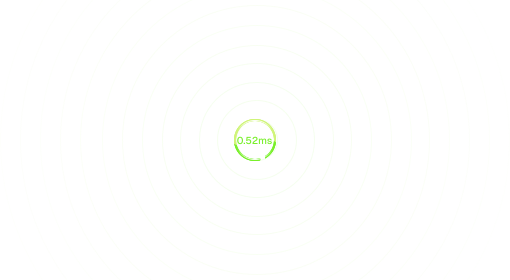
- Low latency is crucial for strategies like scalping or high-frequency trading. VPS providers located near exchange hubs like CME in Aurora, Illinois, offer execution times as low as 0.52ms.
- Reliability matters. Top VPS providers guarantee uptime between 99.99% and 99.999%, minimizing interruptions.
- Hardware performance includes high-speed processors (e.g., AMD Ryzen or Intel Xeon), NVMe SSDs, and fast network connections.
Key providers include:
- QuantVPS: Best for CME futures traders with <0.52ms latency.
- Beeks Financial Cloud: Tailored for institutional clients, offering 0.8ms latency to CME.
- AWS, Google Cloud, Microsoft Azure: Flexible global platforms but with higher latency (10–30ms).
- Budget options like Vultr, DigitalOcean, and Contabo: Affordable but less ideal for ultra-low latency needs.
For CME futures or high-frequency trading, prioritize servers located directly near exchanges. For forex or multi-asset strategies, providers with New York or London servers are better. Choose based on your trading strategy, latency needs, and budget.
Course Algorithmic Trading: Set Up a VPS Server and Secure your Trading Robots
Every millisecond counts when your automated trading bot places orders in fast-moving futures and stock markets. A delayed execution can turn a winning trade into a loss. This article guides you through selecting the best low-latency VPS for algorithmic trading, helping you run automated strategies reliably while minimizing execution delays.
A specialized trading VPS becomes your competitive edge. Our Quant VPS offers server solutions designed for traders who need consistent uptime, proximity to major exchanges, and lightning-fast response times that separate profitable algorithms from underperforming ones. The right VPS infrastructure ensures your strategies execute as intended, without the lag of standard hosting services.
Summary
- Every millisecond of execution delay can turn a profitable algorithmic trade into a loss, especially in high-frequency strategies where spreads close in seconds. Matching your VPS location to your broker's data center reduces latency from double-digit milliseconds to sub-millisecond ranges. When your server sits in Equinix NY4 and your broker hosts in the same facility, round-trip ping times drop dramatically compared to cross-continental routing.
- Algorithmic traders process over $423 billion in trades monthly, and most of that volume depends on infrastructure that remains stable during volatile market conditions. A 99.9% uptime SLA still permits 8.76 hours of annual downtime, and if those hours occur during NFP releases or Fed announcements, your strategy sits idle while markets move. Providers that define uptime specifically during trading hours offer more meaningful protection than calendar-based guarantees.
- Resource allocation should match your strategy's actual workload, not the cheapest available plan. A single EA on one currency pair may run adequately on 2 GB of RAM, but a portfolio of 10 EAs across 15 pairs, recalculating indicators every second, will fail on anything less than 4 GB of RAM with multi-core processing. Choosing plans based on price rather than computational demand creates bottlenecks that erase the edge your algorithm was built to capture.
- Trial periods with full production specifications prevent costly mismatches between your bot and the hosting environment. Testing with the exact CPU cores, RAM allocation, and network configuration you'll use in live trading reveals execution consistency, tick reliability, and platform stability before you commit capital. Validation periods that mirror actual trading conditions expose infrastructure weaknesses that only appear under market volatility.
- Scalability determines whether your infrastructure evolves with your strategy or forces complete rebuilds. As you add currency pairs, increase position sizes, or layer additional EAs, the ability to upgrade RAM or CPU cores without server migration prevents operational disruption. Providers that support in-place resource scaling let your VPS grow alongside your algorithmic approach instead of becoming a constraint.
- QuantVPS provides low-latency servers positioned near major broker hubs with the flexibility to scale resources as algorithmic strategies expand beyond initial configurations.
Best VPS for Algorithmic Trading: Top Low-Latency Servers for Futures & Stocks
1. QuantVPS
QuantVPS operates data centers in Chicago and New York, strategically located to cater to futures and equities traders who need ultra-fast execution speeds. The Chicago facility is positioned right next to CME Group's matching engines, while the New York site is optimized for stocks, options, forex, and crypto trading. This smart placement minimizes the physical distance between servers and exchanges, cutting down on order transmission time.
Latency to Exchanges
The Chicago data center delivers 0.52ms round-trip latency to CME Group, thanks to direct fiber-optic cross-connects. By eliminating unnecessary network hops, it reduces delays and slippage risks. For traders using NinjaTrader bots on instruments like E-mini S&P 500 or crude oil contracts, this speed ensures more precise order fills at desired price levels. Meanwhile, the New York servers offer 1–2ms latency to major equities, futures, forex, and crypto exchanges, making them ideal for traders running multi-asset algorithmic strategies.
On December 16, 2025, traders using QuantVPS executed over $16.44 billion in volume within a single day. This staggering number highlights how much algorithmic traders depend on the platform's speed for high-frequency and scalping strategies. Such performance is made possible by the platform's advanced infrastructure and strategic server placements.
Server Locations
The Chicago facility is tailored for CME futures traders, offering direct connectivity to the exchange's matching engines via dedicated fiber lines. On the other hand, the New York location provides access to a wider range of markets, maintaining servers within 1–2ms of equities, options, forex, and crypto order routing systems. Both locations uphold a 99.999% uptime guarantee , which translates to less than six minutes of downtime per year - critical for automated trading systems that need to run around the clock.
Hardware Specifications
QuantVPS backs its strategic locations with top-tier hardware designed for trading performance. The servers are powered by high-performance AMD EPYC and Ryzen processors, paired with NVMe SSDs and high-speed RAM. This setup ensures that even the most compute-intensive algorithms can run without delays caused by processing bottlenecks. The network infrastructure includes 1Gbps+ connections with 10Gbps burst capability, ensuring smooth data flow even during periods of high market volatility. Servers come pre-configured with Windows Server 2022, optimized for trading platforms like NinjaTrader, MetaTrader 4/5, Sierra Chart, and Quantower.
Uptime and Reliability
QuantVPS has been rigorously tested by AlgoTradingSystems.net and emerged as a "clear winner" in network evaluations, which included jitter analysis, soak tests, and hop counts to trading endpoints. The service is designed to avoid unexpected system restarts during maintenance, ensuring uninterrupted operation for automated strategies.
"QuantVPS does not restart your system unexpectedly on weekends or maintenance windows, leaving you with a server and platform offline! 24/7 Operation and availability allows our AFT Server edition and automation tools to start, download data, and trade unattended." – AlgoTradingSystems.net
QuantVPS also boasts an "Excellent" Trustpilot rating and offers 24/7 US-based technical support through live chat and a ticket system. To protect trading operations, the platform provides enterprise-grade DDoS protection and advanced firewall rules.
2. Beeks Financial Cloud
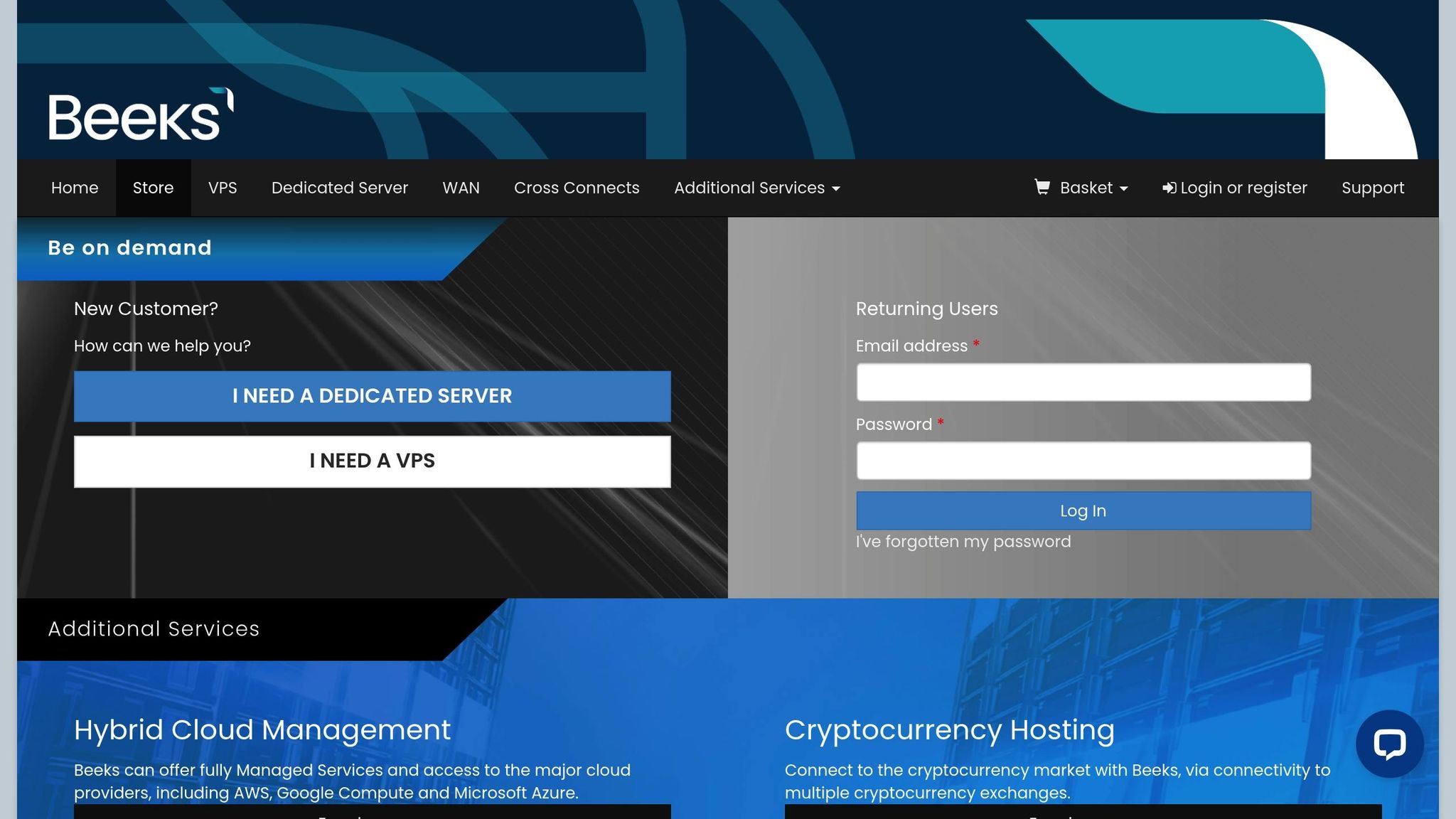
Beeks Financial Cloud serves institutional clients like hedge funds, proprietary trading firms, and regulated organizations that need top-tier infrastructure. The company operates out of high-performance data centers, including Equinix CH1 in Aurora, Illinois, which is home to CME Group's electronic trading engines. This setup is specifically designed to deliver ultra-low latency and high stability - key requirements for algorithmic trading.
Latency to Exchanges
Beeks achieves an impressive 0.8ms round-trip latency to CME’s matching engines in Aurora. This is possible because their servers are located directly within the exchange’s infrastructure, cutting out unnecessary network hops. For reference, the latency from New York to Aurora is approximately 15–25ms, due to the 1,300-kilometer distance. Such low latency highlights Beeks’ ability to meet the demanding performance standards of institutional trading.
Server Locations
The Equinix CH1 facility in Aurora is Beeks’ main hub for CME futures trading. Aurora, located about 40 miles west of downtown Chicago, is where CME Group processes over 3 billion contracts annually.
Hardware Specifications
Beeks provides standard server configurations that include 4 dedicated CPU cores, 8GB of RAM, and NVMe storage. Dedicated CPU cores prevent slowdowns caused by shared resources, while NVMe storage ensures faster data access compared to traditional SSDs. This combination is ideal for running complex, compute-heavy trading algorithms without delays. Beyond the hardware, Beeks also prioritizes uptime, ensuring consistent and reliable performance.
Uptime and Reliability
With its robust infrastructure, Beeks delivers enterprise-level reliability and stability. The platform is described as "technically superior" for institutional clients, addressing their need for dependable operations. Pricing starts at $150 per month, reflecting the high standards and compliance requirements necessary for regulated firms.
3. AWS (EC2)
AWS's EC2 platform provides a global network of scalable and flexible resources, making it a top choice for algorithmic trading. With data centers spread across the world, AWS offers the infrastructure traders need to handle enterprise-level operations and ensure redundancy.
Server Locations
AWS strategically places its servers near key financial hubs, ensuring traders can operate close to major exchanges. The platform spans 33 regions globally, with several positioned to serve critical trading markets. For those trading CME futures, the US East (Ohio) region or AWS Chicago Local Zones provide proximity to Equinix's facilities in Aurora, Illinois (CH1, CH2, CH4). Stock traders targeting the NYSE or NASDAQ should consider US East (N. Virginia) or deploy in New York/Newark Local Zones, aligning with exchange infrastructure in Secaucus and Carteret.
European traders can benefit from EU West (London) for access to the LSE with latency as low as 0–1ms or EU Central (Frankfurt) for DAX and Eurex markets. Meanwhile, those trading in Asian markets are well-served by Asia Pacific (Tokyo) for the TSE and Asia Pacific (Singapore) for SGX.
Latency to Exchanges
Latency is a critical factor in trading, and geographic distance plays a significant role. For example, trading CME futures from AWS servers in US East (N. Virginia) results in a latency of 15–25ms due to the 1,300-kilometer distance to Aurora. In contrast, servers located directly in Equinix Aurora achieve much faster round-trip times of 0.3–0.8ms. To minimize latency, traders must carefully choose AWS regions that align with their target exchanges. These considerations make the hardware setup, discussed below, even more important.

Run 24/7 while you sleep. Keep bots, platforms, and trade copiers online on a dedicated VPS.
Low-latency VPS hosting for your trading platform.
 CHINYC
 LON
LONFrom $29.99/mo


 CHI/CME futuresNYC/US marketsLON/FX EAs
 DUB/Polymarket
 AMS/EU FX
 FRA/Central EU
 TYO/APAC crypto
Hardware Specifications
AWS's compute-optimized instances, such as C5, C6i, and C7g, are ideal for trading workloads that rely heavily on high CPU speeds. Since many trading algorithms are single-threaded, instances with base CPU frequencies of 3.0 GHz or higher are recommended. For storage, NVMe SSDs deliver sub-millisecond read/write performance, ensuring fast data access. Additionally, memory configurations range from 4GB to hundreds of GB, providing the capacity to handle complex backtests and multiple live data feeds simultaneously.
Uptime and Reliability
AWS guarantees 99.99% uptime under its Service Level Agreement, which equates to about 52 minutes of potential downtime per year. While this level of reliability meets the needs of most users, professional trading environments often require even higher standards, such as 99.999% uptime, to ensure continuous operation of trading strategies. AWS achieves its 99.99% uptime through built-in redundancy across its infrastructure, offering a reliable foundation for traders.
4. Google Cloud
Google Cloud's global network is designed to deliver lightning-fast and scalable performance, making it a strong choice for algorithmic trading. Its C3 instances boast node-to-node latencies as low as 18 microseconds (0.018ms) - an impressive 50% improvement over earlier generations. This focus on low latency and high performance aligns with the demands of automated trading systems.
Server Locations
To ensure minimal latency, Google Cloud taps into its extensive global infrastructure. The platform operates in 33 regions, strategically positioned to serve key trading markets. For example, US Central (Iowa) supports CME traders, while US East (Northern Virginia) connects to New York markets. European traders benefit from regions in London and Frankfurt, and Asian hubs like Tokyo and Singapore cater to markets in that area.
Hardware Specifications
The C3 compute-optimized instances are powered by Intel's 4th generation Xeon Scalable processors, running at base frequencies above 3.0 GHz. These processors are ideal for single-threaded trading algorithms that require high-speed execution. Storage is handled by Hyperdisk Extreme, which delivers up to 500,000 IOPS per instance - a 25% speed boost over previous offerings. With network speeds reaching 200 Gbps, these instances far outpace typical on-premise setups. Memory configurations range from 4GB to hundreds of GB, making them capable of handling complex backtesting and multiple live data feeds simultaneously.
"Titanium-powered C3 VMs with Hyperdisk Extreme now support 500K IOPS per compute instance... that's 25% faster IOPS per instance compared to the other two leading hyperscalers." - Google Cloud Blog
Uptime and Reliability
Google Cloud complements its technical capabilities with features designed to ensure uninterrupted trading operations. Live Migration technology allows virtual machines to move between physical hosts without downtime - an essential feature for 24/7 trading. Traders also receive Advanced Maintenance notifications a full seven days in advance, enabling them to delay updates during critical market periods. Additionally, Compact Placement Policies group instances within the same rack to reduce network hops and jitter, ensuring consistent performance (with a max-distance value of 1).
5. Microsoft Azure
Microsoft Azure offers a globally distributed infrastructure, making it a solid choice for algorithmic traders who need worldwide access and flexible scalability. While it's not tailored for sub-millisecond latencies, Azure provides the computing power and dependability necessary for handling complex, multi-market strategies.
Server Locations
Azure's data centers are strategically positioned near key financial hubs, catering to the needs of algorithmic traders. For those trading on New York-based exchanges like the NYSE and NASDAQ, Azure's East US (Virginia) and East US 2 (Virginia) regions are ideal. Traders targeting CME Group's Aurora, Illinois data center can use Central US, though it introduces higher latency compared to solutions located directly adjacent to the exchange. European traders can rely on UK South (London) and Germany West Central (Frankfurt) for markets like the LSE and DAX. Meanwhile, Southeast Asia (Singapore) and Japan East (Tokyo) serve those operating in Asian market hours.
Hardware Specifications
Azure's FX-series virtual machines are well-suited for high-frequency trading algorithms. These machines are powered by Intel Xeon processors, boasting base clock speeds of over 3.0 GHz and burst capabilities of up to 5.7 GHz, ensuring rapid execution. Storage options include NVMe SSDs for lightning-fast data access, while DDR5 RAM configurations provide low-latency memory performance. Network throughput on premium instances can reach up to 100 Gbps, making these configurations ideal for maintaining seamless and efficient trading operations.
Uptime and Reliability
Azure ensures reliability with a 99.99% uptime SLA for multi-zone deployments, which equates to less than 53 minutes of downtime annually. Its Availability Zones are designed to distribute workloads across physically separate data centers within the same region, minimizing the risk of single points of failure. For algorithmic traders, this level of reliability means that strategies can keep running smoothly, even during hardware updates or localized disruptions.
6. Vultr
Vultr is a cloud hosting provider often chosen by algorithmic traders, though it’s not specifically designed for ultra-low-latency execution like some specialized trading infrastructures. What makes Vultr appealing is its broad geographic coverage and scalable resources, which make it a cost-effective choice for traders operating across multiple markets. Let’s take a closer look at how Vultr’s global data centers and hardware specifications play a role in trading performance.
Server Locations
Vultr operates data centers across North America, Europe, and Asia. However, none of these are located directly adjacent to major trading exchanges. For instance, futures traders targeting the CME Group in Aurora, Illinois, might consider Vultr’s Chicago data center. While this location is relatively close, it still adds 20-30ms of latency compared to colocated solutions. For equities or forex traders, the New York servers are a viable option. Similarly, the London and Frankfurt locations are well-suited for European trading sessions, while the Singapore and Tokyo data centers cater to Asian markets - though with higher latency due to their distance from exchange hubs.
Hardware Specifications
Vultr’s hardware setup is another factor contributing to its flexibility for algorithmic trading. The platform uses AMD EPYC processors and NVMe SSD storage, providing solid performance for most trading applications. Instances range from 1 GB to 96 GB of RAM, with network speeds reaching up to 10 Gbps on higher-tier plans. For traders using MetaTrader 4 or 5, which typically require 1-2 GB of RAM, Vultr’s entry-level plans are adequate for single-account strategies. However, if you’re running multi-account setups or processing complex datasets, a plan with 4 GB of RAM or more is recommended.
Uptime and Reliability
Vultr guarantees a 99.99% uptime SLA, which translates to roughly 53 minutes of potential downtime per year. While this level of reliability is impressive, the actual performance can vary depending on the server’s location relative to brokers and exchanges. For traders seeking a balance between cost and performance, Vultr’s uptime and hardware capabilities make it a practical choice, even if its latency isn’t as low as exchange-adjacent solutions.
7. DigitalOcean
DigitalOcean provides versatile and flexible cloud resources that are a favorite among algorithmic traders. Unlike hosting services tailored specifically for trading, DigitalOcean offers general-purpose cloud infrastructure, including CPU, RAM, and storage, which traders can customize to fit their strategies. However, traders must carefully evaluate its latency profile to ensure it aligns with their specific trading needs.
Latency to Exchanges
For traders running futures algorithms on the CME Group, DigitalOcean’s New York data centers face a challenge due to their distance from Aurora, Illinois - roughly 800 miles (1,300 km) away. This distance results in a latency of 15–25 milliseconds. While this may not be ideal for strategies like scalping or arbitrage, where milliseconds are critical, it is generally acceptable for swing trading or longer-term algorithms.
Server Locations
DigitalOcean operates data centers in key locations, including New York (NYC1, NYC2, NYC3), London (LON1), Singapore (SGP1), and Frankfurt (FRA1). The New York facilities are well-suited for traders targeting major U.S. exchanges like the NYSE and NASDAQ. The London center supports traders focusing on the London Stock Exchange and forex markets, while the Singapore location caters to those trading during Asian market hours.
Hardware Specifications
DigitalOcean’s virtual servers, called Droplets, feature NVMe SSDs, which are 5–10 times faster than traditional SATA SSDs. These servers come in configurations ranging from 1 GB to 192 GB of RAM, paired with dedicated gigabit network connections. For most MT4/MT5 setups, 2–4 GB of RAM is sufficient, though strategies involving multiple accounts or heavy data usage may require 8 GB or more. When choosing a configuration, prioritize high CPU clock speeds over the number of cores.
Uptime and Reliability
DigitalOcean delivers a 99.99% uptime guarantee, translating to roughly 52 minutes of downtime annually. This level of reliability is suitable for most trading applications. Additionally, the platform’s scalable infrastructure allows traders to upgrade resources as their needs grow. However, for extremely demanding workloads, such as running multiple market strategies simultaneously or processing large volumes of data, a dedicated server may be a better option than a VPS . For most algorithmic traders, though, DigitalOcean provides a dependable and flexible environment to support their trading operations.
8. OVHcloud
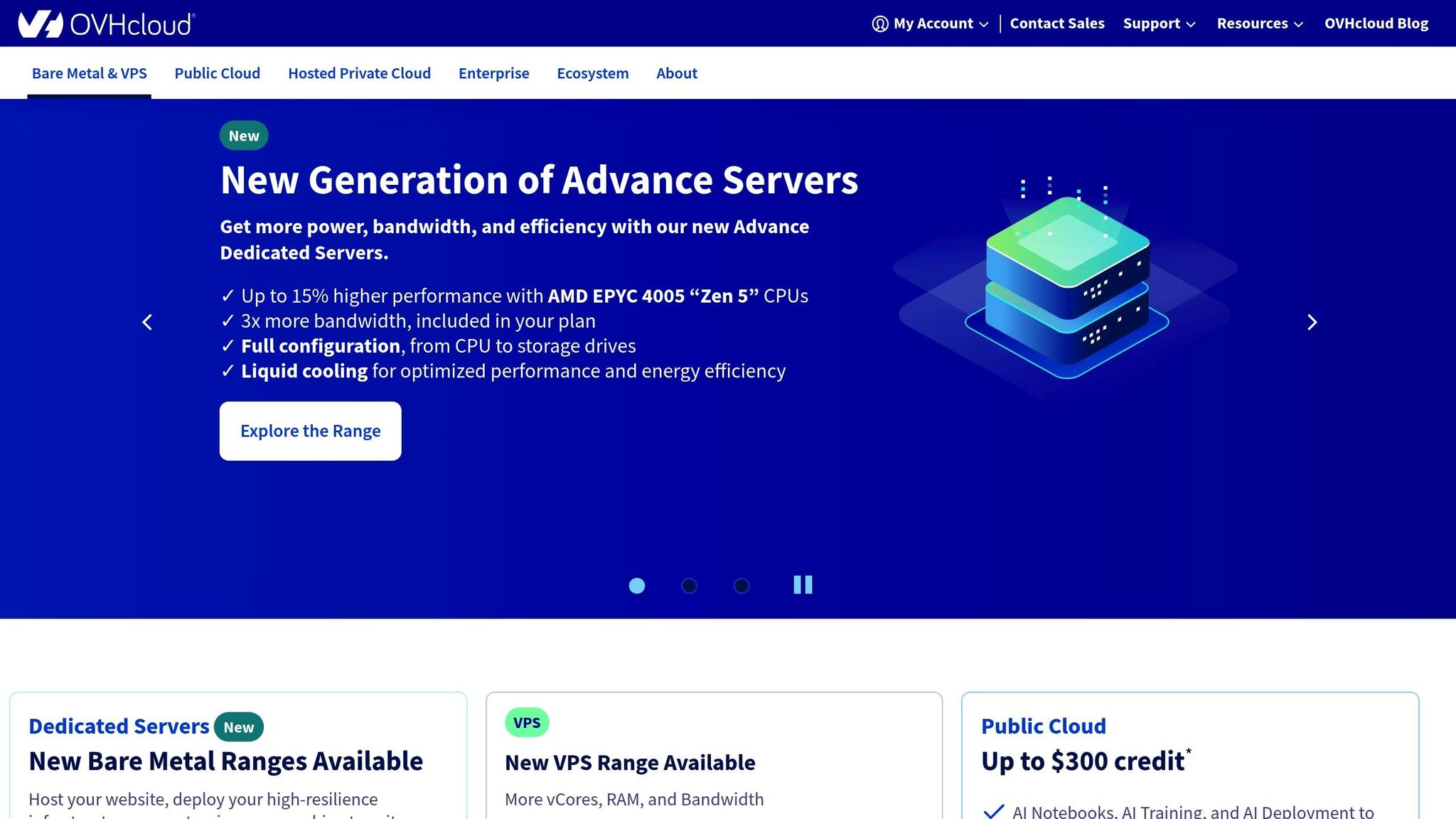
OVHcloud is a French provider offering dedicated server resources and operating a global network of data centers. Its specialized bare metal servers are designed to handle resource-heavy algorithms and multi-account management with ease.
Latency to Exchanges
When it comes to latency, OVHcloud faces some challenges. For example, the absence of a Chicago data center makes it less ideal for futures traders targeting the CME Group in Aurora, Illinois. The closest OVHcloud facility in North America is in Beauharnois, Quebec, which isn't colocated with CME's matching engines. This results in latencies ranging from 20–40 milliseconds. In contrast, top-tier trading VPS providers can achieve latencies as low as 0.52 milliseconds to CME.
Similarly, OVHcloud's Vint Hill, Virginia data center is located 200–300 miles away from NY4 in Secaucus, New Jersey. This distance leads to higher latency compared to servers based directly in New York. However, for European traders, OVHcloud's London data center (LHR/Erith) offers better proximity to LD4 and the London Stock Exchange, making it a reasonable option for those markets.
These geographic placements play a significant role in OVHcloud's latency profile and overall suitability for specific trading needs.
Server Locations
OVHcloud operates data centers across several regions, including North America, Europe, and Asia-Pacific. Some of its key locations are:
- Vint Hill, Virginia
- Beauharnois, Quebec
- London (Erith)
- Frankfurt
- Singapore
Hardware Specifications
On the hardware front, OVHcloud delivers strong performance. Its Advance, Scale, and High Grade server ranges are equipped with high-performance processors, including AMD EPYC and Intel Xeon Gold series. These bare metal servers are built to handle real-time market data processing and order execution efficiently. Since they are dedicated servers, they avoid the resource-sharing issues often found in VPS environments, ensuring consistent CPU performance.
Uptime and Reliability
OVHcloud guarantees 99.99% uptime, translating to about 52 minutes of potential downtime annually. Its redundant network design and multiple data center locations help ensure uninterrupted operation. However, while the uptime is reliable, the latency challenges highlight the importance of choosing server locations that align with your specific trading strategies and market focus.
9. Contabo
Contabo stands out as a cost-effective VPS provider, ideal for traders who prioritize affordability and flexibility over ultra-fast execution. With 9 data centers spread across North America, Europe, Asia, and Oceania, Contabo offers traders the option to choose server locations that best suit their geographic and trading needs.
Server Locations
For traders in the United States, Contabo provides two key data center options. The New York City (US East) location offers an impressive latency of just 3 milliseconds within the NYC metro area, making it a solid choice for equities and forex trading. Meanwhile, the St. Louis (US Central) location connects to Chicago with an 18-millisecond latency. While this isn't fast enough for sub-1ms colocation setups, it works well for lower-frequency trading strategies where ultra-precise execution isn't critical.
Hardware Specifications
Contabo's VPS plans offer a lot of power for the price. Take the VPS L plan, for example - it includes 8 vCPU cores, 30 GB of RAM, 200 GB of NVMe storage, and 600 Mbit/s network bandwidth. If you need more, the VPS XL plan steps it up with 10 vCPU cores, 60 GB of RAM, 400 GB of NVMe storage, and 1 Gbit/s connectivity. These configurations are well-suited for tasks like running intensive backtests, managing multiple data feeds, and handling multi-account setups. For traders who don't need ultra-low-latency performance, Contabo provides a great balance between cost and capability.
Uptime and Reliability
One potential drawback of Contabo's shared virtualization setup is the "noisy neighbor" effect. This happens when other users on the same physical server consume excessive resources, leading to occasional CPU spikes and latency fluctuations. For traders running 24/7 algorithmic strategies, especially high-frequency or scalping bots, this instability could disrupt execution timing. However, for lower-frequency trading strategies that can handle occasional performance hiccups, Contabo remains a viable and affordable choice.
10. Kamatera
Kamatera stands out as a cloud hosting provider offering flexibility and customizable solutions, making it a solid choice for algorithmic traders. Unlike VPS providers tailored specifically for trading, Kamatera operates as a general cloud platform with a global presence. It boasts 18 data centers worldwide, including major financial hubs like Chicago, New York, London, and Tokyo. This extensive network allows traders to access competitive performance across various markets.
Server Locations
Kamatera's Chicago data center is ideal for traders seeking proximity to the CME, while its New York location is optimized for equities and options trading. This strategic positioning ensures traders can place their servers near key broker execution engines for better performance.
Hardware Specifications
Kamatera allows traders to customize their hardware configurations, enabling instant scaling of CPU, RAM, and storage to suit their needs. The platform uses Intel Xeon Platinum/Cascade Lake processors running at 2.7 GHz or higher, combined with NVMe SSD storage for quick data access. Available configurations range from basic setups with 1 vCPU and 1 GB of RAM to large-scale deployments supporting up to 104 vCPUs and 524 GB of RAM. For traders using platforms like MetaTrader 4 or 5, 1–2 GB of RAM is typically sufficient, but those managing multiple accounts or running resource-heavy backtests may need to scale up to 4 GB or more to avoid slowdowns.
While hardware flexibility is crucial, uptime plays an equally important role in maintaining seamless trading operations.
Uptime and Reliability
For algorithmic traders, uninterrupted uptime is critical. Kamatera guarantees 99.95% uptime across its cloud servers. Tests reveal an average response time of about 3 milliseconds. Although Kamatera advertises "ultra-low latency" through its strategically located data centers, actual latency will depend on the selected location and the broker's infrastructure. While it doesn’t offer sub-1ms colocation options like some specialized futures trading providers, Kamatera's high uptime and consistent performance make it a dependable choice for traders running automated strategies around the clock.
11. Hostinger VPS
Stay online and closer to execution. Choose a VPS location for CME futures, New York markets, London FX, API trading, and more.
Host your platform near the market route that matters.
CHINYCLONFrom $29.99/mo
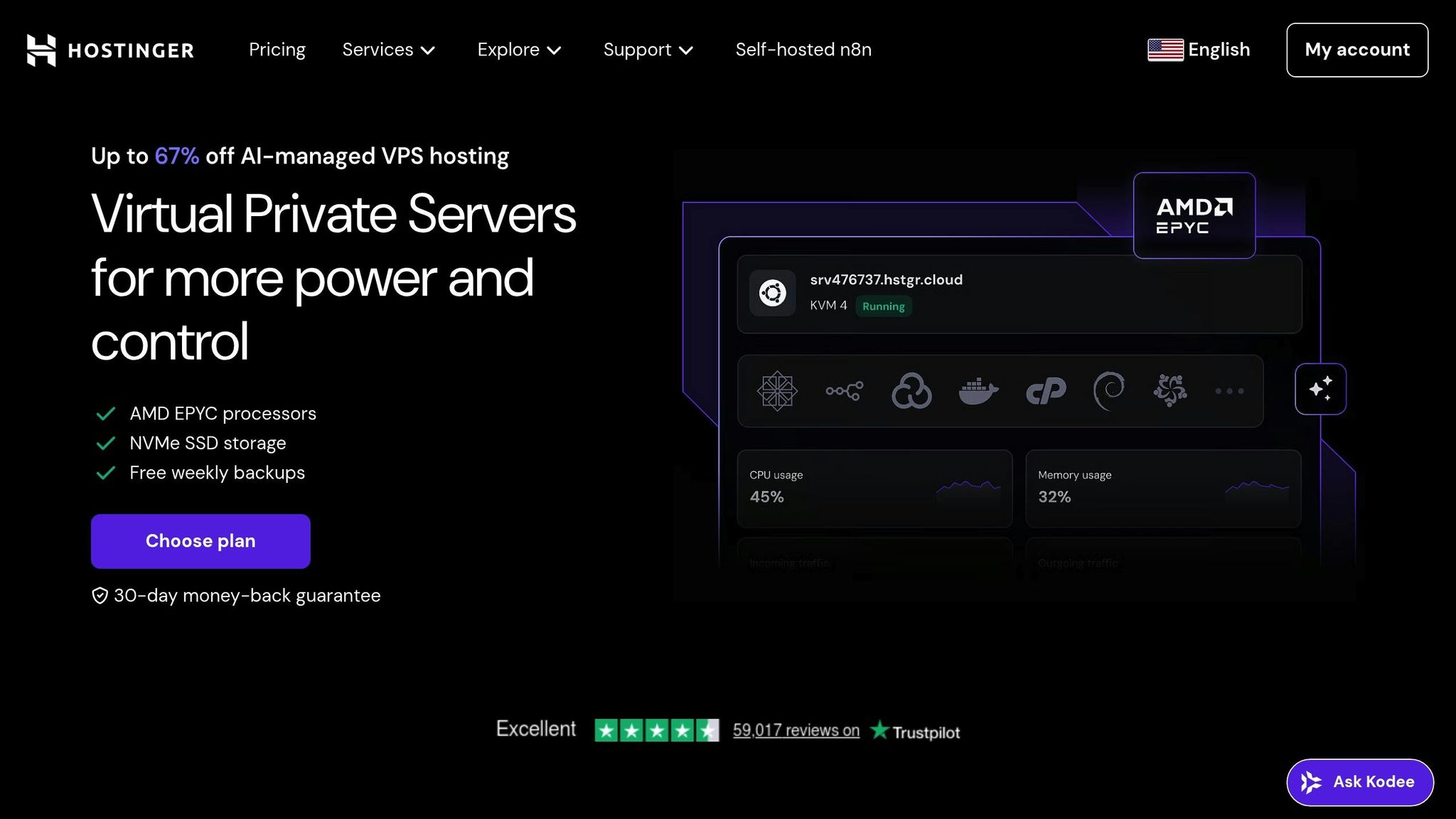
CHI/CME futuresNYC/US marketsLON/FX EAsDUB/PolymarketAMS/EU FXFRA/Central EUTYO/APAC cryptoHostinger VPS provides an affordable option for VPS hosting, catering to users who prioritize cost efficiency over advanced features. It operates on KVM (Kernel-based Virtual Machine) technology, which ensures dedicated hardware resources like RAM and CPU for each user. This setup minimizes the risk of performance dips due to resource sharing on the same physical server. While it offers a solid infrastructure, its server locations are more suited for general hosting rather than proximity to financial exchanges.
Server Locations
Hostinger operates data centers across multiple continents, but they are designed for general hosting needs rather than the ultra-low latency required for high-frequency trading. Unlike specialized trading VPS providers that strategically position servers near key financial hubs - like Aurora, Illinois, close to CME's matching engines at Equinix CH1/CH2/CH4 - Hostinger's facilities are not optimized for such demands. However, for traders using forex expert advisors or strategies where latency under 10 milliseconds isn't critical, Hostinger's broad geographic coverage can still offer decent connectivity to broker servers.
For those who value affordability over ultra-fast execution speeds, Hostinger VPS serves as a practical alternative to the more expensive, exchange-adjacent solutions.
Hardware Specifications
Hostinger VPS plans are powered by AMD EPYC processors and NVMe SSDs, delivering quick disk I/O and strong multi-core performance. These features are essential for handling data-heavy operations, such as real-time market data processing and order execution. For algorithmic trading, systems typically need CPUs with clock speeds of 3.0 GHz or higher and NVMe storage to avoid bottlenecks. Traders with demanding resource requirements should carefully select plans that provide sufficient vCPU and RAM to meet their needs.
Uptime and Reliability
Hostinger promises 99.9% uptime across its VPS plans, supported by redundant systems and a globally distributed network of data centers. However, traders relying on strategies that demand uninterrupted execution may need to consider solutions with even higher uptime guarantees.
12. BeeksFX
BeeksFX is a VPS provider designed specifically for institutional traders, offering enterprise-level infrastructure that meets the demands of dedicated resources and strict compliance requirements. Pricing for their services starts at approximately $150 per month.
Server Locations
BeeksFX operates from Equinix CH1 in Aurora, Illinois, a prime location for traders focused on CME products. This facility is home to the CME electronic trading engines, enabling ultra-low latency connections that are critical for futures trading on products like ES, NQ, GC, and CL.
Hardware Specifications
Each standard configuration includes 4 dedicated CPU cores, 8GB of RAM, and NVMe storage, ensuring rapid data access with sub-millisecond speeds.
Latency to Exchanges
Thanks to its strategic positioning in Aurora, BeeksFX provides an average latency of just 0.8 milliseconds to the CME matching engines. This level of performance is ideal for trading strategies that rely on speed, such as scalping, arbitrage, and high-frequency trading.
Uptime and Reliability
BeeksFX combines speed with stability, delivering the reliability required for institutional trading. With its ultra-low latency of 0.8 milliseconds and a strong focus on regulatory compliance, the service caters to institutional clients who often have in-house technical teams. Support is typically available during business hours, aligning with the operational needs of their clients. This makes BeeksFX a trusted choice for low-latency futures execution.
13. VPSForexTrader
VPSForexTrader is purpose-built for algorithmic traders who want infrastructure optimized specifically for automated trading rather than general cloud hosting. Unlike traditional VPS providers, its servers are deployed inside major financial data centers such as Equinix NY4 and LD4, where many retail and institutional brokers host their own trading infrastructure. When traders select a VPS in the same financial hub as their broker, network latency can fall into the sub-millisecond range, though actual performance depends on the broker's server location and the correct data center selection.
Server Locations
VPSForexTrader focuses on financial infrastructure rather than broad geographic coverage. Its presence in Equinix NY4 and LD4 makes it particularly attractive for forex traders whose brokers operate from New York or London. This close proximity helps minimize execution delays for MetaTrader Expert Advisors and other automated strategies. Since latency depends on matching the VPS location to the broker's servers, traders should verify broker locations before choosing a deployment region.
Hardware Specifications
The platform offers AMD EPYC-powered virtual servers with 3 CPU cores, 4 GB of ECC RAM, 120 GB of high-availability NVMe storage, 1 Gbps networking, and Windows Server pre-installed. These specifications comfortably support multiple MT4 or MT5 terminals running simultaneously, making the service suitable for multi-account strategies and several Expert Advisors operating around the clock. Linux environments are also available on request for traders running hybrid trading workflows.
Uptime and Reliability
Rather than emphasizing raw infrastructure size, VPSForexTrader focuses on execution consistency and trading reliability. Its $0.99 three-day trial allows traders to evaluate broker latency, platform stability, CPU performance, and execution quality before purchasing a full subscription. The platform is designed specifically for continuous automated trading, reducing the amount of server administration typically required with general-purpose VPS providers. For traders seeking a low-maintenance environment optimized for MetaTrader automation, VPSForexTrader offers a strong balance between performance, simplicity, and finance-focused infrastructure.
14. FXVM
FXVM is a specialist trading VPS provider for forex and algorithmic traders, offering low-latency environments for MetaTrader, cTrader, and other trading platforms. Its infrastructure spans multiple global financial hubs, delivering cost-effective specialized hosting without premium enterprise pricing.
Server Locations
FXVM operates 16 server locations worldwide, including dedicated deployments within Equinix LD4 and NY4, two of the most important financial data centers for retail forex trading. This positioning reduces execution latency by placing VPS close to broker servers in Europe and North America, with additional global regions to match traders' broker infrastructure.
Hardware Specifications
All FXVM plans include Windows Server and full Remote Desktop access at no additional cost. The Lite plan suits single-terminal setups, while the Advanced plan offers 4 GB of RAM for multiple MetaTrader terminals or Expert Advisors. The service supports MT4, MT5, cTrader, NinjaTrader, and other Windows-based trading applications.
Uptime and Reliability
FXVM has operated since 2013 and served over 107,000 customers. The company holds ISO 9001 and ISO 27001 certifications for quality management and information security. Traders can test latency through a $0.99 seven-day trial, and FXVM's publicly available broker latency tool helps users identify the best server location. The provider combines low cost, specialist infrastructure, and broker-focused optimization for algorithmic trading.
15. NYCServers
NYCServers is a specialist VPS provider that exclusively hosts in Equinix facilities used by major brokers and liquidity providers. This makes it particularly appealing to forex traders seeking low-latency execution at competitive prices.
Server Locations
NYCServers operates six strategically selected Equinix financial hubs: NY4, LD4, TY3, SG1, HK1, and DUB1. These locations cover major forex trading centers and include broker-based automatic location recommendations during checkout to help traders select the server nearest their broker's infrastructure. Traders requiring locations in continental Europe, Latin America, or additional Asian regions may find fewer deployment options.
Hardware Specifications
NYCServers uses AMD processors paired with DDR5 memory and NVMe storage across all plans. Windows Server comes pre-installed with MT4, MT5, and cTrader, supporting more than 100 brokers. Basic plans start with 2 GB of RAM, though traders running multiple Expert Advisors or terminals may need higher-level plans for additional memory and processing power.
Uptime and Reliability
The provider includes built-in monitoring and alerting features across all plans, helping traders identify issues before they affect automated strategies. NYCServers offers a 14-day money-back guarantee, allowing users to evaluate latency and platform performance with minimal risk.
The company advertises "100% uptime during trading hours," which differs from the continuous 24/7 uptime guarantees offered by traditional cloud hosting providers. Traders should review the service agreement carefully. For traders whose brokers operate in one of NYCServers' supported Equinix hubs, it is among the most affordable specialist VPS options available.
Infrastructure is only half the equation when execution speed determines profitability.
Key Considerations for Choosing a VPS
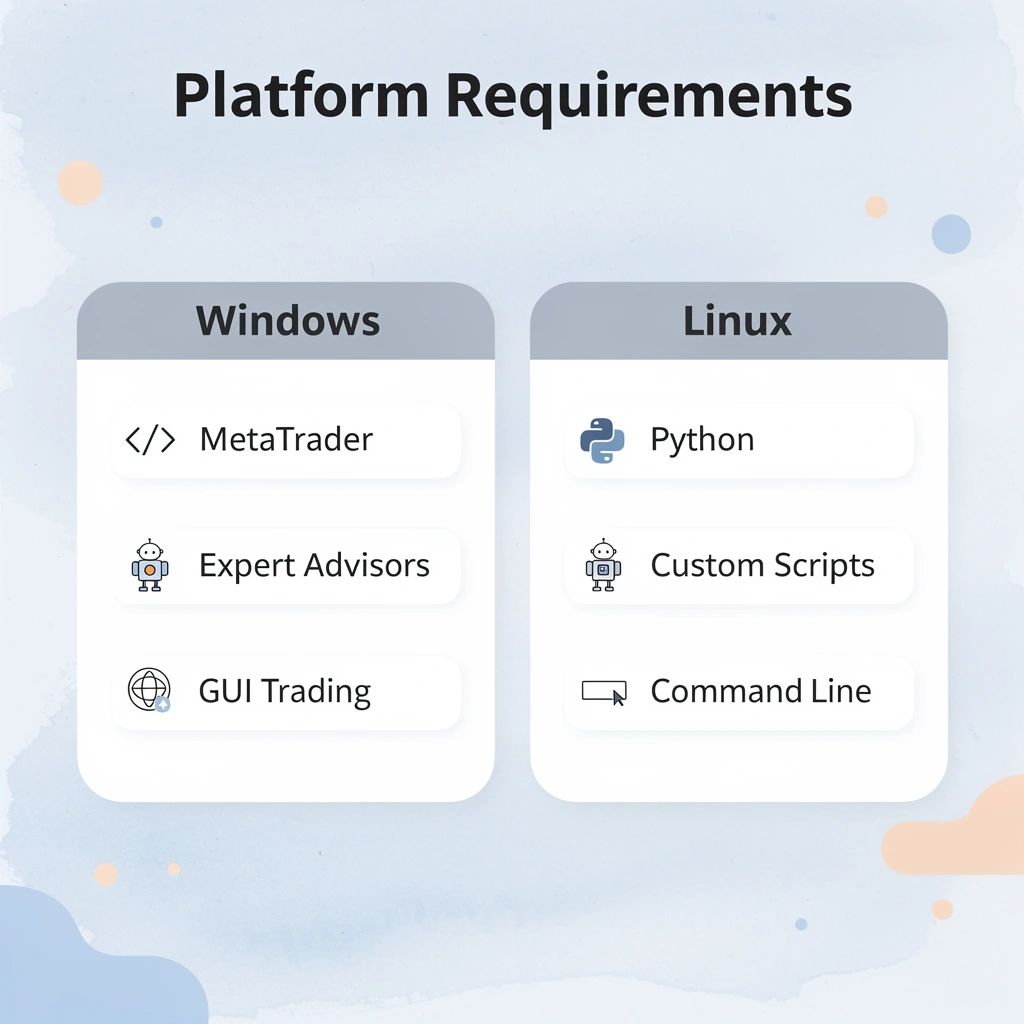
Your VPS choice should match your platform, broker location, and trading strategy. MetaTrader EAs require Windows; custom Python algorithms typically run on Linux. Most providers support both, but verifying compatibility before committing prevents rebuilding mid-campaign.
 🎯 Key Point: Platform compatibility is non-negotiable - choosing the wrong operating system can force you to restart your entire setup and lose valuable trading time.
"85% of algorithmic trading failures stem from infrastructure mismatches rather than strategy flaws." — Trading Technology Research, 2024
 ⚠️ Warning: Don't assume all VPS providers offer the same performance levels - latency differences of even 5-10 milliseconds can significantly impact your trading results in high-frequency strategies.
Matching Your Strategy to the Right Resources
The resources you need depend on what your strategy does, not what sounds impressive. A single EA running on a single pair requires 2 GB of RAM. A portfolio of 10 EAs across 15 currency pairs, each pulling tick data and recalculating indicators every second, requires at least 4 GB and benefits from multi-core processors. Choose a plan based on workload, not price. If your bot slows down during volatile sessions, you've lost the edge you built it for.
Proximity to Your Broker's Server
Latency is the cost you pay for distance. If your broker's server is in Equinix NY4 and your VPS is in Frankfurt, every order travels across the Atlantic before reaching the market. That round trip costs milliseconds, and in high-frequency strategies, milliseconds compound into slippage. Most brokers publish their server locations—match your VPS to the same data center or nearest hub. A 0.3 ms ping beats a 12 ms ping, especially when scalping or arbitraging spreads that close in seconds.
Uptime and the Real Cost of Downtime
Uptime guarantees vary significantly in fine print. A 99.9% SLA allows 8.76 hours of downtime per year, which is problematic if it occurs during NFP or Fed announcements when your strategy sits idle. Look for providers that define uptime specifically during trading hours, not calendar hours. Verify compensation for SLA breaches; a credit on next month's bill won't recover profits lost when your EA goes offline during the London open.
As your strategy evolves—adding pairs, increasing position sizes, and layering in new EAs—infrastructure needs shift. Choose a provider that lets you upgrade RAM or CPU cores without migrating servers or rebuilding your environment. Scalability prevents bottlenecks and lets your VPS grow with your strategy, rather than forcing rebuilds.
When moving from testing to live execution, Quant VPS offers low-latency infrastructure designed for algorithmic traders who need proximity to major broker hubs and the flexibility to scale. The right VPS becomes the platform your edge depends on.
Comparison of VPS Providers
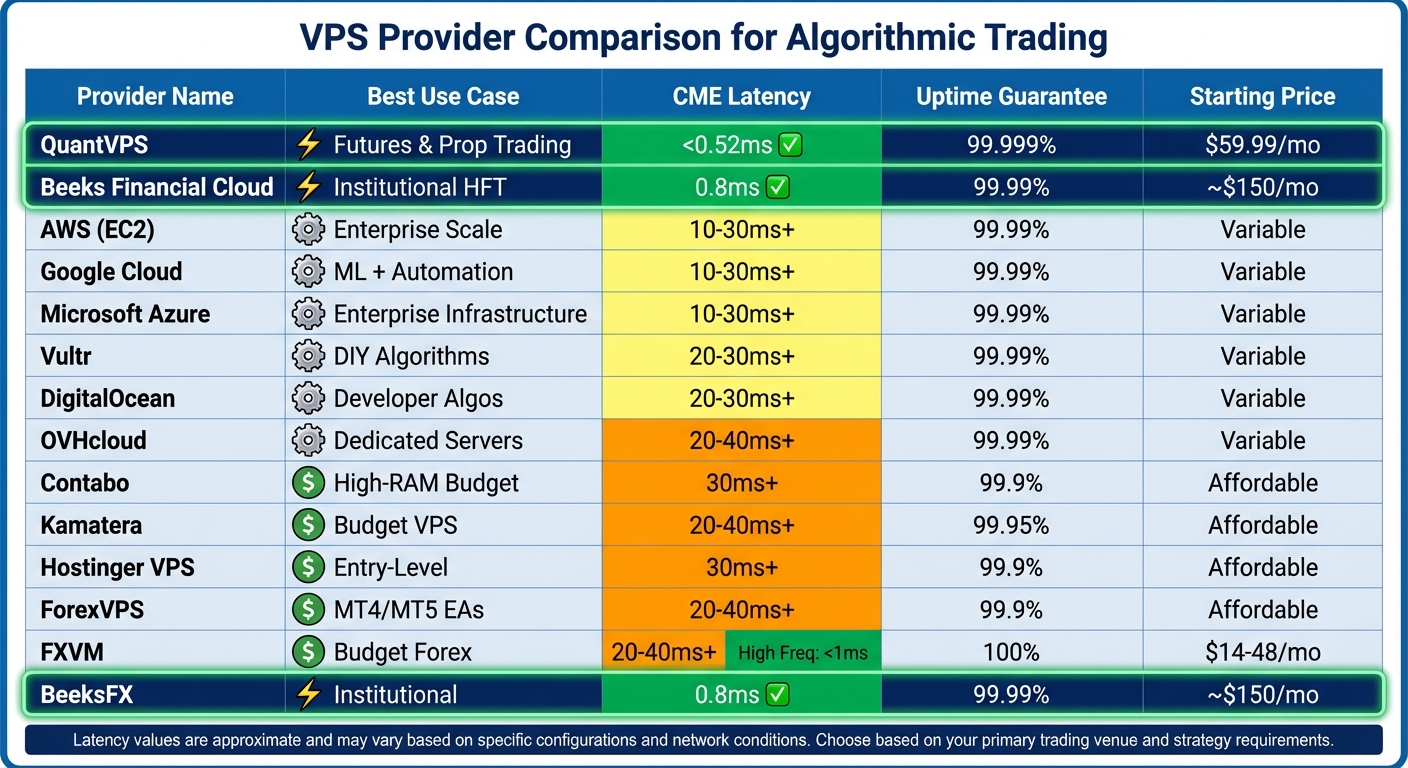
VPS Provider Comparison for Algorithmic Trading: Latency, Specs & Pricing
When it comes to choosing the right VPS provider for high-speed, reliable trading, several factors play a crucial role. These include CME latency, server locations, hardware configurations, network speed, and uptime. Below is a table that summarizes these key metrics, helping you compare providers effectively.
Latency, measured in milliseconds (ms), is critical for trading performance. Providers based in Aurora, such as QuantVPS, deliver ultra-low latency of less than 1ms to CME matching engines. On the other hand, general cloud providers like AWS, Google Cloud, and Microsoft Azure typically offer latency ranging from 10–30ms or more, depending on the region and configuration.
Hardware specifications are particularly important for CPU-intensive trading strategies. QuantVPS, for instance, uses AMD Ryzen 7950X3D processors with clock speeds up to 5.7 GHz, NVMe Gen4 storage, and DDR5 RAM, ensuring peak performance during high-order flow periods. In contrast, budget providers like Contabo and Hostinger VPS rely on AMD EPYC processors with lower clock speeds, which may not be ideal for demanding tasks.
Uptime is another crucial differentiator. QuantVPS guarantees 99.999% uptime, supported by direct fiber-optic cross-connects to CME. General cloud platforms like AWS, Google Cloud, and Microsoft Azure provide a 99.99% uptime SLA, while budget providers typically offer 99.9%, which equates to about 8.76 hours of potential downtime annually.
| Provider | Best For | Key Locations | CME Latency | CPU / RAM | Network | Uptime | Starting Price |
|---|---|---|---|---|---|---|---|
| QuantVPS | Futures, prop trading | Chicago (Aurora) | <0.52ms | AMD Ryzen 7950X3D, 8–128GB | 1–10Gbps+ | 99.999% | $59.99/mo |
| Beeks Financial Cloud | Institutional HFT | London, NY, Aurora | ~0–1ms | Enterprise CPUs | 10–40Gbps | 99.99% | ~$150/mo |
| AWS (EC2) | Enterprise scale | Global | 10–30ms+ (variable) | Elastic | 10–100Gbps | 99.99% | Varies |
| Google Cloud | ML + automation | Global | 10–30ms+ (variable) | Elastic | 10–100Gbps | 99.99% | Varies |
| Microsoft Azure | Enterprise infra | Global | 10–30ms+ (variable) | Elastic | 10–100Gbps | 99.99% | Varies |
| Vultr | DIY algos | Global | 20–30ms+ (variable) | AMD EPYC | 1–10Gbps | 99.99% | Varies |
| DigitalOcean | Developer algos | Global | 20–30ms+ (variable) | Intel/AMD | 1–10Gbps | 99.99% | Varies |
| OVHcloud | Dedicated servers | US/EU | 20–40ms+ (variable) | AMD EPYC/Intel | 1–25Gbps | 99.99% | Varies |
| Contabo | High-RAM budget | US/EU | 30ms+ (variable) | AMD EPYC | 1Gbps | 99.9% | Affordable |
| Kamatera | Budget VPS | Global | 20–40ms+ (variable) | Intel/AMD | 1Gbps | 99.9% | Affordable |
| Hostinger VPS | Entry-level | Global | 30ms+ (variable) | Intel/AMD | 1Gbps | 99.9% | Affordable |
| BeeksFX | Institutional | Aurora (Equinix CH1) | 0.8ms | 4 cores, 8GB, NVMe | 10Gbps | 99.99% | ~$150/mo |
For CME futures scalping, Aurora-based providers like QuantVPS and BeeksFX offer the lowest latency. If you're trading NYSE/NASDAQ equities, servers located in New York are ideal. Meanwhile, for forex EAs, providers with infrastructure near London or New York strike a balance between performance and cost. General cloud platforms can be a good choice for multi-region crypto arbitrage but may require extra effort to optimize latency for specific exchanges.
Conclusion
When selecting a VPS for your trading needs, it’s crucial to match it with your specific strategy. For instance, if you’re scalping CME futures, look for providers offering ultra-low latency - like sub-1ms round-trip times (e.g., 0.52ms from Equinix CH facilities). This ensures your VPS setup aligns perfectly with your market focus.
If your strategy involves forex expert advisors on MetaTrader platforms, consider VPS hubs in New York or London. These locations reduce latency to major broker servers and liquidity providers, enabling quicker and more efficient order execution. Similarly, crypto arbitrage strategies benefit from VPS solutions with multi-region deployments, high-speed network connectivity (1Gbps+), and scalable resources to handle market volatility. Across all strategies, low latency and dedicated resources are key to optimizing performance.
Hardware specifications are just as important as location. Opt for VPS providers offering high-performance CPUs (3.5+ GHz clock speeds), NVMe storage for faster data access, and near-perfect uptime (99.999%) to maintain reliable and speedy order execution.
Start by identifying your primary trading venue - whether it’s CME futures, NYSE equities, forex pairs, or crypto exchanges - and choose a VPS provider with proven infrastructure in the corresponding region. Look for providers that offer dedicated resources, enterprise-grade network connectivity, and technical support tailored to trading platforms like NinjaTrader, Sierra Chart, and Quantower. For a head start, refer to the comparison table above, which outlines latency, hardware specs, and pricing for top providers.
FAQs
What should I look for in a VPS for algorithmic trading?
When selecting a VPS for algorithmic trading, latency should be your top consideration. Servers located close to major exchanges - like Chicago for CME or New York for forex - can process your orders faster, giving you a critical advantage. This geographic proximity reduces the time it takes for data to travel back and forth, which is especially crucial for high-frequency trading or scalping strategies where every millisecond counts.
Beyond location, dedicated hardware resources play a key role. Look for a VPS with robust CPUs, sufficient RAM, and fast NVMe storage to ensure your trading algorithms run seamlessly without disruptions. Additionally, reliable network connectivity is essential. A VPS with redundant, high-speed connections can handle market fluctuations and maintain stability, while a 99.99% uptime guarantee ensures your strategies remain active around the clock.
Don’t overlook security features like DDoS protection to safeguard your operations. Also, opt for a provider that offers scalable plans, allowing your VPS to adapt as your trading needs evolve. By prioritizing these aspects, you’ll be equipped with a VPS that delivers the low-latency, high-performance environment your automated trading systems require.
Why does the location of a VPS provider matter for trading latency?
The location of your VPS provider plays a key role in trading performance. Why? Because the closer your server is to the exchange’s matching engine, the quicker your trade orders can be executed. A shorter distance means fewer network hops and a reduced signal travel time, cutting latency to as little as 0.5–1 ms in some cases. For instance, hosting your VPS in Chicago is ideal for CME futures, while New York or London works best for major FX brokers. This proximity ensures your orders are processed with minimal delay.
When the VPS is located farther from the exchange, the signal has to travel longer routes. This increases latency, which can lead to slippage, missed trades, or outdated price data - issues no trader wants to face. To avoid these problems, traders strategically choose VPS locations near their target exchanges. For example, Chicago is perfect for futures trading, New York or London for forex, and Singapore or Tokyo for crypto markets. This setup allows automated strategies to run with peak precision and efficiency.
Why is high-performance hardware essential for algorithmic trading?
High-performance hardware plays a key role in algorithmic trading, where speed and precision are everything. Trading algorithms need to process massive streams of market data, make split-second decisions, and execute orders in milliseconds. To handle this, a robust multi-core CPU with high clock speeds is essential. It ensures smooth execution of complex strategies, real-time calculations, and backtesting. Pair that with ample RAM - ranging from 8 GB to 256 GB - and you can keep large data sets and price buffers in memory without any lag.
Fast storage is another must-have. NVMe SSDs are particularly effective, as they provide rapid access to tick-level data, which is critical for strategies like scalping, arbitrage, or high-frequency trading. Low-latency hardware further reduces the time it takes to process market data and send out orders, helping traders avoid slippage and secure the best prices. On top of that, reliable hardware ensures uninterrupted operation. It prevents crashes, CPU throttling, or other disruptions, allowing your algorithms to run smoothly around the clock - even when markets are volatile.