
The top five quant trading firms in our 2026 list are Renaissance Technologies, Two Sigma, D. E. Shaw, Citadel Securities and Jane Street. We cover 20 quant, high-frequency trading and market-making firms and group them into S, A and B tiers by reputation among quant candidates, hiring selectivity, pay and how long each firm has operated at scale. Here is the full list, with what each firm is known for:
- Renaissance Technologies: Famous for its Medallion Fund, this firm sets the standard for systematic trading with its use of alternative data and AI.
- Two Sigma Investments: A science-focused firm that uses machine learning and distributed computing to analyze vast market data.
- D.E. Shaw & Co.: A research-intensive firm combining computational finance and investment research.
- Citadel Securities: A global leader in market-making and high-frequency trading, ensuring liquidity across various asset classes.
- Jane Street Capital: Specializes in market-making and arbitrage, backed by a strong emphasis on teamwork and data-driven strategies.
- PDT Partners: Focuses on statistical arbitrage and systematic trading, with advanced AI tools driving its success.
- WorldQuant: Combines systematic trading strategies with a global research network, using tools like its BRAIN platform.
- Tower Research Capital: A high-frequency trading firm excelling in low-latency execution and proprietary algorithms.
- SIG Susquehanna: Renowned for its expertise in options pricing and game theory-driven strategies.
- Hudson River Trading (HRT): A high-frequency trading leader that uses low-latency systems and machine learning to deliver strong results.
- Jump Trading: Focuses on ultra-fast execution and advanced AI models to stay competitive in high-frequency trading.
- Optiver: A global market maker since 1986 that prices more than 1 million financial instruments on 100+ exchanges.
- IMC Trading: An Amsterdam-born market maker founded in 1989 that trades on more than 120 venues with its own automated systems.
- XTX Markets: A London algorithmic trading firm that uses machine learning to forecast prices for over 53,000 instruments.
- DRW: A diversified trading firm founded in 1992 that trades its own capital across asset classes, including crypto through Cumberland.
- Virtu Financial: A listed market maker and execution services firm quoting more than 25,000 securities on over 235 venues.
- Five Rings: A trading firm with offices in New York, Boca Raton, London and Amsterdam that trades established and esoteric markets.
- AQR Capital Management: A quantitative investment manager founded in 1998, running long-only and alternative strategies.
- Man Group (Man AHL): Man AHL is one of the longest-running systematic managers and part of Man Group since 1989.
- Balyasny Asset Management: A multi-strategy fund with dedicated systematic and quantitative research teams.
Quick Comparison
| Firm | Key Focus Areas | Technology Strengths | Career Highlights | Market Role |
|---|---|---|---|---|
| Renaissance Tech | Systematic trading | AI, alternative data | Ph.D.-level hires, high returns | Industry benchmark |
| Two Sigma | Machine learning, data analysis | Distributed computing | Research-focused roles | Data-driven finance |
| D.E. Shaw | Multi-strategy, AI-driven | Computational finance | Collaborative culture | Global hedge fund leader |
| Citadel Securities | Market-making, HFT | Low-latency infrastructure | Competitive roles in HFT | Liquidity provider |
| Jane Street | Arbitrage, market-making | Proprietary models | Merit-based growth | Proprietary trading powerhouse |
| PDT Partners | Statistical arbitrage | AI, predictive analytics | Collaborative work environment | Steady, long-term returns |
| WorldQuant | Multi-strategy, global reach | BRAIN platform | Global research opportunities | Market-neutral equity trading |
| Tower Research | High-frequency trading | Custom low-latency systems | Competitive engineering roles | HFT leader |
| SIG Susquehanna | Options pricing, game theory | Advanced modeling tools | High compensation for analysts | Derivatives trading expert |
| Hudson River Trading | HFT, machine learning | Low-latency systems | Research and algorithmic roles | Liquidity and efficiency |
| Jump Trading | HFT, algorithmic trading | AI, high-performance systems | Innovation-driven culture | Liquidity improvement |
| Optiver | Market making in options, ETFs, equities, bonds and currencies | Low-latency C++ and FPGA systems | Student and graduate programs | Liquidity provider |
| IMC Trading | Market making across asset classes | Own automated trading systems, 9,000+ servers | Programs for students and graduates | Liquidity provider on 120+ venues |
| XTX Markets | Machine learning price forecasts | 25,000+ GPU research cluster | About 300 employees | Liquidity to clients and venues |
| DRW | Diversified trading, crypto via Cumberland | Modeling, technology and quant research | Quant developer programs | Trades its own capital |
| Virtu Financial | Market making and execution services | Execution technology and analytics | Market making and client roles | Listed liquidity provider |
| Five Rings | Trading in established and esoteric markets | In-house strategies and tools | Campus recruiting, mentorship | Proprietary trading |
| AQR Capital Management | Quantitative investment management | Economics, data and technology research | Research-led roles | Asset manager |
| Man Group (Man AHL) | Systematic investment strategies | Man Research Laboratory in Oxford | Research, developer and trader roles | Asset manager |
| Balyasny | Multi-strategy fund with systematic teams | Quantitative Research and Applied AI teams | Analyst and portfolio manager tracks | Asset manager |
These firms showcase the importance of advanced technology, data-driven strategies, and strong talent pipelines in shaping the future of quantitative trading. If you're considering a career in this field, focus on building expertise in mathematics, data science, and programming to stand out.
Quant firm tier list (2026)
We grouped firms on four things: reputation among quant candidates, how selective hiring is, how competitive pay is, and how long the firm has operated at scale. S tier leads on all four, A tier on most, and B tier firms are strong but have a narrower profile or a different model.
| Tier | Firm | Type | Known for |
|---|---|---|---|
| S | Renaissance Technologies | Hedge fund | Founded by mathematician James Simons; its Medallion fund has been closed to outside investors since 1993 |
| S | Jane Street | Prop trading / market maker | Liquidity provider founded in 2000; trades on 200+ venues and writes almost all its software in OCaml |
| S | Citadel Securities | Market maker | Makes markets in equities, options, fixed income and FX; reports $800B+ notional traded per day |
| S | Hudson River Trading | Prop trading / market maker | Founded in 2002; "built by coders, led by coders," trading with automated algorithms across asset classes |
| A | Two Sigma | Hedge fund | Founded in 2001 by David Siegel and John Overdeck; applies data science and technology to investing |
| A | D. E. Shaw | Hedge fund / investment manager | Started in 1988 with six employees and $28 million; an early pioneer of computational finance |
| A | Jump Trading | Prop trading | Chicago firm founded in 1999 by two former CME pit traders; launched Jump Crypto in 2021 |
| A | SIG (Susquehanna) | Prop trading / market maker | Founded in 1987; trains new hires with game theory and strategy games |
| A | PDT Partners | Hedge fund / investment manager | Began in 1993 as Morgan Stanley's Process Driven Trading group before spinning out |
| A | Optiver | Market maker | Global market maker since 1986; prices 1 million+ instruments on 100+ exchanges |
| A | IMC Trading | Market maker | Founded in 1989 by two traders on the Amsterdam Equity Options Exchange; one of the first to automate trading |
| A | XTX Markets | Algorithmic market maker | Machine learning price forecasts for 53,000+ instruments; $250bn daily traded volume with about 300 staff |
| A | Five Rings | Prop trading | Offices in New York, Boca Raton, London and Amsterdam; known for mentorship and campus recruiting |
| B | Tower Research Capital | Prop trading | Founded in 1998 by Mark Gorton; one of the oldest automated, high-frequency trading firms |
| B | WorldQuant | Hedge fund / investment manager | Founded in 2007 by Igor Tulchinsky; its BRAIN platform pays 16,000+ outside research consultants for alpha ideas |
| B | DRW | Prop trading | Founded in 1992 by Don Wilson; trades its own capital on exchanges on five continents |
| B | Virtu Financial | Market maker / execution services | Quotes 25,000+ securities on 235+ venues and sells execution tools to clients |
| B | AQR Capital Management | Asset manager | Founded in 1998 by Cliff Asness, David Kabiller, Robert Krail and John Liew; based in Greenwich, Connecticut |
| B | Man Group (Man AHL) | Asset manager | Man AHL, part of Man Group since 1989, is one of the longest-running systematic managers |
| B | Balyasny Asset Management | Multi-strategy fund | $37B in assets (1 Oct 2026) with Systematic and Quantitative Research teams alongside discretionary ones |
Not ranked: QuantMatter. QuantMatter is a smaller quant firm focused on market making and multi-asset trading, including crypto. It does not publish headcount, assets or track record, so there isn't enough public data to place it against the firms above.
1. Renaissance Technologies
Renaissance Technologies, founded by mathematician James Simons, stands as a giant in quantitative trading. Its Medallion Fund is widely regarded as the gold standard in systematic trading, serving as a benchmark for other quant firms. Renaissance shows how advanced algorithms are reshaping modern finance.
Trading Performance
Renaissance Technologies consistently ranks among the most profitable quantitative hedge funds globally, with the Medallion Fund at the heart of its success. This fund achieves extraordinary returns by employing sophisticated mathematical models, leveraging alternative data, and using AI-powered backtesting to identify and exploit market inefficiencies across a variety of asset classes.
This innovative and data-driven approach allows Renaissance to adapt and thrive even as markets evolve and traditional strategies lose their edge.
Technology Systems
The firm's remarkable performance is built on a foundation of technology. Renaissance employs proprietary machine learning models, deep learning techniques, natural language processing (NLP), and predictive systems to guide its investment decisions.
At the core of its operations is a team of scientists and mathematicians who specialize in uncovering patterns within financial data. These experts constantly refine their models and strategies, ensuring the firm remains ahead of the competition as new data and market conditions emerge.
Renaissance's high-performance computing systems play a critical role, enabling the processing and analysis of massive datasets. By combining advanced mathematics, algorithmic strategies, data science, and big data analytics, the firm optimizes risk-adjusted returns across its diverse trading strategies.
Market Impact
Renaissance Technologies has had a profound influence on the quantitative finance industry, setting the standard for integrating alternative data and AI techniques into trading. Its success has proven the effectiveness of systematic, data-driven investment strategies, inspiring other firms to embrace similar methods.
Beyond its own trading activities, Renaissance has shaped industry practices through its innovations in alternative data usage. Techniques like analyzing satellite imagery, tracking social sentiment, and mining transactional datasets have become common tools for other quant firms.
2. Two Sigma Investments
Two Sigma Investments works by taking a scientific approach to trading. The firm leverages machine learning and distributed computing to analyze vast amounts of market data. This data-driven strategy helps maintain its edge in the highly competitive world of quantitative finance.
3. D. E. Shaw & Co.
D. E. Shaw & Co. is a leader in quantitative investing, blending computational finance with the power of AI.
Trading Performance
As of September 1, 2026, the D. E. Shaw group had more than $115 billion in investment and committed capital. Founded in 1988 by David E. Shaw with six employees and $28 million, the firm now has more than 3,000 people around the globe. Its strategies span the continuum from systematic to discretionary.
Technology Systems
The firm relies on AI-driven computational finance to refine its trading techniques. Its technology stack incorporates statistical arbitrage, alternative data analysis, and AI-powered backtesting tools. By using deep learning algorithms and natural language processing (NLP), D. E. Shaw & Co. enhances the precision of its predictive models.
Market Impact
Beyond its financial results, D. E. Shaw & Co. has shaped how the industry uses computing in investing. The firm says its investment staff draw on research, trading and operational infrastructure built over more than 35 years. Operating as a centralized and collaborative hedge fund, the firm encourages teamwork across various disciplines.
Career Opportunities
D. E. Shaw & Co. is known for attracting top-tier talent, drawn by its research-focused and collaborative culture. Employees work together to contribute to a shared body of knowledge, rather than operating in silos. This environment offers a range of career opportunities and stability for professionals eager to engage in advanced quantitative research and trading. These initiatives further cement the firm's position as a leader in the evolving environment of quantitative trading.
Uptime
99.999% uptime. Built for 24/7 trading reliability.
Your VPS runs in Tier IV datacenters with redundant power and network, monitored 24/7 on site.
See the uptime SLA







From $29.99/mo · Windows or Linux
4. Citadel Securities
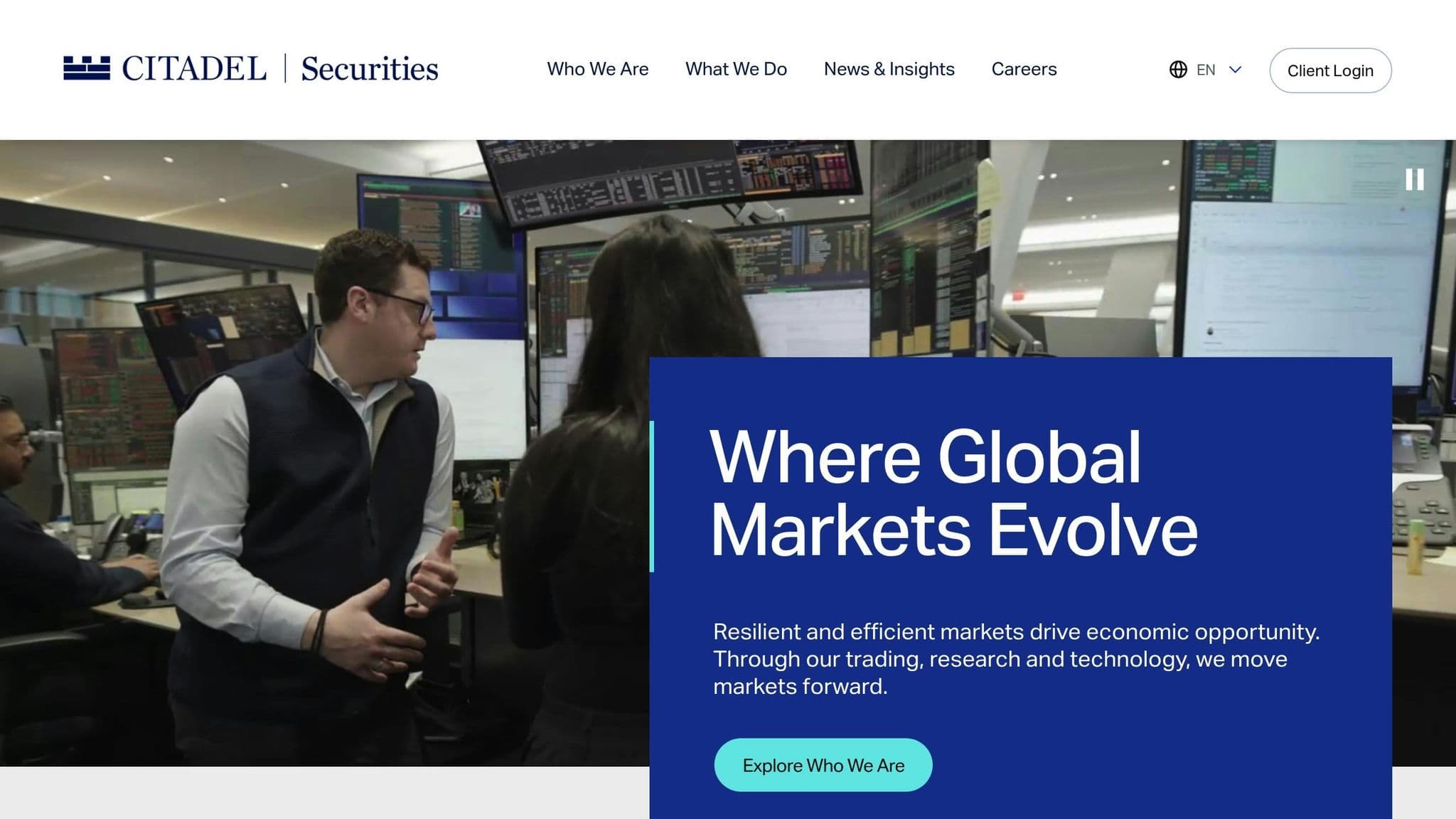
Citadel Securities is a global powerhouse in market making and high-frequency trading, focusing on equities, options, and fixed-income securities. The firm plays a key role in keeping financial markets running smoothly by consistently quoting buy and sell prices, ensuring liquidity for traders worldwide.
Trading Performance
Citadel Securities supplies liquidity across asset classes. Its operations in equities, options, and fixed-income markets contribute directly to market efficiency. This success is built on a technological foundation that ensures reliable performance.
Technology Systems
The firm's competitive edge comes from its advanced technology. Citadel Securities uses real-time data analytics, machine learning, and proprietary trading platforms to stay ahead. Its low-latency infrastructure and high-performance computing systems process massive amounts of market data at lightning speed. AI-driven market analysis helps the firm spot opportunities and fine-tune strategies in real time. By placing its servers close to major financial exchanges, Citadel Securities minimizes delays and ensures faster trade execution.
Market Impact
Through its continuous market-making efforts, Citadel Securities affects global trading. Its tech-driven approach highlights the importance of speed, efficiency, and data-backed decisions in financial markets.
5. Jane Street Capital
Jane Street Capital is a proprietary trading firm specializing in market-making, arbitrage, and algorithmic trading strategies. Known for blending innovative trading techniques with a distinct company culture, the firm has become a magnet for top-tier talent from around the globe.
Trading Performance
Jane Street's trading strategies center on market-making and arbitrage across various asset classes. By using its own capital, the firm ensures that decision-making aligns directly with performance and compensation. Its systematic and data-driven approach allows it to pinpoint and act on market opportunities with precision.
Career Opportunities
Jane Street's success in systematic trading extends to its career offerings. The firm is well-known for its structured onboarding program, which helps new hires integrate quickly. It actively recruits quantitative researchers, software engineers, and traders, offering a merit-based environment where results matter more than titles. Compensation includes a fixed base salary paired with performance-based bonuses, reflecting the firm's emphasis on rewarding success. However, the competitive nature of proprietary trading often comes with longer working hours.
This setup provides a platform for driven individuals to excel, with career growth and compensation closely tied to their trading performance.
6. PDT Partners

PDT Partners has carved out a reputation as a Tier 1 centralized hedge fund, specializing in statistical arbitrage and algorithmic trading. Initially established within Morgan Stanley, it has since grown into a leading quantitative firm known for its expertise in statistical arbitrage.
Trading Performance
The firm focuses on liquidity-taking statistical arbitrage across various asset classes. While this strategy typically delivers lower Sharpe ratios compared to high-frequency trading, it supports the efficient deployment of large amounts of capital. By targeting market inefficiencies through systematic and data-driven methods, PDT Partners emphasizes steady, long-term returns rather than chasing short-term market swings.
Their trading models are built on advanced statistical methodologies, designed to spot price discrepancies and execute trades with precision. These systems continuously analyze market data, ensuring trades align with the firm's risk parameters while capturing arbitrage opportunities.
Technology Systems
PDT Partners has made significant investments in technologies like AI, machine learning, and big data analytics to refine its trading strategies. Speed, efficiency, and predictive analytics are at the heart of their technological framework, enabling them to stay ahead in fast-moving markets.
The firm also integrates advanced deep learning and natural language processing (NLP) techniques to assess alternative data sources. These tools enhance predictive modeling, which affects their systematic trading approach. This solid tech infrastructure not only drives performance but also fosters a culture of collaboration and innovation.
Career Opportunities
PDT Partners champions a cooperative work environment, prioritizing firm-wide collaboration over individual competition. This philosophy is reflected in their compensation model, which ties individual rewards to both personal contributions and the overall success of the fund.
7. WorldQuant

WorldQuant is a well-known quantitative investment firm that combines systematic trading strategies with a strong global market presence. Founded by Igor Tulchinsky, the company integrates centralized research with a worldwide network of skilled individuals.
Trading Performance
WorldQuant takes a multi-strategy approach, focusing on areas like statistical arbitrage, market-neutral equity, and systematic trading. Its medium-frequency strategies use a variety of trading signals. This success is underpinned by a powerful technological infrastructure.
Technology Systems
Central to WorldQuant's operations is WorldQuant BRAIN, a simulation platform where researchers around the world develop and test trading ideas using WorldQuant's data sets and tools; selected users become paid research consultants. By emphasizing scalability and automation, the firm uses machine learning and statistical models to uncover trading opportunities. Initiatives like WorldQuant University's crowd-sourced research model also enable the company to tap into a diverse pool of talent.
Market Impact
WorldQuant has played a significant role in making quantitative research more accessible. Through its educational programs and global research efforts, the firm has helped develop trading expertise in markets around the world, including emerging economies. Its focus on model diversification and risk management has influenced industry practices, setting a standard for innovation in quantitative trading.
Career Opportunities
WorldQuant offers a dynamic workplace for both experienced professionals and new talent. The company prioritizes ongoing learning and skill development, with initiatives such as WorldQuant University. Employees also benefit from opportunities for international assignments and cross-cultural collaboration, making it an excellent environment for advancing careers in quantitative finance.
8. Tower Research Capital
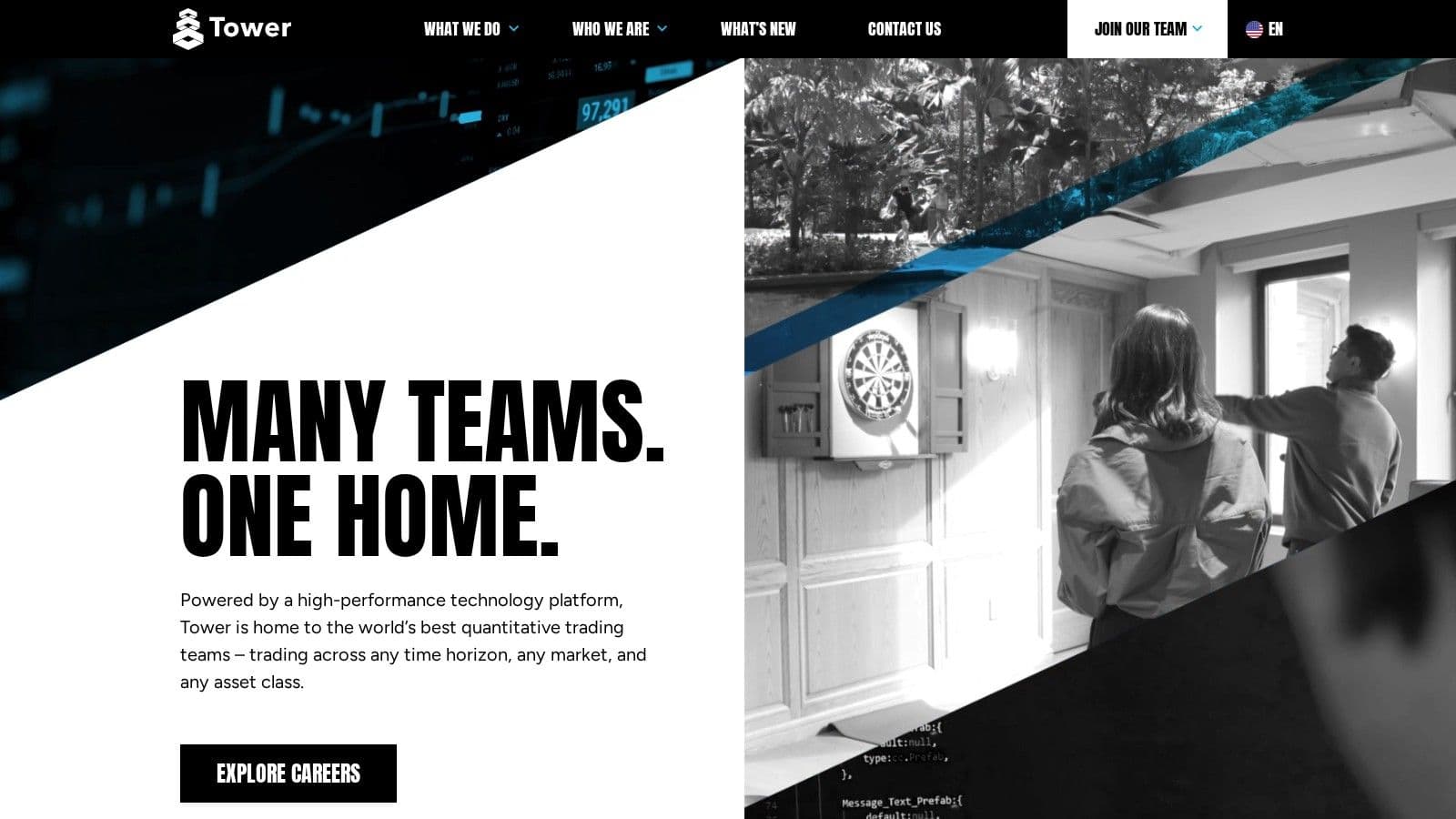
Tower Research Capital is a prominent player in high-frequency trading. The firm is recognized for its lightning-fast trading strategies and its advanced, custom-designed execution platforms. With a global presence, Tower Research Capital relies on proprietary algorithms to navigate a variety of markets, with speed being a key factor in its strong trading performance and technology.
Trading Performance
The firm specializes in high-frequency trading and market-making strategies. By processing massive amounts of data in real time, Tower Research Capital capitalizes on brief market opportunities with incredibly low latency, ensuring swift and efficient trade execution.
Technology Systems
Tower Research Capital has made significant investments in its custom-built execution platforms, which are designed for high-frequency operations. These platforms combine specialized hardware with direct market access systems and proprietary software. Together, they enable the firm to analyze market conditions and execute trades in the shortest possible time.
Market Impact
The firm embodies the growing trend of technology-driven, data-intensive trading that is transforming financial markets. By leveraging ultra-fast, automated decision-making processes, Tower Research Capital highlights the increasing role of artificial intelligence, machine learning, and alternative data sources in shaping trading strategies and enhancing market efficiency.
9. SIG Susquehanna
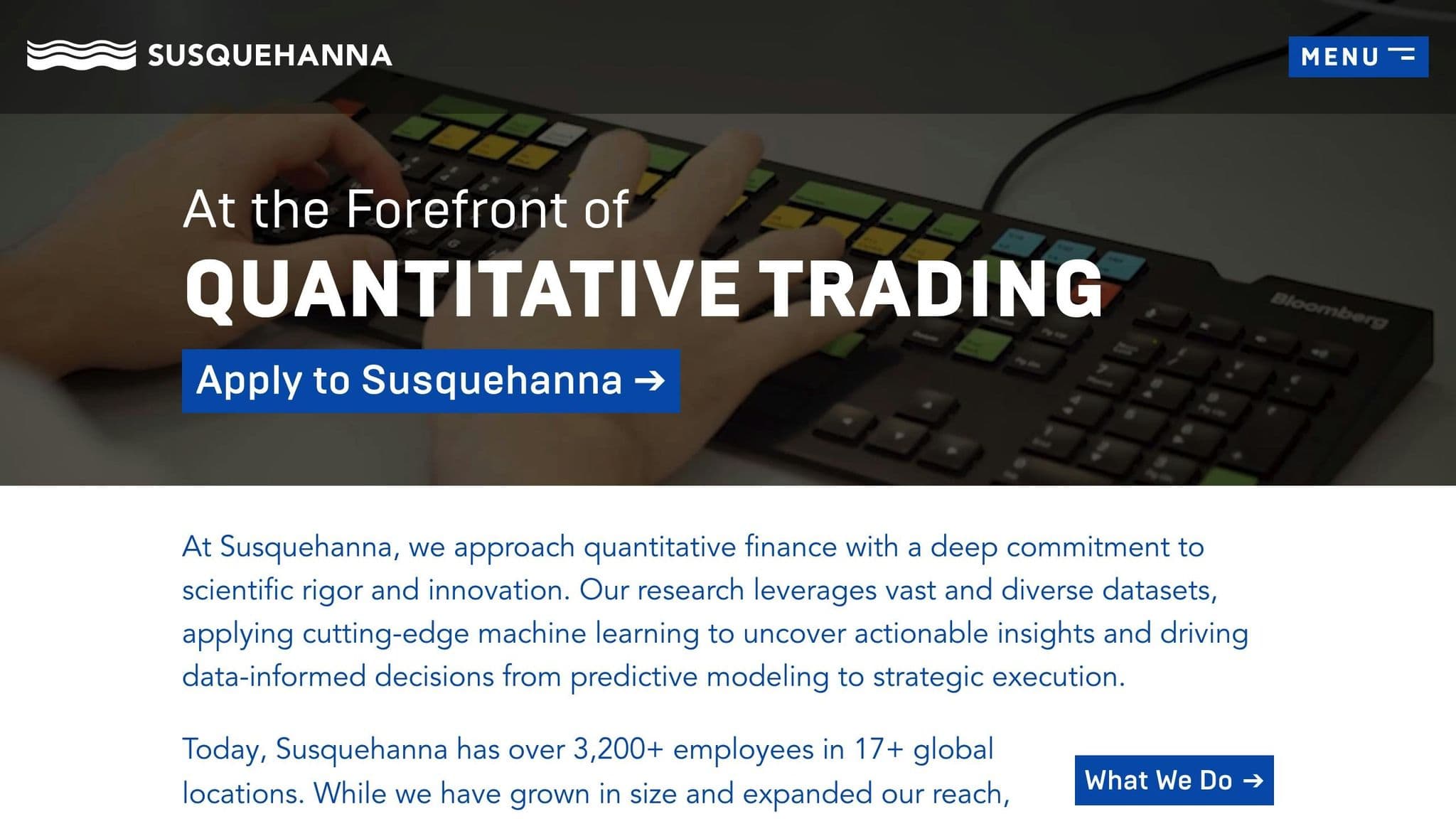
SIG Susquehanna is a leading proprietary trading firm, well-regarded for its use of game theory and mathematical models to fine-tune trading strategies in derivatives and equities markets. Its headquarters are in Bala Cynwyd, Pennsylvania, with additional offices in Dublin and Singapore, solidifying its global footprint in quantitative trading.
Trading Performance
SIG Susquehanna specializes in options pricing, volatility arbitrage, and market-neutral strategies. These areas of expertise highlight the firm’s reliance on advanced quantitative methods to drive its trading success.
Career Opportunities
The firm consistently attracts top-tier quantitative researchers, software engineers, and traders. Susquehanna has more than 3,500 employees in 16+ offices and uses strategic games to teach decision making under uncertainty.
10. Hudson River Trading
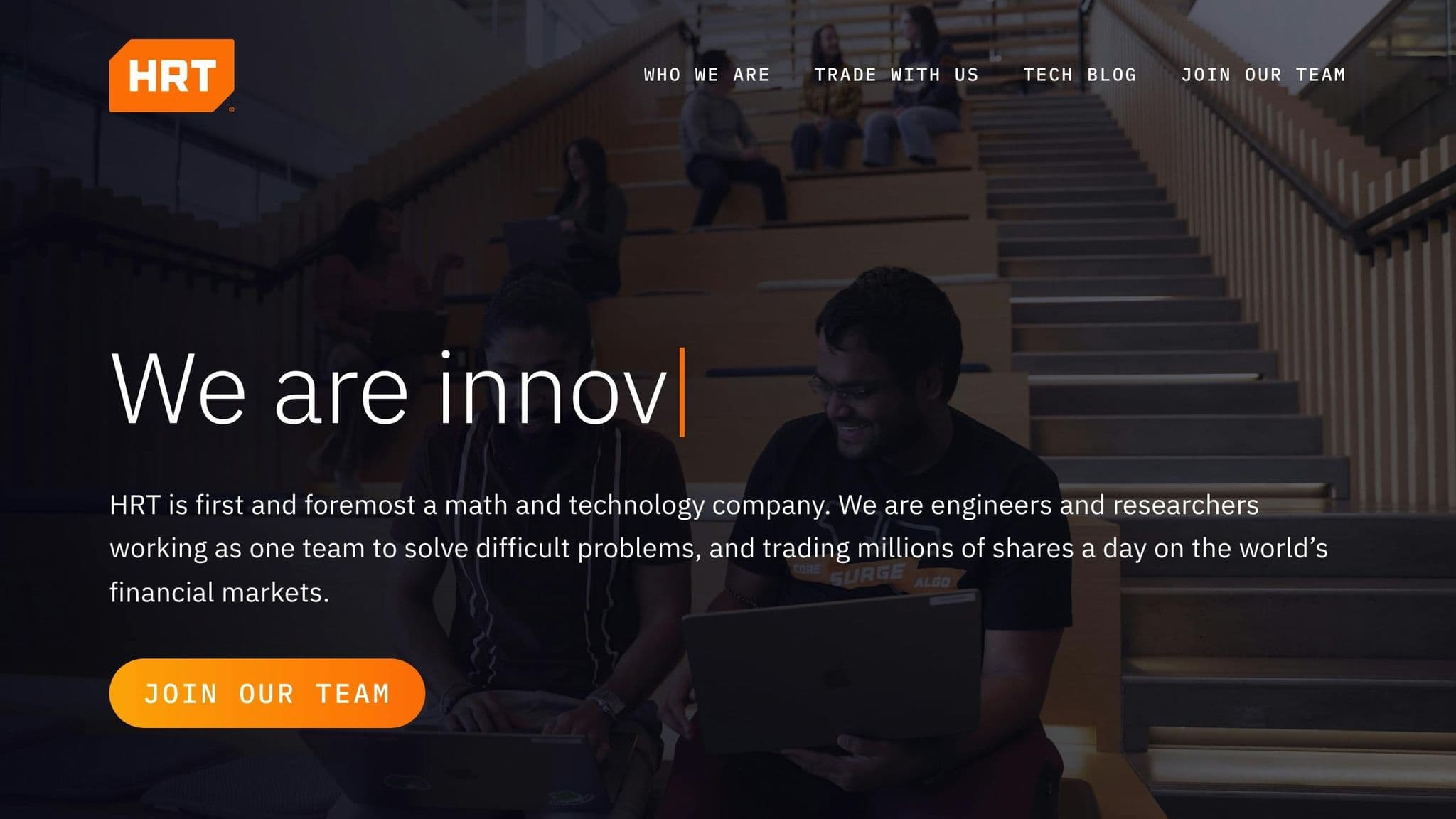
Hudson River Trading (HRT) is a prominent player in high-frequency trading, blending quantitative research with rapid execution to ensure liquidity in global markets. Known for its advanced technology and systems, HRT has earned its reputation as a leader in this highly competitive space.
Technology Systems
HRT's success hinges on its relentless focus on technology. The firm has invested heavily in low-latency infrastructure and high-performance computing, enabling it to execute trades in mere microseconds. By operating co-located servers at major financial exchanges, HRT minimizes delays and processes thousands of trades every second. Beyond speed, the firm employs real-time data analytics, machine learning, and custom-built execution platforms to thrive in technology-driven markets. This technological sophistication is the backbone of HRT's impressive trading capabilities.
Trading Performance
The firm's dedication to research and development ensures it remains at the forefront of trading innovation, constantly refining strategies and improving efficiency.
Order flow
Built for scalpers. Heatmaps on dedicated resources.
Order-flow heatmaps and DOM ladders run on dedicated CPU, memory and NVMe, so your charts keep responding during volatility.
See the dedicated hardwareFrom $29.99/mo · Windows or Linux
Market Impact
HRT's reach extends beyond high-frequency trading. By incorporating medium-frequency strategies, the firm adapts to shifting market dynamics and contributes to efficient price discovery and the smooth operation of global markets across various asset classes.
Career Opportunities
For those eyeing a career in quantitative finance, HRT offers exciting opportunities. The firm provides hands-on experience in high-frequency and algorithmic trading, making it a sought-after destination for aspiring quantitative traders and technologists. Its diverse team, comprising engineers, mathematicians, and scientists, fosters a collaborative environment that supports career growth. With its expansion into medium-frequency trading, HRT is also opening new doors for quantitative traders.
11. Jump Trading

Jump Trading is a prominent name in high-frequency and algorithmic trading. Known for its lightning-fast execution and trading infrastructure, the firm has carved out a strong position in quantitative finance.
Technology Systems
Jump Trading's infrastructure is designed for speed. With co-located servers at major exchanges, the firm cuts latency down to microseconds. It invests heavily in high-performance computing, using custom-built execution platforms powered by machine learning and real-time data analytics to seize market opportunities almost instantaneously.
AI-driven analysis plays a central role in its operations. The firm's models continuously adapt to shifting market conditions, ensuring trading strategies stay sharp and effective. This technological edge directly contributes to its ability to execute trades with precision.
Trading Performance
The firm’s reliance on advanced technology allows it to exploit short-lived market inefficiencies, establishing itself as one of the top players in high-frequency trading globally.
Market Impact
Jump Trading's operations contribute significantly to global financial markets by improving liquidity and facilitating effective price discovery. By narrowing bid-ask spreads, the firm enhances trading efficiency for all participants. In addition to its high-frequency strategies, the company has started branching out into medium-frequency trading - an area traditionally dominated by hedge funds. This diversification enables Jump Trading to capitalize on opportunities across a broader range of timeframes.
Career Opportunities
For those with a background in quantitative fields, Jump Trading offers exciting career paths. The firm actively seeks engineers, mathematicians, and data scientists eager to work on advanced trading systems. It’s an environment where innovation and technical expertise drive success, making it an appealing choice for professionals looking to excel in algorithmic and high-frequency trading.
12. Optiver
Optiver is a global market maker and one of the oldest firms on this list, trading since 1986. Optiver prices more than 1 million financial instruments, from options and ETFs to equities, bonds and currencies, on 100+ exchanges.
Optiver's engineers build low-latency C++ and FPGA systems, and its researchers use deep learning, statistical modelling and reinforcement learning on market data. The firm says it executes more than 10 million trades a day and runs student, internship and graduate programs from offices including Amsterdam, Chicago, London, Sydney and Singapore.
13. IMC Trading
IMC Trading is a quantitative market maker founded in 1989 by two traders on the floor of the Amsterdam Equity Options Exchange. IMC was one of the first firms to build its own automated trading systems.
Today IMC trades across asset classes on more than 120 venues, with 2,070+ employees in 10 offices and 9,000+ servers across 9 countries. Machine learning and AI run through its workflow, from forecasting market behavior to generating signals.
14. XTX Markets
XTX Markets is a London-based algorithmic trading firm that uses machine learning to produce price forecasts for over 53,000 financial instruments. XTX trades equities, fixed income, currencies, commodities and crypto on exchanges and alternative venues, and offers liquidity directly to clients.
XTX is unusually small for its size: about 300 employees, a research cluster of more than 25,000 GPUs and $250bn in daily traded volume across 35 countries. It is building a large data centre in Finland, and it does not deal with individual investors.
15. DRW
DRW is a diversified trading firm founded in 1992 by Don Wilson to apply modeling, technology and quantitative research to global markets. DRW trades only its own capital, with no outside investors, on exchanges on five continents.
DRW describes itself as a liquidity provider, a risk taker and a latency-sensitive trading firm at once. It made its first bitcoin trade in 2010 and launched Cumberland, its crypto trading arm, in 2014.
16. Virtu Financial
Virtu Financial is a publicly listed market maker and execution services firm. Virtu quotes more than 25,000 securities and other instruments on over 235 venues in 50+ countries, across equities, ETFs, foreign exchange, futures and fixed income.
Unlike most firms here, Virtu also sells its technology: execution tools, analytics and multi-dealer workflow platforms for institutional clients. That makes it a good fit for quants who want to work on both market making and client-facing products.
17. Five Rings
Five Rings is a proprietary trading firm with offices in New York, Boca Raton, London and Amsterdam. Five Rings trades a wide range of markets, which it describes as "established and esoteric, domestic and international."
Five Rings publishes little about its strategies, so its profile rests on hiring. The firm stresses mentorship, an open culture and campus recruiting, and new hires develop ideas that feed directly into its trading strategies and systems.
18. AQR Capital Management
AQR Capital Management is a quantitative investment manager founded in 1998 by Cliff Asness, David Kabiller, Robert Krail and John Liew, and based in Greenwich, Connecticut. AQR runs long-only and alternative strategies across equity, macro, arbitrage and multi-strategy portfolios.
AQR, short for Applied Quantitative Research, began with a single multi-strategy hedge fund and was one of the first alternative managers to offer mutual funds, in 2009. Its research sits at the meeting point of economics, behavioral finance, data and technology.
19. Man Group (Man AHL)
Man AHL is the systematic investing arm of Man Group and one of the longest-running systematic managers. AHL has been part of Man Group since 1989, and Man Group managed $253.6 billion in total assets as of 30 June 2026.
Man AHL's researchers, developers and traders apply systematic strategies to hundreds of global markets, from offices in London and the Man Research Laboratory in Oxford. Man Group also runs Man Numeric, a second quantitative manager.
20. Balyasny Asset Management
Balyasny Asset Management is a multi-strategy fund, not a pure quant firm, but it runs dedicated quant teams. Balyasny's Systematic strategy builds mathematical models for risk-adjusted returns, and a Quantitative Research team supports its portfolio managers.
As of 1 October 2026, Balyasny managed $37B with more than 2,000 investment and support professionals in 20+ locations. Its other strategies include equity long/short, fixed income and macro, commodities and multi-asset arbitrage, and an Applied AI team builds tools for staff.
Comparison: Strengths and Weaknesses
Quantitative trading firms carve out their place in the competitive financial environment by employing distinct strategies for their strengths.
Top firms rely heavily on technology and data-driven methods to create sophisticated quantitative models and manage risk effectively. Yet, they face notable hurdles, such as steep operational costs, intense competition for highly specialized talent, and navigating complex regulatory landscapes. To stay ahead, many firms opt to specialize - some zero in on high-frequency trading or options market-making, while others spread their efforts across multiple asset classes. This strategic focus helps them dominate specific market niches but can also narrow their exposure to a wider range of opportunities.
Ultimately, the industry's competitive dynamics revolve around three key pillars: technological advancements, effective risk management, and a clear strategic direction. These factors continue to shape both the strengths and challenges faced by firms in this space.
Conclusion
By 2026, the leaders in quantitative trading are defined by their mastery of technology and well-honed strategies. Renaissance Technologies remains at the forefront with the Medallion Fund, while firms like Two Sigma, D. E. Shaw, Jane Street, and Citadel Securities deliver consistent results through specialized, diversified approaches. Market makers such as Optiver, IMC and XTX Markets, and systematic managers such as AQR and Man AHL, round out the list.
But it’s not just about financial performance - these firms are also shaping the standard for talent acquisition. If you're aiming to break into this field, know that top-tier firms often seek candidates with advanced degrees in fields like mathematics, physics, or computer science. For instance, Renaissance Technologies and Two Sigma are known for hiring Ph.D.-level talent, while firms like WorldQuant and Tower Research Capital offer slightly more accessible entry points. These mid-tier firms still provide excellent learning experiences and highly competitive pay.
Beyond hiring practices, technological advancements are the backbone of these firms’ success. For traders and professionals, the formula for excelling in quantitative trading boils down to three essentials: access to high-quality data, sophisticated modeling, and technological infrastructure. Top firms heavily invest in ultra-low latency systems and redundant network connections to ensure they stay ahead. In this space, even the tiniest delay can result in significant losses.
This reliance on advanced technology isn’t limited to the industry giants. Independent traders and smaller quantitative funds must also prioritize building strong infrastructure to stay competitive. Reliable systems are critical for maintaining market access and executing algorithms efficiently; at retail size, the strategies these firms run at scale usually start on an algo trading VPS.
Ultimately, this analysis underscores a key takeaway: no matter the strategy, success in quantitative trading is driven by a commitment to technology and an unwavering focus on core strengths. These rankings highlight that staying ahead in this field demands more than just skill - it requires a relentless pursuit of technological excellence.
FAQs
What skills and education do top quant trading firms look for in 2026?
In 2026, leading quantitative trading firms are on the lookout for candidates who excel in analytical thinking and programming, paired with a solid grasp of financial markets. Technical expertise in programming languages like Python, C++, or Java is a must, along with skills in data analysis, machine learning, and algorithm creation.
Employers highly value educational backgrounds in mathematics, computer science, engineering, or similar disciplines. Holding an advanced degree - such as a master’s or PhD in a quantitative field - can give applicants a competitive edge. Beyond technical know-how, these firms appreciate individuals with sharp problem-solving skills, meticulous attention to detail, and a drive to push boundaries through innovation.
How are AI and machine learning shaping the trading strategies of top quant firms?
Advances in AI and machine learning are reshaping how top quant firms tackle trading. These tools make it possible to analyze enormous datasets, identify intricate market trends, and execute trades with incredible speed and precision.
With AI-powered algorithms, quant firms can automate their trading strategies, fine-tune risk management, and adjust swiftly to changing market dynamics. This combination of efficiency and adaptability provides a clear advantage in the highly competitive area of quantitative trading.
How do the top quant trading firms differ in their strategies and use of technology?
The leading quant trading firms approach the market with diverse strategies and technologies, each for their specific goals and focus areas. High-frequency trading (HFT) firms are all about speed. They depend on ultra-low-latency systems and advanced algorithms to execute thousands of trades every second, capitalizing on even the smallest market fluctuations.
In contrast, proprietary trading firms often concentrate on activities like market-making, arbitrage, or intraday trading. They rely on data analysis tools to uncover short-term opportunities that others might miss.
Meanwhile, quantitative hedge funds take a different route, focusing on medium- to long-term strategies. These firms use sophisticated models to forecast market trends and fine-tune portfolio performance over time. Some firms are also pushing boundaries by integrating AI and machine learning into their trading processes, boosting both their decision-making and execution precision. These varied approaches underscore how technology and strategy play a critical role in shaping the success of top quant firms.


