Quantitative trading in 2026 has evolved into a tech-driven industry dominated by firms leveraging AI, machine learning, and advanced algorithms to excel in global markets. Here's a quick rundown of the 12 leading quant trading firms, ranked based on performance, technology, market influence, research, and risk management:
- QuantMatter: Known for attracting top talent and offering diverse career paths, QuantMatter excels in fostering a collaborative work environment and driving innovation in quantitative finance.
- Renaissance Technologies: Famous for its Medallion Fund, this firm sets the standard for systematic trading with its use of alternative data and AI.
- Two Sigma Investments: A science-focused firm that uses machine learning and distributed computing to analyze vast market data.
- D.E. Shaw & Co.: A research-intensive firm blending advanced AI with computational finance to deliver consistent returns.
- Citadel Securities: A global leader in market-making and high-frequency trading, ensuring liquidity across various asset classes.
- Jane Street Capital: Specializes in market-making and arbitrage, backed by a strong emphasis on teamwork and data-driven strategies.
- PDT Partners: Focuses on statistical arbitrage and systematic trading, with advanced AI tools driving its success.
- WorldQuant: Combines systematic trading strategies with a global research network, using tools like its WebSim platform.
- Tower Research Capital: A high-frequency trading firm excelling in low-latency execution and proprietary algorithms.
- SIG Susquehanna: Renowned for its expertise in options pricing and game theory-driven strategies.
- Hudson River Trading (HRT): A high-frequency trading leader that uses low-latency systems and machine learning to deliver strong results.
- Jump Trading: Focuses on ultra-fast execution and advanced AI models to stay competitive in high-frequency trading.
Quick Comparison
| Firm | Key Focus Areas | Technology Strengths | Career Highlights | Market Role |
|---|---|---|---|---|
| QuantMatter | Talent development, innovation | Collaborative research tools | Structured training, competitive pay | Cutting-edge quant strategies |
| Renaissance Tech | Systematic trading | AI, alternative data | Ph.D.-level hires, high returns | Industry benchmark |
| Two Sigma | Machine learning, data analysis | Distributed computing | Research-focused roles | Data-driven finance |
| D.E. Shaw | Multi-strategy, AI-driven | Computational finance | Collaborative culture | Global hedge fund leader |
| Citadel Securities | Market-making, HFT | Low-latency infrastructure | Competitive roles in HFT | Liquidity provider |
| Jane Street | Arbitrage, market-making | Proprietary models | Merit-based growth | Proprietary trading powerhouse |
| PDT Partners | Statistical arbitrage | AI, predictive analytics | Collaborative work environment | Steady, long-term returns |
| WorldQuant | Multi-strategy, global reach | WebSim platform | Global research opportunities | Market-neutral equity trading |
| Tower Research | High-frequency trading | Custom low-latency systems | Competitive engineering roles | HFT leader |
| SIG Susquehanna | Options pricing, game theory | Advanced modeling tools | High compensation for analysts | Derivatives trading expert |
| Hudson River Trading | HFT, machine learning | Low-latency systems | Research and algorithmic roles | Liquidity and efficiency |
| Jump Trading | HFT, algorithmic trading | AI, high-performance systems | Innovation-driven culture | Liquidity improvement |
These firms showcase the importance of advanced technology, data-driven strategies, and strong talent pipelines in shaping the future of quantitative trading. If you're considering a career in this field, focus on building expertise in mathematics, data science, and programming to stand out.
Inside the $700K Quant Finance Career Path After College | MIT Jane Street Intern
1. QuantMatter
By 2026, QuantMatter stands out as a magnet for top talent, offering diverse career paths in the dynamic world of quantitative finance.
Career Opportunities
QuantMatter opens doors to a variety of roles in quantitative finance, technology, and research. The company actively recruits from leading universities, prioritizing candidates with solid backgrounds in mathematics, physics, computer science, and engineering. Beyond academic credentials, they place a premium on problem-solving abilities and expertise in managing complex data.
New hires are supported through a robust training program that blends theoretical knowledge with practical application. This hands-on, team-oriented approach helps employees grow professionally while contributing to cutting-edge projects. The collaborative environment ensures that innovation thrives, enabling team members to make a real impact.
To reward and motivate its workforce, QuantMatter offers competitive, performance-driven compensation packages that acknowledge individual achievements. Employees are also encouraged to grow through opportunities like attending industry conferences, pursuing further education, and participating in internal research initiatives. These efforts reflect QuantMatter's dedication to pushing the boundaries of quantitative strategies and maintaining high industry standards.
This emphasis on nurturing talent and driving innovation aligns with the quant sector's broader pursuit of technological and strategic advancement.
2. Renaissance Technologies
Renaissance Technologies, founded by mathematician James Simons, stands as a giant in the world of quantitative trading. Its Medallion Fund is widely regarded as the gold standard in systematic trading, serving as a benchmark for other quant firms. Much like QuantMatter, Renaissance showcases how advanced algorithms are reshaping modern finance.
Trading Performance
Renaissance Technologies consistently ranks among the most profitable quantitative hedge funds globally, with the Medallion Fund at the heart of its success. This fund achieves extraordinary returns by employing sophisticated mathematical models, leveraging alternative data, and using AI-powered backtesting to identify and exploit market inefficiencies across a variety of asset classes.
"Renaissance Technologies, led by Jim Simons, is one of the most profitable quant hedge funds, known for its Medallion Fund."
This innovative and data-driven approach allows Renaissance to adapt and thrive even as markets evolve and traditional strategies lose their edge.
Technology Systems
The firm's remarkable performance is built on a foundation of cutting-edge technology. Renaissance employs proprietary machine learning models, deep learning techniques, natural language processing (NLP), and predictive systems to guide its investment decisions.
At the core of its operations is a team of scientists and mathematicians who specialize in uncovering patterns within financial data. These experts constantly refine their models and strategies, ensuring the firm remains ahead of the competition as new data and market conditions emerge.
Renaissance's high-performance computing systems play a critical role, enabling the processing and analysis of massive datasets. By combining advanced mathematics, algorithmic strategies, data science, and big data analytics, the firm optimizes risk-adjusted returns across its diverse trading strategies.
Market Impact
Renaissance Technologies has had a profound influence on the quantitative finance industry, setting the standard for integrating alternative data and AI techniques into trading. Its success has proven the effectiveness of systematic, data-driven investment strategies, inspiring other firms to embrace similar methods.
Beyond its own trading activities, Renaissance has shaped industry practices through its innovations in alternative data usage. Techniques like analyzing satellite imagery, tracking social sentiment, and mining transactional datasets have become common tools for other quant firms.
3. Two Sigma Investments

Run 24/7 while you sleep. Keep bots, platforms, and trade copiers online on a dedicated VPS.
Low-latency VPS hosting for your trading platform.
 CHINYC
 LON
LONFrom $29.99/mo


 CHI/CME futuresNYC/US marketsLON/FX EAs
 DUB/Polymarket
 AMS/EU FX
 FRA/Central EU
 TYO/APAC crypto
Two Sigma Investments stands out by taking a scientific approach to trading. The firm leverages machine learning and distributed computing to analyze vast amounts of market data. This data-driven strategy helps maintain its edge in the highly competitive world of quantitative finance.
4. DE Shaw & Co.
DE Shaw & Co. stands out as a leader in quantitative investing, blending computational finance with the power of AI. This research-intensive, methodical approach has consistently delivered impressive returns, solidifying the firm's reputation as a major force in the world of quantitative trading.
Trading Performance
In 2024, DE Shaw & Co. achieved outstanding results, securing the #4 spot among the top 12 quant firms. The firm reported $58.5 billion in assets under management (AUM), marking a $4.4 billion increase from the previous year. This success stems from its strong technological foundation and advanced strategies.
Technology Systems
The firm relies on AI-driven computational finance to refine its trading techniques. Its technology stack incorporates statistical arbitrage, alternative data analysis, and AI-powered backtesting tools. By using deep learning algorithms and natural language processing (NLP), DE Shaw & Co. enhances the precision of its predictive models.
Market Impact
Beyond its financial achievements, DE Shaw & Co. has shaped market trends in significant ways. It ranks as the 6th largest hedge fund in North America and 7th globally in the Billion Dollar Club Top 20 for 2024. Among the 66 hedge funds managing over $10 billion in assets, it is one of only ten multi-strategy firms. Operating as a centralized and collaborative hedge fund, the firm encourages teamwork across various disciplines.
Career Opportunities
DE Shaw & Co. is known for attracting top-tier talent, drawn by its research-focused and collaborative culture. Employees work together to contribute to a shared body of knowledge, rather than operating in silos. This environment offers a range of career opportunities and stability for professionals eager to engage in advanced quantitative research and trading. These initiatives further cement the firm's position as a leader in the evolving landscape of quantitative trading.
5. Citadel Securities

Citadel Securities is a global powerhouse in market making and high-frequency trading, focusing on equities, options, and fixed-income securities. The firm plays a key role in keeping financial markets running smoothly by consistently quoting buy and sell prices, ensuring liquidity for traders worldwide.
Trading Performance
Citadel Securities stands out for its ability to maintain liquidity across various asset classes. Its operations in equities, options, and fixed-income markets contribute directly to market efficiency. This success is built on a cutting-edge technological foundation that ensures seamless and reliable performance.
Technology Systems
The firm's competitive edge comes from its advanced technology. Citadel Securities uses real-time data analytics, machine learning, and proprietary trading platforms to stay ahead. Its low-latency infrastructure and high-performance computing systems process massive amounts of market data at lightning speed. AI-driven market analysis helps the firm spot opportunities and fine-tune strategies in real time. By placing its servers close to major financial exchanges, Citadel Securities minimizes delays and ensures faster trade execution.
Market Impact
Through its continuous market-making efforts, Citadel Securities plays a vital role in global trading. Its tech-driven approach highlights the importance of speed, efficiency, and data-backed decisions in today’s financial markets.
6. Jane Street Capital
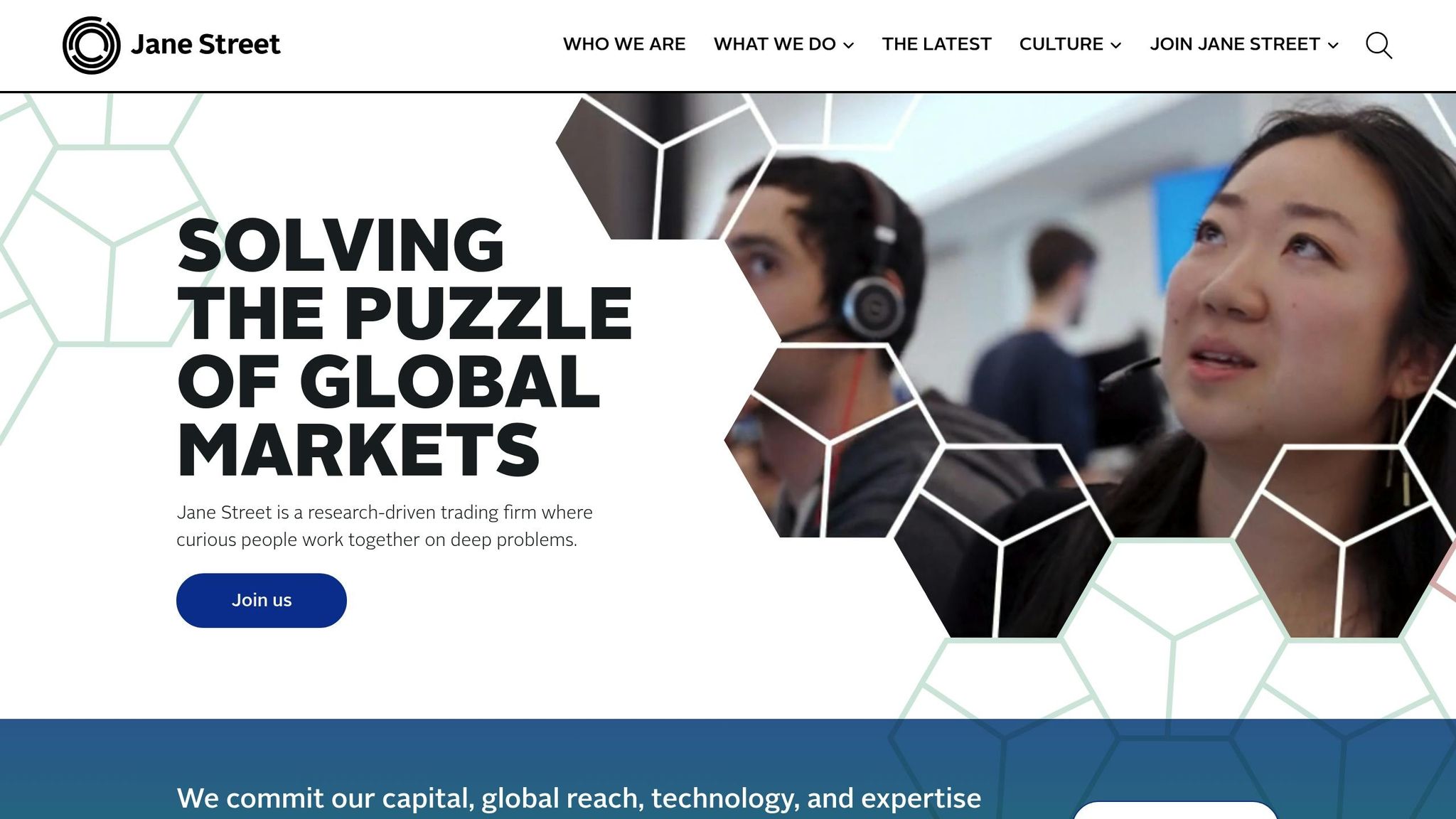
Jane Street Capital is a proprietary trading firm specializing in market-making, arbitrage, and algorithmic trading strategies. Known for blending innovative trading techniques with a distinct company culture, the firm has become a magnet for top-tier talent from around the globe.
Trading Performance
Jane Street's trading strategies center on market-making and arbitrage across various asset classes. By using its own capital, the firm ensures that decision-making aligns directly with performance and compensation. Its systematic and data-driven approach allows it to pinpoint and act on market opportunities with precision.
Career Opportunities
Jane Street's success in systematic trading extends to its career offerings. The firm is well-known for its structured onboarding program, which helps new hires integrate quickly. It actively recruits quantitative researchers, software engineers, and traders, offering a merit-based environment where results matter more than titles. Compensation includes a fixed base salary paired with performance-based bonuses, reflecting the firm's emphasis on rewarding success. However, the competitive nature of proprietary trading often comes with longer working hours.
"Jane Street's collaborative culture and emphasis on innovation have contributed to its success."
This setup provides a platform for driven individuals to excel, with career growth and compensation closely tied to their trading performance.
7. PDT Partners

PDT Partners has carved out a reputation as a Tier 1 centralized hedge fund, specializing in statistical arbitrage and algorithmic trading. Initially established within Morgan Stanley, it has since grown into a leading quantitative firm known for its expertise in statistical arbitrage.
Trading Performance
The firm focuses on liquidity-taking statistical arbitrage across various asset classes. While this strategy typically delivers lower Sharpe ratios compared to high-frequency trading, it supports the efficient deployment of large amounts of capital. By targeting market inefficiencies through systematic and data-driven methods, PDT Partners emphasizes steady, long-term returns rather than chasing short-term market swings.
Their trading models are built on advanced statistical methodologies, designed to spot price discrepancies and execute trades with precision. These systems continuously analyze market data, ensuring trades align with the firm's risk parameters while capturing arbitrage opportunities.
Technology Systems
PDT Partners has made significant investments in cutting-edge technologies like AI, machine learning, and big data analytics to refine its trading strategies. Speed, efficiency, and predictive analytics are at the heart of their technological framework, enabling them to stay ahead in fast-moving markets.
The firm also integrates advanced deep learning and natural language processing (NLP) techniques to assess alternative data sources. These tools enhance predictive modeling, which plays a crucial role in their systematic trading approach. This solid tech infrastructure not only drives performance but also fosters a culture of collaboration and innovation.
Career Opportunities
PDT Partners champions a cooperative work environment, prioritizing firm-wide collaboration over individual competition. This philosophy is reflected in their compensation model, which ties individual rewards to both personal contributions and the overall success of the fund.
8. WorldQuant

WorldQuant is a well-known quantitative investment firm that combines systematic trading strategies with a strong global market presence. Founded by Igor Tulchinsky, the company integrates centralized research with a worldwide network of skilled individuals.
Trading Performance
WorldQuant takes a multi-strategy approach, focusing on areas like statistical arbitrage, market-neutral equity, and systematic trading. Their expertise lies in medium-frequency strategies, which rely on a variety of trading signals to deliver steady, risk-adjusted returns. This success is underpinned by a powerful technological infrastructure.
Technology Systems
Central to WorldQuant's operations is WebSim, a cloud-based, distributed computing platform. This tool allows researchers from around the world to develop and test trading strategies using vast datasets. By emphasizing scalability and automation, the firm uses machine learning and statistical models to uncover trading opportunities. Initiatives like WorldQuant University's crowd-sourced research model also enable the company to tap into a diverse pool of talent.
Market Impact
WorldQuant has played a significant role in making quantitative research more accessible. Through its educational programs and global research efforts, the firm has helped develop trading expertise in markets around the world, including emerging economies. Its focus on model diversification and risk management has influenced industry practices, setting a standard for innovation in quantitative trading.
Career Opportunities
WorldQuant offers a dynamic workplace for both experienced professionals and new talent. The company prioritizes ongoing learning and skill development, with initiatives such as WorldQuant University. Employees also benefit from opportunities for international assignments and cross-cultural collaboration, making it an excellent environment for advancing careers in quantitative finance.
9. Tower Research Capital

Tower Research Capital stands out as a prominent player in the world of high-frequency trading. The firm is recognized for its lightning-fast trading strategies and its advanced, custom-designed execution platforms . With a global presence, Tower Research Capital relies on proprietary algorithms to navigate a variety of markets, with speed being a key factor in its strong trading performance and cutting-edge technology.
Stay online and closer to execution. Choose a VPS location for CME futures, New York markets, London FX, API trading, and more.
Host your platform near the market route that matters.
CHINYCLONFrom $29.99/mo
CHI/CME futuresNYC/US marketsLON/FX EAsDUB/PolymarketAMS/EU FXFRA/Central EUTYO/APAC cryptoTrading Performance
The firm specializes in high-frequency trading and market-making strategies . By processing massive amounts of data in real time, Tower Research Capital capitalizes on brief market opportunities with incredibly low latency, ensuring swift and efficient trade execution.
Technology Systems
Tower Research Capital has made significant investments in its custom-built execution platforms, which are tailored for high-frequency operations . These platforms combine specialized hardware with direct market access systems and proprietary software. Together, they enable the firm to analyze market conditions and execute trades in the shortest possible time.
Market Impact
The firm embodies the growing trend of technology-driven, data-intensive trading that is transforming financial markets. By leveraging ultra-fast, automated decision-making processes, Tower Research Capital highlights the increasing role of artificial intelligence, machine learning, and alternative data sources in shaping trading strategies and enhancing market efficiency.
10. SIG Susquehanna
SIG Susquehanna is a leading proprietary trading firm, well-regarded for its use of game theory and mathematical models to fine-tune trading strategies in derivatives and equities markets. Its headquarters are in Bala Cynwyd, Pennsylvania, with additional offices in Dublin and Singapore, solidifying its global footprint in the world of quantitative trading.
Trading Performance
SIG Susquehanna specializes in options pricing, volatility arbitrage, and market-neutral strategies. These areas of expertise highlight the firm’s reliance on advanced quantitative methods to drive its trading success.
Career Opportunities
The firm consistently attracts top-tier quantitative researchers, software engineers, and traders. It is also known for its impressive compensation packages - entry-level quantitative analysts at SIG can earn as much as $600,000 in their first year.
11. Hudson River Trading
Hudson River Trading (HRT) stands out as a prominent player in high-frequency trading, blending cutting-edge quantitative research with rapid execution to ensure liquidity in global markets. Known for its advanced technology and robust systems, HRT has earned its reputation as a leader in this highly competitive space.
Technology Systems
HRT's success hinges on its relentless focus on technology. The firm has invested heavily in low-latency infrastructure and high-performance computing, enabling it to execute trades in mere microseconds. By operating co-located servers at major financial exchanges, HRT minimizes delays and processes thousands of trades every second. Beyond speed, the firm employs real-time data analytics, machine learning, and custom-built execution platforms to thrive in technology-driven markets. This technological sophistication is the backbone of HRT's impressive trading capabilities.
Trading Performance
Thanks to its advanced systems, HRT has mastered high-frequency trading strategies, delivering some of the industry's most impressive risk-adjusted returns, as reflected in its top-tier Sharpe ratios. The firm's dedication to research and development ensures it remains at the forefront of trading innovation, constantly refining strategies and improving efficiency.
Market Impact
HRT's reach extends beyond high-frequency trading. By incorporating medium-frequency strategies, the firm adapts to shifting market dynamics and contributes to efficient price discovery and the smooth operation of global markets across various asset classes.
Career Opportunities
For those eyeing a career in quantitative finance, HRT offers exciting opportunities. The firm provides hands-on experience in high-frequency and algorithmic trading, making it a sought-after destination for aspiring quantitative traders and technologists. Its diverse team, comprising engineers, mathematicians, and scientists, fosters a collaborative environment that supports career growth. With its expansion into medium-frequency trading, HRT is also opening new doors for quantitative traders.
12. Jump Trading
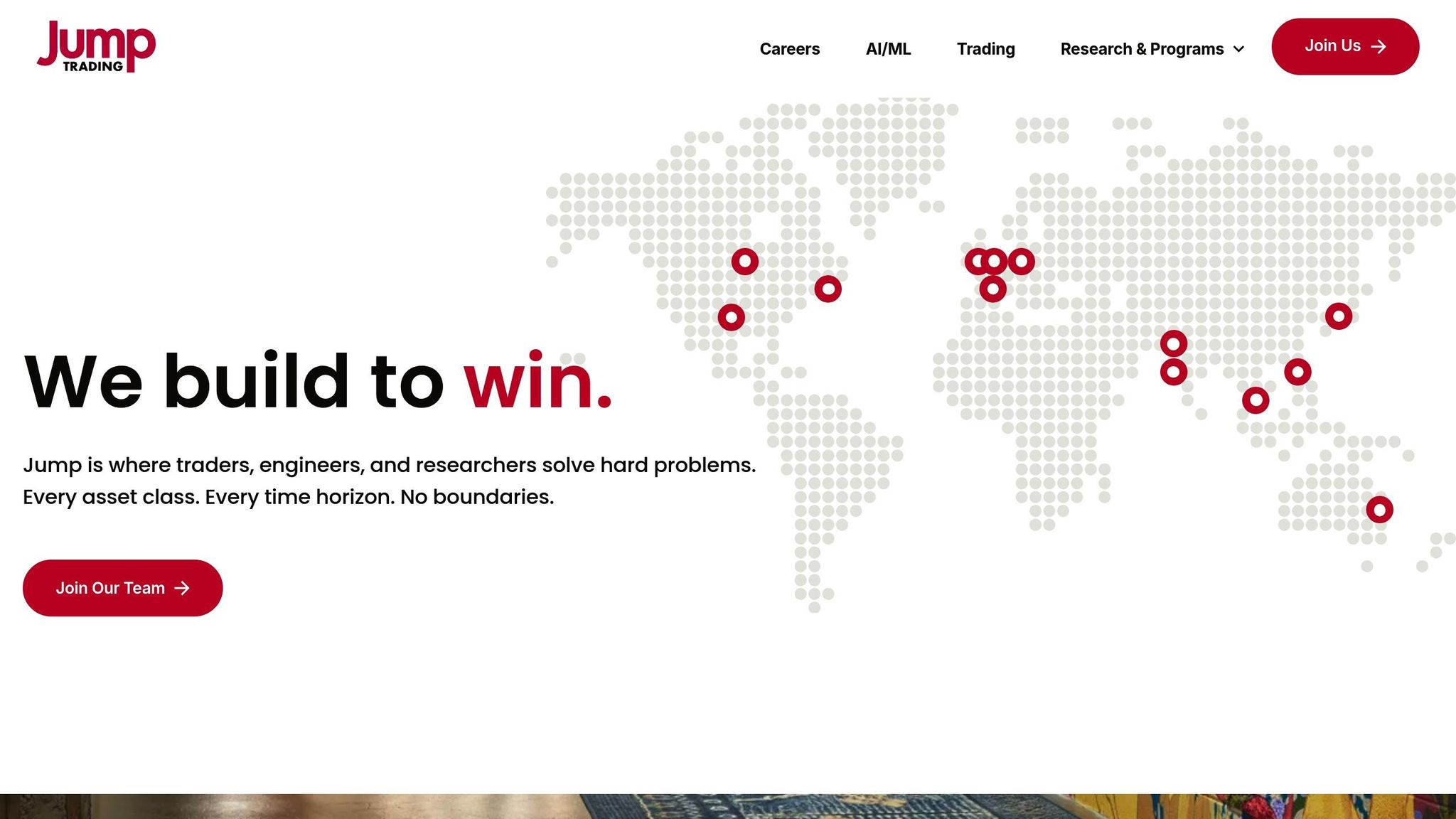
Jump Trading rounds out our list as a prominent name in high-frequency and algorithmic trading. Known for its lightning-fast execution and cutting-edge trading infrastructure, the firm has carved out a strong position in the fast-paced world of quantitative finance.
Technology Systems
Jump Trading's infrastructure is designed for speed. With co-located servers at major exchanges, the firm cuts latency down to microseconds. It invests heavily in high-performance computing, using custom-built execution platforms powered by machine learning and real-time data analytics to seize market opportunities almost instantaneously.
AI-driven analysis plays a central role in its operations. The firm's models continuously adapt to shifting market conditions, ensuring trading strategies stay sharp and effective. This technological edge directly contributes to its ability to execute trades with precision.
Trading Performance
The firm’s reliance on advanced technology allows it to exploit short-lived market inefficiencies, establishing itself as one of the top players in high-frequency trading globally.
"The most successful HFT firms - such as Jump Trading, Hudson River Trading (HRT), and Citadel Securities - leverage real-time data analytics, machine learning models, and custom-built execution platforms to maintain an edge in global financial markets."
Market Impact
Jump Trading's operations contribute significantly to global financial markets by improving liquidity and facilitating effective price discovery. By narrowing bid-ask spreads, the firm enhances trading efficiency for all participants. In addition to its high-frequency strategies, the company has started branching out into medium-frequency trading - an area traditionally dominated by hedge funds. This diversification enables Jump Trading to capitalize on opportunities across a broader range of timeframes.
Career Opportunities
For those with a background in quantitative fields, Jump Trading offers exciting career paths. The firm actively seeks engineers, mathematicians, and data scientists eager to work on advanced trading systems. It’s an environment where innovation and technical expertise drive success, making it an appealing choice for professionals looking to excel in algorithmic and high-frequency trading.
Comparison: Strengths and Weaknesses
Quantitative trading firms carve out their place in the competitive financial landscape by employing distinct strategies tailored to their strengths.
Top firms rely heavily on cutting-edge technology and data-driven methods to create sophisticated quantitative models and manage risk effectively. Yet, they face notable hurdles, such as steep operational costs, intense competition for highly specialized talent, and navigating complex regulatory landscapes. To stay ahead, many firms opt to specialize - some zero in on high-frequency trading or options market-making, while others spread their efforts across multiple asset classes. This strategic focus helps them dominate specific market niches but can also narrow their exposure to a wider range of opportunities.
Ultimately, the industry's competitive dynamics revolve around three key pillars: technological advancements, effective risk management, and a clear strategic direction. These factors continue to shape both the strengths and challenges faced by firms in this space.
Conclusion
By 2026, the leaders in quantitative trading are defined by their mastery of technology and well-honed strategies. Renaissance Technologies remains at the forefront with the Medallion Fund, while firms like Two Sigma, D.E. Shaw, Jane Street, and Citadel Securities deliver consistent results through specialized, diversified approaches.
But it’s not just about financial performance - these firms are also shaping the standard for talent acquisition. If you're aiming to break into this field, know that top-tier firms often seek candidates with advanced degrees in fields like mathematics, physics, or computer science. For instance, Renaissance Technologies and Two Sigma are known for hiring Ph.D.-level talent, while firms like WorldQuant and Tower Research Capital offer slightly more accessible entry points. These mid-tier firms still provide excellent learning experiences and highly competitive pay.
Beyond hiring practices, technological advancements are the backbone of these firms’ success. For traders and professionals, the formula for excelling in quantitative trading boils down to three essentials: access to high-quality data, sophisticated modeling, and cutting-edge technological infrastructure. Top firms heavily invest in ultra-low latency systems and redundant network connections to ensure they stay ahead. In this space, even the tiniest delay can result in significant losses.
This reliance on advanced technology isn’t limited to the industry giants. Independent traders and smaller quantitative funds must also prioritize building strong infrastructure to stay competitive. Reliable systems are critical for maintaining seamless market access and executing algorithms efficiently.
Ultimately, this analysis underscores a key takeaway: no matter the strategy, success in quantitative trading is driven by a commitment to technology and an unwavering focus on core strengths. These rankings highlight that staying ahead in this field demands more than just skill - it requires a relentless pursuit of technological excellence.
FAQs
What skills and education do top quant trading firms look for in 2026?
In 2026, leading quantitative trading firms are on the lookout for candidates who excel in analytical thinking and programming, paired with a solid grasp of financial markets. Technical expertise in programming languages like Python, C++, or Java is a must, along with skills in data analysis, machine learning, and algorithm creation.
Employers highly value educational backgrounds in mathematics, computer science, engineering, or similar disciplines. Holding an advanced degree - such as a master’s or PhD in a quantitative field - can give applicants a competitive edge. Beyond technical know-how, these firms appreciate individuals with sharp problem-solving skills, meticulous attention to detail, and a drive to push boundaries through innovation.
How are AI and machine learning shaping the trading strategies of top quant firms?
Advances in AI and machine learning are reshaping how top quant firms tackle trading. These tools make it possible to analyze enormous datasets, identify intricate market trends, and execute trades with incredible speed and precision.
With AI-powered algorithms, quant firms can automate their trading strategies, fine-tune risk management, and adjust swiftly to changing market dynamics. This combination of efficiency and adaptability provides a clear advantage in the highly competitive realm of quantitative trading.
How do the top quant trading firms differ in their strategies and use of technology?
The leading quant trading firms approach the market with diverse strategies and technologies, each tailored to their specific goals and focus areas. High-frequency trading (HFT) firms are all about speed. They depend on ultra-low-latency systems and advanced algorithms to execute thousands of trades every second, capitalizing on even the smallest market fluctuations.
In contrast, proprietary trading firms often concentrate on activities like market-making, arbitrage, or intraday trading. They rely on cutting-edge data analysis tools to uncover short-term opportunities that others might miss.
Meanwhile, quantitative hedge funds take a different route, focusing on medium- to long-term strategies. These firms use sophisticated models to forecast market trends and fine-tune portfolio performance over time. Some firms are also pushing boundaries by integrating AI and machine learning into their trading processes, boosting both their decision-making and execution precision. These varied approaches underscore how technology and strategy play a critical role in shaping the success of top quant firms.