Looking for the best proprietary trading firm in 2026? Here's a quick breakdown of the top contenders:
- DNA Funded: Offers low entry fees, spreads starting at 0.0 pips, and up to 90% profit splits with flexible evaluation options.
- FTMO: Known for its rigorous two-phase evaluation process, institutional-grade pricing, and scaling plans for increased profit splits.
- Topstep: Focused on futures trading, with 100% profit retention for the first $10,000 and a structured evaluation process.
- The 5%ers: Provides flexible profit-sharing (50%-100%), supports speculative trading, and offers competitive spreads.
- Funding Pips: Offers fast funding options with up to 90% profit splits, low-cost evaluations, and rapid scaling for consistent traders.
Quick Comparison Table:
| Firm | Profit Split | Markets | Spreads | Evaluation | Payout Cycle | Entry Fees |
|---|---|---|---|---|---|---|
| DNA Funded | 80%-90% | Forex, stocks, indices | From 0.0 pips | 1-phase, 2-phase, rapid | 7-14 days | From $49 |
| FTMO | 80%-90% | Forex, CFDs | Competitive | 2-phase | 14-30 days | From $155 |
| Topstep | 100% (first $10k), then 90% | Futures | Contract-specific | Structured | Flexible | $49-$149/month |
| The 5%ers | 50%-100% | Forex, indices | From 0.2 pips | Speculative programs | 1-3 days | Varies |
| FundingPips | Up to 90% | Forex, indices, commodities | From 0.0 pips | 1-phase, 2-phase | 7–14 days | From $85 |
Key Takeaway: Choose a firm based on your trading goals. FundingPips and FTMO suit forex traders, Topstep is ideal for futures, and The 5%ers caters to long-term growth. Dive deeper into the article for detailed comparisons.
Top Prop Trading Firms of 2024: Honest Reviews & Head-to-Head Comparison "Part 1"
1. DNA Funded
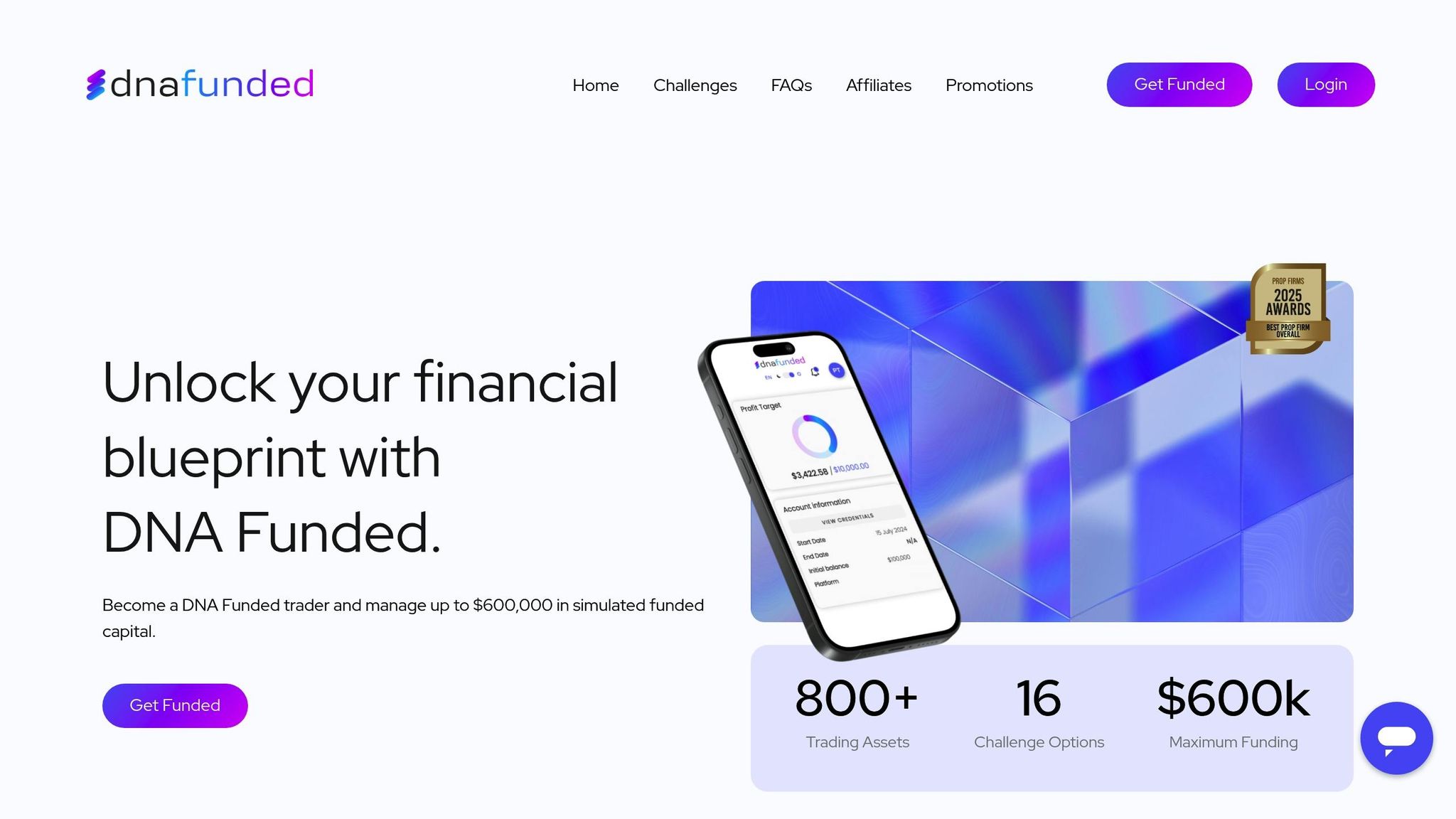
DNA Funded is a proprietary trading firm backed by the regulated broker DNA Markets. It offers three challenge types tailored to different trading preferences. With competitive spreads, straightforward rules, and flexible payout options, DNA Funded aims to attract traders looking for a streamlined experience.
Spreads
Forex traders will find spreads starting at 0.0 pips on major pairs like EUR/USD. A $5.00 round-turn commission applies, which is lower than the industry average of $7.00.
Rules
DNA Funded offers three challenge structures, each with specific requirements and restrictions. These challenges are designed to test trading skills while maintaining a fair trading environment. Key rules include:
- Daily profit cap: Limited to 40%.
- Minimum trading days: At least three days are required to meet profit targets.
- Strategy restrictions: Martingale strategies are banned, and news trading is prohibited within 10 minutes of major releases.
- Hedging and IP consistency: Inter-account hedging is not allowed, and traders must use a consistent IP address.
Algorithmic trading and Expert Advisors (EAs) are allowed for funded accounts. These accounts range from $5,000 to $200,000 and provide access to over 800 trading instruments.
Here’s a breakdown of the challenge types:
| Challenge Type | Profit Target | Max Daily Loss | Max Drawdown | Leverage | Duration |
|---|---|---|---|---|---|
| 1 Phase | 10% | 5% | 6% | 1:30 | Unlimited |
| 2 Phase | 10% / 5% | 6% | 10% | 1:50 | Unlimited |
| Rapid | 5% | 4% | 5% | 1:30 | 10 Days |
Payouts
DNA Funded offers an 80% profit split by default, with an option to upgrade to 90% through a profit split add-on. Payouts are available every 14 days, but traders can opt for a 7-day payout cycle by purchasing an early payout add-on.
- Add-on costs: Both the profit split and early payout add-ons increase the challenge price by 20%. Alternatively, traders can choose the Pro Challenge add-on, which combines the 90% profit split and 7-day payout, for a 30% premium.
- Withdrawal minimums: The minimum withdrawal amount is $100. Refunds are no longer available after the fourth withdrawal.
Trader Requirements
Challenge prices vary based on account size and structure:
- A $5,000 2 Phase Challenge costs $49, while the 1 Phase equivalent is priced at $59.
- For larger accounts, a $200,000 2 Phase Challenge is $1,079, compared to $1,209 for the 1 Phase.
- The Rapid Challenge, available for a $100,000 account, costs $549 and matches the 2 Phase pricing. However, it must be completed within 10 days.
DNA Funded has a Trustpilot rating of 3.4 out of 5, with 55% of reviews being positive and 39% negative.
2. FTMO

Run 24/7 while you sleep. Keep bots, platforms, and trade copiers online on a dedicated VPS.
Low-latency VPS hosting for your trading platform.
 CHINYC
 LON
LONFrom $29.99/mo


 CHI/CME futuresNYC/US marketsLON/FX EAs
 DUB/Polymarket
 AMS/EU FX
 FRA/Central EU
 TYO/APAC crypto
FTMO is a well-known proprietary trading firm that provides traders with professional trading conditions and a structured evaluation process. By partnering with tier-1 liquidity providers, FTMO ensures tight spreads and institutional-grade pricing that closely align with real market conditions. Let’s break down FTMO’s features, including spreads, rules, and payout structures.
Spreads
FTMO offers competitive spreads across major forex pairs and CFDs. Thanks to its partnerships with top-tier liquidity providers, traders benefit from live market pricing and high-quality execution. Beyond forex, tight spreads are also available for CFDs on indices, commodities, and individual stocks, making FTMO a versatile choice for traders employing diverse strategies.
Rules
FTMO uses a two-phase evaluation process to assess traders' skills and ensure fair trading practices.
- Phase 1: The Challenge requires traders to achieve a 10% profit target.
- Phase 2: Verification lowers the target to 5%. Both phases require a minimum of four trading days to complete.
Risk management is central to FTMO’s approach. Traders face a daily loss limit of 5% and an overall loss limit of 10% of the account balance. For instance, on a $10,000 account, the daily loss cap is $500, and the total loss limit is $1,000. These limits scale with account size.
Additional trading rules include:
- Position Duration: During the evaluation, trades must be held for at least four days. Once funded, traders are required to close positions by the weekend market close or after two hours of rollover, except for swing traders.
- News Trading: During the Challenge and Verification phases, there are no restrictions on trading during major economic events. Funded accounts, however, impose a two-minute restriction before and after significant news releases for specific instruments like USDJPY and GBPUSD. Other pairs, such as EURGBP and AUDNZD, remain unrestricted.
- Trading Strategies: FTMO supports a variety of strategies, including the use of Expert Advisors (EAs) and algorithmic trading, provided they align with risk management rules. Maximum forex order volume is capped at 50 lots.
"Money management is one of the most important factors affecting a trader's long-term performance in trading. Reasonable risk per trade will give you the much-needed psychological comfort that will prevent you from making unnecessary mistakes. In turn, it will show us that you are a trader who is serious about trading and wants to make consistent profits over the long term." – FTMO
Payouts
FTMO’s profit-sharing model allows traders to keep 80% of their profits, with the potential to increase this to 90% through the Scaling Plan.
- Withdrawal Process: Withdrawals are processed monthly by default, but traders can request payouts after 14 days. These requests are typically handled within 1–2 business days, with an average processing time of just 8 hours.
- Payment Methods: Options include bank wire transfers, Visa Direct/Mastercard Send (up to $20,000), Skrill, and cryptocurrencies. FTMO doesn’t charge additional fees, but minimum profit thresholds apply - $20 for bank wires and $50 for crypto transfers.
- Reinvestment Option: Traders can reinvest their profits, though the profit split remains in effect regardless of withdrawal choices.
Trader Requirements
FTMO emphasizes consistent performance, recommending traders manage risk at 1%–1.5% per trade. It’s also essential for traders to familiarize themselves with FTMO’s Terms & Conditions, especially clause 5.4, which prohibits certain trading practices. All evaluation trading is conducted using simulated capital designed to mimic real market conditions closely. Additionally, FTMO provides a timezone converter to help traders track when daily loss limits reset, reducing the risk of accidental breaches.
3. Topstep
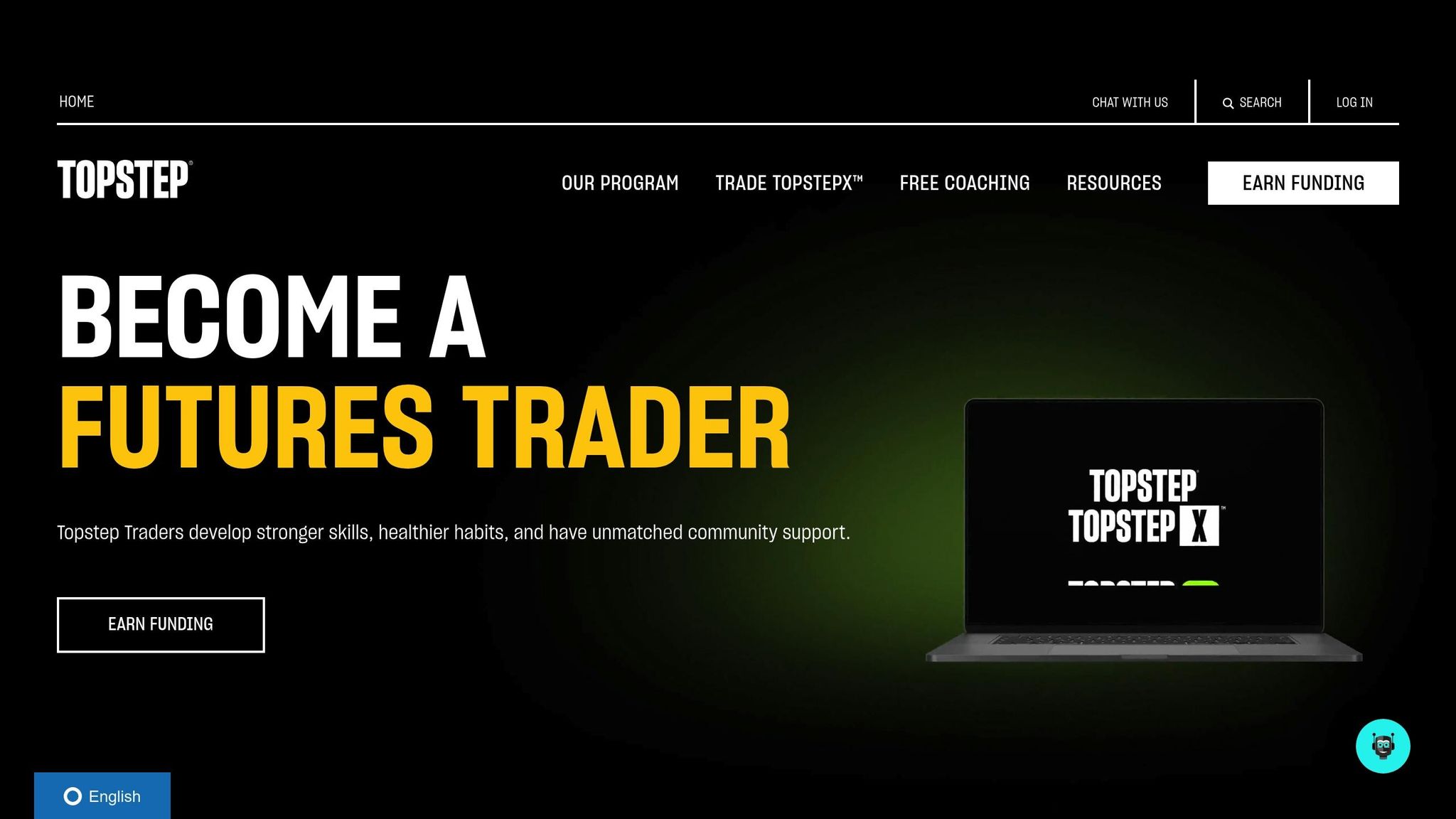
Topstep has carved out a niche in the world of proprietary trading by focusing on futures trading. This focus caters to traders working in commodities, indices, and other futures markets. Unlike forex trading, which often involves traditional spreads, trading futures with Topstep comes with fees and costs tied to specific contracts. Let’s break down how Topstep operates, including its evaluation process, payout structure, and trader requirements.
Rules
Topstep employs a clear evaluation process to identify traders who can consistently perform in the futures market. To qualify for a live funded account, traders must show both profitability and strong risk management by achieving a winning day. A winning day is defined as a Net PNL (Profit and Loss) of $200 or more. This rule applies across all account types, ensuring traders can generate returns that align with the capital they are given.
Payouts
Topstep incentivizes traders with a two-tier payout system that grows as they demonstrate consistent performance. Here’s how it works:
- Traders keep 100% of the first $10,000 they withdraw in profits.
- Once they surpass that threshold, the profit split shifts to 90/10, with traders retaining 90% of the profits and Topstep taking 10%.
The table below highlights the payout structure and requirements for Topstep accounts:
| Account Type | Express Funded Account | Live Funded Account |
|---|---|---|
| 5 Winning Days of $200 or More | 5 non-consecutive days of Net PNL $200 or more | 5 non-consecutive days of Net PNL $200 or more |
| Payout Amount (Minimum $125) | Up to $5,000 or 50% of account balance per request | Up to 50% of account balance per request |
| 30 Winning Days of $200 or More | - | 30 non-consecutive days accumulated across both accounts |
| Enhanced Payout (Minimum $125) | - | Daily payouts up to 100% of the account balance |
The minimum payout request is $125, allowing traders to withdraw profits regularly. Additionally, there’s a one-time activation fee of $149 for Express Funded Accounts.
Trader Requirements
Topstep places a strong emphasis on risk management and long-term trading strategies. Traders are required to balance profit-taking with account growth, ensuring they maintain enough capital for proper position sizing. After the first payout, the Maximum Loss Limit resets to $0, which corresponds to the account’s starting balance. This means traders must keep their account above the initial funding level.
Reaching 30 winning days unlocks additional benefits, including daily payout eligibility and access to withdraw up to 100% of the account balance.
4. The 5%ers
The 5%ers has built a reputation for its flexible trader development programs and profit-sharing opportunities, earning a stellar 4.9 rating on Trustpilot. It supports speculative trading strategies across various markets, making it a popular choice for traders looking for growth.
Spreads
The 5%ers provides competitive spreads for traders. For major currency pairs, spreads range between 0.2 to 0.9 pips. If you opt for raw spread trading, spreads start at 0.0 pips, with commissions set at $4 per standard lot (round-trip) or $8 per 1.0 standard lot.
As Dukascopy Bank SA explains:
"Spreads are a key component of trading costs, directly affecting profitability and are often narrower in high-liquidity markets and wider during low liquidity or volatile conditions."
Traders can access real-time spread details in MT5 by right-clicking a symbol in the market watch window and selecting "specification". This transparency ensures traders have the information they need to manage their costs effectively.
Rules
The 5%ers imposes strict trading rules to maintain a structured environment. Prohibited practices include high-frequency trading (HFT), copy trading, hedging, arbitrage, tick scalping, account sharing, and using third-party expert advisors unless you own the source code.
Accounts that remain inactive for over 30 consecutive days are set to expire, with the countdown starting from the registration date. Despite these restrictions, traders are allowed to hold positions overnight, over weekends, and during news events. However, the High Stakes Program has an exception: no orders can be placed within two minutes before or after high-impact news related to the traded currency or index. Violating these rules can lead to account termination. These stringent protocols help ensure a fair and disciplined trading environment.
Payouts
The 5%ers offers a flexible profit-sharing model, with payouts ranging from 50% to 100%. Traders can request withdrawals anytime, typically processed within 1 to 3 business days, with a minimum withdrawal amount of $150. Payment options include Rise, cryptocurrencies, or hub credits, which are added directly to the trader’s dashboard.
A one-time entry fee applies for each challenge, and profits earned with bonuses are subject to a 50% split. Importantly, withdrawals do not impact account scaling, though the 14-day payout cycle resets upon scaling.
Stay online and closer to execution. Choose a VPS location for CME futures, New York markets, London FX, API trading, and more.
Host your platform near the market route that matters.
CHINYCLONFrom $29.99/mo
CHI/CME futuresNYC/US marketsLON/FX EAsDUB/PolymarketAMS/EU FXFRA/Central EUTYO/APAC cryptoTrader Requirements
To succeed with The 5%ers, traders must showcase consistent speculative performance while adhering to strict conduct rules. This includes avoiding trade coordination, copy trading, account sharing, or using unverified automation tools. These requirements emphasize the firm’s focus on disciplined and independent trading practices.
5. FundingPips
FundingPips is a proprietary trading firm headquartered in Dubai (United Arab Emirates), offering multiple challenge and funding paths for traders of various experience levels. Known for its flexible model—ranging from one-step challenges to direct funded “zero” programs—it aims to provide low entry cost, transparent rules, and high profit-split opportunities.
Spreads & Markets
Traders at FundingPips gain access to a broad range of instruments, including forex, commodities, indices, and cryptocurrencies. Spreads are competitive: for instance, review sources report spreads “starting from 0.1 pips” on major forex pairs under certain challenge accounts. Commission structure likewise varies by account type but is designed to be cost‐efficient for day/swing traders.
Rules & Challenge Types
FundingPips offers several evaluation/funding models, typically including:
- A one-step challenge: hit ~10 % profit target, maintain static drawdown (≈6 %), minimum trading days ~3.
- A two-step challenge: phase 1 ~8 %, phase 2 ~5 % profit target, daily loss/drawdown limits ~5 %/10 % respectively.
- An instant/zero funding program: skip or minimise evaluation, ~5 % static drawdown, daily loss ~3 %, designed for traders ready to go live.
General rules across their programs include:
- Minimum trading days: ~3 days required in most challenge paths.
- Static drawdown limits (rather than trailing) in many models.
- Leverage varies by program: forex up to 1:100 in two-step models.
- Use of EAs/automated trading: FundingPips allows certain risk-management tools, but prohibits fully automated bots placing trades.
Payouts & Profit Splits
FundingPips offers profit splits of typically 80% up to 100%, depending on account size, program and payout cycle. Their payout cycles range from weekly (“Tuesday Payday”), bi-weekly, monthly, or on-demand (especially via their “Hot Seat” or Master trader programme). Some review sources note that higher splits (100%) are unlocked after multiple successful payout cycles or achieving “Master/Elite” status.
Minimum challenge fee entry points are reported as low as US$29 for a $5K account in certain models.
Trader Requirements & Scaling
FundingPips offers scaling up to larger capital allocations (e.g., up to US$2 million in some references) through performance milestones and “Hot Seat” tiers. Withdrawal minimums may vary by program, and payout processing times generally claim expedited service (some within 48-hours) under certain conditions.
Reputation & Considerations
Most recent reviews highlight FundingPips as competitive and trader-friendly with strong profit potential. However, there are trader complaints and caution notes: issues raised include changing rules post-funding, slippage or execution complaints in phase 2, and delay in payouts or “interview” requirements.
Advantages and Disadvantages
Here's a quick look at the pros and cons of the firms surveyed:
| Firm | Advantages | Disadvantages |
|---|---|---|
| DNA Funded | • Profit share up to 90% with funded accounts reaching $600,000 • Low entry fees starting at $49 • Offers flexible evaluation options: one-step, two-step, or 10-day models • Trustscore of 3.5/5 stars |
• Lower leverage of 1:30 (1:50 for two-step accounts only) • Daily loss limits between 4% and 6% • Maximum trailing drawdown ranges from 5% to 10% |
| FTMO | • Flexible trading rules: "As long as your trading is legitimate (in line with proper risk management), conforms to real market conditions, and avoids forbidden practices, we impose no limits on your strategy - whether discretionary, algorithmic, or EA-based." • Account Swing allows news trading and weekend holds • Supports algorithmic trading and expert advisors • Clear profit targets: 10% for Challenge and 5% for Verification |
• Platform restricts 200 orders at a time and 2,000 positions per day • News trading restrictions apply to standard accounts |
| Topstep | • Traders keep 100% of the first $10,000 in profits • Offers a structured path for futures trading • High Trustpilot score of 4.6/5 • Monthly fees range from $49 to $149 |
• Prohibits account stacking and trading outside the best bid/offer • Limited to futures markets only • Enforces strict rules to promote responsible trading and prevent unrealistic order fills |
| The 5%ers | • Flexible profit-sharing model offering 50% to 100% | • Variable profit-sharing may appeal to some but lacks fixed payouts, creating uncertainty |
The cost structures vary across firms. For instance, DNA Funded's challenge fees start as low as $49, while Topstep charges monthly fees from $49 to $149. DNA Funded’s 90% profit share is ideal for high-volume traders, while Topstep’s model of keeping 100% of the first $10,000 in profits suits smaller-scale traders.
Evaluation processes also differ. DNA Funded provides multiple evaluation paths, while FTMO sticks to a standardized two-phase method. Market access varies, too - Topstep focuses exclusively on futures, while DNA Funded, FTMO, and The 5%ers offer broader market options. FTMO's order cap of 200 simultaneous orders and 2,000 daily positions may limit high-frequency traders, whereas other firms impose no such restrictions.
Ultimately, no single firm excels in every area. Choosing the best fit depends on your priorities - whether it’s cost, payout structure, trading flexibility, or market access. These comparisons aim to help you align your choice with your trading strategy.
Conclusion
Selecting the right proprietary trading firm is all about finding one that aligns with your trading style and goals.
DNA Funded stands out with its low entry fees, generous profit splits, and access to over 800 trading instruments. As Noam Korbl, co-founder of Prop-Firms.com, explains:
"DNA Funded's extensive range of markets includes a broad selection of global equities and indices. In an industry that often prioritizes forex and commodities, DNA Funded addresses the needs of stock traders, providing them with unmatched access in the prop trading space."
FTMO is well-regarded for its rigorous evaluation process and large funded accounts, making it a strong choice for seasoned traders looking for higher capital.
For those focused on futures, Topstep is a compelling option. Their unique model allows traders to keep 100% of the first $10,000 in profits, and their high Trustpilot rating reflects strong user satisfaction.
Meanwhile, The 5%ers caters to traders aiming for steady, long-term growth. Their conservative approach is ideal for those who prefer a more measured trading style.
When evaluating firms, pay close attention to eligibility criteria and profit-split structures. Many U.S.-based traders lean toward firms offering profit splits of 80% or more. As the industry continues to evolve, transparency and reduced fees are becoming key competitive factors.
Each firm has its strengths - whether it’s affordability, evaluation processes, or market specialization. The key is to choose a firm that aligns with your trading capital, market preferences, and profit objectives.
FAQs
How do the evaluation processes of DNA Funded and FTMO differ?
DNA Funded gives traders two evaluation options: a single-step process with a 10% profit target or a two-step process where traders aim for a 10% profit target in Phase 1 and 5% in Phase 2. This setup offers more flexibility and places a strong focus on managing risk effectively.
On the other hand, FTMO follows a more structured two-phase evaluation system. The first phase, known as the Challenge, requires traders to hit specific profit and risk targets within a set timeframe. The second phase, called Verification, ensures traders can maintain consistent performance, but with a lower profit target.
The main difference? DNA Funded lets traders choose between single-step or two-step evaluations, offering more adaptability. FTMO, however, sticks to a fixed two-phase structure aimed at testing both a trader's profitability and discipline.
How do the payout structures of Topstep and The 5%ers compare, and what do they mean for traders?
Topstep offers a payout system where traders keep 100% of their profits up to $10,000. Beyond this threshold, profits are split 90/10. However, payouts are capped at $5,000 or 50% of the account balance, and traders must achieve at least five winning days before they can request a withdrawal.
The 5%ers, by contrast, begin with an 80% profit split, which can increase to 100% as traders advance through their program. Payouts are processed on a bi-weekly schedule, providing a consistent timeline for receiving earnings.
For traders, Topstep's structure allows for full retention of initial profits but imposes limits as earnings grow. Meanwhile, the 5%ers' approach, with its higher starting split and potential for full profit sharing, may appeal to those focused on long-term growth and more flexible payout options.
What should traders look for when evaluating proprietary trading firms based on market access and available instruments?
When choosing a proprietary trading firm, it's crucial to examine the kind of market access they provide. Do they offer direct market access (DMA), or will you be trading through intermediaries? This distinction can significantly affect your trading experience.
You'll also want to check the variety of trading instruments available. Whether you're into stocks, forex, futures, or options, make sure the firm's offerings align with your trading strategy and goals.
Equally important are factors like order execution speed, available liquidity, and the firm's approach to risk management. These elements play a big role in how smoothly and securely you can trade. Lastly, confirm that the firm adheres to relevant regulations, such as FINRA’s Market Access Rule, to ensure you're working within a safe and reliable trading environment.