Futures trading can feel overwhelming when deciding which positions to take and how to manage risk in changing markets. Copy trading lets you mirror the trades of experienced futures traders in real time, syncing your portfolio with tested strategies. This article breaks down how to find the best copy trading platform for your investing goals, so you can follow skilled traders, reduce risk, and grow your account with confidence.
Finding the right platform is only part of the equation. To keep your copy trading running smoothly around the clock, you need reliable infrastructure: QuantVPS. Our trading VPS keeps your automated trades and signal copying active 24 hours a day with low latency and zero downtime, so you never miss a position entry or exit.
Summary
- Copy trading in futures markets works by mirroring the positions of experienced traders in real time, which removes the need for constant manual analysis. This approach is particularly useful in volatile markets where timing and strategy consistency matter more than individual trade decisions.
- Platform selection comes down to three practical filters: the available asset classes, the level of manual oversight required, and the fee structure. Execution costs and platform fees can significantly reduce net returns over time, making cost comparison a necessary step before committing to any service.
- The range of copy trading platforms available in 2026 spans from fully automated futures replication to signal-driven environments where traders can observe and learn. This variety means the best choice depends heavily on whether a trader wants hands-off automation or a more active, educational experience.
- Reliable infrastructure is a non-negotiable factor for automated copy trading setups. A dropped connection at the wrong moment can result in missed entries or exits, which directly affects performance outcomes regardless of how strong the underlying strategy is.
- Low latency and consistent uptime are technical requirements that affect the quality of trade execution in futures markets. Because futures positions can move quickly, even brief connectivity interruptions can cause meaningful slippage or missed signals that compound over time.
- QuantVPS trading VPS addresses this by keeping automated trades and signal copying active around the clock, so connectivity issues do not interfere with position entries or exits.
How Copy Trading Works
Master-Follower Setup
At its core, copy trading operates on a straightforward master-follower system. The master account is the decision-maker, while follower accounts automatically replicate the master’s trades using specialized software. This setup ensures that the actions of the master are mirrored in real time across all connected follower accounts.
When the master opens a position, the software captures critical trade details - such as the trading instrument, position size, entry point, stop loss, and take profit levels - and instantly transmits this information to the follower accounts. These signals are sent via direct connections or by monitoring the trading platform. Many professional tools, like those compatible with NinjaTrader or MetaTrader, maintain constant connections to the platform to ensure that signals are transmitted within milliseconds of the master’s actions.
The system also offers flexibility for followers to adjust their position sizes. Options typically include fixed lot sizes, percentage-based scaling, or scaling proportional to the follower’s account balance. This customization allows the strategy to align with each follower’s financial capacity.
Once you understand how signals are transmitted, it’s essential to dive into the challenges of execution and timing.
Order Execution and Timing
Speed is everything in copy trading. Even a delay of just 50–200 milliseconds can affect profitability. Network issues or latency can extend these delays, leading to differences in execution between the master and follower accounts.
Another hurdle is partial fills. When the master account places a large order and only part of it gets filled, the software must decide whether to replicate the partial position immediately or wait for the full order to execute. Most advanced tools allow traders to configure this setting, offering flexibility based on their strategy.
If follower orders fail due to broker or network issues, sophisticated systems automatically retry execution. In some cases, they adjust the order price to reflect real-time market conditions, ensuring trades are placed as accurately as possible.
The software also manages order modifications and position closures. For instance, if the master trader updates a stop loss or takes partial profits, these changes must be mirrored across all follower accounts. This requires constant monitoring of the master’s positions and precise synchronization to keep everything aligned.
Addressing these execution details is critical for minimizing risks and ensuring smooth operations in copy trading.
Different Types of Copy Trading
Copy trading can be implemented in several ways, each with its own strengths and limitations:
- Synchronous copying: Trades are executed simultaneously for both the master and followers, minimizing delays. This method is ideal for strategies like day trading, where timing is crucial, but it demands a robust, low-latency infrastructure.
- Asynchronous copying: This method introduces intentional delays between the master’s and followers’ trades. It’s useful for accounts in different time zones or when brokers have varying execution speeds.
- Delayed copying: Trades are replicated after a set time delay, which could range from minutes to hours. While this approach reduces infrastructure demands, it increases the risk of price slippage and missed opportunities.
- Cloud-based copying: Signals from the master account are sent to a cloud server, which then distributes them to follower accounts. This method is scalable and reliable, though it introduces additional latency compared to direct, local copying.
- Local copying: All copying logic is handled on a single machine or local network. This method offers the lowest latency but comes with scalability limitations and a potential single point of failure.
- Hybrid systems: These combine multiple approaches to balance performance and reliability. For example, a trader might use synchronous copying for primary accounts while employing delayed copying for accounts with different risk profiles or position sizes.
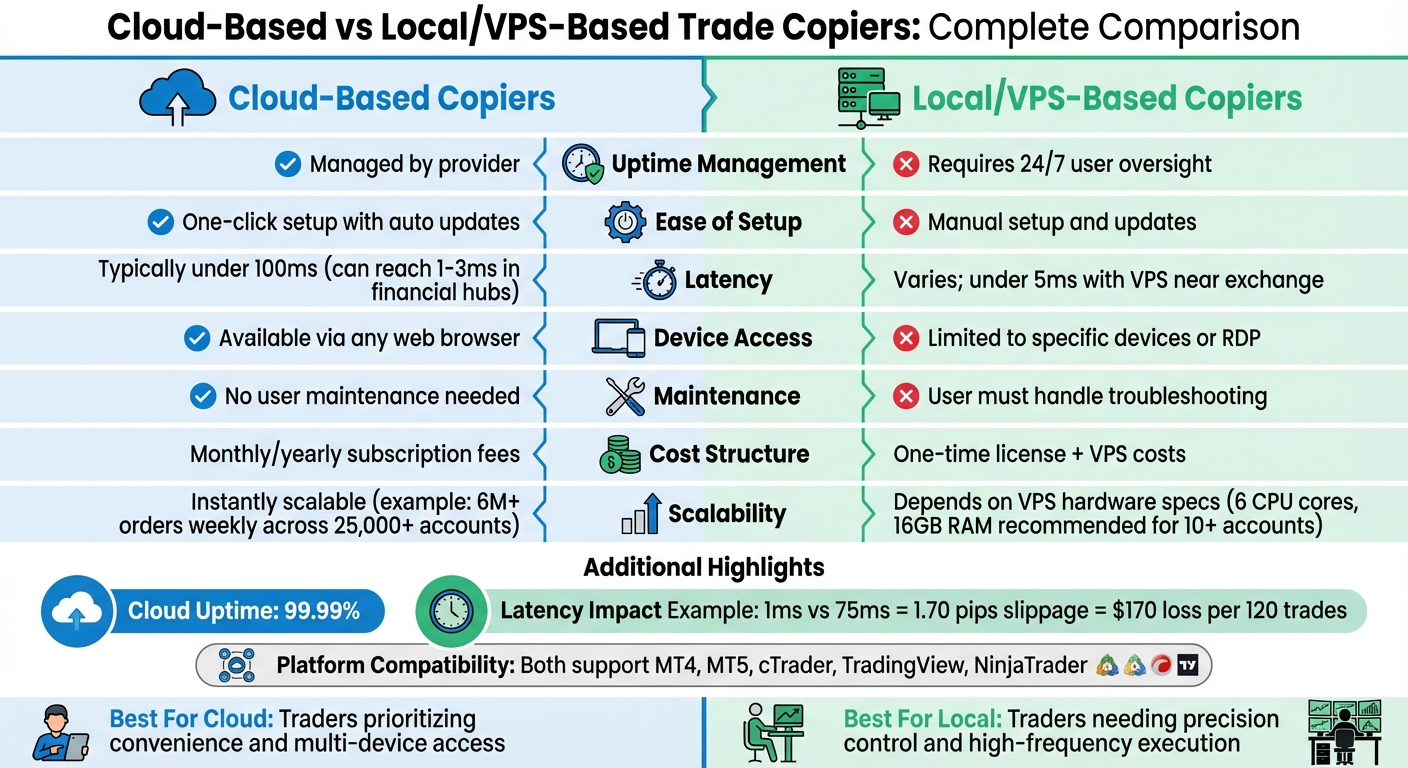
Cloud-Based vs Local VPS Trade Copiers Comparison Chart
When it comes to cloud-based and local/VPS-based trade copiers, each offers its own set of advantages and limitations, particularly in areas like control, speed, and maintenance.
The choice of method impacts the infrastructure needed. Synchronous and local copying, for instance, require the most robust hosting solutions to maintain performance and reliability.
For traders using high-frequency strategies or tackling prop firm challenges, speed is critical. Hosting your VPS close to exchange servers - like in Chicago for CME futures - can cut latency down to under 5ms. Meanwhile, cloud-based systems like Copygram boast 99.99% uptime thanks to features like automatic failover and global server networks. In contrast, local setups rely entirely on the stability of your own infrastructure. Here’s a quick comparison of the two:
| Feature | Cloud-Based Copier | Local/VPS-Based Copier |
|---|---|---|
| Uptime Management | Managed by the provider | Requires 24/7 user oversight |
| Ease of Setup | One-click setup with auto updates | Manual setup and updates |
| Latency | Typically under 100ms | Varies; depends on network/VPS |
| Device Access | Available via any web browser | Limited to specific devices or RDP |
| Maintenance | No user maintenance needed | User must handle troubleshooting |
| Cost Structure | Monthly or yearly subscription fees | One-time license plus VPS costs |
| Scalability | Instantly scalable | Depends on VPS hardware specs |
Both options cater to different needs, so the choice ultimately depends on your priorities - whether it's ease of use, control, or speed.
How does copy trading work and how do you choose a strategy provider?
Copy Trading Applications by Market
Copy trading is not a one-size-fits-all solution. Markets like futures, forex, CFDs, and crypto have distinct technical and regulatory demands, requiring tailored tools and approaches. Here's a closer look at how copy trading adapts to these diverse environments.
Futures and Prop Firms
Futures trading is one of the most challenging markets for copy trading because success often hinges on low-latency execution. In this space, even a few milliseconds can mean the difference between profit and loss, so selecting the right infrastructure is absolutely critical.
Platforms like NinjaTrader have become popular for futures copy trading, offering tools such as Replikanto. These tools integrate directly with data feeds like Rithmic, CQG, and Interactive Brokers, ensuring fast and accurate order replication.
For proprietary trading firms, copy trading is a valuable tool to scale strategies. However, traders need to confirm whether the firm's policies allow copying, as restrictions may apply.
On the regulatory side, the Commodity Futures Trading Commission (CFTC) and the National Futures Association (NFA) oversee copy trading in futures markets. Firms offering these services must register with the NFA and comply with CFTC regulations, often classifying their activities under portfolio management or brokerage services.
Next, let’s examine how copy trading operates in forex and CFD markets, which bring their own set of challenges.
Forex and CFDs
Forex copy trading comes with its own hurdles, particularly because forex operates as an over-the-counter (OTC) market. This can lead to execution discrepancies since trades are processed on dealer-controlled platforms.
Platforms like MetaTrader 4 and 5 dominate forex copy trading, offering tools such as Local Trade Copier, Forex Copier, and FX Blue. These tools can work on a single VPS or distribute signals across multiple brokers and servers, providing flexibility for traders.
Regulation in forex markets varies by region. For example, the EU’s MiFID II, the UK’s FCA, and Australia’s ASIC mandate that copy trading services meet portfolio management authorization standards.
From a technical standpoint, forex copy trading requires robust systems to handle security, capacity, and risk. Electronic trading platforms must ensure integrity in key areas such as pricing, slippage, and rollover adjustments. Risk management plays a central role here, as traders need to account for the 24/5 trading schedule and fluctuating liquidity across global sessions.
While forex and CFDs present execution and regulatory challenges, crypto and social trading bring an entirely different set of complexities.
Crypto and Social Trading
In the crypto world, copy trading operates in an environment filled with regulatory uncertainty. The SEC classifies some crypto assets as securities, while the CFTC treats others as commodities, creating a patchwork of rules.
API-driven solutions dominate crypto copy trading, with platforms connecting directly to exchanges like Binance, Coinbase Pro, and Kraken. Social trading platforms such as ZuluTrade have also expanded into crypto, enabling signal-based copying. These platforms often feature rankings, performance stats, and community feedback to help users choose strategies.
Compliance in crypto copy trading requires a deep understanding of blockchain technology. Anti-Money Laundering (AML) protocols are especially critical, often relying on blockchain intelligence tools to track wallet activity and flag potentially illicit transactions. This ensures adherence to regulations like the Bank Secrecy Act (BSA) and rules set by FinCEN and OFAC.
Another unique challenge in crypto is data retention. Companies must keep extensive records, including trading data, employee activity, asset details, and communications, for several years.

Run 24/7 while you sleep. Keep bots, platforms, and trade copiers online on a dedicated VPS.
Low-latency VPS hosting for your trading platform.
 CHINYC
 LON
LONFrom $59.99/mo


 CHI/CME futuresNYC/US marketsLON/FX EAs
 DUB/Polymarket
 AMS/EU FX
 FRA/Central EU
 TYO/APAC crypto
The crypto market’s 24/7 nature provides constant trading opportunities but also demands strong risk management to handle price volatility. Local regulations, such as New York’s BitLicense and Wyoming’s DAO laws, further complicate compliance, depending on where a company operates.
Copy Trading Benefits and Risks
Understanding how copy trading works is only part of the equation. Its advantages and risks play a big role in determining how effective it can be in practice. While copy trading offers some great opportunities for traders aiming to expand their operations, it also comes with challenges that require thoughtful planning.
Main Benefits
Effortless Account Scaling is one of the standout advantages. By automating trades across multiple accounts, traders can scale their activities without the hassle of manual intervention. This is especially useful for proprietary traders managing several funded accounts or portfolio managers handling client investments.
Diversifying Risk Across Strategies and Markets becomes easier with copy trading. It allows traders to run various strategies on different accounts simultaneously, spreading risk while ensuring consistent execution.
Access to Established Trading Strategies is another major plus, particularly for those new to trading. Many social trading platforms let users follow seasoned traders with proven track records, offering a chance to learn from and leverage sophisticated trading methods.
Automation Reduces Emotional Decisions, especially during volatile market conditions. By relying on automated, rule-based executions, traders can avoid the stress and impulsive decisions that often lead to mistakes.
Round-the-Clock Market Exposure is achievable with copy trading, particularly in markets like forex and cryptocurrency that operate 24/7. Even when traders can’t actively monitor their positions, they can maintain a presence in the market.
While these benefits can streamline trading, they are not without their challenges.
Common Risks and Problems
Latency, Order Mismatches, and Partial Fills can disrupt the smooth execution of trades. Even a slight delay can lead to slippage in fast-moving markets. Additionally, differences in account sizes or margin requirements between master and follower accounts may result in incorrect position sizing.
Infrastructure Failures pose another risk. If the copy trading software crashes or loses connection, follower accounts may end up in unintended positions or miss critical exit signals.
Overcrowding of Strategies can weaken their performance. When many traders blindly follow the same strategy without understanding its fundamentals, it can lead to reduced effectiveness, especially if the strategy becomes too popular.
Compliance and Regulatory Issues are serious concerns, particularly for proprietary traders. Many prop firms have strict rules regarding automated trading, and failing to follow these can lead to penalties or account restrictions.
Broker-Specific Restrictions can also create hurdles. Policies on automated trading, API access, and execution speeds vary between brokers, which can lead to unexpected limitations.
These risks highlight the importance of having a solid plan to manage potential pitfalls.
How to Manage Risks
Set Up Monitoring Systems to keep an eye on the performance and synchronization of all connected accounts. Alerts for delays, mismatches, or unusual performance can help catch problems early.
Test with Small Positions before fully committing to a new copy trading setup. This minimizes potential losses while allowing you to troubleshoot any technical issues.
Define Clear Risk Parameters like maximum drawdowns, position size limits, and stop-loss rules. Applying these consistently across all copied accounts can help protect your capital.
Use Reliable Infrastructure by investing in VPS hosting with backup systems and failover capabilities. A stable internet connection and adequate server resources are also critical for seamless operations.
Regularly Review and Adjust Strategies to ensure they align with current market conditions and your trading goals. Strategies that worked in the past may not always remain effective.
Prepare for Emergencies by documenting and testing procedures for system failures or outages. Having a clear plan for manually closing positions can prevent small issues from escalating into significant losses.
Stay on Top of Regulatory Compliance, especially if you’re trading through a prop firm or managing client accounts. Regular checks can help you avoid unintentional violations.
Balancing the efficiency of copy trading with strong risk management practices is key to long-term success. By taking these steps, traders can better evaluate and select reliable copy trading tools and hosting solutions.
Popular Copy Trading Tools
Copy trading tools come in a variety of options, tailored to different platforms and market needs. From NinjaTrader to MetaTrader, each tool brings unique features to the table. Let’s break down some of the top tools for NinjaTrader, Forex, and cross-platform trading.
NinjaTrader Copy Tools

If you're using NinjaTrader, here are some tools worth exploring:
- Replikanto: Perfect for futures traders, Replikanto excels in real-time synchronization with minimal latency. It's a solid choice for scalping and managing multiple funded accounts.
- Affordable Indicators Trade Copier: This budget-conscious tool covers the basics, including handling partial fills and modifying orders. It’s a straightforward option for those looking to get started with copy trading.
These tools integrate directly with NinjaTrader's API, ensuring reliable performance and real-time execution. Most also support both live and simulation accounts, giving traders the chance to fine-tune their strategies without risking real money.
Forex Copy Tools
For Forex traders, the following tools stand out:
- Local Trade Copier: A popular choice for MT4/MT5 users, this tool supports hedging, partial closes, and modifying pending orders. Its ability to work across multiple brokers simultaneously makes it ideal for managing diverse forex accounts.
- Forex Copier: With both local and cloud-based options, Forex Copier allows you to copy signals regardless of time zones. It doesn’t require constant master-follower connections, offering flexibility for traders on the go.
- FX Blue: Combining local copying with web-based monitoring, FX Blue provides advanced analytics to help traders refine their strategies.
Forex-specific tools often excel in handling the unique challenges of currency trading, such as weekend gaps, broker execution differences, and varying spreads. They also tend to offer broader broker compatibility compared to platform-specific solutions.
Cloud and Multi-Platform Solutions
For those juggling multiple platforms, cloud-based and cross-platform tools can be game-changers:
- TradeSyncer: This tool bridges platforms like NinjaTrader, MT4, and TradingView, enabling seamless signal copying across different trading environments.
- Copygram: By converting trading signals into actionable orders using email, SMS, or webhooks, Copygram simplifies multi-platform trading.
Cloud-based solutions come with distinct advantages, such as no need for constant computer connections, built-in redundancy, and mobile access for monitoring. However, they may introduce slight latency, making them less suitable for high-frequency trading. Scalpers and day traders often lean toward local tools for their speed, while swing traders and signal providers appreciate the convenience of cloud-based systems.
When choosing a copy trading tool, consider factors like platform compatibility, broker support, latency needs, and the complexity of your strategies. Many providers offer trial periods or demo versions, allowing you to test their features before committing. With these tools, traders can find solutions tailored to their specific needs. Up next, we’ll dive into how VPS hosting can further enhance trade replication.
10 Best Copy Trading Platforms For Investing in 2026
These ten platforms span copy trading choices available in 2026, from fully automated futures replication to signal-driven learning environments. Your best pick depends on three factors: which asset classes you need, how much manual oversight you'll accept, and which fee structure preserves the most net returns after execution costs.
1. eToro
eToro remains a leading choice in 2026 for its pioneering CopyTrader system, which democratizes professional-level investing. With millions of users worldwide, it offers an intuitive interface, broad asset selection, and strong community tools for copying real-time trades.
Key Features
- A global community of over 2.5 million traders available to copy.
- Advanced filters for selecting traders by performance, risk level, nationality, and strategy.
- Multi-asset support, including stocks, crypto, forex, and ETFs.
- Regulated by top authorities for enhanced security and trust.
- Mobile apps for iOS and Android, plus a web platform.
- No additional fees for copy trading; commissions are built into spreads.
- Real-time trade mirroring and portfolio diversification options up to 100 traders.
Limitations
- Spread-based costs can exceed those of flat-fee alternatives for certain assets.
- Popular traders can fill up, limiting access to top performers.
- Diversification is capped at 100 copied traders per account.
2. Echo Trade
Echo Trade stands out as a flexible overlay service in 2026, connecting to your existing brokerage without requiring a full switch. It grants access to professionally managed portfolios from registered investment firms, delivering automated strategy mirroring once reserved for ultra-high-net-worth individuals.
Key Features
- Integrates with major U.S. brokers: E*TRADE, Schwab, Fidelity, and Robinhood.
- Provides real-time trade alerts and automatic execution for selected portfolios.
- Offers commentary, position tracking, and performance insights from professionals.
- Features a free 14-day trial to test portfolios risk-free.
- Supports subscription-based access starting at around $40 monthly for one portfolio.
- Maintains user control while automating replication of expert trades.
- Focuses on diversified, professionally curated strategies for steadier outcomes.
Limitations
- Subscription costs accumulate when copying multiple portfolios.
- Limited to U.S. brokers, restricting access for international users.
- Less suited to active traders seeking full control over individual trades.
3. Stock Market Guides
Stock Market Guides excels in 2026 in delivering research-backed trade signals rather than fully automated copying. It provides instant notifications via email or text for stock and options trades with predefined entry, exit, and profit targets.
Key Features
- Real-time alerts for stock and options trades with clear rules upfront.
- Backtested annualized returns averaged 79.4% for stocks and 150.4% for options.
- Transparent trade details, including entry/exit criteria and risk parameters.
- Subscription pricing is $69 per month per service (stocks or options).
- An education-focused approach reveals the full trade logic of learning.
- Manual implementation required, giving users added control over execution.
- High-probability opportunities vetted through rigorous analysis.
Limitations
- No automated execution; timing depends on user responsiveness.
- Backtested returns don't guarantee future results.
- Separate fees for stocks and options services increase the total cost.
4. Mindful Trader
Mindful Trader, led by experienced trader Eric Ferguson since 2026, prioritizes direct communication through daily email updates on trades, market views, and results, including losses, fostering a genuine personal connection rare in the space.
Key Features
- Daily emails detailing current trades, exits, and market commentary
- Full transparency on wins and losses with no sugarcoating
- Personal customer support handled directly by the trader
- Real equity curves and performance are displayed for credibility
- Affordable $47 monthly subscription
- The trader invests personal capital in every shared position
- Consistent, straightforward updates and direct access build trust
Limitations
- Relies on a single trader's strategy and judgment rather than diversified signals.
- Manual execution required; users must act on emails promptly.
- Limited scalability as a one-person operation compared to larger platforms.
5. DupliTrade
In 2026, DupliTrade delivers a fully automated experience for forex and CFD traders seeking vetted strategies. It partners with select brokers to mirror only top-tier, pre-screened providers with proven records.
Key Features
- Fully automated trade replication with minimal user intervention
- Strict selection of high-performing, experienced strategy providers
- Customizable settings to align copying with personal risk preferences
- Supports forex, CFDs, and select other assets through partnered brokers
- Minimum deposit is typically around $5,000, depending on the broker
- Risk-aware automation with performance monitoring tools
- Broker-dependent fees, often including setup costs and variable spreads
Limitations
- A high minimum deposit creates a barrier for smaller accounts.
- Limited to forex and CFDs, with minimal support for stocks or crypto.
- Tied to specific partner brokers, reducing choice flexibility.
6. NAGA
NAGA is a dynamic social trading network that blends stocks, forex, and cryptocurrencies with seamless copy trading. It attracts tech-oriented users who value quick setup, zero-commission crypto trades, and community interaction.
Key Features
- Strong emphasis on cryptocurrency copy trading alongside stocks and CFDs.
- User-friendly interface with social sharing and gamified elements.
- Beginner-accessible tools enable fast account creation and navigation.
- Over 1,000 assets available for copying and direct trading.
- Zero commissions on many crypto trades with competitive spreads.
- Minimum deposit of around $250 for broad accessibility.
- Community-driven environment encouraging interaction and learning.
Limitations
Stay online and closer to execution. Choose a VPS location for CME futures, New York markets, London FX, API trading, and more.
Host your platform near the market route that matters.
CHINYCLONFrom $59.99/mo
CHI/CME futuresNYC/US marketsLON/FX EAsDUB/PolymarketAMS/EU FXFRA/Central EUTYO/APAC crypto- Gamified elements may encourage impulsive trading for some users.
- Spreads on non-crypto assets are less competitive.
- The platform is newer than long-established competitors like eToro.
7. ZuluTrade
ZuluTrade is a dedicated social trading network ideal for international users seeking MT4/MT5 compatibility and broad asset coverage. It emphasizes simplicity, automated protection tools such as ZuluGuard, and connections to numerous brokers for flexible trade replication.
Key Features
- Supports forex, crypto, CFDs, commodities, stocks, and indices.
- Automated safeguards, including ZuluGuard for risk management.
- Low minimum trade sizes starting at $1 for precise control.
- Integrates with popular brokers worldwide.
- Advanced filtering and performance metrics for strategy selection.
- Classic or profit-sharing account structures.
- Transparent leader rankings and real-time execution.
Limitations
- Performance varies significantly depending on broker execution quality.
- Profit-sharing account structures reduce net returns.
- Interface and strategy quality can be inconsistent across providers.
8. MetaTrader 4 and 5 (with Signals/Copy Integrations)
MetaTrader 4 and MetaTrader 5 remain powerhouse platforms favored by intermediate to advanced forex traders. These tools connect to various brokers and support built-in signals or third-party copy add-ons, delivering speed, reliability, and extensive customization for precise trade mirroring.
Key Features
- Cross-platform availability on Windows, Mac, iOS, Android, and more.
- Vast array of built-in indicators, tools, and charting capabilities.
- Seamless compatibility with most major brokers and copy services.
- Signals marketplace for subscribing to and automating expert trades.
- High execution speed and reliability in volatile markets.
- Free deposits and withdrawals through connected brokers.
- Advanced scripting and expert advisors for enhanced automation.
Limitations
- Steeper learning curve; less ideal for complete beginners.
- Signal quality varies widely and requires careful vetting.
- Customization options can feel overwhelming without trading experience.
9. Forex Copier
Forex Copier offers specialized downloadable software for serious forex traders using MT4 or MT5. It provides one-time purchase access with deep customization, allowing users to fine-tune copying rules, reverse modes, and filters for maximum control.
Key Features
- Supports bidirectional copying between MT4 and MT5 terminals.
- Reverse copy mode to benefit from opposing moves.
- Adjustable slippage, lot sizing, and order filtering options.
- Custom rules for trade size, pairs, and maximum orders.
- Flexible settings beyond standard platform limits.
- Local or remote copying capabilities.
- One-time fee model with no recurring subscriptions.
Limitations
- Requires technical setup and familiarity with MT4/MT5 environments.
- No built-in trader discovery or social features; users must source signals elsewhere.
- One-time fee excludes ongoing support or strategy guidance.
10. AvaTrade (with DupliTrade/ZuluTrade/AvaSocial)
AvaTrade is a well-regulated, multi-platform broker offering robust copy trading through integrated solutions like DupliTrade for vetted strategies, ZuluTrade for signal providers, and its own AvaSocial app. It suits users seeking a single trusted broker with multiple automation options.
Key Features
- Multiple copy systems, including DupliTrade, ZuluTrade, and AvaSocial.
- Broad asset range spanning forex, stocks, crypto, and commodities.
- Strong regulatory oversight for user security.
- User-friendly mobile and web apps for on-the-go monitoring.
- Educational resources and tools to complement copying.
- Competitive spreads and no extra copy-specific fees on many plans.
- Flexible minimum deposits and risk management integrations.
Limitations
- Multiple copy systems can confuse users initially.
- Fees and minimums vary by integration.
- Not all asset classes are available in every region.
11. Binance & Bybit – Best for Crypto-Only Copy Trading
Major crypto exchanges now include native copy trading features.
Key Features
- Integrated Execution: Trades execute directly on exchange order books with no third-party intermediaries.
- Futures & Spot Support: Copy advanced strategies using leverage or spot markets.
- Transparent Metrics: View ROI, drawdowns, and active positions in real time.
- Low Fees: No subscription fees; standard trading fees apply.
- Binance: Largest selection of crypto assets and pairs.
- Bybit: Known for competitive leaderboards and an active trader community.
Limitations
- Crypto only, with no exposure to stocks, forex, or ETFs.
- Volatility can lead to large, rapid drawdowns.
- Access may be restricted in certain jurisdictions, such as in the U.S.
Reliable infrastructure is critical for copy trading. A trading VPS from QuantVPS keeps your positions active 24/7 with low latency, preventing dropped connections from disrupting entries or exits. Consistent uptime ensures dependable trade execution.
VPS Hosting for Copy Trading
When it comes to copy trading, a dependable VPS is absolutely essential for smooth trade replication. Without reliable hosting, even the most advanced tools can falter at critical moments. As discussed earlier, trading in volatile markets demands a setup that can keep up, and a solid VPS can make all the difference.
Why Low-Latency VPS Matters
Speed is everything. Latency - the time it takes for a follower account to execute a trade after the master account initiates it - needs to be as close to zero as possible. High latency can disrupt synchronization, leading to missed opportunities or even losses. This issue becomes even more pressing during fast-moving markets. For instance, when major news or economic reports trigger rapid price changes, a VPS with 0-1ms latency ensures follower accounts can act almost instantly. On the other hand, a slower connection might leave you scrambling to catch up with prices that have already moved.
Stability is just as important as speed. A stable network ensures that trades are executed without hiccups. Unstable connections can result in order failures or partial fills, both of which can be costly. A professional-grade VPS minimizes these risks with consistent uptime and redundant network paths to maintain a steady flow of data.
VPS Specifications You Should Look For
To ensure your VPS can handle the demands of copy trading, focus on these key specifications:
-
CPU Power: The CPU is the engine behind fast order processing.
- At least 4 cores for basic setups (2-3 accounts)
- 6+ cores for more complex setups (5+ accounts)
- Up to 24 cores for high-frequency trading strategies
-
RAM: Sufficient memory prevents slowdowns.
- 8GB for simple configurations
- 16GB or more for setups with multiple accounts or resource-heavy strategies
- 64GB+ for large-scale operations
-
Storage: NVMe SSDs boost platform responsiveness and reduce startup times.
- 70GB for basic setups
- 150GB-500GB+ for setups that deal with extensive historical data
- Bandwidth: Unmetered 1Gbps+ connections are ideal for handling continuous data flow without throttling.
-
Location: Proximity to broker servers is crucial for reducing latency. For example:
- Chicago for futures trading
- New York for U.S. equities
- London for forex trading
Best Practices for VPS Setup
Getting the right hardware is just the first step. To maximize performance, follow these best practices:
- Co-locate master and follower accounts: Hosting both the signal source and the copy trading software on the same VPS eliminates unnecessary network delays. If they must be separate, ensure they’re in the same region and connected via high-speed networks.
- Set up monitoring and alerts: Configure email or SMS notifications for issues like high CPU usage or network disruptions. Early warnings can help you address potential problems before they affect your trading.
- Use backup VPS instances: Having a standby VPS ready to take over in case of failure minimizes downtime. A backup system ensures your trading operations can continue smoothly during unexpected outages.
- Optimize system settings: Disable unnecessary services and schedule updates during non-trading hours. Make sure your copy trading software starts automatically with the system and runs with the necessary privileges.
- Enable detailed logging: Keep comprehensive logs for both your trading software and system performance. These records are invaluable for troubleshooting and identifying patterns that could lead to issues.
- Test failover plans regularly: Practice switching to backup systems to ensure all accounts, settings, and connections transfer seamlessly. Regular testing ensures your contingency plans will work when you need them most.
A high-quality VPS is the backbone of any successful copy trading system. By investing in the right infrastructure, you can improve trade execution, reduce slippage, and operate with the confidence that your system will perform as expected.
Setting Up Copy Trading: Step-by-Step Guide
Now that we've covered VPS and tool configurations, let's dive into the next steps for setting up your copy trading system. While this guide focuses on NinjaTrader - a widely-used platform for futures trading - the core concepts can be applied to other platforms as well.
Choose Your Copy Trading Tool
Start by assessing your platform, account requirements, and budget to pick the right copy trading tool. For NinjaTrader users, Replikanto is the most popular options, offering real-time synchronization and advanced features.
- Replikanto offers added control with advanced filtering options. You can set rules to copy specific instruments or exclude certain types of trades, giving you more precision over what gets replicated.
Once you've chosen your tool, you're ready to install and configure it.
Install and Configure the System
Before installation, double-check that your VPS and data feeds are stable. Your NinjaTrader platform and broker connections should be fully operational. Install the copy trading tool with administrator privileges to avoid setup issues.
- Set Master Account Settings: Define the account that will generate trading signals. Specify the instruments to monitor and the types of orders to copy. For instance, if you're trading ES futures, ensure the software is configured to track ES orders specifically.
- Configure Follower Accounts: Set up scaling ratios to match the follower accounts' capital. For example, if the master account trades 2 contracts but a follower account has half the capital, adjust the scaling so the follower trades 1 contract. Most tools allow scaling based on percentages or fixed ratios. A common approach is to scale proportionally to account size - e.g., a scaling ratio of 0.5 for an account with 50% of the master account's capital.
- Establish Risk Management Parameters: Set limits on position sizes, daily losses, and instrument restrictions for each follower account. These safeguards minimize the impact of a single poor trade. For instance, you might cap any single position at 2% of account equity, regardless of the master account's position size.
Once everything is configured, it's time to validate the system's performance.
Testing and Going Live
Start with simulation mode to test your setup without risking real funds. Monitor execution details, such as fill prices, timing, and order failures. Here's how to proceed:
- Simulate for One Week: Run both master and follower accounts in NinjaTrader's simulation environment. Use this time to identify any issues, like timing discrepancies or scaling errors.
- Log Every Trade: Keep detailed records of trades, including order time, instrument, quantity, and fill price. A simple spreadsheet can help spot recurring problems.
- Test Under Varied Conditions: Simulate trading during both quiet and volatile market periods. Fast-moving markets can expose latency issues or slippage that may not occur in slower conditions. If problems arise, consider upgrading your VPS or tweaking software settings.
Once you're confident in the system's reliability, transition to live trading gradually:
- Start with your smallest follower account and minimal position sizes.
- Monitor performance closely, tracking not just profits and losses but also metrics like slippage, fill rates, and timing delays.
- Set up alerts for failed orders, connection issues, or unusual account activity. While many tools include built-in monitoring, it's wise to keep an eye on your accounts directly through NinjaTrader.
Patience and thorough testing are essential for a successful copy trading setup. Rushing into live trading without proper validation can lead to costly mistakes. Take the time to fine-tune your system and address any issues before scaling up.
Conclusion and Next Steps
Key Points to Remember
Copy trading presents a real opportunity to expand your trading operations, but success hinges on a few critical factors: reliable infrastructure, effective risk management, and the right tools. A dependable VPS hosting solution is the backbone of your setup. Without it, issues like latency or connection failures can quickly derail even the most promising strategies.
Risk management is non-negotiable. Before you go live, establish clear limits - such as position sizes, daily loss caps, and instrument restrictions - for every follower account. These safeguards are essential to prevent a single misstep from causing significant losses.
Choosing the right tools is equally important. Different platforms require different solutions. For instance, some tools are tailored for NinjaTrader, while others are designed for MT4/MT5. As mentioned earlier, a solid VPS infrastructure ensures precise order replication, reducing the chances of slippage or failed trades.
Infrastructure stability matters. Investing in a reliable VPS can save you from costly mistakes. For example, QuantVPS offers plans starting at $59.99/month for their VPS Lite package, which includes 4 cores, 8GB RAM, and ultra-low latency - perfect for trading applications.
Getting Started with Copy Trading
Once you’ve grasped the fundamentals, it’s time to put them into practice. Start by running simulations to test your system. During this phase, monitor key performance metrics like slippage rates, order fill success, and timing delays to ensure everything functions as expected.
When transitioning to live trading, take it slow. Begin with minimal position sizes to reduce your risk while fine-tuning your setup. Beyond tracking profits and losses, pay close attention to execution metrics to identify any potential issues early.
Your VPS must deliver ultra-low latency and consistent uptime from the very beginning. These factors are crucial for ensuring your copy trading system runs smoothly and efficiently.
Start small by pairing a single master account with a follower account. This focused approach allows you to better understand how your tools handle different order types and market conditions. Once you’ve gained confidence, you can scale up to multiple accounts or even experiment with cross-platform copying between brokers.
Documenting your setup is equally important. Keep detailed records of your configuration, scaling ratios, and risk parameters. This will make troubleshooting easier and help you replicate successful strategies.
The world of copy trading is always evolving, with new tools and features being introduced regularly. Stay up to date by following updates for your software and engaging with user communities where traders share tips and experiences. Ultimately, the key to success lies in consistent, reliable execution rather than overly complicated strategies. By sticking to these principles, you’ll be well-positioned to grow your copy trading operations with confidence.
FAQs
What should I look for in a VPS to ensure fast and reliable performance for copy trading?
When setting up a VPS for copy trading, prioritize a powerful CPU, ample RAM, reliable SSD storage, and a fast, low-latency network connection. To reduce delays, opt for a VPS that's geographically close to your trading servers. It's also crucial to choose a provider that ensures stable routing and offers tools for monitoring network performance to keep things running smoothly and efficiently.
What are the best ways to reduce risks like latency and order mismatches in copy trading?
To reduce risks like latency and order mismatches in copy trading, it’s important to use a low-latency VPS for fast and dependable trade execution. Placing master and follower accounts in the same region can also cut down delays - this is especially crucial for strategies that rely on quick reactions, like scalping.
Regularly checking network performance and fine-tuning order execution settings can make a big difference. Tools that measure tick-to-trade latency and direct exchange data feeds can help keep everything in sync. On top of that, reviewing execution quality - things like slippage and fill rates - can uncover potential problems early, giving you a chance to fix them before they become bigger issues.
What’s the difference between synchronous and asynchronous copy trading, and how do they affect trade execution?
Synchronous copy trading replicates trades instantly, matching the actions of the master account in real-time. This method ensures immediate execution but comes with potential challenges like higher latency and slippage, particularly in fast-paced markets where prices shift rapidly.
Asynchronous copy trading, by contrast, introduces a minor delay before executing trades. This slight pause can sometimes lead to more efficient execution, but it also opens the door to trade drift or slippage if market conditions shift during the delay.
Key takeaway: Synchronous trading shines in high-speed environments like futures markets, where timing and accuracy are crucial. Asynchronous trading, however, is better suited for less time-sensitive markets, such as forex or those with slower price movements.