Prop trading firms let you trade with their capital, but not all are trustworthy. Many firms operate in a gray area, with scams charging fees without paying traders. Legitimate firms focus on transparency, fair rules, and timely payouts.
Here’s how to spot the difference:
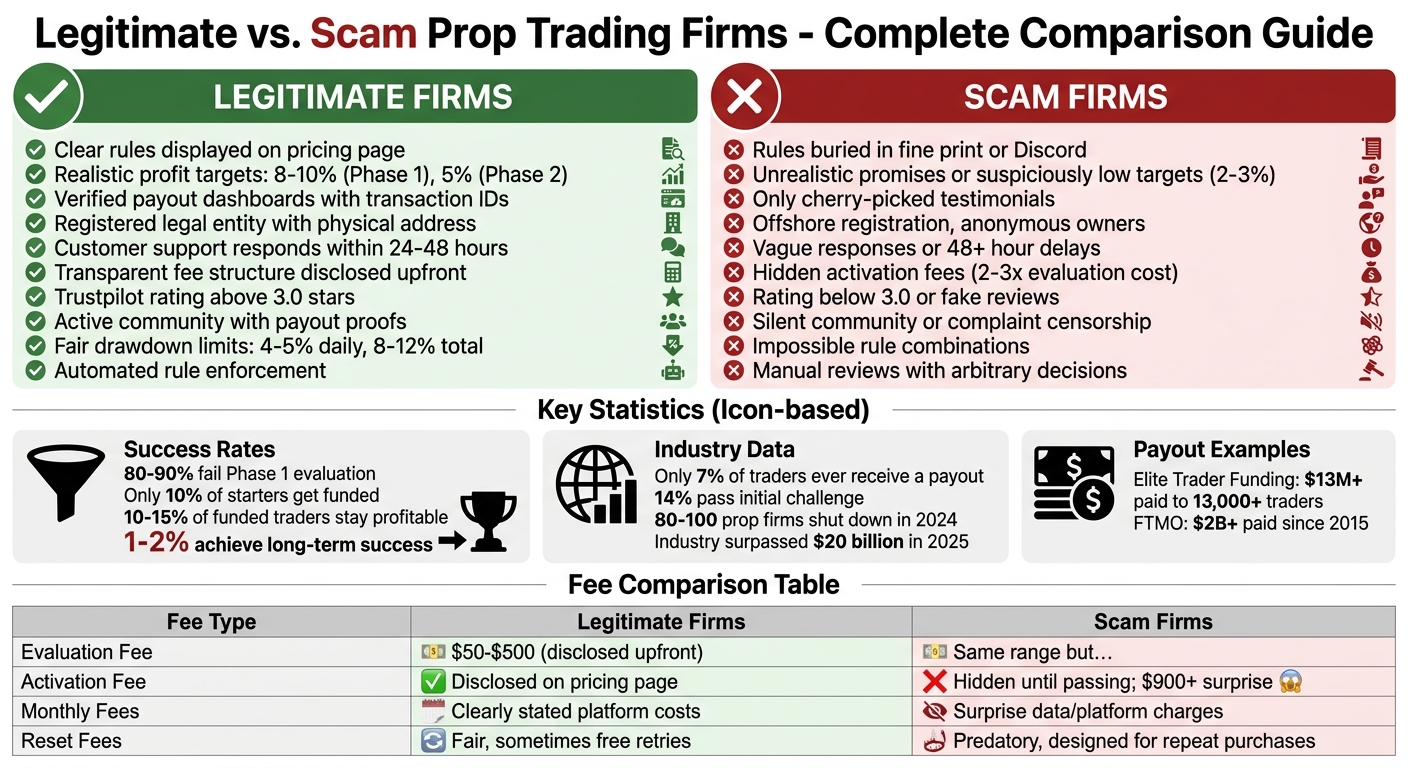
- Legitimate Firms: Clear rules, realistic profit targets (8–10%), verified payouts, and responsive support.
- Scam Firms: Hidden fees, vague policies, unrealistic promises, and payout issues.
Key stats:
- Only 1–2% of traders succeed long-term.
- 80–90% fail initial evaluations.
- Top firms like Elite Trader Funding have paid over $13M to traders.
Start small, research carefully, and test their reliability before committing large sums.
Legitimate vs Scam Prop Trading Firms: Key Differences and Warning Signs
How Prop Trading Firms Work
The Prop Trading Business Model
Prop trading firms primarily generate income through evaluation fees and related charges rather than from the profits of their traders.
"The majority of prop firm revenue comes from evaluation fees, not from trader profits." - ThePropFirmGuide
When you trade a "$100,000 account", the firm isn’t actually putting up $100,000 of its own money. Instead, they use virtual capital while managing the real financial risk separately, often through hedging strategies.
The firm's revenue streams include evaluation fees, which range from $50 to $500 depending on the account size, and additional charges like activation fees after passing the challenge, monthly platform or data fees, and profit splits from successful traders. Profit-sharing arrangements typically favor traders, with splits ranging from 70/30 to 90/10. Some firms even offer a 100% profit split on the first $25,000 earned. For traders who perform consistently, scaling plans allow them to manage increasingly larger amounts of capital, with some reaching $400,000 or more across multiple accounts.
Transparent firms stand out by clearly outlining their fees and profit-sharing terms, distinguishing themselves from less reliable operations. This fee-driven structure also explains the rigorous evaluation processes that traders must navigate.
Requirements for Joining a Prop Trading Firm
Joining a prop trading firm means passing a structured evaluation process designed to test both profitability and discipline. This typically involves two phases:
- Phase 1 (Challenge): Achieve an 8–10% profit target.
- Phase 2 (Verification): Achieve a lower profit target, usually around 5%.
To ensure traders aren't succeeding through luck, firms require trading over a minimum of 4–10 days.
Another major hurdle is the drawdown limit. Daily drawdowns are capped at 4–5%, while overall drawdowns range between 8–12%. Firms may use a static drawdown (a fixed loss limit) or a trailing drawdown (which adjusts upward as profits increase). Trailing drawdowns can lock in gains but also reduce the buffer available for risk.
The evaluation process is tough. Data shows that 80–90% of traders fail Phase 1, and only about 10% of those who start the challenge ever get funded. Of those who do reach funded status, just 10–15% maintain consistent profitability, meaning only 1–2% of all challenge participants achieve long-term success.
Firms also impose operational restrictions, such as bans on trading during major news events, holding positions over weekends, or using specific strategies like latency arbitrage or high-frequency trading. Violating these rules can lead to immediate disqualification, even if you're profitable overall. Reputable firms clearly define these rules and stages, helping traders understand the requirements upfront.
Passing these evaluations not only gives traders access to firm capital but also opens the door to professional growth and financial opportunities.
Benefits of Working with Prop Trading Firms
Prop trading firms offer traders access to significant capital without risking their personal savings. After passing the evaluation, you could be managing six-figure accounts within weeks, giving you the chance to substantially increase your earning potential.

Run 24/7 while you sleep. Keep bots, platforms, and trade copiers online on a dedicated VPS.
Low-latency VPS hosting for your trading platform.
 CHINYC
 LON
LONFrom $29.99/mo


 CHI/CME futuresNYC/US marketsLON/FX EAs
 DUB/Polymarket
 AMS/EU FX
 FRA/Central EU
 TYO/APAC crypto
These firms provide a structured trading environment with clear rules and performance metrics. This setup promotes discipline while allowing you to keep 70–90% of your profits, with the firm absorbing any losses.
For high-performing traders, the opportunity to scale is a major advantage. Many manage multiple accounts and earn consistent five-figure monthly incomes without putting their own money at risk. Some firms also offer instant funding options, where experienced traders can skip the evaluation process by paying a higher upfront fee. However, these options often come with stricter risk controls and lower initial profit splits.
Additionally, some firms transition traders from simulated accounts to live capital accounts once they meet specific withdrawal milestones, typically between $10,000 and $25,000. This progression offers a clear pathway for traders to grow their careers while minimizing personal financial risk.
How to Identify Legitimate Prop Trading Firms
With the high risks and failure rates associated with prop trading, it's crucial to thoroughly evaluate a firm's credibility before investing your time and money. In 2024 alone, between 80 and 100 prop firms shut down, underscoring the importance of separating reliable firms from scams. Here’s how you can identify trustworthy operations.
Clear and Transparent Rules
Reputable firms make their rules easy to find and understand. Details like profit targets, drawdown limits, and payout schedules should be prominently displayed on their pricing page - long before you make a purchase. If you have to dig through Discord messages or log in to access basic information, that's a red flag.
Legit firms also rely on automated systems to enforce their rules, ensuring consistent monitoring. Scams, on the other hand, often use manual reviews, which can lead to biased decisions or retroactive rule changes. Be cautious if you see terms like "at our sole discretion" or "rules may change without notice" in a firm's policies - these phrases indicate potential trouble.
Understanding drawdown structures is another key step. Static drawdown (a fixed loss limit) and End-of-Day (EOD) trailing drawdown (which updates at the close of the market) are generally more trader-friendly. However, intraday trailing drawdown, which adjusts in real time, can penalize normal market fluctuations and make success much harder.
Before committing funds, ensure all rules are clearly visible on the pricing page. Consider reaching out to their support team with a specific question about payouts. If they take more than 48 hours to respond or provide vague answers, that’s another warning sign.
Verified Track Record and Reputation
The reality is harsh: only 7% of prop firm traders ever receive a payout, even though 14% manage to pass the initial challenge. This makes verifying a firm’s track record essential.
Start by confirming the firm is a registered legal entity with a verifiable physical address. Tools like the Wayback Machine can help you check how long the firm has been in operation - firms less than a year old carry higher risks. For example, Elite Trader Funding has paid out over $13 million to more than 13,000 traders and holds a 3.9-star Trustpilot rating.
"The difference between a firm publishing a payout leaderboard and a firm operating a live payout dashboard is significant. The leaderboard is marketing. The dashboard is accountability."
– PropAccount
When reviewing Trustpilot, skip the overall rating and focus on the most recent 30 reviews. Look for mentions of withdrawal delays or arbitrary account closures. A rating below 3.0 should raise serious concerns.
Realistic Profit Goals and Fair Evaluation Processes
Fair firms set profit targets that traders can realistically achieve - typically 8–10% for Phase 1 and around 5% for Phase 2. Be wary of firms that pair tight daily loss limits with aggressive profit goals. Such setups often feel designed to ensure failure.
Some firms go a step further by offering flexibility. For instance, certain firms provide free retries for traders who remain profitable but fail due to time limits. Others, like Elite Trader Funding, remove time limits entirely, creating a more balanced evaluation process.
The math behind the evaluation structure should make sense. If drawdown limits are so restrictive that a single trade could disqualify you, the firm is likely more interested in collecting fees than supporting traders. Clear and fair evaluation processes are essential for building trust.
Accessible Customer Support
Good customer support can make or break your experience with a prop firm. Legitimate operations offer multiple support channels and respond to inquiries within 24–48 hours with specific, clear answers. Before committing, test their support by asking detailed questions about payouts or drawdown rules. Slow or vague responses can indicate future problems.
Joining the firm's official Discord or Telegram channel is another smart move. Look for active discussions about successful withdrawals and observe how staff handle public complaints. Channels featuring "payout-proof" screenshots from real users are a positive sign. Conversely, inactive channels or staff silencing complaints are major red flags.
| Verification Step | Verification Criteria | Red Flag |
|---|---|---|
| Rule Location | Clearly displayed on the homepage/pricing page | Buried in fine print or hidden in Discord |
| Payout Evidence | Real-time dashboards with transaction IDs; at least 10 independent confirmations from the last 60 days | Only cherry-picked testimonials |
| Company Registration | Verifiable LLC/Ltd with a physical address | Offshore registration with anonymous owners |
| Support Response | Specific answers within 24–48 hours | Vague responses or delays beyond 48 hours |
Red Flags: How to Spot Scam Prop Trading Firms
When evaluating prop trading firms, spotting warning signs can save you from falling into a scam. Legitimate firms operate transparently, but scam operations often rely on deceptive tactics. Here’s how to identify potential pitfalls.
Unrealistic Profit Promises
Trading is inherently risky, and no firm can guarantee profits. Be wary of companies that promise effortless success or offer unusually low profit targets (like 2–3%) paired with high drawdown limits (15–20%). These setups are often bait to lure in unsuspecting traders. Some firms even provide influencers with fake accounts pre-loaded with winning trades to create an illusion of easy profitability.
"If the price seems too good to be true, it probably is."
– A1 Trading
Excessive discounts or guarantees are another red flag. Offers like 90% off evaluations, unlimited resets, or "guaranteed passes" often indicate a focus on collecting fees rather than running a legitimate business. For example, a $100K challenge priced far below the industry standard of $500 (e.g., $200–$250) suggests the firm may lack the funds to pay out successful traders.
Hidden Fees and Lack of Transparency
Hidden fees are a common tactic used by fraudulent firms. They may advertise low entry costs but tack on hefty activation fees - sometimes 2–3 times the initial evaluation fee - once you pass. For instance, a $300 evaluation fee may come with a surprise $900 activation charge.
"A scam firm can set rules that virtually guarantee failure, collecting fee after fee from hopeful traders who never reach a payout."
– Elite Trader Funding
Other hidden costs include monthly data fees, platform access charges, and predatory reset fees. These fees might only surface after you complete the evaluation phase, making it difficult to calculate the true cost upfront. Some firms also design rules that are nearly impossible to follow, such as tight daily loss limits coupled with high profit targets or mandatory trading days that conflict with other consistency requirements. These traps are often buried in the terms of service rather than displayed prominently.
| Fee/Policy Type | Scam Firm Red Flags | Legitimate Firm Standards |
|---|---|---|
| Activation Fees | Hidden until passing; 2–3× evaluation cost | Disclosed upfront on the pricing page |
| Data/Platform Fees | Surprise monthly charges; undisclosed until after passing | Clearly stated monthly or one-time costs |
| Trading Rules | Buried in ToS; subject to change without notice | Published clearly in accessible help centers |
| Consistency Rules | Used to disqualify traders for normal market variance | Designed to encourage disciplined, long-term growth |
Unclear or Questionable Payout Policies
Ambiguity around payouts is another hallmark of scam firms. They often delay or deny withdrawals, citing vague "consistency rules" that punish traders for normal market fluctuations. Hidden penalties during the withdrawal process can also drastically reduce your share of profits.
Always review the terms of service thoroughly. Look for payout policies that aren’t clearly explained on the marketing page. Legitimate firms stick to fixed payout schedules and honor them. To verify a firm's credibility, check third-party reviews on platforms like Trustpilot or discussions on Reddit and Discord, instead of relying on testimonials or screenshots provided by the firm itself.
It’s also worth noting that most prop firms use simulated accounts and operate outside the regulatory frameworks that govern futures brokers. This lack of oversight allows scams to thrive.
Poorly Designed Trading Platforms
A well-maintained trading platform is a cornerstone of a trustworthy firm. Websites with broken links, outdated designs, or generic content suggest the company hasn’t invested in proper infrastructure. Scam firms often mimic the websites of reputable companies, using white-label solutions to create a professional appearance without real substance.
Signs of a poorly designed platform include outdated copyright dates, stock photos, and missing HTTPS security. Test the platform before committing - issues like frequent disconnections or outdated interfaces are red flags. If a firm can’t maintain a functional platform, they’re unlikely to honor payouts.
Also, be cautious if the firm lacks a physical address, has no identifiable leadership team, or is registered in an offshore jurisdiction with minimal oversight. Anonymous ownership combined with a subpar platform is a clear signal to avoid the firm.
Stay online and closer to execution. Choose a VPS location for CME futures, New York markets, London FX, API trading, and more.
Host your platform near the market route that matters.
CHINYCLONFrom $29.99/mo
CHI/CME futuresNYC/US marketsLON/FX EAsDUB/PolymarketAMS/EU FXFRA/Central EUTYO/APAC cryptoThese warning signs highlight the importance of doing your homework before engaging with any prop trading firm.
Steps to Evaluate Prop Trading Firms
When evaluating a proprietary trading firm, it's essential to take a structured approach to ensure the firm is trustworthy and reliable.
Conduct Thorough Research
Begin by confirming the firm's legal status. Check your state's Secretary of State registry to ensure the company is registered as an LLC or Ltd. Be cautious of firms based in offshore jurisdictions with little regulatory oversight. Look for identifiable founders and at least a year of operating history - newer firms may not have had enough time to establish credibility.
Search for independent payout evidence. Instead of relying on testimonials provided by the firm, use terms like "[Firm Name] payout Reddit" to find real traders sharing withdrawal confirmations on platforms like YouTube, Reddit, or Discord. For instance, FTMO has reportedly paid out over $2 billion since 2015, while Elite Trader Funding has distributed more than $13 million to over 13,000 traders.
Pay attention to recent reviews on platforms like Trustpilot or ForexPeaceArmy. Reading the most recent 20–30 reviews can help identify trends, as overall ratings can sometimes be skewed by fake reviews. For example, Elite Trader Funding holds a 3.9-star rating on Trustpilot, backed by thousands of verified reviews. Additionally, calculate all costs involved in reaching your first payout, including evaluation fees and discounts, activation fees, platform subscriptions, and data feed charges. After completing this research, seek direct feedback from traders currently using the firm.
Request References and Verify Claims
Once you've done your initial research, join the firm's community channels, such as Discord or Telegram, to gather firsthand insights. Look for an active "payouts" channel where traders share proof of withdrawals. If the community is silent or filled with complaints about denied payouts, it's a warning sign.
Engage with customer support to ask specific questions about payout timelines, drawdown rules, and how policies are enforced. Understanding these rules is a core part of trading risk management for funded accounts. Legitimate firms generally respond clearly within 24–48 hours. Vague or delayed responses should raise concerns. As one expert explains:
"If you need a lawyer to decode withdrawal policies, don't sign. Real firms explain rules simply."
– Funded Trading
For firms promoting large payouts, ask for verifiable evidence, such as redacted transaction IDs or video proof of withdrawals. Prioritize feedback from community members rather than relying solely on the firm's testimonials. Carefully review the terms of service for any clauses that could allow the firm to terminate accounts arbitrarily, such as "at our sole discretion." Once you're satisfied with your research and the firm's transparency, test your findings with a small investment.
Start with a Small Commitment
Instead of diving in with a large account, begin with the smallest account offered - typically a 25K account priced between $99 and $129. This step is about testing the firm's reliability, not maximizing profits. Use this account for 2–3 weeks to evaluate platform performance, rule adherence, and payout processes.
Request a payout as soon as you're eligible to verify the firm's legitimacy. As one trader aptly puts it:
"Losing $99 to test a firm is research. Losing $350 on a 150K account at an unproven firm is gambling."
– Paul, Author
Once you've successfully received a payout, consider scaling up or opening additional accounts. If you're new to this, plan for 2–3 attempts, budgeting around $200–$600, instead of risking everything on one large evaluation. Some firms even offer refund guarantees if you place fewer than five trades within seven days, reducing the risk of losing your initial investment. Taking this cautious, step-by-step approach helps safeguard against scams and confirms the firm's credibility.
Why Trading Infrastructure Matters for Prop Trading Success
Once you've chosen a reputable prop trading firm, the next step is ensuring your technical setup meets their requirements. Many traders overlook how crucial their trading infrastructure is - tiny execution delays or unexpected downtime can quickly erode profitability. A solid trading setup not only protects your trades but also ensures you stay within the firm's risk limits. This foundation is essential for making the most of the firm's capital once you’re funded.
The Importance of Low Latency in Trading
In trading, speed is everything. It determines whether your orders hit the target price or fall victim to slippage. For prop traders using high-frequency strategies on instruments like the Nasdaq-100 (NQ), even a millisecond delay can turn a winning trade into a failed evaluation. Low-latency infrastructure helps ensure your trades execute at the intended price, reducing slippage that can sabotage your strategy. For context, fiber latency adds about 5 milliseconds per 1,000 km, making the location of servers near broker and exchange hubs a critical factor.
Professional trading VPS (Virtual Private Server) services provide institutional-grade infrastructure with dedicated CPU, RAM, and storage to ensure smooth operations. A top-tier trading VPS typically offers latency between 1 and 5 milliseconds, compared to the 10+ milliseconds you might experience with a standard home or office setup.
"In the 2026 market, your edge is your technology."
– Quantum Navigator
High-Performance VPS Hosting for Consistent Uptime
Prop firms enforce risk limits with machine precision, not human reaction time. If your connection drops during a volatile market move, you won’t have time to manually flatten positions before hitting your daily loss limit. High-performance VPS hosting guarantees the reliability needed for automated risk modules, which can instantly close positions when thresholds are breached.
QuantVPS offers a 100% uptime guarantee, DDoS protection, and automatic backups to maintain stability during high-volatility periods. Their plans start at $59.99/month for the VPS Lite package (4 cores, 8GB RAM, 70GB NVMe storage) and go up to $299.99/month for dedicated servers designed for heavy trading workloads, offering 128GB RAM and over 2TB NVMe storage.
Additionally, a robust VPS supports seamless API integration between your trading tools and the prop firm’s dashboard, ensuring precise execution and real-time risk management. Beyond uptime, it’s critical that your VPS works smoothly with your trading software to avoid disruptions.
Compatibility with Popular Trading Platforms
Your VPS must reliably support the platforms and data feeds required by your prop firm. Many futures prop firms rely on protocols like Rithmic or dxFeed, and your hosting environment needs to handle these connections without latency spikes or disconnections. QuantVPS is optimized for industry-standard platforms such as NinjaTrader, MetaTrader (MT4/MT5), and TradeStation.
For traders using algorithmic strategies or trade copiers, uninterrupted operation of third-party systems is essential. QuantVPS provides full root access and system monitoring, allowing you to run automated trading systems without issues. It also supports multi-monitor setups - up to six monitors on dedicated servers - making it easier to manage multiple charts and data feeds simultaneously. Reliable performance across platforms ensures that the low-latency infrastructure translates into better trading outcomes.
Before committing to a VPS provider, check that they can handle your specific data feed requirements. Also, test their technical support responsiveness - if it takes over 48 hours to get a reply, that’s a major red flag for professional trading needs.
Conclusion
Finding a trustworthy prop trading firm boils down to a few key factors: transparency, verified payouts, and aligned incentives. Scam firms often rely on evaluation fees, setting traders up for failure with unrealistic rules - like tight loss limits combined with steep profit targets - forcing repeated purchases. Legitimate firms, on the other hand, succeed when their traders succeed. They prioritize clear documentation, responsive support, and verifiable track records to build trust [1,10].
To protect your investment, start by checking critical operational details. Look for firms with Trustpilot ratings above 3.0 stars, confirm their legal registration through state or national business registries, and explore active trader discussions on platforms like Discord or Telegram. Test their support team by asking specific payout-related questions - if they take longer than 48 hours to respond or provide vague answers, consider it a red flag [1,4].
"Legitimate firms welcome scrutiny. Transparent rules, public track records, and responsive support are signs you are dealing with a real business." – Elite Trader Funding
Since 80–95% of traders fail in their early attempts, it’s wise to budget for multiple evaluations [5,10]. Once funded, invest in a reliable VPS hosting service to avoid connectivity issues that could lead to rule violations.
The prop trading industry surpassed $20 billion in 2025, but only 1% to 2% of challenge participants go on to earn consistently [2,10]. Success requires more than just strategy - it depends on partnering with firms that value transparency and leveraging technology to ensure smooth, uninterrupted execution.
FAQs
Do prop firms use real money or simulated accounts?
Most proprietary trading firms operate using simulated accounts filled with virtual capital. This approach helps them reduce market risk while earning revenue through fees. Although some firms might assert that they use real funds, it's essential to dig deeper into their claims. Be on the lookout for warning signs, such as hidden fees or overly ambitious guarantees. Always take the time to research thoroughly to confirm the firm's legitimacy.
What should I check before paying a prop firm fee?
Before handing over your money to a prop firm, make sure to check their payout reliability. Look for a proven history of consistent payments to traders. Be cautious of red flags like unexpected fees or promises of profits that seem too good to be true. Take time to understand their evaluation process - it should be straightforward and easy to follow. Also, dig into their reputation by reading feedback from other traders. Lastly, ensure the profit split terms and withdrawal process are reasonable and don’t come with unnecessary hoops to jump through.
How can I confirm a prop firm actually pays traders?
To ensure a proprietary trading firm follows through with payouts, look for verified evidence of payments. This can include public proof of withdrawals or trader testimonials on trusted review platforms. Reputable firms are upfront about their payment processes, often sharing clear payout histories and maintaining consistent records of payments.
On the flip side, be wary of red flags like a lack of proof for payouts or a history of inconsistent payments. These could be signs that the firm might not honor its obligations to traders. Always take the time to verify before committing.