Amsterdam is a hotspot for trading VPS services in 2026, offering ultra-low latency and robust infrastructure due to its proximity to AMS-IX, one of the world's largest internet exchanges. Traders benefit from response times as low as 2-3ms to key brokers like IC Markets and Exness, making it ideal for forex, crypto, and prediction markets. Here's a quick rundown of the top 11 providers:
- QuantVPS: Tailored for high-frequency trading, with sub-1ms latency and pre-configured setups for platforms like MetaTrader and NinjaTrader. Pricing starts at $59.99/month.
- AWS EU Region: Scalable cloud infrastructure with excellent latency (2-3ms to brokers) but requires technical expertise. Costs vary with usage.
- OVHcloud: Reliable and cost-effective, starting at €10/month, with strong latency performance and GDPR compliance.
- DigitalOcean: Developer-friendly with flexible pricing ($6/month+), ideal for custom bot setups but requires manual configuration.
- Vultr: Offers high-performance CPUs and flexible plans ($12/month+), suited for medium-frequency trading.
- Linode: Affordable VPS ($5/month+) with stable performance, best for budget-conscious traders.
- Kamatera: Highly customizable, starting at $4/month, for traders needing advanced setups.
- Serverspace: Simple, pay-as-you-go pricing ($10+/month), good for API-driven systems.
- SSD Nodes: Budget-friendly ($4/month+) with SSD storage for fast data access.
- Hostkey: Enterprise-grade options with GPU servers, starting at $2.13/month.
- BlueVPS: Quick setup and low latency (sub-1ms to 7ms), starting at $5/month, great for single-bot setups.
Quick Comparison
| Provider | Starting Price | Latency (ms) | Best For | Ease of Setup |
|---|---|---|---|---|
| QuantVPS | $59.99/month | Sub-1ms | High-frequency trading | Pre-configured |
| AWS EU Region | $14/month+ | 2-3ms | Multi-bot setups | Advanced |
| OVHcloud | €10/month | 2-3ms locally | European traders | Moderate |
| DigitalOcean | $6/month+ | 10-15ms | Custom bot developers | Advanced |
| Vultr | $12/month+ | 2-7ms | Medium-frequency strategies | Moderate |
| Linode | $5/month+ | 11-17ms | Budget setups | Advanced |
| Kamatera | $4/month+ | 7-15ms | Advanced setups | Advanced |
| Serverspace | $10+/month | Low latency | API-driven systems | Moderate |
| SSD Nodes | $4/month+ | Low latency | Cost-sensitive traders | Moderate |
| Hostkey | $2.13/month | 8-15ms | AI-driven or data-heavy analytics | Advanced |
| BlueVPS | $5/month | Sub-1ms to 7ms | Single-bot setups, strategy testing | Easy |
Amsterdam's VPS providers cater to a range of trading needs, from budget options to high-performance setups. Whether you're running single bots or complex multi-strategy systems, there's a VPS that fits your requirements and skill level.
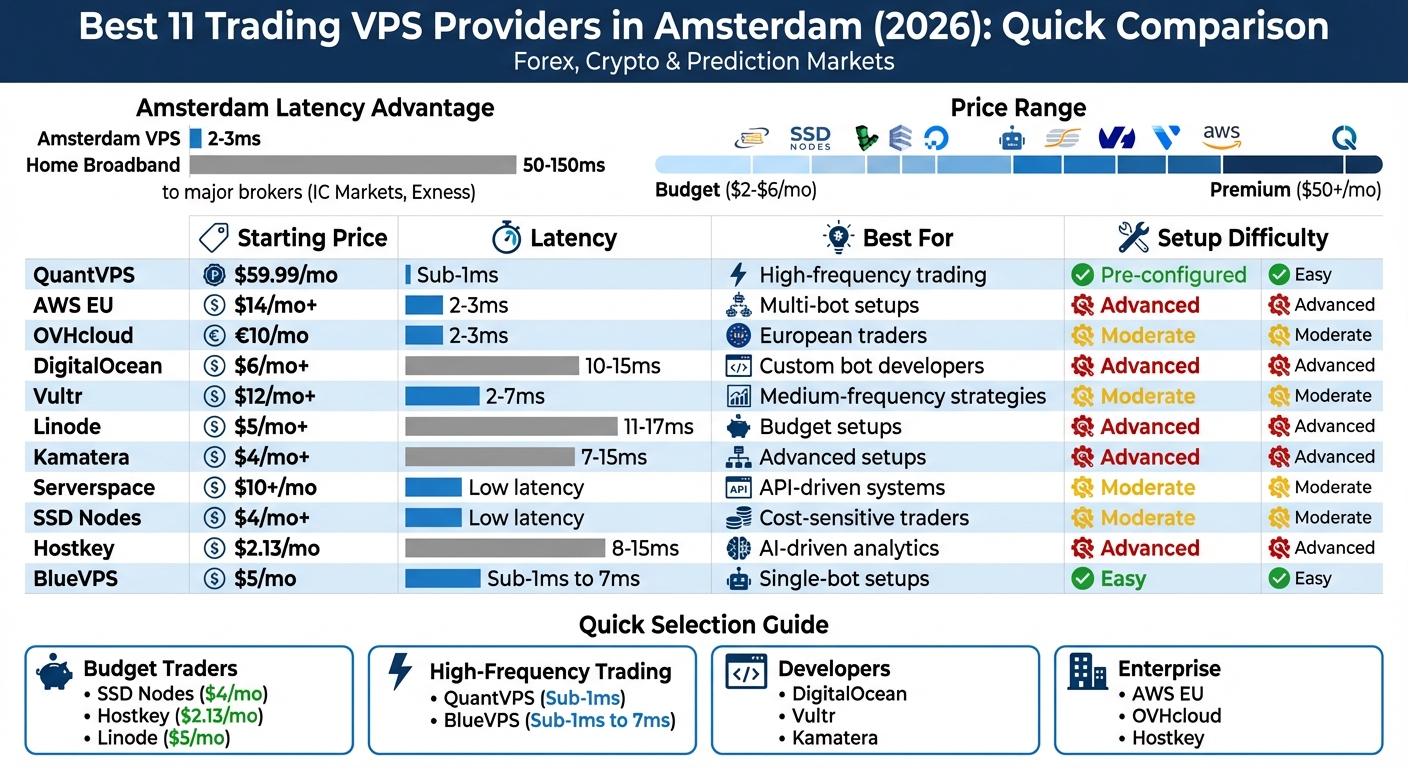
Amsterdam VPS Providers Comparison: Pricing, Latency & Best Use Cases 2026
1. QuantVPS (Amsterdam)
QuantVPS runs a specialized infrastructure in Amsterdam, tailored for algorithmic and institutional traders. It’s designed to excel in futures, forex, crypto, and prediction market automation, with hardware setups that prioritize execution speed over general computing tasks.
Pricing and Plans
QuantVPS offers eight pricing tiers, ranging from $41.99 to $399.99 per month when billed annually. The VPS Lite plan starts at $59.99/month ($41.99/month annually), providing 4 cores, 8GB RAM, and 70GB NVMe storage - suitable for managing 1–2 trading charts or a single trading bot. Stepping up, the VPS Pro plan costs $99.99/month ($69.99/month annually) and offers 6 cores, 16GB RAM, and the ability to handle 3–5 charts with dual-monitor support.
For those running multiple strategies or high-frequency systems, the VPS Ultra plan delivers 24 cores, 64GB RAM, and 500GB NVMe storage at $189.99/month ($132.99/month annually). At the top end, the Dedicated Server plan is priced at $299.99/month ($209.99/month annually), offering 16+ dedicated cores, 128GB RAM, and 2TB+ NVMe storage. This tier supports 7+ charts and is ideal for heavy workloads across platforms like NinjaTrader, MetaTrader, or custom Python and Node.js bots.
Performance Plans, denoted with a "+", enhance routing and resource priority for an additional $20–$100 per month, depending on the tier. These options allow traders to choose plans that align closely with their specific trading automation needs.
Latency and Performance
The Amsterdam infrastructure ensures sub-1ms latency to key European liquidity hubs and futures exchanges like CME and Eurex. This low latency is critical for high-frequency trading strategies that rely on consistent data delivery. Even during heavy data loads, the network maintains stability, enabling seamless trading.
QuantVPS hardware includes AMD Ryzen 9 9950X CPUs with clock speeds between 4.3 and 5.7 GHz, DDR5 RAM running at 5200–5600 MT/s, and Gen4 NVMe SSD storage. All plans come with 1Gbps+ network connectivity, unmetered bandwidth, and Windows Server 2022 pre-installed.
Trading Optimization Features
QuantVPS is built to optimize trading execution, supporting platforms like NinjaTrader, MetaTrader 4/5, TradeStation, and custom trading applications. Full root access is provided, allowing traders to configure their setups as needed. Multi-monitor support ranges from single-screen setups with the Lite plan to 6-monitor configurations on Dedicated Servers, making it suitable for complex charting and order management workflows.
Additional features include DDoS protection, automatic backups, system monitoring, and a 100% uptime guarantee. Dedicated resources ensure stable performance even during volatile market conditions, where every microsecond counts.
Ease of Setup and Support
QuantVPS simplifies the setup process by providing pre-configured Windows Server environments ready for trading platform installations. Remote desktop access is available immediately, and their 24/7 technical support team is well-versed in trading-specific issues, including platform compatibility, API connectivity, and bot troubleshooting. This makes it easier for traders to maintain the low-latency, reliable environments crucial for algorithmic trading success.
2. AWS EU Region (Amsterdam)
Amazon Web Services (AWS) provides a powerful cloud infrastructure in Amsterdam, catering primarily to enterprise-level applications and large-scale fintech operations. This region features CloudFront edge locations and high-performance compute instances, making it a great choice for traders setting up automated trading systems.
Pricing and Plans
AWS follows a pay-as-you-go pricing model, which can be a bit tricky for individual traders to navigate. Managed instances via platforms like Cloudways start at about $14/month for a 1GB RAM plan. On the lower end, VPS options in Amsterdam begin around $3/month, while premium, high-performance plans can go up to $179/month. If you're using AWS directly, you'll need to piece together EC2 instance types, storage, and network bandwidth, which requires careful monitoring to avoid unexpected costs. This flexibility, however, allows you to scale resources based on your specific trading demands.
Latency and Performance
AWS Amsterdam boasts excellent connectivity to major European brokers. For instance, latency to IC Markets is typically around 2ms, while Exness averages about 3ms. London-based brokers like Pepperstone and Frankfurt-based XM show latency figures of roughly 7ms. In comparison, standard home broadband in the EU averages between 50–150ms, making AWS a far superior option for traders needing low-latency trading infrastructure.
The infrastructure is designed to handle high trading volumes and can automatically scale during volatile market periods. Amsterdam's position at the AMS-IX internet exchange makes it an ideal hub for blockchain-related projects, such as Solana/Web3 nodes, alongside trading operations. This ensures smooth performance for both straightforward and advanced trading setups.
Trading Optimization Features
AWS offers a scalable environment that supports a variety of trading strategies, though it does require some manual configuration. You'll need to install tools like MetaTrader 4/5, cTrader, or custom Python bots, just as you would on a traditional desktop setup. For more advanced needs, AWS supports "infrastructure as code" solutions, allowing traders to automate and scale their setups using tools like Terraform and Ansible. This makes it a great option for teams managing multiple strategies or complex algorithmic systems requiring precise programmatic control.
Ease of Setup and Support
Setting up AWS can be challenging for traders unfamiliar with cloud infrastructure. While AWS provides extensive documentation, it assumes a working knowledge of Linux systems, networking, and cloud architecture. For a smoother experience, managed platforms like Cloudways simplify deployment with features like built-in staging and Git integration. AWS also offers support plans ranging from basic developer options to enterprise-level assistance, but they don't specialize in trading-related troubleshooting. This makes AWS less user-friendly compared to platforms specifically designed for trading, which often come with pre-configured environments and tailored support.
3. OVHcloud (Amsterdam)

Run 24/7 while you sleep. Keep bots, platforms, and trade copiers online on a dedicated VPS.
Low-latency VPS hosting for your trading platform.
 CHINYC
 LON
LONFrom $59.99/mo


 CHI/CME futuresNYC/US marketsLON/FX EAs
 DUB/Polymarket
 AMS/EU FX
 FRA/Central EU
 TYO/APAC crypto
OVHcloud takes advantage of Amsterdam's position as a key European hub to deliver high-performance VPS solutions for trading. With NVMe SSD storage and a 99.9% uptime SLA, it’s designed for reliability and speed. Its connection to AMS-IX ensures access to major European financial markets and crypto infrastructure.
Pricing and Plans
OVHcloud provides five VPS tiers: Starter, Value, Essential, Comfort, and Elite. Trading plans start at approximately $9.66 per month, with entry-level options as low as €3.50. The Comfort and Elite plans are particularly suited for traders who need higher CPU and RAM for running multiple MetaTrader terminals or resource-heavy indicators. OVHcloud’s transparent monthly pricing simplifies budgeting, eliminating surprise bandwidth fees. These plans, combined with strong latency performance, make it an appealing choice for traders.
Latency and Performance
OVHcloud delivers impressive latency metrics: 2–3ms locally, 7–8ms to London, and 7–12ms to Frankfurt. These speeds are ideal for strategies like forex scalping and crypto arbitrage, where fast order execution is critical.
Trading Optimization Features
The platform includes a sandbox environment, perfect for testing and refining trading algorithms without affecting live setups. This feature is especially valuable for backtesting Expert Advisors (EAs) and validating risk management tools. OVHcloud supports a variety of operating systems, including Windows Server and multiple Linux distributions, ensuring compatibility with MT4, MT5, and custom Python-based trading bots. Additional features like built-in DDoS protection and automated backups help secure trading data and strategies.
Ease of Setup and Support
Setting up trading software on OVHcloud requires some technical know-how. Users must manually install MetaTrader platforms or other trading tools, similar to a standard VPS setup. While there’s extensive documentation available, it’s aimed at users with basic server management skills. Customer support is accessible but doesn’t specialize in trading-specific issues like broker connectivity or EA troubleshooting. This makes OVHcloud a solid choice for traders with IT experience or those comfortable managing server configurations.
4. DigitalOcean (AMS2/AMS3)
DigitalOcean's two Amsterdam data centers (AMS2 and AMS3) cater to developers looking for flexible VPS options that can handle custom trading setups. With AMS-IX connectivity, these data centers offer reliable, low-latency routes, which are crucial for automated trading. While the platform provides powerful automation tools, it requires users to take a hands-on approach compared to providers tailored specifically for trading.
Pricing and Plans
DigitalOcean offers its basic Droplets starting at $6.00 per month, which includes 1 vCPU, 1GB of RAM, and 25GB of SSD storage. This entry-level plan is ideal for lightweight trading bots or testing environments. For active trading, higher-tier plans are recommended. One standout feature is the hourly billing option, which allows traders to scale resources during market volatility without locking into monthly commitments.
Latency and Performance
Performance is just as critical as pricing for traders. DigitalOcean's Amsterdam region delivers latency of about 10ms to London and 15ms to Frankfurt, making it suitable for swing trading and medium-frequency strategies. However, traders focused on high-frequency scalping may find these latency levels less competitive compared to specialized trading VPS providers.
Trading Optimization Features
While DigitalOcean doesn’t come with pre-configured trading setups, its flexibility makes it a strong choice for advanced users. Features like managed databases, Kubernetes clusters, and private networking (VPC) support complex setups, such as multi-bot systems or data-heavy crypto arbitrage strategies. Tools like floating IPs and load balancers ensure uptime during volatile market conditions. Additionally, the platform’s API and CLI tools allow for the automate trading bot deployment and management, especially for those using programming languages like Python, Go, or Node.js. However, leveraging these tools requires a solid programming background, making them better suited for traders who are comfortable coding custom solutions.
Ease of Setup and Support
Setting up a trading environment on DigitalOcean requires technical know-how. Users must manually install and configure trading software, as well as manage server security and updates. While the platform offers thorough documentation aimed at developers, it doesn’t address trading-specific needs like broker connectivity or optimizing expert advisors. Customer support focuses on infrastructure issues and won’t assist with trading bot troubleshooting. For traders with programming skills, this hands-on approach provides the freedom to customize every element of their trading environment, offering a tailored experience for those seeking full control over their setup.
5. Vultr (AMS-NL)
Vultr takes advantage of Amsterdam's well-regarded low-latency network, offering cloud solutions tailored for various automated trading strategies. By utilizing AMS-IX, it ensures the quick access needed for forex, crypto, and prediction market trading, where speed can make all the difference.
Pricing and Plans
Vultr offers flexible cloud compute instances designed to suit different trading needs. With pricing that starts at budget-friendly levels and an hourly billing option, traders can adjust their resources during volatile market conditions without being tied to long-term contracts. This flexibility aligns well with its reliable speed and performance metrics.
Latency and Performance
Vultr delivers impressive latency figures, with approximately 7ms to London and Frankfurt from Amsterdam. For local brokers like IC Markets, latency drops to as low as 2ms. This makes Vultr a solid choice for swing trading and medium-frequency strategies. However, traders focused on high-frequency scalping, which demands sub-millisecond execution, might require more specialized setups. Additionally, Vultr's NVMe SSD storage ensures fast data processing, helping your trading bot access market data and execute trades efficiently.
Trading Optimization Features
Vultr offers features that help traders fine-tune their setups. Private networking allows multiple VPS instances to connect seamlessly, which is perfect for running different bots across various strategies or markets. The snapshot feature is another highlight - it enables you to back up your trading environment, making it easy to restore after updates or configuration tweaks. Advanced users can also tap into Vultr's API for automating server deployment and management, adding another layer of convenience and control.
Ease of Setup and Support
Setting up a trading environment on Vultr requires some familiarity with server administration. Traders need to handle the installation of their preferred platforms, such as MetaTrader or cTrader, and take care of security configurations and updates. While Vultr provides solid documentation for its infrastructure, it doesn’t cover trading-specific use cases. As a result, beginners might find the setup process more challenging compared to providers that offer pre-configured, trading-focused environments.
6. Linode (NL-AMS)
Linode takes advantage of Amsterdam's low-latency infrastructure to provide a dependable platform for automated trading strategies. This general-purpose cloud service is ideal for technically skilled traders who prioritize network stability and complete control over their servers, making it a solid choice for managing trading operations.
Pricing and Plans
Linode keeps its pricing simple and transparent. The basic plan starts at $5.00 per month, offering 1 vCPU, 1GB of RAM, and 25GB of SSD storage. For those needing more power, the mid-tier plan costs $12.00 per month and includes 2 vCPUs, 2GB of RAM, and 40GB of SSD storage. Both plans come with the added benefit of no bandwidth overage fees.
Latency and Performance
Operating out of its Amsterdam data center, Linode delivers latency numbers that are competitive for many trading needs: around 11ms to London, 14ms to Frankfurt, and 17ms to Paris. Network speeds are equally impressive, with download and upload rates averaging 940 Mbps. While these metrics are well-suited for swing trading and medium-frequency strategies, ultra-low-latency traders aiming for sub-10ms execution might find these speeds slightly above their ideal range. However, Linode's stable performance makes it a reliable option for most trading setups.
Trading Optimization Features
Linode emphasizes strong infrastructure rather than trading-specific tools. Key features include private VLANs for secure communication between instances, native IPv6 support, and advanced DDoS protection through its Akamai integration. However, it doesn't offer pre-configured trading environments like MT4 or MT5, and its Linux-focused design means Windows setups require manual configuration using tools such as Wine.
Ease of Setup and Support
Setting up a trading environment on Linode demands a good level of technical knowledge. Tasks like operating system installation, security configuration, and platform setup must be handled manually. While Linode provides 24/7 expert support and detailed documentation, its developer-focused approach might feel challenging for beginners.
7. Kamatera (Amsterdam)
Kamatera stands out as an enterprise-grade alternative for traders who want full control over their server configurations. Unlike pre-configured trading hosts, Kamatera offers a highly customizable cloud VPS solution in Amsterdam, making it ideal for traders running complex multi-bot setups or automated strategies that require precise resource management. This flexibility makes it a strong contender when you compare low-latency VPS options for algorithmic trading.
Pricing and Plans
Kamatera's pricing is flexible, starting at about $4 per month with hourly billing options. You can fully customize resources like vCPU, RAM, and NVMe storage, which is great for traders who want to experiment with different setups or run seasonal strategies without locking into fixed plans.
Latency and Performance
Operating from Amsterdam's data centers, Kamatera ensures reliable latency to key European trading hubs. Expect round-trip times of around 7ms to 12ms for London and 7ms to 15ms for Frankfurt. These consistent performance levels are well-suited for latency-sensitive trading. However, if your trading demands ultra-low latency, it's worth confirming these figures against your broker or exchange endpoints.
Trading Optimization Features
Kamatera doesn't come with pre-installed trading platforms like MT4 or MT5, but it offers advanced infrastructure tools for customization. You can automate deployments using APIs, Terraform, or Ansible, and features like private networks help isolate trading traffic. The platform also supports quick cloning to streamline multiple instance setups and offers a variety of OS images to match your preferred environment.
Ease of Setup and Support
Setting up Kamatera requires a solid understanding of cloud infrastructure. You'll need to handle OS installation, security hardening, and full configuration yourself. While their robust API and extensive image library make deployments faster for experienced teams, beginners might find the process challenging. If you're comfortable building custom solutions, Kamatera provides the tools to create an environment tailored to your specific trading needs.
8. Serverspace Netherlands (Amsterdam)
Serverspace Netherlands offers a cloud VPS service that focuses on keeping things simple while delivering dependable performance. It's an appealing option for traders who want reliable hosting in Amsterdam without dealing with overly complex setups. Perfect for bot operators and API-driven trading systems, it’s designed to handle the demands of active trading.
Pricing and Plans
Serverspace uses a pay-as-you-go pricing model, which makes it easy to adjust costs as your trading needs change. This flexibility allows you to scale resources like CPU, memory, and storage incrementally, rather than locking into rigid plans. It’s a practical solution for traders whose strategies require varying levels of resources over time.
Stay online and closer to execution. Choose a VPS location for CME futures, New York markets, London FX, API trading, and more.
Host your platform near the market route that matters.
CHINYCLONFrom $59.99/mo
CHI/CME futuresNYC/US marketsLON/FX EAsDUB/PolymarketAMS/EU FXFRA/Central EUTYO/APAC cryptoLatency and Performance
With its location in Amsterdam at the AMS-IX, Serverspace provides fast and stable connections to major European trading hubs. This setup ensures low-latency performance, which is essential for activities like automated forex trading, running crypto trading bots, or managing automated trading on Polymarket. The proximity to key endpoints helps ensure your trades execute efficiently and reliably.
Trading Optimization Features
Although Serverspace doesn’t come with pre-installed trading platforms, it offers full root access and supports various operating systems, including Windows Server and Linux distributions. This flexibility lets you install tools like MT4/MT5, deploy Python-based crypto bots, or set up custom trading applications. API access is also available, making it easier to automate server management - ideal for those running multiple instances or dynamic trading setups.
Ease of Setup and Support
Getting started with Serverspace requires some technical know-how for tasks like OS installation, security configurations, and software deployment. However, the platform includes a user-friendly control panel to simplify basic management tasks. Plus, their 24/7 support team is on hand to help with urgent trading issues. This combination of customization and support makes it a solid choice for traders with a basic understanding of server administration.
9. SSD Nodes (Amsterdam)
SSD Nodes offers affordable pricing for Amsterdam-based VPS services while maintaining the key performance features traders depend on. It’s a standout choice for those seeking high-speed, SSD-based servers at competitive rates. The Amsterdam location benefits from the city's top-tier network infrastructure and proximity to AMS-IX, one of the largest internet exchanges globally, ensuring excellent connectivity for European markets.
Pricing and Plans
SSD Nodes focuses on providing cost-effective VPS options without compromising on SSD performance. Entry-level plans start at just $4.00 per month, making it an appealing choice for traders who are new to automated systems or running lightweight trading bots. The use of SSD storage across all plans ensures fast data access, which is crucial for trading bots that frequently process order logs or market data.
Latency and Performance
By leveraging Amsterdam's robust network infrastructure, SSD Nodes delivers low-latency forex trading connections to key European hubs like London and Frankfurt. This makes it especially beneficial for forex traders using MT4/MT5 platforms, crypto arbitrage bots, and other automated trading systems that require rapid response times to stay ahead of market changes.
Trading Optimization Features
For traders seeking a budget-friendly option with solid performance, SSD Nodes provides the speed needed for automated trading. While it doesn’t come with pre-configured trading environments, the SSD-based infrastructure supports the fast read/write operations essential for active trading setups. This makes it a good fit for traders comfortable with configuring their own servers, whether they’re running custom Python scripts, crypto bots, or forex automation tools.
Ease of Setup and Support
Setting up with SSD Nodes requires some technical expertise. You’ll need to handle tasks like installing the operating system, configuring security settings, and deploying trading software. While this approach might not suit traders looking for managed services, it’s ideal for those with server management skills or a willingness to learn. For technically savvy traders, SSD Nodes offers a cost-effective way to tap into Amsterdam’s network strengths without paying for extra setup assistance.
10. Hostkey (Netherlands)
Hostkey operates out of Tier III data centers in Amsterdam, offering a robust infrastructure tailored for enterprise needs. Starting at just $2.13 per month for 40GB SSD storage, it’s an affordable choice for traders who prioritize uptime and are comfortable managing their own server configurations for round-the-clock automated operations. Thanks to its direct peering with European hubs, Hostkey ensures the low latency that’s critical for high-frequency trading.
Pricing and Plans
Hostkey provides flexible scaling options, allowing traders to customize resources based on their specific needs. Whether you're running a single forex bot or handling multiple crypto arbitrage systems, there’s a plan to suit your workload. For those requiring advanced capabilities, higher-tier plans include GPU acceleration, ideal for AI and machine learning strategies, though these come at a premium.
Latency and Performance
Hostkey leverages premium network connectivity and direct peering with major Amsterdam internet hubs, ensuring fast routing to key European financial centers. Typical latencies range from 8–12 ms to London and 10–15 ms to Frankfurt. Additionally, all plans come with built-in DDoS protection, shielding trading systems from volumetric attacks.
Trading Optimization Features
For traders running AI-driven processes or complex quantitative models, Hostkey’s GPU-powered VPS servers stand out. While it doesn’t offer preconfigured MT4/MT5 setups, its high-performance hardware provides a solid foundation for custom trading infrastructures. This makes it an attractive option for experienced traders using crypto bots, prediction market automation, or data-heavy analytics.
Ease of Setup and Support
Setting up a server with Hostkey requires a higher level of technical expertise, including OS installation, security configuration, and software deployment. While the provider offers 24/7 technical support, this assistance primarily addresses infrastructure-related issues rather than trading platform-specific needs.
11. BlueVPS (Amsterdam)
BlueVPS offers VPS hosting in Amsterdam tailored to lightweight trading operations. With instant setup and remote access, it supports both Linux and Windows VPS plans. Windows plans are ideal for platforms like MetaTrader and cTrader, while Linux plans cater to Python bots or Solana nodes. Pricing starts at around $5 per month for basic setups, with premium options available for traders needing more resources. This makes BlueVPS a great option for traders running single-bot setups or testing strategies without requiring heavy infrastructure.
Latency and Performance
BlueVPS utilizes AMS-IX to achieve impressively low latency, with round-trip times ranging from sub-1ms to 7ms to major European brokers. This speed is crucial for forex scalping, crypto arbitrage, and prediction market automation - trading scenarios where fast execution matters but resource demands stay moderate.
Trading Optimization Features
With its instant setup feature, BlueVPS enables traders to quickly deploy their environments, minimizing delays between strategy creation and live trading. Windows plans offer full remote desktop access for easy installation of trading platforms, while Linux plans provide flexibility for custom bot development. BlueVPS focuses on delivering simplicity and speed, making it a solid choice for individual traders who value rapid deployment over complex infrastructure.
Ease of Setup and Support
BlueVPS streamlines the onboarding process with pre-configured server environments, reducing the time needed for manual setup. While some technical knowledge is helpful for installing and configuring trading platforms, the simplified deployment process makes it more approachable than providers requiring extensive server management. Support is available for infrastructure-related issues, though traders should be ready to handle platform-specific configurations on their own.
This balance of speed, simplicity, and performance makes BlueVPS stand out for traders seeking efficient, lightweight hosting solutions.
Strengths and Weaknesses of Each Provider
When picking an Amsterdam VPS, striking the right balance between latency, budget, and technical know-how is key. Providers optimized for trading often feature pre-configured setups and cutting-edge hardware but come with higher price tags. On the other hand, general cloud platforms offer flexibility and developer tools but require manual setups. The table below breaks down how each provider performs across essential metrics for forex, crypto, and prediction market automation.
| Provider | Key Strengths | Main Weaknesses | Best For | Pricing Range |
|---|---|---|---|---|
| QuantVPS | Sub-1ms latency to futures exchanges; 100% uptime guarantee; pre-configured for NinjaTrader, MT4/MT5 | Higher cost; complex for beginners | High-frequency traders and institutional algo trading | $59.99–$399.99/month |
| AWS EU Region | Scalable infrastructure; robust APIs; enterprise-level security | Complicated pricing; requires technical expertise | Multi-bot setups and cloud-native developers | Pay-as-you-go; typically $50–$300+/month |
| OVHcloud | Strong GDPR compliance; high-performance hardware; direct AMS-IX access | Challenging interface for less experienced users | Enterprise traders prioritizing European data sovereignty | €10–€100+/month |
| DigitalOcean | Developer-friendly APIs; straightforward pricing; extensive documentation | Not tailored for trading; manual installations needed | Crypto bot developers using Python/Node.js | $12–$96/month |
| Vultr | Quick setup; high-frequency CPU options; global network | No pre-installed trading tools; limited managed services | Performance-driven apps and custom bots | $12–$120/month |
| Linode | Clear pricing; strong community support; reliable uptime | Generic infrastructure; lacks trading-specific features | DIY traders on a budget | $12–$96/month |
| Kamatera | Hourly billing; API-driven infrastructure; flexible scaling | Steeper learning curve; setup complexity | Advanced traders needing custom resource allocation | $4–$200+/month (hourly) |
| Serverspace | Customizable configurations; 24/7 access; good for API hosting | Smaller brand; fewer resources for trading communities | Developers running custom APIs and webhooks | $10–$80/month |
| SSD Nodes | Affordable SSD storage; straightforward pricing | Limited features; minimal trading support | Cost-sensitive traders testing strategies | $5–$40/month |
| Hostkey | Tier III data centers; GPU servers for AI workloads | Complex setup; geared more toward enterprises | Data-heavy analytics and machine learning for trading | $15–$150+/month |
| BlueVPS | Instant setup; sub-1ms to 7ms latency to European brokers; easy deployment | Limited scalability for complex setups | Single-bot setups and strategy testing | $5–$30/month |
Key Insights for Amsterdam VPS Providers
Amsterdam VPS providers stand out for their exceptional connectivity, thanks to the AMS-IX hub. Many top-tier options rely on AMD Ryzen 9 9950X CPUs and NVMe SSDs to minimize latency. This proximity to major European liquidity sources ensures sub-1ms latency, which is critical for strategies like scalping and high-frequency trading, where every millisecond can affect profits.
However, recent increases in DRAM prices have pushed VPS costs higher. If you're planning memory-intensive multi-bot setups, it's worth factoring these rising costs into your long-term strategy.
Ease of use also varies widely. Providers with pre-installed MT4 or MT5 platforms and one-click setups allow retail traders to get started in under 5 minutes, avoiding the hassle of Windows Server configuration. Meanwhile, platforms like Kamatera cater to developers with advanced features like infrastructure-as-code and API access, though they demand technical expertise.
The right VPS ultimately depends on your trading style and technical skills. High-frequency traders will benefit from specialized providers offering top-tier latency and uptime guarantees. Developers working on custom Python bots might lean toward cloud platforms with strong APIs. For those watching their budget, entry-level options like SSD Nodes or BlueVPS offer a cost-effective starting point, with room to upgrade as strategies evolve.
Conclusion
Selecting the best Amsterdam VPS for your trading needs boils down to understanding your trading style, budget, and technical expertise. If you're a high-frequency trader or rely on algorithmic strategies, QuantVPS offers an edge with sub-1ms latency to major European exchanges and markets like Polymarket. Powered by AMD Ryzen 9 9950X processors running at up to 5.7 GHz, it guarantees 100% uptime - critical when even a few milliseconds can mean the difference between hitting your target price or dealing with slippage.
For traders focused on cost-effective solutions, platforms like SSD Nodes and BlueVPS are worth considering. They provide straightforward pricing and quick deployment, making them ideal for single-bot setups or strategy testing without the added complexity of enterprise-grade features. On the other hand, developers managing custom Python bots or multi-bot setups may prefer DigitalOcean or Vultr for their flexible APIs and detailed documentation, though these options often require more hands-on configuration.
When it comes to automated trading, uptime and latency are non-negotiable. A single missed signal due to connectivity issues can result in unmanaged positions or lost opportunities. Amsterdam’s strategic location as a digital hub, anchored by the AMS-IX internet exchange, ensures local VPS providers can deliver latency as low as 2–3ms to brokers like IC Markets and Exness - something home broadband simply cannot achieve.
For institutional traders, regional compliance is another key factor. Hosting in Amsterdam ensures GDPR compliance and EU data residency, which are increasingly vital for regulated environments. Additionally, Amsterdam-based hosting can bypass geographic IP restrictions for platforms like Polymarket while maintaining fast response times to decentralized order books.
Ultimately, the ideal VPS depends on your specific execution needs. Plans built on Ryzen processors are perfect for speed-intensive tasks like scalping and high-frequency trading, while EPYC-based solutions often provide better value for scalable automation where microsecond precision isn't critical. Many providers also offer free trials lasting 1–3 days, allowing you to test latency to your broker before committing to a long-term plan.
FAQs
What latency do I need for my trading strategy?
The latency you require hinges on your trading strategy and objectives. For high-frequency approaches such as scalping or algorithmic trading, a latency under 1 millisecond (ms) is crucial for almost instantaneous order execution and reducing slippage. On the other hand, if you're engaged in swing trading or holding long-term positions, a latency range of 5 to 20 milliseconds typically works well. To achieve the best execution speed and minimize delays, it's essential to select a VPS located near your broker or exchange.
How do I test VPS latency to my broker before paying?
Before committing to a VPS, it’s smart to test its latency to your broker. This ensures you’ll have a fast and reliable connection. Here’s how you can do it:
- Use Tools Like Looking Glass: These tools let you simulate network performance from the VPS provider’s location to your broker.
-
Run a Ping Test: Use a command like
ping -c 100 your_server_IP. This will give you the average latency. Ideally, you’re aiming for under 50ms, which is considered excellent. -
Check for Latency Spikes or Packet Loss: For a more detailed breakdown, use
mtr --report your_server_IP. This combines traceroute and ping to identify any issues like packet loss or sudden spikes in latency.
By following these steps, you can make sure your VPS offers a stable, low-latency connection - critical for smooth trading.
What VPS specs are enough for MT4/MT5 or one bot?
To operate MT4/MT5 or a single trading bot, you'll generally need a VPS with 1-2 CPU cores, 2 GB of RAM, and 50-100 GB SSD storage. Ensuring low latency (preferably under 10ms) to your broker or market servers is key for smooth performance and dependable execution. This configuration strikes a good balance between affordability and functionality, making it well-suited for running one trading platform or bot efficiently.