In trading, every millisecond matters. A Virtual Private Server (VPS) optimized for trading ensures ultra-low latency, reliability, and uninterrupted performance. The best VPS providers for 2026 focus on proximity to major financial hubs like Chicago (CME), New York (NYSE/NASDAQ), and London (LD4), while offering high-speed NVMe storage and powerful CPUs to handle algorithmic trading and automated strategies.
Key Takeaways:
- Latency: Opt for servers near your broker's location (e.g., Chicago for CME or New York for equities).
- Reliability: Look for uptime guarantees of 99.99% or higher to avoid interruptions.
- Performance: Prioritize NVMe SSD storage and CPUs with high single-thread speeds (3.5 GHz+).
- Cost: Plans range from $5/month (basic) to $300/month (dedicated servers), depending on your needs.
Quick Comparison Table
| Provider | Key Locations | Uptime | Storage | Starting Price |
|---|---|---|---|---|
| QuantVPS | Chicago, New York, London | 100% | NVMe | $41.99/mo (annual) |
| Beeks Financial Cloud | New York, Chicago, London | 99.99% | NVMe | ~$50/mo |
| AWS | Virginia, Ohio, London | 99.99% | SSD/NVMe | ~$10/mo |
| Microsoft Azure | Virginia, Illinois, London | 99.99% | SSD/NVMe | ~$13/mo |
| Google Cloud Platform | Virginia, Iowa, London | 99.99% | SSD/NVMe | ~$12/mo |
| OVHcloud | New York, Chicago, London | 99.9% | SSD/NVMe | ~$7/mo |
| Vultr | New York, Chicago, London | 99.9% | SSD/NVMe | ~$6/mo |
| DigitalOcean | NYC, Chicago, London | 99.99% | SSD | ~$6/mo |
| Linode (Akamai) | Newark, Chicago, London | 99.9% | SSD/NVMe | ~$5/mo |
| Hetzner | Germany, Finland | 99.9% | SSD/NVMe | ~$5/mo |
| Leaseweb | New York, Chicago, London | 99.99% | SSD/NVMe | ~$15/mo |
| Kamatera | New York, Chicago, London | 99.95% | SSD | ~$4/mo |
| Hostinger Cloud | New York, London, Singapore | 99.9% | SSD | ~$9/mo |
| Scala Hosting | New York, London | 99.9% | SSD | ~$10/mo |
| Liquid Web | Michigan, Arizona, Amsterdam | 100% | SSD/NVMe | ~$15/mo |
| UpCloud | New York, Chicago, London | 99.99% | NVMe | ~$5/mo |
| IONOS Cloud | New Jersey, London, Frankfurt | 99.9% | SSD | ~$8/mo |
| Alibaba Cloud | Virginia, London, Singapore | 99.9%+ | SSD | ~$5/mo |
Choose a VPS based on your trading strategy, broker location, and budget. Proximity to exchanges and reliable infrastructure are critical for consistent performance in fast-moving markets.
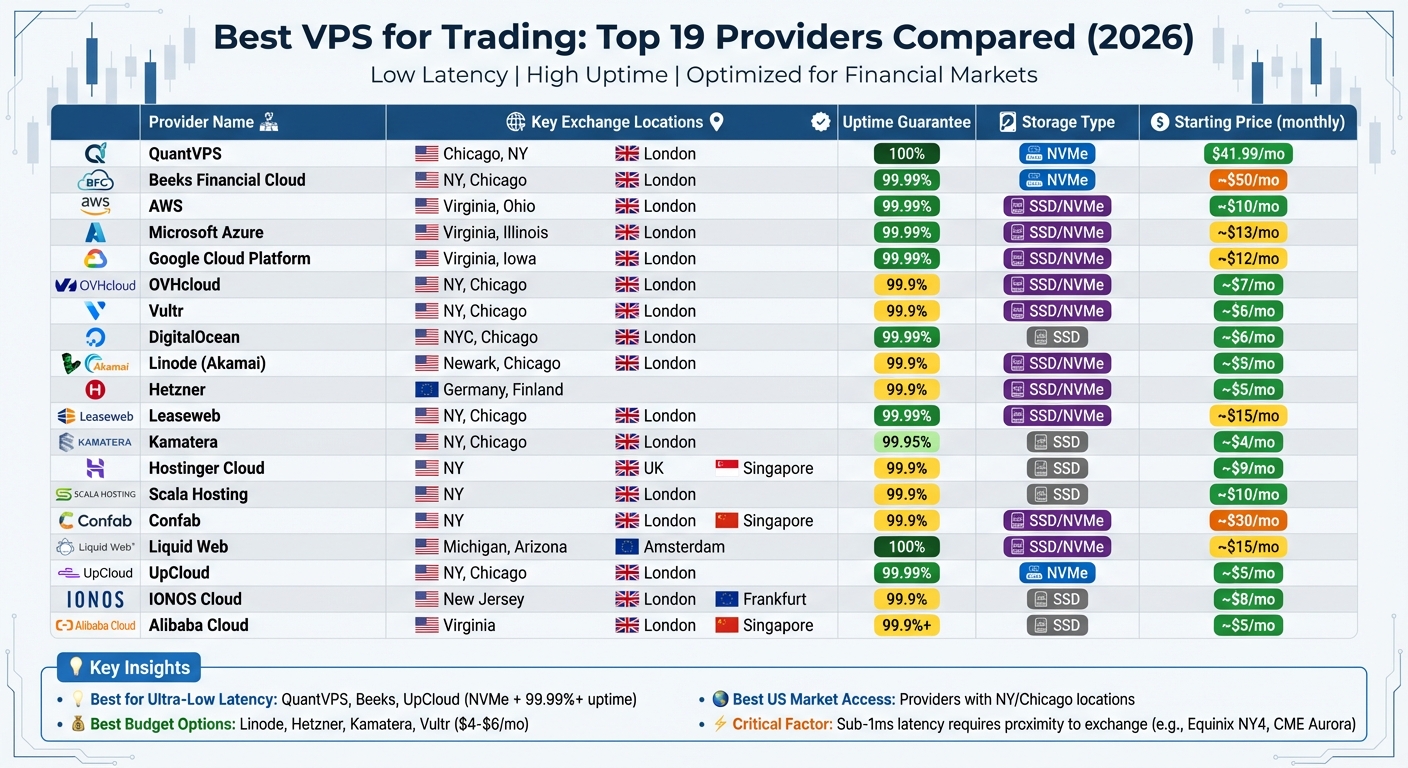
Top 19 VPS Providers for Trading: Latency, Uptime & Pricing Comparison 2026
1. QuantVPS
Latency Proximity to Major Financial Hubs
QuantVPS positions its servers in key locations like Chicago (CME proximity), New York (NY4), London, Amsterdam, and Singapore. These strategic placements ensure your trades execute within milliseconds of the world's busiest financial exchanges. With AMD Ryzen 9950X and AMD EPYC processors paired with DDR5 memory, their infrastructure is designed for speed and reliability, delivering sub-millisecond routing to major matching engines. This setup helps reduce slippage, even during high-volatility trading sessions.
Storage Type
Every plan comes with NVMe storage, starting at 70 GB for basic configurations and scaling up to 2,000 GB for dedicated servers. This high-speed storage, combined with powerful CPUs, ensures smooth handling of resource-heavy trading platforms like NinjaTrader, MetaTrader 4/5, and TradeStation. It’s especially effective for processing rapid tick data in demanding trading environments.
Starting Price
QuantVPS plans are designed to cater to a range of trading needs:
- VPS Lite: Starting at $59.99/month (or $41.99/month with annual billing), this plan includes 4 CPU cores, 8 GB RAM, and 70 GB NVMe storage.
- VPS Pro: Priced at $99.99/month, it offers 6 CPU cores, 16 GB RAM, and 150 GB NVMe storage.
- VPS Ultra: At $189.99/month, this tier delivers 24 CPU cores, 64 GB RAM, and 500 GB NVMe storage, ideal for managing multiple charts.
- Dedicated Servers: Starting at $299.99/month, these come with 16+ dedicated cores, 128 GB+ RAM, and 2,000 GB NVMe storage for the most demanding traders.
| Plan Tier | CPU Cores | RAM | Storage Type | Starting Price (Monthly) |
|---|---|---|---|---|
| VPS Lite | 4 | 8 GB | 70 GB NVMe | $59.99 |
| VPS Pro | 6 | 16 GB | 150 GB NVMe | $99.99 |
| VPS Ultra | 24 | 64 GB | 500 GB NVMe | $189.99 |
| Dedicated | 16+ dedicated cores | 128 GB+ | 2,000 GB NVMe | $299.99 |
QuantVPS also provides 24/7 technical support tailored for traders and is fully compatible with popular platforms like NinjaTrader, MetaTrader 4/5, and TradeStation.
2. Beeks Financial Cloud
Latency Proximity to Major Financial Hubs
Beeks Financial Cloud strategically positions its servers close to key financial exchanges and liquidity hubs worldwide. Locations include New York (NY4/NY5 ecosystem), Chicago (CME ecosystem), London (LD4/LD5), Frankfurt, and Tokyo. By reducing the number of network hops, their setup minimizes execution delays, making it ideal for institutional-grade trading. This proximity ensures lower latency and supports seamless operation in high-pressure trading environments.
Uptime Guarantees
Designed specifically for professional traders and brokers, Beeks Financial Cloud offers infrastructure that prioritizes consistent uptime and reliability. In financial markets, where even a brief outage can result in substantial losses, their platform is built to meet these critical demands. It’s also highly scalable, allowing users to transition from a single VPS to dedicated servers or hybrid cloud solutions as their trading needs expand. The architecture is tailored to deliver both speed and uninterrupted service that traders rely on.
Storage Type
Beeks Financial Cloud's infrastructure is engineered to meet the rigorous demands of professional trading platforms. With an emphasis on performance and reliability, their service ensures steady operation even during peak market activity, focusing on what matters most to traders rather than offering generic hosting features.
3. Amazon Web Services (AWS)
Latency Proximity to Major Financial Hubs
AWS strategically places its data centers near major financial markets to ensure low latency and high reliability - both critical for trading. For example, the US-East-1 region in Northern Virginia supports traders accessing New York exchanges like NASDAQ and NYSE, while US-East-2 in Ohio is closer to Chicago's CME Group. In Europe, regions such as EU-West-2 in London and EU-West-1 in Ireland provide access to important liquidity hubs. The closer the data center to the market, the faster the connection. A practical example? A London-based VPS may experience around 60ms of latency when connecting to a New York broker. This global infrastructure helps traders minimize lag by deploying instances near their broker's servers.
Storage Options
AWS provides advanced storage solutions tailored to trading needs. Options like SSD-backed EBS volumes and high-performance NVMe instance storage enable users to fine-tune their setups. This level of customization is particularly appealing to traders who require precise server configurations to optimize their platforms.
Pricing and Configurations
AWS operates on a pay-as-you-go pricing model, with costs varying based on instance type, region, and storage requirements. High-performance setups designed for trading, especially those with advanced networking features, come at a premium. This pricing flexibility, combined with robust configuration options, makes AWS an attractive choice for traders looking to balance cost, performance, and scalability.
4. Microsoft Azure
Latency Proximity to Major Financial Hubs
Microsoft Azure strategically places its data centers to cater to traders who need ultra-fast connections to U.S. financial markets. For instance, the East US (Virginia) region provides low-latency access to New York's financial hubs, while the Central US (Illinois) region is close to Aurora, home to CME Group's matching engines for key instruments like ES, NQ, CL, GC, and 6E. This setup ensures traders can execute orders with minimal delay, which is especially critical during periods of high market activity. Coupled with Azure's advanced storage solutions, this proximity is a key advantage for time-sensitive trading operations.
Storage Type
Azure features NVMe SSD storage, a must-have for high-frequency trading. These drives excel at processing large volumes of tick data quickly and maintaining smooth performance for indicators and charts, even during market spikes. This is particularly useful for tasks like loading historical data or running multiple technical analyses simultaneously, where speed and reliability are paramount.
Starting Price

Run 24/7 while you sleep. Keep bots, platforms, and trade copiers online on a dedicated VPS.
Low-latency VPS hosting for your trading platform.
 CHINYC
 LON
LONFrom $29.99/mo


 CHI/CME futuresNYC/US marketsLON/FX EAs
 DUB/Polymarket
 AMS/EU FX
 FRA/Central EU
 TYO/APAC crypto
Azure's pricing follows a flexible pay-as-you-go model, with costs varying based on the instance type, region, and storage options. While high-performance configurations with premium networking and NVMe storage come at a higher price, they offer the scalability needed to match trading demands. This pricing structure reflects the value Azure delivers for traders who prioritize low latency and robust performance in their setups.
5. Google Cloud Platform (GCP)
Latency Proximity to Major Financial Hubs
Google Cloud Platform (GCP) strategically places its data centers to cater to traders who require quick access to both U.S. and global markets. The us-east4 region in Virginia offers low-latency connections to New York's financial district, while us-central1 in Iowa provides excellent access to CME Group's matching engines in the Midwest. For European traders, the europe-west2 region in London and europe-west4 in the Netherlands ensure direct connections to key trading venues. By reducing physical distance, GCP minimizes execution delays, which is crucial for high-frequency trading. This thoughtful regional placement also supports GCP's strong uptime performance.
Uptime Guarantees
GCP boasts 99.99% uptime for Compute Engine instances that are spread across multiple zones, allowing for just about 52.56 minutes of downtime annually. For single instances, uptime ranges between 99.9% and 99.95%, depending on the machine family. If these guarantees are not met, customers are eligible for financial credits, which can range from 10% to 100% of their monthly charges. For traders seeking even greater reliability, Google Cloud Interconnect offers a solution by bypassing the public internet, reducing failure points and cutting latency by up to 44% compared to standard connections.
Storage Type
GCP provides two key storage options: SSD and NVMe (Local SSD). While SSD is ideal for routine tasks, NVMe excels in high-frequency trading scenarios, handling rapid tick data and managing heavy loads during volatile market conditions. This distinction becomes critical during activities like backtesting or analyzing historical data in real-time, especially during market surges triggered by major news events. NVMe storage ensures stability even during 300–500% load spikes.
Starting Price
GCP offers a pay-as-you-go pricing model with hourly billing, giving traders flexibility in managing costs. Depending on the region, instance type, and storage configuration, mid-range trading setups typically cost between $30 and $70 per month. For those using Google Cloud Interconnect to establish direct connections, data egress costs can be reduced by up to 60% compared to standard internet transfers. However, this service does involve monthly fees for each port and VLAN attachment. These pricing options allow traders to balance performance, speed, and reliability efficiently.
6. OVHcloud
Latency Proximity to Major Financial Hubs
OVHcloud strategically places its data centers in prime trading locations like New York (Vint Hill, VA), Chicago, London, and Gravelines, France. For instance, the New York facility is close to Equinix NY4, a major interconnection hub for U.S. equities, while the Chicago center benefits from its proximity to the CME Group’s infrastructure, which supports futures contracts like ES and NQ. These locations enable traders in these regions to experience latencies as low as 1–2 ms. Such minimal latency is crucial for high-frequency trading, where every millisecond counts.
Uptime Guarantees
OVHcloud offers a 99.9% uptime target, which is in line with industry norms for trading-grade VPS providers. This level of reliability is vital for ensuring that automated trading strategies and platforms run smoothly, even if local network issues arise. For algorithmic traders, consistent uptime is a must-have to maintain robust server-side risk management.
Storage Type
All OVHcloud VPS plans feature NVMe SSD storage, a critical component for trading-grade setups. NVMe drives process tick data and market depth far more efficiently than older SATA SSDs, keeping trading platforms responsive during periods of intense market activity.
Next, we dive into Vultr's low-latency solutions.
7. Vultr
Latency Proximity to Major Financial Hubs
Vultr strategically operates data centers in key locations like New York, Chicago, London, Amsterdam, and Frankfurt, bringing traders closer to major financial hubs. For instance, its New York facility achieves ultra-low latency of just 2–3 ms to trading venues such as Equinix NY4. This kind of proximity is crucial for minimizing delays. On the flip side, hosting a VPS in a less optimal region can add up to 60 ms of network lag, which could severely impact latency-sensitive trading strategies.
Storage Type
Vultr’s High Frequency Compute instances are equipped with NVMe SSDs, offering data processing speeds up to 10 times faster than standard SSDs. This rapid storage is a game-changer for algorithmic traders, as it eliminates bottlenecks during critical tasks like logging tick data or executing rapid-fire orders in volatile markets. Whether it’s initializing strategies or recording data, everything runs smoothly.
Starting Price
Vultr’s self-managed cloud model is ideal for developers who need full root access to tailor their trading environment. Its flexible pay-as-you-go pricing lets traders adjust resources based on market conditions without the commitment of long-term contracts.
8. DigitalOcean
Latency Proximity to Major Financial Hubs
DigitalOcean places its data centers in key locations like NYC, Chicago, London, Amsterdam, and Frankfurt. These locations are chosen to reduce network delays, which is essential for precision trading. By being close to major financial hubs, traders can benefit from faster order execution and lower latency.
Uptime Guarantees
DigitalOcean ensures uptime levels between 99.9% and 99.99% to keep operations running smoothly during market hours. This reliability is achieved through redundant power systems and round-the-clock monitoring. For active traders, a stable connection is non-negotiable - any downtime during volatile market conditions could mean missed trades or unmanaged risks.
Storage Type
DigitalOcean offers two storage options: standard SSDs for basic Droplets and NVMe SSDs for Premium Droplets. NVMe SSDs are up to 10 times faster than standard SSDs, making them ideal for algorithmic trading. They can handle large volumes of tick data during high market volatility without causing delays or random freezes. This ensures smooth data logging and performance during live trading sessions.
Starting Price
DigitalOcean provides new users with a $200 credit to experiment with their trading setups. This allows traders to fine-tune configurations before incurring costs. Additionally, the platform's straightforward pricing makes it simple to adjust resources as trading demands change.
9. Linode (Akamai)
Latency Proximity to Major Financial Hubs
Linode's data center in Newark, New Jersey, is strategically located near New York's financial district, making it an attractive option for traders who need fast connections to major trading venues like the NYSE and NASDAQ. Additionally, Linode operates facilities in Chicago, London, and Frankfurt, all close to prominent exchanges and trading infrastructure. This setup minimizes latency, potentially cutting down execution times by milliseconds - an edge that's critical for high-frequency trading. The low-latency network is further supported by a reliable uptime infrastructure.
Uptime and Global Network
Linode’s extensive global network includes approximately 365,000 servers spread across more than 135 countries. This wide reach ensures redundancy and failover options, which are essential for maintaining uninterrupted trading operations, even if issues arise in a specific region. To complement its network reliability, Linode also offers high-performance storage solutions.
Storage Type
Linode’s advanced plans, such as the G7 and G8, feature NVMe storage paired with AMD EPYC processors. This combination provides the speed and processing power necessary for handling real-time market data and logging tick-by-tick price movements. NVMe storage ensures that data processing is smooth and free from bottlenecks, even during high-frequency trading activities.
Starting Price
Linode's entry-level Nanode plan is priced at $5.00 per month, offering 1 GB RAM, 1 vCPU, 25 GB storage, and 1 TB of monthly data transfer. New users can also take advantage of a $100 promotional credit. The flat pricing model combines CPU, storage, RAM, and data transfer into a single predictable rate, with outbound data pooled across all instances in the account. This straightforward pricing structure is ideal for traders who value cost efficiency and reliability in all market conditions.
10. Hetzner
Latency Proximity to Major Financial Hubs
Hetzner operates data centers primarily in Europe, with locations in Germany (Nuremberg and Falkenstein) and Finland. While this setup works well for European traders, it falls short for those needing low-latency access to U.S. financial hubs like New York or Chicago. This can lead to higher latency when trading on exchanges such as the NYSE, NASDAQ, or CME. For European traders, the German facilities offer decent proximity to Frankfurt's financial infrastructure. However, the absence of London-based servers means U.K. traders may experience slightly increased latency compared to providers with dedicated London facilities. If ultra-low latency for U.S. markets is a priority, these geographic constraints make Hetzner less suitable. On the other hand, those focusing on European markets might find Hetzner's locations adequate.
Storage Type
Hetzner VPS leverages NVMe SSD storage, which ensures fast read/write speeds - essential for processing real-time market data. This type of storage is particularly valuable for high-frequency trading, as it supports quick data logging and seamless backtesting. Traders dealing with tick data, market depth, or footprint charts will notice the speed advantage of NVMe SSDs over standard SATA drives. These faster load times help reduce bottlenecks when handling large volumes of trading data.
Next, we’ll explore Leaseweb’s offerings to see how they stack up in the low-latency VPS landscape.
11. Leaseweb
Latency Proximity to Major Financial Hubs
When it comes to trading, location can make all the difference. Leaseweb strategically places its data centers in key U.S. and European financial hubs to minimize latency. Their New York and Chicago facilities provide quick access to major exchanges like the NYSE, NASDAQ, and CME, ensuring faster trade execution. In Europe, Leaseweb operates in London, Amsterdam, and Frankfurt, offering direct connections to critical financial networks. This setup allows traders to position their servers close to the exchanges they target, whether they're trading U.S. stocks, futures, or European forex markets.
Storage Type
The VPS 1 plan from Leaseweb includes 100 GB of storage, which is enough for most traders running single or multiple platforms with standard data needs. However, traders handling large volumes of tick data or running resource-heavy backtests may require higher-tier plans or additional storage options.
Starting Price
Leaseweb’s VPS 1 plan is priced at just $3.50 per month, featuring 4 CPU cores and 6 GB of RAM - ideal for running a single trading platform with basic automation. For those needing more power, the VPS 2 plan offers 6 cores and 16 GB of RAM for $9.00/month. High-demand users can opt for the VPS 5 plan, which delivers 16 cores and 64 GB of RAM at $36.70/month. These flexible pricing options make Leaseweb an appealing choice for traders in search of affordable, low-latency solutions.
12. Kamatera
Latency Proximity to Major Financial Hubs
Kamatera runs data centers in key locations like New York, Chicago, London, Amsterdam, and Frankfurt, ensuring excellent connectivity for traders. Their Chicago and NYC facilities deliver 2–3 ms latency to major financial exchanges such as the CME, NYSE, and NASDAQ. By leveraging Intel Xeon processors and DDR5 RAM, Kamatera's infrastructure is designed to handle complex algorithms with precision, making it a strong choice for high-frequency trading and automated systems.
Uptime Guarantees
With a 99.95% uptime guarantee, Kamatera ensures the reliability traders need for round-the-clock automated strategies and Expert Advisors (EAs). This level of uptime reduces the risk of missing trades during key market movements. Additionally, their 24/7 live technical support is available to resolve server issues quickly, which is especially valuable during high-volatility periods.
Storage Type
Kamatera provides customizable storage options, including NVMe SSD storage for those requiring top-tier speed. This is particularly beneficial for traders managing high-frequency tick data or platforms processing large amounts of market depth information during volatile sessions. This flexibility allows you to tailor your server setup - whether you're running a single MetaTrader instance or multiple NinjaTrader configurations with heavy data demands.
Stay online and closer to execution. Choose a VPS location for CME futures, New York markets, London FX, API trading, and more.
Host your platform near the market route that matters.
CHINYCLONFrom $29.99/mo
CHI/CME futuresNYC/US marketsLON/FX EAsDUB/PolymarketAMS/EU FXFRA/Central EUTYO/APAC cryptoStarting Price
Kamatera offers a custom pricing model based on the resources you choose, such as vCPU, RAM, storage type, and data center location. Both hourly and monthly billing options are available, giving you control over costs. Plus, new users can take advantage of a 30-day free trial, allowing them to test execution speeds and platform performance before committing to a paid plan.
13. Hostinger Cloud
Latency Proximity to Major Financial Hubs
Hostinger Cloud operates from over 8 global locations, including key hubs like US East (New York), UK (London), and Singapore. By partnering with AWS, Hostinger strategically places servers near major financial exchanges, ensuring competitive latency for retail traders. Its hPanel management interface simplifies the process by recommending the best server location based on delay measurements, helping traders minimize latency to their broker servers. This setup provides a reliable foundation for smooth trading sessions.
Hostinger's infrastructure features AMD EPYC processors and 1 Gbps network speeds across all plans, which work together to reduce lag during order execution. While it may not meet the demands of high-frequency trading, it performs well for retail traders using platforms like MetaTrader or running automated Expert Advisors under typical market conditions.
Uptime Guarantees
Hostinger backs its VPS services with a 99.9% uptime guarantee. This translates to roughly 8.76 hours of downtime annually, which is adequate for most retail traders. However, it falls short of the 99.95% uptime often preferred by professional algorithmic traders.
Storage Type
All VPS plans from Hostinger utilize NVMe SSD storage, which is 3–4 times faster than traditional SSDs. In performance tests, Hostinger delivered 120,300 IOPS, ranking at the top among major VPS providers. This high-speed storage ensures faster platform launches, quicker data logging, and efficient execution of Expert Advisors, particularly during high-volatility periods. It helps avoid bottlenecks when processing tick data and market depth information.
Starting Price
Hostinger's entry-level KVM 1 plan is priced at $4.99/month (with a 24-month term) and includes 1 vCPU, 4GB RAM, 50GB NVMe storage, and 4TB bandwidth. For traders needing more power, the KVM 2 plan at $6.99/month offers 2 vCPUs and 8GB RAM, making it suitable for handling multiple charts or automated systems. At the higher end, the KVM 8 plan costs $19.99/month, providing 8 vCPUs, 32GB RAM, and 400GB NVMe storage, ideal for complex algorithmic trading strategies. Be aware that introductory rates increase upon renewal.
14. Scala Hosting
Latency Proximity to Major Financial Hubs
Scala Hosting runs its data centers in New York and London, two major financial centers. These locations make it possible to connect to NASDAQ and NYSE with impressively low latencies of just 1–2 ms.
Storage Type
Scala Hosting relies on SSD storage, which ensures fast performance for trading platforms like MetaTrader. While NVMe storage is better suited for high-frequency trading demands, SSDs are more than capable of handling the needs of most retail traders.
Starting Price
Scala Hosting offers plans starting at $15 to $30 per month, making it a solid mid-range option. For comparison, premium trading VPS services typically fall in the $50 to $100 per month range. Up next, let’s dive into what Confab brings to the low-latency VPS market.
15. Confab
Currently, there isn’t reliable information available about Confab’s trading VPS services. This includes details like their data center locations, storage technology, or pricing. As soon as verified information is accessible, this section will be updated to reflect the latest details.
16. Liquid Web
Latency Proximity to Major Financial Hubs
Liquid Web runs data centers in Michigan and Arizona for U.S. users, along with a facility in Amsterdam to support European traders. However, the Michigan data center is farther from Chicago's CME matching engines in Aurora, Illinois. This distance results in higher latency, which can be a disadvantage for traders working with ES, NQ, CL, GC, and 6E futures. For algorithmic traders, even slight increases in latency can impact queue priority during high-frequency trades. Similarly, the Arizona facility’s location adds extra round-trip time to key trading hubs like New York and Chicago, making it less ideal for latency-sensitive strategies.
Storage Type
Storage technology is another key factor in trading performance. Liquid Web’s VPS plans use SSD storage, which is suitable for basic tasks such as platform startup and strategy initialization. However, NVMe SSD storage is the preferred choice for traders dealing with tick data, market depth, and footprint charts, as it significantly outperforms traditional SATA SSDs in load times. NVMe storage minimizes random freezes and I/O bottlenecks, especially during volatile market conditions.
Starting Price
Liquid Web’s VPS plans are priced between $25–$35/month for entry-level configurations. While this is slightly above the typical budget VPS range of $15–$30/month, it’s still lower than premium trading-focused VPS options, which often cost $50–$100/month. Traders need to consider whether the added cost aligns with their performance needs, particularly in terms of data center proximity and storage capabilities.
17. UpCloud
Latency Proximity to Major Financial Hubs
UpCloud runs data centers in key locations like New York, Chicago, London, Amsterdam, and Frankfurt - giving traders direct access to some of the busiest financial markets in the world. For instance, the New York facility (US-NYC1) is strategically positioned near the NASDAQ and NYSE matching engines, while the Chicago facility (US-CHI1) offers low-latency connections crucial for high-frequency and algorithmic trading. This setup reduces network delays, speeds up order execution, and helps minimize slippage during trades. These features make UpCloud a strong choice for time-sensitive trading operations.
Storage Type
To complement its prime locations, UpCloud uses its proprietary MaxIOPS storage technology, designed for high-speed I/O performance. This is critical for analyzing tick data, market depth, and footprint charts. While NVMe SSD storage is standard for handling such demanding tasks, MaxIOPS goes a step further by reducing random freezes and I/O bottlenecks, even during volatile market conditions. This makes it especially useful for traders running multiple platforms or processing large datasets for backtesting strategies.
18. IONOS Cloud
Latency Proximity to Major Financial Hubs
IONOS Cloud hosts its data centers in key locations, including New Jersey (close to New York), Las Vegas, London, and Frankfurt, covering both U.S. and European markets. The New Jersey center, situated near Equinix NY4, helps reduce latency for U.S.-based trading activities. Similarly, the London facility is directly connected to the LD4 hub, catering to European trading markets. For traders relying on high-frequency or algorithmic strategies, achieving ultra-low latency - typically between sub-1ms and 2ms - is critical when the VPS is optimally positioned near the broker's hub.
Now, let’s delve into reliability metrics, which are essential for seamless trading operations.
Uptime Guarantees
While IONOS Cloud does not disclose specific uptime statistics, the industry standard typically demands a minimum of 99.9% SLA, with top-tier providers often aiming for 99.95%. Even minor outages can cause significant issues, such as disconnections, order delays, or slippage, all of which can impact trading outcomes.
Storage Type
In 2026, high-performance trading VPS solutions prioritize NVMe storage for its ability to handle rapid data logging and real-time backtesting efficiently. While SSD storage remains valuable for quick boot times and initializing strategies, NVMe stands out for high-frequency trading, as it can meet the intense input/output demands needed for optimal performance.
19. Alibaba Cloud
Latency Proximity to Major Financial Hubs
Alibaba Cloud operates data centers in key locations like US East (Virginia), London, Frankfurt, and Singapore, strategically placing itself near critical trading markets. For instance, the Virginia data center offers access to New York's financial ecosystem, while the London and Singapore centers connect to their respective regional markets. Proximity to hubs like Equinix NY4/NY5 or LD4 is vital since these facilities host major matching engines. However, the actual latency you experience will depend on your broker's data center location and how well Alibaba Cloud aligns with those trading hubs.
Uptime Guarantees
Alibaba Cloud provides standard uptime guarantees of 99.9% or higher. Traders should ensure its SLA aligns with their risk tolerance, particularly if uninterrupted connectivity is crucial. While many general-purpose cloud providers offer SLAs around 99.95%, it's essential to confirm that Alibaba Cloud's uptime commitments meet the demands of your trading operations.
Storage Type
Details about Alibaba Cloud's specific storage configurations aren't readily available, but storage performance is a critical factor in trading. At a minimum, SSD storage is required for fast platform startups and strategy initialization. For high-frequency trading, where rapid data logging and real-time backtesting are essential, NVMe storage becomes a necessity.
Provider Comparison Table
When it comes to low-latency trading, proximity to exchanges and advanced technology are key factors. Below, you’ll find a comparison of 19 providers, evaluating their exchange locations, uptime reliability, storage technology, and starting prices. All prices are in U.S. dollars, with storage options including SSD and NVMe.
Quick tip: Uptime guarantees often range from 99.9% (standard) to 99.999% (institutional-grade), with NVMe storage offering reduced data lag during peak usage. For traders relying on high-frequency strategies, latency under 1 ms is critical. Always verify your broker’s server location with a ping test. For example, if your broker operates out of Equinix NY4 in New York or LD4 in London, ensure your VPS is hosted in the same facility.
Here’s a snapshot of the key metrics:
| Provider | Key Exchange Locations | Uptime Guarantee | Storage Type | Entry Price |
|---|---|---|---|---|
| QuantVPS | Chicago (CME), New York (NYSE/NASDAQ), London, Amsterdam, Singapore | 100% | NVMe | $41.99/mo (annual) |
| Beeks Financial Cloud | New York (NY4/NY5), Chicago (CME), London (LD4/LD5), Frankfurt, Tokyo | 99.99% | NVMe | ~$50/mo |
| AWS | Virginia (NY proximity), Ohio (Chicago proximity), London, Ireland | 99.99% | SSD/NVMe options | ~$10/mo (basic) |
| Microsoft Azure | Virginia (NY proximity), Illinois (Chicago proximity), London, Netherlands | 99.99% | SSD/NVMe options | ~$13/mo (basic) |
| Google Cloud Platform | Virginia (NY proximity), Iowa (Midwest), London, Netherlands | 99.99% | SSD/NVMe options | ~$12/mo (basic) |
| OVHcloud | New York (Vint Hill VA region), Chicago, London, Gravelines (France), Germany | 99.9% | SSD/NVMe options | ~$7/mo (basic) |
| Vultr | New York, Chicago, London, Amsterdam, Frankfurt | 99.9% | SSD/NVMe options | ~$6/mo (basic) |
| DigitalOcean | NYC, Chicago, London, Amsterdam, Frankfurt | 99.99% | SSD | ~$6/mo (basic) |
| Linode (Akamai) | Newark, NJ (NY proximity), Chicago, London, Frankfurt | 99.9% | SSD/NVMe options | ~$5/mo (basic) |
| Hetzner | Germany (Nuremberg, Falkenstein), Finland; closest to London via Germany | 99.9% | SSD/NVMe options | ~$5/mo (basic) |
| Leaseweb | New York, Chicago, London, Amsterdam, Frankfurt | 99.99% | SSD/NVMe options | ~$15/mo |
| Kamatera | New York, Chicago, London, Amsterdam, Frankfurt | 99.95% | SSD | ~$4/mo (basic) |
| Hostinger Cloud | New York region (via AWS partnerships), UK, Netherlands, Singapore | 99.9% | SSD | ~$9/mo |
| Scala Hosting | New York, Dallas (not directly Chicago), London, Sofia (EU) | 99.9% | SSD | ~$10/mo |
| Confab | New York, London, Singapore | 99.9% | SSD/NVMe options | ~$30/mo |
| Liquid Web | Michigan (Midwest), Arizona, Amsterdam | 100% (core network) | SSD/NVMe options | ~$15/mo |
| UpCloud | New York, Chicago, London, Amsterdam, Frankfurt | 99.99% | NVMe | ~$5/mo (basic) |
| IONOS Cloud | New Jersey (NY proximity), Las Vegas, London, Frankfurt | 99.9% | SSD | ~$8/mo |
| Alibaba Cloud | Virginia (US East), London, Frankfurt, Singapore | 99.9%+ | SSD | ~$5/mo (basic) |
This table provides a quick way to assess options based on your trading needs, whether you're prioritizing proximity, storage speed, or budget.
Conclusion
When choosing a VPS for trading, focus on aligning it with your strategy and your broker's location. Proximity is key - servers in Equinix Aurora provide sub‑1ms latency for CME futures, while the same setup in New York can result in a 15–25ms delay, potentially costing 1–2 ticks per trade.
"A weaker VPS placed in the right physical location will usually outperform a powerful server that's far away." – Agneta Venckute, Marketing Manager, VPS Forex Trader
Be mindful of uptime guarantees. A VPS with a 99.9% uptime SLA might still allow hours of downtime annually. For automated trading, aim for providers offering 99.99% to 100% uptime with maintenance scheduled during market closures.
When it comes to hardware, prioritize single‑core CPU speeds above 3.5 GHz over higher core counts, and opt for NVMe storage to efficiently process tick data without slowdowns.
Leverage short‑term trials - some as affordable as $0.99 for three days - to test performance during peak market conditions. The ideal VPS combines proximity, uptime, and hardware capabilities to ensure the speed and reliability needed in trading where every millisecond matters.
FAQs
How do I find my broker’s server location?
To find your broker’s server, start by checking their official website or the trading platform you’re using. Many brokers list their server locations there, and some platforms even allow you to view or select server locations directly in the settings. If you’re using a VPS, knowing the server’s location is crucial for minimizing latency - selecting a VPS close to your broker’s server can make a big difference. If you’re unsure, reach out to your broker’s support team for clarification, especially if you rely on low-latency trading strategies.
What latency should I aim for when trading?
For trading, aim to keep latency below 1 millisecond. This helps minimize slippage and ensures orders are executed faster. This level of speed is particularly important in high-frequency or highly volatile markets, where even a slight delay can make a big difference in results.
How much CPU and RAM do I need for my trading platform?
When it comes to CPU and RAM, what you’ll need largely depends on your trading strategies, the number of platforms or EAs you’re running, and your overall performance expectations. For most setups, a mid-range CPU like a Ryzen 5 paired with at least 8 GB of RAM will do the job just fine.
However, if you’re diving into high-frequency trading or running complex algorithms, you’ll want to step it up. In these cases, go for a Ryzen 7 or better and 16 GB or more of RAM to maintain stability and keep latency as low as possible. These upgrades can make a big difference when milliseconds count.