
The Turtle Soup trading strategy fades a false breakout: it buys when price makes a new 20-day low and then trades back above the previous 20-day low, and sells the mirror image at a new 20-day high. Linda Bradford Raschke and Larry Connors published it in their book Street Smarts. ICT traders later borrowed the name for any run above an obvious high or below an obvious low that quickly reverses.
Key points:
- Original rule: the previous 20-day low must be at least four trading sessions old, and the entry is a buy stop slightly above it, good for that day only.
- Stop: just below the day's low once the entry fills, then a trailing stop.
- ICT turtle soup: a liquidity raid on stops beyond a high or low, followed by a shift in structure and an entry back inside the range.
- No edge is promised. Both versions are setups to test, not systems with a published success rate.
What Is the Turtle Soup Strategy?
Turtle Soup is a counter-trend setup that takes the opposite side of a breakout that fails. Instead of buying a new high or selling a new low, it waits for the break to reverse and trades back toward the range.
The name is a joke at the expense of the Turtles, the traders Richard Dennis and William Eckhardt trained to follow trends. As StockCharts explains, trend-following breakout methods like theirs suffer from many false breakouts, and Turtle Soup tries to take the other side of them (StockCharts on the Turtle Soup setup, checked on 31 Oct 2026).
StockCharts also notes that the setup is not a full trading system with fixed exits and money management. It is a pattern that traders fit into their own plan.
The Original Turtle Soup Rules
The original Turtle Soup buy rules, as summarized by StockCharts from Street Smarts, have six parts. Sell rules are the same in reverse at a new 20-day high.
- New low: today must make a new 20-day low.
- Old low age: the previous 20-day low must have been made at least four trading sessions earlier. StockCharts marks this rule as important.
- Entry: after price falls below the prior 20-day low, place a buy stop slightly above that prior low. The order is good for today only.
- Initial stop: if the buy stop fills, immediately place a good till cancelled stop just below today's low.
- Trailing stop: as the position moves into profit, trail the stop. According to the authors, some trades last a few hours and others a few days.
- Re-entry: if the trade is stopped out on day one or day two, you may re-enter on a buy stop at the original entry level, on those two days only.
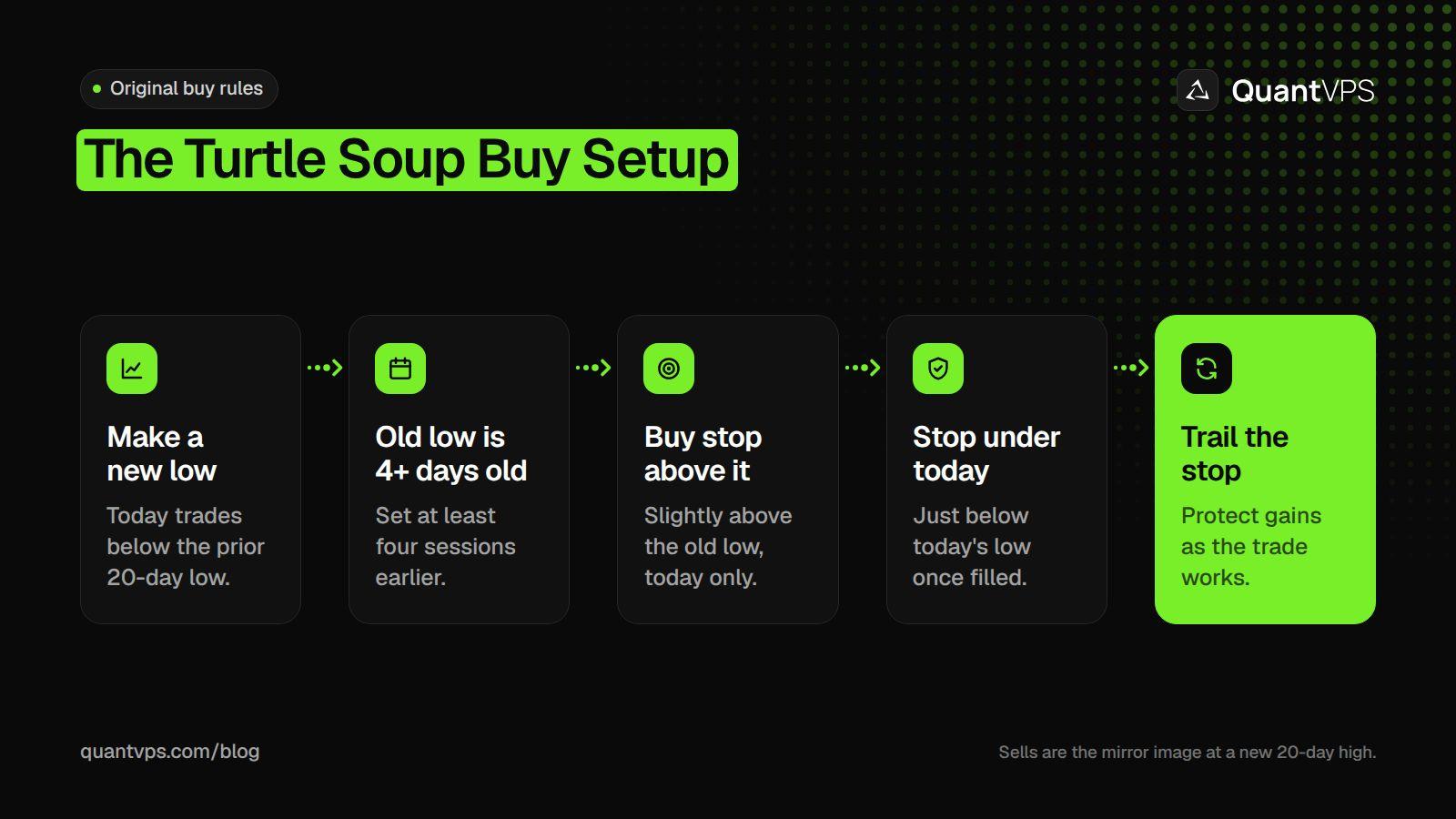
The original Turtle Soup buys a failed 20-day low and sells a failed 20-day high.
The four-session rule matters because it makes sure the old low is a real, established level that other traders can see. A "new low" one or two days after the last one is just a continuation of the same move.
Order flow
Built for scalpers. Heatmaps on dedicated resources.
Order-flow heatmaps and DOM ladders run on dedicated CPU, memory and NVMe, so your charts keep responding during volatility.
See the dedicated hardware





From $29.99/mo · Windows or Linux
Turtle Soup Plus One
Turtle Soup Plus One is a slower variant that waits one more day. A 2006 TradingMarkets article lists its rules (Turtle Soup Plus One rules, checked on 31 Oct 2026):
- Day one: the market makes a new 20-day low, the previous 20-bar low was made at least three trading sessions earlier, and day one closes at or below the previous 20-bar low.
- Day two: place a buy stop at the earlier 20-day low. If it does not fill on day two, the trade is cancelled.
- Stop: if filled, place a sell stop one tick under the lower of the day-one or day-two low.
- Exit: take partial profits within two to six bars and trail a stop on the rest.
The extra day means the false break has to hold through a close before the trade is set up. Short sells use the same rules at a 20-day high.
The ICT Turtle Soup
In ICT (Inner Circle Trader) teaching, turtle soup is the name traders use for a liquidity raid: price runs just beyond an obvious high or low, fills the stop orders resting there, and then reverses. It keeps the idea of fading a false break but drops the 20-day rule.
Michael J. Huddleston teaches the idea on his Inner Circle Trader channel, and traders apply it with some variation, since there is no written rulebook. The levels traders watch include the previous day's high or low, session highs and lows, and two or more equal highs or lows, where stops tend to cluster.
Our guide to liquidity sweeps explains how those stop clusters form. In the ICT version, the sweep alone is not the trade; traders want a shift in structure back inside the range first.
How ICT traders build the entry
After the raid and the shift, ICT traders look for a price zone to enter on a pullback. Common choices are the last opposite candle before the reversal, covered in our guide to order blocks. Another is the wick zone at the raid itself, known as a rejection block.
Some also look at a correlated market for confirmation. If ES runs above its high while NQ fails to make a higher high, that SMT divergence is read as a sign the raid lacked broad buying.
A raid can also leave a failed order block that flips roles, explained in breaker blocks vs order blocks. When that breaker overlaps a fair value gap, the entry matches the ICT unicorn model.
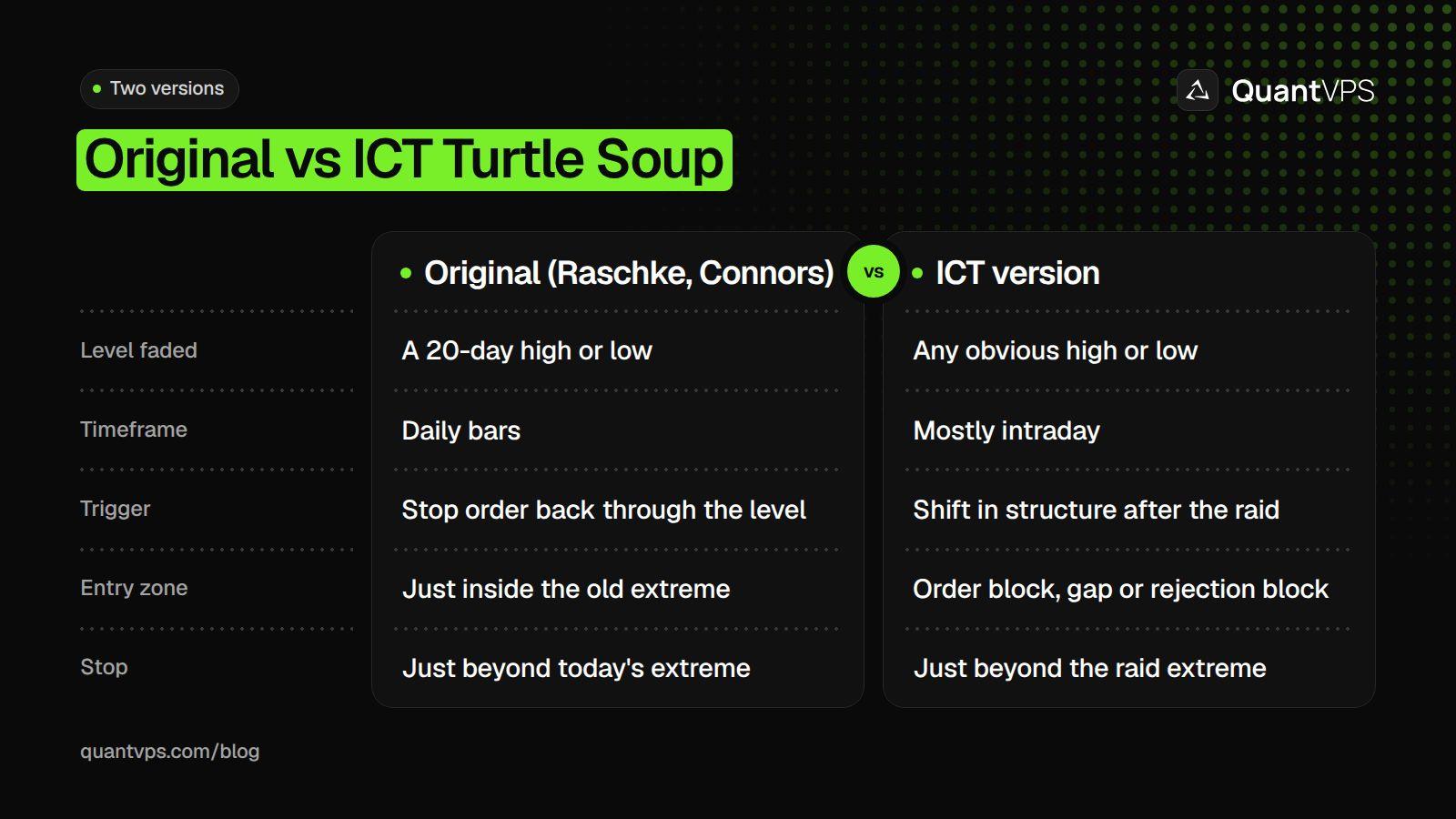
Both versions fade a false breakout; they differ in which level counts and how the entry is triggered.
Original vs ICT Turtle Soup
Both versions fade a false break of a level, but they differ in which level counts, the timeframe and the trigger. The table sets them side by side.
| Original Turtle Soup | ICT turtle soup | |
|---|---|---|
| Source | Street Smarts by Raschke and Connors | ICT video teaching |
| Level | A 20-day high or low at least four sessions old | Any obvious high or low: prior day, session, equal highs or lows |
| Timeframe | Daily bars | Mostly intraday |
| Entry trigger | Stop order slightly back through the old extreme, same day | Shift in structure, then a pullback to an entry zone |
| Stop | Just beyond the day's low or high | Just beyond the raid's low or high |
| Exit | Trailing stop; re-entry allowed on days one and two | Usually the next opposite high or low |
Uptime
99.999% uptime. Built for 24/7 trading reliability.
Your VPS runs in Tier IV datacenters with redundant power and network, monitored 24/7 on site.
See the uptime SLAFrom $29.99/mo · Windows or Linux
Turtle Soup Examples
These are illustrative examples with made-up round prices, not real charts or trade signals. E-mini S&P 500 futures (ES) are $50 per index point, with a 0.25-point tick worth $12.50 (CME Group ES contract specs, checked on 31 Oct 2026).
Original rules on a daily chart
- The setup: the previous 20-day low on ES is 7,600.00, set six sessions ago, so it passes the four-session rule.
- The break: today ES trades down to 7,585.00, a new 20-day low.
- The entry: you place a buy stop at 7,601.00, slightly above the old low, good for today only. Price recovers and the stop fills.
- The stop: just below today's low, at 7,584.75. Risk is 16.25 points, or $812.50 per ES contract.
- The exit: you trail the stop as price rises. If the trade is stopped out on day one or two, the rules allow one re-entry at 7,601.00.
ICT version on a 5-minute chart
- The level: ES made two equal highs at 7,880.00 overnight.
- The raid: at 9:40 ET, ES runs to 7,884.25, then closes back below 7,880.00.
- The shift: by 10:00 ET, ES breaks the last swing low at 7,870.00.
- The entry: price pulls back into the bearish order block left before the drop, and you sell at 7,878.00.
- The stop: 7,884.50, one tick above the raid high. Risk is 6.5 points, or $325 per ES contract.
- The target: the overnight low at 7,855.00, 23 points away, or $1,150 per ES contract.
Risks and Common Mistakes
The main risk in any Turtle Soup trade is that the breakout was real. A trend that keeps going will stop out every fade, and counter-trend trades against a strong move can lose several times in a row.
- Skipping the four-session rule. In the original setup, a low that is only a day or two old is not an established level.
- Fading without a trigger. Selling the moment price breaks a high is guessing. The original waits for a stop order to fill back through the level; the ICT version waits for a shift in structure.
- Moving the stop. The stop sits beyond the false break because a close past it proves the break was real.
- Ignoring news. Major data releases can push price through a level and keep it there.
- Treating every sweep as turtle soup. Many highs are taken and price simply keeps going. Only trade the ones that reverse and confirm.
- Using old results as a promise. No source publishes a success rate that applies to today's markets. Test the rules yourself.
Test the version you plan to use on past charts and in a simulator first, and size each trade so a failed fade is a small loss.
Turtle Soup rules are mechanical enough to code, and if you run alerts or an automated strategy for them, a trading VPS keeps the platform and its orders running while your own computer is off.
FAQs
Who created the Turtle Soup strategy?
Linda Bradford Raschke and Larry Connors described it in their book Street Smarts. The name pokes fun at the Turtles, the trend followers trained by Richard Dennis and William Eckhardt.
What is ICT turtle soup?
In ICT trading, turtle soup is a raid on the stops beyond an obvious high or low that reverses back into the range. Traders wait for a shift in structure and enter on a pullback, with the stop beyond the raid extreme.
What is the difference between Turtle Soup and Turtle Soup Plus One?
Turtle Soup enters the same day price trades back above the old 20-day low. Turtle Soup Plus One waits for day one to close at or below the old low, then enters on day two with a buy stop at the old low.
Does Turtle Soup work on intraday charts?
The original rules were written for daily bars. The ICT version is used mostly intraday, on levels such as the prior day's high or low and session highs and lows.


