
Funded accounts work in three stages: you pay a proprietary (prop) trading firm a fee, pass its evaluation by hitting a profit target without breaking a loss limit, then trade the firm's funded account and keep a share of the profits as payouts. At most retail prop firms the funded account itself is simulated, so your trades do not reach the market, but the payouts are real money.
FTMO Futures and the Funded Futures Family Prime plan, for example, both pay 90% of funded account profits to the trader (firm pages checked on 31 Oct 2026).
In short:
- You pay for an evaluation (a monthly subscription or a one-time fee), not a deposit.
- You pass by hitting a profit target without breaking a drawdown or daily loss limit.
- You get paid a share of simulated profits once you meet the payout rules.
- Live capital is usually offered later, by invitation only.
What Is a Funded Account in Trading?
A funded account in trading is an account a prop firm lets you trade under its rules, with the firm's capital behind it instead of your own. At most retail firms that capital is simulated, and you earn a share of the simulated profits as real payouts.
The firms say so in their own words. Funded Futures Family's disclosures say: "All Evaluation Accounts and Funded Accounts offered by FFF are simulated trading accounts." FTMO says the same of its futures Sim-Funded Account: "This is an account with simulated funds, but with quotes based on the real market directly from regulated exchanges."
You are still paid in real money. FTMO says that on a Sim-Funded Account you "become eligible to receive real monetary payouts based on your results." Live trading with real capital comes later, if at all: FTMO says a small group "may be invited, at FTMO's discretion" to a Live Funded Account.
Firms are open about the odds. Funded Futures Family's disclosures state: "Most traders who purchase an evaluation do not receive a payout."
Uptime
99.999% uptime. Built for 24/7 trading reliability.
Your VPS runs in Tier IV datacenters with redundant power and network, monitored 24/7 on site.
See the uptime SLA





From $29.99/mo · Windows or Linux
How Do Funded Accounts Work?
Funded accounts work in five steps: pay, pass, verify, trade and request payouts. The details differ by firm, but the order does not.
- Buy an evaluation. You choose an account size, such as 50K, and pay a monthly subscription or a one-time fee.
- Pass the evaluation. Reach the profit target while staying inside the max drawdown, any daily loss limit and any consistency rule.
- Verify and sign. At FTMO you "complete the FTMO Identity (KYC verification) and sign" the Sim-Funded Account terms (FTMO).
- Trade the funded account. The risk rules still apply. Break the max drawdown and the account usually ends.
- Request payouts. Once you meet the payout rules (days traded, profit, buffer), you request a payout and keep your share.
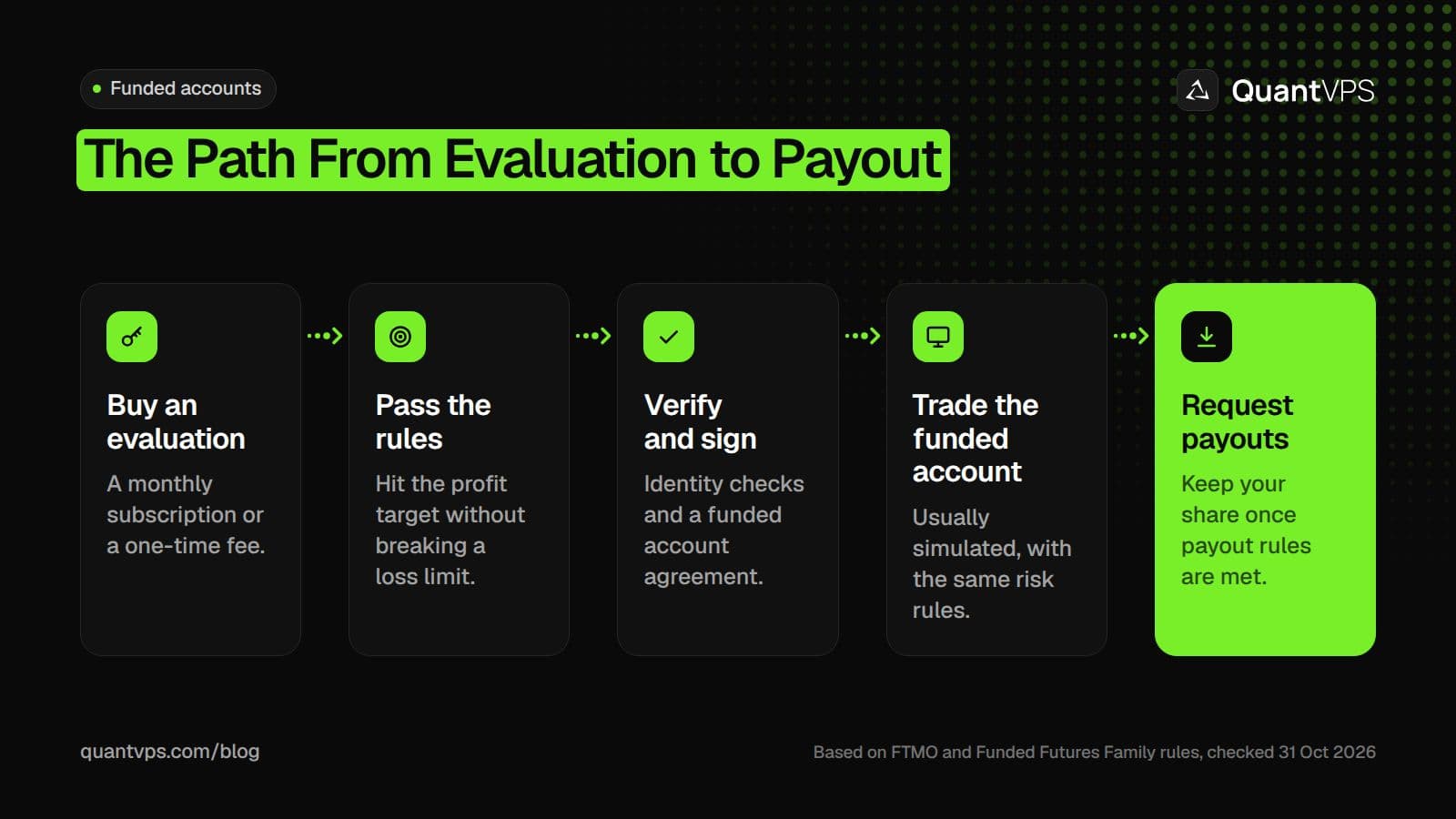
Most funded accounts follow the same five steps, whatever the firm.
One-Step, Two-Step, Instant and Direct Funding
Firms differ mainly in how many phases you pass before you are funded. Two-step evaluations have two profit targets; one-step evaluations have one; instant or direct funding (Funded Futures Family calls its version "Straight to Funded") skips the evaluation for a higher upfront fee. Examples from the firms' own pages, checked on 31 Oct 2026:
| Model | Example | What you must do | Key rules |
|---|---|---|---|
| Two-step | FTMO 2-Step Challenge (CFDs) | Hit 10% in phase 1, then 5% in phase 2 | 5% max daily loss, 10% max loss, 4 minimum trading days |
| One-step | FTMO 1-Step Challenge (CFDs) | Hit one 10% target | 3% max daily loss, 10% max loss, 50% best day rule |
| One-step (futures) | FTMO Futures Growth 50K | Hit a $3,000 target | $2,000 end-of-day trailing drawdown, 40% consistency |
| Straight to funded | Funded Futures Family Payday 50K | No evaluation; pay once and start funded | $2,000 end-of-day drawdown, $1,000 hard daily loss limit, 40% consistency, 7 trading days of $200 or more before a payout |
Skipping the evaluation does not remove the rules. Straight to funded accounts usually have their own consistency and payout conditions, as the Payday row shows.
The Rules That Matter: Drawdown, Daily Loss and Consistency
Three rules decide whether you keep a funded account: the max drawdown, the daily loss limit and the consistency rule. Read each one for your plan before you place a trade.
Max drawdown is the lowest your balance may fall. Many futures firms use a trailing drawdown that rises with your highest balance. Worked example from Funded Futures Family's Prime drawdown table: a $50,000 account with a $2,000 end-of-day drawdown starts with a $48,000 limit; after a close at $51,000 the limit is $49,000, and it locks at $50,000 once a close passes $52,000.
Daily loss limits can be soft or hard. FTMO's Trading Objectives FAQ says a soft breach locks the account "for the rest of the trading day", while after a hard breach "the account is considered failed, and you lose the account."
A consistency rule caps how much of your profit can come from one day. Worked example at 40%: with a $1,200 best day, you need at least $3,000 of total profit, because $1,200 is 40% of $3,000.
Costs and Profit Splits: Real Examples
You pay a fee to take part and keep a share of each payout. The table shows 50K accounts at two firms, from their own pages (list prices, checked on 31 Oct 2026):
| 50K account | Fee | Activation fee | Profit split | Payout limit |
|---|---|---|---|---|
| FTMO Futures Growth | $119 a month | None | 90/10 | Up to 50% of profit, $2,500 cap |
| FTMO Futures Pro | $139 a month | None | 90/10 | Up to 100% of profit, $5,000 cap |
| Funded Futures Family Prime | $204 a month | None | 90/10 | $2,000 first payout, $2,500 after |
| Funded Futures Family Payday | $699.99 once | Not stated | Not stated on the plan page | $1,000 (payouts 1 and 2), $1,250 (payout 3 on) |
Funded Futures Family often sells plans below these list prices with discount codes, so check the checkout price. Some firms also charge an activation fee when you pass. Topstep lists its 50K Trading Combine on its pricing page at $49 a month plus a $149 activation fee per funded account, or $95 a month with no activation fee (checked on 31 Oct 2026).
Worked example: if it takes two months to pass a $119 a month evaluation, the cost is $238. A $2,000 payout at 90/10 pays $1,800 to the trader. The fees are paid whether or not you ever reach a payout. For a side-by-side list of firms, see our top prop firms guide.
Order flow
Built for scalpers. Heatmaps on dedicated resources.
Order-flow heatmaps and DOM ladders run on dedicated CPU, memory and NVMe, so your charts keep responding during volatility.
See the dedicated hardwareFrom $29.99/mo · Windows or Linux
Why Funded Accounts Fail
Most funded accounts end on a rule breach, not a single bad trade. The common causes, all written into firms' own rules:
- Hitting the max drawdown. On a trailing drawdown, a drop from a new high can end the account even if you are still up overall.
- Breaking a hard daily loss limit on a bad day.
- Taking a payout without a cushion. Funded Futures Family warns: "Your Drawdown does not reset after a payout."
- Breaking trading rules, such as holding past the session close, hedging across accounts or copying another trader. FTMO lists these on its forbidden practices page.
- Inactivity. FTMO warns a Sim-Funded Account after 30 consecutive calendar days with no trading and closes it after a further 30 days; Funded Futures Family requires at least one trade each week (idle rule).
- Platform or connection problems during an open trade, which leave a position unmanaged.
What to Check Before You Buy an Evaluation
Compare plans on the rules that end accounts, not only on price. A quick checklist:
- Is the funded account simulated, and how does a trader reach live capital?
- Is the drawdown end-of-day or intraday, and does it lock?
- Is there a daily loss limit, and is it soft or hard?
- What are the consistency rule, payout days, buffer and payout cap?
- Which platforms are supported, and is automated trading allowed?
- Are there activation, reset or data fees?
If your platform must stay open for the whole session, a trading VPS keeps it running when your home PC or internet drops. A QuantVPS Chicago VPS sits 0.52ms from CME, with always-on DDoS protection with advanced filtering and automatic off-site backups on every VPS plan. QuantVPS plans are backed by a 99.999% uptime SLA.
FAQs
Are funded trading accounts real money?
Payouts are real money, but at most retail prop firms the funded account is simulated. FTMO and Funded Futures Family both say their evaluation and funded accounts are simulated; live capital comes later, by invitation.
Do you have to pay for a funded account?
Yes, in almost every case. You pay for the evaluation, as a monthly subscription (for example $119 a month for an FTMO Futures Growth 50K) or a one-time fee for straight to funded accounts. Some firms also charge an activation fee when you pass.
How much of the profit do you keep?
FTMO Futures and the Funded Futures Family Prime plan both pay 90% to the trader on funded accounts (90/10), checked on 31 Oct 2026; FTMO's CFD challenges pay up to 90%. Payout caps and withdrawal limits still decide how much you can take out at once.
Can you lose more than the evaluation fee?
On a simulated account, trading losses are simulated, so what you lose is the fees you paid. Funded Futures Family calls the purchase "a fee for access to our simulated evaluation program and tools; it is not a deposit or an investment".
How long does it take to get funded?
It depends on the plan. FTMO Futures says in its evaluation FAQ that there is "no maximum time limit", and its minimum time to pass is 3 trading days on Growth and 2 on Pro because of the consistency rule. Straight to funded accounts start funded on day one.


