
Funded Futures Network (FFN) pays Sim Funded accounts the same day you become eligible, with a $500 minimum. MAX Standard accounts keep an 80% profit split and a 40% consistency rule; STEADY accounts keep 90% with no consistency rule once funded, but need 5 winning days per payout. Every payout is capped per account and at $10,000 per user across all accounts (checked on 24 Oct 2026 on FFN's own site).
Key points:
- Split: 80% on MAX Standard, 90% on STEADY, and 90/10 in the FFN Institution (live) account.
- Timing: same day once eligible on Sim Funded; same business day in the Institution account.
- Caps: from $750 (25K, payouts 1 to 3) to $2,500 (250K, payout 4 and later), and $10,000 per user per payout.
- Live review: after 4 payouts on one account, or 10 since your last review. All sim accounts close when it happens.
FFN Payout Rules at a Glance
FFN sells two one-time evaluations, MAX Standard and STEADY, in 25K to 250K sizes, with no activation fee after you pass. The funded rules differ mainly in the split and in what you must show before each payout (checked on 24 Oct 2026).
| Funded rule | MAX Standard | STEADY |
|---|---|---|
| Profit split | 80% | 90% |
| Payout frequency | Same day | Same day |
| Consistency rule | 40% | None |
| Winning days per payout | Not required | 5 |
| Minimum payout | $500 | $500 |
| Cap per user | $10,000 per payout, all accounts | $10,000 per payout, all accounts |
| Daily loss limit | $1,000 (25K) to $4,500 (250K) | None |
| Drawdown | End of day, locks at starting balance + $100 | End of day, locks at starting balance + $100 |
| Other rule | Balance $500 above the account threshold | Balance must exceed the level after your last payout |
| Funded reset fee | Before any payout, once | Before any payout, once |
Payout Caps and Buffers by Account Size
Each account has a cap per payout that rises from the fourth payout, and a buffer you build before you can withdraw. The caps are the same on both account types; the buffers are smaller on STEADY.
| Account | Cap, payouts 1 to 3 | Cap, payout 4+ | MAX Standard buffer | STEADY buffer | Funded reset fee |
|---|---|---|---|---|---|
| 25K | $750 | $900 | $1,500 | $1,200 | $475 |
| 50K | $1,000 | $1,250 | $2,000 | $2,000 | $625 |
| 100K | $1,500 | $1,750 | $3,600 | $3,200 | $1,250 |
| 150K | $1,750 | $2,000 | $5,000 | $4,700 | $1,875 |
| 250K | $2,000 | $2,500 | $6,000 | $5,500 | $3,125 |
The $10,000 cap is counted across all your accounts at once. FFN's FAQ says you "are not permitted to request several withdrawals across several accounts if they are copy traded."
Uptime
99.999% uptime. Built for 24/7 trading reliability.
Your VPS runs in Tier IV datacenters with redundant power and network, monitored 24/7 on site.
See the uptime SLA





From $29.99/mo · Windows or Linux
MAX Standard Payouts: Threshold and Consistency
On a MAX Standard Sim Funded account, you can request a payout the same day you qualify. Two conditions apply: your balance is at least $500 above the account minimum threshold, and no single day breaks the 40% consistency rule.
| Account | Minimum threshold | Balance needed for a $500 payout |
|---|---|---|
| 25K | $26,500 | $27,000 |
| 50K | $52,000 | $52,500 |
| 100K | $103,600 | $104,100 |
| 150K | $155,000 | $155,500 |
| 250K | $256,000 | $256,500 |
A balance below the threshold is not a broken rule. FFN's FAQ says you "will have to meet the Account Minimum Threshold before withdrawing again."
The consistency rule resets on an account after each payout, and only on that account: if you copy trade 5 accounts and withdraw from 2, the other 3 keep their count. FFN adds one exception in the same FAQ: "your best day P&L never resets."
STEADY Payouts: 90% With No Consistency Rule
STEADY trades a stricter evaluation for easier payouts. The evaluation has a 52% consistency rule and a 2-day minimum, but once funded there is no consistency rule and no daily loss limit, and the split is 90%.
Each STEADY payout needs 5 winning days, and FFN's net rule says your "balance must exceed the level after your last payout." The minimum, the caps and the $10,000 per-user limit are the same as on MAX Standard.
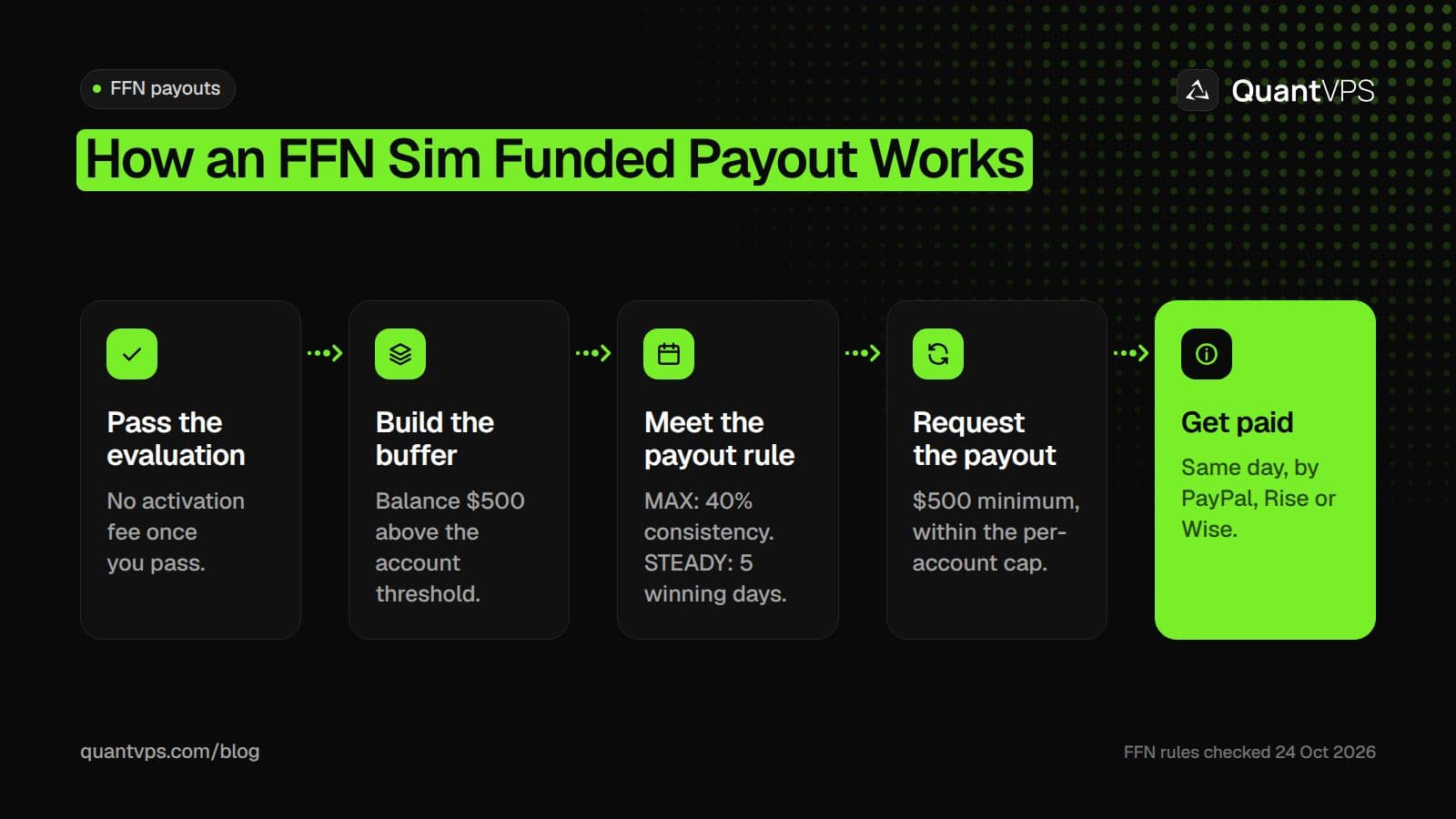
The steps from a passed FFN evaluation to a paid withdrawal.
Live Review and the FFN Institution Account
FFN reviews an account for live trading after 4 payouts on that account, or after 10 payouts across your accounts since your last review. When the review happens, all your sim accounts close.
Traders moved to the FFN Institution account start with $3,000 of real FFN capital, which can never be withdrawn. The account has no consistency rule, pays out the same business day, and splits profit 90/10, with FFN's 10% generally staying in the account as extra capital. Payouts must leave the account's Permanent Risk Buffer in place. Professional market data fees apply to Institution accounts only; FFN lists the amount as "TBD".
Rules That Can Cost You a Payout
Most payout problems at FFN come from trading rules rather than the payout rules themselves (checked on 24 Oct 2026 in FFN's FAQ):
- Tier 1 news: in Exhibition and Funded accounts you must be flat 1 minute before and 1 minute after FOMC meetings and minutes, the Employment Report (NFP) and CPI; EIA for energy traders and agricultural reports for agricultural traders. A resting order counts as not flat.
- Session close: every position must be closed by 4:50 PM ET. Overnight trading from 6:00 PM ET is allowed.
- Hedging: a long and a short at the same time in one product, or across ES and NQ in any size (ES, MES, NQ and MNQ count as one family), is a broken rule.
- Copy trading: up to 5 accounts. More than 5 accounts on one product at once makes all of them ineligible for funding.
- Bots: automated trading is allowed at FFN's discretion; HFT bots or exploiting the simulated environment cost the account.
- Closing accounts: if you close an account, you forfeit its profits, including on funded accounts.
You can hold up to 5 active Sim Funded accounts at once. A pass beyond that waits in a queue until a slot opens.
Payout Methods and FFN's Payout Record
FFN pays by PayPal, Rise or Wise. Its public payout ledger listed 3,034 completed payouts totalling $5,579,105 when it was last updated on 22 Oct 2026, with trader names masked. FFN says it pays every approved payout in full and tells the trader why a request is declined.
Order flow
Built for scalpers. Heatmaps on dedicated resources.
Order-flow heatmaps and DOM ladders run on dedicated CPU, memory and NVMe, so your charts keep responding during volatility.
See the dedicated hardwareFrom $29.99/mo · Windows or Linux
FFN Evaluation Prices
Both evaluations are one-time payments with no activation fee. List prices on 24 Oct 2026, before any promotion:
| Account | MAX Standard | MAX profit target | STEADY | STEADY profit target |
|---|---|---|---|---|
| 25K | $148 | $2,000 | $149 | $2,000 |
| 50K | $178 | $3,000 | $229 | $3,000 |
| 100K | $348 | $6,000 | $308 | $6,000 |
| 150K | $408 | $9,000 | $585 | $9,000 |
| 250K | $658 | $15,000 | $750 | $15,000 |
MAX Standard needs at least 5 trading days to pass and STEADY at least 2, each with a minimum daily profit that rises with account size. To see how FFN compares with other firms, read our full list of futures prop firms.
Running FFN Platforms on a VPS
FFN's preferred platforms are Onyx, Quantower (FundX), EdgeProX and MotiveWave Mobile, and its checkout offers Rithmic with Onyx or FFN's own Nexus Trader and Nexus Connect. A desktop platform such as Onyx or Quantower has to stay running and connected while you trade, including through the 4:50 PM ET close. A Rithmic VPS in Chicago keeps it online 0.52ms from CME, with 99.999% uptime.
FAQs
How often does Funded Futures Network pay out?
Sim Funded accounts can request a payout the same day they become eligible. FFN Institution (live) accounts are paid the same business day.
What is the FFN consistency rule?
MAX Standard funded accounts have a 40% consistency rule, which resets on an account after each payout. STEADY funded accounts have no consistency rule, though the STEADY evaluation has a 52% rule.
How much can I withdraw from FFN at once?
Between $500 and the account's cap, from $750 on a 25K account to $2,500 on a 250K account after the third payout. FFN also limits each user to $10,000 per payout across all accounts.
Does FFN charge an activation fee?
No. Both MAX Standard and STEADY are one-time evaluations with no activation fee after you pass. A funded account can be reset once, before any payout, for $475 to $3,125.
What happens at the FFN live review?
After 4 payouts on one account or 10 since your last review, FFN reviews you for live trading and all your sim accounts close. Traders moved to the Institution account start with $3,000 of FFN capital and a 90/10 split.


