
A stock is a share of ownership in a company, while a futures contract is an agreement to buy or sell an asset at a set price on a future date, traded on an exchange such as CME. Futures trade almost 24 hours a day, need a deposit of about 3 to 12% of the contract value instead of the up to 50% you can borrow on stocks, and in the US are taxed under the 60/40 rule (checked on 31 Oct 2026).
Key differences:
- Ownership: a stock makes you a part owner; a futures contract gives you exposure to a price, and it expires.
- Hours: regular stock trading runs 9:30 a.m. to 4:00 p.m. ET; E-mini S&P 500 futures trade from Sunday 6:00 p.m. to Friday 5:00 p.m. ET with a daily one-hour break.
- Leverage: CME says futures margin is typically 3 to 12% of notional value, against up to 50% of the price for stocks bought on margin.
- Day trading rules: FINRA replaced the $25,000 pattern day trader rule for securities with intraday margin requirements from 4 June 2026.
- Taxes: gains on regulated futures are treated as 60% long term and 40% short term whatever the holding period.
Futures vs Stocks at a Glance
The table sets the main rules side by side. Each row comes from the CME Group, SEC, FINRA or IRS page named in the section below it, checked on 31 Oct 2026.
| Stocks | Stock index futures (ES, MES) | |
|---|---|---|
| What you hold | Shares: part ownership of a company | A contract on the index value; you do not own the stocks |
| Regular trading hours | 9:30 a.m. to 4:00 p.m. ET; extended hours vary by venue | Sunday 6:00 p.m. to Friday 5:00 p.m. ET, break 5:00 to 6:00 p.m. ET daily |
| Margin | Broker can lend up to 50% of the purchase price (Reg T) | Good-faith deposit, typically 3 to 12% of notional |
| Minimum equity to use margin | $2,000 (FINRA) | Set by CME Clearing per contract; brokers may ask for more |
| Expiry | None | Quarterly: Mar, Jun, Sep, Dec |
| Settlement | T+1 for most equity trades | Marked to market every day; ES is cash settled |
| Going short | A short sale: selling stock you do not own | Sell a contract to open |
| US tax on gains | Long term if held over 1 year, short term if 1 year or less | 60% long term, 40% short term (section 1256) |
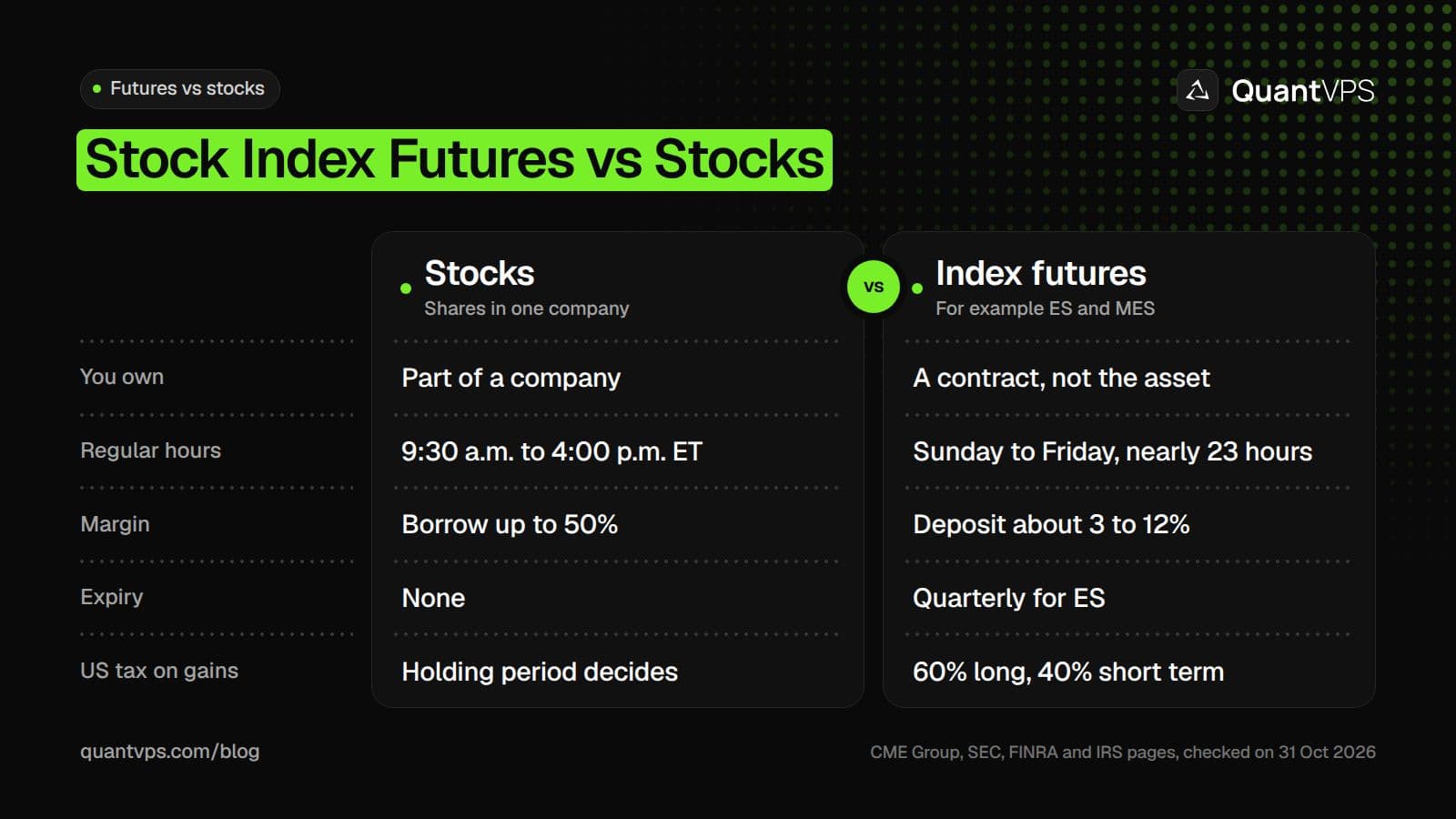
The biggest practical differences are hours, margin and how gains are taxed.
What Are Futures in Stocks?
"Futures" in the stock market usually means stock index futures: contracts whose value follows an index such as the S&P 500 or Nasdaq-100. CME Group lists the most traded ones, and they let you trade the whole index in one contract.
CME defines a futures contract as "a contract to buy or sell a specific commodity of standardized quality at a certain date in the future and at a market-determined price." For an index there is nothing to deliver, so equity index futures are cash settled: at expiry, accounts are credited or debited for the contract's value.
| Contract | Symbol | Contract size | Tick size and value |
|---|---|---|---|
| E-mini S&P 500 | ES | $50 x S&P 500 Index | 0.25 point = $12.50 |
| Micro E-mini S&P 500 | MES | $5 x S&P 500 Index | 0.25 point = $1.25 |
| E-mini Nasdaq-100 | NQ | $20 x Nasdaq-100 Index | 0.25 point = $5.00 |
| Micro E-mini Nasdaq-100 | MNQ | $2 x Nasdaq-100 Index | 0.25 point = $0.50 |
From CME Group contract specs, checked on 31 Oct 2026. A micro contract is one tenth the size of its E-mini, which lets smaller accounts trade the same index. Every other contract is listed in our chart of futures tick values.
Order flow
Built for scalpers. Heatmaps on dedicated resources.
Order-flow heatmaps and DOM ladders run on dedicated CPU, memory and NVMe, so your charts keep responding during volatility.
See the dedicated hardware





From $29.99/mo · Windows or Linux
Ownership and Expiration
Owning a stock makes you a part owner of the company with no end date; a futures position is a contract that expires. The SEC's Investor.gov says stocks give holders "a share of ownership in a company", and common stock usually carries votes and dividends.
CME's course on futures margin says you "do not own the underlying commodity". ES lists quarterly contracts (March, June, September and December) and trading ends at 9:30 a.m. ET on the third Friday of the contract month. To keep exposure you roll: CME describes it as offsetting the expiring contract and opening the same position in a later month.
Trading Hours
Stock index futures trade nearly around the clock on weekdays, while regular stock trading lasts six and a half hours. That matters if news breaks overnight or you trade from another time zone.
- Stocks: the SEC says "regular trading hours for stocks traded on exchanges and certain other markets are from 9:30 a.m. to 4:00 p.m. Eastern Time." Extended-hours sessions exist, but the SEC warns of thinner liquidity and wider spreads, and sessions vary by broker and venue.
- E-mini S&P 500 futures: CME Globex hours are Sunday 6:00 p.m. to Friday 5:00 p.m. ET, with a daily maintenance period from 5:00 to 6:00 p.m. ET.
Margin and Leverage
Futures need far less money up front than stocks for the same exposure, which raises both gains and losses. CME puts futures margin at "typically 3-12% per futures contract as opposed to up to 50% of the face value of securities purchased on margin."
The two kinds of margin also work differently. Securities margin is a loan from your broker; under the Federal Reserve's Regulation T, FINRA says brokers can lend "up to 50 percent of the total purchase price." Futures margin is not a loan or a down payment. CME calls it a good-faith deposit you keep with your broker while the position is open.
| Contract (Dec 2026) | CME maintenance margin (long) | Notional at 7,614.50 | Margin as share of notional |
|---|---|---|---|
| ES | $25,962 | $380,725 (7,614.50 x $50) | About 6.8% |
| MES | $2,596 | $38,072.50 (7,614.50 x $5) | About 6.8% |
CME Group margins pages and last price shown, checked on 31 Oct 2026. CME sets the minimum, and your broker may collect more. Brokers also set their own day trading margins, so check yours. Use our futures profit calculator to see what a move of a given number of points does to your account.
Leverage cuts both ways. FINRA warns that trading on margin carries "the potential to lose more than your original investment," and CME notes that a position can be liquidated if the account falls below the maintenance level.
Day Trading Rules in 2026
The $25,000 pattern day trader (PDT) minimum for stock accounts is being phased out. FINRA adopted new intraday margin standards in Regulatory Notice 26-10, effective 4 June 2026, with brokers allowed to transition through 20 October 2027.
- No $25,000 minimum and no "pattern day trader" label based on counting trades.
- $2,000 is the minimum equity to trade on margin. Below it you can trade only with the cash you have.
- Intraday maintenance margin of 25% of the value of long margin-eligible equities applies throughout the day, not only at the close.
- Repeated unmet intraday deficits can restrict margin trading for up to 90 days.
During the transition your broker may still apply the old PDT rules, so ask which system your account uses. These FINRA rules cover securities accounts. Futures margin is set per contract by CME Clearing and collected by your broker.
In a cash stock account, FINRA reminds traders to pay with settled funds: buying and selling before paying is "free-riding" under Regulation T, and most equity trades settle T+1.
Settlement and Daily Profit and Loss
Futures profits and losses are settled in cash every day; stock gains stay on paper until you sell. CME explains that futures are marked to market against an official daily settlement price, and "losers pay winners every day."
If a daily loss takes your equity below the margin level, you must add funds or reduce the position. A stock bought with cash can fall without a margin call, because nothing is borrowed.
Taxes: Section 1256 vs Capital Gains
In the US, regulated futures contracts are section 1256 contracts, and stocks are not. IRS Publication 550 says that under the mark-to-market system "60% of your capital gain or loss will be treated as a long-term capital gain or loss, and 40% will be treated as a short-term capital gain or loss," however long you held the contract.
| Tax point | Stocks | Regulated futures |
|---|---|---|
| Long or short term | Long term if held more than 1 year; short term if 1 year or less | 60% long term, 40% short term, regardless of holding period |
| Open positions at year end | Not taxed until sold | Treated as sold at fair market value on the last business day |
| Form | Form 8949 and Schedule D | Form 6781 |
| Wash sale rule | Applies to stock or securities sold at a loss and rebought within 30 days | Not covered here; ask a tax professional |
IRS Publication 550 (2025), Topic 409 and the Form 6781 page, read on 31 Oct 2026. The IRS notes that net short-term gains are taxed as ordinary income. This is a summary, not tax advice.
Uptime
99.999% uptime. Built for 24/7 trading reliability.
Your VPS runs in Tier IV datacenters with redundant power and network, monitored 24/7 on site.
See the uptime SLAFrom $29.99/mo · Windows or Linux
Going Short
Going short in futures is the mirror image of going long, while shorting a stock is a separate kind of trade called a short sale. Investor.gov defines a short sale as when "you sell stock you do not own", hoping to buy it back lower; ask your broker what it requires before you short.
With futures, you open a short position by selling a contract and close it by buying one back. CME's own example is a trader "short two WTI Crude Oil contracts" who exits by buying two contracts of the same month.
Futures or Stocks: Which Suits You?
Neither is better for everyone; the right choice depends on how you trade. The table matches common needs to the market whose rules fit them.
| If you want to | Better fit | Why |
|---|---|---|
| Own companies and hold for years | Stocks | No expiry, and long-term rates after 1 year |
| Trade the whole index in one position | Index futures | One ES or MES contract follows the S&P 500 |
| Trade overnight and around world news | Index futures | Nearly 23 hours a day, Sunday to Friday |
| Keep leverage low | Stocks in a cash account | No borrowing and no margin calls |
| Start small with index futures | Micro futures | MES ticks are $1.25 against $12.50 on ES |
Whichever you choose, size positions from the dollar value of a tick or a share, not from the margin figure.
Trading Futures From a VPS
Because futures trade almost all week, platforms and automated strategies often need to stay on while you sleep. A trading VPS keeps NinjaTrader, Tradovate or your own bot running and connected when your PC is off, and QuantVPS servers in Chicago list 0.52ms to CME.
FAQs
What is the main difference between futures and stocks?
A stock is ownership in a company with no expiry. A futures contract is an exchange-traded agreement on a future price that expires, needs only a margin deposit, and is settled every day.
Is it better to trade futures or stocks?
It depends on your goals. Futures offer longer hours and more leverage on an index; stocks offer ownership, no expiry and the option to trade without borrowing.
Do you need $25,000 to day trade?
Not under FINRA's new intraday margin rules, effective 4 June 2026, which drop the $25,000 minimum and set $2,000 as the minimum equity for margin trading. Brokers can keep the old rules until 20 October 2027, so check with yours. Futures accounts follow CME and broker margins instead.
How are futures taxed compared with stocks?
Regulated futures are section 1256 contracts: gains are 60% long term and 40% short term, and open positions are marked to market at year end. Stock gains are long term only if held more than a year.
Can you lose more than you invest in futures?
Yes. Futures are leveraged, and CME explains that losses are settled daily; if your account falls below maintenance margin you must add funds or the position can be liquidated.


