
Futures contracts seem straightforward until settlement day arrives and someone must deliver barrels of oil or bushels of wheat. Physical delivery is the process where the seller of a futures contract transfers the underlying asset to the buyer, and understanding how it works can mean the difference between a smooth trade and an expensive surprise. This article breaks down how physical delivery works, from delivery notices to warehouse receipts, so you can trade commodity futures and agricultural futures with clarity on what happens when a contract expires.
Timing matters in futures trading, especially when delivery dates, margin requirements, and position management converge.
Summary
- Physical delivery in futures contracts means the actual underlying asset changes hands at expiration, at the agreed futures price, regardless of where the spot market sits on settlement day. If you entered a crude oil futures contract at $58.40 per barrel and the spot price on settlement day is $52.00, you still pay $58.40. The contract is a binding obligation, and that obligation involves real warehouses, real transfer of title, and real logistical coordination.
- Despite this, fewer than 2% of futures contracts actually result in physical delivery. Most traders close or roll their positions before expiration to avoid the delivery window entirely. The traders who do engage with physical delivery tend to be commercial hedgers, producers, or large institutions with the infrastructure to receive and store real assets.
- Three dates control everything when a physically-delivered futures contract approaches expiration: First Notice Day, Last Trading Day, and Last Notice Day. For most physically-delivered contracts, traders need to be out before First Notice Day, not by Last Trading Day; for WTI crude oil, notices start after the last trading day, so that day is the deadline. A long position still open when First Notice Day arrives can receive a delivery notice even without any intent to take the asset, at which point the broker's risk desk takes control.
- Physical delivery carries costs that go well beyond the futures price itself. Storage fees, transportation logistics, inspection requirements, and grade specifications all apply and vary by commodity and exchange. Crude oil delivery at Cushing, Oklahoma involves pipeline access and tank storage arrangements, while gold delivery requires approved vault facilities and assay certification. These are contractual obligations with real financial consequences, not theoretical inconveniences.
- Traders who manage expiration well consistently treat contract specifications as operating instructions rather than fine print. They verify the settlement method, know exactly where First Notice Day falls, and understand delivery grade requirements before entering a position. That knowledge shapes position sizing, roll timing, and risk exposure in ways that compound positively over hundreds of trades.
- A trading VPS keeps automated strategies running through delivery windows, so a local hardware failure or lost connection does not cause a missed exit and an unplanned delivery obligation.
What Is Physical Delivery in Futures?
Definition and Why It Matters
Physical delivery in futures means the actual transfer of the underlying asset from the seller to the buyer on a specified date, rather than settling the contract in cash. This process plays a key role in keeping futures prices closely aligned with spot market prices. As a contract nears expiration, the futures price converges with the spot price because arbitrageurs take advantage of any price discrepancies. This alignment is crucial for understanding settlement options.
Exchanges oversee every detail of physical delivery, including quality standards, delivery locations, and grading requirements, to ensure consistency. For instance, a COMEX gold (GC) contract is delivered as one 100 troy ounce bar or three 1 kilo bars, each assaying at least 995 fineness. Similarly, crude oil futures are delivered to specific storage facilities in Cushing, Oklahoma. This standardization gives commercial participants - like farmers, manufacturers, and airlines - the ability to secure inventory and manage supply chain costs with certainty.
While speculators typically close their positions before expiration to avoid the logistical challenges of physical delivery, this mechanism is vital for commercial hedgers who need the actual commodity. For example, a single WTI Crude Oil futures contract represents 1,000 barrels of oil, while a gold futures contract equals 100 troy ounces. These contracts are not just financial tools - they are binding agreements for the exchange of real goods.
Now, let’s compare physical delivery with cash settlement to better understand their practical differences.
Physical Delivery vs. Cash Settlement
Cash settlement provides a more straightforward alternative. Instead of transferring physical goods, the contract is settled with a net cash payment based on the difference between the entry price and the final settlement price. This means no need for warehouses, transportation, or quality inspections - just a simple adjustment to your margin account.
Here’s a comparison of the two settlement methods:
| Feature | Physical Delivery | Cash Settlement |
|---|---|---|
| Final Result | Actual transfer of physical goods | Financial credit/debit to account |
| Primary Users | Commercial hedgers and producers | Speculators and retail traders |
| Logistics | Requires storage, transport, and inspection | No logistical requirements |
| Typical Assets | Crude oil, corn, gold, wheat, cattle | Stock indices, interest rates, crypto |
Margin is a separate question: exchanges set it by each contract's volatility and risk, not by its settlement method, so check the current initial vs. maintenance margin requirements for the contract you trade. Before trading, check the settlement method in the contract specs: CME Group lists physically delivered contracts as "Deliverable" and cash-settled ones as "Financially Settled".
Order flow
Built for scalpers. Heatmaps on dedicated resources.
Order-flow heatmaps and DOM ladders run on dedicated CPU, memory and NVMe, so your charts keep responding during volatility.
See the dedicated hardware







From $29.99/mo · Windows or Linux
How Physical Delivery Works: Step-by-Step
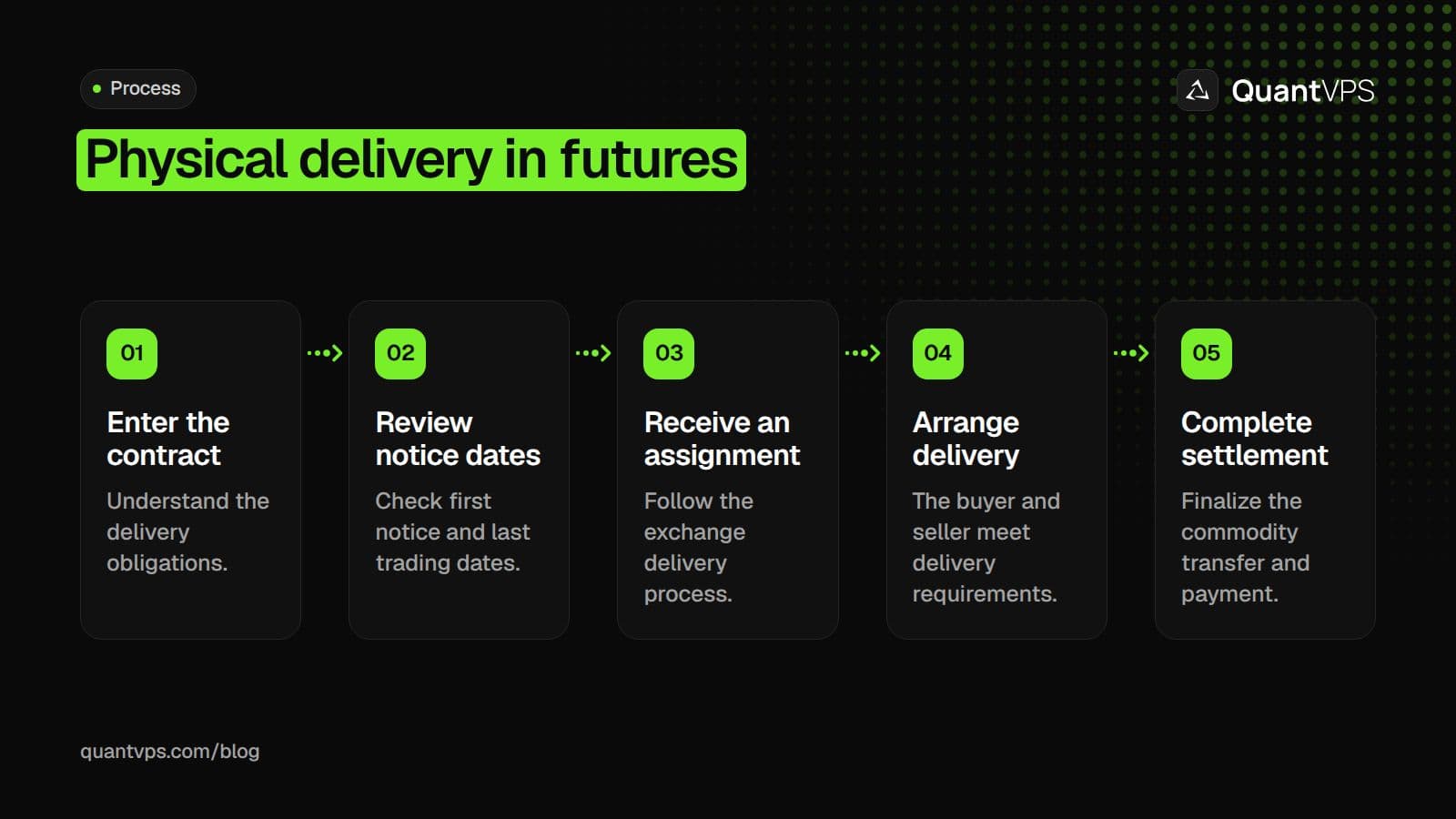
Timeline and Key Dates
Physical delivery in futures trading follows a carefully organized timeline, established by exchanges like CME and NYMEX. This process begins when traders enter into standardized futures contracts and continues with daily mark-to-market settlements, which help manage both margin requirements and delivery obligations.
The process kicks into high gear around the First Notice Day (FND), and its timing depends on the contract. For gold, silver and the grains, FND is the last business day of the month before the contract month, weeks before trading ends. For WTI crude oil, notices start only after the last trading day. From FND, the clearinghouse can notify traders that they need to either make or take delivery. Sellers signal their intent to deliver by issuing a delivery notice, and the clearinghouse matches these sellers with buyers holding long positions.
The Last Trading Day is the final chance for traders to close their positions through market trades. Any contracts still open after this point must go through physical settlement. For the seller, this means providing a warrant or bearer receipt that represents the agreed-upon quantity and quality of the commodity at a designated storage facility. The buyer, in turn, pays the full contract value.
The table shows how the key dates work for six popular physically delivered contracts, with the December 2026 contract as an example (November 2026 for soybeans). Dates are from CME Group's product calendars, checked on 10 Oct 2026.
| Contract | Last trading day rule | First Notice Day | Example dates |
|---|---|---|---|
| WTI crude oil (CL) | 3 business days before the 25th calendar day of the month before the contract month | After the last trading day | Dec 2026: last trade 20 Nov, first notice 24 Nov |
| Gold (GC) | 12:30 p.m. CT on the third last business day of the contract month | Last business day of the month before the contract month | Dec 2026: first notice 30 Nov, last trade 29 Dec |
| Silver (SI) | 12:25 p.m. CT on the third last business day of the contract month | Last business day of the month before the contract month | Dec 2026: first notice 30 Nov, last trade 29 Dec |
| Corn (ZC) | Business day before the 15th of the contract month | Last business day of the month before the contract month | Dec 2026: first notice 30 Nov, last trade 14 Dec |
| Soybeans (ZS) | Business day before the 15th of the contract month | Last business day of the month before the contract month | Nov 2026: first notice 30 Oct, last trade 13 Nov |
| Chicago SRW wheat (ZW) | Business day before the 15th of the contract month | Last business day of the month before the contract month | Dec 2026: first notice 30 Nov, last trade 14 Dec |
This structured timeline ensures all parties know their responsibilities and deadlines, making the entire process run smoothly.
What Buyers, Sellers, and Exchanges Do
Each participant in the futures market has a specific role in the physical delivery process:
- Sellers holding short positions must issue a delivery notice as the contract nears expiration. This confirms their intent to deliver the asset.
- Buyers holding long positions are required to accept delivery and pay the full value of the contract. For example, a West Texas Intermediate (WTI) crude oil futures contract involves taking delivery of 1,000 barrels of oil.
Exchanges play a key role by setting quality standards, defining acceptable grades, and designating approved delivery locations. For instance, WTI crude oil is delivered to storage facilities in Cushing, Oklahoma, while agricultural commodities are delivered to licensed grain depots near Chicago or along the Illinois River.
Clearinghouses act as intermediaries, matching buyers with sellers and issuing daily delivery reports throughout the delivery period. Clearing brokers handle the final settlement process right after the last trading day.
This well-defined system ensures efficiency and clarity, as highlighted by Bruce Blythe:
"Delivery is the process through which sellers of futures contracts fulfill their obligations by transferring the underlying asset to buyers, who must accept and pay for it."
- Bruce Blythe, Financial Journalist
Once the buyer receives the warrant, they have two options: take physical possession of the commodity (which involves transportation costs) or leave it in storage for a fee. This flexibility allows buyers to manage their assets based on their needs and logistical considerations.
Physical Delivery Examples
Crude Oil Delivery
A single West Texas Intermediate (WTI) crude oil futures contract represents 1,000 barrels of oil. When physical delivery takes place, the process centers around Cushing, Oklahoma - an important pricing and storage hub for the CME Group. For the full contract details, see our guide to crude oil futures delivery terms.
Delivery is facilitated through a warrant or bearer receipt, which serves as proof of ownership for a specific quantity and grade of oil stored at an approved facility. To maintain consistency, the exchange enforces strict quality standards, ensuring all contracts deliver the same grade of crude oil.
Once the buyer receives the warrant, they have two options: leave the oil in storage (paying ongoing storage fees) or arrange transportation to move it elsewhere. Transportation costs fall on the buyer, making physical delivery impractical for most retail traders. Access to pipelines or storage facilities at the delivery point is essential, which is why this method is primarily used by commercial entities like refineries and oil producers.
For example, at a price of $70 per barrel, one WTI contract equates to a notional value of $70,000. To take physical delivery, the buyer must pay this full amount. This high cost explains why speculators usually exit their positions before First Notice Day, leaving physical delivery to those with operational needs.
Agricultural Commodities Delivery
Agricultural commodities, such as corn and soybeans, follow a comparable delivery process but involve different logistics. For instance, a standard soybean futures contract represents 5,000 bushels, with deliveries typically occurring at licensed grain storage facilities near Chicago or along the Illinois River.
Quality control is a key factor in agricultural deliveries. Take wheat as an example: Chicago SRW wheat (ZW) is priced on No. 2 Soft Red Winter, with No. 1 Soft Red Winter at a 3 cent premium and other deliverable grades listed in the exchange's rules. Grades follow the official U.S. standards set by the USDA, and hard red winter wheat has its own contract, KC HRW Wheat.
For corn, soybeans and wheat, delivery notices can be issued from First Notice Day, the last business day of the month before the contract month, and they specify the quantity, location, and quality of the commodity. Once the warrant transfers to the buyer, they can either keep the goods in storage for a periodic fee or arrange transportation to another location.
This standardized approach ensures consistency in both quality and logistics across agricultural contracts, much like in crude oil delivery.
Uptime
99.999% uptime. Built for 24/7 trading reliability.
Your VPS runs in Tier IV datacenters with redundant power and network, monitored 24/7 on site.
See the uptime SLAFrom $29.99/mo · Windows or Linux
Risks, How to Avoid Delivery, and Trading Considerations
Risks of Physical Delivery
Physical delivery in futures trading can pose significant challenges, especially for traders who aren't prepared. One of the biggest hurdles is the full capital requirement. Unlike trading on margin, taking delivery means paying the total value of the underlying asset. For instance, gold futures demand a significant financial commitment due to their high notional values.
As contracts near expiration, liquidity typically dries up because professional traders roll their positions forward. This reduced liquidity often leads to wider bid-ask spreads and more volatile prices, making it harder to exit positions favorably. On top of that, traders must deal with storage costs, transportation fees, and potential disputes over the quality of the delivered asset. Brokers may also impose hefty logistical fees or, worse, liquidate positions at less-than-ideal prices when delivery obligations are triggered.
How to Avoid Physical Delivery
To sidestep the complications of physical delivery, it's crucial to act before the First Notice Day (FND). This is the first date when sellers can notify their intent to deliver the underlying commodity. Long holders should close or roll their positions before this date.
"First notice day (FND) marks the date when holders of long futures contracts can first be required to take delivery of the underlying commodity." - Investopedia
One effective method is to exit positions at least two days before FND. This provides a buffer to correct any trade errors. Another option is to roll contracts forward - this involves closing the expiring contract and opening a new one for a later month. This approach helps maintain market exposure while avoiding delivery obligations. Our guide to rolling contracts to avoid delivery covers when and how to make the switch.
For traders who want to completely bypass these logistical hurdles, cash-settled contracts are an excellent alternative. Products like the S&P 500 E-mini or Micro energy futures settle financially, eliminating the need for physical delivery. Always check the contract specifications - look for "C" to confirm cash settlement or "P" for physical delivery - before entering a trade.
Trading Implications and Technology Tools
Managing these risks requires efficient execution tools, especially as expiration approaches and liquidity becomes scarce. Speed is critical in this scenario. Automated trading alerts and low-latency execution systems can make the difference between exiting smoothly and being stuck with unwanted delivery obligations.
Setting up automated alerts for FND and the last trading day is another way to ensure timely rollovers. While many retail brokers automatically liquidate positions before FND, relying solely on this safeguard can lead to trades being executed at unfavorable prices. Advanced tools and proactive strategies are essential for navigating these challenges effectively.
Conclusion
This guide has broken down the essentials of physical delivery in futures contracts. In this process, the actual asset - be it 1,000 barrels of crude oil, 5,000 bushels of corn, or 100 troy ounces of gold - is transferred between parties, often involving high notional values. For commercial hedgers like farmers or manufacturers, this mechanism is a practical way to secure necessary commodities. However, for retail speculators, the logistical demands of storage, transportation, and quality checks make physical delivery far less practical.
These challenges emphasize the need for careful planning and the right tools to navigate futures trading effectively. One critical concept is understanding the First Notice Day (FND) - the earliest point at which a seller can declare their intent to deliver. Traders should always verify whether contracts are designated "C" for cash settlement or "P" for physical delivery before entering a trade.
As expiration approaches, timing becomes crucial. If you don't want the commodity, exit or roll a physically delivered position before its First Notice Day, or before the last trading day for WTI crude oil, and confirm the settlement method in the contract specs before you enter a trade.
FAQs
What happens if I hold a futures contract past First Notice Day?
If you keep a futures contract beyond its First Notice Day, you're obligated to either deliver or accept delivery of the underlying asset. At this point, the contract progresses toward settlement, and for contracts requiring physical delivery, you'll need to meet the terms specified in the agreement.
How do I know if a futures contract is cash-settled or physically delivered?
To figure out if a futures contract is cash-settled or physically delivered, take a close look at its contract specifications. Here's the difference:
- Physically delivered contracts: These involve the actual transfer of the underlying asset when the contract expires.
- Cash-settled contracts: Instead of exchanging the asset, these are settled by paying the price difference in cash.
You'll find the settlement method clearly outlined in the contract documentation, so it's worth reviewing those details carefully.
What do I need to take delivery of a commodity like oil or corn?
To take delivery, you hold a long position into the delivery period, past First Notice Day, so the clearinghouse can assign you a delivery notice from a short. The short makes delivery; the long takes it and pays the full contract value, for example 1,000 barrels of crude oil or 5,000 bushels of corn.
You also need a clearing firm that will handle delivery for you, the cash to pay the full contract value, and a plan for the commodity: pipeline or storage access at Cushing, Oklahoma for crude oil, or storage fees and transport from a regular warehouse for grain.


