
One tick on E-mini Russell 2000 futures (RTY) is 0.10 index points and is worth $5.00, so one full point is $50. One tick on Micro E-mini Russell 2000 futures (M2K) is also 0.10 points and is worth $0.50, or $5 per point. Both contracts have 10 ticks in every point.
Key points:
- RTY tick value: $5.00 per 0.10 index point ($50 per point).
- M2K tick value: $0.50 per 0.10 index point ($5 per point).
- Ticks per point: 10 on both contracts.
- Size ratio: M2K is one tenth of RTY, so 10 M2K move the same dollars as 1 RTY.
- Hours: CME Globex, Sunday 6:00 p.m. to Friday 5:00 p.m. ET, with a daily break from 5:00 to 6:00 p.m. ET.
For every other contract in one place, see our futures tick value chart.
RTY and M2K Contract Specifications
RTY is $50 times the Russell 2000 Index and M2K is $5 times the same index. Both move in steps of 0.10 index points. The table shows the figures CME Group lists for each contract.
| Spec | RTY (E-mini Russell 2000) | M2K (Micro E-mini Russell 2000) |
|---|---|---|
| Contract unit | $50 x Russell 2000 Index | $5 x Russell 2000 Index |
| Minimum tick (outright) | 0.10 index point = $5.00 | 0.10 index point = $0.50 |
| Point value | $50 | $5 |
| Ticks per point | 10 | 10 |
| Calendar spread tick | 0.05 index point = $2.50 | 0.05 index point = $0.25 |
| Settlement | Financially settled | Financially settled |
| Contract months | Mar, Jun, Sep, Dec | Mar, Jun, Sep, Dec |
| Last trade | 9:30 a.m. ET, 3rd Friday of the contract month | 9:30 a.m. ET, 3rd Friday of the contract month |
| Exchange rulebook | CME Chapter 393 | CME Chapter 363 |
Contract specs checked on CME Group on 10 Oct 2026. To turn these tick values into a dollar result for your own entry, exit and size, use our futures profit calculator.
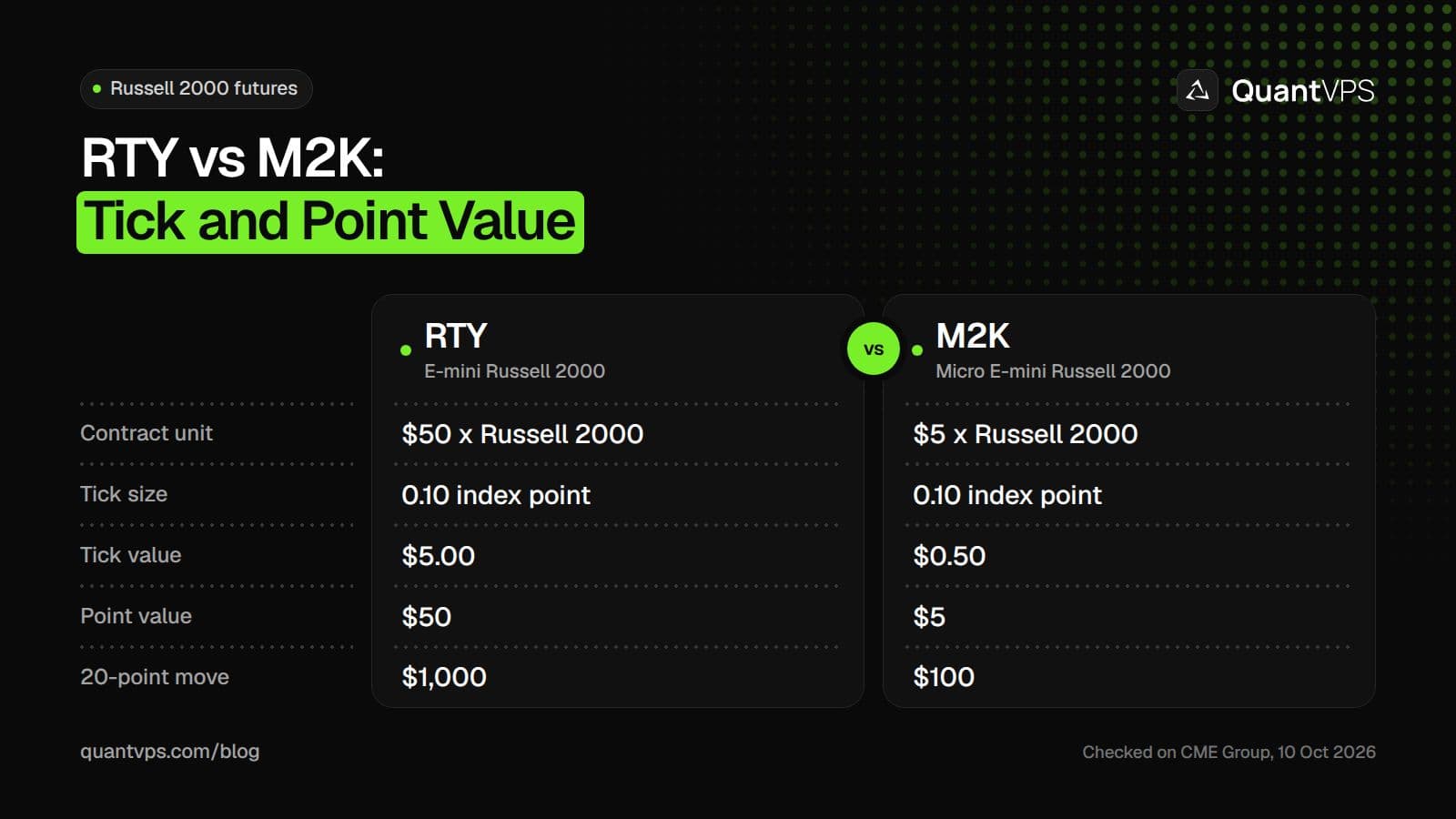
RTY and M2K share the same 0.10-point tick; M2K is one tenth the size.
Ticks per Point: Why There Are 10
RTY and M2K have 10 ticks in every index point because each tick is 0.10 points. A move from 2,000.0 to 2,001.0 is one point and ten ticks.
That is finer than the S&P 500 contracts, which move in 0.25-point ticks (four to a point). It matters when you set orders in ticks: a 10-tick stop on RTY is 1 point ($50), while a 10-tick stop on ES is 2.5 points ($125).
| Contract | Tick size | Ticks per point | Tick value | Point value |
|---|---|---|---|---|
| RTY | 0.10 point | 10 | $5.00 | $50 |
| M2K | 0.10 point | 10 | $0.50 | $5 |
| ES | 0.25 point | 4 | $12.50 | $50 |
| MES | 0.25 point | 4 | $1.25 | $5 |
Order flow
Built for scalpers. Heatmaps on dedicated resources.
Order-flow heatmaps and DOM ladders run on dedicated CPU, memory and NVMe, so your charts keep responding during volatility.
See the dedicated hardware







From $29.99/mo · Windows or Linux
How to Calculate RTY and M2K Tick Value
Tick value is the contract multiplier times the tick size. Point value is the multiplier on its own.
Tick value = contract multiplier x minimum tick
RTY: $50 x 0.10 = $5.00
M2K: $5 x 0.10 = $0.50
Profit or loss on a trade is the number of points moved, times the point value, times the number of contracts. If you count in ticks, use ticks times the tick value instead; the answer is the same. Fees and commissions come on top and depend on your broker.
P&L = points moved x point value x contracts
P&L Examples: a 20-Point Move
A 20-point move in the Russell 2000 is worth $1,000 on one RTY contract and $100 on one M2K contract. That is 200 ticks: 200 x $5 on RTY, or 200 x $0.50 on M2K.
| Move | Ticks | 1 RTY | 1 M2K | 10 M2K |
|---|---|---|---|---|
| 0.10 point | 1 | $5 | $0.50 | $5 |
| 1 point | 10 | $50 | $5 | $50 |
| 5 points | 50 | $250 | $25 | $250 |
| 20 points | 200 | $1,000 | $100 | $1,000 |
The same math works for risk. A 3-point stop costs $150 on 1 RTY and $15 on 1 M2K. If you want to risk $100 on a trade, that is 2 points (20 ticks) on 1 RTY or 20 points (200 ticks) on 1 M2K.
Notional value follows the multiplier. At an example index level of 2,500 (an illustration, not a quote), one RTY controls $125,000 of the index and one M2K controls $12,500.
RTY vs M2K: Which One to Trade
RTY and M2K track the same index with the same 0.10-point tick; M2K is one tenth the size. The choice comes down to how many dollars you want each tick to be worth.
| Feature | RTY | M2K |
|---|---|---|
| Dollars per tick | $5 | $0.50 |
| Dollars per point | $50 | $5 |
| Size vs RTY | 1x | 1/10 |
| Scaling | Whole $50 per point steps | 10 M2K = 1 RTY |
M2K suits smaller accounts and traders who want to add or cut size in small steps. It is also common in prop firm evaluations, where a fixed drawdown limit leaves little room per trade. RTY suits traders who already size in larger amounts and want one contract instead of ten.
Margin is separate from tick value. It is set by the exchange and your broker and can change, so check your broker before you trade. Our page on micro futures tick values lists the other micro contracts next to M2K.
How RTY and M2K Compare With ES and MES
Per point, RTY and ES are worth the same: $50. M2K and MES are worth the same too: $5. The difference is the tick: Russell contracts tick in 0.10 points and S&P 500 contracts in 0.25 points.
| Contract | Contract unit | Tick | Tick value | Point value |
|---|---|---|---|---|
| RTY | $50 x Russell 2000 | 0.10 point | $5.00 | $50 |
| ES | $50 x S&P 500 | 0.25 point | $12.50 | $50 |
| M2K | $5 x Russell 2000 | 0.10 point | $0.50 | $5 |
| MES | $5 x S&P 500 | 0.25 point | $1.25 | $5 |
A point is not the same size of move on each index. The Russell 2000 trades at a lower index level than the S&P 500, so one point is a larger percentage move. Compare contracts by the dollar risk of a typical trade, not by point value alone.
For the S&P 500 E-mini, see the ES tick value guide. The MES tick value guide covers its micro version.
Uptime
99.999% uptime. Built for 24/7 trading reliability.
Your VPS runs in Tier IV datacenters with redundant power and network, monitored 24/7 on site.
See the uptime SLAFrom $29.99/mo · Windows or Linux
RTY and M2K Trading Hours
RTY and M2K trade on CME Globex from Sunday 6:00 p.m. to Friday 5:00 p.m. ET, with a daily maintenance break from 5:00 to 6:00 p.m. ET (4:00 to 5:00 p.m. CT). Hours checked on CME Group on 10 Oct 2026.
Both contracts list quarterly months (March, June, September and December). Trading in an expiring contract ends at 9:30 a.m. ET on the third Friday of the month, so roll before then if you want to keep the position. For how the overnight and regular sessions differ, read our guide to CME trading sessions.
Trading Russell 2000 Futures From a VPS
Every tick on RTY is $5 and every tick on M2K is $0.50, so the price you get filled at matters. A CME VPS in Chicago runs your platform 0.52ms from CME, with always-on DDoS protection with advanced filtering, and it keeps running when your home PC is off.
FAQs
What is the RTY tick value?
The RTY tick value is $5.00. RTY, the E-mini Russell 2000, is $50 times the Russell 2000 Index and moves in 0.10 index point ticks, so each tick is $5 and each full point is $50.
What is the M2K tick value?
The M2K tick value is $0.50. M2K, the Micro E-mini Russell 2000, is $5 times the index and moves in 0.10 index point ticks.
What is the M2K point value?
One point on M2K is worth $5 per contract: 10 ticks of $0.50 each.
How many ticks are in a point on RTY?
Ten. Each RTY and M2K tick is 0.10 index points, so one point is 10 ticks.
How much is a 20-point move on RTY and M2K?
A 20-point move is $1,000 on one RTY contract (20 x $50) and $100 on one M2K contract (20 x $5), before fees.
When do RTY and M2K trade?
On CME Globex from Sunday 6:00 p.m. to Friday 5:00 p.m. ET, with a daily break from 5:00 to 6:00 p.m. ET. Holiday hours differ; check the CME Group holiday calendar before a holiday week.


