Natural Gas (NG) futures are contracts traded on NYMEX that allow you to buy or sell 10,000 MMBtu of natural gas at a future price. These contracts are benchmarked at Henry Hub in Louisiana, a key hub for the North American natural gas market. With 400,000 daily trades and 1.7 million open contracts, NG futures are among the most actively traded commodity futures globally.
Here’s what you need to know:
-
Contract Sizes:
- Standard (NG): 10,000 MMBtu (physical delivery).
- E-mini (QG): 2,500 MMBtu (cash-settled).
- Micro (MNG): 1,000 MMBtu (cash-settled).
-
Tick Value:
- Standard NG: $10.00 per tick ($0.001 price change).
- E-mini QG: $12.50 per tick ($0.005 price change).
- Micro MNG: $1.00 per tick ($0.001 price change).
-
Margins (as of March 19, 2026):
- Initial margin for a standard NG contract: $4,023.
- Maintenance margin: $3,658.
- Smaller contracts (E-mini and Micro) require lower margins, starting at $341.
- Volatility: NG futures are highly volatile, with price swings influenced by weather, seasonal demand, and geopolitical events. For example, January 2026 saw a record 246.9% historical volatility due to an Arctic blast that disrupted production.
- Trading Hours: Nearly 24/5 trading, from Sunday 6:00 PM to Friday 5:00 PM ET, with a daily 60-minute break.
Understanding these details is critical for managing risks and capital in this fast-moving market. Whether you’re hedging costs or trading price movements, staying informed about specifications, margins, and volatility patterns can make a big difference.
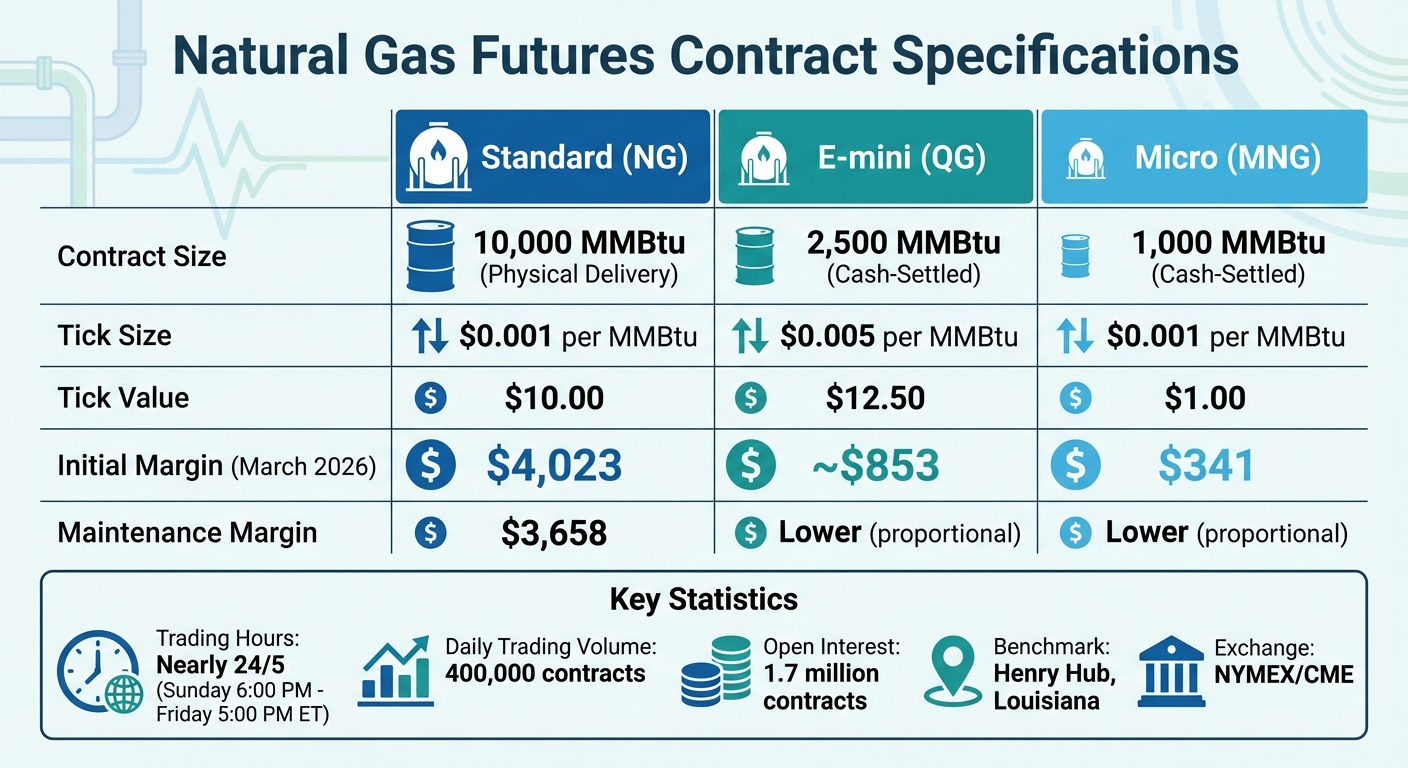
Natural Gas Futures Contract Specifications Comparison Chart
NG Futures Contract Specifications
Contract Size and Trading Units
The standard Natural Gas (NG) futures contract traded on NYMEX represents 10,000 MMBtu of natural gas. This contract is tied to physical delivery at Henry Hub, a critical hub connected to 16 major pipelines. Henry Hub serves as the primary pricing benchmark for the North American natural gas market.
The sheer volume of these contracts highlights their importance. Natural gas is a key energy source, with about 40% of U.S. consumption attributed to electric power generation and 32% to industrial use.
To cater to varying trading preferences, NYMEX/CME offers three different contract sizes:
- Standard Contract (NG): Covers 10,000 MMBtu and is physically delivered.
- E-mini Contract (QG): Covers 2,500 MMBtu and is cash-settled.
- Micro Contract (MNG): Covers 1,000 MMBtu, offering exposure at one-tenth the size of the standard contract.
Trading is available nearly 24/5 on CME Globex, starting Sunday at 5:00 p.m. and ending Friday at 4:00 p.m. CT, with a daily 60-minute break. NG traders running automated strategies through those overnight sessions typically host them on a CME VPS in Chicago for the shortest path to Globex.
Once the contract size is clear, it's crucial to understand how price movements translate into financial impact.
Tick Size and Tick Value
The tick size for standard NG futures is $0.001 per MMBtu, which is the smallest allowable price movement. To determine the value of a tick, multiply this by the contract size:
$0.001 × 10,000 MMBtu = $10.00 per tick.
This means that every one-tenth of a cent change in the price of natural gas equates to a $10.00 shift in the contract's value.
Here's a breakdown of tick sizes and values across different contract types:
| Contract Type | Contract Size | Tick Size | Tick Value |
|---|---|---|---|
| Standard (NG) | 10,000 MMBtu | $0.001 per MMBtu | $10.00 |
| E-mini (QG) | 2,500 MMBtu | $0.005 per MMBtu | $12.50 |
| Micro (MNG) | 1,000 MMBtu | $0.001 per MMBtu | $1.00 |
Understanding these tick values is critical for managing risk. For instance, if the price of natural gas moves from $2.940 to $2.950 per MMBtu (a 10-tick movement), a trader would experience a gain or loss of $100.00 per standard contract.
To help manage extreme volatility, the market enforces daily price limits. These are typically set at $1.00 per MMBtu (equivalent to $10,000 per contract) or 15% above or below the prior settlement price.
Next, we’ll dive into margin requirements to better equip you for NG futures trading.
Margin Requirements for NG Futures

Run 24/7 while you sleep. Keep bots, platforms, and trade copiers online on a dedicated VPS.
Low-latency VPS hosting for your trading platform.
 CHINYC
 LON
LONFrom $29.99/mo


 CHI/CME futuresNYC/US marketsLON/FX EAs
 DUB/Polymarket
 AMS/EU FX
 FRA/Central EU
 TYO/APAC crypto
Initial vs. Maintenance Margins
Margin requirements serve as a form of collateral, ensuring traders can cover potential losses and fulfill their contract obligations. These requirements are set by the exchange and are adjusted regularly to account for market volatility and price risks.
The initial margin is the upfront amount needed to open a futures position. For example, as of March 19, 2026, trading a standard Natural Gas (NG) contract requires approximately $4,023. The maintenance margin, on the other hand, is the minimum equity required to keep the position open, which is about $3,658 for the May 2026 contract.
If the account balance drops below the maintenance margin, a margin call is issued, requiring traders to deposit additional funds to restore the balance to the initial margin level. To avoid potential liquidation during intraday price swings, maintaining a buffer above the maintenance margin is often a smart strategy.
Futures trading offers significant capital efficiency. For instance, with roughly $3,400 in margin, a standard NG contract (10,000 MMBtu) can control a notional value of around $29,400. For traders with smaller accounts, scaled-down contracts offer more accessible entry points: the E-mini contract (QG) requires only about $853, and the Micro contract (MNG) needs just $341 in margin.
Current Margin Levels by Contract Month
Margin requirements vary depending on the contract month, reflecting seasonal trends and potential market volatility. Winter months, such as December and January, typically have higher margins due to increased heating demand and historical price fluctuations. For example, the maintenance margin for a long position in the January 2027 contract is $3,348, while the margin for June 2026 is significantly lower at $2,602.
Another important detail is that maintenance margins for long positions are generally higher than those for short positions. The December 2026 contract highlights this difference, with a maintenance margin of $3,228 for longs compared to $2,784 for shorts.
| Contract Month | Product Code | Exchange | Maintenance (Long) | Maintenance (Short) |
|---|---|---|---|---|
| Mar 2026 | NG | NYMEX | $3,588 | $3,402 |
| Apr 2026 | NG | NYMEX | $3,588 | $3,402 |
| May 2026 | NG | NYMEX | $3,193 | $3,063 |
| Jun 2026 | NG | NYMEX | $2,602 | $2,523 |
| Jul 2026 | NG | NYMEX | $2,726 | $2,505 |
| Aug 2026 | NG | NYMEX | $2,767 | $2,513 |
| Sep 2026 | NG | NYMEX | $2,786 | $2,459 |
| Oct 2026 | NG | NYMEX | $2,811 | $2,473 |
| Nov 2026 | NG | NYMEX | $2,764 | $2,520 |
| Dec 2026 | NG | NYMEX | $3,228 | $2,784 |
| Jan 2027 | NG | NYMEX | $3,348 | $3,009 |
Source: CME Group Maintenance Margin Data as of March 19, 2026[9]
How to Trade Natural Gas Futures Step by Step
Trading natural gas futures is not just about picking a direction. It is about building a process in which each decision connects to the next, and in which preparation does more work than instinct.
What Makes Natural Gas Different From Other Futures
It's tempting to treat natural gas like any other futures contract — pick a direction, set a stop, manage size. The mechanics are similar, but the reasons prices move are not, and that difference should shape how you prepare for a trade, not just how you place one.
| Feature | Natural Gas Futures | Other Asset Futures (Equity, Commodity, Currency) |
| Underlying Asset | A physical commodity with real storage and transportation constraints | Stocks, metals, currencies — generally easier to hold and move |
| Price Drivers | Weather, supply/demand, geopolitics, storage levels | Company performance, interest rates, and broader economic indicators |
| Seasonality | Sharp seasonal swings tied to heating and cooling demand | Usually milder, aside from some agricultural commodities |
| Contract Specs | Defined by delivery point, heating value, and quality standards | Standardised terms specific to each asset class |
| Regulatory Environment | Energy-specific rules, including environmental and transport regulations | Financial-market and exchange-specific rules |
| Risk Factors | Weather shocks, supply disruptions, geopolitical tension | Market, credit, liquidity, and operational risk |
| Trading Hours | Extended hours reflecting global demand | Generally, track the underlying asset's home market hours |
The practical takeaway: a stock trader's instincts about what moves prices don't transfer cleanly to natural gas. You're trading exposure to something that has to be physically extracted, stored underground, and piped to where it's needed — and every one of those steps is a place where price can move.
What Actually Moves the Price
Since the physical nature of natural gas is what sets it apart, the factors that move its price are worth understanding individually rather than lumping them into "supply and demand."
- Stored reserves — Governments and utilities hold natural gas in reserve to cushion against periods of lower productivity. As those reserves are drawn down, more must be purchased to replenish them, which tends to push prices higher as availability tightens. The EIA's Weekly Natural Gas Storage Report is the primary public source for tracking this — it's released every Thursday and measures the week-over-week change in underground storage across the Lower 48 states.
- Global demand — Natural gas demand has climbed steadily over the past decade, with the US as the largest consumer and emerging Asian markets adding meaningfully to global pull.
- Alternative fuel development — As greener alternatives scale up and governments direct infrastructure funding toward them, demand for natural gas as a heating and power source can soften, putting downward pressure on price over time.
- Production variability — Restrictions on hydraulic fracturing, whether from regulation or public opposition, can constrain extraction and tighten supply, thereby supporting higher prices.
- Weather — This is the fastest-moving driver of the group. Hurricanes and storms can shut down production facilities for weeks, while cold snaps spike heating demand almost immediately. Because natural gas storage and consumption both respond to weather in real time, this is often the single biggest source of short-term volatility in the contract.
These five factors are also why the step-by-step process below treats "reading the market" as a distinct step rather than folding it into order entry — with natural gas, the data that moves price runs on a weekly public schedule, and trading without watching it is trading blind into a known volatility event.
How to Trade Natural Gas Futures Step by Step
1. Open a futures trading account with a verified broker
Before funding anything, confirm the firm is actually registered to handle your money. In the US, futures brokers and their associated persons must be registered with the CFTC, and that registration is enforced through the National Futures Association's BASIC database, a free tool where you can look up a firm's registration status and disciplinary history before you ever wire a deposit. The CFTC's own guidance is blunt about this: most scams involve unregistered entities, people, and products, so verifying registration matters before you evaluate the trade itself.
2. Choose the right contract size for your account
Natural gas trades under a few different contract sizes on CME Group's NYMEX exchange, and the size you pick should match your account, not your ambition. The standard Henry Hub contract represents 10,000 mmBtu, but CME also lists a Micro Henry Hub contract that's one-tenth the size of the benchmark, allowing traders to tailor their exposure more precisely with smaller margin requirements. A trader who wants exposure without controlling a full-size position can scale in gradually, exit part of a position while holding the rest, and keep dollar risk proportional to account size.
3. Learn tick value and margin before you learn timing
You can't manage risk on a trade whose cost structure you don't understand. Natural gas futures move in minimum increments of $0.001 per MMBtu, and because the standard contract covers 10,000 MMBtu, each increment carries a real dollar value that scales with contract size. Margin is a performance bond, not a purchase price — and because only a percentage of a contract's value is required to trade, it's possible to lose more than the amount deposited. That's the mechanic that makes leverage cut both ways.
4. Select the contract month with trading activity in mind
Front-month contracts — the nearest expiration — typically carry the tightest bid/ask spreads and the deepest liquidity, which matters because a wide spread quietly eats into your entry and exit prices on every trade, win or lose. Months further from expiration often see thinner order books, making fills less predictable.
5. Build a market read before you place the order
This is where the price drivers above actually matter in practice. The EIA's Weekly Natural Gas Storage Report, released every Thursday at 10:30 a.m. Eastern, is one of the most closely watched data points in the market — a larger-than-expected build or draw can move prices sharply within minutes of release. Layering weather forecasts and seasonal demand patterns onto the storage calendar turns "guessing direction" into "trading around known catalysts."
6. Enter the order with a defined type, not just a direction
Market orders guarantee a fill but not a price; limit orders guarantee a price but not a fill; stop orders trigger automatically once a price level is hit, which is the tool most traders use to define risk in advance rather than reacting emotionally mid-trade.
7. Manage risk and position size before, not after, you're in the trade
Decide your stop level and profit target before entering, not while watching the position move against you. Size the position so a stop-out is a loss you've already planned for. Given how sharply a single storage report or weather event can move natural gas, sizing as if the market will move gently is usually the first mistake, not the last.
A quick note
Stay online and closer to execution. Choose a VPS location for CME futures, New York markets, London FX, API trading, and more.
Host your platform near the market route that matters.
CHINYCLONFrom $29.99/mo
CHI/CME futuresNYC/US marketsLON/FX EAsDUB/PolymarketAMS/EU FXFRA/Central EUTYO/APAC cryptoThis is general education on how the market and process work, not a recommendation to buy or sell any specific contract — natural gas futures are leveraged and genuinely high-risk. Happy to also walk through a worked example of tick value and margin on an actual position size if that would help.
Volatility Patterns and Price Movement in NG Futures
Historical Volatility Data
Natural Gas futures are known for their sharp price swings, influenced by extreme weather, storage levels, and production issues. For traders, recognizing these patterns is key to managing risk effectively.
Take January 2026, for example. An Arctic blast caused U.S. natural gas production to plummet from a record 109.7 Bcf/d in December to just 92.5 Bcf/d by January 25, 2026. This drop was largely due to well freeze-offs in regions like Texas, Louisiana, and Oklahoma. The result? A 30-day historical volatility surge to an all-time high of 246.9%, smashing the prior record of 177.7% set in February 2022. On January 29, 2026, the front-month contract faced a dramatic daily percentage decline of nearly 49% - a record-breaking move.
The table below highlights how volatility in recent years has mirrored the market's sensitivity to weather and inventory conditions:
| Period | Average Volatility | Primary Driver |
|---|---|---|
| January 2026 | 246.9% | Arctic blast, production freeze-offs |
| February 2022 | 179% | Russia‑Ukraine dynamics, low inventories |
| February 2024 | 92% | Winter Storm Heather |
| Mid‑2025 | 69% | Balanced inventories, seasonal stability |
| 5‑Year Avg (2021‑2025) | 72.4% | Long‑term baseline |
Volatility typically peaks in the first quarter because of unpredictable heating demand and the risk of production freeze-offs. For instance, in early 2025, a polar vortex prompted the fourth-largest weekly storage withdrawal on record, pushing 30-day volatility to 102% by February 3, 2025. By mid-2025, conditions stabilized, and volatility eased to 69% as storage inventories aligned with the five-year average, supported by strong seasonal injections.
Storage levels are a critical factor in dampening price fluctuations. Katy Fleury of the U.S. Energy Information Administration explains:
"Significant amounts of natural gas in storage can make these uncertainties less critical and reduce exposure to volatility."
When inventories are balanced, the market tends to follow more predictable seasonal trends. However, deviations from the five-year average often lead to heightened volatility, which directly impacts trading decisions.
How Volatility Affects Trading Strategies
Periods of high volatility bring both opportunities and challenges. While sharp price moves can offer the chance for significant gains, they also require traders to exercise careful risk management. For instance, during January 2026’s volatility spike to 246.9%, traders faced intraday price swings of 30%–50%, making it essential to reduce position sizes to manage risk effectively.
Andy Huenefeld, Managing Partner at Pinebrook Energy Advisors, captured the ongoing market tension:
"I wouldn't expect volatility to go away anytime soon, and today feels more like a break in the action than anything significant."
Key resources, like the EIA Weekly Natural Gas Storage Report released every Thursday, often trigger immediate price reactions based on whether the reported withdrawals or injections align with analyst expectations. Conflicting weather forecasts also contribute to a "wait-and-see" approach in the market. Additionally, tracking daily LNG feedgas flows to export terminals provides insight into supply shifts that can influence the Henry Hub benchmark.
In these volatile conditions, maintaining a margin buffer is crucial to avoid forced liquidations, ensuring traders can weather sudden price swings.
Using QuantVPS for NG Futures Trading
In the fast-paced world of NG futures trading, where price swings and market movements can shift in an instant, having technology that minimizes delays is critical.
Faster Order Execution with Low-Latency VPS
When trading NG futures, every millisecond counts. With around 400,000 contracts changing hands daily and a tick value of $10.00, even the slightest delay can lead to significant slippage per contract. Quick execution is essential for hitting those precise price points during volatile market conditions.
QuantVPS offers ultra-low latency infrastructure, with speeds ranging from 0 to 1 millisecond, directly connecting to CME Globex and ClearPort. This is a game-changer for traders, especially since NG futures operate almost 24/7 - from Sunday at 6:00 pm ET to Friday at 5:00 pm ET. Whether you're trading manually or using algorithms, maintaining a stable, low-latency connection across global sessions is key. This level of performance is achieved through cutting-edge network infrastructure designed to minimize delays.
Standard plans provide speeds of 1Gbps or more, while Dedicated Servers offer over 10Gbps. This ensures smooth order execution, even during high-volume events, such as the release of the EIA Weekly Natural Gas Storage Report every Thursday.
Reliable Trading with Dedicated Resources
QuantVPS goes beyond speed by offering dedicated resources across all plans. From the VPS Lite plan (4 CPU cores, 8GB RAM) to Dedicated Servers (16+ cores, 128GB RAM), these resources ensure consistent performance, even during peak trading hours. This means your trading platform stays responsive, whether you're running a single strategy or managing complex algorithmic systems.
With a 100% uptime guarantee, you can trade uninterrupted throughout NG's extended market hours. Additional features like automatic backups and DDoS protection provide extra reliability. Plus, compatibility with platforms like NinjaTrader, MetaTrader, and TradeStation ensures seamless integration with your trading setup. Considering that commercial traders and large speculators account for over 85% of daily NG volume, having a stable, always-on connection is essential for staying ahead in volatile markets and managing risks effectively.
Conclusion
Trading Natural Gas (NG) futures involves more than just market speculation - it demands a solid grasp of contract details, margin requirements, and market behavior. With a $10 per tick value, precise position sizing and well-placed stop-losses are essential. As of March 2026, the margin requirement for standard contracts stands at $3,393, meaning traders need sufficient capital to withstand the market's inevitable swings without risking liquidation.
The market's liquidity is impressive, with around 400,000 contracts traded daily, making it a dynamic space for active traders. Staying ahead means keeping an eye on critical factors like the EIA storage reports released every Thursday and seasonal demand fluctuations, which often drive price changes.
Technology plays a pivotal role in this nearly 24-hour market, operating from Sunday at 6:00 PM to Friday at 5:00 PM ET. Reliable connectivity and fast execution are non-negotiable, as even minor delays can lead to slippage, especially during volatile periods or high-volume events. This is where QuantVPS steps in, offering low-latency solutions and dependable infrastructure tailored for platforms like NinjaTrader and MetaTrader. Such tools ensure consistent performance, even during peak trading hours, helping traders manage positions effectively in a market with daily price limits of up to 15% above or below the previous settlement.
Success in NG futures trading hinges on combining informed market strategies with cutting-edge technology. By leveraging both, traders can confidently navigate this challenging yet rewarding market.
FAQs
How do I choose between NG, QG, and MNG?
Choosing between NG (Natural Gas Futures), QG (Mini Natural Gas Futures), and MNG (Micro Natural Gas Futures) comes down to your trading volume, risk appetite, and overall objectives.
- NG: These are standard contracts representing 10,000 MMBtu. They’re typically geared toward large-scale or institutional traders who handle significant capital and can manage higher risk exposure.
- QG: Mini contracts, sized at 2,500 MMBtu, are a better fit for retail traders who have a moderate amount of capital and prefer slightly smaller positions.
- MNG: Micro contracts are the smallest option, making them ideal for beginners or traders looking for more precise control over their risk.
What’s my max $ risk per contract per day with limits?
Your maximum risk per contract per day is approximately $10. This calculation is based on the minimum price fluctuation (tick size) of $0.001 per MMBtu and a tick value of $10.00. These factors outline how price changes directly affect your trading exposure.
When should I roll or avoid delivery on NG?
As the expiration date for natural gas (NG) futures approaches, it's wise to either roll over your position or close it altogether. By rolling your position into a later contract, you can sidestep the complexities of physical delivery and better manage the timing of your rollover. This strategy helps maintain smoother trading operations and minimizes the risks tied to holding contracts until they expire.