
FOMO in trading is the fear of missing out: the urge to jump into a trade because price is moving without you, not because your plan says to. It shows up as chasing a move late, entering before a setup confirms, or adding size to make up for a trade you missed. You stop it with written entry rules, a fixed dollar risk on every trade and limits you set before the session starts.
Key points:
- What it is: an emotional entry driven by a move you are watching, not by your rules.
- Why it costs you: a late entry moves your price away from your stop, so the same stop risks more and the target pays less.
- How to spot it: you are chasing, skipping confirmation, oversizing or trading outside your plan.
- How to stop it: decide entries, stops and size before the move, and pass on any trade that no longer fits.
What FOMO Means in Trading
FOMO is short for fear of missing out. Merriam-Webster defines it as "fear of not being included in something (such as an interesting or enjoyable activity) that others are experiencing" (Merriam-Webster). In trading, the "something" is a price move, and the others are the traders you imagine are already in it.
Regulators warn about it directly. The SEC's Investor.gov says that "buying and selling investments along with trends and influencers because of a fear of missing out isn't the best way to plan for a strong financial future" (Investor.gov). FINRA's page on crypto assets tells investors to avoid investing based on FOMO (FINRA crypto assets).
Others also use the feeling against you. FINRA notes that "pump-and-dump operators rely on the fear of missing out (FOMO), which they recognize as a powerful motivator for many investors" (FINRA).
Signs a Trade Is Driven by FOMO
A FOMO trade is one you would not take if you had planned it before the move started. These are the signs to look for, in your head and in your trade log.
| Sign | What it looks like | Why it hurts |
|---|---|---|
| Chasing | Buying after a large candle, well above your planned entry | Worse price, wider distance to a logical stop |
| No confirmation | Entering before the close, break or retest your setup needs | You take trades your rules would filter out |
| Oversizing | Trading bigger to catch up on a move you missed | A normal loss becomes a large one |
| Stop skipped or moved | Entering first and deciding the stop later | Your loss has no planned limit |
| Crowd calls | Taking a trade because a chat, feed or friend is in it | Someone else's plan, with your money |
| Off plan | Trading a market or session you don't normally trade | No tested rules for that market |
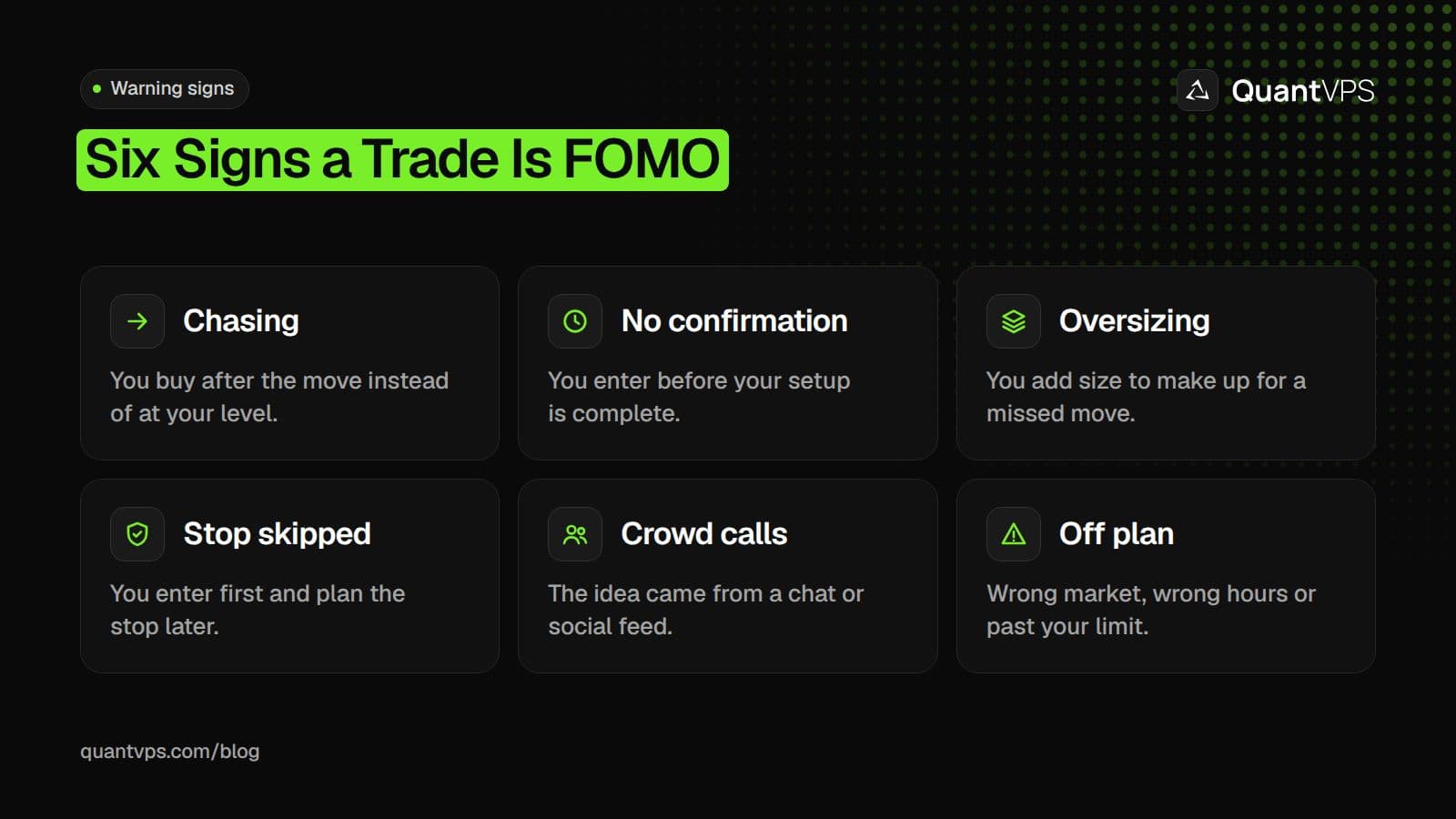
If a trade shows one of these signs, it is likely FOMO rather than your plan.
Uptime
99.999% uptime. Built for 24/7 trading reliability.
Your VPS runs in Tier IV datacenters with redundant power and network, monitored 24/7 on site.
See the uptime SLA




From $29.99/mo · Windows or Linux
Why FOMO Costs You: The Math of a Late Entry
Chasing a move changes your risk and reward even when the trade idea is the same. The stop belongs at the level that proves the idea wrong, and that level does not move up because you entered late.
Assumptions: a long setup with a planned entry at 100, a stop at 98 and a target at 104. These prices are an illustration, not a real chart.
| Planned entry | FOMO entry | |
|---|---|---|
| Entry | 100.00 | 102.50 |
| Stop | 98.00 | 98.00 |
| Target | 104.00 | 104.00 |
| Risk per unit | 2.00 | 4.50 |
| Reward per unit | 4.00 | 1.50 |
| Reward to risk | 2 to 1 | 1 to 3 |
With the same position size, the late entry risks more than twice as much per unit to make less than half as much. To keep the same dollar risk, you would have to cut the size by more than half.
Oversizing does damage beyond one trade. Trading twice your normal size halves the number of losses your account can take before it hits its limit, which raises your risk of ruin.
What Triggers FOMO
FOMO usually starts with something you see, not something your rules flagged. Knowing your own triggers lets you plan for them before the session.
- A sudden large candle or news spike. Fast moves feel like they will keep going, and the late entry looks safe until it reverses.
- Other people's results. Screenshots of wins in chats and on social media make your flat account feel like a loss.
- A trade you just missed. The next setup gets taken too early, or a weak one gets taken because the good one got away.
- A profit target with pressure on it. On a prop firm challenge, the target can make every move feel like one you must catch.
- Markets that never close. Crypto trades around the clock, so there is always a move you are not in.
- A slow session. After hours of waiting, any movement looks like the trade you were waiting for.
How to Stop FOMO in Trading
You stop FOMO by making the decision before the move, so that in the moment you only check whether the trade fits. These rules turn a feeling into a yes or no answer.
- Write your setups down. For each one, note the market, the trigger, where the stop goes and where the target is. If you cannot name the setup a trade belongs to, it is not a trade.
- Use a pre-trade checklist. Setup present, price near the planned entry, stop placed, size within limits. One "no" means you pass.
- Set a maximum entry price. Decide how far past your level you will still enter. Beyond it, the trade is gone, and a missed trade costs you nothing.
- Fix your dollar risk per trade. Size every position from the distance to the stop, and never size up to catch up.
- Cap your trades and losses for the day. A daily trade count and a daily loss limit stop one FOMO entry from turning into five.
- Wait for the bar to close. Waiting for the candle or bar to close gives you time to run your checklist before a spike pulls you in.
- Cut the noise during the session. Mute trading chats and social feeds while you trade, and read them after the close.
- Tag FOMO trades in your journal. Mark each trade as planned or unplanned and compare the two groups every week.
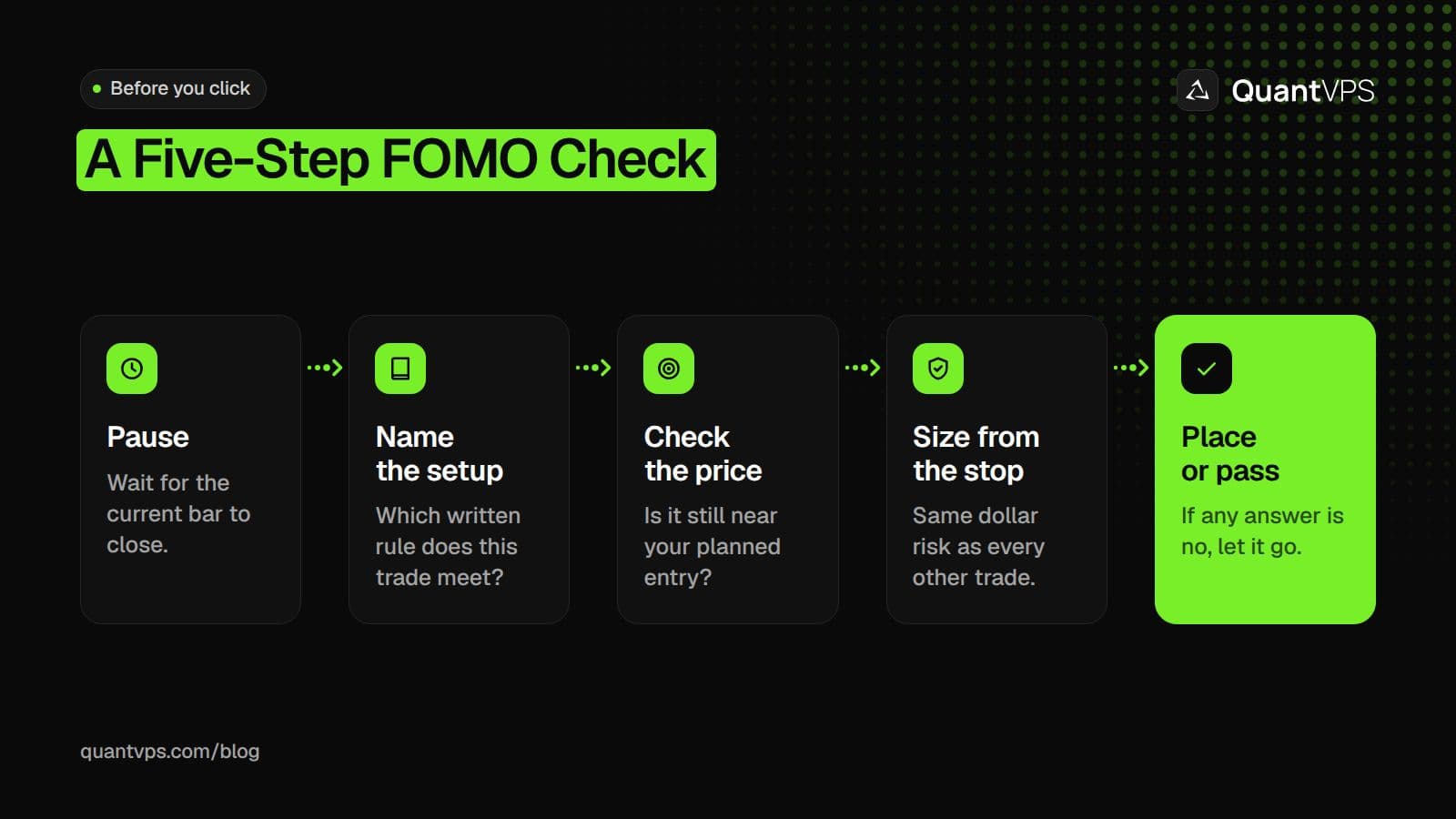
A short check before every entry turns a FOMO impulse into a yes or no decision.
Automation helps as well. Price alerts and order rules that fire only on your conditions mean you don't have to watch every tick to avoid missing a setup. If those alerts or a bot run on a trading VPS, they keep running when your own computer is off or you step away from the desk.
Order flow
Built for scalpers. Heatmaps on dedicated resources.
Order-flow heatmaps and DOM ladders run on dedicated CPU, memory and NVMe, so your charts keep responding during volatility.
See the dedicated hardwareFrom $29.99/mo · Windows or Linux
How to Review FOMO Trades in Your Journal
A weekly review shows whether FOMO is costing you, using your own numbers instead of a feeling. The key is to tag each trade at the time you take it, before you know how it ends.
| Journal field | What to record |
|---|---|
| Planned or unplanned | Was the setup written down before the session? |
| Entry vs planned level | How far past your planned entry you got in |
| Size vs normal | Normal, larger or smaller than your standard risk |
| Trigger | What made you click: a candle, a chat, a missed trade, boredom |
| Result in R | Profit or loss divided by your planned risk per trade |
At the end of the week, total the result in R for planned and unplanned trades separately. If the unplanned group adds nothing or loses, you have a clear reason to drop those trades and a list of the triggers to watch for next week.
FOMO vs a Planned Entry
A planned entry can happen fast and still not be FOMO. The difference is whether the rules came before the move or after it.
| Question | Planned entry | FOMO entry |
|---|---|---|
| When was it decided? | Before the move, in your plan | During the move, while watching it |
| Is there a named setup? | Yes | No, or one made up to fit |
| Where is the stop? | Set before entry at a level that proves the idea wrong | Set after entry, moved or missing |
| How is it sized? | Same dollar risk as every trade | Bigger, to catch up |
| What if price runs without you? | You let it go | You chase it |
FAQs
What does FOMO mean in trading?
FOMO means fear of missing out. In trading, it is the urge to enter a position because price is moving and you feel left behind, rather than because your trading plan gives a signal.
Is FOMO the same as revenge trading?
No, but they often come together. FOMO is about a gain you think you are missing; revenge trading is about winning back a loss you already took. Both lead to unplanned entries and larger size, and the same rules help with both.
How do I know if a trade is FOMO?
Ask whether you would have taken it if you had planned it before the move started. If the entry is far from your planned level, the setup is incomplete, or the size is bigger than usual, it is likely FOMO.
Does FOMO affect crypto traders differently?
Crypto markets trade every day around the clock, so there is always a move happening somewhere and no closing bell to end the session. Set your own trading hours and daily limits, because the market will not stop for you.


