Best Brokers for Options Trading: Full Comparison Guide
Choosing the right broker for options trading can significantly impact your trading success. Whether you're a beginner or an experienced trader, this guide compares six leading brokers - Fidelity, Charles Schwab, Interactive Brokers, tastytrade, E*TRADE, and Robinhood - to help you make an informed decision. Here's what you need to know:
Key Factors:
- Trading Costs: Fees per contract, margin rates, and hidden charges vary widely. For example, Interactive Brokers offers margin rates as low as 2%, while E*TRADE's start above 12%.
- Platform Tools: Advanced features like Greeks analysis, strategy builders, and profit/loss simulators are offered by most brokers, with platforms like thinkorswim (Charles Schwab) and Power E*TRADE standing out.
- Execution Quality: Fidelity and Interactive Brokers excel in price improvement and execution speed.
- Educational Resources: Schwab and Fidelity are ideal for beginners, while tastytrade integrates live education into its platform.
Quick Comparison:
| Broker | Commissions | Best For | Margin Rates | Platform Strength | Education |
|---|---|---|---|---|---|
| Fidelity | $0.65/contract | Research-driven traders | 7.5%-11.825% | Advanced analytics | Comprehensive library |
| Charles Schwab | $0.65/contract | Beginners and thinkorswim fans | High (varies) | thinkorswim platform | Extensive resources |
| Interactive Brokers | $0.15-$0.65 | Advanced, low-cost traders | 2%-3% | Institutional-grade tools | Advanced courses |
| tastytrade | $1.00 (open) | High-volume options traders | N/A | Options-focused features | Integrated live content |
| E*TRADE | $0.50-$0.65 | Balanced trading styles | 12%+ | Intuitive, powerful tools | Solid coverage |
| Robinhood | $0.00 | Beginners | Low (varies) | Simple mobile interface | Limited resources |
Each broker offers unique benefits depending on your trading style. For low-cost, advanced tools, Interactive Brokers stands out. tastytrade is ideal for active options traders, while Fidelity and Charles Schwab cater to those seeking robust tools and education. Robinhood remains a beginner-friendly choice with zero commissions.
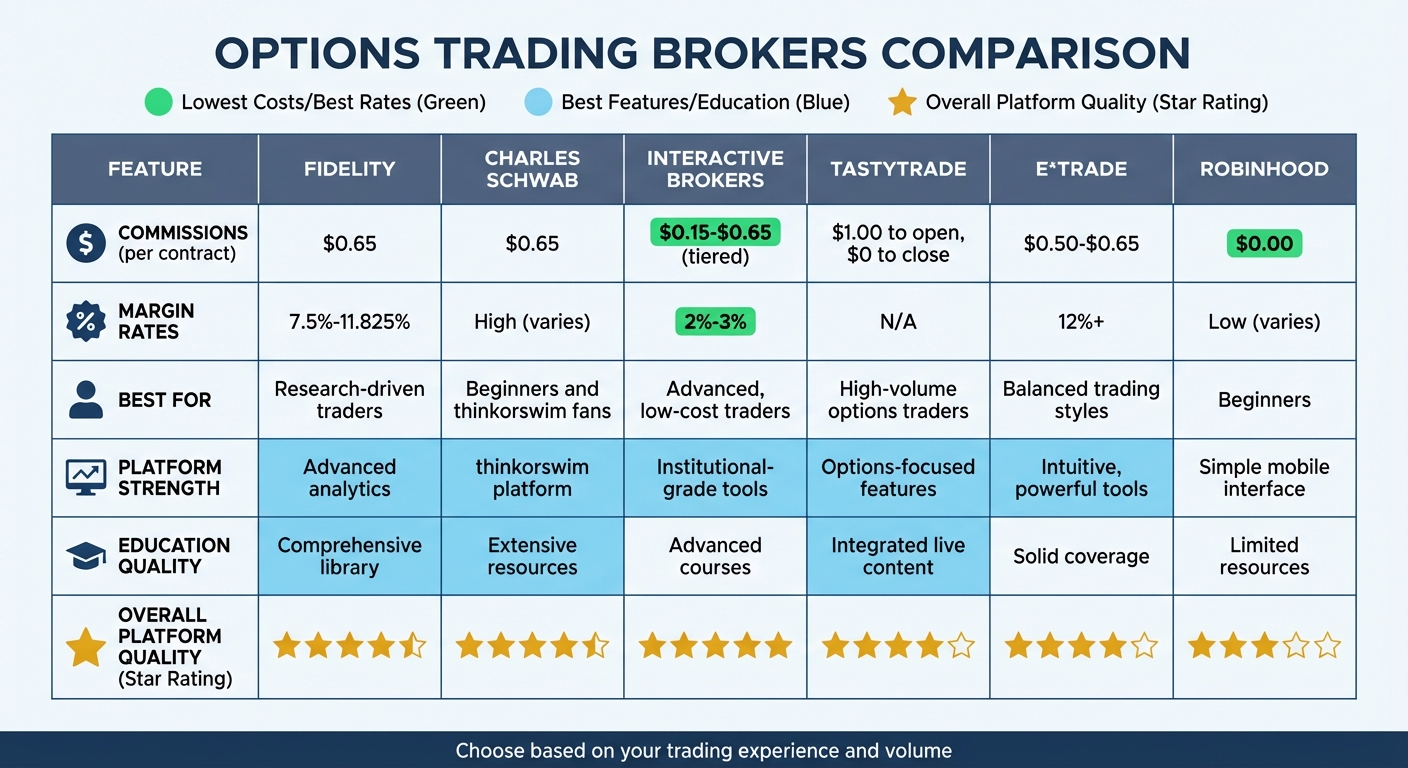
Options Trading Brokers Comparison: Commissions, Margin Rates, and Platform Features
1. Fidelity
Commissions
Fidelity offers $0 commission for online U.S. equity options trades, with a $0.65 per contract fee. This pricing aligns with the industry standard set by major competitors, ensuring a clear and predictable fee structure.
The "Buy to Close" incentive reduces the fee to $0 for closing positions priced at $0.65 or less. This is particularly useful for traders frequently closing low-premium positions. Margin rates range from 11.825% (<$25K) to 7.50% (>$1M), effective December 12, 2025. While these rates are higher compared to brokers like Interactive Brokers, they remain competitive for a full-service platform.
Beyond pricing, Fidelity stands out with its advanced tools designed for options traders.
Platform Tools
Fidelity's Fidelity Trader+ is a browser-based platform launched in September 2025. It requires no downloads and features an Option Chain tool for sorting calls and puts by expiration and strike. The platform also includes a Trade Analyzer, which helps traders visualize potential risk and reward before committing funds. Additionally, Active Trader Pro (ATP) provides multi-monitor layouts, advanced options analytics, and pre-filled multi-leg trade tickets for faster execution.
Both platforms allow extensive customization of option chains, offering over 20 data columns, including Greeks, implied volatility, and open interest. Josh Krugman, Fidelity’s SVP of Brokerage, described the platform's approach:
Fidelity Trader+™ is an evolution of our best-in-class trading technology that brings together industry-leading execution speed with sophisticated tools in one integrated experience.
These features combine to create a seamless and efficient trading environment.
Execution Speed
Fidelity routes orders through third-party market makers, listed exchanges, and its National Financial Services (NFS) desks, aiming for the National Best Bid or Offer (NBBO) across seven major options exchanges, including CBOE, AMEX, and ISE. For multi-leg options, Fidelity ensures simultaneous leg execution, eliminating "leg risk" and guaranteeing the requested net price or better.
In September 2025, 97.7% of Fidelity's listed market orders (100–1,999 shares) received price improvement, and 99.5% executed at or within the NBBO. For NASDAQ-listed shares, the price improvement rate was 96.2% during the same period. These stats reflect Fidelity's consistent execution quality, although options trading may be temporarily restricted during deposit hold periods to mitigate fraud risk.
Educational Resources
Fidelity's Learning Center offers a wide range of educational materials, including videos, articles, and expert insights, covering topics from basic options strategies to advanced volatility techniques. StockBrokers.com awarded Fidelity a 5.0/5 overall score in 2026, naming it "Best for research-driven options traders" and commending its "top-notch education on options strategies".
2. Charles Schwab
Commissions
Charles Schwab charges $0.65 per options contract and offers $0 commission for online stock and ETF trades. Futures options come with a fee of $2.25 per contract, while broker-assisted trades incur a $25 service charge. Automated phone orders are priced at $5. However, Schwab does not offer fee caps for high-volume options traders. As of September 2025, Schwab manages 37.8 million customer accounts with a staggering $11.23 trillion in assets under management.
Platform Tools
Beyond competitive pricing, Schwab offers a suite of advanced trading platforms. Following its 2023 acquisition of TD Ameritrade, Schwab now provides access to the highly regarded thinkorswim platform across desktop, web, and mobile. Investopedia highlighted its significance:
Schwab's acquisition of TD Ameritrade in 2023 gave it control over the award-winning thinkorswim trading platform... a true powerhouse and a strong asset for options traders.
The thinkorswim platform delivers advanced charting, in-depth Greeks analysis, and robust multi-leg trade support, making it a favorite among experienced traders. For beginners, the Schwab.com web platform simplifies trading with tools like the All-In-One Trade Ticket® and Options Trade & Probability Calculator. Advanced traders benefit from features such as Walk Limit® orders, which adjust limit prices for better execution, and SnapTicket®, designed for quick multi-leg order placements.
Execution Speed
Schwab routes undirected orders to a network of unaffiliated broker-dealers and major exchanges, selecting venues based on factors such as speed, accuracy, market depth, and reliability. The firm prioritizes best execution over Payment for Order Flow (PFOF) rebates. According to Schwab:
Best execution for our clients always takes priority when determining where to route orders. Any eligible rebates from a particular market center are not a consideration in order routing decisions.
This approach improves the likelihood of price enhancements, often achieving executions at prices better than the National Best Bid or Offer (NBBO).
Educational Resources
Charles Schwab earned Investopedia's "Best for Beginner Options Traders" award in March 2026, thanks to its extensive educational content and advanced options screening tools. Schwab offers daily live webcasts, podcasts, and focused training sessions on analyzing spreads using risk profile tools. Additionally, the How To Center video library and Schwab Coaching® provide step-by-step guidance for new traders, ensuring they can confidently navigate the platform before tackling more advanced strategies.
NEVER MISS A TRADE
Your algos run 24/7
even while you sleep.
99.999% uptime • Chicago, New York & London data centers • From $59.99/mo
3. Interactive Brokers
Commissions
Interactive Brokers gives traders two options for commission structures when it comes to options trading: Fixed and Tiered. With the Fixed plan, the cost is $0.65 per contract, with a $1.00 minimum per order. The Tiered structure, however, offers reduced rates based on trading volume, potentially dropping as low as $0.15 per contract. For example, traders handling between 50,001 and 100,000 contracts end up paying around $0.25 per contract. For trades involving options priced below $0.05, the fee is $0.25 per contract if monthly volumes are under 10,000. Notably, IBKR doesn’t charge commissions for U.S. exercise and assignment or cabinet buy-to-close trades. This flexible pricing model complements IBKR's extensive trading tools.
Platform Tools
Interactive Brokers provides advanced traders with a powerful set of tools designed for professional use. The OptionTrader tool delivers a streamlined interface to manage option chains and create multi-leg orders. For those building strategies like spreads, butterflies, or condors, the Options Strategy Builder simplifies the process by letting users select strikes directly. Other standout features include the Probability Lab, which visualizes market sentiment, and the Volatility Lab, which compares historical and projected volatility across stocks and industries. The Options Lattice on the IBKR Desktop platform uses a bubble-style graphic to showcase relative volume, open interest, and implied volatility across different strikes and expirations.
As of March 2026, Interactive Brokers managed $820 billion in client equity and provided access to options trading on over 30 global market centers. These tools, combined with IBKR’s SmartRouting system, offer a comprehensive trading experience.
Execution Speed
IBKR’s IB SmartRouting technology is designed to ensure traders get the best available firm price by routing orders efficiently. The platform’s infrastructure, which includes the Trader Workstation (TWS) and the updated IBKR Desktop, prioritizes fast execution - an essential feature for active traders. Bankrate highlighted this strength, stating:
"Interactive Brokers is an ideal choice for investors focused on keeping costs to a minimum... top choice among advanced traders and those who value the finer points, such as swift trade execution".
Additionally, the IBKR Mobile app supports complex strategies involving up to six legs - surpassing the four-leg limit found on many competing platforms.
Educational Resources
Interactive Brokers provides a variety of resources to help traders improve their options trading skills. The Traders' Academy offers courses like "Introduction to Options", "Advanced Option Strategies", and "Neutral Option Market Strategies." The IBKR Campus features webinars, while the IBKR Quant Blog delivers insights for quantitative traders. For on-the-go learning, the IBKR InvestMentor app, introduced in July 2025, provides short, focused lessons. Given the platform's complexity, new users are encouraged to start with futures paper trading simulators to build confidence before trading with real funds.
4. tastytrade
tastytrade stands out among its competitors by blending competitive pricing with advanced technology and a unique focus on live, integrated education.
Commissions
tastytrade’s pricing model, "pay to open, free to close", offers significant savings for high-volume traders. Stock and ETF options cost $1.00 per contract to open, with no fee to close, and commissions are capped at $10 per leg. For example, a 20-contract leg costs just $10, compared to around $13 at brokers charging $0.65 per contract. Futures options are priced at $1.25 per contract to open and close, while micro futures options cost $0.75 per contract. Designed by the creators of thinkorswim, the platform caters specifically to options-focused traders. In March 2026, Investopedia recognized tastytrade as the "Best Overall" online brokerage for options trading. Beyond its cost-effective structure, tastytrade offers a suite of advanced tools tailored for active traders.
Platform Tools
The desktop platform is packed with features like "Curve Mode" for visualizing profit and loss and "Order Chains" for tracking multi-leg trades. Other highlights include beta-weighted delta displays, IV Rank indicators, and a backtesting tool with over 10 years of historical data. It also boasts more than 300 technical indicators and 30+ drawing tools. Unique features like "Follow" mode allow users to replicate strategies from the tastylive network, while a liquidity rating indicator helps traders find optimal pricing. The Risk Analysis tool provides real-time stress tests for portfolios, simulating price changes and volatility shifts. Jessica Inskip, Director of Investor Research at StockBrokers.com, praised the platform:
tastytrade is designed for the active derivatives trader... advanced desktop trading platform features tools like beta-weighted delta and probability analysis and provides a high-performance environment that generalist platforms simply can't match.
These tools are paired with a platform engineered for fast, reliable execution.
Execution Speed
Built to handle high traffic, tastytrade remains stable even during periods of peak market volatility. Through its sister brand tastyfx, traders can access over 80 forex pairs with execution speeds as fast as 17 milliseconds. StockBrokers.com awarded tastytrade the #1 spot for options trading in its 2026 Annual Awards, stating:
Simply put, tastytrade sets the industry standard for options trading in 2026.
By combining cutting-edge technology with robust learning tools, tastytrade offers a seamless experience for traders.
Educational Resources
Education is seamlessly integrated into the platform through tastylive, a financial network that streams live strategy discussions and actionable market insights 24/7. This real-time educational content, paired with trading tools, creates an environment where traders can learn continuously while they trade.
5. E*TRADE
E*TRADE blends a tiered pricing structure with powerful tools and plenty of educational resources, making it a solid option for active traders.
Commissions
E*TRADE's pricing is one of its main attractions. For standard options trading, the platform charges $0.65 per contract, but this drops to $0.50 per contract if you make 30 or more trades in a quarter. Stock and ETF trades are commission-free, and there are no fees for exercise or assignment. With its Dime Buyback Program, traders can close short options positions priced at $0.10 or less without paying contract fees, which helps reduce costs for managing tail risk. Fees for index options vary: SPX is $0.54, NDX is $0.68, VIX is $0.28, and RUT is $0.17 per contract. Futures options cost $1.50 per contract, while cryptocurrency futures are priced at $2.50 per contract.
Platform Tools
E*TRADE offers four platforms tailored to different trading styles: E*TRADE Web, Power E*TRADE, E*TRADE Mobile, and the Power E*TRADE App. The Power E*TRADE platform stands out with features like one-click trading from options chains, chart pattern recognition, and real-time Greeks analysis to help manage Delta and Theta. Additional tools include:
- Strategy Optimizer: Scans for trade ideas based on your market outlook.
- Options Income Backtester: Compares historical returns of income strategies versus holding the underlying stock.
- Live Action Scanner: Flags unusual market activity and shifts in volatility.
- Risk Slide Tool: Simulates portfolio performance during major market moves and compares it to the S&P 500.
These features make it easier for traders to fine-tune their strategies and act decisively.
Execution Speed
E*TRADE uses multiple market centers to route orders, ensuring a balance of price, speed, and opportunities for price improvement. The Power E*TRADE platform integrates real-time market data, enabling traders to place orders quickly. Many users highlight the platform's quick execution. Financial expert Evan Caldwell notes:
STOP LOSING TO LATENCY
Execute faster than
your competition.
Sub-millisecond execution • Direct exchange connectivity • From $59.99/mo
E*TRADE is well-suited for advanced traders seeking top-tier tools.
Educational Resources
E*TRADE complements its trading platforms with extensive educational offerings. These include live webinars, thematic investing guides, and insights from Morgan Stanley Thought Leadership. For more personalized support, traders can consult Dedicated Options Specialists, many of whom are former floor traders, for help with complex strategies. The platform also provides paper trading on Power E*TRADE, allowing users to practice multi-leg strategies without risk.
6. Robinhood
Robinhood has earned its reputation by offering a user-friendly platform with zero-commission trading. It’s particularly appealing to beginners but also provides essential tools for more experienced traders.
Commissions
Robinhood keeps its pricing simple. Trades for stocks, ETFs, and options are completely commission-free, with no hidden fees. This stands out compared to traditional brokers, which often charge around $0.65 per contract. The only exception is for index options, which come with minimal fees. Jessica Inskip, Director of Investor Research at StockBrokers.com, highlighted Robinhood’s appeal, stating:
Between the 3% IRA match, the 3% cash back on the Gold Card, and margin rates that undercut the industry average by half, Robinhood offers a value proposition that is simply impossible to ignore.
Platform Tools
Robinhood’s mobile-first approach makes options trading simple for newcomers. For those looking for more advanced tools, the Robinhood Legend desktop platform includes over 90 technical indicators and 26 drawing tools. Its Strategy Builder allows users to create multi-leg strategies with up to four legs, complete with educational prompts to guide them. Other features include the Options Analyzer, which provides visual profit and loss charts, and Cortex AI, an AI-driven investing assistant available to Gold members. However, the platform lacks some advanced tools like paper trading, conditional orders, and backtesting capabilities.
Execution Speed
Robinhood uses algorithmic routing to send orders to market makers based on past performance. Most trades are executed at or better than the National Best Bid and Offer (NBBO), ensuring competitive pricing. Execution speed largely depends on asset liquidity - orders for assets with tighter spreads, higher trading volumes, and greater open interest tend to fill faster. To improve your order speed, consider placing buy orders closer to the ask price or sell orders near the bid price. These features align with Robinhood’s goal of making trading accessible and straightforward.
Educational Resources
Robinhood offers an Options Knowledge Center that covers everything from basic trading concepts to advanced strategies. The Investor’s Guild provides market commentary along with guides for creating multi-leg trades. For contracts expiring the same day, users can open positions until 3:00 PM ET and close them until 3:30 PM ET for stocks and ETFs. While these resources are helpful for beginners, they don’t delve as deeply into advanced topics as some other platforms do.
Pros and Cons
Here’s a breakdown of the main strengths and weaknesses of each broker to help you match your trading needs with the right platform.
Fidelity scores a 5.0/5 for its research tools and customer service. However, it falls short by not offering a dedicated mobile trading app.
Charles Schwab provides the thinkorswim platform, known for its advanced screening tools. On the downside, it has high margin rates and offers low interest on cash balances.
Interactive Brokers stands out with the lowest margin rates (2–3%) and access to global markets via institutional-grade tools. That said, its steep learning curve and complex fee structures can be tough for beginners.
tastytrade is a great choice for high-volume traders, with capped commissions at $10 per leg and $0 closing fees. However, it lacks paper trading features and options for passive investments.
E*TRADE strikes a balance between sophistication and ease of use, thanks to its user-friendly Power E*TRADE app and income strategy tools. Its main drawbacks include margin rates over 12% and the absence of fractional share trading.
Robinhood appeals to beginners with $0 fees and a simple mobile interface. But advanced traders may find it lacking, as it doesn’t include Greeks displays or implied volatility analytics found on more professional platforms.
| Broker | Commissions | Platform Tools | Execution Speed | Educational Resources |
|---|---|---|---|---|
| Fidelity | ★★★★★ | ★★★★☆ (Strong research) | ★★★★★ (Price improvement) | ★★★★★ (Comprehensive) |
| Charles Schwab | ★★★★☆ | ★★★★★ (thinkorswim) | ★★★★☆ (Reliable) | ★★★★★ (Extensive) |
| Interactive Brokers | ★★★★★ | ★★★★★ (Institutional) | ★★★★★ (Direct access) | ★★★★☆ (Advanced) |
| tastytrade | ★★★☆☆ | ★★★★★ (Options-focused) | ★★★★★ (Fast fills) | ★★★★★ (tastylive) |
| E*TRADE | ★★★★☆ | ★★★★☆ (Intuitive) | ★★★★☆ (Solid) | ★★★★☆ (Good coverage) |
| Robinhood | ★★★★★ | ★★☆☆☆ (Basic) | ★★★☆☆ (PFOF impact) | ★★☆☆☆ (Limited) |
This comparison provides a clear overview to assist you in selecting the best broker for your options trading needs.
Conclusion
When selecting a broker, it's essential to find one that aligns with your trading experience and strategy. If you're just starting out, Charles Schwab offers a wealth of educational resources and the chance to grow into advanced strategies through platforms like thinkorswim.
For traders focused on high-volume options, tastytrade stands out with capped commissions at $10 per leg and $0 to close. As Jessica Inskip, Director of Investor Research at StockBrokers.com, explains:
tastytrade is strongest when you evaluate it through an options-only lens. The tools reinforce trade impacts on risk, probabilities, and portfolio exposure.
Experienced traders managing larger accounts might find Interactive Brokers appealing, thanks to its institutional-grade execution and margin rates typically ranging from 2% to 3%. However, the platform's complexity makes it better suited for those who can navigate its advanced features.
For a balanced approach, Fidelity and E*TRADE combine powerful research tools with user-friendly interfaces, making them ideal for traders who blend options strategies with long-term investing. On the other hand, Robinhood offers a simple, commission-free entry point for beginners. While its ease of use is appealing, it may lack the in-depth tools needed for more advanced trading.
Ultimately, the right choice depends on your trading style and goals. Take advantage of paper trading accounts to test platforms and find the one that fits your needs today while supporting your growth as a trader.
FAQs
How do I pick a broker for my options strategy?
To pick the right broker for your options strategy, focus on a few essential factors: fees, platform features, and ease of use. Look for brokers offering competitive commission rates, tools such as options Greeks and DTE (days to expiration) filters, and a platform that suits your skill level - whether you're a beginner or an experienced trader. Make sure the broker provides what you need for your strategy, whether that's fast order execution, in-depth analytics, or keeping costs low. The best fit will depend on your trading volume and how complex your strategies are.
Which broker is best for low margin rates?
Public.com stands out as the best option for low margin rates in 2026, with a base rate of 4.9%. While competitors like Robinhood offer rates near 5%, Public.com's tiered pricing structure makes it a more affordable choice overall. For traders aiming to keep margin costs low, this could lead to considerable savings over the course of a year.
What tools matter most for multi-leg options trades?
When it comes to multi-leg options trades, there are a few tools that traders rely on to make informed decisions: Greeks analysis, DTE (Days to Expiry) filtering, and spreads support.
- Greeks analysis: This tool helps traders understand and manage key metrics like delta, gamma, theta, and vega. These are especially important for strategies involving multiple legs, such as spreads or butterflies, where small movements in price or volatility can have a big impact.
- DTE filtering: Timing is everything in options trading, and DTE filtering allows traders to pinpoint contracts with specific expiration dates. This precision is especially helpful for strategies like calendar spreads, where the timing between different legs is crucial.
- Spreads support: Executing multiple contracts at once is a hallmark of multi-leg strategies. Whether you're trading iron condors, straddles, or vertical spreads, having robust support for managing and executing these trades efficiently is essential.
These tools work together to simplify the complexities of multi-leg options trading, helping traders execute their strategies with greater confidence.