
If you've tried to track congressional stock trades, insider sentiment, or alternative data sources for investment decisions, you know how scattered and time-consuming the process can be. Quiver Quantitative consolidates this data in one place, giving retail investors access to market intelligence once available only to large institutions. This article examines what Quiver Quantitative offers, the accuracy of its data tools, and whether it delivers value for traders and analysts.
Our virtual private server, built for traders, runs your algorithms, screeners, and automated strategies without interruption, with low latency and consistent uptime, so you never miss critical signals.
Summary
- Quiver Quantitative tracks over 10,000 stocks, providing sufficient market coverage to surface genuine patterns across alternative data categories rather than confirming signals on a narrow slice of large-cap names. That breadth is what separates a useful data platform from one that only validates what most traders already know.
- The platform aggregates congressional trading disclosures, lobbying expenditures, and government contract awards in one interface, data that previously required a Bloomberg terminal or hours of manual cross-referencing across SEC filings and congressional disclosure portals. For retail investors, this closes a meaningful information gap that has historically favored institutional research teams.
- Accuracy holds up under independent scrutiny. Quiver Quantitative's congressional trading database matches official Senate and House records with over 99% accuracy, achieved by pulling directly from official filings rather than relying on secondary aggregation, where most alternative data providers introduce errors.
- The platform does carry one structural limitation worth understanding before building strategies around it. Congressional trades are disclosed within a 45-day window after the transaction occurs, meaning the data reflects what happened, not what is happening. For long-term positioning, this lag is workable, but short-term traders need to weigh it carefully against other inputs.
- The interface is designed with deliberate restraint, organizing data into logical clusters (government activity, insider behavior, public sentiment, corporate signals) without visual noise that would pull attention away from the signal. That design choice reflects a clear understanding of how analysts actually use the platform rather than how it might look in a product demo.
Core Features and Tools
Alternative Data Sources Available
Quiver Quantitative brings together around 30 different datasets into one streamlined dashboard, each designed to help traders spot early market signals. These datasets are neatly categorized, allowing users to either explore them individually or combine them for more in-depth analysis.
At the heart of the platform are congressional and insider trading data. Thanks to the STOCK Act, members of Congress must disclose their trades within 45 days, while corporate insiders are required to report their transactions within two business days. Additionally, Schedule 13D filings - filed when an individual or group acquires over 5% of a company’s equity - offer a way to monitor major institutional activity.
The platform also includes social sentiment tools, such as the WallStreetBets "Fear and Greed Index", which tracks retail investor sentiment in real time, helping traders gauge bullish or bearish trends throughout the day.
For insights into company performance, operational and economic indicators are available. For example, port congestion tracking highlights potential supply chain disruptions, while app store ratings, summarized into a proprietary "Hype Score", provide a snapshot of consumer sentiment. On top of that, an "Inflation Risk Score" is calculated for each stock, reflecting its sensitivity to inflation shocks based on historical price movements.
All of these datasets are presented in user-friendly dashboards, making it easier for traders to analyze markets quickly and effectively.
Data Visualization and Interface Design
Quiver Quantitative doesn’t just provide data - it turns it into actionable insights through its advanced visualization tools. The platform's dashboards are designed to highlight top-performing and underperforming stocks at a glance. A centralized Ticker Search feature brings together all relevant data, reports, and price movements, while custom metrics and visual tools simplify even the most complex data.
"We have built out distinct dashboards for each of our datasets, which make it easy to visualize winners and losers." - Quiver Quantitative
For congressional trading data, the platform includes specialized "Trading Performance" graphs, which simulate potential returns from long or short positions based on public disclosures. Algorithmic traders can also take advantage of a backtesting interface, which uses metrics like CAGR, Sharpe Ratio, Alpha, Beta, and Max Drawdown to evaluate strategy performance.
Quiver also offers a free iPhone app on the Apple App Store, which puts the same dashboards on your phone and makes the data easy to access and interpret.
These tools make it easier for retail traders to incorporate alternative data into their decision-making processes.
Congressional Trading Tracker
Quiver also features a Congressional Trading Tracker, which simplifies the often-complicated world of political trading. This tool scans financial disclosures from U.S. Senators and Representatives, extracting key details like stock tickers, transaction types, politicians’ names, and estimated trade values. It even calculates "estimated excess returns" to show how these trades have performed compared to the broader market.
Uptime
99.999% uptime. Built for 24/7 trading reliability.
Your VPS runs in Tier IV datacenters with redundant power and network, monitored 24/7 on site.
See the uptime SLA







From $29.99/mo · Windows or Linux
Is Quiver Quantitative Legit? (Detailed 2026 Review)
Quiver Quantitative is a real investment research platform that collects alternative financial data from public sources like SEC filings, congressional disclosures, and government contract databases. It is not a scam, trading bot, or "guaranteed returns" scheme. It's a data and research tool. However, being real doesn't mean it's right for every investor. Whether it's worth your time and money depends on your investment approach, what you already pay for, and how comfortable you are turning raw data into your own trading decisions.
Key Point: Being a legitimate platform and being the right platform for you are two different questions. Both matter before you spend a dollar.
Warning: Don't confuse data access with investment advice. Quiver Quantitative provides raw alternative data. Turning that into profitable trades requires your own analysis and judgment.
Below, we break down the evidence across the key factors that determine trustworthiness: who runs the company, where the data comes from, how accurate it is, how the business makes money, and what independent voices say about it.
| Trust Factor | What We Examine |
|---|---|
| Company Leadership | Who runs it and their credibility |
| Data Sources | Where the raw data originates |
| Data Accuracy | How reliable the information is |
| Business Model | How Quiver Quantitative makes money |
| Independent Reviews | What outside voices say |
Takeaway: Trustworthiness isn't a single yes-or-no answer. It's built across multiple layers of evidence, from data sourcing to business transparency to real user feedback.
Company Background and Transparency
Quiver Quantitative was founded by James Kardatzke, who is publicly identified as the CEO and co-founder. This transparent leadership distinguishes it from low-quality fintech products that hide behind anonymous teams or vague "our experts" language.
One transparency gap: the second co-founder's identity isn't easy to independently verify. This is a minor flag rather than a disqualification, as many early-stage startups have thin public bios, but worth noting for cautious readers.
Where the Data Actually Comes From
This is the most important question of legitimacy for a platform like this, and Quiver Quantitative performs well on this front. The platform consolidates publicly available but scattered data, including:
- Congressional trading disclosures (House and Senate financial disclosure filings)
- SEC filings for insider trading and corporate insider transactions
- Government contract awards
- Corporate lobbying records
- Patent filings from government patent offices
- Social sentiment from Reddit (for example, r/WallStreetBets), Twitter/X, Wikipedia page views, and developer-community sites like Hacker News and Stack Overflow
- Corporate jet flight tracking, used as a proxy signal for possible M&A activity
Because the underlying data comes from official government and regulatory sources, the legitimacy of the raw information can be verified against the original filings rather than relying solely on Quiver Quantitative's word.
Data Accuracy
Accuracy determines a research platform's credibility. Congressional trading data on the platform has been verified against official records with over 99% accuracy, with most differences attributed to delayed filings by politicians rather than platform errors.
Social sentiment data is inherently noisier, with stronger correlations to stock movement in high-retail-interest stocks (meme-stock-style names) and weaker correlations across broader market sectors. This limitation applies to any sentiment-tracking tool, so sentiment data should be treated as a supplementary signal rather than a standalone reason to trade.
Reputation Among Investors and Media Coverage
User sentiment is generally positive, with praise for accuracy in congressional trading and government contract data. The platform is cited in institutional research and academic studies on the predictive value of alternative data, signaling credibility beyond the retail-investor community.
Common criticisms include occasional mobile app performance issues, limited suitability for active day traders (it prioritizes research over real-time execution), and restricted customization in some tools. These reflect product maturity and use-case limitations rather than legitimacy concerns.
Pricing Transparency
Quiver Quantitative publishes its pricing clearly rather than hiding it behind a sales call or vague "contact us" wall. Substantial free data is available, suggesting the business isn't purely paywall-first and lets you evaluate data quality before paying.
| Plan | Price (checked on 10 Oct 2026) | Access |
|---|---|---|
| Visitor | Free | Congress trading, insider trading, government contracts, lobbying data, social/search trends, and more |
| Premium | $25/month or $300/year | Everything in Visitor, plus backtesting tools, stock screener, copy-trading via a Quantbase partnership, alerts, and exportable data |
Security, Privacy, and Customer Support
Information on security, privacy, and customer support is limited. There is no independently verifiable detail on data encryption practices, privacy policy specifics, or support responsiveness. For any platform linking financial accounts or personal data, review Quiver Quantitative's current privacy policy and terms of service before subscribing.
What It's Being Compared Against
Quiver Quantitative competes with platforms like Unusual Whales, TipRanks, and StockCharts, each taking a different angle: options flow, analyst ratings, and technical charting. "Legitimate" for Quiver Quantitative means "does what it claims: surfaces public alternative data in a usable way," not "is the single best research tool on the market."
Our Assessment
Putting the evidence together:
- Is it a scam? No. It's a data-aggregation platform built on publicly verifiable government and regulatory sources.
- Is the data accurate? The official-record data (congressional trades, insider trading, government contracts) checks out well against independent verification. Social sentiment data is naturally less precise, and the platform doesn't oversell it.
- Is it transparent? Mostly. Leadership and pricing are public, though some background details (like the second co-founder) are harder to verify.
- Is it right for you? It suits research-driven, longer-horizon investors seeking an information edge more than active day traders who need real-time execution tools.
A Note on Using This for Investment Decisions
Quiver Quantitative provides data, not investment advice. Congressional stock purchases or unusual jet movements are facts, not signals directing your actions. Treat alternative-data platforms as one piece of information among many, conduct your own research, and consult a licensed financial advisor before making decisions. This article is for informational purposes only and does not constitute financial or legal advice.
Once you understand how to use the data correctly, the question becomes whether your setup is fast enough to act when it matters.
Practical Applications for Traders
Spotting Market Trends
Quiver's datasets offer a way to identify market trends before they hit mainstream reports. Tools like the WallStreetBets sentiment tracker and the app store "Hype Score" provide real-time insights into investor and consumer enthusiasm, keeping you ahead of the curve.
For example, corporate lobbying data highlights companies making significant investments to influence legislation - potential indicators of expected growth or upcoming regulatory hurdles. The government contracts tracker, pulling directly from USASpending.gov, reveals new revenue streams as soon as they're awarded, often ahead of public announcements. Similarly, the corporate flight tracker monitors private jet movements, which can hint at high-level business meetings that may precede major deals. These datasets can be integrated into automated trading systems for actionable insights.
Order flow
Built for scalpers. Heatmaps on dedicated resources.
Order-flow heatmaps and DOM ladders run on dedicated CPU, memory and NVMe, so your charts keep responding during volatility.
See the dedicated hardwareFrom $29.99/mo · Windows or Linux
Integrating Data into Trading Algorithms
Algorithmic traders can tap into Quiver's data using the Quiver API or the quiverquant Python package.
To get the most out of these datasets, traders can backtest specific indicators using Quiver's interface, which provides key metrics like CAGR, Beta, and Max Drawdown. Real-time datasets, such as those from WallStreetBets, require algorithms capable of capturing and acting on sentiment changes as they happen.
Using Data for Risk Management
Quiver's data isn't just for strategy building - it’s also a powerful tool for managing risk. The Risk Factors dashboard, for instance, tracks changes in 10-K filings, while the Insider Trading Dashboard highlights significant executive sell-offs. These insights can trigger alerts, enabling quick action during periods of volatility.
Because corporate insiders are required to disclose transactions within two business days, this data often arrives faster than quarterly financial reports. With customizable alerts, traders can respond immediately to notable insider activity or shifts in market sentiment.
Advantages and Limitations
Platform Strengths
Quiver Quantitative opens up access to data that was once exclusive to institutional investors. It consolidates a variety of datasets - like congressional trading activities, corporate lobbying expenses, and social media sentiment - into a single, user-friendly platform. This makes it easier for individual traders to analyze and act on complex information.
The platform is also budget-friendly. It offers a free tier that includes core features, while Premium costs $25 per month or $300 per year. The free tier lets you judge the data before you pay.
"Our mission is to bridge this information gap between Wall Street and Main Street, and make high-quality alternative data accessible to everyone." – Quiver Quantitative
One standout feature is its transparency into political influence. Leveraging disclosures mandated by the STOCK Act and similar rules for corporate insiders, Quiver organizes this data into actionable insights. This allows users to track the trading activity of prominent politicians such as Nancy Pelosi, Markwayne Mullin, and J.D. Vance.
Platform Limitations
While the platform offers many benefits, there are a few areas where users should exercise caution. For instance, backtested results on Quiver Strategies are purely hypothetical. These results rely on historical data and do not account for real-world factors like market liquidity, slippage, or volatility. Traders should factor these limitations into their risk management strategies.
Another drawback is the frequency of data updates. While some datasets, such as WallStreetBets activity, refresh multiple times during the trading day, most dashboards only update once after the market closes. This lag could be a disadvantage for traders looking to make quick moves. Premium users, however, can set up real-time alerts to address this issue.
Additionally, Quiver's data relies on public web scraping from sources like the SEC, USASpending.gov, and social media platforms. While this approach ensures a wide range of data, its accuracy depends heavily on the reliability of the original sources. It's also worth noting that Quiver is strictly a research tool - it doesn't support direct trading or provide investment advice.
| Aspect | Strength | Limitation |
|---|---|---|
| Pricing | Free tier with core datasets; Premium plan at $25.00/month | - |
| Data Updates | Real-time updates for some datasets (e.g., WallStreetBets) | Most dashboards update only once daily |
| Backtesting | Historical performance metrics available via Quiver Strategies | Hypothetical results; excludes slippage and liquidity |
| Data Sources | Aggregates 30+ alternative datasets | Depends on the reliability of publicly scraped data |
| Platform Scope | Focus on investment research and data visualization | Does not support trading execution or provide advice |
Final Assessment
Overall Platform Evaluation
Quiver Quantitative opens up access to alternative data for retail traders, offering insights traditionally reserved for institutional investors who often pay hefty fees. By pulling information from 30 different data sources - including congressional trading activity, corporate lobbying expenses, and social media sentiment - the platform delivers a wealth of actionable data at a fraction of the cost. While the free Visitor plan provides access to core tools, the Premium plan offers advanced features like backtesting a strategy and real-time alerts.
This platform is particularly suited for traders who focus on event-driven strategies, follow political developments closely, or use quantitative methods to build custom algorithms. That said, traders who need high-frequency intraday data or access to non-public institutional information may find Quiver less suitable, as it exclusively uses publicly available sources.
These features and limitations make Quiver a strong option for many traders while keeping the onboarding process straightforward.
Getting Started with Quiver Quantitative
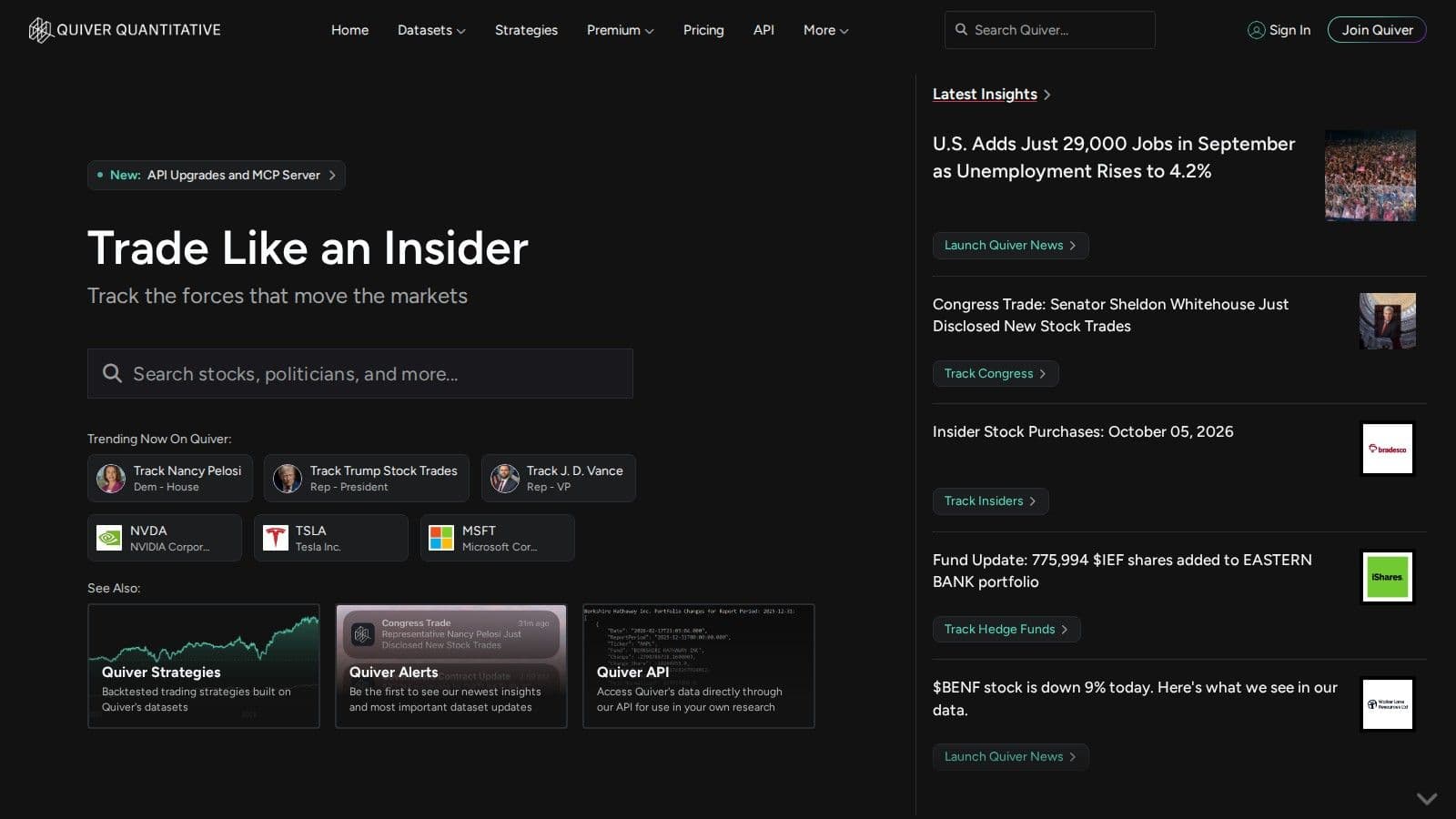
If you're ready to dive in, here’s how to make the most of Quiver Quantitative right from the start. With its range of tools, you can quickly see how alternative data might reshape your trading approach.
Begin by using the ticker search function to look up stocks you're tracking. This feature consolidates key data - like insider trading, government contracts, and social sentiment - into a single view, helping you identify unusual patterns that could influence your trading decisions.
Start on the free tier, then upgrade to Premium if you need features such as the Congress Backtester and Stock Smart Score. If you’re comfortable with programming, consider the Quiver API: the Hobbyist plan costs $30 per month and the Trader plan $75 per month, billed monthly, or $25 and $62.50 per month billed annually (checked on 10 Oct 2026). Use it to pull raw data into Python scripts or Excel for deeper analysis. The "quiverquant" Python package makes it easy to get started with just a few lines of code.
For those new to alternative data, the Quiver Strategies tool is a great starting point. It offers backtested performance metrics - like compound annual growth rate (CAGR) and Sharpe ratios - for portfolios built on specific datasets. This helps you identify which data sources have historically delivered strong results, saving you from the trial-and-error process of finding reliable signals.
FAQs
How accurate and timely is Quiver’s data?
Quiver updates its data daily after the market closes, ensuring users have access to timely information. The platform prioritizes transparency by openly sharing its methodology, enabling users to verify the accuracy of the data. This commitment builds trust and supports traders in making well-informed decisions.
Which Quiver datasets are most useful for my trading style?
For Quiver datasets, the most helpful ones depend on what you're focusing on in your trading strategy. If you're keeping an eye on political factors, datasets like Senate and House Trading or Government Contracts can shed light on how policies might be influencing the market. On the other hand, if your interest lies in corporate behavior, the Corporate Lobbying and Insider Trading datasets can provide insights into lobbying efforts and insider confidence levels. By combining these datasets, you can gain a more comprehensive view to support different trading strategies.
How do I use Quiver data in a Python trading bot?
To integrate Quiver data into your Python trading bot, the first step is to sign up for an API token from Quiver. Once you have the token, install the quiverquant package using pip. After installation, connect to the Quiver API by providing your token. From there, you can access datasets such as congressional trades or social sentiment to identify market trends. Incorporate this data into your trading algorithm for tasks like backtesting or making real-time decisions. This approach simplifies data integration, giving you better tools to refine your trading strategies.


