High-frequency trading (HFT) firms dominate global financial markets by leveraging ultra-fast technology and algorithms to execute trades in microseconds. These firms account for a significant portion of trading volume in U.S. and European markets, with some achieving trade execution speeds as low as 10 microseconds. Here's a quick overview of the top 10 HFT firms shaping the industry:
- Jane Street: A leader in ETFs and fixed-income trading, generating $10.1 billion in revenue in Q2 2025, with cutting-edge OCaml-based infrastructure.
- Jump Trading: Known for its microwave networks and FPGA-based systems, achieving 90-microsecond latency and expanding into crypto.
- Citadel Securities: The largest U.S. equity market maker, handling 25% of U.S. equities with trade execution in 10 microseconds.
- Hudson River Trading (HRT): Balances high- and mid-frequency strategies, with a 15% U.S. equity market share and advanced "World Simulation" models.
- Virtu Financial: A publicly traded firm with 20% of U.S. equity trading volume, focusing on low-latency execution and risk management.
- DRW Trading: Diversified across asset classes, including crypto and carbon credits, with sub-nanosecond latency systems.
- IMC Trading: A global liquidity provider in equities and options, operating on petabyte-scale data platforms and custom FPGA hardware.
- Tower Research Capital: Uses independent trading pods and advanced systems to connect to 150+ venues worldwide.
- Two Sigma Securities: Combines AI and data science for systematic trading, executing 300 million shares daily with 380 petabytes of data.
- Flow Traders: Europe's largest ETF market maker, expanding into tokenization and digital assets.
These firms invest heavily in infrastructure like co-location, FPGAs, and microwave networks to reduce latency and stay competitive in a winner-takes-all market. Speed, precision, and advanced algorithms are their key to success.
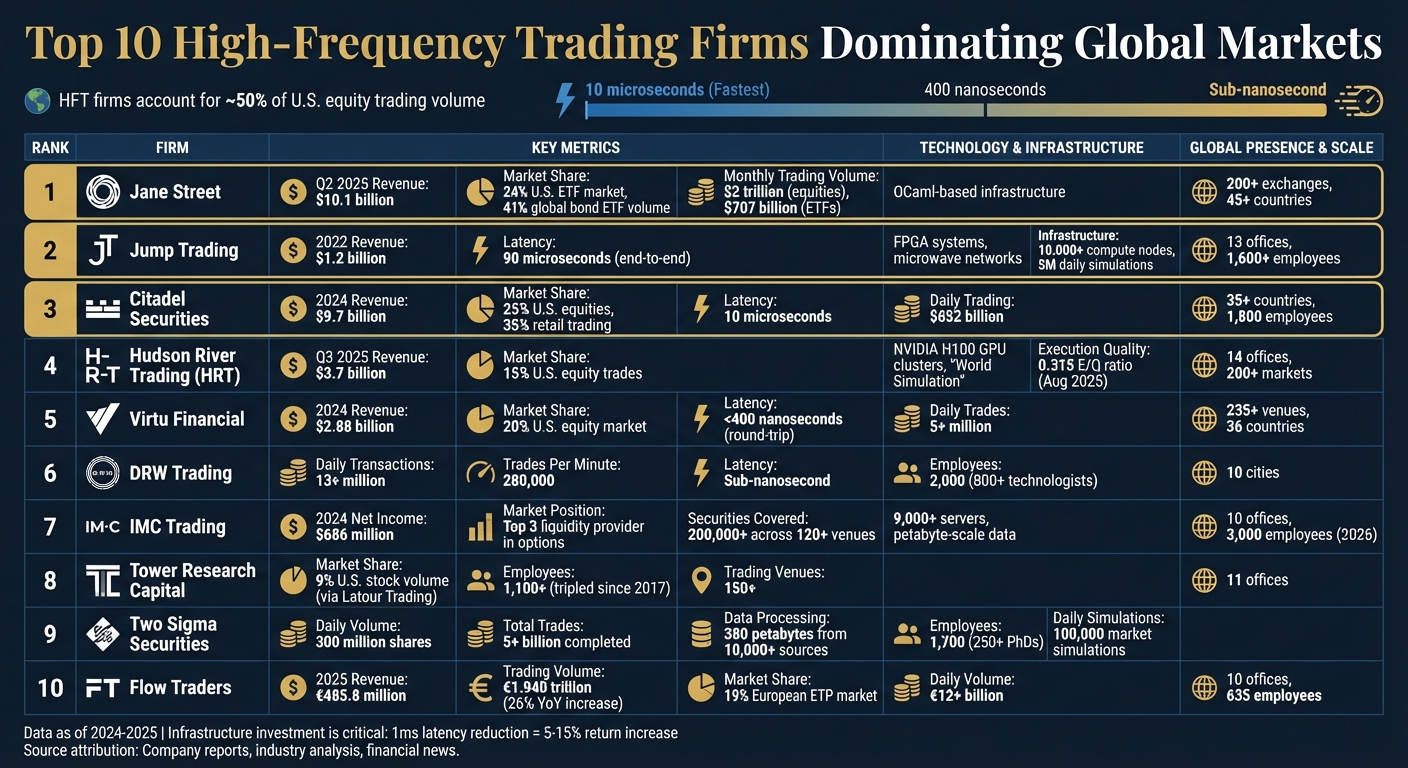
Top 10 High-Frequency Trading Firms: Market Share, Revenue & Technology Comparison 2025
1. Jane Street
Market Share and Global Presence
Jane Street operates on a global scale, with offices in major financial hubs and a workforce of about 3,000 people. The firm is active on more than 200 exchanges across 45+ countries. In the second quarter of 2025, Jane Street reported a record-breaking $10.1 billion in net trading revenue and $6.9 billion in net profit, surpassing even the trading revenues of Wall Street giants like Citigroup and Bank of America.
Jane Street's influence is especially pronounced in the ETF market. In 2024, the firm was responsible for 41% of global bond ETF trading volume and held 24% of the U.S.-listed ETF market. On average, it handled $2 trillion in equity and $707 billion in ETF trading volumes each month during that year. Alongside Citadel Securities, Jane Street controlled roughly 30% of the U.S. equity trading volume.
These figures highlight Jane Street's commanding role in the market, driven by its advanced use of technology and strategic positioning.
Trading Volume and Asset Classes
Jane Street ensures continuous liquidity across a wide range of asset classes, including equities, bonds, options, and currencies. In 2024, the firm averaged $230 billion in monthly fixed-income trading volume and was responsible for about 8% of all Options Clearing Corporation (OCC) transactions. It also captured 16% of U.S. Treasury ETF trading volume and accounted for over 10% of the equity trading market in North America during the same period.
| Asset Class | 2024 Monthly Trading Volume | Market Share |
|---|---|---|
| Equities | $2 trillion | >10% of North American market |
| ETFs | $707 billion | 41% of bond ETF volume |
| Fixed Income | $230 billion | 16% of U.S. Treasury ETF volume |
| Options | N/A | 8% of OCC transactions |
These numbers underline Jane Street's ability to dominate multiple markets while maintaining a diverse portfolio of trading activities.
Technology Infrastructure and Latency Performance
Rather than relying on the more common C++, Jane Street uses OCaml, a statically typed programming language that emphasizes accuracy without sacrificing speed. The company has contributed over one million lines of open-source code and even established OCaml Labs at Cambridge University to support the language's development.
Jane Street takes its technological edge further with Hardcaml, a custom OCaml library designed for FPGA development. This integration allows the firm to bridge high-level software logic with low-latency hardware execution seamlessly. Internal tools like "magic-trace" for process tracing and "Memtrace" for memory analysis help identify and resolve latency issues, ensuring peak performance.
This well-honed infrastructure enables Jane Street to execute advanced algorithmic strategies with unmatched efficiency.
Algorithmic Trading and AI/ML Capabilities
Unlike many high-frequency trading firms, Jane Street tends to hold positions for nearly five minutes, a reflection of its focus on in-depth quantitative research and strategic AI applications. The firm's infrastructure supports not only low-latency trading but also the development of complex predictive models. While OCaml remains central to its trading systems, Python has gained traction within its machine learning teams.
"Machine learning has been a key part of Jane Street's work from the beginning... The depth of our reliance on these models has grown dramatically in the last few years as we've adopted ever more sophisticated techniques to improve and inform our trading."
- Jane Street Official Overview
In April 2025, during a period of high market volatility caused by shifts in U.S. trade policy, Jane Street's algorithms generated an impressive $2 billion in single-day revenue by executing over 50,000 bond inquiries. The firm also maintained a $6.4 billion liquidity buffer, which accounted for 15% of its total capital, to sustain its aggressive trading strategies.
These achievements showcase how Jane Street's blend of technology, research, and strategy enables it to consistently outperform competitors.
2. Jump Trading
Market Share and Global Presence
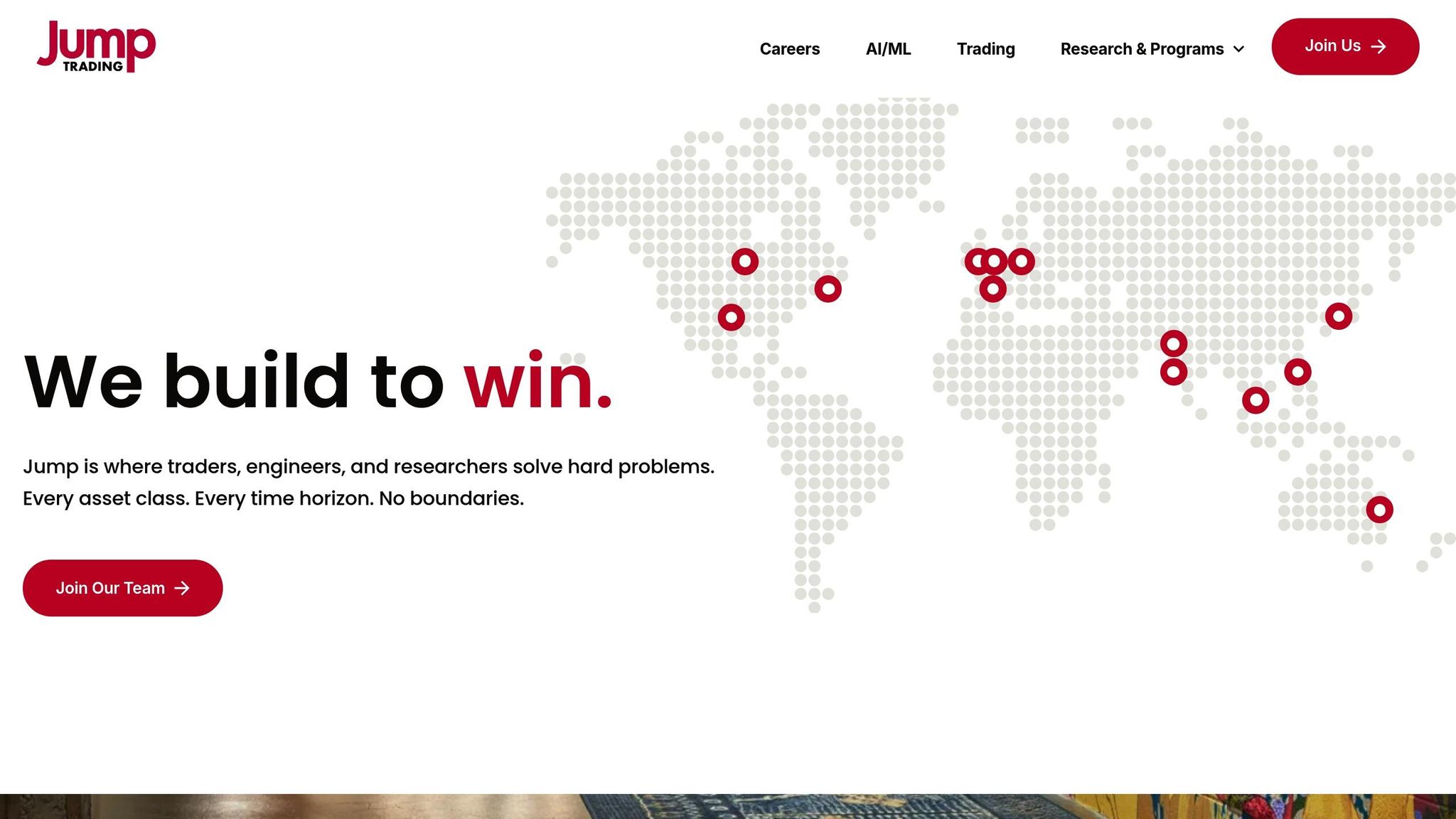
Jump Trading operates across 13 offices situated in key financial hubs like Chicago, New York, London, Singapore, and Shanghai, covering North America, Europe, and Asia-Pacific. Since its founding in 1999 by Paul Gurinas and Bill Disomma, both former pit traders, the firm has grown to employ over 1,600 people worldwide as of late 2024. In 2022, Jump Trading reported $1.2 billion in revenue, reflecting an 11% compound annual growth rate. The firm is a member of major exchanges, including the CME Group, NYSE, Eurex, and the London Stock Exchange, solidifying its position as a leading global market maker. Additionally, its 2021 launch of Jump Crypto has expanded its focus to blockchain infrastructure and cryptocurrency liquidity. This extensive global reach highlights Jump Trading's commitment to leveraging technology in the financial markets.
Technology Infrastructure and Latency Performance
Jump Trading has built its infrastructure with a focus on hardware optimization, tailoring systems from the silicon level to execution. The firm operates over 10,000 compute nodes globally and conducts more than 5 million simulations daily, continuously refining its trading strategies. In a notable move, Jump purchased a Belgian microwave tower in 2013 - previously owned by NATO - to enhance its high-frequency communication capabilities. The firm's technology stack is centered on C++, avoiding the delays associated with Java Virtual Machines.
Between 2023 and 2025, Jump transitioned its telemetry pipeline from Apache Kafka to Redpanda, a change led by CTO Alex Davies. This migration, deployed across both bare metal and containerized environments, eliminated JVM-related performance issues. The result? A stable P95 latency of 50 milliseconds and P99 latency of 150 milliseconds, even while processing billions of messages daily.
"Because of Redpanda's performance-engineered architecture, we see little jitter in terms of our p95 and p99 latencies... Redpanda's C++ codebase means we can load it up to line rate data loads and know that all the packets and messages will get delivered within an optimal distribution of latencies." - Alex Davies, CTO, Jump Trading
Jump Trading also employs Field-Programmable Gate Arrays (FPGAs) and custom silicon for critical trading operations. Combined with advanced networking techniques, these innovations have reduced network processing latency by about 40%. With end-to-end trade execution latency as low as 90 microseconds, the firm maintains a competitive edge by capitalizing on fleeting market opportunities.
Trading Volume and Asset Classes
Jump Trading provides liquidity across a diverse range of asset classes, including equities, futures, options, fixed income, currencies, and cryptocurrencies. Operating as a registered broker-dealer and designated market maker, the firm maintains active positions on 235+ exchanges and markets in 36 countries. In 2024–2025, Jump integrated DDN's AI Data Intelligence Platform into its trading engine, achieving a 10x reduction in data processing latency. This upgrade has significantly enhanced its ability to handle massive datasets in real time, further cementing its role as a key player in global markets.
Algorithmic Trading and AI/ML Capabilities
Jump Trading relies on advanced machine learning (ML) techniques to adapt dynamically to market conditions. Over 75% of its workforce utilizes large language model (LLM) tools weekly, supported by an infrastructure that enables model deployment with trader feedback in under 24 hours. The firm's high-performance computing (HPC) grid, equipped with thousands of GPUs and high-speed I/O, supports petabyte-scale data analysis.
"We build where infrastructure meets intelligence. Our ML stack powers live inference and fast iteration, delivering seamless edge when it matters most." - Jump Trading
Jump's algorithms are designed to adapt to market volatility in real time, with precision timing achieved through GPS-disciplined oscillators that maintain sub-microsecond clock accuracy. Engineers employ techniques like CPU pinning, real-time scheduling policies, and isolated CPU cores to prevent interruptions during latency-sensitive operations. By combining hardware acceleration, advanced networking, and AI-driven strategies, Jump Trading executes trades with precision, seizing opportunities in markets where every microsecond counts.

Run 24/7 while you sleep. Keep bots, platforms, and trade copiers online on a dedicated VPS.
Low-latency VPS hosting for your trading platform.
 CHINYC
 LON
LONFrom $59.99/mo


 CHI/CME futuresNYC/US marketsLON/FX EAs
 DUB/Polymarket
 AMS/EU FX
 FRA/Central EU
 TYO/APAC crypto
3. Citadel Securities
Market Share and Global Presence
Citadel Securities stands as the largest designated market maker on the NYSE, with operations spanning over 35 countries. Key locations include Miami, London, Hong Kong, Tokyo, Sydney, and Paris. The firm handles roughly 25% of all U.S. equities trading and dominates about 35% of retail trading in U.S. equities and options. It also controls over 30% of the trading volume for U.S.-listed options. In 2023, its Hong Kong subsidiary achieved Qualified Foreign Institutional Investor (QFII) status, granting expanded access to mainland China's bond and stock markets. Paris serves as the firm's European hub for rates trading, while its Tokyo office focuses on launching U.S. fixed-income offerings. With approximately 1,800 employees, Citadel Securities reported $9.7 billion in net trading revenue for 2024 and $8.4 billion in the first nine months of 2025.
"We like to think we are the Amazon of finance. We trade more equity flow than anyone on the planet." - Jim Esposito, President, Citadel Securities
Technology Infrastructure and Latency Performance
To maintain its competitive edge, Citadel Securities invests heavily in advanced technology. The firm has developed custom microchips capable of processing the 45 billion U.S. options quotes it generates daily. These innovations have reduced trade execution times to an impressive 10 microseconds, enabling the execution of $652 billion in daily trades. In April 2025, the firm processed a record $1.4 trillion in gross U.S. Treasuries trades, nearly doubling its previous high. According to COO Matt Culek, their platform is designed to handle at least three times this volume, ensuring stability even during extreme market conditions. This level of reliability is a key factor when evaluating a high-frequency trading platform comparison for institutional-grade performance. A recent overhaul of its infrastructure further reduced latency by 30%, enhancing the performance of its cloud-based quantitative research platforms.
Trading Volume and Asset Classes
Citadel Securities plays a crucial role in global high-frequency trading, offering a diverse portfolio that includes equities, futures, options, currencies, Treasury bonds, credit, interest rate swaps, and corporate debt. In the corporate credit space, the firm holds a 15% market share for block trades exceeding $5 million with maturities longer than seven years. It is also expanding into European government bonds and interest-rate derivatives in euro and sterling, positioning itself as a primary dealer in major markets like Germany, France, and Japan. Retail participation reached new heights in early 2026, with average daily net notional trading rising 60% compared to 2025 levels. Through Payment for Order Flow agreements with brokers such as Robinhood, Citadel Securities processes about 40% of U.S. retail trading volume and is aiming for a 15% share of the cryptocurrency market within two years.
Algorithmic Trading and AI/ML Capabilities
Citadel Securities integrates cutting-edge technologies like predictive modeling, natural language processing (NLP), and machine learning into its trading systems. These tools enable the firm to price hundreds of thousands of securities in real time. Its approach, described as a "man plus machine" model, combines high-frequency electronic trading with a personalized high-touch institutional strategy.
"Historically, we've been dominant in low-touch electronic channels. This year was all about investing in the high-touch voice channels to build deeper client relationships." - Jim Esposito, President, Citadel Securities
The firm has standardized its global architecture to streamline processes and accelerate the onboarding of new exchanges. Additionally, it is investing in quantum computing research and next-generation algorithm development. These efforts have paid off, with Q1 2025 profits surging 70% year-over-year to $1.7 billion. Such advancements reinforce Citadel Securities' position as a leader in the fiercely competitive high-frequency trading market.
4. Hudson River Trading
Market Share and Global Presence
Hudson River Trading (HRT) has grown from a niche high-frequency trading (HFT) operation into one of the top three liquidity providers worldwide, standing alongside Jane Street and Citadel Securities. In the U.S., it facilitates around 15% of all equity trades, while globally, it handles 10% of total stock-trading volume. With 14 offices spread across the globe and operations in more than 200 markets, HRT has established a significant international presence. This growth surged in January 2018 with the acquisition of Sun Trading, a competitor active on over 115 exchanges.
HRT employs a dual strategy, balancing traditional high-frequency trading with mid-frequency approaches. The firm retains 25% of its capital overnight and typically holds positions for an average of five minutes. Its "Prism" unit alone generated over $2 billion in revenue in 2024, while its net revenue for Q3 2025 reached $3.7 billion.
Technology Infrastructure and Latency Performance
HRT's success is deeply rooted in its advanced technology platform, which is designed to minimize latency and maximize efficiency. A key advantage is its monolithic codebase, which integrates all trading logic and research into a single system. This setup allows instant data sharing across asset classes, enabling, for example, an equity signal to trigger an options trade in mere milliseconds.
The firm employs NVIDIA H100 GPU clusters to power its "World Simulation", a reinforcement learning system that models global market behavior.
"HRT's monolithic codebase architecture enables unified data integration and 'World Simulation' capacity, delivering superior execution quality through superior short-term price prediction." - Bancara
In August 2025, HRT reported a share-weighted median execution quality (E/Q) ratio of 0.315, which significantly outperformed Citadel Securities' 0.515 during the same timeframe. The firm processes real-time price and volume data for over 1,000,000 symbols daily across global markets. With a workforce of approximately 1,110 employees as of 2025, HRT generates between $8 million and $10 million in revenue per employee, underscoring the efficiency of its operations.
Trading Volume and Asset Classes
HRT is a major player across multiple asset classes, including equities, futures, options, fixed income, currencies, ETFs, and systematic credit. While its roots are in U.S. cash equities, the firm has diversified significantly, achieving a 4.7% share of the wholesale market-making sector by late 2025. It also handles retail order flow from prominent brokers like Fidelity and Charles Schwab.
The firm is making strides in the options market, particularly with 0DTE (zero days to expiration) contracts. While its share in options trading (4%) is smaller compared to its 15% share in equities, this area is showing strong growth potential. Notably, HRT conducts less than 1% of its trading in dark pools, choosing instead to focus on transparent, lit exchanges. For the full year 2024, the firm reported nearly $8 billion in net trading revenue. These capabilities highlight HRT's ability to leverage cutting-edge analytics and AI in its trading strategies.
Algorithmic Trading and AI/ML Capabilities
HRT has moved beyond latency arbitrage to focus on predictive modeling. Its "World Simulation", enhanced through a 2024 partnership with Google Cloud, allows the firm to test strategies in digital replicas of market environments. This innovative approach, combined with a highly skilled AI team, has facilitated its expansion into hedge-fund-style strategies.
"HRT's success stems from the precision of their inference models... these models possess an unparalleled ability to differentiate between informed and uninformed flow." - Bancara
To attract top-tier AI talent, HRT offers competitive compensation, with London-based quantitative analysts and traders earning an average of £940,000 annually in 2025. This investment in both people and technology has enabled the firm to explore new strategies, including quant macro, systematic credit, and ETF arbitrage, further cementing its position as a vital player in global markets.
5. Virtu Financial
Market Share and Global Presence
Virtu Financial stands out as the only publicly traded high-frequency trading (HFT) firm on this list, trading on Nasdaq under the ticker symbol VIRT. The company handles a substantial 20% of the U.S. equity market, making it one of the largest liquidity providers in the country. Its operations extend to over 235 exchanges, markets, and dark pools across 36 countries, supported by regional trading hubs in New York, Austin, Dublin, and Singapore.
Virtu’s growth has been fueled by major acquisitions, including KCG Holdings in 2017 and Investment Technology Group in 2019, which significantly boosted its market-making capabilities and broadened its services. These acquisitions complement the firm’s cutting-edge technology. In 2024, Virtu reported $2.88 billion in total revenue, supported by a streamlined workforce of just 969 employees worldwide. This global reach is powered by a highly advanced technological infrastructure.
Technology Infrastructure and Latency Performance
Virtu’s technology platform is designed for speed and efficiency, achieving a round-trip latency of under 400 nanoseconds. This performance is made possible by FPGA hardware acceleration and a 323,000-square-foot data center located in Austin, Texas. The data center employs liquid cooling and custom-built server racks to maximize operational efficiency.
Key tools in Virtu’s arsenal include its proprietary Smart Order Router for optimal trade execution and the Prism Platform, which provides real-time oversight of algorithmic trading. The firm’s risk management system is equally impressive, running thousands of stress tests per second and monitoring Greek letter risk metrics to maintain delta neutrality. With this infrastructure, Virtu executes over 5 million trades daily, supporting a wide range of trading strategies and market activities.
Trading Volume and Asset Classes
Virtu operates across five major asset classes: equities, fixed income, currencies, commodities, and digital assets. It provides passive quotations for more than 12,000 securities and financial instruments. The firm’s trading strategies revolve around three main areas: single-instrument market making, statistical arbitrage (such as trading ETFs against their underlying assets), and cross-asset portfolio optimization using machine learning.
Remarkably, Virtu maintained profitability on 1,277 out of 1,278 trading days over a five-year period, profiting from bid-ask spreads that average just 2–3 basis points. The company is also exploring new opportunities in digital assets through its acquisition of LedgerX and is working on infrastructure to support carbon marketplaces as part of its ESG initiatives. To attract top-tier engineering talent, Virtu offers competitive salaries, with software engineers earning a median of $290,000.
6. DRW Trading
Market Share and Global Presence
DRW Trading, a proprietary trading firm founded in 1992 by Don Wilson, has carved out a dominant position in the world of high-frequency trading. Operating independently, the firm thrives on innovation and agility. With a workforce of approximately 2,000 employees - over 800 of whom are technologists - DRW has established offices in 10 major cities, including Chicago, London, Singapore, Tel Aviv, and Amsterdam. This global presence allows it to provide liquidity across nearly all major exchanges and time zones.
The firm's growth has been fueled by strategic acquisitions. In 2015, DRW acquired Chopper Trading, followed by RGM Advisors and Martin Energy Trading in 2017, bolstering its expertise in fixed income, equity, and energy markets. Notably, during the 2008 financial crisis, DRW purchased Lehman Brothers' portfolios covering foreign exchange, interest-rate derivatives, and agricultural derivatives. In 2020, the firm achieved a milestone by becoming the first carbon-neutral global trading firm through its partnership with Climate Vault. These moves, coupled with cutting-edge technology, have solidified DRW’s leadership in the trading world.
Technology Infrastructure and Latency Performance
DRW’s technological backbone is powered by its NX team, which designs and operates an ultra-low-latency private network. This infrastructure supports sub-nanosecond latency, enabling the execution of 280,000 trades per minute and over 13 million daily transactions. The firm’s engineering team develops high-speed algorithms integrated with real-time analytics, ensuring swift responses to market changes. DRW also invests in advanced technologies through DRWVC and uses co-location strategies to further reduce latency.
Trading Volume and Asset Classes
DRW’s trading operations span a wide range of asset classes, including fixed income, options, energy, agriculture, equities, foreign exchange, and cryptocurrencies. The firm has embraced diversification, trading traditional instruments alongside emerging assets like carbon credits. Its Cumberland DRW division, launched in 2014, focuses on providing institutional-grade liquidity for cryptocurrency spot and futures markets. A notable achievement came in 2021 when Cumberland executed Goldman Sachs’ first-ever cryptocurrency block trade, marking a major step in institutional adoption of digital assets.
"DRW's strength lies in its diverse strategies across asset classes, integrating liquidity provision, risk taking, and low-latency execution." – DRW
In October 2025, DRW partnered with Alpaca’s Instant Tokenization Network (ITN), enabling instant minting and redemption of traditional stocks into tokenized versions on the Solana blockchain. Sam Courtney, Managing Director at DRW, highlighted the firm’s commitment to providing liquidity in these 24/7 markets. Additionally, in 2024, DRW launched Artemeter DRW to expand its reach into global compliance and voluntary carbon markets.
7. IMC Trading
Market Share and Global Presence
Founded in 1989, IMC Trading has established itself as one of the top three liquidity providers in listed options by volume. The firm acts as the lead market maker for over 150 U.S. exchange-traded funds (ETFs) and supplies liquidity for more than 200,000 securities across 120+ trading venues worldwide. On the New York Stock Exchange, IMC serves as a Designated Market Maker, covering over 630 securities and around 400 operating companies. Its footprint extends to major U.S. exchanges such as NYSE Arca, NASDAQ, CBOE, BATS, and CME Group.
With 10 offices spread across Europe, the U.S., and Asia-Pacific, IMC is a truly global player. By February 2026, the firm expects to employ roughly 3,000 people. Financially, IMC reported a net income of $686 million and total equity valued at $1.866 billion in 2024.
Technology Infrastructure and Latency Performance
IMC operates on a cutting-edge technological backbone, managing over 9,000 servers across nine countries. These servers process petabytes of data daily to ensure competitive pricing. The firm's FPGA teams design custom hardware to accelerate processes, achieving ultra-low latency for trade execution. Additionally, IMC integrates AI and machine learning into its operations to enhance pricing models and uncover trading opportunities.
"We see strong long-term prospects in expanding our trading strategies, as well as building new research capabilities in emerging areas like AI and machine learning."
- Andrew Fong, Managing Director, IMC Hong Kong
This combination of advanced technology and innovative research supports IMC's trading across diverse asset classes.
Trading Volume and Asset Classes
IMC actively trades across a wide range of asset classes, including equities, bonds, commodities, currencies, futures, options, and digital assets. Its cryptocurrency division handles spot trades, perpetual swaps, futures, and options both on-chain and off-chain. In June 2024, IMC became a direct trading participant on Cboe Europe Derivatives (CEDX), contributing significant liquidity to CEDX's pan-European index derivatives and equity options markets, which encompass more than 300 European companies from 14 countries.
The firm's operations run 24/7, spanning the U.S., Europe, Asia-Pacific, and India. IMC also offers direct, off-screen liquidity to institutional buy-side firms through its global sales desks.
8. Tower Research Capital
Stay online and closer to execution. Choose a VPS location for CME futures, New York markets, London FX, API trading, and more.
Host your platform near the market route that matters.
CHINYCLONFrom $59.99/mo
CHI/CME futuresNYC/US marketsLON/FX EAsDUB/PolymarketAMS/EU FXFRA/Central EUTYO/APAC cryptoMarket Share and Global Presence
Tower Research Capital has built a strong international footprint since its inception in February 1998. With 11 key offices in cities like New York, London, and Singapore, the firm connects to over 150 trading venues worldwide. By 2025, its workforce has grown to over 1,100 employees - more than tripling since 2017, driven largely by aggressive hiring efforts in India. One of its subsidiaries, Latour Trading, has historically been responsible for up to 9% of all U.S. stock trading volume. This expansive reach is supported by an advanced technological framework that powers its trading operations globally.
Technology Infrastructure and Latency Performance
Tower operates through independent trading pods, each developing its own strategies while leveraging a shared, high-performance technology platform. A dedicated engineering team oversees the entire system, which includes low-latency connectivity, robust data infrastructure, and proprietary trade simulators. According to the company:
"Powered by a high-performance technology platform, Tower is home to the world's best quantitative trading teams – trading across any time horizon, any market, and any asset class."
Tower’s distributed systems handle thousands of transactions per second across global markets. Their continuous investment in advanced computing, low-latency programming, and FPGAs ensures the platform remains cutting-edge. This infrastructure supports a wide range of trading strategies, enabling seamless execution across markets.
Trading Volume and Asset Classes
Tower Research Capital is active in trading equities, options, futures, foreign exchange (FX), and cryptocurrencies. The firm provides liquidity across varying time horizons and trading frequencies. Its business model is centered on equipping quantitative traders and systematic portfolio managers with an advanced platform to research, develop, and implement their strategies. This technological strength not only attracts top-tier quantitative talent but also fosters the development of innovative trading approaches.
In addition to its trading activities, Tower Research Capital runs Tower Research Ventures, which invests in early-stage tech companies like Guard Owl, a physical security automation firm. The firm has also broadened its focus from traditional equities and futures to include digital assets, showcasing its ability to adapt to new market trends and opportunities.
9. Two Sigma Securities
Market Share and Global Presence
Two Sigma Securities is a powerhouse in systematic trading, with offices in New York, Chicago, and London. The firm executes an impressive 300 million shares daily and has completed over 5 billion trades to date. With a workforce of about 1,700 employees, including over 250 PhDs - 60% of whom are dedicated to research and development - the company drives trading across a variety of asset classes. The broader Two Sigma organization oversees more than $60 billion in assets under management.
The business operates in three main areas: Market Making and Intraday Alpha, Options Trading, and Client Trading. Two Sigma Securities actively trades more than 8,000 U.S. exchange-listed equities and provides liquidity across equities, futures, ETFs, options, and currencies.
"Our market making and intraday alpha business brings advanced data science and ultra-low latency execution capabilities together to provide liquidity in equity, futures, and ETF markets across the globe."
Their success comes from combining detailed market data with immense computational power. This blend of expertise and infrastructure solidifies their position as a leader in the trading industry.
Technology Infrastructure and Latency Performance
Two Sigma has built its reputation on cutting-edge technology designed to reduce latency. The firm employs a high-density hardware setup featuring 28-core processor servers, enabling five times more trading programs to run per server compared to previous configurations. This approach not only reduces execution delays but also cuts absolute power consumption by 66%.
"In the new configuration, five times more trading programs run per server, sharing one cache of processed market data. It is also lower latency – trades are executed with minimal delay."
To further optimize performance, Two Sigma developed "Cook", an open-source resource scheduler that prioritizes latency-sensitive tasks over batch processing jobs through preemption. Engineers rely on high-performance programming languages like Rust and C++ to fine-tune systems for speed and efficiency. The firm's infrastructure handles over 380 petabytes of data from more than 10,000 sources, enabling 100,000 market simulations daily. This robust setup supports their advanced algorithmic trading strategies.
Algorithmic Trading and AI/ML Capabilities
Two Sigma leverages Large Language Models (LLMs) to speed up alpha generation and feature engineering, cutting research timelines from months to just days. Ben Wellington, Head of Complex Feature Engines, highlighted the transformative impact of AI:
"AI has turbocharged this ability for us."
The firm uses Gaussian Mixture Models (GMM) for unsupervised learning to classify market regimes like Crisis, Steady State, and Inflation. Deep learning aids in sequence modeling for quantitative strategies, while natural language processing extracts insights from both conventional and unconventional data sources. In 2024, Two Sigma's Spectrum fund achieved a 10.9% return, while the Absolute Return Enhanced fund delivered 14.3%. Matt Greenwood, Chief AI Innovation Officer, commented on the evolving landscape:
"The era of 'bigger is better' is ending. Training costs are outpacing ROI, and the action is shifting to efficiency: new architectures, specialized accelerators, neural compression."
Two Sigma's focus on efficiency and innovation ensures it remains at the forefront of algorithmic trading.
10. Flow Traders
Market Share and Global Presence
Flow Traders is recognized as Europe's largest ETF market maker, providing liquidity for over 13,000 ETP listings across North America, Europe, and Asia Pacific. Headquartered in Amsterdam, the firm also operates from offices in cities like New York, London, Milan, Paris, Cluj, Shanghai, Singapore, Chicago, and Hong Kong. Additionally, they plan to enter Chinese markets by early 2026.
The company employs 635 full-time staff, with 40% of its workforce dedicated to technology roles. Flow Traders is publicly listed on Euronext Amsterdam under the ticker FLOW and reported €1.044 billion in trading capital as of December 31, 2025. In 2025, the firm achieved €485.8 million in Net Trading Income and facilitated €1.940 trillion in ETP trades, marking a 26% increase compared to the previous year. This extensive global footprint reflects its focus on advanced trading technologies.
Technology Infrastructure and Latency Performance
Flow Traders operates trading hubs across three continents, ensuring round-the-clock liquidity on major global exchanges. The company's technological advancements emphasize intelligent system management and AI-driven analytics to handle growing volumes while maintaining low latency. CEO Thomas Spitz highlighted this focus:
"We are expanding intelligent system management and accelerating AI-driven analytics to boost trading efficiency, alongside launching a dedicated deep learning initiative."
Their modular technology architecture reduces operational complexity and allows for quick experimentation and updates. This setup supports trading across a wide range of asset classes, including index futures, cash equities, corporate and sovereign bonds, digital assets, commodities, and FX.
Trading Volume and Asset Classes
Flow Traders has capitalized on its robust infrastructure to diversify its offerings across multiple asset classes. The firm has expanded into fixed income, digital assets, and tokenized markets, managing over €12 billion in daily trading volume and securing an estimated 19% share of the European ETP market. As a proprietary trading firm, Flow Traders does not serve external clients but plays a crucial role in stabilizing markets during periods of volatility.
The company is also making strides in tokenization, which CEO Thomas Spitz has called the new "ETP moment":
"Tokenization is the new 'ETP moment,' and we expect this to develop as a stand-alone asset class."
In 2024, Flow Traders partnered with Dinari to enable 24/7 trading of tokenized U.S. equities, creating a bridge between traditional finance and digital asset markets. This move underscores the firm's efforts to seize opportunities at the intersection of traditional and decentralized finance.
Why Infrastructure Matters in HFT
In high-frequency trading (HFT), every millisecond counts - sometimes translating directly into millions of dollars. The firm with the fastest infrastructure often wins the trade outright. HFT opportunities are typically "winner-take-all", where the quickest operator captures the profit, leaving competitors empty-handed. This urgency drives nearly every infrastructure decision in the HFT world.
Speed is critical because price discrepancies in markets are fleeting, lasting only fractions of a second. HFT firms capitalize on these brief windows by trading on stale quotes - executing trades on outdated prices before market makers can adjust. This strategy alone generates around $5 billion annually across global markets. Additionally, HFT firms are responsible for 70% of price reactions within the first 10 seconds of major news events, underscoring the importance of ultra-low latency in seizing market-moving opportunities.
Modern HFT systems execute trades in as little as 10 milliseconds, leveraging specialized hardware that reduces latencies to as low as 200 nanoseconds. Even a 1-millisecond reduction in execution latency can boost strategy returns by 5% to 15% annually. To achieve these speeds, leading firms invest heavily in co-location services, placing their servers directly within exchange data centers like Equinix NY4. This minimizes the physical distance and signal travel time.
But speed isn’t the only factor. Deterministic performance and maximum uptime are just as crucial. To ensure consistent and reliable operations, firms deploy advanced technologies like Field-Programmable Gate Arrays (FPGAs) and SmartNICs, which process market data directly at the hardware level, bypassing slower operating system layers. For inter-city connections, many firms use microwave networks, as signals travel faster through air than through fiber-optic cables. With HFT accounting for roughly 50% of trading volume in U.S. equity markets, these infrastructure investments are essential for staying competitive.
| Firm | Latency (ms) | Uptime (%) | Primary Deployment |
|---|---|---|---|
| Citadel Securities | ~0.010 (10 µs) | 99.99%+ | Colocation / Proprietary Low-Latency Infrastructure |
| Jump Trading | <1.0 | 99.99%+ | Microwave Networks / FPGA Acceleration |
| Virtu Financial | <1.0 | 99.99%+ | Colocation / Smart Order Router (Prism) |
QuantVPS: High-Performance Hosting for HFT
QuantVPS delivers a high-speed hosting solution tailored for high-frequency trading (HFT), addressing the critical need for ultra-low latency. While major trading firms invest heavily in custom infrastructure, QuantVPS bridges the gap for smaller operations and independent algorithmic traders, offering access to similar speed advantages at a fraction of the cost.
The platform boasts sub-millisecond latency - less than 0.52ms to the CME Group matching engines in Chicago - achieved through direct fiber-optic cross-connects in key financial hubs like Chicago, New York, London, Frankfurt, and Tokyo. These connections provide traders with a tangible edge in execution speed.
"Our Chicago datacenter enables faster futures trade execution and minimizes slippage."
– QuantVPS
QuantVPS leverages cutting-edge hardware, including AMD EPYC and Ryzen processors paired with NVMe M.2 SSDs, to deliver consistent, low-latency performance essential for HFT strategies. Even microsecond improvements can be the difference between profit and loss in this competitive space. The platform ensures uninterrupted operations with a 99.999% uptime SLA, supported by redundant power and network connections.
Traders can utilize popular interfaces like NinjaTrader, MetaTrader 4/5, TradeStation, Quantower, Sierra Chart, and Tradovate, all running on pre-configured Windows Server 2022 environments. This compatibility ensures seamless integration for a variety of trading setups.
As of February 28, 2026, QuantVPS reported handling over $82 billion in weekly trading volume on its low-latency servers, underscoring its adoption by active traders.
"QuantVPS is designed specifically for traders who need microsecond execution times."
– Fred Harrington, Founder of Vetted Prop Firms
QuantVPS goes beyond speed, offering enterprise-grade DDoS protection, automatic backups, and 24/7 technical support from specialists in trading infrastructure.
| Plan Name | Monthly Price (USD) | Annual Price (USD/mo) | Cores | RAM (GB) | Storage (GB NVMe) | Network Speed | Use Case |
|---|---|---|---|---|---|---|---|
| VPS Lite | $59.99 | $41.99 | 4 (AMD EPYC) | 8 | 70 | 1Gbps+, unmetered bandwidth | 1–2 charts |
| VPS Pro | $99.99 | $69.99 | 6 (AMD EPYC) | 16 | 150 | 1Gbps+, unmetered bandwidth | 3–5 charts |
| VPS Ultra | $189.99 | $132.99 | 24 | 64 | 500 | 1Gbps+ | 5–7 charts |
| Dedicated | $299.99 | $209.99 | 16+ dedicated cores | 128 | 2TB+ | 1Gbps+ | 7+ charts / heavy trading workloads |
Conclusion
The top high-frequency trading firms, like Jane Street and Flow Traders, stay ahead of the competition by consistently investing in cutting-edge technology. In the world of microsecond markets, even the tiniest latency reduction can significantly impact profitability. Their success relies on building and maintaining exceptional infrastructure.
What sets these firms apart is their commitment to co-location, custom hardware, and ultra-precise timing. By placing servers directly inside exchange data centers, using FPGAs for hardware-level processing, and implementing specialized microwave networks, they can trim critical microseconds from transmission times. This infrastructure isn't just an advantage - it's the backbone of their operations.
"Speed is your edge, don't trade without it." – Fred Harrington, Founder of Vetted Prop Firms
This relentless focus on speed drives every trading decision. While institutional firms pour resources into custom setups, independent traders can also gain a competitive edge by leveraging professional hosting solutions. Opting for infrastructure with sub-millisecond latency, dedicated resources, and proximity to major U.S. financial centers can make all the difference.
For algorithmic traders, having a dependable hosting platform is essential. QuantVPS offers low-latency, high-performance infrastructure - starting at $59.99 per month - that helps bridge the gap between retail and institutional trading capabilities.
FAQs
How do HFT firms actually make money?
High-frequency trading (HFT) firms thrive by leveraging cutting-edge algorithms and lightning-fast execution to capitalize on small price differences in the market. Acting as market makers, they profit from the bid-ask spread, relying on high trade volumes to generate revenue. Another common approach is statistical arbitrage, where they identify and act on slight discrepancies in the prices of related securities. While each trade yields only a tiny gain, the sheer number of transactions adds up to substantial profits. At the same time, their activity helps boost market liquidity.
What is co-location, and why does it matter for speed?
Co-location means setting up trading servers physically close to the exchange's infrastructure. Why does this matter? Because it cuts down on latency - the time it takes for data to travel between systems. For high-frequency trading, every microsecond counts. This proximity allows firms to execute trades almost instantly, giving them an edge in spotting and acting on tiny price changes before their competitors can.
Are FPGAs better than GPUs for HFT?
When it comes to high-frequency trading (HFT), FPGAs are often the go-to option for latency-sensitive tasks. Why? They offer nanosecond-level latency with deterministic performance, thanks to their customizable pipelines. This precision makes them perfect for ultra-low-latency operations.
On the other hand, GPUs shine in parallel processing tasks like deep learning and data analysis. However, their latency, which ranges from microseconds to milliseconds, makes them less ideal for the demands of HFT. In environments where every nanosecond counts, FPGAs tend to outperform GPUs.