Algorithmic trading is evolving fast, thanks to AI tools like Claude and ChatGPT. These tools simplify and speed up tasks like strategy creation, backtesting, and market analysis. Instead of coding from scratch, traders can describe their ideas in plain language and get actionable algorithms in minutes. AI also processes vast amounts of data, integrates sentiment analysis, and refines strategies with precision.
Key takeaways:
- AI in Trading: Over 50% of trading systems now use AI, with the market expected to reach $45.2 billion by 2026.
- Benefits: Faster strategy development, real-time sentiment analysis, and better risk-adjusted returns.
- Examples: AI-powered strategies have outperformed traditional methods, like a TSLA strategy that beat Buy-and-Hold by nearly 300%.
- Tools: Claude excels at backtesting and refinement, while ChatGPT transforms trading ideas into functional code.
- Limitations: AI requires human oversight to avoid errors, biases, and issues during unexpected market events.
AI tools are game-changers for traders, but success depends on combining their capabilities with careful validation and robust infrastructure.
Building Trading Strategies with ChatGPT
ChatGPT can quickly transform natural language trading ideas into functional code. It supports various programming languages, including Python for backtesting frameworks, Pine Script for TradingView indicators, and C++ for high-performance execution engines [9, 11, 12].
To get the most out of this tool, it's important to define specific parameters. Instead of requesting a generic "moving average strategy", traders should provide detailed conditions. For example: "Buy when the price exceeds the 20-day simple moving average by two standard deviations, and sell when it drops below a specific threshold." Additionally, integrating risk management rules - like setting a stop-loss at 2% below entry or determining position size based on portfolio volatility - ensures a more robust strategy [9, 10, 11]. Below, we explore how to create effective rules-based strategies with AI-generated frameworks.
Creating Rules-Based Strategies
ChatGPT is particularly effective at designing rules-based strategies tailored to specific market conditions. It can identify inefficiencies such as volatility clusters, price deviations, or breakout patterns [6, 9]. By assigning ChatGPT a role, like "Quantitative Trading Researcher", traders can request technically precise code that meets their exact needs [11, 13].
The process involves iterative prompting. Start with basic logic to ensure the code compiles, then gradually add more advanced features like trailing stops or partial profit-taking. Traders can test and refine the code by pasting it into TradingView's Pine Editor and using error feedback for adjustments.
Once the strategy's rules are defined, ChatGPT enables efficient testing across different market conditions to evaluate its performance. This process is a core component of algorithmic trading strategies, which rely on rigorous testing before deployment.
Testing Hypothetical Market Scenarios
ChatGPT helps traders simulate and analyze strategy performance before live deployment. It can process scenarios across a range of asset classes, including S&P 500 equities, BTCUSDT cryptocurrency, and futures like RTY (Russell 2000), ZC (Corn), and CC (Cocoa). This allows it to identify patterns such as volatility clusters during specific trading hours or mean reversion opportunities when prices deviate from historical averages [6, 12, 16].
In 2023, Prof. Dr. Holger K. von Jouanne-Diedrich used ChatGPT-4 to develop a quantitative "long/flat" trading strategy for the S&P 500 in R. The AI suggested a 20-day lookback period and a 0.15 volatility threshold. When backtested on historical data from January 2000 to December 2021, the strategy delivered an annualized return of 3.34% with a standard deviation of 8.75%. This compared to the benchmark's 5.56% return and 19.64% volatility. The Sharpe ratio for the strategy was 0.3821, outperforming the benchmark's 0.2833, indicating better risk-adjusted returns.
"By reducing exposure during high volatility, the long/flat strategy can avoid some of these potential losses." - Prof. Dr. Holger K. von Jouanne-Diedrich, Learning Machines
To ensure accuracy, it’s important to explicitly instruct ChatGPT to use "lag" functions in the code (e.g., lag(signal, 1)) to avoid look-ahead bias in backtests. Since the AI may sometimes provide inaccurate metrics like volatility or backtest results, traders should verify these figures against raw market data. Adding assertions in the code - such as validating that "max drawdown must be between 0 and 1" - can also help catch logical errors early.
These AI-generated strategies integrate seamlessly with automated backtesting and market analysis workflows, which are explored in later sections.
Improving Backtesting with Claude
Claude is a powerful tool for analyzing backtests and automating the refinement of trading strategies. By connecting directly to broker APIs (like Alpaca), local databases, and CSV files, it enables traders to move beyond manual testing and embrace a more automated, efficient process.
What sets Claude apart is its Model Context Protocol (MCP). This feature allows seamless integration with broker APIs, databases, and file formats, streamlining the data flow for backtesting and strategy improvement. Another standout feature is Claude's Plan Mode (/plan), which reviews your existing codebase to identify potential conflicts before any new code is written. This is especially useful for multi-file frameworks, ensuring smoother automation and deeper insights into backtesting workflows.

Run 24/7 while you sleep. Keep bots, platforms, and trade copiers online on a dedicated VPS.
Low-latency VPS hosting for your trading platform.
 CHINYC
 LON
LONFrom $29.99/mo


 CHI/CME futuresNYC/US marketsLON/FX EAs
 DUB/Polymarket
 AMS/EU FX
 FRA/Central EU
 TYO/APAC crypto
Getting Better Data Insights from Backtests
Claude doesn’t just report metrics like the Sharpe ratio or trailing drawdown - it goes further by identifying weaknesses in your strategy and suggesting actionable improvements. This approach bridges the gap between initial strategy development and practical enhancements, making your backtesting process more impactful.
In February 2026, quantitative researcher Saulius developed an autonomous factor mining framework, QuantaAlpha, using Claude Code. This system analyzed 53 commodity futures contracts over a decade of historical data. It followed a three-phase loop: Planning, Factor Mining (with three Claude calls per factor), and Evolution. Over five rounds, 20 factors were explored, with 80% achieving positive RankIC during out-of-sample testing. The standout factor, "Vol Regime Adaptive Momentum", delivered a Sharpe ratio of 1.72 and an annualized return of 38.7% between January 2023 and February 2026.
"Claude Code is surprisingly effective at quant research. Given a constrained DSL and clear evaluation metrics, it generates creative hypotheses and self-corrects through feedback loops." - Saulius, Quantitative Researcher
While Claude is highly capable, it’s wise to cross-check its calculations - like Sharpe and Sortino ratios - against spreadsheets or verified libraries, as AI can sometimes miscalculate. Using a Domain-Specific Language (DSL) with constrained operators (e.g., rolling means, z-scores) ensures that Claude produces mathematically sound and interpretable results.
Automating Backtesting Workflows
Claude doesn't just enhance insights - it also automates repetitive tasks in backtesting. Features like persistent memory systems and tiered context loading make the process more efficient, reducing the need to re-explain setups or repeat manual steps. For example, creating a CLAUDE.md file in your project folder allows you to store architecture rules, data formats, and risk constraints, saving time and effort in future sessions.
Developer Chudi Nnorukam leveraged these features to build an autonomous Polyphemus trading bot between December 2025 and March 2026. By using tiered context loading - organizing project information into three levels (project map, current task, and specific files) - and a two-gate verification system (automated linting and manual checklists), Chudi achieved remarkable results. API costs dropped from $340 to $136 per month, uptime reached 99.2%, and the error rate fell from 1 in 6 outputs to 1 in 40. Getting a bot from 99.2% toward 99.99% uptime is usually an infrastructure question: running it on an algo trading VPS rather than a laptop removes the biggest source of downtime.
"The quality of your output is directly proportional to the quality of the constraints you impose on the process." - Chudi Nnorukam, Developer
Tiered context loading reduces session token usage by 58%, while the two-gate verification system cuts production error rates by 84%. For those using voice-based workflows, speaking instructions to Claude can result in prompts that are 2–3 times more detailed than typed ones, offering better clarity for handling complex entry and exit signals.
AI-Powered Market Analysis Workflows
AI Models for Algorithmic Trading: Capabilities Comparison
AI has transformed market analysis, automating tasks that once required hours of manual effort. Instead of poring over news feeds or calculating complex indicators for numerous financial instruments, traders can now process massive datasets and uncover actionable insights in just minutes.
Automating Sentiment Analysis
AI tools can turn unstructured text - like news articles, social media posts, and earnings reports - into clear, actionable signals. For example, platforms like Reddit, CNBC, BBC, and Finnhub provide raw data, which is then analyzed by AI models such as Claude Haiku. This model processes the text and generates JSON outputs that include sentiment classifications (bullish, bearish, or neutral), urgency levels (from low to critical), and confidence scores.
A real-world test of this technology took place during the week of January 13–17, 2026. A news-based trading agent powered by Claude Haiku was backtested using a $1,000 paper trading account. The agent focused on volatile, low-priced stocks like RIOT, RBLX, and AMC, achieving a weekly profit of $19.48. This result outperformed a strategy centered on higher-priced stocks (which earned $2.15) and a long-only approach (which lost $4.76). The agent locked in profits using trailing stops triggered by a 2% gain.
The cost of processing news items with Claude Haiku is minimal - about $0.001 per item, adding up to just $0.05–$0.10 daily. Advanced strategies include sentiment-driven exits, where long positions are closed automatically if bearish news with a confidence level above 65% is detected. Other workflows involve market regime filters, which only trigger short trades when the S&P 500 drops more than 0.3% intraday.
AI also incorporates Bayesian updating to refine probabilities in real time. For instance, during Federal Reserve rate decision periods, the model recalculates the likelihood of a rate cut as new data - like CPI reports or employment figures - becomes available. Using Model Context Protocol (MCP) servers, Claude can connect directly to broker APIs and live market data feeds, eliminating the need for manual data uploads.
In addition to sentiment analysis, AI excels at processing numerical data at unprecedented speeds.
Processing Quantitative Data Faster
AI significantly speeds up the analysis of numerical market data. Traders can input multi-year datasets covering dozens of instruments to uncover patterns and rank quantitative trading strategies. Tasks like analyzing OHLC data, volume, and rolling metrics (such as z-scores, moving averages, and percentile ranks) that used to take hours can now be completed in minutes.
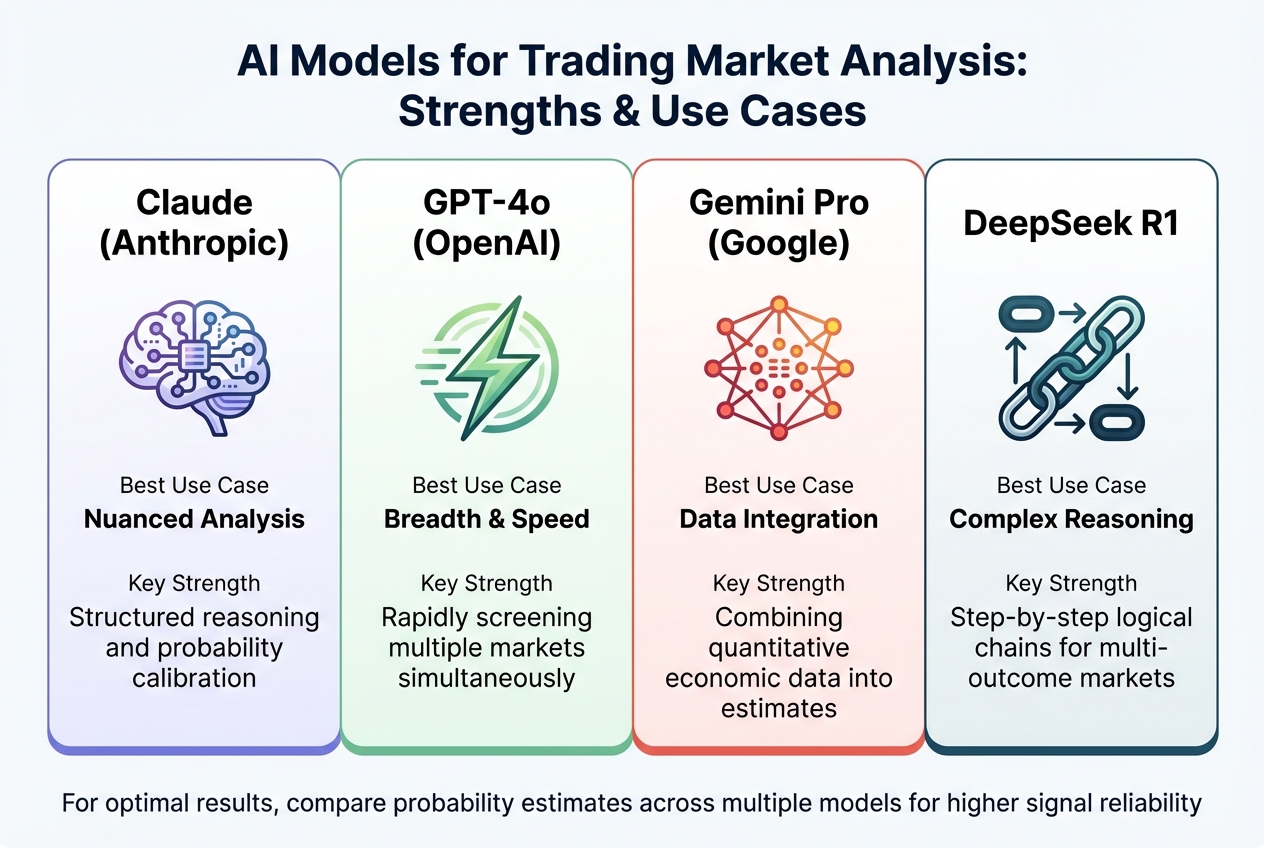
Different AI models bring unique strengths to market analysis:
| AI Model | Best Use Case | Key Strength |
|---|---|---|
| Claude (Anthropic) | Nuanced Analysis | Structured reasoning and probability calibration |
| GPT-4o (OpenAI) | Breadth & Speed | Rapidly screening multiple markets simultaneously |
| Gemini Pro (Google) | Data Integration | Combining quantitative economic data into estimates |
| DeepSeek R1 | Complex Reasoning | Step-by-step logical chains for multi-outcome markets |
For optimal results, traders often compare probability estimates across multiple models. When platforms like Claude, GPT-4o, and Gemini align on a signal, it indicates higher reliability. Interestingly, voice prompts can further enhance output quality. Spoken strategy descriptions tend to be two to three times longer than typed ones, providing the AI with richer context to create more accurate code.
Running AI Trading Systems on QuantVPS
Installing AI-Driven Trading Systems on QuantVPS
Setting up AI-driven trading systems on QuantVPS ensures smooth access to market data, reliable trade execution, and robust recovery mechanisms. The process starts by installing Claude Code on your VPS terminal. This tool allows the AI to handle file management, execute scripts, and install necessary packages in your production environment.
Next, configure MCP to integrate AI tools with your trading APIs and local data. Update the ~/.claude.json file, setting the server type to "http" and pointing it to http://localhost:3001/. This configuration enables Claude to interact with broker APIs, such as Interactive Brokers, Alpaca, or Polymarket CLOB, for real-time trade monitoring and execution.
To ensure clarity and consistency, create a CLAUDE.md file. Use this document to define risk parameters, coding standards, and preferred data handling practices. For maintaining system state, implement a database layer using SQLite. This setup tracks critical details like open positions, entry prices, and exit statuses, allowing the system to recover seamlessly after server reboots or process interruptions.
A notable example of this approach is from March 2026, when developer Chudi Nnorukam built a 4,000-line trading system using Claude Code and the Polymarket CLOB API. The system featured a five-module architecture: signal generation (via Binance WebSockets), position management with SQLite, exit strategies, state persistence, and health monitoring. Nnorukam also conducted a six-week paper trading phase to identify and resolve liquidity traps, avoiding what could have been $2,000 in real-money losses.
"The hard part was building a system that could run continuously for weeks without losing state, crashing silently, or entering impossible positions." - Chudi Nnorukam
For automation, enable headless mode using the -p flag. QuantVPS also offers custom templates to simplify deployment.
Once your system is fully installed and configured, the next step is to focus on reducing latency to enhance trade execution.
Achieving Low-Latency Trade Execution
After setting up your trading system, reducing latency becomes a top priority for improving performance. Low latency can significantly impact profitability. For example, a home fiber connection averages a 62ms ping, while a specialized NY4 Forex VPS reduces this to just 0.8ms. This improvement cuts EUR/USD slippage from 0.8 pips to 0.1 pips, which can make a noticeable difference in trading outcomes.
On March 31, 2026, traders using QuantVPS achieved a staggering $11.77 billion in trading volume within 24 hours. This success highlights the advantages of infrastructure designed specifically for trading. AI agents running models like GPT-4 or DeepSeek require dedicated CPU resources to process sentiment data and order flows in real time. Shared cloud instances often fail to meet these demands during peak market activity, leading to throttling.
QuantVPS also enhances security with static IP addresses. By whitelisting API keys at the exchange or broker level, you ensure that leaked keys become unusable outside the server. This infrastructure aligns with the growing prevalence of algorithmic trading, which accounted for over 80% of equity market volume in developed markets as of 2026.
"Reliability comes from a well-placed VPS, clean data, robust automation, and constant observability." - Thomas Vasilyev, EA Developer
Stay online and closer to execution. Choose a VPS location for CME futures, New York markets, London FX, API trading, and more.
Host your platform near the market route that matters.
CHINYCLONFrom $29.99/mo
CHI/CME futuresNYC/US marketsLON/FX EAsDUB/PolymarketAMS/EU FXFRA/Central EUTYO/APAC cryptoEffective Prompts for Claude and ChatGPT in Trading
Prompts for Strategy Development
The success of your trading strategy often hinges on how you frame your requests to the AI. Rather than simply saying, "build me a trading bot", use a planning prompt to gather all the necessary details. For instance, you could ask: "I want to build a mean reversion system on S&P 500 stocks. Ask me everything you need to know before we write a line of code." This method ensures the AI avoids making incorrect assumptions about critical aspects like data sources, exit rules, or handling market gaps.
Another effective technique is assigning a specific persona to the AI. Phrasing your request with roles such as, "You are a seasoned algorithmic trader with 30 years of experience" or "You are a former Renaissance Technologies researcher," helps anchor the AI's responses in expertise and produces higher-quality, domain-specific code. In fact, one trader noted that using a structured 8-part prompt framework improved a strategy's profit factor from 2.0 to 5.0 - without tweaking any actual parameters.
For tackling complex logic, instruct the AI to "think step-by-step" within <thinking> tags. This approach minimizes errors and clarifies any underlying assumptions. When asking for code, be specific about function names and inputs. For example: "Write a Python function called calculate_signals that accepts date, close, and volume columns and returns entry signal booleans".
"With LLMs, the question you ask is 80% of the edge. The answer you get depends on the question you ask." - The Rogue Quant
This structured approach not only sharpens the development process but also sets the stage for extracting deeper market insights.
Prompts for Market Analysis and Insights
The same level of precision used in strategy prompts applies to market analysis. For sentiment analysis and insights, craft prompts that request specific metrics like urgency, confidence, and impact. For example: "Analyze sentiment from these 10 TSLA articles and score trends, providing urgency, confidence, and reasoning for each signal."
Bayesian updating prompts are especially effective for prediction markets and real-time analysis. You might ask: "Using Bayes' theorem: What is the likelihood this new information would be seen IF YES is true? What should my updated posterior probability be?". Traders leveraging AI for probability updates in prediction markets have reported achieving 10-30% returns per winning trade, with win rates of 60-70%.
For uncovering patterns in historical data, use prompts like: "What patterns and inefficiencies (e.g., volatility clusters, mean reversion) can you detect in this minute-level BTCUSDT data?". When evaluating multiple opportunities, a two-step approach works well: start with a quick 2-minute screening prompt to assess 15-20 markets, then follow up with a detailed analysis template for the most promising setups. Interestingly, speaking prompts aloud has been shown to generate 2-3 times more detail and specificity, leading to more accurate code and insights.
Best Practices and Limitations of AI Tools
Getting the Most from AI Tools
AI tools are best viewed as assistants rather than standalone solutions. While they can enhance efficiency, human oversight is crucial for validating strategies, managing risks, and ensuring compliance with regulations. This aligns with the earlier discussion on strategy development and backtesting. For example, rigorous backtesting of AI-generated strategies helps identify and eliminate those that are unlikely to succeed. As Jacob Denbrock, CCO at LuxAlgo, explains:
"It is best to view backtesting as a method for rejecting strategies, than as a method for validating strategies. One thing is for sure, if it doesn't work in a backtest, it won't work in real life."
To maintain consistency, use a centralized repository like a CLAUDE.md file for storing permanent rules. Employ an 80/20 split for training and testing data, and limit parameters to three or four to reduce the risk of overfitting. Instead of relying solely on a single historical backtest, consider walk-forward optimization, which tests performance on unseen data to provide a more realistic assessment.
It's also important to verify AI-generated metrics like Sharpe or Sortino ratios using reliable Python libraries. Before deploying strategies in live markets, forward-test them in a paper trading environment to ensure they perform well under current conditions. Additionally, set manual stop-loss orders and position-size limits as extra safeguards.
While these practices improve the utility of AI tools, it’s equally important to understand where they may fall short.
Recognizing AI Limitations
Even with best practices, AI tools have limitations that traders must account for to build effective strategies. Issues like poor-quality data, mismatched files, or historical biases can lead to flawed predictions. Furthermore, many machine learning models operate as "black boxes", making it challenging to interpret their decisions - especially during volatile or unprecedented market events.
AI also struggles with black swan events - rare, unpredictable shocks that lack historical patterns. A notable example is the May 6, 2010 Flash Crash, where a large automated sell order triggered a chain reaction among high-frequency trading algorithms. This resulted in nearly $1 trillion in market value being wiped out within minutes. Maximilian Goehmann, a PhD candidate at LSE, noted:
"The issue was that there were a lot of algorithms with similar settings that were each triggering each other … and that created a cascading failure that led to this sudden and huge drop in the market."
Technical constraints also limit tools like Claude and ChatGPT. Their context windows are finite, and they may produce confident but incorrect answers when given vague or complex instructions. For instance, a FinanceBench study showed that GPT-4-Turbo failed to answer or provided incorrect responses to 81% of complex questions about publicly traded companies. The key is to provide clear, precise instructions to guide the AI effectively, rather than expecting flawless output.
| Risk | Description | Mitigation Strategy |
|---|---|---|
| Data Bias/Hallucination | Fabricated prices or skewed sentiment scores | Cross-verify with primary sources (e.g., SEC filings) |
| Overfitting | Strategy tuned too tightly to historical noise | Use walk-forward validation and out-of-sample testing |
| Regime Shifts | AI fails when market conditions change abruptly | Use real-time liquidity visualization and manual oversight |
| Black Swan Events | Inability to predict non-repetitive external shocks | Maintain human-in-the-loop oversight and fallback plans |
Human oversight remains indispensable, as emphasized throughout this discussion.
Conclusion
AI tools like Claude and ChatGPT are reshaping how traders approach algorithmic trading. From crafting strategies and backtesting to analyzing markets in real time, these tools serve as valuable assistants - generating code and interpreting sentiment. However, human oversight is still critical to ensure accurate results and manage risks effectively.
Austin Starks, a trader, sums it up well:
"LLMs aren't going to transform you into a Wall Street Wizard overnight. ChatGPT is nothing more than a tool. An extremely powerful tool, but a tool nonetheless."
While these AI tools excel in strategy development and data analysis, the journey doesn’t end there. Deploying these strategies in a live trading environment is a crucial next step. This is where QuantVPS becomes a game-changer. By offering low-latency infrastructure, 99.2%+ uptime, and round-the-clock execution capabilities, QuantVPS ensures AI-driven bots can perform reliably. With automated verification gates, it also reduces production errors by 84%, making it an essential component for traders aiming to operationalize their AI-powered strategies.
FAQs
How do I prevent look-ahead bias in AI-written backtests?
To ensure your backtesting process avoids look-ahead bias, it's crucial to use only the data that would have been available at the time of trading. This means structuring the backtest to rely strictly on historical data, steering clear of any future data that could inadvertently influence decisions.
Additionally, implementing rigorous data handling protocols is key. Carefully validate your setup to confirm there's no leakage of future information into the decision-making process. By doing so, you can preserve the reliability and accuracy of your backtesting results.
What’s the safest way to validate AI-generated Sharpe and drawdown metrics?
To ensure the reliability of AI-generated Sharpe and drawdown metrics, the safest approach is thorough backtesting and cross-validation. By comparing these metrics against independent datasets or alternative models, you can check for accuracy and reduce the risk of overfitting. This method is essential for confirming that the metrics hold up under practical, real-world conditions.
What do I need to reliably run an AI trading bot on QuantVPS?
To ensure your AI trading bot operates smoothly on QuantVPS, you'll need a few essential elements in place:
- Adequate VPS resources: Make sure your VPS has enough CPU power, RAM, and storage capacity to handle your trading algorithms efficiently.
- Reliable internet connection: A stable, high-speed connection is critical for real-time data processing and executing trades without delays.
- Properly configured software: Install and set up the necessary tools, such as Python, trading libraries, and AI tools like Claude or ChatGPT, to support your bot's functionality.
- Automation and monitoring: Use automation scripts and monitoring tools to track performance and ensure your bot runs without interruptions.
- Robust security: Protect your setup with firewalls, secure SSH access, and other security measures to guard against unauthorized access.
By addressing these requirements, you can create a dependable environment for your AI trading bot on QuantVPS.