Derivatives trading involves buying and selling financial contracts tied to underlying assets like stocks, commodities, or currencies. Traders use these instruments for hedging risks, speculating on price movements, or arbitraging price differences. The job requires sharp analytical skills, risk management, and the ability to handle high-pressure environments. Here's what you need to know:
- What Are Derivatives? Financial contracts based on assets like oil, gold, or market indexes. Common types include futures, options, swaps, and forwards.
- Trader Roles: Proprietary traders (use firm capital), sell-side traders (work for banks), and buy-side traders (manage institutional investments).
- Key Skills: Strong math and finance knowledge, programming (Python, R, C++), and understanding of pricing models like Black-Scholes.
- Daily Work: Monitoring markets, managing risks, executing trades, and adjusting positions to maintain portfolio balance.
- Salary: Median annual salary is $195,000, with top earners exceeding $300,000.
To become a derivatives trader, focus on building a strong foundation in quantitative skills, gain certifications like CFA or FRM, and develop a track record through internships or personal trading. Advanced tools like Bloomberg Terminal, Python, and low-latency VPS for trading are essential for success in this field.
What a Derivatives Trader Does Day to Day
Core Responsibilities of a Derivatives Trader
A derivatives trader's day is packed with tasks that require precision and focus. It kicks off early, typically around 6:00 AM, with a review of overnight market developments. This includes scanning global news, central bank updates, and any significant moves in international markets. Next, traders dive into risk reports, update pricing grids, and prepare for the day ahead by aligning on liquidity, volatility, and client activity during morning meetings.
Once the markets open at 9:30 AM, the action begins. Traders focus on executing orders across instruments like futures, options, and swaps while ensuring accurate pricing for both internal teams and clients. A critical part of the job involves managing the "Greeks" - especially delta and gamma - to keep the trading book within acceptable risk levels, such as Value at Risk (VAR) thresholds. When market prices shift, they dynamically adjust positions through delta hedging to manage exposure and mitigate potential losses.
After the market closes (4:00–5:30 PM), the day isn’t over. Traders reconcile trades, assess overnight exposures, and ensure compliance with regulations. This includes preparing performance and risk reports. The role demands a deep understanding of complex instruments and the ability to adapt quickly to market changes.
Key Instruments Used in Derivatives Trading
Derivatives traders rely on a variety of financial tools, each tailored to specific strategies and needs:
| Instrument | Common Examples | Primary Use |
|---|---|---|
| Futures | S&P 500 index futures, crude oil, gold | High-leverage hedging and speculation |
| Options | Calls, puts, exotic structures | Limiting downside risk or leveraging for upside potential |
| Swaps | Interest rate swaps, currency swaps | Managing fluctuations in interest rates or borrowing costs |
| Forwards | Currency forwards | Locking in future prices through private agreements |
In practice, standard options are often used for straightforward hedging strategies, while exotic options - due to their complex conditions - may require traders to hedge using a mix of instruments. Swaps, on the other hand, are frequently employed by institutions to manage long-term interest rate exposure tied to debt portfolios.
Work Environment and Schedule
The trading floor is a fast-paced, high-energy setting where traders juggle multiple screens displaying pricing systems, risk dashboards, and tools like Bloomberg and Reuters. The intensity peaks at the market's open and close, while the middle of the day is often used for rebalancing portfolios and running scenario analyses.
With the rise of electronic trading, much of the manual work has shifted to automated systems. These systems handle tasks like order routing and execution, freeing traders to focus more on strategy and risk management. For those using algorithmic strategies, tools like VPS (Virtual Private Server) hosting ensure low-latency connections to exchanges, enabling automated hedging and round-the-clock monitoring.
Risk management remains central to the role. For example, the "3-5-7 rule" is a common framework: limit risk to 3% per trade, cap overall exposure at 5%, and ensure no more than 7% is tied up in correlated positions. This structured approach helps traders maintain discipline in a rapidly changing market.
Skills and Tools Every Derivatives Trader Needs

Run 24/7 while you sleep. Keep bots, platforms, and trade copiers online on a dedicated VPS.
Low-latency VPS hosting for your trading platform.
 CHINYC
 LON
LONFrom $29.99/mo


 CHI/CME futuresNYC/US marketsLON/FX EAs
 DUB/Polymarket
 AMS/EU FX
 FRA/Central EU
 TYO/APAC crypto
Technical and Financial Skills
To excel in derivatives trading, a strong grasp of pricing models like Black-Scholes and Binomial Trees is essential. These models help traders determine fair value before making trades. Additionally, traders rely on the Greeks - Delta, Gamma, Theta, Vega, and Rho - to understand and manage their market exposure effectively.
Programming knowledge is another must-have. Languages like Python and R are widely used for building pricing models and automating repetitive tasks. Meanwhile, C++ and VBA remain relevant in institutional settings, particularly for high-frequency trading and Excel-based workflows. Many firms, especially those in quantitative finance, favor candidates with academic backgrounds in mathematics, engineering, or the hard sciences over those with general finance degrees.
Traders also combine macroeconomic research with technical indicators such as RSI, moving averages, and Stochastics to time their trades. A deep understanding of market microstructure - including order flow, the FIX protocol, and the impact of liquidity on execution - completes the technical toolkit.
While technical knowledge forms the foundation, success in fast-moving markets ultimately depends on discipline and the ability to make quick decisions.
Behavioral and Cognitive Skills
The ability to manage emotions and think clearly under pressure is just as important as technical expertise. Many traders fail not because their strategies are flawed, but because fear and greed cloud their judgment. These emotions can lead to mistakes like exiting profitable trades too early, holding onto losing positions for too long, or overtrading after a bad day. As Investopedia notes:
"Discipline is the backbone of a trading career. Without it, even the best strategy can fail."
Practical measures like setting a maximum daily loss limit - often 1.5 to 2 times the average winning trade - and stopping for the day once that limit is hit can help traders maintain discipline. If monthly losses exceed 8–10%, reducing position sizes until achieving two consecutive profitable weeks is another effective strategy.
In derivatives markets, where prices can change dramatically within seconds, quick and accurate decision-making is critical. Successful traders are flexible and ready to adjust their strategies as new data emerges, avoiding the trap of stubbornly defending a losing position.
Technology and Trading Infrastructure
Beyond skills, having the right technology and infrastructure is crucial for executing trades efficiently. Professional trading desks typically use tools like the Bloomberg Terminal and Thomson Reuters Eikon for real-time data, news, and analytics. Platforms such as FlexTrade and Portware manage complex order flows across multiple trading venues. On the risk management side, tools like Calypso and Murex enable traders to monitor exposure, conduct stress tests, and evaluate counterparty risk. Cloud services like AWS and Azure handle heavy processing loads, while visualization tools like Tableau and Power BI turn complex data into actionable insights.
For those running algorithmic or automated strategies, reliable infrastructure is non-negotiable. A dropped connection during a volatile market can lead to unhedged positions or missed opportunities. This is where trading VPS (Virtual Private Server) hosting comes into play. For example, QuantVPS offers features tailored to traders, such as 0–1ms latency, DDoS protection, and automatic backups. It supports popular trading platforms like NinjaTrader, MetaTrader, and TradeStation, with plans starting at $59.99 per month. For traders managing multiple charts or complex setups, dedicated server options are available.
| Category | Key Tools |
|---|---|
| Market Data & Terminals | Bloomberg Terminal, Thomson Reuters Eikon, ICE Data Services |
| Programming & Modeling | Python, R, C++, VBA, MATLAB, SQL |
| Execution & Order Management | FlexTrade, Portware, FIX Protocol |
| Risk & Analytics | Calypso, Murex, Tableau, Power BI |
| Infrastructure | Linux/Unix, AWS/Azure, Trading VPS (e.g., QuantVPS) |
How to Become a Derivatives Trader
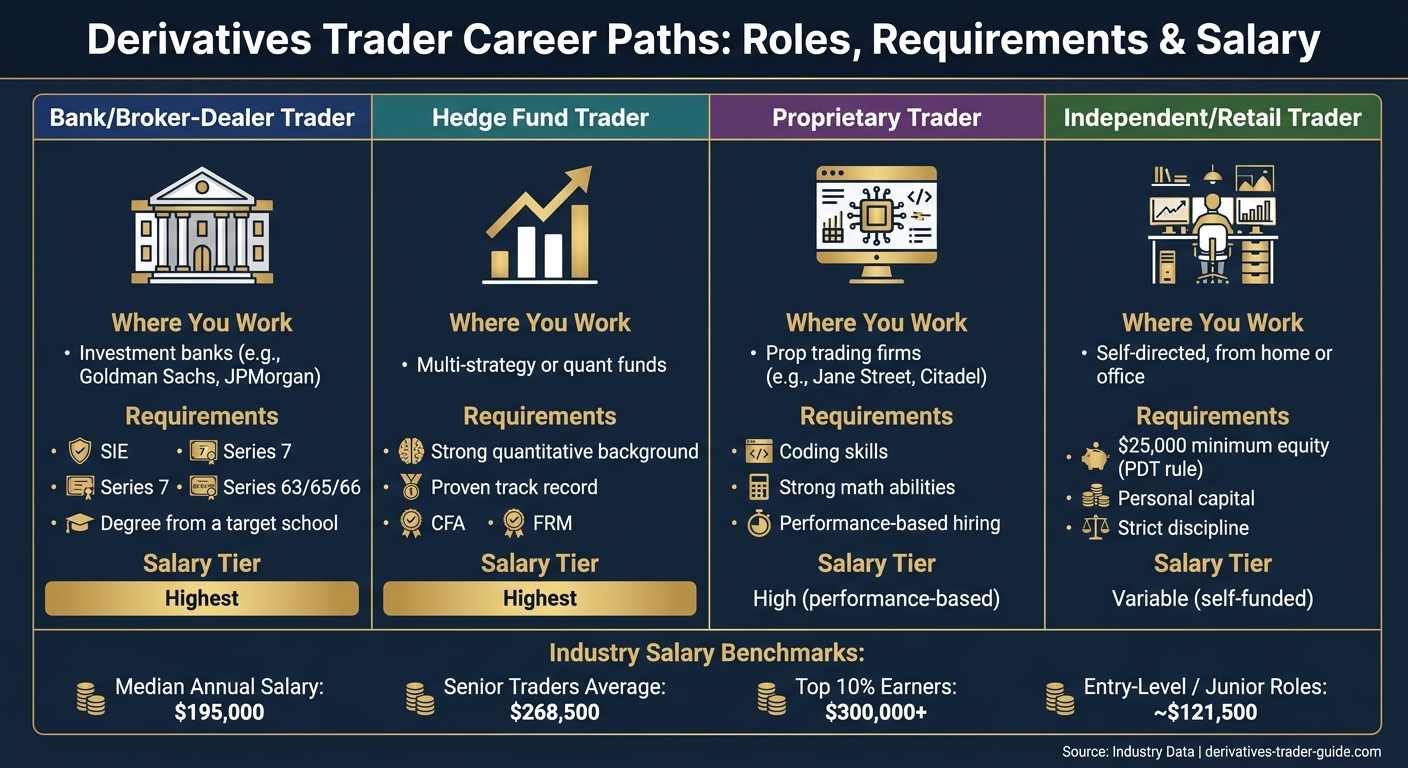
Derivatives Trader Career Paths: Roles, Requirements & Salary
Choosing Your Career Path
The first step in becoming a derivatives trader is deciding which trading niche aligns with your interests and skills. Different paths come with unique requirements, risks, and earning potential.
| Career Path | Where You Work | What It Requires |
|---|---|---|
| Bank/Broker-Dealer Trader | Investment banks (e.g., Goldman Sachs, JPMorgan) | SIE, Series 7, Series 63/65/66; a degree from a target school |
| Hedge Fund Trader | Multi-strategy or quant funds | Strong quantitative background, proven track record, often CFA or FRM |
| Proprietary Trader | Prop trading firms (e.g., Jane Street, Citadel) | Coding skills, strong math abilities, performance-based hiring |
| Independent/Retail Trader | Self-directed, from home or office | $25,000 minimum equity to avoid PDT restrictions |
Bank and hedge fund roles typically offer the highest salaries, but they demand rigorous qualifications. Proprietary trading focuses more on analytical and technical skills, while independent trading offers flexibility but requires personal capital and strict discipline. Your choice will shape the educational and experiential steps you need to take.
Educational Requirements and Certifications
Most firms expect a bachelor’s degree in a quantitative field like Finance, Economics, Mathematics, Statistics, Computer Science, or Engineering. For advanced roles, especially on complex trading desks, a Master’s degree in Financial Engineering, Quantitative Finance, or an MBA with a finance focus is increasingly favored.
Attending top feeder universities can significantly improve your chances of landing a role at leading investment banks.
When it comes to certifications, three stand out in the trading world:
| Certification | Focus | Best For |
|---|---|---|
| CFA | Broad investment and portfolio management | General trading and asset management |
| FRM | Risk management and understanding derivatives | Risk-focused trading roles |
| CQF | Practical quantitative methods | Algorithmic trading and financial engineering |
These certifications are highly valued across the industry. Additionally, specific regulatory licenses are often required depending on the trading role. For example, securities traders need to pass the SIE and Series 7 exams (both requiring firm sponsorship), while futures traders must pass the Series 3 exam and register with the National Futures Association (NFA).
"Education = the right rulebook + the right exam for your seat, not a one-size-fits-all degree." - TradeScope
However, education alone isn’t enough. Gaining hands-on experience is just as important for building a successful trading career.
Gaining Experience and Building a Track Record
To establish yourself as a derivatives trader, you’ll need a solid trading record. Start with a demo account to test strategies and understand risk management metrics without risking real money. Once you develop a consistent system, transition to a small live account to experience the pressures of real-world trading.
Keep a detailed trading journal. Document your trade rationale, entry/exit points, and outcomes. Use metrics like total return, Sharpe ratio, and maximum drawdown to showcase your performance. This journal can serve as a portfolio, proving your approach is consistent and not based on luck.
Stay online and closer to execution. Choose a VPS location for CME futures, New York markets, London FX, API trading, and more.
Host your platform near the market route that matters.
CHINYCLONFrom $29.99/mo
CHI/CME futuresNYC/US marketsLON/FX EAsDUB/PolymarketAMS/EU FXFRA/Central EUTYO/APAC cryptoInternships at investment banks or trading desks provide invaluable exposure to real-world operations. Entry-level roles, such as junior trader, trading analyst, or desk assistant, offer the chance to learn from seasoned professionals while earning a median starting salary of around $121,500. Enhance your skills further by developing and backtesting trading strategies using tools like Python.
Practical Strategies for Success in Derivatives Trading
Risk Management and Position Sizing
Once you've nailed down the basics, the next step is safeguarding your capital. In derivatives trading, position sizing is the one variable you can fully control - even more than your entry timing or chart patterns. Think of it as your safety net.
Many professional traders stick to the 1% rule, meaning they never risk more than 1% of their total portfolio on a single trade. Some experienced traders may stretch that to 2%. Here's a simple formula to calculate your position size:
Position Size = (Account Risk % × Account Size) ÷ Stop-Loss Distance
For example, if you have a $50,000 account, set a 1% risk limit, and your stop-loss is $500, your maximum position size would be $1,000. This approach ensures that even a losing trade won't cause significant harm. It's equally important to monitor your broker’s margin requirements to avoid unexpected liquidations.
Once you've got risk under control, the next step is fine-tuning and testing your trading strategies.
Developing and Testing Trading Strategies
With risk management locked in, it’s time to focus on crafting strategies that consistently work. The stakes are high in derivatives markets, and the statistics are sobering: 58% of retail traders lose money at Interactive Brokers, 71% at CMC, and 81% at IG. This isn’t a reason to give up but a reminder to test every strategy thoroughly before risking real money.
"Better to miss a zillion opportunities than blow up once." - Nassim Nicholas Taleb, Author/Trader
Start by backtesting your strategy using historical data. Tools like Python or NinjaTrader can help. Once you’ve got promising results, move to paper trading for at least 30–60 trades. Track key metrics like win rate, average risk/reward ratio, and maximum drawdown. If your strategy struggles during simulated drawdowns, it’s unlikely to perform well in live markets.
Automating your strategy can add another layer of discipline. A tiered risk system is a smart way to stay in control during volatile markets:
| Risk Level | Trigger Condition | Action Taken |
|---|---|---|
| NORMAL | Equity at/near peak | 100% position allocation |
| REDUCED | Drawdown > 10% | 50% position sizing |
| PAUSED | Daily loss limit hit | No new positions allowed |
| HALTED | Maximum drawdown breached | Close all positions |
The success of any strategy also depends on having a solid trading setup for execution.
Building a Professional Trading Setup
Once your strategies are ready to go, a reliable and efficient trading setup becomes essential. Latency matters a lot in trading. For example, a typical home fiber connection might have a 62 ms ping, leading to about 11 order errors per 100 trades. In contrast, a co-located VPS near a major exchange hub - like NY4 - can reduce latency to 0.8 ms with almost no errors.
For traders running automated systems or multiple charts, QuantVPS offers several tailored plans:
- VPS Pro: $99.99/month (or $69.99/month billed annually). Ideal for 3–5 charts, with 6 cores and 16GB RAM.
- VPS Ultra: $189.99/month. Designed for algorithmic traders managing 5–7 charts, with 24 cores and 64GB RAM.
- Dedicated Server: Built for institutional workloads (7+ charts), featuring 16+ dedicated cores, 128GB RAM, and a 10Gbps+ network.
All QuantVPS plans include NVMe storage, a 1Gbps+ network connection, Windows Server 2022, DDoS protection, and automatic backups. This ensures your setup stays online and performs smoothly, even during high market volatility.
Conclusion and Key Takeaways
Derivatives trading is both demanding and rewarding. At its heart, this career revolves around handling financial contracts connected to underlying assets while managing risks through advanced pricing models and risk management strategies.
To thrive in this field, traders need a strong command of technical tools like Python, statistics, and financial modeling. Equally important is the ability to remain calm under pressure and adhere to strict risk limits. This combination of technical expertise and discipline is what sets successful traders apart in such a competitive arena.
"Successful derivatives traders fuse creativity with analytical rigor to generate alpha while ensuring adherence to risk limits and compliance standards." - Jobicy
Career growth in derivatives trading is typically gradual and experience-driven. Traders often start in junior roles focused on monitoring markets and progress to senior positions where they manage larger portfolios and influence desk-level strategies. In the U.S., the median annual salary for derivatives traders is $195,000, with senior traders earning an average of $268,500, and the top 10% surpassing $300,000. Achieving these levels often requires a strong academic background, certifications like the CFA or FRM, and practical experience through internships or personal trading.
As technology continues to evolve, staying updated is essential. AI, machine learning, and algorithmic systems are reshaping how trades are executed and strategies are developed. Mastering these tools - alongside continuously refining technical skills and upgrading trading systems - is no longer optional. It's the key to maintaining consistent performance in this ever-changing landscape.
FAQs
How risky is derivatives trading?
Derivatives trading involves a high level of risk due to the complex nature and leverage associated with instruments like options, futures, and swaps. These tools are known for their volatility, and sudden market swings can result in either significant profits or steep losses. To tackle these challenges effectively, strong risk management and a disciplined trading strategy are absolutely critical. While the potential for rewards is enticing, traders need to be fully prepared to manage the uncertainties and intricacies that come with these financial instruments.
Which derivatives product should I learn first?
When diving into derivatives, starting with futures or options is often the smartest choice. These are the backbone of trading and risk management, making them ideal for beginners. Futures are relatively straightforward, offering a great way to grasp the basics of derivatives. Mastering these first lays the groundwork for tackling more advanced instruments, like swaps, down the road. To deepen your understanding, explore beginner-friendly courses and resources - they can make the learning process much easier.
Do I need coding to become a derivatives trader?
Coding isn’t a must-have skill for becoming a derivatives trader. Instead, the job typically focuses on analytical thinking, understanding market dynamics, and managing risk effectively. While some advanced or quantitative roles might include coding, most entry- or mid-level positions don’t require it. To excel without programming knowledge, consider gaining expertise in areas like pricing models, risk analysis, and market trends. Taking relevant courses or earning certifications can give you a competitive edge.