
The cost of a futures broker includes more than the advertised commission. Exchange, clearing and regulatory charges affect each trade, while platform subscriptions and market data affect the monthly bill. Intraday margin is another separate figure: it describes the collateral required to hold a position under specified conditions, not a commission or a limit on possible losses.
This comparison covers eleven brokers available to U.S. futures traders. Figures come from official pricing, account and margin pages checked in October and November 2026, and each broker section gives the all-in cost of one round turn where the broker publishes a rate. Where an ordinary rate or fixed amount was not available in the reviewed official material, the table says not published. Discount tiers, introductory offers and reduced intraday margins should not be assumed to apply to every account.
Futures brokers at a glance
The commission column is per contract, per side, before exchange and regulatory fees. A round turn includes both entry and exit. ES is the E-mini S&P 500 contract and MES is its Micro E-mini counterpart. Margin schedules can change, including during volatile markets or near a session close.
| Broker | Ordinary published commission per side | Account funding information | Published ES / MES intraday margin | All-in cost per round turn, ES / MES |
|---|---|---|---|---|
| NinjaTrader Brokerage | Free: $1.29 standard / $0.39 micro; paid plans reduce commissions | No minimum deposit to open; trading margin still required | $500 / $50 | $5.74 / $1.88 on the Free plan; $4.34 / $1.28 on Lifetime |
| Tradovate | Free: $1.29 standard / $0.39 micro; paid plans reduce commissions | Any funding amount to open; trading margin still required | $500 / $50 | $5.74 / $1.88 on the Free plan; $4.34 / $1.28 on Lifetime |
| Optimus Futures | $0.75 standard / $0.25 micro base rate | $2,000 for standard futures; $500 for micros | $500 / $50 | $5.00 / $1.62 |
| Discount Trading | $0.49 or less standard / $0.20 or less micro index, for self-directed online accounts | $1,500 to open; $500 for a micro-only account | $400 / $40 on Rithmic-routed platforms; standard $500 / $50 | $3.96 to $4.36 / $1.32 to $1.72, including a Rithmic fee of $0.10 to $0.30 per side |
| Interactive Brokers | $0.85 U.S. standard / $0.25 eligible micro at the first volume tier | No general account minimum; permissions and margin requirements still apply | $20,313 / $2,031, risk-based and changing daily (1 Nov 2026) | $4.48 / $1.22 |
| TradeStation | $1.75 standard / $0.50 micro at 0 to 500 contracts a month, plus $0.10 clearing; lower at higher volume | Futures-specific deposit minimum not published in the reviewed pricing material | $1,431 / $143, 5% of the exchange margin, so it changes daily (1 Nov 2026) | $6.48 / $1.92 |
| Charles Schwab | $2.25 per contract, including futures options, plus pass-through fees | $1,500 account minimum for the stated margin-account requirement | Contract-specific schedule; a fixed ES/MES amount not confirmed here | Not calculated here |
| AMP Futures | Ordinary broker-only rate not published as one universal amount; configuration quote required | $100 minimum account funding | $400 / $40 | Depends on platform and routing |
| Ironbeam | Unconditional base rate not published in the reviewed offer; qualifying new-account offer advertises $0.99 standard / $0.39 micro | No minimum to open; advertised commission offer requires $1,000 deposit | $500 / $50 | Quote required |
| EdgeClear | $0.22 micro index, for all accounts; standard contracts by quote | $5,000 recommended for standard contracts; $1,500 for micros only | About $2,878 / $288, as low as 10% of the exchange margin | Quote required / $1.38 |
| tastytrade | $1.00 standard / $0.75 micro, plus $0.30 clearing | No minimum balance to trade CME futures in a margin account | About $7,229 / $723, 25% of the exchange margin; E-minis need a $25,000+ account | $5.38 / $2.82 |
All-in cost is one contract in and out at the entry or free tier: broker commission, CME exchange and clearing fees, broker clearing and routing fees, and the NFA fee. Monthly data and platform subscriptions are not included.
These figures answer different questions. An account-opening minimum does not establish how much money is necessary to place an order. Likewise, a low intraday requirement does not establish an overnight requirement. Before funding an account, obtain the actual fee and margin schedule for the instrument, platform and account classification you will use.
1. NinjaTrader Brokerage
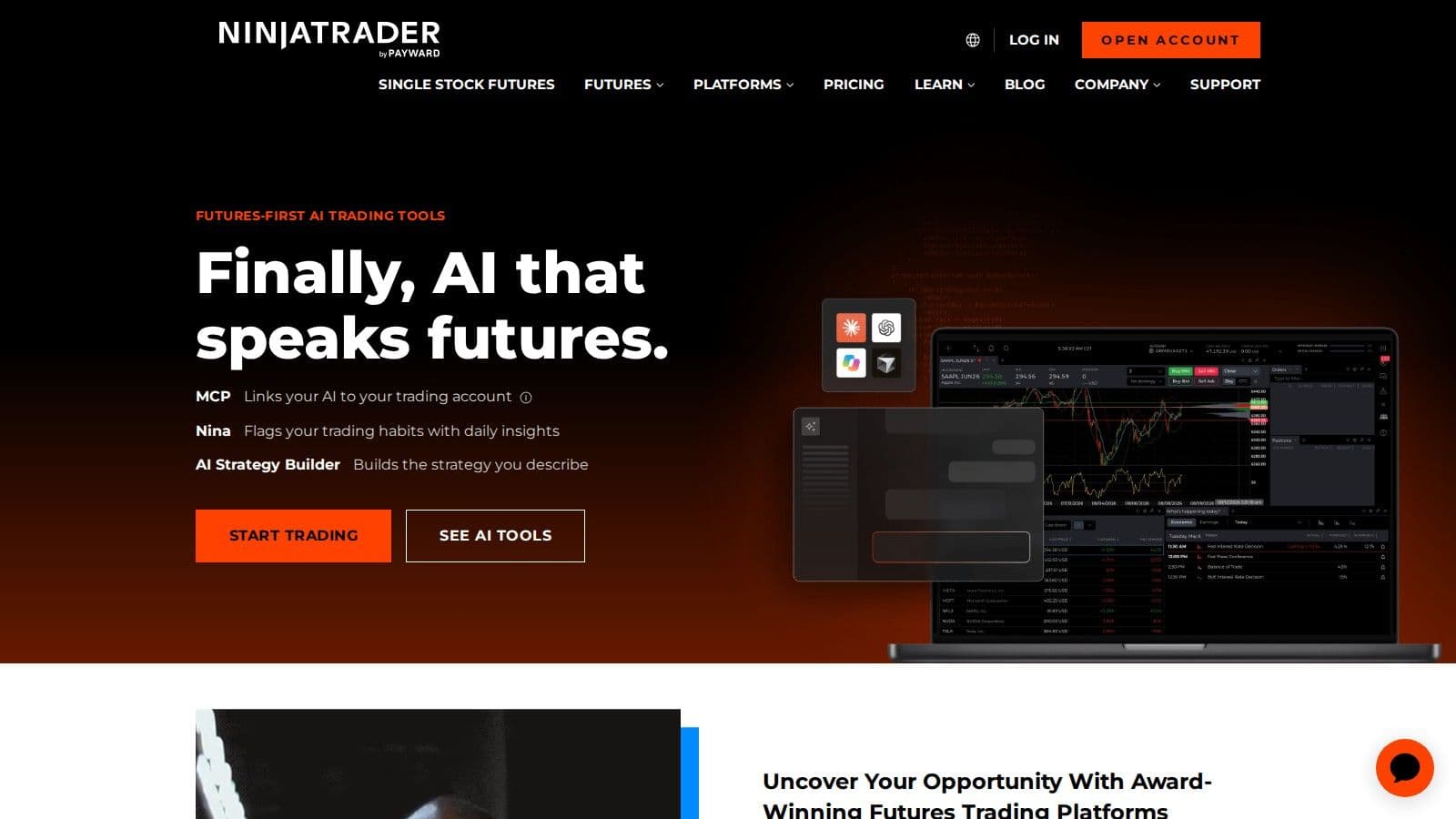
NinjaTrader’s Free plan has no monthly plan charge and commissions of $1.29 for standard contracts and $0.39 for eligible micros per side. The Monthly plan costs $99 and reduces those commissions to $0.99 and $0.29. Lifetime costs $1,499 once and lists $0.59 and $0.09. Exchange, clearing and NFA fees remain additional. All-in, one ES round turn costs $5.74 and one MES round turn $1.88 on the Free plan, or $4.34 and $1.28 on Lifetime, counting the commission, exchange and clearing fees and the NFA fee.
The published intraday margins for ES and MES are $500 and $50. There is no minimum deposit to open, but the account must still have enough equity to satisfy the actual order and margin conditions. A paid plan reduces broker commission; it does not eliminate every other trading charge.
All plans include access to Desktop, Web and Mobile. The current pricing page includes top-of-book market data after the account is approved and funded. Extra market-data selections and account-service charges should be checked separately. For a remote desktop setup, our NinjaTrader VPS page covers running the application away from a home computer.
Choose the plan from expected activity, rather than assuming that the lowest per-contract headline gives the lowest overall cost. A trader placing only a few round turns may not offset the Monthly subscription through commission savings. An upfront Lifetime payment also needs a different comparison period.
2. Tradovate
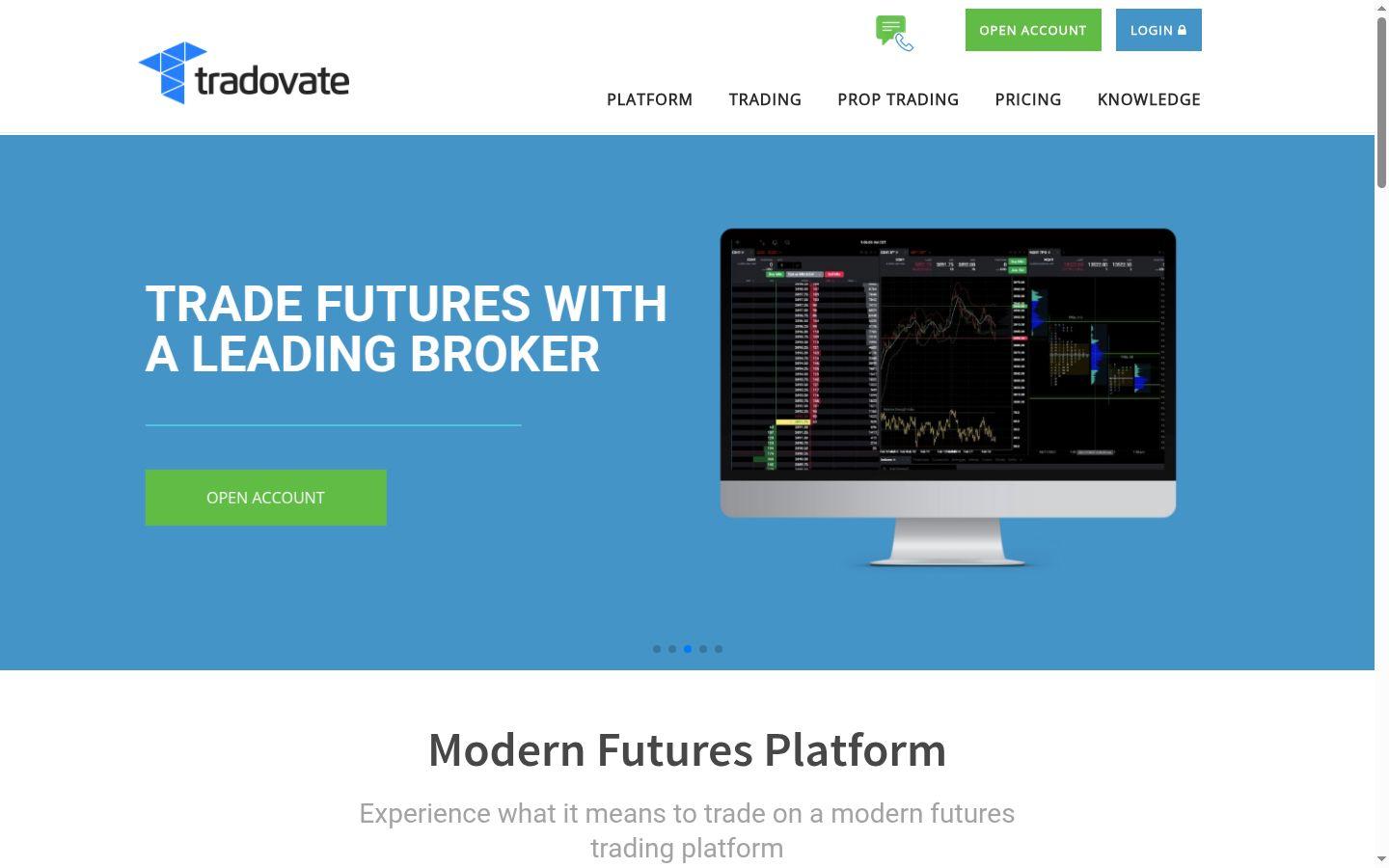
Tradovate’s current plan ladder uses the same published broker commissions: Free at $1.29 standard and $0.39 micro, Monthly at $0.99 and $0.29 with a $99 monthly charge, and Lifetime at $0.59 and $0.09 with a $1,499 one-time payment. The installment option has a different total and should not be mistaken for the one-payment price. All-in, the round turn costs are the same as NinjaTrader's: $5.74 for ES and $1.88 for MES on the Free plan, or $4.34 and $1.28 on Lifetime.
The pricing page permits any account-opening funding amount and lists $500 ES and $50 MES intraday margins. Exchange, clearing and regulatory charges still apply. The available account balance must cover current trading requirements even though opening the account does not impose a fixed funding minimum.
The plan includes desktop, web and mobile access and top-of-book data with an approved, funded account. Check the selected data entitlement and any additional depth package. Our Tradovate VPS page explains the remote-hosting context where a desktop or connected workflow needs to keep running.
Tradovate and NinjaTrader are affiliated offerings, so their similar plan pricing should not be treated as proof of two unrelated clearing arrangements. Compare the interface, integrations and account terms actually offered for your purchase. A platform preference and a commission-plan choice are related but distinct decisions.
3. Optimus Futures
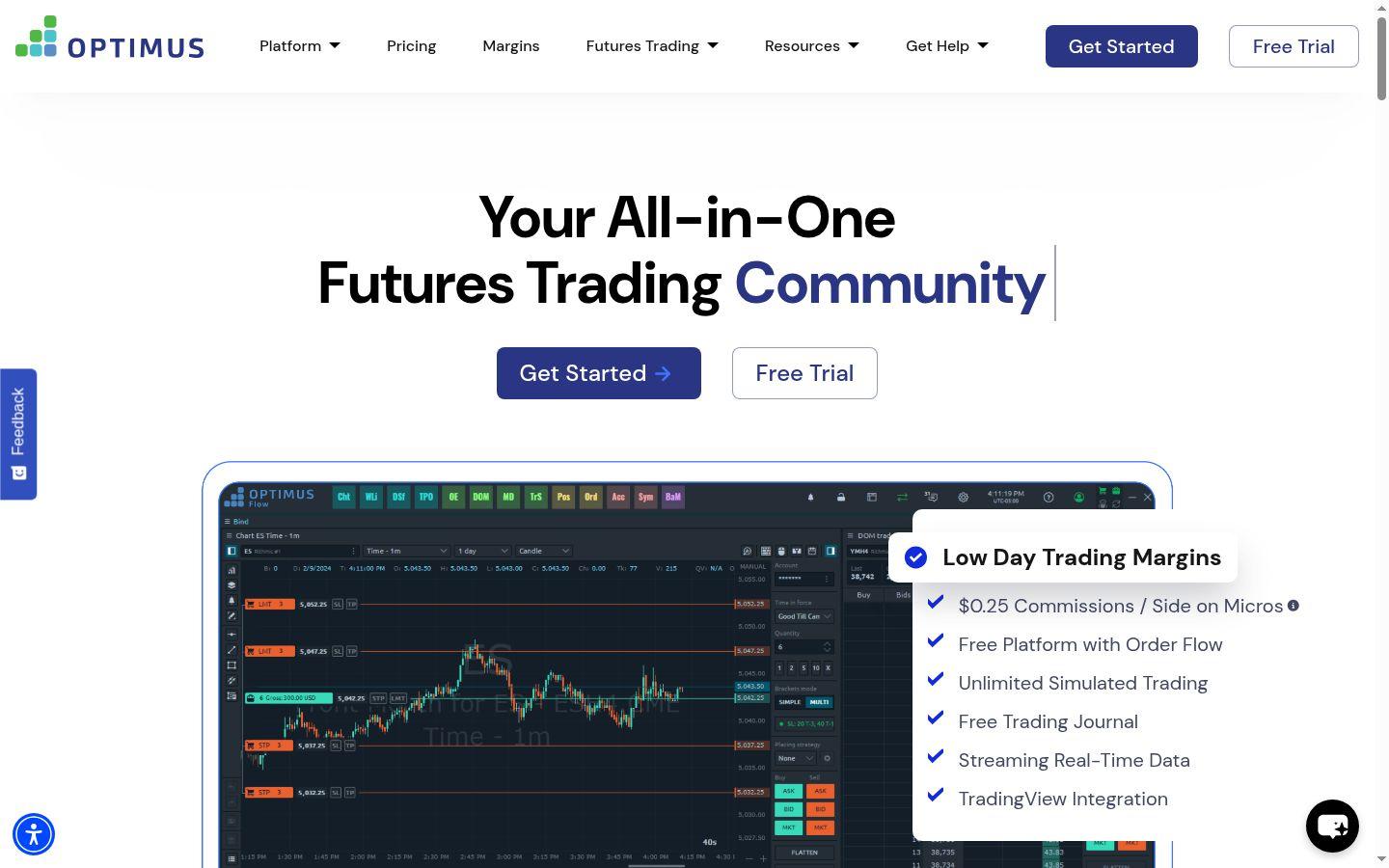
Optimus publishes base commissions of $0.75 per side for standard futures and $0.25 for micros, with lower rates available under qualifying volume tiers. Clearing, exchange and regulatory charges are additional. The advertised lowest possible tier should not replace the base rate for a trader who does not meet its conditions. At the base rate, one ES round turn costs $5.00 all-in and one MES round turn $1.62, counting IronBeam clearing, Rithmic or CQG routing, CME fees and the NFA fee.
The official account information lists $500 minimum funding for micro trading and $2,000 for standard futures. The ES and MES intraday margins are $500 and $50. These figures do not establish how much loss a strategy may sustain or how much capital is appropriate for a particular trader.
Optimus Flow, Web and Mobile are included without a separate platform charge in the described offering. The pricing page lists $3 monthly CME top-of-book data and a conditional rebate for qualifying trading activity, with a submission requirement. The rebate should not be presented as automatic free data for every account.
For a fuller breakdown, see our Optimus Futures fees guide. Check the clearing arrangement and selected platform before comparing the total with another broker, especially if you need a specific third-party charting or execution tool.
Order flow
Built for scalpers. Heatmaps on dedicated resources.
Order-flow heatmaps and DOM ladders run on dedicated CPU, memory and NVMe, so your charts keep responding during volatility.
See the dedicated hardware





From $29.99/mo · Windows or Linux
4. Discount Trading
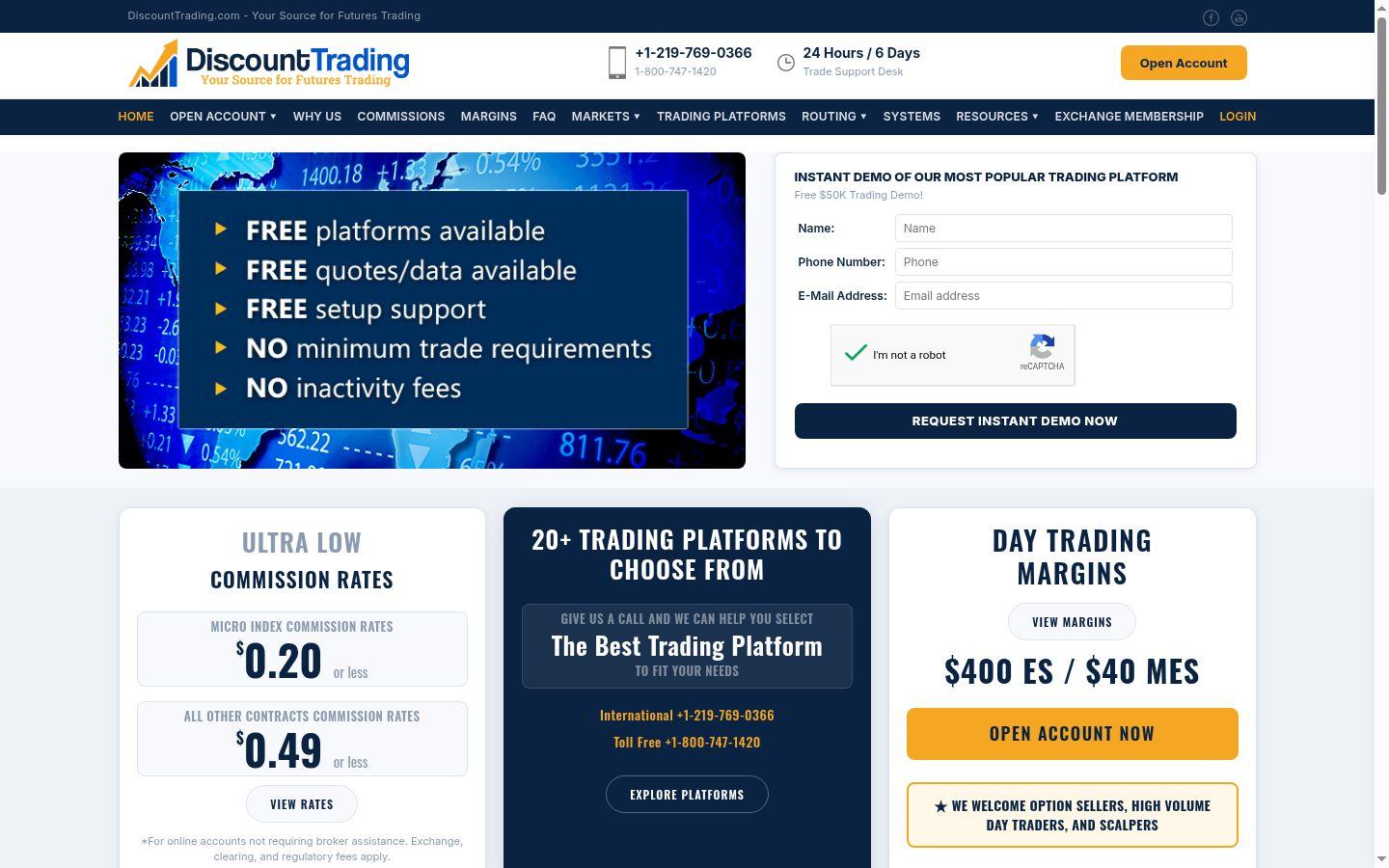
Discount Trading is a U.S. futures broker registered with the CFTC and a member of the NFA (NFA ID 0283032), and it says it has served futures traders for over 25 years. Self-directed online accounts pay $0.49 or less per contract on standard futures and $0.20 or less per contract on micro index futures, plus exchange, clearing and regulatory fees. Accounts that need broker assistance pay a higher rate.
On its own fee table, a non-member pays $0.49 commission, $1.38 CME exchange and clearing fee and $0.01 NFA fee per side on ES, plus a Rithmic fee of $0.10 to $0.30 per side that depends on the platform. That puts one ES round turn at $3.96 to $4.36 all-in, the lowest ES figure among the brokers here that publish a rate, and one MES round turn at $1.32 to $1.72.
Day-trade margins on Rithmic-routed platforms are $400 for ES, $800 for NQ, $40 for MES and $80 for MNQ. The standard day margins are $500, $1,000, $50 and $100. Its margin page calls the lower figures enhanced margins on select platforms and says not all clients qualify, so confirm the rate for your account. A position held past the day session needs the overnight margin on that page.
The account opening minimum is $1,500, or $500 for a micro-only account, and there are no inactivity fees. Discount Trading lists more than 20 platforms, including its free flagship platform, Sierra Chart, R | Trader Pro, CQG Desktop and Quantower, with routing over Rithmic, CQG or Teton, and it offers 24/6 trade support. Our Discount Trading hosting page covers running these platforms in Chicago, close to CME.
5. Interactive Brokers
Interactive Brokers lists $0.85 per contract for U.S. standard futures at the first monthly volume tier and $0.25 for the listed micro products, including MES. Its tiered schedule reduces the broker component at higher volumes. Exchange and regulatory charges are separate, and the applicable schedule depends on the instrument and pricing arrangement. Using IBKR's own ES example, the all-in cost is $2.24 per side, or $4.48 a round turn; one MES round turn costs $1.22.
The commission page states no general account minimum. That does not remove margin-account eligibility, futures permissions or contract-specific collateral requirements. Its margins are risk-based and change daily: on 1 Nov 2026 they were $20,313 for ES and $2,031 for MES.
Trader Workstation, desktop tools and other supported account interfaces are part of the broker’s platform offering. Market-data subscriptions vary by exchange package and professional status. Compare the package required for the actual futures instruments, including whether additional depth is necessary for the chosen workflow.
This option is relevant when a trader needs several asset classes and an integrated account environment. It should be assessed using its current futures margin tool, permissions and data schedule. A multi-asset account does not automatically provide the same reduced day margins advertised by a futures-focused broker.
6. TradeStation
TradeStation charges $1.75 per side for standard futures and $0.50 for micros at 0 to 500 contracts a month, plus a $0.10 clearing fee. Rates fall with volume, to $0.50 and $0.25 above 10,000 contracts a month, where the clearing fee also drops to $0. Exchange and NFA fees are extra. All-in at the first tier, one ES round turn costs $6.48 and one MES round turn $1.92.
TradeStation's intraday margin is 5% of the exchange margin, so it changes daily: on 1 Nov 2026 it was $1,431 for ES and $143 for MES. The reduced rate has session and stop-order conditions, and the schedule warns that posted values may not reflect real-time requirements. Confirm the current amount before trading or carrying a position beyond the reduced-rate window.
TradeStation offers desktop and mobile tools and supports TradingView connections. Its futures page advertises included real-time exchange data for specified packages, with additional subscriptions available. The futures-specific minimum deposit was not confirmed in the reviewed current pricing material.
This broker deserves a separate cost calculation when a trader values its platform and strategy tools. Include the actual commission tier, chosen data package and any platform or account charges. Do not assume an older platform plan or a securities-account minimum applies unchanged to a new futures account.
7. Charles Schwab
Schwab’s futures FAQ lists a $2.25 per-contract commission, plus exchange and regulatory fees. The same stated commission applies to online and broker-assisted futures orders. Compare that complete charge with the other brokers’ broker-only and pass-through components, rather than mixing an all-in total with a base commission.
The futures application requirements include a $1,500 account minimum for the specified margin-account requirement. Eligible intraday-margin access has additional conditions; the published agreement describes a $15,000 net liquidation requirement. Neither figure should be substituted for the collateral requirement of one ES or MES contract.
Futures trading is available through thinkorswim. The precise data entitlement and margin schedule should be confirmed for the approved futures account. A fixed ES or MES intraday figure was not confirmed in the material reviewed for this comparison, so the table does not supply one.
The useful question is whether an existing Schwab and thinkorswim workflow justifies its cost and account requirements. Compare the interface and service arrangement you already use with the fee difference. Familiarity may reduce operational friction, but it does not establish better trading results.
8. AMP Futures
AMP Futures publishes a $100 minimum account-funding requirement and reduced intraday margins of $400 for ES and $40 for MES. Its commission offering depends on the selected platform, routing and account arrangement, so a broker-only commission cannot be taken from an unrelated all-in example and presented as one universal rate. For the same reason, this comparison gives no single all-in figure for AMP.
The official data schedule, effective June 2026, lists a nonprofessional CME bundle at $15 monthly for top-of-book data and $45 for depth through the specified CQG or Rithmic arrangements. Individual CME-group exchange packages are listed separately. Professional classification and additional connection charges can change the cost.
AMP offers multiple platform and feed choices, including CQG, Rithmic and Sierra Chart arrangements. Confirm the exact supported combination, connection fees and permissions. For more detail on the broker, see our AMP and NinjaTrader setup guide.
The practical comparison is the total charge for the chosen contract and routing setup. Ask for the broker commission, clearing charge, exchange fee and regulatory fee separately, then check the applicable data package. A low account minimum should not be used as a substitute for a trading-risk budget.
9. Ironbeam
Ironbeam’s reviewed offer advertises $0.99 standard and $0.39 micro commissions for qualifying new accounts with a $1,000 deposit. That conditional offer is different from a universally available ordinary base rate. The latter was not published in the reviewed material, so it is identified separately instead of presented as the promotion.
The official offer says there is no minimum funding requirement simply to open an account and lists $500 ES and $50 MES intraday margins. Its own platform, web and mobile access are included, and the offer advertises depth-of-market data subject to its terms. Verify the selected account’s eligibility and ongoing charges.
Ironbeam is also a clearing arrangement behind some introducing-broker offerings. That does not mean every account opened through another broker has the same fee schedule as this direct offer. Compare the agreement and pricing for the route through which the account is actually opened. Because the standard commission is not published, this comparison gives no all-in figure for Ironbeam; ask for a quote.
Uptime
99.999% uptime. Built for 24/7 trading reliability.
Your VPS runs in Tier IV datacenters with redundant power and network, monitored 24/7 on site.
See the uptime SLAFrom $29.99/mo · Windows or Linux
10. EdgeClear
EdgeClear publishes one rate: $0.22 per side on micro index futures, such as MES and MNQ. It says all accounts get this rate automatically. Standard contracts such as ES are priced by quote, through a form on its commissions page. Exchange, NFA and transaction fees are extra.
All-in, one MES round turn costs $1.38: $0.22 commission, $0.37 exchange and NFA fees and a $0.10 Rithmic transaction fee per side. EdgeClear lists Rithmic at $0.10 per side instead of the standard $0.25. Because the ES commission is by quote, this comparison gives no all-in ES figure; ask for a quote.
EdgeClear lists day margins as low as 10% of the exchange margin, so they move with the exchange. At 10%, that is about $2,878 for ES, $4,670 for NQ, $288 for MES and $467 for MNQ. Confirm the rate for your account. A position held past the day session needs the full exchange margin.
EdgeClear's support center recommends $5,000 to start with standard contracts, or $1,500 if you trade micros only. It routes orders through Rithmic and CQG. Its platforms include its own EdgeProX, and you can also trade an EdgeClear account from TradingView.
11. tastytrade
tastytrade charges $1.00 per contract to open and to close E-mini futures, and $0.75 each way on Micro E-mini futures. A $0.30 clearing fee, CME fees and the NFA fee are extra. All-in, one ES round turn costs $5.38: $1.00 commission, $0.30 clearing, $1.38 CME fee and $0.01 NFA fee per side. One MES round turn costs $2.82.
Its day margin is 25% of the exchange margin, so it moves with the exchange: about $7,229 for ES, $11,225 for NQ, $723 for MES and $1,122 for MNQ. The reduced margin runs from 8:30 a.m. to 3:00 p.m. CT in eligible non-IRA margin accounts, and E-minis need a $25,000+ account. A futures position still open after 3:00 p.m. CT goes back to the full overnight requirement.
tastytrade's futures page says there is no minimum account balance to trade CME futures in a margin account. Its own platform has an active trader interface built for futures traders, and an API is available for traders who automate orders.
Its day margins are much higher than those of the futures-focused brokers above. tastytrade fits best when you already trade stocks or options there and want futures in the same account.
Best futures brokers for Rithmic
Rithmic is a market data and order routing service, not a broker. You open the account with a broker, and the broker sets the commission and passes on any Rithmic fees. Five brokers in this comparison name Rithmic routing on their own sites: Optimus Futures, Discount Trading, Ironbeam, AMP Futures and EdgeClear.
| Broker | Day-trade margin, ES / NQ / MES / MNQ | All-in cost per round turn, ES / MES | Note |
|---|---|---|---|
| Optimus Futures | $500 / $1,000 / $50 / $100 | $5.00 / $1.62 | Ironbeam clearing, Rithmic or CQG routing. The all-in cost counts a $0.10 routing fee per side. |
| Discount Trading | $400 / $800 / $40 / $80 | $3.96 to $4.36 / $1.32 to $1.72, including a Rithmic fee of $0.10 to $0.30 per side, by platform | Margins on Rithmic-routed platforms. Standard: $500 / $1,000 / $50 / $100. |
| Ironbeam | $500 / $1,000 / $50 / $100 | Quote required | Standard commission not published. |
| AMP Futures | $400 / $1,000 / $40 / $100 | By platform and data feed; ask for a quote | Twice these margins on balances over $100,000. |
| EdgeClear | About $2,878 / $4,670 / $288 / $467 | Quote required / $1.38 | Day margins as low as 10% of the exchange margin. ES commission by quote. |
Day margins apply only inside each broker's session window. All-in cost is one contract in and out at the entry or free tier, as in the table at the top. Figures come from each broker's own site in November 2026 and can change at any time.
Rithmic platforms such as R | Trader Pro and Sierra Chart run on Windows and need to stay open while you trade. A Rithmic VPS keeps them online when your home PC sleeps or your connection drops.
Best futures brokers for small accounts
For a small account, AMP Futures has the lowest published entry point: $100 to fund the account and $40 intraday margin on MES. Discount Trading also gives $40 MES day margin on Rithmic-routed platforms, with $500 to open a micro-only account and the lowest published micro commission here. NinjaTrader Brokerage, Tradovate and Ironbeam have no fixed opening minimum and list $50 MES day margins, while Optimus Futures asks for $500 to trade micros. Minimums and margins below were checked on each broker's own site on 10 Oct 2026.
| Broker | Minimum to open or fund | MES intraday margin | Micro commission per side |
|---|---|---|---|
| AMP Futures | $100 to keep a live data connection; a trade needs the day trade margin | $40 | Quote required (depends on platform and routing) |
| Discount Trading | $1,500 to open; $500 for a micro-only account | $40 on Rithmic-routed platforms; standard $50 | $0.20 or less for self-directed online accounts |
| NinjaTrader Brokerage | Any amount above $0 unlocks plan features ($5 minimum by ACH or debit card) | $50 | $0.39 Free plan; $0.29 Monthly; $0.09 Lifetime |
| Tradovate | Any funding amount | $50 | $0.39 Free plan; $0.29 Monthly; $0.09 Lifetime |
| Optimus Futures | $500 for micros; $2,000 for E-minis or standard contracts | $50 | $0.25 base rate |
| Ironbeam | No account minimum | $50 | $0.39 on the qualifying new-account offer ($1,000 deposit) |
| Interactive Brokers | No account minimum | $2,031, risk-based and changing daily (1 Nov 2026) | $0.25 at the first volume tier |
| TradeStation | Futures minimum not published | $143, 5% of the exchange margin (1 Nov 2026) | $0.50 at 0 to 500 contracts a month |
| Charles Schwab | $1,500 (required for margin accounts) | Not published as a fixed amount | $2.25 per contract |
Exchange, clearing and NFA fees are extra in every row. Day margins apply only inside each broker's session window, and full exchange margin applies after it. Brokers can raise margins at any time, especially around news and the session close.
E*TRADE is another option if you already hold an account there. E*TRADE charges $1.50 per contract per side plus exchange fees, needs a margin-enabled brokerage account or eligible IRA, and sets intraday futures margin at 50% of the initial margin requirement (checked on 10 Oct 2026).
Keep a small futures account alive
Start with the usable risk budget and the contract you intend to trade. MES has a smaller contract size than ES, but a lower intraday margin is not a maximum possible loss. Leave room for commissions, adverse price movement and a change in broker requirements rather than sizing a position to use every available dollar of collateral.
- Trade micro contracts first: MES moves $1.25 per tick against $12.50 on ES, so each loss is a tenth of the size.
- Practice on the broker's demo or simulated account before you fund it, so you learn the order tickets without risking money.
- Know the time your broker switches from day margin to full overnight margin, and flatten or fund the account before then.
For the published figures above, AMP and Discount Trading have $40 MES intraday margin, and several other futures-focused offerings list $50. These are operating requirements under stated conditions. Our low intraday margin comparison explains why the session window and overnight requirement matter.
If you run a desktop platform all session, a Chicago VPS keeps it online when your home connection drops. QuantVPS servers in Chicago sit 0.52ms from CME, where ES and MES trade.
Calculate all-in cost per round turn
Add the broker commission, exchange charge, clearing charge and regulatory fee for one side, then account for both entry and exit. Add monthly platform and data costs separately. Dividing fixed monthly charges by expected round turns can help compare plans, but the estimate should reflect actual expected activity rather than an aspirational volume.
For example, Discount Trading's ES round turn on a platform with a $0.10 Rithmic fee is ($0.49 commission + $1.38 CME fee + $0.01 NFA fee + $0.10 Rithmic fee) x 2 = $3.96, and NinjaTrader's Free plan is ($1.29 + $1.39 exchange and NFA + $0.19 clearing) x 2 = $5.74.
Also record incidental costs such as inactivity, liquidation, withdrawals and additional connections where the broker’s schedule applies. Keep the same contract and account classification across comparisons. A micro contract and a standard contract usually have different commission components, so they should have separate calculations.
Frequently asked questions
Which futures broker has the lowest commission?
There is no single answer across every contract and volume. Compare the applicable broker tier plus pass-through fees and subscriptions. A low headline that requires a paid plan or qualifying offer may not produce the lowest total for a lightly traded account. Of the brokers here that publish a rate, Discount Trading has the lowest all-in ES cost, $3.96 to $4.36 per round turn including its Rithmic fee, and Interactive Brokers has the lowest MES cost at $1.22.
Is the minimum deposit enough to start trading?
An account-opening amount and trading collateral are separate. The account must satisfy current permissions and margin requirements, and the trader still needs room for fees and losses. A $0 opening minimum does not mean an order can be placed without funded equity.
Can reduced intraday margin be used overnight?
Only if the broker’s rules expressly permit it. Reduced margins normally have defined session conditions. Closing time, announcements and volatility can change the requirement, so check the actual broker schedule before holding beyond the reduced-rate window.
Does a free platform mean free trading?
No. Broker commissions, exchange and regulatory charges and some data packages may remain payable. Compare the complete fee schedule and the permissions of the chosen account rather than using the platform subscription alone.
Are market-data fees the same for everyone?
No. Exchange packages, depth requirements, connections and professional classification can affect the price. Verify the package needed for the actual instruments and workflow, including any conditions attached to a rebate or included-data offer.


