
If you want to pursue algorithmic trading seriously, identifying which books merit your time proves surprisingly difficult. There are hundreds of titles covering everything from trading strategies and backtesting to market microstructure, statistics, machine learning, and quantitative research. A beginner learning systematic trading needs a different book from an experienced trader researching portfolio construction or financial machine learning. This guide cuts through the noise and points you to the best algorithmic trading books for your skill level and goals, so you can build, test, and improve trading systems with confidence.
Reading about systematic trading is only part of the equation. Our trading VPS keeps your automated trading strategies running around the clock without interruption, providing a stable environment to test and execute everything you learn from these books.
Summary
- Algorithmic trading requires at least three distinct disciplines working together: alpha modeling, risk management, and automated execution systems. Most beginners focus almost entirely on building entry signals while treating risk management and execution as optional extras. That imbalance tends to surface only when a drawdown exposes what the design missed.
- Backtesting failures are not random. Look-ahead bias, survivorship bias, data snooping, and overfitting are the specific mechanisms that cause a strategy to perform well in testing and collapse in live markets. Understanding these well enough to audit your own work, rather than just recognizing the terminology, is what separates a system you can trust from one you merely hope will hold up.
- Hypothesis formation is a step most traders skip entirely. Jumping from "this pattern looks interesting" to "let me backtest it" produces systems built on historical coincidence rather than market logic. The more reliable approach involves asking what market condition creates a given edge and why that condition should persist, a question that changes how you design and evaluate everything downstream.
- AI tools like ChatGPT can generate trading strategies quickly, but they cannot flag when an underlying assumption violates market microstructure principles. Large language models are trained to produce confident, coherent responses, not to evaluate whether a statistical relationship is real, persistent, or already arbitraged away. Traders who use AI effectively tend to use it to reduce implementation friction, not to replace the judgment required to decide what is worth implementing.
- Market mechanics including spreads, slippage, order book depth, and market impact are not footnotes to a strategy. They are the environment the strategy operates in, and position-sizing rules that ignore correlation across holdings or treat all drawdowns as equivalent will eventually produce losses no backtest anticipated. Building these concepts as interconnected layers rather than isolated definitions is what gives traders the judgment to question their own assumptions before the market does.
- Momentum and mean reversion are the two core strategy types most consistently examined across foundational trading books, and for good reason. They behave differently under the same failure conditions, so studying both shows how context changes whether a signal is meaningful or misleading. Readers who learn better from a guided syllabus than from a book can start with structured day trading courses and come back to these titles later.
Can I Use ChatGPT to Master Algorithmic Trading as a Beginner?
ChatGPT can really help you learn algorithmic trading faster. It explains quantitative concepts whenever you need them, writes Python code, debugs backtests, and turns raw ideas into working implementations.
"The ability to get on-demand explanations, working Python code, and instant debugging in one tool makes ChatGPT a game-changing resource for beginner algorithmic traders." (Key Insight)
Tip: Use ChatGPT as your always-available tutor: ask it to break down complex quantitative concepts step by step until you truly understand them before moving on.
Warning: ChatGPT is a powerful learning accelerator, but it is not a substitute for real backtesting, live market validation, or understanding the risks behind every strategy it helps you build.
| What ChatGPT Helps With | Benefit for Beginners |
|---|---|
| Explaining quantitative concepts | Instant clarity on complex theory |
| Writing Python code | Faster implementation without deep coding experience |
| Debugging backtests | Saves hours of frustrating trial and error |
| Turning ideas into strategies | Bridges the gap between concept and working model |
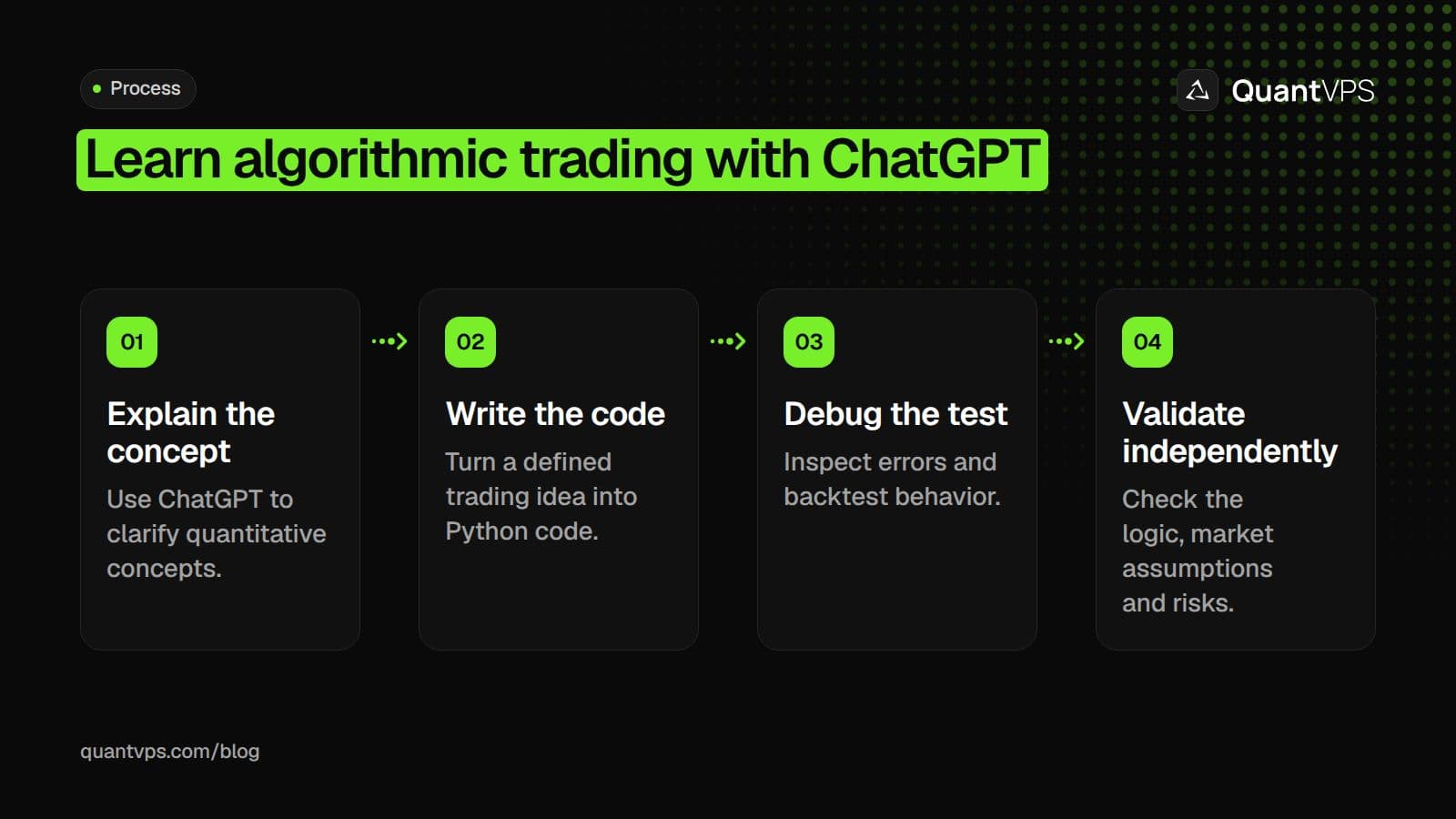
What can ChatGPT actually do for algorithmic trading learners?
But creating an answer isn't the same as knowing whether the underlying assumption is sound. When you ask ChatGPT to build a mean-reversion strategy, it will. What it cannot tell you is whether the statistical relationship you're using is real, persistent, or already arbitraged away by funds with better data and faster infrastructure. That judgment requires a mental model built from studying how markets work, not how code runs.
The failure point is invisible until real money is on the line. A strategy can look convincing in a backtest and collapse in live trading because the model never accounts for transaction costs, slippage, or the difference between adjusted and unadjusted price data. These aren't edge cases; they are the core problems separating profitable systematic traders from those who built something that worked only in a spreadsheet. According to machinelearning-basics.com, a focused introduction to using ChatGPT for algorithmic trading takes about 10 minutes to read, showing how surface-level AI-assisted learning often stops there.
Where does relying on AI-generated strategies break down?
Most traders who rely solely on AI-generated strategies eventually hit the same problem: they can build systems but cannot evaluate them. They don't know if their Sharpe ratio is meaningful or inflated by overfitting. They can't distinguish signal from noise in their equity curve. They lack the vocabulary to ask the right questions, so they cannot spot when ChatGPT gives them answers that sound right but contain methodological flaws.
How does foundational knowledge change the way AI tools perform?
This doesn't make AI useless. It makes AI a powerful tool for someone who understands the basics and can evaluate what it produces. Think of a calculator in the hands of someone who understands math versus someone who doesn't. Traders who use AI effectively use it to make implementation easier, not to replace the judgment required to decide what's worth implementing. Running those strategies reliably around the clock is a separate challenge, and that's where our trading VPS helps: it keeps your automated systems executing without interruption while you focus on refining the logic behind them.
What books give you that AI cannot is harder to name but easy to feel when it's missing.
What Do Algorithmic Trading Books Teach That AI Can't?
Knowledge has layers. The top layer is information: facts, formulas, code snippets, and indicator explanations. AI delivers that instantly and accurately, but that's only the surface. Underneath sits something far harder to transfer: the conceptual architecture that tells you why those facts connect, which ones to trust, and what to do when they conflict. That architecture is exactly what the best algorithmic trading books transmit, and what no prompt can replicate.
"The difference between information and understanding is the difference between knowing a formula and knowing when not to use it." (A foundational principle across elite quant trading literature)
Tip: When reading algorithmic trading books, don't just absorb the what. Actively interrogate the why behind every model, rule, and framework presented.
Takeaway: AI excels at delivering the top layer (facts, code, and formulas), but the deeper layer of conceptual architecture, judgment, and conflict resolution between competing signals is what separates an informed reader from a disciplined algorithmic trader.
| Layer | What It Contains | Who Delivers It Best |
|---|---|---|
| Top Layer | Facts, formulas, code snippets, indicator explanations | AI (instantly and accurately) |
| Deep Layer | Conceptual architecture, trust hierarchies, conflict resolution | Algorithmic trading books |
The knowledge gaps that actually cost traders money
According to QuantStart, algorithmic trading requires three skills: alpha modeling, risk management, and automated execution systems. Most beginners focus only on the first. Books encourage you to consider all three as an integrated system rather than separate components.
Uptime
99.999% uptime. Built for 24/7 trading reliability.
Your VPS runs in Tier IV datacenters with redundant power and network, monitored 24/7 on site.
See the uptime SLA





From $29.99/mo · Windows or Linux
Why does skipping hypothesis formation undermine your strategy?
Strategy design finds problems early. Most traders skip hypothesis formation and jump from "this pattern looks interesting" to backtesting. That shortcut creates systems built on coincidence, not logic. A trading book teaches you to ask: what market condition creates this edge, and why should it persist?
How does overconfidence in backtesting become expensive?
Backtesting and validation are where overconfidence becomes expensive. Look-ahead bias, survivorship bias, data snooping, and overfitting are not abstract warnings: they are the specific ways a strategy that looks brilliant in testing fails in live markets. Understanding them deeply enough to check your own work separates a system you can trust from one you merely hope works. QuantStart identifies momentum and mean reversion as the two core strategy types consistently examined across foundational trading books because they behave differently under these failure conditions.
Where do self-taught traders have the thinnest foundation?
Market mechanics and risk construction are where most self-taught traders have the weakest foundation. Spreads, slippage, order book depth, and market impact form the environment your strategy operates within. A position-sizing rule that ignores correlation across holdings, or a system that treats all drawdowns as equivalent, will produce losses the backtest never showed. Books build these concepts as connected layers, developing your judgment to question assumptions before the market does.
The books below address these specific layers from different angles, giving you the words to examine your own system honestly. Knowing which question to ask is often worth more than any answer AI can generate.
Ready to Put Your Algorithmic Trading Strategy to Work?
Most traders start by running automated strategies on their personal computer, but a restart, dropped connection, or system update can interrupt a live position with real consequences. Even a brief disruption can mean missed entries, unmanaged exits, or unexpected losses: risks that are entirely avoidable with the right infrastructure.
Warning: Running automated trading strategies on a personal computer is one of the most common and most costly mistakes new algorithmic traders make. System updates, power outages, and internet drops don't wait for a convenient moment.
Our platform lets you deploy your environment in minutes without depending on your local machine staying online.
| Platform Supported | Use Case |
|---|---|
| NinjaTrader | Futures & forex automation |
| TradeStation | Equities & options strategies |
| MetaTrader | Forex & CFD algo trading |
| Interactive Brokers | Multi-asset automated execution |
| Sierra Chart | Advanced charting & system trading |
| Quantower | Modern multi-broker algo deployment |
1. Algorithmic Trading by Ernest P. Chan
Ernest P. Chan's "Algorithmic Trading: Winning Strategies and Their Rationale" expands on his earlier work by diving deeper into advanced mathematical concepts and practical strategy development. This book shifts its focus toward actionable strategy execution, making it a valuable resource for both novice retail traders and seasoned institutional professionals.
The book explores real-world trading strategies, such as mean reversion and momentum, offering detailed guidance on their development and implementation. Chan pairs theoretical insights with practical coding examples, ensuring readers can apply what they learn directly to the markets. For instance, advanced techniques like Kalman Filters, stationarity and cointegration testing, and the CADF test are introduced to help identify trading opportunities while reducing false signals.
What makes the book particularly versatile is its coding examples. Originally written in MatLab, these examples can be easily adapted to Python (using pandas), R, or C++, which is especially useful when working in Python. This flexibility ensures that the mathematical principles Chan presents remain applicable, no matter the programming language.
Chan also addresses some of the most common challenges in algorithmic trading, such as design flaws, risk management issues, and discrepancies between backtesting results and live trading performance. He emphasizes the importance of recognizing shifts in market behavior - known as regime changes - and adjusting algorithms accordingly. This adaptive approach is critical in understanding the ever-changing environment of today's financial markets.
Beyond just strategy execution, the book encourages readers to critically evaluate the performance of their algorithms. It stresses the importance of understanding why certain strategies succeed in specific market conditions, helping traders avoid the trap of curve-fitting historical data. For anyone looking to develop robust algorithmic trading systems, this guide offers a thoughtful balance of theoretical depth and practical insights, equipping readers with the tools needed to thrive in a dynamic trading environment.
2. Quantitative Trading by Ernest P. Chan
For those starting out, Ernest P. Chan's "Quantitative Trading: How to Build Your Own Algorithmic Trading Business" is a go-to resource. This book's second edition remains a standout introduction to algorithmic trading, blending theory with hands-on application. It’s widely regarded as one of the easiest-to-digest books in the field.
What makes this book unique is its straightforward approach to creating a quantitative trading system. Chan focuses on helping individuals build their own algorithmic trading setups without needing the resources of a large institution. He breaks down the process step by step, covering everything from alpha generation (developing trading strategies) to creating automated execution systems. The book connects core concepts to practical tools, making it a solid starting point for anyone aiming to dive deeper into the world of algorithmic trading.
The book also dives into specific strategies like momentum and mean reversion, offering clear, actionable advice. Chan explains how to design, backtest, and implement these strategies using tools like MatLab or Excel. This practical guidance helps readers understand how these strategies perform in real-world markets.
Risk management is another key focus. Chan stresses the importance of protecting your capital and understanding the risks involved in trading. This balanced approach ensures that readers are equipped to avoid common mistakes that could undermine their strategies.
The second edition, published by Wiley in July 2021, adds new case studies, updated backtests with Python and R code examples, and a method that uses machine learning to tune parameters as market regimes change. These additions keep the book relevant for today's markets.
"Dr. Chan offers a clear overview of the process of setting up a 'retail' quantitative trading system, using MatLab or Excel. He makes the subject highly approachable and gives the impression that 'anyone can do it'."
Beyond just strategies, the book takes a broader look at building a trading business. Chan shares advice on assembling a strong investment team and structuring operations for long-term growth - essential for traders aiming to scale beyond personal accounts.
This book is a strong first read for newcomers and a useful check on process for experienced traders.
While Chan’s other works examine more advanced techniques, "Quantitative Trading" provides the solid groundwork needed before tackling more complex strategies.
3. Inside the Black Box by Rishi K. Narang
Rishi K. Narang’s "Inside the Black Box" pulls back the curtain on how professional quantitative hedge funds operate. What makes this book stand out is its focus on more than just trading strategies - it dives into how institutional traders build and manage their entire trading systems from scratch.
Narang walks readers through the structure of a professional quantitative trading system, covering everything from strategy development and testing to day-to-day operations. For retail traders, this perspective is eye-opening, as it highlights the significant differences between their methods and those of seasoned professionals. The book emphasizes that managing costs and risks isn’t just a side note - it’s at the core of creating effective trading strategies.
A major strength of the book lies in its detailed exploration of transaction costs and risk management. These topics might not seem flashy, but they are critical. Narang explains how professional firms handle slippage, commissions, and market impact - hidden costs that can quietly eat away at returns if ignored. He also delves into how institutional traders approach risk management, offering insights into portfolio construction and position sizing that can help readers rethink their own trading frameworks.
The book provides a broad overview of the quantitative trading world, touching on everything from data management to execution systems. While it doesn’t go into extreme depth on any single topic, its wide-ranging scope is actually one of its greatest assets. It gives readers a clear picture of how the various components of quantitative trading fit together, making it easier to understand the bigger picture.
"Many retail algo traders could do well to pick this up and see how the 'professionals' carry out their trading."
What makes this book especially relevant today is its ability to bridge the gap between retail and institutional trading. By understanding how professional quantitative funds operate, retail traders can identify blind spots in their own systems and adopt practices they might not have considered. It also offers a deeper understanding of market dynamics - knowing how the big players think and act can provide a competitive edge. These insights can help retail traders fine-tune their systems and improve their overall performance.
"Great book for a headstart on all the different aspects of quant trading. Very general information, but broadly brushes through every aspect of the business."
4. Python for Algorithmic Trading by Yves Hilpisch
Yves Hilpisch's "Python for Algorithmic Trading" is a must-read for anyone who wants to use Python for algorithmic trading. The book goes beyond Python syntax. It shows how to apply Python to real trading problems, from analyzing data to placing trades in live markets, and bridges basic Python skills and advanced trading applications.
The book, published by O'Reilly in November 2020, covers the coding and data-analysis tasks traders face today. Hilpisch works through advanced coding methods, data-driven trading strategies and execution models, so you can put it into practice right away.
For those new to algorithmic trading, the book provides a clear roadmap for implementing trading strategies using Python. It covers essential skills such as data manipulation and time series analysis, making it accessible for beginners.
Experienced traders will appreciate the deeper look at advanced techniques. For example, the book teaches how to construct a complete framework for Monte Carlo simulation-based derivatives and risk analytics, a critical tool for quantitative professionals.
One of the book's strengths is its detailed guidance on backtesting and data analysis. It walks readers through the process of testing strategies against historical data, helping to interpret results effectively and avoid common errors. Additionally, the discussion on execution models is particularly useful for transitioning from simulated strategies to live trading. The book also includes key functions for quants working in algorithmic trading and derivatives pricing, offering practical tools for immediate use.
As markets evolve, staying ahead requires a solid technical foundation. This book equips traders with the skills needed to build reliable, automated trading systems that hold up as markets change.
5. Advances in Financial Machine Learning by Marcos López de Prado
This book takes the principles of algorithmic trading to the next level by incorporating advanced machine learning techniques to sharpen and refine trading strategies.
Marcos López de Prado's "Advances in Financial Machine Learning" is widely regarded as a resource in the field of algorithmic trading. It delves into structuring large datasets for trading purposes, leveraging machine learning for financial research, and utilizing advanced computing methods to solve complex problems in finance. The book tackles real-world challenges that professionals encounter when applying machine learning, offering practical tools and methods for rigorous testing.
"This book will provide you with an in-depth knowledge of structuring big data, conducting research with Machine Learning algorithms and using computing methods which are much more improved. It has comprehensive content on real-life problems that are faced by those who use Machine Learning on a regular basis. You can even test the solutions in a particular setting and be equipped with powerful tools to succeed." - QuantInsti
For traders eager to enhance their toolkit with sophisticated machine learning approaches, this book serves as a must-have guide to move beyond basic strategies and tackle the complexities of modern financial markets.
Order flow
Built for scalpers. Heatmaps on dedicated resources.
Order-flow heatmaps and DOM ladders run on dedicated CPU, memory and NVMe, so your charts keep responding during volatility.
See the dedicated hardwareFrom $29.99/mo · Windows or Linux
6. Building Winning Algorithmic Trading Systems by Kevin J. Davey
Kevin J. Davey offers a practical, no-nonsense guide to algorithmic trading in his book "Building Winning Algorithmic Trading Systems." Unlike books heavy on theory, this one walks you through the process of building a trading system from the ground up - covering everything from data mining and Monte Carlo simulation to live trading implementation.
One of the standout features of this book is its focus on backtesting and optimization. Davey emphasizes the importance of using data mining and Monte Carlo simulations as tools to develop and validate trading systems before putting real money on the line. These methods help traders grasp the range of potential outcomes in actual market conditions, making the transition from paper trading to live trading smoother and less risky.
What makes this book unique is its comprehensive approach. Davey doesn’t stop at strategy creation; he also dives into the critical validation steps required before taking a system live. This end-to-end perspective ensures traders have a clear understanding of the entire lifecycle of a trading system.
The book has earned its reputation as a reliable resource. It is supported by an accompanying website that provides extra tools and materials for your learning.
If you're looking to move beyond basic trading strategies and want to learn how to properly validate your systems before going live, this book serves as an excellent guide. It provides a structured approach to help you build confidence in your trading systems, setting a strong foundation for exploring more advanced techniques in the sections ahead.
7. Trading Systems and Methods by Perry J. Kaufman
Perry J. Kaufman's "Trading Systems and Methods" is a go-to resource for anyone serious about systematic trading. Instead of focusing on a single strategy or coding language, this book takes you through the entire process of rules-based trading - from understanding market behavior and designing strategies to testing, execution, and risk management.
Kaufman’s platform-agnostic approach can be used across trading platforms. While markets and automation tools continue to evolve, the core principles he outlines still hold up. When coding in Python, using a backtesting engine, or connecting to a broker’s API, his methods can be applied across modern trading platforms. This flexibility makes it easier to integrate his strategies into today’s coding practices and testing environments.
The book dives into a wide range of trading systems, many of which align with strategies used by U.S. algorithmic traders. Kaufman covers trend-following systems, mean-reversion setups, pattern-based rules, and volatility- or momentum-driven models. On top of individual strategies, he also discusses portfolio-level techniques, filters, and parameter selection, helping you scale single-strategy ideas into diversified, automated trading programs.
Kaufman places a strong emphasis on disciplined backtesting and evaluation. He explains how to use out-of-sample data, walk-forward testing, and robustness checks to avoid curve-fitting and over-optimization. His methods encourage testing strategies on historical data from major U.S. markets and evaluating metrics like drawdown, win rate, and Sharpe ratio to ensure your system can handle real-world conditions.
For those new to algorithmic trading, Kaufman’s examples provide a clear starting point. For instance, he demonstrates a moving-average trend-following strategy on a U.S. equity index ETF, using simple crossover signals to define entries, exits, and position sizes. Another beginner-friendly example is a mean-reversion system for highly liquid U.S. stocks, where you buy during short-term price dips and exit on recovery. His guidelines for incorporating volatility filters and risk management make these strategies easy to code and test.
Risk and money management are central themes throughout the book. Kaufman stresses that managing risk is just as important as generating signals, dedicating significant attention to position sizing, diversification, and controlling drawdowns. For practical application, he recommends using fixed-fractional or volatility-based position sizing, limiting per-trade risk to a small percentage of account equity (e.g., 0.5–2%), and monitoring drawdowns in both percentage and dollar terms. These practices help traders decide when to scale back or pause a system altogether.
Unlike books that focus on machine learning or specific coding platforms, Kaufman’s work serves as a guide to rules-based trading. It’s a foundational reference you can pair with more technical resources. By applying Kaufman’s principles, you can design systems and then confidently implement them programmatically.
That said, the book isn’t without challenges. It’s dense and math-heavy, so don’t expect a quick-start guide or ready-made algorithms. Some examples date back to earlier market conditions, so you’ll need to adapt them for today’s U.S. markets. This includes accounting for modern transaction costs, market structures, and the impact of automation.
To make the most of this book, start small. Focus on one type of system, such as trend-following or mean reversion, and convert the rules into pseudo-code or executable code. A practical workflow might look like this: choose a market (e.g., a major U.S. futures contract or ETF), implement one Kaufman-style system, test it on several years of historical data, analyze performance and risk metrics, and then expand to multi-asset portfolios or refine the strategy further. The book is available in both hardcover and digital formats, making it easy to apply its concepts using tools like Python notebooks or broker APIs.
This book is best suited for intermediate to advanced traders, quants, or developers looking for a deep and systematic framework rather than quick strategy templates. Beginners may find the material challenging and should consider pairing it with an introductory book on algorithmic trading or Python to build foundational knowledge. If you’re comfortable with data analysis and statistics and are committed to building long-term, rules-based trading systems, this book will serve as an invaluable resource.
Kaufman’s insights perfectly complement the technical and infrastructure topics discussed earlier, providing a solid foundation for a well-rounded approach to algorithmic trading. The next section will introduce additional resources to further expand your trading expertise.
8. Big Data and Machine Learning in Quantitative Investment by Tony Guida
"Big Data and Machine Learning in Quantitative Investment", edited by Tony Guida and published by Wiley in March 2019, shows how practitioners apply machine learning and big data to quantitative investing. Wiley describes it as a book "by practitioners for practitioners" that covers the why and the how, not just the maths or the code.
The book has 13 chapters, each written by a different author on a specific case. They run from the big picture and a taxonomy of methods, to practical machine learning applications, to newer approaches using deep learning. It pairs well with the more technical books above.
9. QuantConnect: Algorithmic Trading Platform and Data Resource
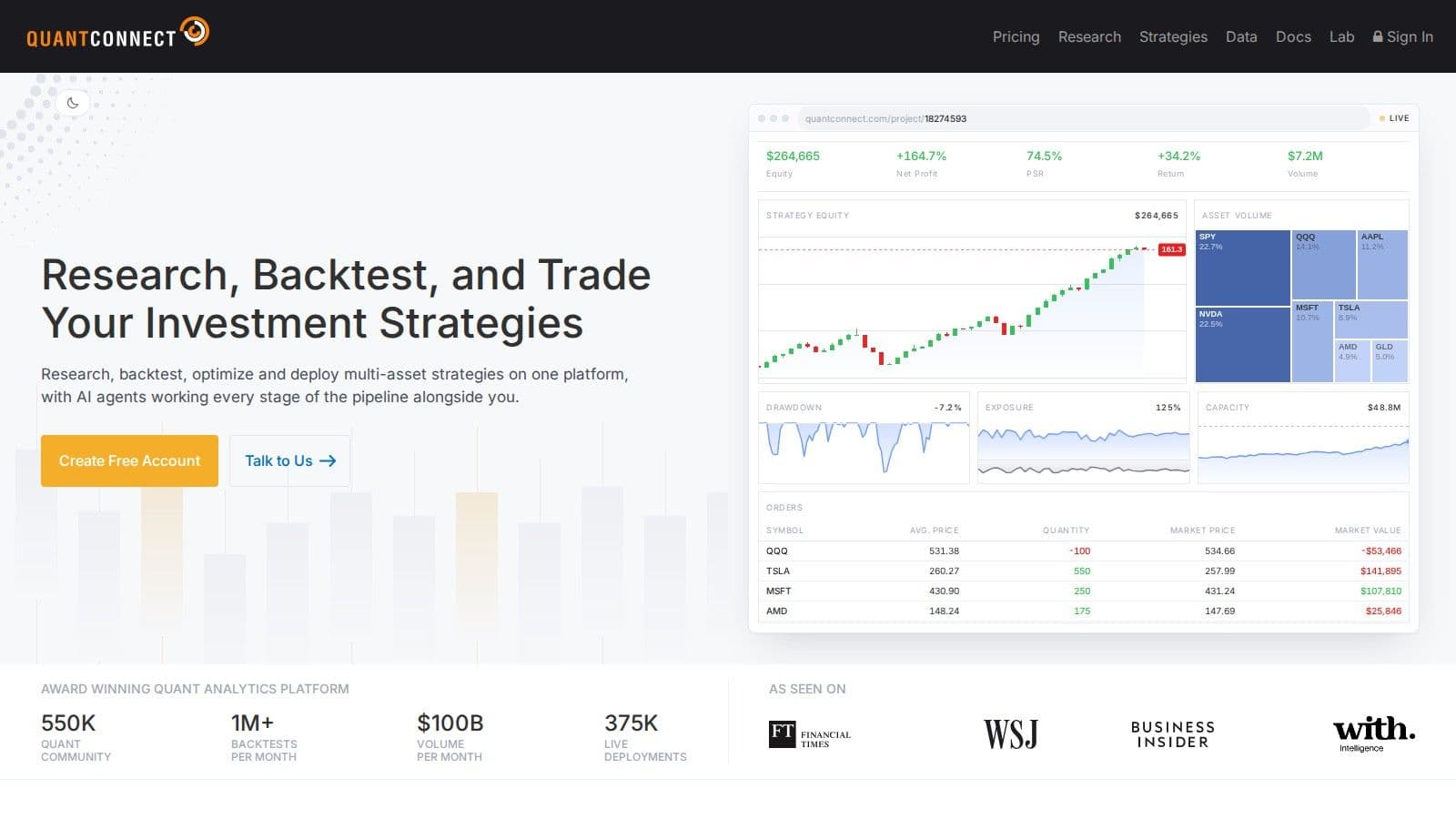
QuantConnect provides a streamlined platform for algorithmic trading, with tools for strategy creation, testing and deployment in one place, as covered in our QuantConnect review. With its cloud-based setup, you can design, backtest, and execute trading strategies without the hassle of managing your own data pipelines or infrastructure. This makes it a convenient choice for traders looking to simplify the technical side of their operations.
QuantConnect has earned a solid reputation among traders. As Jared Broad, the platform's Founder and CEO, stated, it has "empowered over 300,000 algorithmic traders worldwide with a platform that simplifies strategy design, backtesting, and live deployment".
QuantConnect Features
One of QuantConnect's key strengths is its access to institutional-grade market data. This allows users to backtest strategies using historical data that mirrors actual market conditions, providing a reliable foundation for strategy development.
If you're familiar with resources like Python for Algorithmic Trading or Advances in Financial Machine Learning, QuantConnect offers a practical environment to bring those concepts to life. The platform is particularly well-suited for Python-based trading and even supports AI-driven strategies, making it a versatile tool for modern traders.
Integration with Development Tools
QuantConnect enhances its functionality by integrating with popular development tools. For instance, it connects with GitHub for version control, making collaboration and code management easier. The platform also supports Jupyter notebooks, which are great for exploratory data analysis and prototyping. On top of that, detailed performance reports help you evaluate and refine your strategies effectively.
From Backtesting to Live Trading
What sets QuantConnect apart is its ability to take you from idea to execution. You can write your strategy in Python or C#, backtest it with historical data, and then deploy it for live trading through supported brokers - all within the same platform. This end-to-end workflow eliminates the usual friction between testing and real-world application, allowing you to focus on fine-tuning your strategies.
Focus on Practicality
By leveraging QuantConnect's cloud-based system, traders can avoid the complexities of managing infrastructure. This lets you channel your energy into improving your trading strategies and honing your techniques, rather than getting bogged down in technical details.
Conclusion
Developing an algorithmic trading process requires a combination of sound theoretical knowledge and execution. This guide brings together resources that blend foundational principles with hands-on application to help you succeed.
Start with Ernest P. Chan's books to establish a strong base in strategy development and risk management. These works provide the groundwork for understanding more advanced concepts. For insights into how professional trading firms operate, Rishi K. Narang's Inside the Black Box offers a detailed look at institutional approaches to quantitative strategies. Perry J. Kaufman's Trading Systems and Methods serves as a go-to resource for technical indicators and system design principles that have proven their worth over time.
Python remains the dominant programming language for algorithmic trading, and Yves Hilpisch's Python for Algorithmic Trading is an excellent resource to connect coding skills with trading applications. Pair this with Marcos López de Prado's Advances in Financial Machine Learning, which addresses the challenges of applying machine learning to financial data - an increasingly important skill as AI-driven strategies gain traction.
As you advance, practical guides can help you refine your strategies. Kevin J. Davey's Building Winning Algorithmic Trading Systems and Big Data and Machine Learning in Quantitative Investment, edited by Tony Guida, focus on real-world implementation and portfolio management. These books not only help you avoid common mistakes but also teach you how to evaluate whether your strategies are ready for live trading.
Once you've honed your theoretical understanding, it's time to put it into action. QuantConnect supports backtesting and strategy deployment in Python. Its integration with tools like GitHub and Jupyter notebooks makes it easier to turn ideas into working code.
For live trading, reliable infrastructure is critical. QuantVPS plans range from VPS Starter at $29.99/month to Dedicated+ at $399.99/month (checked on 10 Oct 2026), catering to traders with varying needs.
The combination of educational resources and practical tools is key. By progressively integrating these resources, you can transition from learning the theory to achieving profitability.
For U.S. traders, the environment offers advanced learning materials and tools. The secret lies in treating algorithmic trading as a skill that develops over time. By systematically working through these resources and applying your knowledge in practical settings, you'll build the expertise needed to understand the complexities of modern markets with confidence and precision.
FAQs
What are the best ways for beginners to move from learning algorithmic trading theory to applying it in real markets?
For those just starting out in algorithmic trading, bridging the gap between learning and doing is all about using the right resources that mix practical advice with hands-on tools. Books like "Python for Algorithmic Trading" by Yves Hilpisch and "Quantitative Trading" by Ernest P. Chan are fantastic for beginners. These guides walk you through the essentials - coding, backtesting, and executing trading strategies step by step.
If you're ready to examine practice, look into platforms that let you test strategies in simulated environments. This way, you can experiment with pre-built or custom strategies without risking real money. Tools like AI-assisted code generators can also help streamline tasks like developing strategies and analyzing markets. The key is to practice regularly and stick to resources that keep up with the latest trends in algorithmic trading.
How do the recommended books and resources help integrate machine learning into algorithmic trading strategies?
The books explain how to prepare data, test models and evaluate a trading strategy. Marcos López de Prado's Advances in Financial Machine Learning and Machine Learning for Asset Managers cover methods used in financial research. Read the assumptions behind each method and test it on data that was not used to fit the model.
For hands-on practice, consider Hands-On AI Trading with Python, Quantconnect, and AWS. This book emphasizes practical applications, such as creating regression-based portfolios and forecasting market volatility. These resources aim to tackle real-world trading challenges and provide traders with the tools to stay competitive in a rapidly changing market.


