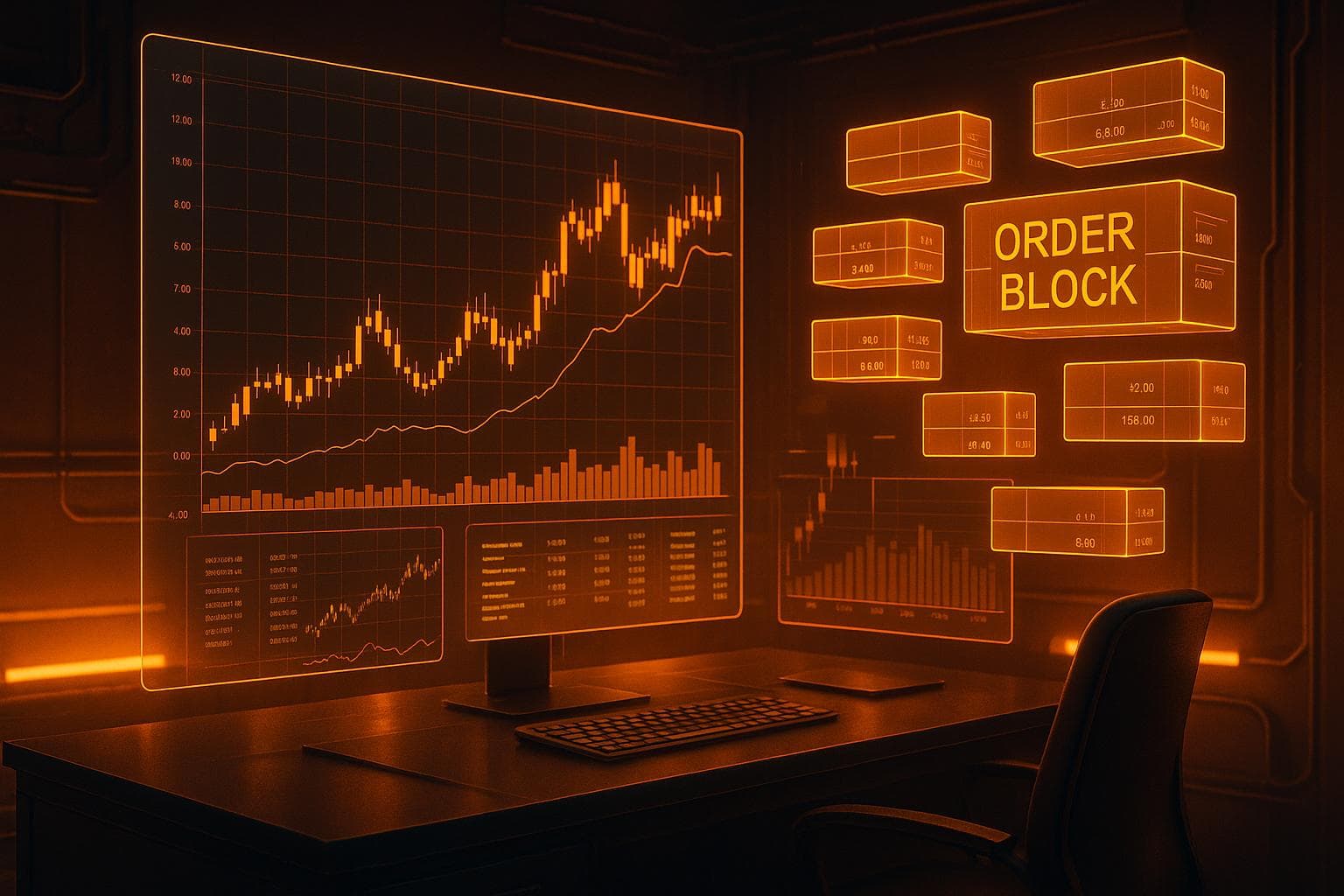
Order blocks are key price zones where large institutions place buy or sell orders. These zones, formed during market consolidation followed by strong breakouts, represent areas of institutional interest and often act as support or resistance levels. Retail traders can use these to align their strategies with institutional activity, improving trade accuracy and risk management.
Key takeaways:
- Bullish Order Blocks: Form below the current price and act as demand zones.
- Bearish Order Blocks: Form above the current price and act as supply zones.
- Identification: Look for consolidation zones, engulfing candlestick patterns, and volume spikes.
- Automation: Order blocks can be integrated into algorithms for systematic trading.
Order blocks provide precise entry, exit, and stop-loss zones, making them a valuable tool for traders seeking structured setups. However, they require careful analysis and reliable data to avoid false signals and ensure effective execution.
How to Identify and Trade Order Blocks
What Are Order Blocks? Key Concepts
An order block is a price area where institutional traders execute large buy or sell orders. Instead of placing one massive order that could disrupt the market, institutions break these orders into smaller chunks, creating zones of concentrated buying or selling interest.
Unlike traditional support and resistance levels, which are based on historical price patterns, order blocks reflect actual order flow. This makes them a more reliable indicator of future price movements. Essentially, an order block highlights areas where institutional orders remain unfilled or where renewed interest in the market is likely to occur.
By understanding how order blocks influence price direction, traders can identify whether these zones act as demand or supply areas. Let’s explore the differences between bullish and bearish order blocks and their roles in market behavior.
Bullish vs. Bearish Order Blocks
Bullish order blocks are areas where institutional buying has driven prices higher. These zones often appear as periods of consolidation before a strong upward breakout. When the price revisits these levels, they serve as demand zones, attracting renewed buying interest.
A bullish order block typically shows price moving within a tight range, followed by a sharp upward breakout with strong momentum. The consolidation phase represents where institutions accumulated long positions, making it a critical area for future price support.
On the flip side, bearish order blocks form in regions where institutional selling has pushed prices lower. These zones act as supply zones, drawing selling interest when the price returns to them. Bearish order blocks usually appear as areas where the price struggled to rise before breaking down.
The distinction between the two is straightforward: bullish order blocks are below the current price and act as support when tested, while bearish order blocks are above the current price and act as resistance. However, the strength of these zones depends heavily on the volume and institutional activity that created them - data an order-flow platform shows best when it runs on a low-latency algo trading VPS with a clean tick feed.
What are the Types of Order Block Strategy?
Not every order block deserves the same response. Treating all order blocks as the same is one of the most common mistakes traders make, silently draining performance over time. The type of order block you're looking at should shape your entry logic, targets, and risk tolerance.
⚠️ Warning: Treating every order block with the same entry logic silently kills performance. The type of block you're trading should fundamentally change your approach.
💡 Tip: Before placing any trade, identify the specific order block type first. Your risk tolerance and target levels should shift accordingly.

According to Colibri Trader's guide on order block trading strategy, bullish and bearish order blocks form the foundation of the institutional order block trading strategy, but the full picture is considerably more complex than that simple view suggests.
"Bullish and bearish order blocks form the foundation of institutional order block trading strategy — but the full picture is considerably more complex than that simple view suggests." — Colibri Trader
🔑 Takeaway: Understanding the complete spectrum of order block types — not just bullish and bearish — is what separates consistent institutional traders from those who struggle to replicate results.
| Order Block Type | Market Bias | Trader Response |
|---|---|---|
| Bullish Order Block | Upward momentum | Look for long entries |
| Bearish Order Block | Downward momentum | Look for short entries |
| Breaker Block | Reversal signal | Adjust risk tolerance aggressively |
| Mitigation Block | Retest of failed move | Tighten targets and entries |
Bullish Order Block
A bullish order block forms when institutions build large buy positions before a sharp upward move. It appears as the last bearish candle before an impulsive bullish rally: the final moment smart money loaded up on long positions at a discount. Price tends to return to that zone before continuing higher.
When and how should you trade a bullish order block?
This strategy works best when prices are rising and making higher highs and higher lows. Traders use it to find entry points during pullbacks rather than buying after large moves. The advantage is entering where institutional buyers entered, providing solid support. However, prices returning to the zone won't always hold: if the overall market turns downward, a bullish order block can fail without warning.
Bearish Order Block
The bearish order block forms as the last bullish candle before a strong downward move, marking the zone where institutions distributed sell orders into retail buying pressure. Price often returns to this supply zone before continuing lower, providing traders a high-probability short entry.
This strategy performs best in downtrending conditions with clear market structure breaks to the downside. Shorting presents a greater psychological challenge for many traders because it requires fighting the instinct to seek buying opportunities. If price reclaims the bearish order block and closes above it, the zone has been invalidated.
Continuation Order Block
The continuation order block forms inside an existing trend, representing a brief pause rather than a reversal. In an uptrend, this looks like re-accumulation; in a downtrend, re-distribution. Price consolidates temporarily as smart money adds to existing positions, then the trend resumes with fresh momentum.
What are the strengths and limitations of this strategy?
This strategy's strength is that it aligns with the easiest path: you join the trend at a better price instead of fighting it. Traders who miss the first move often find their best second chance to enter here. The limitation is timing—continuation blocks can be difficult to distinguish from early reversal signals, especially in choppy or news-driven markets.
Reversal Order Block
Reversal order blocks form near significant market tops and bottoms where institutional behavior shifts from accumulation to distribution, or vice versa. The last bullish candle at a major top or the last bearish candle at a major bottom often marks this transition.
Why do reversal order blocks carry the highest risk and reward?
This strategy offers the highest reward potential and the highest risk. Calling a reversal means positioning against current momentum, which requires strong signals from multiple timeframes and market structure. According to Colibri Trader, order blocks are identified across timeframes ranging from one-minute to monthly charts, with the four-hour and daily timeframes most commonly used by institutional traders. Reversal order blocks on higher timeframes carry significantly more weight than those on lower ones.

Your trading computer. In the cloud.
Connect and control your trading strategies from any device, anywhere in the world, through secure remote desktop, while execution remains on QuantVPS.
From $29.99/mo · Windows or Linux · 8 datacenters
0.52ms to CME from our Chicago nodes.


 NinjaTrader
 MetaTrader
 TradingView
 Tradovate
 Rithmic
 Sierra Chart
 Bookmap
 Quantower
Breaker Blocks
When a valid order block fails and price breaks through it, the zone flips: former support becomes resistance, and former resistance becomes support. This is a breaker block, one of the most powerful setups in smart money trading because it traps traders positioned on the wrong side of the break.
The breaker block strategy works best after a clear structural break, where price decisively breaks through a previous order block. These zones are precise and well-defined, but traders often misidentify temporary wicks through a zone as true breaks, leading to false signals and premature entries.
Mitigation Blocks
Mitigation blocks form when price returns to a previous order block, allowing institutions to reduce or exit positions before the next significant move. Smart money balances its books, creating predictable price reactions.
Mitigation blocks often precede significant directional moves, allowing traders to position ahead of the move rather than react. The risk is that mitigation may be incomplete, with the price resuming before a full reaction occurs.
What makes an order block strong versus weak?
A strong order block breaks an important structure: price breaks a high or low after leaving the zone, leaving a visible imbalance and a fast, clean move away. It signals genuine institutional involvement and has not been tested repeatedly. Each revisit depletes pending orders, gradually weakening the zone.
How does a weak order block lead traders astray?
A weak order block drifts away slowly, doesn't break structure, and has been visited multiple times. Trading weak blocks is one of the most consistent ways traders lose money on seemingly valid setups. The structural context separates them.
Understanding what makes a block strong versus weak is tested when you face a live chart with no labels and no hindsight.
How to Identify a Valid Order Block
Telling the difference between a real order block and a fake one decides whether traders get an edge or lose it. Live charts don't show labels or proof of big institutional money — you have to find it yourself. You need a repeatable checklist that you apply the same way before every single trade.
"Live charts don't show labels or proof of big institutional money — the edge belongs to traders with a repeatable, disciplined checklist." — Core Order Block Principle
🎯 Key Point: A valid order block is not just any consolidation zone — it must meet specific structural criteria before you risk a single dollar on it.
⚠️ Warning: The most common mistake traders make is misidentifying random wicks or consolidation areas as order blocks. Without a strict checklist, you're trading noise, not institutional intent.
| Criteria | Valid Order Block | Fake Order Block |
|---|---|---|
| Price Reaction | Strong, impulsive move away | Weak or gradual drift |
| Return to Zone | First or second touch only | Multiple touches (zone is consumed) |
| Institutional Evidence | Clear imbalance or FVG present | No supporting market structure |
| Trend Alignment | Aligned with higher timeframe bias | Against the prevailing trend |
⚡ Pro Tip: Apply your order block checklist on a higher timeframe first — then drop down to refine your entry. This keeps you aligned with big-money moves and filters out low-quality setups before they cost you.

Six criteria that confirm a genuine order block
Check whether the order block preceded a sudden price move. Institutions build up quietly, leaving order blocks as their mark. If the candle sits within a ranging structure with no clear directional explosion afterward, it is invalid. According to LuxAlgo's research on order block identification, a valid order block requires a three-candle structure: the order block candle itself, a displacement or gap candle, and a follow-through candle confirming the move. Without it, you are drawing zones on noise.
Strong displacement is the second filter. Price should move sharply and cleanly in one direction after the block forms. Choppy, grinding movement signals indecision rather than institutional involvement. The third criterion follows directly: identify the last candle that moved in the opposite direction to the upcoming trend. In a bullish setup, that is the final bearish candle before the rally; in a bearish setup, it is the last bullish candle before the drop. That specific candle defines the zone you will draw.
The fourth and fifth criteria work together. The move from the block must break a structural level or clear a liquidity area: a prior swing high or low, a cluster of stop-losses, or key support and resistance. A block producing a weak, contained move is not genuine. Price must then return to mitigate the block. Institutions rarely fill entire positions in one pass; the revisit is where they complete the order and create the high-probability trade setup.
LiquidityFinder's guide on drawing order blocks accurately identifies four key confirmation factors: displacement, liquidity, fair value gap proximity, and curve context. A sixth criterion—volume spikes, oversized wicks, and other smart money footprints—strengthens the block's validity. When volume surges at the point of origin, it confirms the move was institutional rather than retail-driven. When these six conditions align, the block reflects genuine institutional positioning rather than a random price level.
Are Higher Timeframe Order Blocks Stronger?
Higher-timeframe order blocks are structurally different because they represent significant liquidity absorbed over extended periods. A daily or weekly block reflects institutional participation and deeper position-building, creating a stronger reaction when price returns, whereas a one-minute block formed by a scalping algorithm carries none of that weight.
| Timeframe | Relative Strength | Who Forms Them | Reliability | Best Trading Use |
|---|---|---|---|---|
| Monthly / Weekly | Very High | Banks, funds, institutions | Extremely high | Long-term bias, major reversals |
| Daily / 4H | High | Institutions, swing traders | High | Swing trades, key demand and supply zones |
| 15m / 5m | Medium | Active traders, algos | Moderate | Entry timing with higher timeframe alignment |
| 1m to 3m | Low | Scalpers, noise | Low | Precision entry only |
The practical application is top-down analysis: identify institutional intent on the daily or weekly chart, then drop to the fifteen-minute or five-minute chart to find a lower-timeframe order block nested inside the higher-timeframe zone. That alignment concentrates probability. A lower-timeframe entry without a higher-timeframe anchor is speculation; a lower-timeframe entry within a confirmed higher-timeframe block is a structured trade.
Once your framework is solid, the next challenge is executing before the window closes.
Why Order Blocks Matter in Trading
Order blocks are significant because they reveal where institutional traders - often referred to as "smart money" - are active. Unlike retail traders, institutions base their decisions on extensive research, structured risk management, and clear profit objectives. When they establish positions within order blocks, it reflects calculated moves tied to fundamental analysis and market conditions.
For retail traders, understanding order blocks means aligning with institutional activity rather than working against it. Many retail traders lose money trying to counter institutional moves, only to find themselves caught on the wrong side of strong trends. By identifying order blocks, traders can position themselves in areas where institutions are likely to defend or add to their positions.
Order blocks also offer precise entry and exit points for trading strategies. Unlike subjective methods that rely on intuition or vague chart patterns, order blocks provide well-defined price zones that can be integrated into systematic approaches. This is particularly useful for traders who use automated systems, as order blocks allow for clear, testable criteria.
One of the reasons order blocks are so reliable is that institutional orders are not short-term. For example, when a major financial institution establishes a position at a specific price level, they often have long-term objectives. This ensures that these levels remain relevant over time, creating repeated opportunities as the price revisits these zones.
For automated trading, order blocks provide structured risk-reward setups. Traders can set entries within the order block, place stop-loss orders just outside the block, and target areas where institutional objectives are likely to be met. This systematic approach eliminates emotional decision-making, making it easier to stick to consistent and optimized trading rules. By identifying these zones of institutional activity, traders can build strategies that align with the underlying market structure.
How to Identify and Analyze Order Blocks
To effectively identify and analyze order blocks, you’ll need to focus on price action, volume, and patterns that hint at institutional orders driving the market. Here’s a practical guide to help you get started.
Step-by-Step Identification Process
The first step in spotting order blocks is recognizing engulfing candlestick patterns on your charts. These patterns, where one candlestick completely engulfs the previous one, often signal a shift in market sentiment triggered by institutional activity.
Next, look for areas where the price consolidates within a tight range before making a strong directional move. This consolidation phase marks the formation of an order block, while the breakout confirms institutional involvement. For bullish order blocks, you’ll see a sideways or slightly downward movement followed by a sharp upward breakout. Bearish order blocks, on the other hand, show a sideways or slightly upward movement before a sharp drop.
Once you’ve identified a potential order block, mark the high and low of the consolidation zone with horizontal lines or rectangles. This visual boundary helps define where institutional orders were likely placed. Make sure the zone covers the entire consolidation area, not just a single candlestick.
Pay close attention to the strength of the breakout from the consolidation zone. Institutional order blocks typically result in clean, decisive price moves with minimal pullbacks. If the price struggles to break away or shows multiple false breakouts, the order block may not be reliable.
A key characteristic of effective order blocks is price rejection when it revisits the zone. For bullish blocks, look for a strong bounce off the lower boundary. For bearish blocks, watch for rejection at the upper boundary. This rejection indicates that institutional orders in the area are still influencing price action.
Using Volume and Liquidity Analysis
Volume analysis plays a crucial role in confirming order blocks. Look for above-average volume during both the consolidation phase and the breakout. A volume spike typically signals institutional participation rather than retail-driven movements.
Within the consolidation zone, examine the volume profile. High-volume nodes - areas where the most activity occurred - often act as strong support or resistance when the price revisits the zone. These high-volume areas are where institutions executed significant portions of their orders.
Liquidity analysis can further validate order blocks by identifying where stop-loss orders and pending orders are concentrated. Institutions often target these liquidity pools, providing additional confirmation. For bearish order blocks, check for stops just above swing highs, and for bullish ones, look below swing lows.
The bid-ask spread around order blocks also offers valuable insights. During the formation of an order block, spreads may tighten as institutions provide liquidity. Later, as the price nears the order block, widening spreads can signal renewed institutional interest.
To dig deeper, use order flow data to assess buying and selling pressure at various price levels. This can help you confirm whether an order block reflects genuine institutional activity or is simply technical price action.
Time Frame Considerations
Order blocks behave differently depending on the time frame, with higher time frames generally offering more reliable signals. Daily and weekly order blocks carry significant weight as they reflect larger institutional positions intended for long-term objectives. These blocks often remain relevant for weeks or even months, making them ideal for swing trading.
On the other hand, 4-hour order blocks are versatile, suitable for both intraday and swing trading. They capture institutional activity over several trading sessions and often align with key market times, such as the London or New York sessions.
For shorter-term strategies, intraday order blocks on 15-minute to 1-hour charts are useful for scalping and day trading. However, these blocks require close monitoring and may only stay valid for a few hours or days. They’re particularly effective during high-impact news events when institutions adjust positions rapidly.
Combining multiple time frames enhances the reliability of order blocks. For instance, if a 15-minute order block falls within a daily order block zone, the overlap creates a higher-probability setup. Always cross-check at least two higher time frames when analyzing order blocks on your primary chart.
Session timing also matters for intraday order blocks. For example, blocks formed during the London session often remain relevant into the New York session. However, those created during the low-volume Asian session may not hold as much weight. Knowing when institutional traders are most active can help you filter out weaker signals.
With these steps, you’ll be able to identify and analyze order blocks more effectively, setting the stage for integrating them into advanced trading systems.
Adding Order Blocks to Automated Trading Strategies
Automated order block trading turns institutional trading patterns into precise, rule-based strategies capable of analyzing multiple timeframes at once. This method is especially useful during volatile markets, where emotions can lead to poor decisions. By automating the process, these systems can identify consolidation zones, assess breakout strength, and outline order block boundaries - all without requiring constant human input.
Setting Entry, Exit, and Stop-Loss Zones
Once automated detection is in place, managing trades effectively becomes the next priority. Order blocks naturally serve as reference points for trade management, offering clear boundaries that algorithms can act on. It’s crucial to program the system to wait for confirmation signals before entering trades within an order block.
For bullish order blocks, configure the system to enter long positions when the price rejects the lower boundary and shows strong upward momentum, supported by appropriate volume levels. Stop-loss orders should be placed just outside the order block to account for normal market fluctuations.
"Sound risk management in order block trading involves the use of stop loss orders, appropriate position sizing, and limiting account exposure per trade to protect capital." - Saghar Hoseinpoor, Trading Guide Author
Dynamic position sizing is another essential feature. By risking just 1–2% of capital per trade, the system can calculate position sizes based on the distance between the entry and stop-loss levels. This ensures consistent risk exposure, regardless of the order block's size.
For take-profit targets, consider setting them at the next major market structure or applying a 2:1 risk-reward ratio. For instance, if your stop-loss is positioned a certain distance below your entry, your take-profit target should be set at twice that distance. In strong trending markets, you may want to avoid take-profit orders that could prematurely close positions before the trend fully develops.
Stay online and closer to execution. Choose a VPS location for CME futures, New York markets, London FX, API trading, and more.
8 datacenters help your platforms keep running day and night without depending on your home PC.
From $29.99/mo · Windows or Linux · 8 datacenters
0.52ms to CME from our Chicago nodes.

Combining Order Blocks With Other Indicators
Order block signals on their own can occasionally produce false positives, particularly in choppy markets. To enhance the reliability of automated strategies, pairing order blocks with other indicators is key.
For example, momentum oscillators like RSI or MACD can confirm setups. A bullish order block could be validated if the RSI is below 30 and shows bullish divergence. Volume indicators also play a critical role. Program your system to require above-average volume during the formation of an order block and during its retest. A volume spike of at least 150% of the 20-period average during a bounce can confirm institutional activity.
The Role of VPS Hosting in Automated Trading
For automated strategies, reliable execution is non-negotiable, and VPS hosting ensures the precision required. Automated order block trading relies on pinpoint timing to execute trades at the exact entry and exit points. Even a millisecond delay can mean the difference between catching a reversal or missing it entirely.
QuantVPS hosting offers the infrastructure needed for such precision. With 0–1ms latency and a 100% uptime guarantee, your system can track multiple order blocks across various instruments without interruption. This reliability is especially important during high-impact news events, where multiple order blocks might trigger simultaneously across correlated markets.
Dedicated resources like high-speed NVMe storage and dedicated CPU cores ensure your algorithms run smoothly, even when handling the heavy computational demands of monitoring price action, breakout strength, and volume patterns.
Global accessibility is another advantage. Your system can seamlessly trade European order blocks during London hours and shift to U.S. markets during New York sessions, maximizing opportunities across time zones. Automatic backups safeguard your algorithms and data, ensuring continuity even after extensive backtesting and optimization.
For better oversight, multi-monitor support allows you to display order block formations across various instruments and timeframes simultaneously. This setup not only enhances your system's monitoring capabilities but also provides room for manual intervention when market conditions call for human judgment.
Tools and Charting Techniques for Order Block Trading
The right tools can turn order block trading into a well-organized and efficient process. With modern platforms and specialized software, identifying and trading order blocks becomes less of a chore and more of a streamlined, visual experience. These tools build on the strategies we've discussed, offering automation and insights into institutional order flow.
Popular Charting Platforms and Tools
MetaTrader 4 and 5 are go-to platforms for forex traders focusing on order blocks. They provide excellent charting features, customizable indicators, and tools to mark support and resistance zones. With built-in volume indicators, traders can confirm order block formations. Plus, the Expert Advisor feature automates order block detection, saving time and effort.
NinjaTrader is a favorite for futures traders, offering advanced tools for analyzing order blocks. Its Market Analyzer lets you scan multiple instruments at once, hunting for order block setups. The Volume Profile and Market Depth tools dig into institutional activity, while the Strategy Builder helps you create automated trading systems - no coding skills required.
TradingView stands out for its Pine Script programming language and a vibrant community sharing custom indicators. The platform’s multi-timeframe analysis lets you track order blocks across various time periods simultaneously. And with its alert system, you’ll never miss price movements approaching key order block zones.
TradeStation also offers powerful tools for order block trading. Its RadarScreen feature monitors hundreds of symbols for setups, and its EasyLanguage environment allows you to create custom indicators and automation strategies tailored to your needs.
For those who want to go beyond manual charting, automated tools and scripts can take order block detection to the next level.
Automated Detection Tools and Scripts
Custom indicators simplify the process of spotting order blocks. On TradingView, Pine Script indicators can automatically highlight potential zones based on factors like volume spikes, price consolidations, and breakouts.
MetaTrader Expert Advisors (EAs) continuously scan charts for order block formations, marking these areas with colored rectangles. Some advanced EAs even evaluate the strength of these zones by considering volume, time spent consolidating, and the size of the subsequent price move.
NinjaTrader indicators often combine order block detection with other technical tools. For example, you might use an indicator that not only identifies order blocks but also checks for alignment with moving averages, Fibonacci retracements, or key support and resistance levels.
The biggest advantage of automation? Consistency. Unlike manual analysis, which can be affected by mood or fatigue, automated tools apply the same rules every time. This is especially useful for backtesting strategies and staying disciplined during live trading.
To maintain their effectiveness, automated tools need regular updates and adjustments to adapt to changing market conditions. And for these tools to work seamlessly, robust computing power and reliable connectivity are a must.
Maximizing Efficiency With VPS Hosting
For traders running automated order block detection across multiple platforms, a reliable VPS (Virtual Private Server) is crucial.
QuantVPS offers the infrastructure necessary to handle complex order block analysis. Their plans range from the VPS Lite option with 4 dedicated CPU cores to the Dedicated Server plan with 16+ cores. This ensures you can run platforms like MetaTrader, NinjaTrader, and TradingView simultaneously without lag.
Multi-monitor support is another major perk. The VPS Pro plan supports up to two monitors, the VPS Ultra handles four, and the Dedicated Server accommodates six. This setup is perfect for tracking multiple instruments and timeframes at once. For instance, you could monitor daily order blocks on EUR/USD on one screen, 4-hour blocks on GBP/USD on another, and intraday setups for indices on a third.
Fast NVMe storage ensures your platforms load quickly, which is vital when analyzing multiple markets. Delays could mean missing out on time-sensitive opportunities.
The 100% uptime guarantee ensures that your tools are always running, even when you’re not at your desk. Automated systems continue scanning for setups, and alerts stay active, giving you an edge in global, around-the-clock markets.
With global accessibility, you can check on your systems from anywhere with an internet connection. Whether you’re traveling or away from your main setup, you’ll have full access to your tools and data.
Automatic backups add another layer of security. They safeguard your custom indicators, trading strategies, and historical data, so even if hardware fails, your work remains intact.
For serious traders managing resource-heavy order block detection across multiple instruments, VPS hosting transforms a manual, time-consuming process into a smooth, automated operation that works 24/7.
Pros and Cons of Order Block Trading
Order block trading comes with both advantages and challenges. Let’s dive into the key benefits and obstacles traders face when incorporating this method into their strategies.
Benefits of Order Block Trading
One of the standout benefits is gaining insight into institutional activity. Order blocks highlight zones where major players - like banks or hedge funds - have placed significant orders. This gives retail traders a rare glimpse into the flow of "smart money."
Another advantage is the presence of objective price zones. Unlike subjective support and resistance levels that can vary between traders, order blocks are rooted in actual price movements and volume data, making them more reliable for backtesting and automation.
The multi-timeframe compatibility of order blocks is another strong point. When zones align across different timeframes, they often lead to stronger price reactions and better risk-to-reward opportunities.
Additionally, order blocks provide clear boundaries for stop-loss placement. If the price breaks through an order block, it’s a clear sign that institutional interest in that zone has likely diminished, helping traders manage risk effectively.
Drawbacks of Order Block Trading
Despite its benefits, order block trading has its share of challenges.
One significant hurdle is identification subjectivity. Traders often interpret consolidation periods differently or disagree on what qualifies as a meaningful breakout, leading to inconsistent results.
False signals are another issue. Not every consolidation zone will act as future support or resistance. Markets evolve, and institutional positions can shift, rendering some order blocks less effective over time.
The strategy also demands high-quality data, which can be costly. Accurate volume and price data are essential for effective analysis, but many retail brokers, especially in forex markets, offer limited volume data. This often forces traders to rely on less precise tick volume or invest in premium data feeds.
Another drawback is the lagging nature of order blocks. These zones are identified after they’ve already formed, meaning the institutional activity that created them might have already moved on by the time a trader acts.
Finally, execution in fast-moving markets can be tricky. High competition and potential slippage occur when multiple traders target the same price zones, making it harder to enter or exit trades effectively.
Summary Table of Pros and Cons
Here’s a quick side-by-side look at the advantages and challenges of order block trading:
| Advantages | Disadvantages |
|---|---|
| Reveals institutional trading activity | Identification can be subjective |
| Provides objective price zones | False signals are common |
| Works across multiple timeframes | Requires high-quality, expensive data |
| Great for backtesting strategies | Lagging indicator by nature |
| Clear risk management boundaries | Execution challenges in fast markets |
| Compatible with systematic trading | Sensitive to shifting market conditions |
| High probability when zones align | Competition at key levels |
To make the most of order block trading, it’s essential to address these challenges head-on. Combining order blocks with other technical tools, sticking to disciplined risk management, and staying flexible in response to market changes can help traders maximize their success.
Conclusion and Key Takeaways
Order blocks provide a window into institutional trading activity, offering traders a way to identify smart money movements and potential reversal points. By focusing on areas of price consolidation followed by sharp breakouts, traders can uncover signals that traditional support and resistance levels might overlook.
The main advantage of using order blocks lies in their objective foundation. Unlike subjective chart patterns, order blocks are rooted in actual price action and volume data. Their alignment across multiple timeframes creates high-probability setups with clearly defined risk parameters, making them a valuable tool for traders seeking consistency.
That said, effectively using order blocks comes with its own set of challenges. Identifying these zones can sometimes be subjective, and not every consolidation area will act as a future level of support or resistance. This makes precision and proper analysis essential.
For traders employing automated strategies based on order blocks, a reliable trading infrastructure is non-negotiable. Accurate identification and timely execution hinge on dependable systems. Platforms like QuantVPS provide the high-performance hosting needed to run detection algorithms with ultra-low latency and uninterrupted uptime. This ensures your strategies remain operational and responsive to institutional moves at all times.
To maximize the effectiveness of order blocks, many traders pair them with additional technical indicators. Whether you're manually spotting these zones or leveraging automation, the ultimate goal remains the same: track institutional money flow to identify high-probability opportunities. Combining order blocks with other tools and insights can lead to a more complete understanding of market sentiment, helping you refine your entries and exits for better results.
FAQs
What are order blocks in trading, and how can retail traders use them effectively?
Order blocks are specific zones on a price chart that highlight where significant buying or selling activity has occurred, typically driven by institutional traders. These areas often act as key indicators for potential market reversals or zones of strong support and resistance, making them a helpful tool for retail traders.
To spot order blocks, focus on higher timeframes, such as 4-hour or daily charts. These timeframes offer a clearer picture of major market movements. Pay attention to features like liquidity sweeps, price inefficiencies, and unmitigated zones, as these are common signs of institutional involvement. Once you've identified an order block, watch for price retracements or reversals within these zones. Combining this analysis with other tools, like price action strategies or liquidity zones, can help you refine your trade entries and exits.
By aligning your approach with these institutional patterns, you can make more informed trading decisions and gain a better understanding of market trends.
What is the difference between bullish and bearish order blocks, and how do they impact market trends?
Bullish order blocks mark areas where major institutional buyers have stepped in, often pushing prices higher. On the flip side, bearish order blocks point to zones of heavy selling activity, which usually drive prices lower. These zones often act as critical support or resistance levels, shaping how prices move.
Bullish order blocks can hint at possible upward reversals or the continuation of an uptrend, whereas bearish order blocks might signal weakening trends or potential downward reversals. Traders rely on these zones to fine-tune their entry and exit points, aligning their moves with market momentum and the actions of larger players.
How does VPS hosting improve the performance of automated trading strategies that use order blocks?
VPS hosting enhances the performance of automated trading strategies by offering low latency, consistent uptime, and dependable execution. These are crucial for strategies that depend on precise timing, such as those using order blocks, to spot and capitalize on market opportunities.
Using a VPS to run trading algorithms helps avoid issues caused by local hardware or internet disruptions. This means your strategy can operate smoothly around the clock, ensuring quicker response times and minimizing slippage. With a VPS, traders gain the tools to execute systematic strategies with improved precision and efficiency.