You've studied charts for months, but when real trades happen, something goes wrong. That gap between knowing and doing is where most traders get stuck. A trading simulator like FX Replay, closes it. This review breaks down the platform's features, pricing, backtesting tools, and usability to help you decide if it fits your trading practice routine.
Trading simulator quality depends on internet connection and system speed. Our QuantVPS trading VPS solutions keep your platform running smoothly with low latency and consistent uptime, ensuring replay sessions and strategy testing remain uninterrupted. Reliable tools let you focus on sharpening entries, reading price action clearly, and building the screen time that leads to better decisions.
Summary
- Backtesting failure is rarely caused by a bad strategy. According to The Financial Hacker, 90% of backtests fail because of a broken process, not a flawed edge. Look-ahead bias, data snooping, and survivorship bias are the default outcomes when traders test without a structured environment that enforces discipline, and most retail setups offer no protection against any of them.
- Historical data depth separates useful backtesting from superficial pattern-matching. FX Replay's historical data goes back to 2003 for major forex pairs, which means traders can stress-test a strategy across the 2008 financial crisis, the 2015 SNB shock, and the 2020 COVID volatility spike in a single session. That range forces a strategy to prove itself across genuinely different market conditions, not just favorable ones.
- The candle-by-candle replay format solves a problem that manual chart scrolling cannot. When traders scroll through historical charts, the eye catches future price action before the brain registers it, which corrupts every conclusion drawn from the session. Removing that contamination is not a minor UX improvement; it is the difference between practicing a decision and rehearsing a known answer.
- Prop firm candidates are arguably the clearest fit for a platform like FX Replay. Many funded-account evaluations are lost not because the trader lacks an edge, but because of behavioral failures under pressure, including violating daily loss limits or misreading position-sizing rules. FX Replay offers a Free plan at $0, which means a trader can expose those discipline problems before committing a single dollar to an evaluation fee.
- The Pro plan, priced at $35 per month, is the only tier that unlocks futures and stocks data, second-level granularity, and unlimited session logging. For traders preparing for prop firm evaluations or practicing futures scalping, the gap between the Intermediate and Pro tiers is not cosmetic. Restricted data access and session caps will interrupt workflow at exactly the moment momentum is building.
- FX Replay has no mechanism to import algorithmic strategies, run batch parameter tests, or evaluate coded logic at scale. That is a deliberate scope decision, not a design flaw. The platform is built for discretionary traders who want to sharpen their execution judgment, and treating it as a quantitative research environment will lead to frustration rather than insight.
- A trading VPS bridges the infrastructure gap between a clean replay session and reliable live execution by keeping the platform running in a dedicated, always-on environment that eliminates memory conflicts, connection drops, and interference from background processes.
Why Most Backtesting Platforms Fail Serious Traders
Most traders quit because traditional backtesting is so boring and time-consuming that they never develop a regular testing habit.
"The biggest barrier to serious trading isn't strategy — it's the friction of traditional backtesting that kills consistency before it ever starts."
⚠️ Warning: If your backtesting process feels like a chore, you will abandon it — and untested strategies are one of the fastest paths to blown accounts.
🎯 Key Point: The real failure isn't the trader — it's a platform that makes testing so painful that building a sustainable habit becomes nearly impossible.

What common flaws break the backtesting process before it starts?
Manually scrolling through charts leaks future price data by default, since the human eye doesn't work like a time-locked feed. Poor execution simulation makes fills look cleaner on paper than in real trading. Inconsistent journaling stems from switching between tools during sessions, which breaks focus. Without consistent logging, you cannot spot patterns across dozens of trades.
The assumption worth questioning is that better results come from finding a better strategy. Consistent repetition and disciplined process matter as much as the edge itself. Professional trading desks don't test strategies once—they run them hundreds of times under controlled conditions, reviewing every variable with the rigor a pilot uses in a simulator. According to The Financial Hacker, 90% of backtests fail, and the root cause is rarely a bad strategy. It's a broken process.
Which statistical traps cause backtests to fail in live markets?
A LinkedIn post by Roman Paolucci identifies look-ahead bias, data snooping, and survivorship bias as three statistical traps that cause backtests to fail in live markets despite favorable screen results. Most retail backtesting setups don't protect against any of them. The tools are passive; traders must police themselves, and when handling large amounts of information, consistency rarely follows.
Platforms like FX Replay enforce discipline structurally by locking out future candles and simulating real order flow, rather than relying on manual restraint. Traders using a Forex VPS report fewer session interruptions and more consistent replay performance, which matters when a single lag spike can corrupt an otherwise clean test.
Is FX Replay Good for Backtesting?
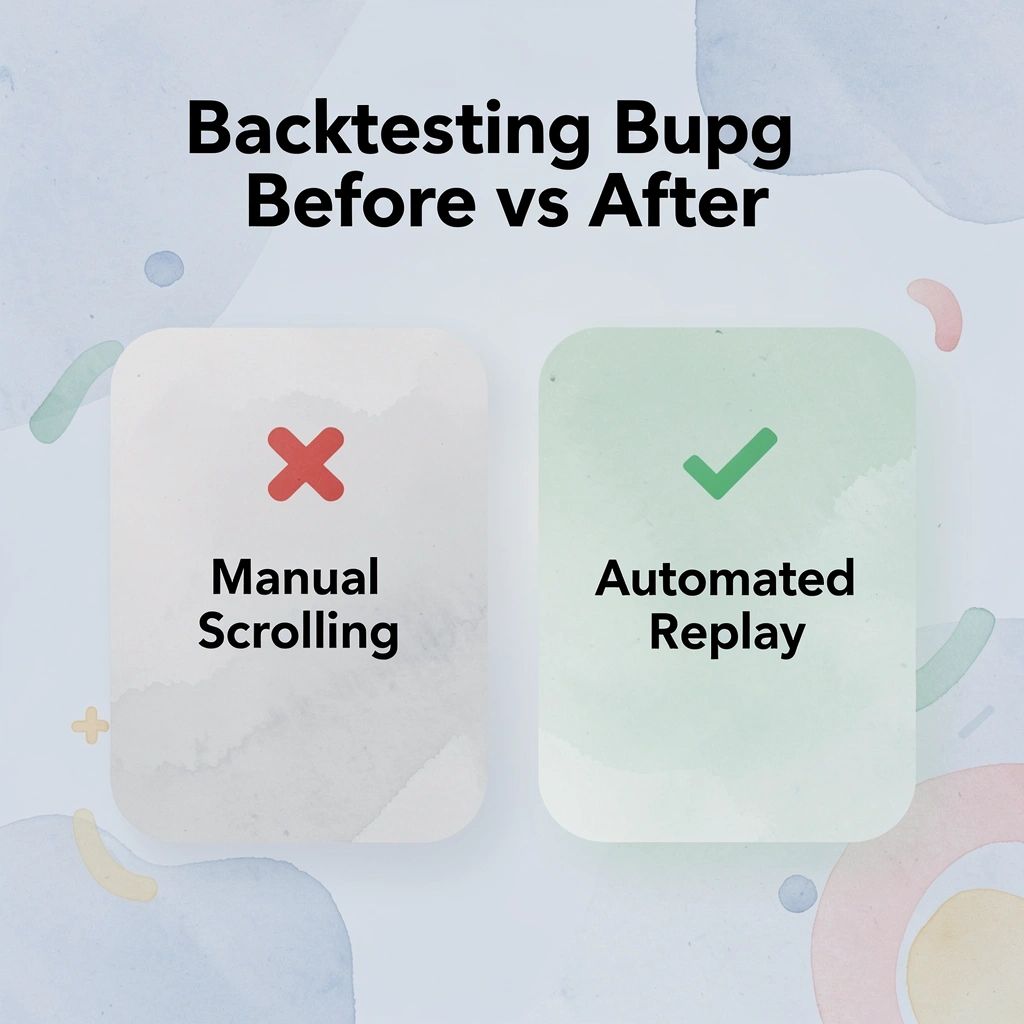
FX Replay handles core backtesting problems remarkably well: it eliminates manual chart scrolling, tab-switching between journals, and the confirmation bias that comes from knowing what happened next. It replaces that chaos with a structured environment where you control time.
"The biggest enemy of honest backtesting isn't laziness — it's confirmation bias, the invisible force that distorts every trade review when you already know the outcome."
— PMC Research
🎯 Key Point: FX Replay eliminates the three biggest backtesting killers — manual scrolling, journal tab-switching, and confirmation bias — in a single structured platform.
💡 Tip: The real power of FX Replay isn't just convenience — it's the ability to control time during replay, which is essential for building unbiased trading intuition.
| Backtesting Problem | Without FX Replay | With FX Replay |
|---|---|---|
| Chart Navigation | Manual scrolling, error-prone | Automated, time-controlled replay |
| Journal Workflow | Constant tab-switching | Structured, integrated environment |
| Confirmation Bias | High risk — outcome visible | Eliminated — future bars hidden |

Run 24/7 while you sleep. Keep bots, platforms, and trade copiers online on a dedicated VPS.
Low-latency VPS hosting for your trading platform.
 CHINYC
 LON
LONFrom $29.99/mo


 CHI/CME futuresNYC/US marketsLON/FX EAs
 DUB/Polymarket
 AMS/EU FX
 FRA/Central EU
 TYO/APAC crypto
 What the data depth actually gives you
Most backtesting setups fail because they use shallow historical data. You test for 18 months, build confidence, then encounter a market situation your strategy has never seen. According to the FX Replay Backtest Page FAQ, historical data extends to 2003 for major Forex pairs, allowing you to stress-test across the 2008 financial crisis, the 2015 SNB shock, and the 2020 COVID volatility spike in a single session. This depth forces your strategy to prove itself across genuinely different market conditions, not just favorable ones.
Does the timeframe range cover what real traders actually need?
Timeframes range from 5-second candles to monthly charts, which matters for futures traders. A scalping strategy tested only on 1-minute bars misses details that 5-second data reveals. A swing trader who never examines weekly context flies blind on trend alignment. Having the full range in one environment means you replicate real trading conditions rather than approximate them.
Can local machine interference skew your replay results?
Most traders run replay sessions on local machines that share resources with browsers and background processes. A memory spike during a critical replay sequence can corrupt test data or introduce artificial lag that mimics slippage. Traders using our dedicated trading VPS avoid this problem by keeping the replay environment isolated, resulting in cleaner results.
Where the tradeoffs show up
The journaling feature works but lacks depth. You can record trades and add session notes, though traders who need detailed statistics, expectancy curves, or R-multiple distributions must export the data elsewhere for analysis. The platform prioritizes the replay experience, making analysis tools secondary. If post-trading session review matters as much as live trading, consider whether this platform suits your needs.
How does the platform hold up for different types of traders?
FX Replay earns a 4.3 out of 5 based on 583 reviews, indicating solid satisfaction with some reservations. Ratings in this range typically reflect strong core features, with limitations that depend on your use case. For futures traders, the platform's focus on Forex pairs limits data availability and simulation accuracy for contracts such as ES or NQ.
The more interesting question becomes whether the numbers behind it actually hold up when you look at them more carefully.
In-Depth FX Replay Review 2026
FX Replay is a browser-based market replay and backtesting platform for discretionary traders seeking structured practice without risking real money. The platform has reached over 1 million traders, according to the FX Replay Homepage, demonstrating its popularity with traders of all experience levels.
"FX Replay has reached over 1 million traders, making it one of the most widely adopted browser-based backtesting platforms available today." — FX Replay Homepage
🎯 Key Point: With 1 million+ traders on the platform, FX Replay has established itself as a dominant force in discretionary trading practice, proving that structured, risk-free replay training is in high demand.
🔑 Takeaway: The 1 million trader milestone signals that browser-based market replay has become an essential tool for traders building real skill without real financial risk.
 How does the replay engine remove bias from your practice?
The replay engine is the product's strongest feature. When you scroll through historical charts manually, your eyes catch future price action before your brain registers it, a leak that corrupts every conclusion you draw. FX Replay's candle-by-candle advance removes that contamination, forcing decisions before outcomes are visible. This is the difference between practicing and rehearsing a known answer.
How does the journaling layer turn screen time into real insight?
The journaling layer adds significant value. Most traders who backtest informally keep no records, accumulating screen time without learning anything. FX Replay's built-in journal tracks win rate, drawdown patterns, timing errors, and session-level performance, helping you distinguish between setups that are profitable and ones that feel profitable because you remember winners more clearly than losses.
Supported Markets, Data, And Access Limits
FX Replay markets include forex, futures, stocks, indices, and crypto. Free users can trade non-premium pairs in battles, while Pro users access all assets. Verify the latest details on the FX Replay supported assets support page before choosing a plan.
Which data and instruments does your trading style actually need?
Backtesting quality depends on relevant data. A trader using major forex pairs on higher time frames has different needs from a futures scalper who requires second-by-second data. Choose a plan based on the instruments, time frames, and session style you trade.
What are the practical tradeoffs of a browser-based platform?
FX Replay is browser-based, so no installation is required. This benefits Mac users, Chromebook users, and traders who switch between computers. The downside is its dependence on the web app, the browser, and the computer's performance. If the interface feels slow on the free plan, upgrading may not resolve all workflow issues.
For traders building a larger trading setup, FX Replay should complement charting, execution, journaling, and research tools rather than replace them.
What the pricing structure actually means for your workflow
The Pro plan, priced at $35 per month according to FX Replay, is the only tier that offers futures and stock data, second-level detail, and unlimited session logging. For Forex traders on higher timeframes, the Intermediate plan may suffice. For anyone preparing for prop firms or futures scalping, the gap between Intermediate and Pro is significant: limited data access and session caps will disrupt your workflow when you need it most.
Browser-based tools depend as much on your local setup as on the platform itself. Memory-heavy replay sessions running alongside a live browser stack can introduce lag that distorts simulated execution feel. Traders running FX Replay alongside multiple chart windows, news feeds, and communication tools often find that our trading VPS eliminates environmental noise and keeps replay sessions clean and consistent.
What are the differences between FX Replay plans and their pricing?
If you upgrade your subscription, all data migrates to your new plan but remains subject to that tier's limits.
Which features are included across backtesting, analytics, and journal tiers?
At any time, if you choose to upgrade your subscription, all of your data will be migrated to the plan you choose; however, it will only be available according to the limitations of that tier.
| Plan | Price | Description |
| Beginner | $0/Month or $0/Year | Start improving your trading skills. |
| Intermediate | $17.99/Month or $180/Year | Optimize and scale your trading game. |
| Pro Trader | $35/Month or $350/Year | Everything you need to achieve profitability. |
Backtesting Features:
| Feature | Beginner | Intermediate | Pro Trader |
| Backtesting Sessions | 2 | 10 | Unlimited |
| Indicators | 1 | 3 | Unlimited |
| Max session duration | 1 Month | 6 Months | Unlimited |
| Go to Feature | 1 | 3 | Unlimited |
| Trades per Session | 50 | 200 | Unlimited |
| Data Retention | 1 Week | 6 Months | Unlimited |
| Multichart | x | ✓ | Unlimited |
| Auto Break Even | x | ✓ | ✓ |
| Rewind Price | x | ✓ | ✓ |
| Seconds Data | x | x | ✓ |
| Futures and CME data | x | x | ✓ |
| Custom Timeframes | x | x | ✓ |
Analytics Features:
Stay online and closer to execution. Choose a VPS location for CME futures, New York markets, London FX, API trading, and more.
Host your platform near the market route that matters.
CHINYCLONFrom $29.99/mo
CHI/CME futuresNYC/US marketsLON/FX EAsDUB/PolymarketAMS/EU FXFRA/Central EUTYO/APAC crypto| Feature | Beginner | Intermediate | Pro Trader |
| Analytics dashboard | 1 | 10 | Unlimited |
| Strategies | x | 3 | Unlimited |
| Strategy analytics | x | ✓ | ✓ |
| Seconds data | x | Unlimited | ✓ |
| Futures and CME data | x | 200 | ✓ |
Journal Features:
| Feature | Beginner | Intermediate | Pro Trader |
| Journal | ✓ | ✓ | ✓ |
| Screenshots | 1 | 2 | Unlimited |
| Checklist | 1 | 3 | Unlimited |
Where the platform hits its ceiling
The more interesting question is whether FX Replay fits your trading style.
What does FX Replay lack for algorithmic and quantitative traders?
The main difference between FX Replay and more advanced research environments is automation. FX Replay cannot import algorithmic strategies, run batch tests across hundreds of parameter combinations, or evaluate coded logic at scale. This is deliberate: the platform serves discretionary traders seeking to improve execution judgment, not quants requiring statistical validation of rule-based systems. Treating it as the latter will cause frustration.
How does the prop firm simulator address real behavioral failure modes?
The prop firm simulator deserves specific mention because it addresses a failure mode that costs traders real money. Many funded-account challenges are lost not because the trader lacks an edge, but because they violate daily loss limits, overtrade during drawdowns, or misread position-sizing rules under pressure. Practicing within simulated challenge constraints exposes those behavioral patterns before paying for a real evaluation.
Who Should (and Shouldn't) Use FX Replay?
FX Replay is a great fit for traders who like to make their own choices and learn by practicing over and over. It's not the right tool for traders who use math-based systems and need API access, or those who want to test trading plans across many different types of investments.
"The best trading tool is the one that matches your style — the wrong fit can reinforce bad habits instead of building real skill." — Trading Psychology Principle
| Trader Type | FX Replay: Good Fit? | Why |
|---|---|---|
| Discretionary traders | ✅ Yes | Learn by hands-on repetition and personal decision-making |
| Algorithmic/quant traders | ❌ No | Requires API access and automated system testing |
| Multi-asset investors | ❌ No | Limited to FX-focused instruments, not broad asset classes |
| Manual forex traders | ✅ Yes | Built specifically for manual practice and skill-building |
🎯 Key Point: FX Replay is purpose-built for discretionary forex traders who want to sharpen their decision-making skills through deliberate, repeated practice.
⚠️ Warning: If your strategy depends on automated backtesting, multi-asset coverage, or API integration, FX Replay is not the right tool — using the wrong platform can waste valuable practice time and skew your performance results.

If you trade price action or structure
Scalpers and swing traders who rely on reading candlestick behavior, order flow context, or session-based setups will find FX Replay useful. The candle-by-candle replay format forces you to make decisions without knowing what comes next, which mirrors the condition your live edge depends on. A scalper practicing 50 London open setups in a weekend builds pattern recognition that chart reading alone cannot replicate. Swing traders benefit from testing how their entries hold across multi-day moves using data that includes real volatility events.
If you are preparing for a prop firm evaluation
Prop firm candidates are the clearest fit. The platform lets you practice your strategy and behavior under simulated constraints, where most evaluation attempts fail. According to FX Replay's Demo Days 2025 First Look, FX Replay offers a free plan, allowing traders to stress-test rule compliance before paying evaluation fees. Finding a discipline problem in simulation costs nothing; finding it mid-challenge costs the full evaluation price.
If you trade futures or crypto
FX Replay's historical data coverage is strongest in forex pairs. Futures traders needing volume profile, DOM data, or tick-level precision will outgrow the platform. Crypto traders face similar limits: asset coverage tends to favor major pairs over altcoins. For these traders, FX Replay serves best as a behavioral training tool for practicing discipline and decision-making, not for strategy validation.
Running FX Replay through a dedicated trading VPS prevents memory spikes and lag that can corrupt data mid-session. QuantVPS keeps sessions stable throughout long practice blocks, preventing background processes from competing for resources.
If budget is the deciding factor
According to FX Replay's Demo Days 2025 First Look, the Intermediate plan costs $17.99 per month, far less than most trading education subscriptions and a fraction of a single prop firm evaluation fee. For traders serious about deliberate practice but not yet making consistent returns, this removes financial friction that delays skill development. Experienced traders with a validated edge can use the Free plan for targeted drill work.
Systematic developers needing code-based strategy testing, multi-asset portfolio managers, or traders whose edge depends on market microstructure data should look elsewhere. FX Replay's clarity of purpose is a strength.
Knowing where a tool fits in your practice routine is different from applying that practice in real-world market conditions.
Take Your Trading From Backtesting to Live Execution
Taking a well-tested strategy into live markets reveals a gap most traders don't expect. The practice environment is clean, controlled, and patient. Live markets are none of those things, and your infrastructure either keeps up or it doesn't.
Running automated strategies on a personal computer brings real risks: sleep mode interruptions, memory conflicts, and connection drops at critical moments. A trading VPS like QuantVPS removes that friction, providing a dedicated, always-on environment with ultra-low latency and support for NinjaTrader, Sierra Chart, MetaTrader, and more. The gap between a strategy that works in replay and one that executes reliably in real time is often infrastructure, not logic.
FX Replay sharpens your read of price action and builds decision-making repetition. QuantVPS keeps those decisions executing without interruption when real money is on the line.
FAQs
How does FX Replay improve the backtesting process for Forex traders?
FX Replay simplifies backtesting by merging the power of TradingView charts with tools that mimic real-market scenarios. This setup lets traders experiment with multiple assets at once - up to 16 charts spanning Forex, Crypto, and Futures markets - making analysis more diverse and adaptable.
The platform is packed with time-saving features like session jumps, customizable replay speeds, and reusable templates. Plus, its in-depth performance analytics - covering profit and loss patterns, drawdown details, and Monte Carlo simulations - offer traders the insights they need to refine their strategies. These tools make it easier to test and adjust trading approaches before diving into live markets.
What are the key advantages of using QuantVPS with FX Replay for Forex trading?
Using QuantVPS with FX Replay offers Forex traders a range of practical benefits that can significantly improve their trading experience. QuantVPS delivers ultra-low latency and lightning-fast execution speeds, which are crucial for making precise trade entries and exits. Its 24/7 uptime and secure, isolated environments ensure your trading remains uninterrupted while keeping sensitive data protected.
When combined with FX Replay, traders gain access to powerful backtesting tools that replicate realistic market conditions. This allows for detailed analysis of trade performance and helps fine-tune strategies. By using these tools together, traders can make better decisions and achieve more consistent results. QuantVPS and FX Replay work hand-in-hand to provide a smooth and efficient trading setup tailored to the needs of Forex professionals.
What are some budget-friendly options for traders looking to use FX Replay with QuantVPS?
For traders keeping an eye on their budget, there are some wallet-friendly tools to help you get started with FX Replay and QuantVPS. QuantVPS offers plans starting as low as $2.99 per month, making it a great choice for running a few charts without putting a dent in your finances. On the other hand, FX Replay's Pro plan is available for $29.16 per month, providing an affordable way to backtest Forex strategies. These options make it easier for traders to test and fine-tune their strategies without needing to invest a lot upfront.