
ChartVPS sells CPU-oriented trading VPS plans, GPU VPS plans and dedicated servers. Alpha starts at $50 per month, Gamma at $100 and Delta SE at $250. This review compares their published resources with QuantVPS and four other alternatives. Prices and specifications were checked on 7 October 2026. Recurring monthly prices are shown separately from annual terms and first-month offers.
What ChartVPS offers
The three product families address different workloads. Alpha is the CPU-oriented VPS range. Gamma adds an NVIDIA L4 GPU for software that can use GPU acceleration. Delta provides dedicated-server configurations. A GPU does not automatically speed up a trading application: the software must actually support the relevant acceleration. Likewise, additional disk space and additional CPU cores solve different resource limits.
Current ChartVPS plans and pricing
| Product | Published monthly starting price | Published configuration |
|---|---|---|
| Alpha Mark-1 | $50 | 2 AMD Ryzen 9 9950X cores, 4GB DDR5, 128GB Gen4 NVMe |
| Alpha Mark-2 | $80 | 3 AMD Ryzen 9 9950X cores, 8GB DDR5, 256GB Gen4 NVMe |
| Alpha Mark-3 | $140 | 4 AMD Ryzen 9 9950X cores, 16GB DDR5, 384GB Gen4 NVMe |
| Gamma | $100 | 3 CPU cores, 10GB DDR5, 250GB NVMe and NVIDIA L4 GPU |
| Delta SE | $250 | 16 cores / 32 threads, 128GB ECC memory and two 1TB NVMe drives |
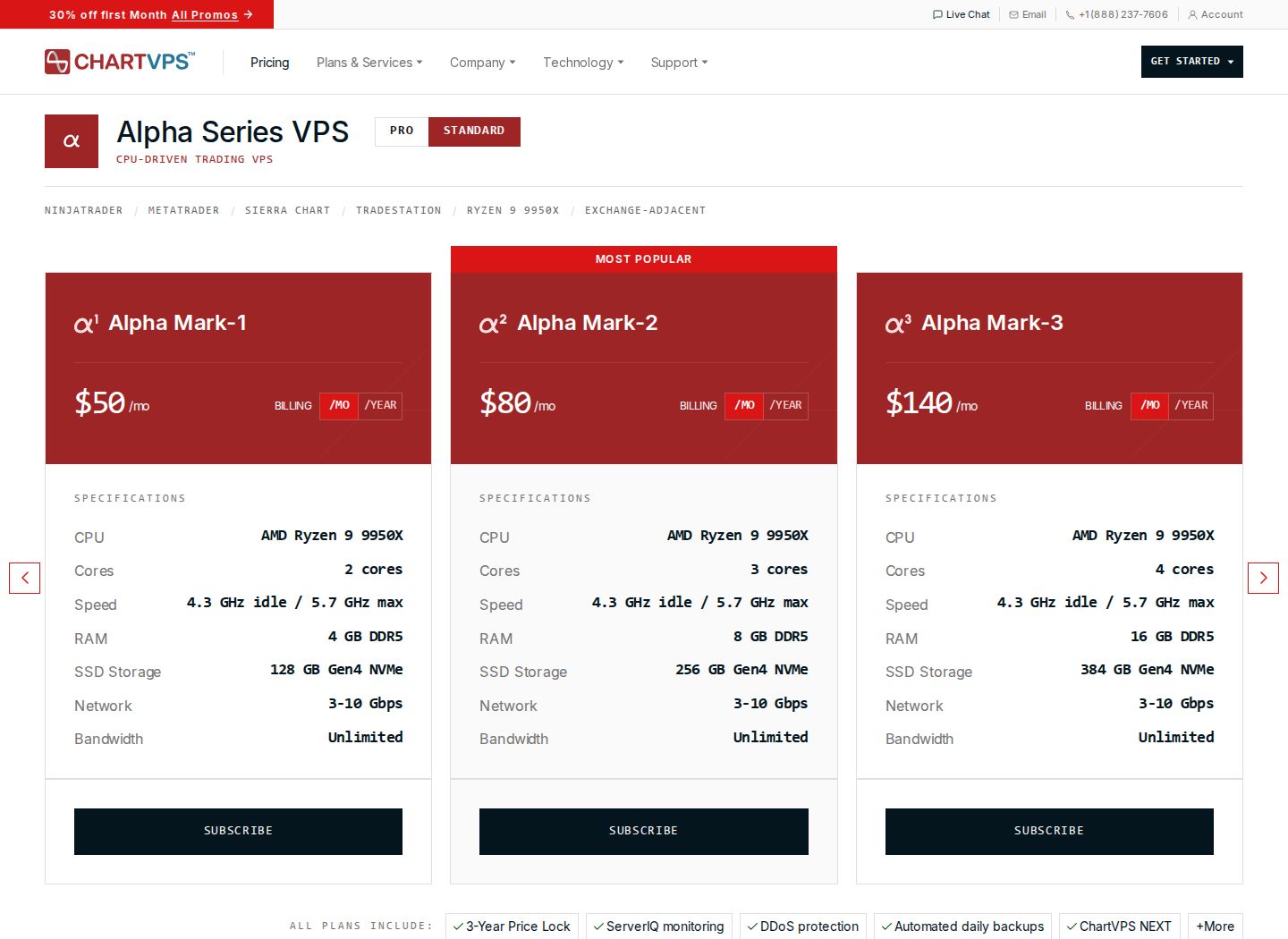
Source: chartvps.com, October 2026
The Alpha plans publish a 3–10Gbps network specification. ChartVPS includes ServerIQ monitoring, DDoS protection, one automated daily snapshot and a three-year base-price lock on new subscriptions. Check the selected dedicated or GPU configuration separately, because the CPU, operating system and available region can differ.
TradeCopy is an optional service listed at $30 per month for each connected VPS subscription. Hibernation costs $15 per month for Alpha and Gamma, or $30 for Delta. A hibernated server is offline: its trading applications and copier connections do not continue running. These charges are separate from the ordinary active-server price.
Locations, latency and uptime
ChartVPS lists seven available cities: Chicago, New York, London, Frankfurt, Singapore, Tokyo and Dallas. Its data-centres page marks Hong Kong and Sydney as coming soon, so neither is counted as available here. Select a location by the actual broker or exchange route and confirm that the chosen plan is offered there.
ChartVPS advertises typical Chicago-to-CME latency of 0–1ms. Its uptime page separates a 99.99% measured operating record, a 100% credit-backed guarantee and a 99.9% contractual monthly service commitment. These are provider statements. QuantVPS publishes a 0.52ms Chicago-to-CME network measurement and a 99.999% uptime SLA. The latency figures use different descriptions and measurement bases, so they do not establish which provider will deliver a faster order fill.
Order flow
Built for scalpers. Heatmaps on dedicated resources.
Order-flow heatmaps and DOM ladders run on dedicated CPU, memory and NVMe, so your charts keep responding during volatility.
Explore the hardware







From $29.99/mo · Windows or Linux
Who ChartVPS suits
Alpha is worth evaluating when a trader needs Windows applications and local tick-data storage in one of the advertised regions. Gamma is a distinct option when the chosen application can use an NVIDIA GPU. Delta addresses workloads that need a dedicated machine. These are configuration differences, rather than claims that a particular provider improves trading results.
Before selecting a plan, measure CPU and memory use with the actual charts, indicators and terminals running. Estimate disk use for recorded sessions and databases, then allow room for growth. Confirm the required Windows version, support responsibilities and backup recovery process. A larger storage allocation does not compensate for insufficient CPU or memory.
ChartVPS vs QuantVPS
The table uses published monthly prices before optional services or discounts. Alpha is compared with QuantVPS Performance because both publish Ryzen 9 9950X hardware and DDR5 memory. The Standard entry price is also shown so a reader can compare a lower-priced EPYC option. Core allocation, RAM and storage matter together; a lower monthly price alone does not establish that a plan fits the workload.
| Comparison | ChartVPS | QuantVPS |
|---|---|---|
| Entry plan | Alpha Mark-1, $50/month: 2 Ryzen 9 9950X cores, 4GB DDR5, 128GB NVMe | VPS Starter+, $39.99/month: 2 Ryzen 9 9950X cores, 4GB DDR5, 50GB NVMe. Standard Starter is $29.99 on EPYC. |
| Mid plan | Alpha Mark-2, $80/month: 3 cores, 8GB DDR5, 256GB NVMe | VPS Lite+, $79.99/month: 4 cores, 8GB DDR5, 75GB NVMe |
| Upper plan | Alpha Mark-3, $140/month: 4 cores, 16GB DDR5, 384GB NVMe | VPS Pro+, $129.99/month: 6 cores, 16GB DDR5, 150GB NVMe |
| Dedicated | Delta SE, $250/month: Ryzen 9 7950X, 16 cores/32 threads, 128GB DDR5 ECC, 2 x 1TB NVMe. Delta with Ryzen 9 9950X starts at $300. | Dedicated, $299.99/month: 12+ Ryzen cores, 128GB DDR4, 1TB NVMe. Dedicated+, $399.99/month: 12+ cores, 128GB DDR5, 2TB+ NVMe. |
| GPU | Gamma Mark-1, $100/month: NVIDIA L4 GPU, 3 CPU cores, 10GB DDR5, 250GB NVMe | No GPU plans listed |
| Available cities | Chicago, New York, London, Frankfurt, Singapore, Tokyo, Dallas. Hong Kong and Sydney: coming soon. | Chicago, New York, London, Dublin, Amsterdam, Frankfurt, Tokyo, Singapore |
| Chicago to CME | Advertised typical 0–1ms; not an order-fill measurement | Published 0.52ms network measurement; not an order-fill measurement |
| Uptime | 99.99% measured; 100% credit-backed guarantee; 99.9% contractual monthly commitment | 99.999% uptime SLA |
| Price lock | At least 36 months on the starting base subscription price | Rates locked for 3+ years |
| Refunds | Fees generally non-refundable. Conditional misdescription claims within 30 days of the latest payment; see the provider's terms. | 14-day money-back guarantee |
| Backups | One automated daily full-system snapshot included. Extra backup capacity costs 20% of the server plan. | Automatic backups on Performance VPS plans; RAID 1 on Dedicated and Dedicated+ |
| Monitor support | Per-plan monitor count not published on the checked plan pages | 1 on Starter/Lite; up to 2 on Pro, 4 on Ultra, 6 on Dedicated, including corresponding + plans |
| Pause fee | Alpha/Gamma $15/month; Delta $30/month while offline | A comparable paid pause fee is not stated on the checked public pricing page |
Read each provider's terms as well as the product card. A snapshot, mirrored disks and an uptime credit cover different failure cases. A refund policy also differs from an SLA credit. ChartVPS's terms generally make fees non-refundable, with conditional remedies for a service that does not match its purchase description. QuantVPS advertises a 14-day money-back guarantee. Neither description means that hosting compensates a trader for market losses.
Which to choose
QuantVPS provides more advertised CPU cores per dollar at the compared Ryzen VPS tiers. Starter+ has the same two-core allocation as Alpha Mark-1 at a lower monthly price; Lite+ has four cores against Mark-2's three; Pro+ has six against Mark-3's four. A trader whose charts, indicators and automation are CPU-limited can compare those allocations, while also checking memory use. This is a resource comparison, not a trading-platform benchmark.
ChartVPS allocates more NVMe storage at each Alpha tier shown. It may fit a trader who retains tick data, recordings and large local databases, provided the CPU and memory allocation also fits. Its Delta SE starting price is below QuantVPS Dedicated and Dedicated+, and its Gamma line offers a GPU configuration that QuantVPS does not list. Check whether the actual application uses GPU acceleration before paying for it.
Location can settle the choice before price does. QuantVPS lists Dublin and Amsterdam; ChartVPS lists Dallas. These are useful differences when the broker, API or exchange route calls for one of those cities. Do not rank the providers by comparing a typical latency range with a single published measurement. Use the same destination, protocol and trading hours when checking a route, then evaluate reconnect behaviour and application processing separately.
Compare the complete monthly and annual configurations on QuantVPS pricing. Annual billing saves 20%, so the monthly equivalent is 80% of the ordinary monthly price; the subscription is still billed annually. Budget separately for trading-platform licences, market data and copier subscriptions.
Five alternatives compared
| Alternative | Published price basis | What to compare |
|---|---|---|
| QuantVPS | Standard VPS Starter $29.99/month; Performance Starter+ $39.99/month | Plan resources, eight locations and 99.999% uptime SLA |
| Beeks Group | Bronze £32/month excluding VAT | Infrastructure configuration and connectivity quote |
| Amazon EC2 | Usage-based; no single fixed trading VPS price | Region, Windows licensing, storage, data transfer and operating responsibility |
| TradingFXVPS | Standard plan $17.50/month equivalent, $210 billed yearly | Annual commitment, broker route and included copier/monitoring tools |
| ForexVPS.net | Core $40/month before alternative billing terms | 22 advertised locations, Windows workload and SLA terms |
1. QuantVPS
QuantVPS Standard VPS Starter costs $29.99 per month for 2 AMD EPYC cores, 4GB DDR4 and 50GB NVMe. Standard Lite, Pro, Ultra and Dedicated cost $59.99, $99.99, $189.99 and $299.99 per month. Performance Starter+, Lite+, Pro+, Ultra+ and Dedicated+ cost $39.99, $79.99, $129.99, $199.99 and $399.99. Annual billing saves 20%, and the uptime commitment is a 99.999% SLA.
The eight locations are Chicago, New York, London, Dublin, Amsterdam, Frankfurt, Tokyo and Singapore. The published Chicago-to-CME network measurement is 0.52ms; it is not a guarantee of exchange processing or execution. Performance VPS plans include automatic backups, while Dedicated plans use RAID 1 storage. Compare the exact pricing-page configuration rather than assuming every plan has the same hardware or network speed.
The QuantVPS location directory lists eight cities. Choose Chicago for the published CME route, then compare the actual broker or API endpoint when working in another market. A city being listed does not mean every plan and platform combination is currently orderable; confirm the selectable configuration before arranging a migration.
Use the QuantVPS hardware specifications to distinguish the Standard EPYC and DDR4 VPS tiers from Performance Ryzen and DDR5 tiers. Standard Dedicated uses Ryzen with DDR4. Performance Dedicated+ uses Ryzen with DDR5 and more storage. A plus sign identifies a different configuration, not a reason to reuse the Standard plan's core count or price.
For a Windows futures workspace, the NinjaTrader VPS page explains the hosting setup. Count the charts, strategies, indicators and simultaneous account connections you actually run. Leave headroom for a replay or backtest, and check whether that work should run separately from the live execution process.
The Chicago CME VPS route has a published 0.52ms network measurement. That figure does not include every stage between a signal and a fill. Market-data delivery, strategy computation, copier processing, broker routing and exchange matching remain separate parts of the execution path.
Low latency
Stay online and closer to execution.
Host your platform beside its market: Chicago for CME futures, New York for US markets, London for FX EAs.
Explore the hardwareFrom $29.99/mo · Windows or Linux
2. Beeks Group
Beeks Group lists Bronze at £32 per month excluding VAT, with 1 vCPU, 2,560MB memory and 30GB SSD storage. Silver costs £57 for 2 vCPU, 4,096MB and 50GB; Gold costs £100 for 4 vCPU, 6,656MB and 75GB.
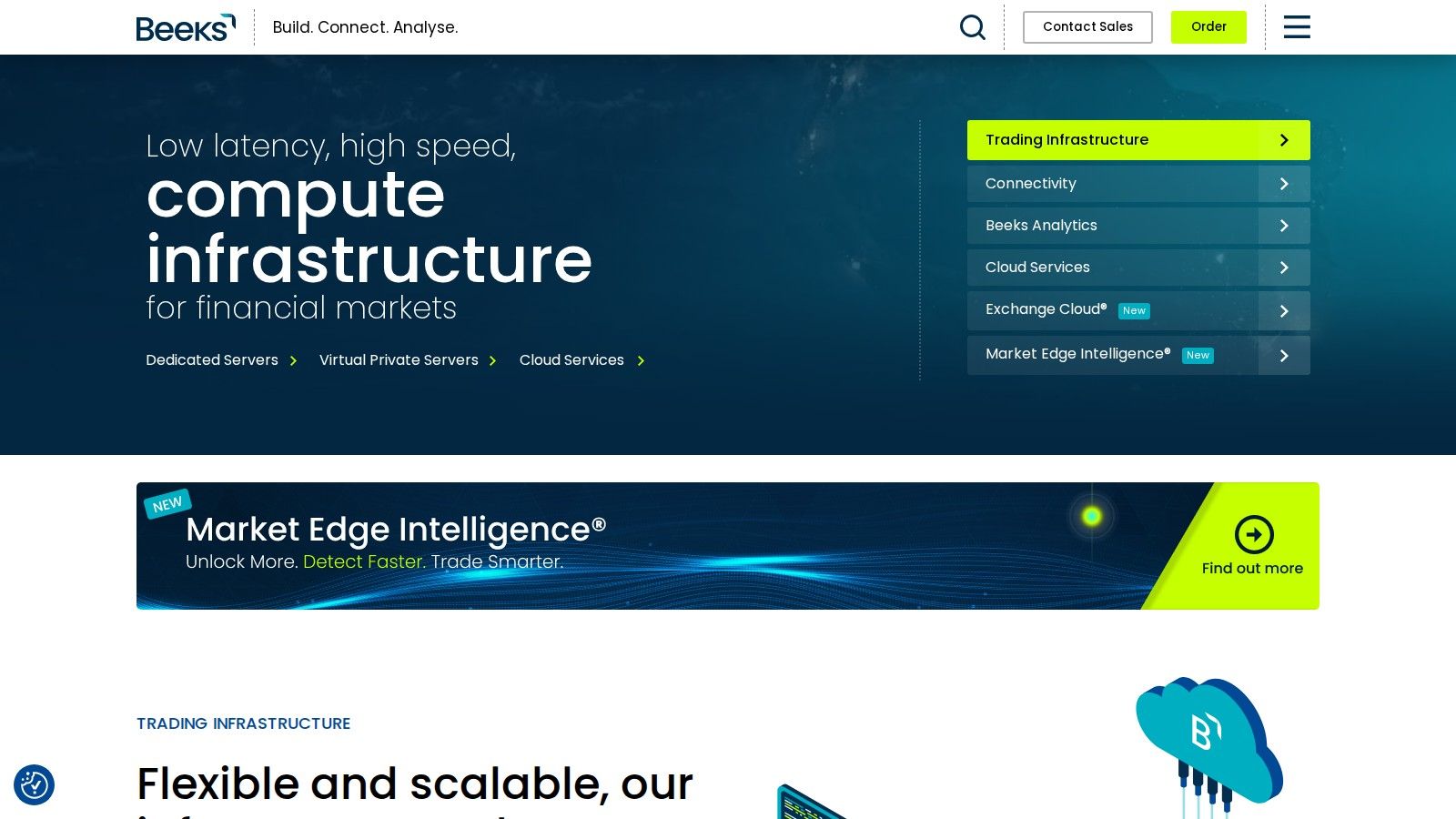
The useful comparison is the required server configuration, trading connectivity and support arrangement. Ask for an itemized quote and verify the location and network route relevant to the trading venue. A provider’s broad infrastructure offering does not by itself establish the price or latency of an individual VPS.
3. Amazon EC2
EC2 is priced by selected instance, region and usage, rather than as one fixed trading VPS package. Windows licensing, storage and data transfer affect the total.
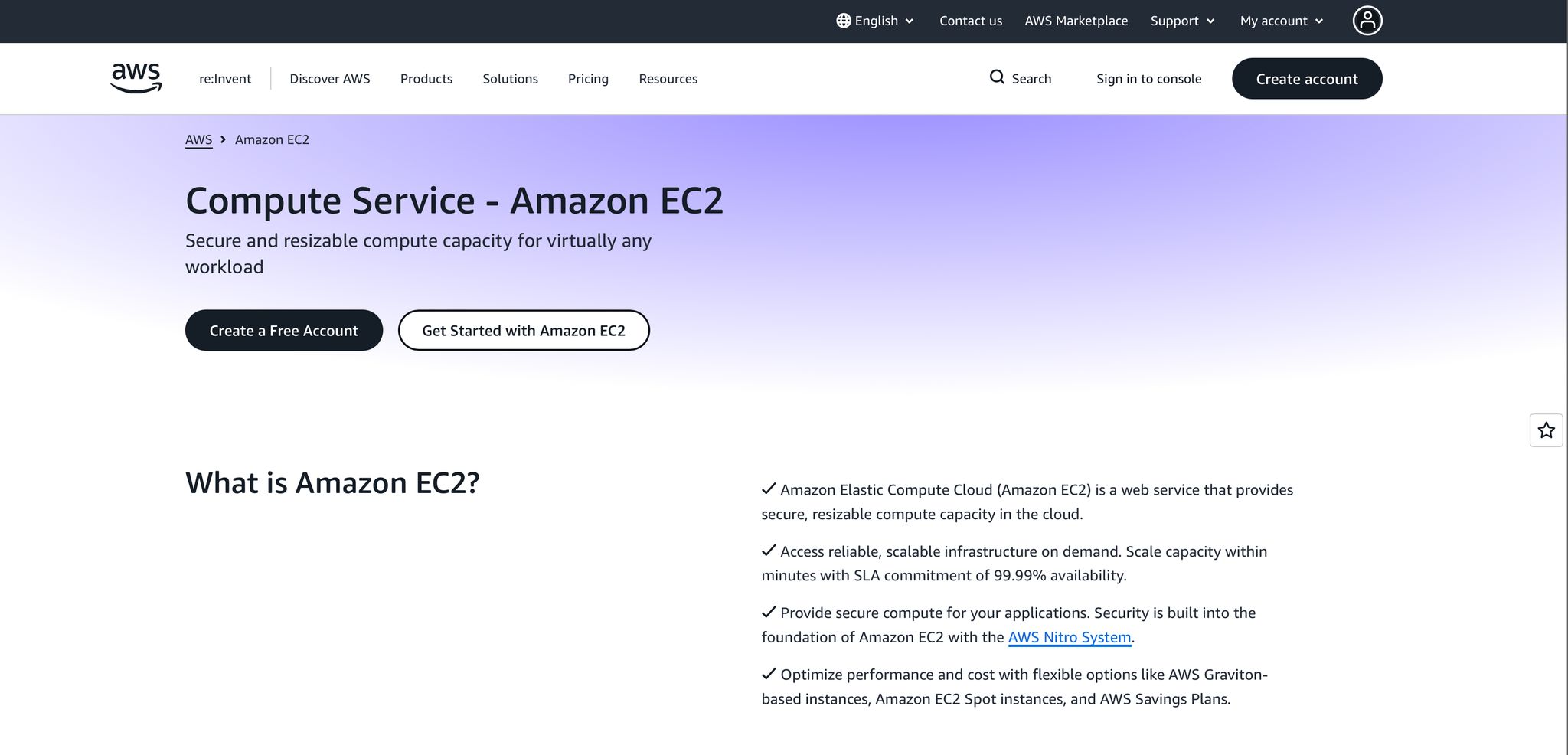
The 99.99% EC2 region-level SLA requires instances deployed across at least two availability zones under its stated conditions. It should not be presented as the SLA of an ordinary single-instance trading server. A customer also needs to plan installation, monitoring, backups and application recovery. Compare the full operating arrangement as well as the compute bill.
4. TradingFXVPS
TradingFXVPS publishes Standard at $17.50 per month equivalent with $210 billed yearly, for 1 AMD Ryzen core, 2GB DDR5 and 30GB NVMe. Its homepage states a 99.99% uptime SLA and advertises broker cross-connect latency from 0.30ms. That broker-specific claim is not directly comparable with a Chicago-to-CME network measurement.
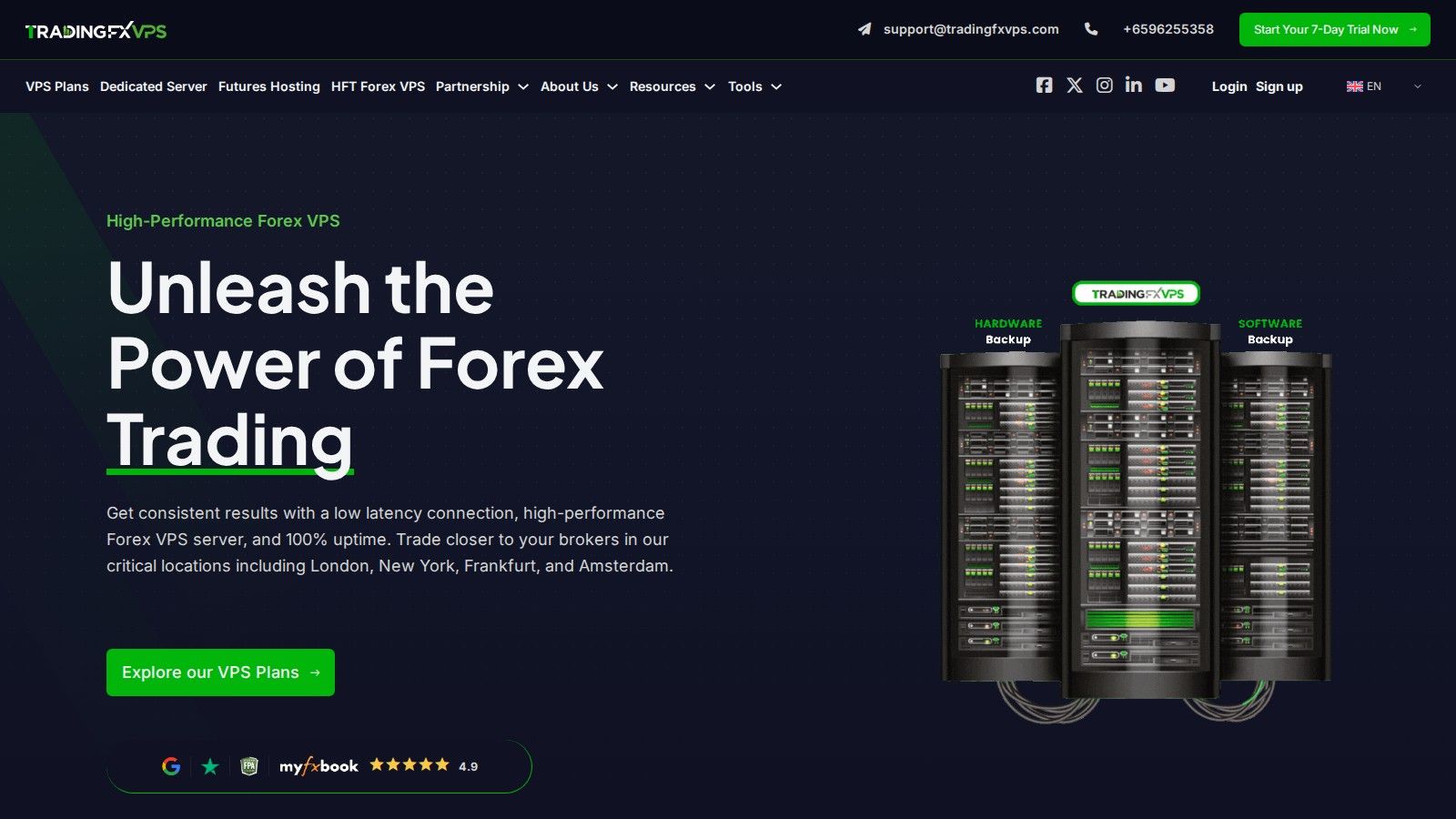
The current site includes a remote copier and monitoring tools. Confirm the billing interval, broker route and installed tools for the chosen product. An annual equivalent should not be compared with another provider’s cancel-any-month price without explaining the commitment.
5. ForexVPS.net
ForexVPS.net Core costs $40 per month and advertises 22 locations. The provider markets 100% uptime, while the homepage footnote says SLA remedies apply below 99.99%, with notified maintenance and force-majeure exclusions. Its annual or promotional equivalents should be identified separately from the monthly price.
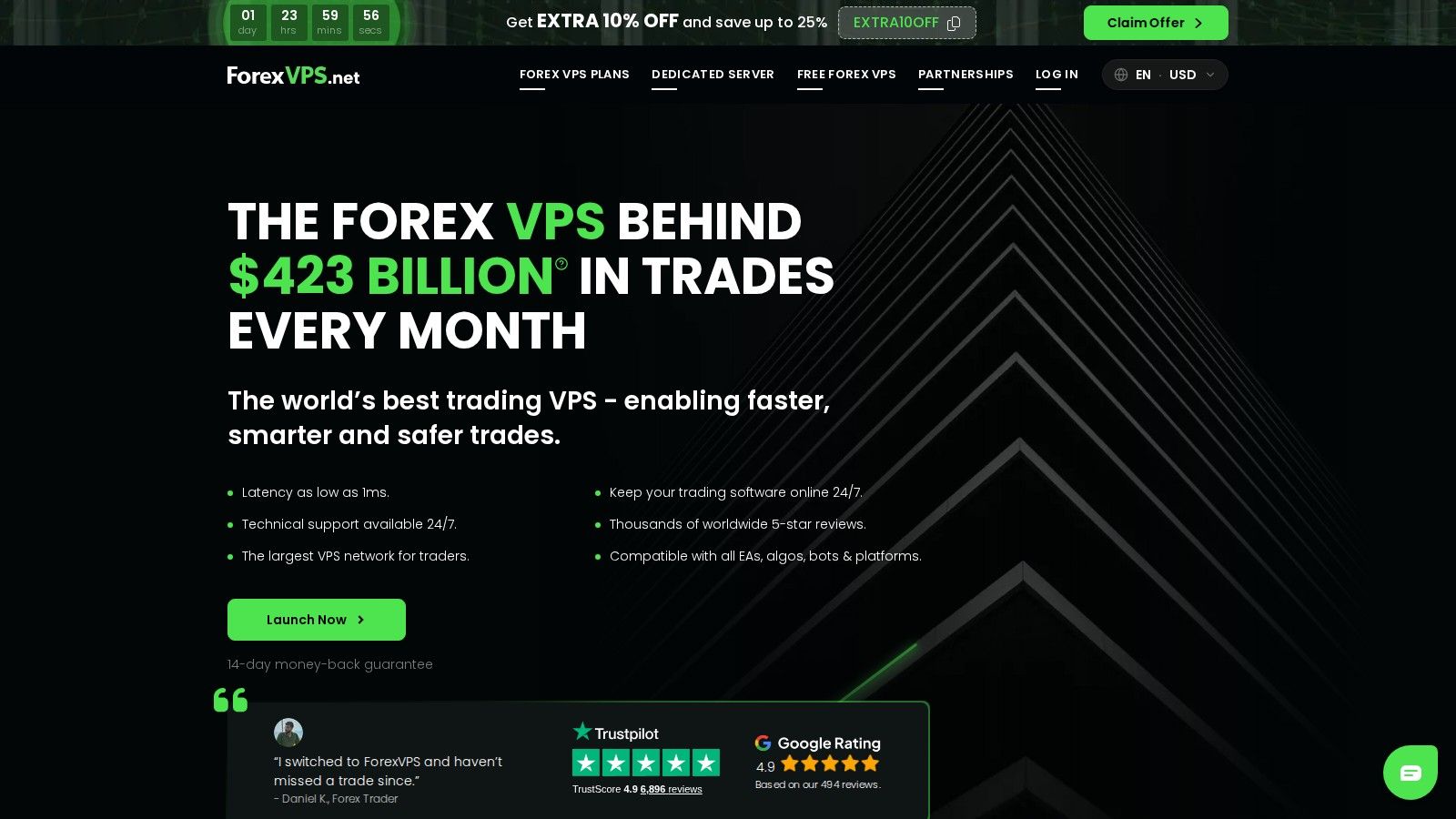
Compare the location closest to the broker’s actual trading server, the required terminal count and the plan resources. A large region list can be useful for forex workflows, but it does not prove that every region has the same latency to the same destination.
How to compare the options fairly
Use the same billing term and workload when comparing providers. Record CPU allocation, memory, storage, operating-system licensing and network specifications. Measure the route to the actual broker or exchange during the intended trading hours. Read SLA exclusions and recovery responsibilities. Then test the application’s reconnect and restart behavior before relying on unattended operation.
A hosting service can separate trading software from a home computer. It cannot guarantee a profitable strategy, prevent all slippage or ensure that a broker accepts an order. For a wider provider comparison, see our guide to the best VPS for trading.
Uptime
99.999% uptime. Built for 24/7 trading reliability.
Your VPS runs in Tier IV datacenters with redundant power and network, monitored 24/7 on site.
See the uptime SLAFrom $29.99/mo · Windows or Linux
ChartVPS questions
Is ChartVPS good for NinjaTrader?
ChartVPS lists NinjaTrader among the applications supported on Alpha. Assess the selected plan against your charts, indicators, strategies and data storage. Published hardware specifications can help with that decision, but this review does not claim an application test or a particular trading result.
Where are ChartVPS servers located?
The checked pages list Chicago, New York, London, Frankfurt, Singapore, Tokyo and Dallas. Hong Kong and Sydney are marked as coming soon. Confirm that the required plan is available in the city you choose, and measure the connection to your actual broker or data service.
How much does ChartVPS cost?
Published monthly starting prices are $50 for Alpha Mark-1, $100 for Gamma Mark-1 and $250 for Delta SE. Alpha Mark-2 is $80 and Mark-3 is $140. Delta with Ryzen 9 9950X starts at $300. Optional services and a different billing term can change the total.
Does ChartVPS have a promo code?
This page does not list third-party ChartVPS codes. Check the provider's site for its current offers and their conditions. QuantVPS's current public prices are on the pricing page; compare the recurring cost rather than assuming a first-month offer lasts for the subscription.
ChartVPS vs QuantVPS: which is cheaper?
At the compared monthly Ryzen VPS tiers, QuantVPS Starter+, Lite+ and Pro+ cost $39.99, $79.99 and $129.99, against ChartVPS Alpha Mark-1, Mark-2 and Mark-3 at $50, $80 and $140. ChartVPS Delta SE starts below QuantVPS's dedicated plans. The resource allocations differ, so choose the tier that meets the workload rather than comparing the price alone.


