Quantitative trading is evolving fast, thanks to large language models (LLMs). These tools are slashing the time it takes to turn ideas into trading strategies - what once took months now takes minutes. In 2026, six standout LLMs are leading the charge:
- GPT-5: Excels in coding with a 1M-token context window and advanced debugging features. Great for rapid strategy creation.
- Gemini 3: Offers a huge 2M-token context window and fast processing, ideal for analyzing large datasets.
- Claude 4: Known for its reasoning and multi-file coding capabilities, but it's pricier than alternatives.
- Llama 4: Provides unmatched control with open weights and a massive 10M-token context window, but hardware costs are high.
- Qwen3: Strong in database-heavy tasks and efficient for backtesting.
- DeepSeek-R1: Budget-friendly with excellent math and logic skills, suitable for quantitative workflows.
Key takeaway: The right LLM depends on your priorities. Whether you need speed, cost-efficiency, or control, there's a model that fits your trading needs. By pairing these tools with local hosting options like QuantVPS, traders can cut costs and improve performance.
LLM Comparison for Quant Trading: Features, Performance & Pricing
1. GPT-5
GPT-5 made waves with its initial 400,000-token capacity, but the latest version, GPT-5.4, takes it even further with support for up to 1 million tokens. This massive token window lets users tackle hefty tasks like analyzing entire codebases, multi-year SEC filings, or 500-page contracts in a single go. It’s a game-changer for complex trading strategies that rely on historical data, regulatory documents, or extensive APIs. For context, a typical 10-K SEC filing uses about 150,000 tokens, leaving plenty of room for additional trading logic.
Coding Proficiency
GPT-5.4 stands out as OpenAI's top-tier coding model. It achieves a 74.9% score on SWE-bench, a benchmark designed to evaluate real-world GitHub coding tasks. On the Aider polyglot benchmark for code editing, it scores 88%, cutting error rates by one-third compared to earlier versions. The model introduces a "build-run-verify-fix" loop, enabling it to autonomously debug, interpret errors, and apply fixes - no human input required.
"GPT-5 is the smartest coding model we've used... It not only catches tricky, deeply-hidden bugs but can also run long, multi-turn background agents to see complex tasks through to the finish." - Michael Truell, Co-Founder & CEO, Cursor
Its 97% tool-calling success rate ensures seamless integration with exchange APIs, data feeds, and risk management tools. The model also supports custom tools using plaintext inputs like SQL queries or shell commands, making it easier to work with older trading systems.
These advancements directly translate into better results for quantitative and financial applications.
Financial Benchmark Scores
When it comes to financial tasks, GPT-5.4 delivers impressive results. It scores 87.3% on junior investment banking spreadsheet modeling tasks, a leap from GPT-5.2's 68.4%. On GDPval, it matches or surpasses human professionals in 83% of cases, with a score of 83.0%. Additionally, it achieves 94.6% on the American Invitational Mathematics Examination (AIME 2025) and 93.2% on GPQA Diamond, a benchmark for high-level mathematical reasoning. BBVA highlighted that GPT-5 slashed the time needed for financial analysis from three weeks to just a few hours.
These capabilities allow quantitative traders to work faster and with greater confidence.
Monthly API Costs
Cost efficiency is just as critical as performance, particularly for high-frequency trading. GPT-5.4 is priced at $2.50 per million input tokens and $15.00 per million output tokens. For budget-conscious users, GPT-5.4-mini is available at $0.25 per million input tokens and $2.00 per million output tokens. Tasks that aren’t time-sensitive, like backtesting trading strategies, can benefit from even lower costs using Batch or Flex pricing options. The model also includes a "tool search" feature that cuts token usage in complex workflows by 47%. However, requests exceeding 272,000 tokens are billed at double the standard rate.
| API Model | Input (per 1M tokens) | Output (per 1M tokens) |
|---|---|---|
| gpt-5.4 | $2.50 | $15.00 |
| gpt-5.4-mini | $0.25 | $2.00 |
| gpt-5.4-nano | $0.05 | $0.40 |
| gpt-5.4-pro | $30.00 | $180.00 |
2. Gemini 3
Context Window Size
Gemini 3 Pro and 3.1 Pro offer an impressive 1 million-token input window alongside a 64,000-token output limit. This means quant traders can load entire codebases, hundreds of research papers, or even years' worth of trade logs into a single prompt - without needing to break things up into smaller chunks using complex RAG (retrieval-augmented generation) techniques. The model is designed to map cross-component dependencies, giving it a deep understanding of software architecture, which is especially useful for intricate trading bots.
Traders can also leverage the "Deep Think" mode, which allows the model to evaluate multiple hypotheses simultaneously. This feature is particularly handy for tackling challenging mathematical and logical problems. Additionally, Gemini 3 supports agent-driven workflows through platforms like Google Antigravity. Here, AI agents autonomously handle tasks like installing dependencies, verifying API documentation in real time, and running backtests with Backtrader. With a time-to-first-token of 420 milliseconds and a throughput of 128 tokens per second, Gemini 3 Pro offers faster responses compared to many other options. These capabilities make it a strong choice for complex coding tasks.
Coding Proficiency
Gemini 3.1 Pro pairs its large context window with exceptional coding skills. It scored 80.6% on SWE-Bench Verified, a benchmark based on real-world GitHub issues, and boosted its ARC-AGI-2 score from 31.1% to 77.1%. On the AIME 2025 math benchmark, where code execution tools are part of the test, it achieved a perfect score of 100%.
"Gemini 3 Pro handles complex, long-horizon tasks across entire codebases, maintaining context through multi-file refactors, debugging sessions, and feature implementations."
- Nik Pash, Head of AI, Cline

Run 24/7 while you sleep. Keep bots, platforms, and trade copiers online on a dedicated VPS.
Low-latency VPS hosting for your trading platform.
 CHINYC
 LON
LONFrom $29.99/mo


 CHI/CME futuresNYC/US marketsLON/FX EAs
 DUB/Polymarket
 AMS/EU FX
 FRA/Central EU
 TYO/APAC crypto
The model offers three Thinking Levels - Low, Medium, and High - so users can balance performance with cost. For example, "High" is ideal for debugging intricate race conditions in trading servers, while "Low" works well for simpler tasks like data classification. It also suggests using the "Antigravity Protocol", which organizes code into three distinct layers: Memory (local logging), Workflow (strategy logic), and Execution (safe API interaction). This structure is designed to improve safety and efficiency in trading operations.
Monthly API Costs
Gemini 3's pricing is divided into two tiers: Standard (up to 200K tokens) and Extended (over 200K tokens). Standard pricing is $2.00 per million input tokens and $12.00 per million output tokens, while Extended pricing is $4.00 per million input tokens and $18.00 per million output tokens. Cost-saving options include batch processing, which reduces costs by 50%, and context caching, which can cut costs by up to 75% for repeated queries. With these optimizations, pricing can drop to as low as $0.20–$0.40 per million tokens. These flexible pricing models are particularly appealing for quant traders aiming to streamline their automated workflows.
| Context Tier | Input (per 1M tokens) | Output (per 1M tokens) |
|---|---|---|
| Standard (≤200K) | $2.00 | $12.00 |
| Extended (>200K) | $4.00 | $18.00 |
| Batch (50% off) | $1.00 | $6.00 |
3. Claude 4
Context Window Size
Claude 4 models, including Opus 4.6 and Sonnet 4.6, feature a massive 1 million-token context window, a significant leap from the earlier versions' 200,000 tokens. This expanded capacity allows users to load entire trading codebases, comprehensive market reports, or lengthy regulatory filings in one go. Additionally, a beta Memory Tool extends this limit, while the Extended Thinking mode enables complex, multi-step reasoning for up to 7 hours. To optimize usage, tiered context loading can cut token consumption by as much as 58%.
Coding Proficiency
Claude 4 doesn't just excel in handling large-scale data; it also delivers strong coding capabilities. For example, Claude Opus 4.5 achieved an impressive 80.9% on SWE-bench Verified, outperforming competitors like GPT-5.1 Codex Max (77.9%) and Gemini 3 Pro (76.2%). Meanwhile, Claude Opus 4.6 scored 65.4% on Terminal-Bench 2.0. As of mid-2026, the model holds the top spot on the LMSYS Chatbot Arena for both reasoning and non-reasoning tasks.
A practical example of its coding prowess comes from developer Chudi Nnorukam, who used Claude 4 to build a 4,247-line autonomous Polymarket trading bot in just six weeks. By leveraging tiered context loading and a two-gate verification process, Nnorukam reduced monthly API costs from $340 to $136 and cut production errors by 84%. The bot has maintained 99.2% uptime since launch, with zero capital lost due to model errors.
"Claude Code is a force multiplier - but only if you have a system. Without one, it's an expensive way to ship buggy code faster." - Chudi Nnorukam, Developer
To avoid integration errors, users are advised to use the /plan command in Claude Code before writing code that spans more than two files. This feature lets the model analyze the codebase and suggest architectural changes early on. The model also incorporates "calibrated uncertainty", signaling when it lacks sufficient information, which helps prevent errors like hallucinated trading logic.
Beyond coding, Claude 4's performance in financial benchmarks highlights its utility in quantitative trading.
Financial Benchmark Scores
Claude Opus 4.6 demonstrates strong analytical capabilities in finance and law. It scored 60.7% on the Finance Agent benchmark, which evaluates key financial analyst tasks like reviewing SEC filings. On the GDPval-AA benchmark, which measures economically valuable financial and legal knowledge, it surpassed the next-best model by approximately 144 Elo points. Additionally, it earned a 90.2% score on BigLaw Bench, showcasing its legal reasoning strengths. These benchmarks make Claude 4 a valuable tool for navigating complex financial documents and making informed decisions in high-stakes trading scenarios.
Monthly API Costs
Claude 4 offers flexible pricing based on model tiers. Claude Opus 4.6 is priced at $5.00 per 1 million input tokens and $25.00 per 1 million output tokens. Claude Sonnet 4.6 is slightly more affordable at $3.00 per 1 million input tokens and $15.00 per 1 million output tokens. For those on a tighter budget, Claude Haiku 4.5 costs just $1.00 per 1 million input tokens and $5.00 per 1 million output tokens. Users can further reduce costs with prompt caching, which saves up to 90% on recurring queries, or batch processing, which offers a 50% discount. For reference, the Polyphemus bot mentioned earlier operated efficiently on a monthly API budget of $136.
| Model | Input (per 1M tokens) | Output (per 1M tokens) |
|---|---|---|
| Claude Opus 4.6 | $5.00 | $25.00 |
| Claude Sonnet 4.6 | $3.00 | $15.00 |
| Claude Haiku 4.5 | $1.00 | $5.00 |
4. Llama 4
Context Window Size
The 512,000-token context window in Llama 4 Maverick enables quant traders to process entire technical libraries or massive codebases in a single prompt. Meanwhile, the Scout variant takes it even further with a 10-million-token context window - about 80 times larger than earlier versions of Llama. This capability stems from the iRoPE architecture, which alternates layers with and without Rotary Position Embeddings, allowing the model to handle much larger contexts than typical models.
These expanded windows open up new possibilities, such as acting as a collaborative programmer for repositories up to 500,000 tokens or managing multi-step autonomous trading tasks without losing coherence. While most models are capped at 128,000 tokens, Llama 4 Scout can seamlessly process entire books or lengthy financial reports that other models simply cannot handle.
Coding Proficiency
Llama 4 Maverick has proven its coding prowess with a 43.4% score on LiveCodeBench, outperforming other leading models. It achieves this through a Mixture of Experts (MoE) architecture, which activates only 17 billion parameters per token out of a total of 400 billion, optimizing performance without overwhelming computational resources. Additionally, it scored 73.7% on MathVista, showcasing its strong quantitative and mathematical reasoning skills - key for developing automated trading strategies.
To get the most out of Maverick, developers can use tailored prompts like: "Provide only functional Python code with inline documentation" when building quant strategies. For real-time trading insights, it integrates seamlessly with tools like Freqtrade or LLM_trader, leveraging its reasoning and tool-calling capabilities. Its multimodal abilities, powered by "early fusion" of text and vision tokens, also make it ideal for analyzing financial charts and technical indicators - essential for technical trading.
"Llama 4 Maverick is the most intelligent model option Meta provides today, designed for reasoning, complex image understanding, and demanding generative tasks." - Ivan Nardini, AI/ML Advocate, Google Cloud
Next, let's dive into its latency performance on QuantVPS infrastructure.
Latency on QuantVPS Plans
For QuantVPS users, Llama 4's performance metrics highlight its suitability for real-time trading. It achieves a p99 latency of 35ms for conversational tasks. In practical terms, this means it can transition from breaking news to a live, customized trading strategy in about 60 minutes. With a throughput of 1,200 requests per second, it’s perfect for high-volume, low-latency applications.
When hosted on QuantVPS infrastructure, Llama 4 Scout averages a 189ms response time, while Maverick averages 142ms. For inference throughput, the Scout variant (using Int4 quantization) handles 120–150 tokens per second on a single H100 GPU, while Maverick (using Int8) processes 45–65 tokens per second. Scout’s ability to run on a single 80GB H100 GPU makes it a strong candidate for self-hosted setups on QuantVPS's Dedicated+ Server plans, which offer 16+ dedicated cores and 128GB RAM.
Monthly API Costs
Llama 4 is a cost-effective solution for quant traders. On Together.ai, Maverick costs $0.27 per 1 million input tokens and $0.85 per 1 million output tokens, with a blended rate of $0.19–$0.49 per 1 million tokens. Scout, on the other hand, is even more budget-friendly at $0.18 per 1 million input tokens and $0.59 per 1 million output tokens. For those seeking the lowest pricing, Groq offers Scout at around $0.11 per 1 million tokens.
This pricing translates to a 9x–23x improvement in price-performance, making Maverick particularly appealing for firms conducting extensive backtesting or generating large volumes of trading code. For self-hosted deployments on QuantVPS infrastructure, the amortized cost for running Scout Q4 on an H100 GPU is estimated at $0.30–$0.49 per 1 million tokens under moderate usage scenarios.
| Model | Input (per 1M tokens) | Output (per 1M tokens) |
|---|---|---|
| Llama 4 Maverick | $0.27 | $0.85 |
| Llama 4 Scout | $0.18 | $0.59 |
5. Qwen3
Context Window Size
Qwen3-Coder offers a 256,000-token context window, with the ability to extend up to 1 million tokens using YaRN extrapolation methods. This feature allows users to load entire trading repositories or multi-day datasets in one go, avoiding the hassle of splitting tasks. Built with a Mixture-of-Experts architecture, the flagship Qwen3-Coder-480B-A35B-Instruct model includes 480 billion parameters but activates only 35 billion per token, ensuring efficient performance.
This extended context window is a game-changer for traders working with large-scale financial reports or conducting backtesting over years of tick data. With a training dataset of 7.5 trillion tokens and a 70% code-to-text ratio, the model excels in code-heavy quantitative workflows, making it ideal for high-stakes strategy development.
"A context window fight only matters when you're working on genuinely large codebases - but when it does matter, it really matters." - Ari Vance, Software Engineer
Coding Proficiency
Qwen3-Coder achieved a 70.6% score on SWE-Bench Verified, trailing Claude Opus 4.5's 80.9% but still holding its own for tackling GitHub issues in real-world scenarios. In March 2026, Ari Vance tested the model in a debugging challenge: while Claude resolved a database deadlock in a single exchange, Qwen3-Coder needed four, initially offering symptom-based solutions. Its scores include 73.7% on GPQA for general reasoning and 32.3% on SciCode for scientific coding tasks.
The model features a "Hybrid Reasoning Engine" with two modes: "Thinking Mode" for tackling complex algorithms and "Non-Thinking Mode" for delivering quick responses. It excels at converting natural language prompts into production-ready Python strategies. For example, the QLN Quantitative Research Division used Qwen3-Coder to analyze a 41-page Middle East geopolitical crisis report, generating six CME futures strategies in under 10 minutes. One of these, a "Natural Gas Mean Reversion" strategy, simulated a +$52,800 profit and loss (P&L) with a Sharpe ratio of 4.3.
Fast response times on QuantVPS further enhance its coding capabilities, as outlined below.
Stay online and closer to execution. Choose a VPS location for CME futures, New York markets, London FX, API trading, and more.
Host your platform near the market route that matters.
CHINYCLONFrom $29.99/mo
CHI/CME futuresNYC/US marketsLON/FX EAsDUB/PolymarketAMS/EU FXFRA/Central EUTYO/APAC cryptoLatency on QuantVPS Plans
Qwen3-Coder pairs its robust coding performance with impressive speed on QuantVPS infrastructure. It delivers 135 tokens per second with a Time to First Token (TTFT) of 0.84 seconds. For traders using QuantVPS, local inference reduces latency to under 20ms - dramatically faster than the 200–800ms typical for cloud API calls. The model requires at least 64GB of RAM for deployment, aligning well with QuantVPS's Ultra+ or Dedicated+ Server plans, which offer 64GB and 128GB RAM, respectively.
Monthly API Costs
Qwen3-Coder is priced at $0.35 per 1 million input tokens and $1.20 per 1 million output tokens on Alibaba Cloud DashScope. For traders processing 10 million tokens monthly, this adds up to an annual cost of approximately $15,000, a stark contrast to the $600,000+ cost of Claude Opus 4.5. A smaller variant, Qwen3-32B, offers even lower rates at $0.08 per 1 million input tokens and $0.24 per 1 million output tokens. Additionally, context caching can cut input costs by up to 90% for users who frequently reuse lengthy strategy documents or datasets.
| Model Variant | Input (per 1M tokens) | Output (per 1M tokens) | Context Window |
|---|---|---|---|
| Qwen3-32B | $0.08 | $0.24 | 41,000 |
| Qwen3-Coder-Next | $0.35 | $1.20 | 262,000 |
| Qwen3-Max | $0.78 | $3.90 | 262,000 |
6. DeepSeek-R1
Context Window Size
DeepSeek-R1 provides a 128,000-token context window, making it highly capable for most quantitative workflows. Its architecture is based on a Mixture-of-Experts design, featuring 671 billion parameters in total, though only 37 billion are activated per token. This approach balances computational efficiency with strong reasoning abilities. The model's focus on reasoning comes from its use of large-scale reinforcement learning, enabling it to tackle complex logic and machine learning automated trading strategies step by step.
Coding Proficiency
Developed by High-Flyer Quant, DeepSeek-R1 benefits from the firm's advanced GPU infrastructure and expertise in mathematics. On the LiveCodeBench, it scored 65.9%, performing exceptionally well on key benchmarks. Additionally, it achieved a Codeforces rating of 2029, placing it in the 96.3rd percentile among human competitors.
For quant developers, an ideal workflow involves pairing DeepSeek Coder for quick autocompletion with DeepSeek-R1 for in-depth debugging and refactoring. To optimize reasoning performance, responses should begin with a <think> tag, and the temperature setting should be set to 0.6.
In October 2025, a research firm, Nof1, conducted the "Alpha Arena" challenge. During this event, DeepSeek V3.1 was given $10,000 to trade six cryptocurrency perpetual contracts on Hyperliquid. The model earned a 10% profit in just a few days, while GPT-5 suffered a nearly 40% capital loss. This highlights its ability to handle real-world coding and trading scenarios effectively.
Latency on QuantVPS Plans
DeepSeek-R1 shines in deployment efficiency. When hosted locally on QuantVPS, it achieves inference latencies of 10–20 ms, compared to the 200–800 ms typically seen with cloud API calls. The full DeepSeek-R1 model (671B) requires enterprise-grade clusters, using 4–8 NVIDIA H100 or B200 GPUs. However, the R1-Distill-70B variant offers a more accessible option, running on dual RTX 4090s with 44 GB of VRAM using 4-bit quantization (Q4_K_M).
For traders handling millions of tokens daily, self-hosting on a dual RTX 4090 setup (costing around $6,500 over three years) can result in 70–80% savings compared to cloud API usage. QuantVPS's VPS Ultra+ and Dedicated+ Server plans, offering 64 GB and 128 GB RAM respectively, are ideal for supporting these deployments.
Monthly API Costs
DeepSeek-R1's pricing is competitive, with costs of $0.14 per 1M input tokens and $2.19 per 1M output tokens. Additionally, context caching can reduce input costs by half.
| Model Variant | Input (per 1M tokens) | Output (per 1M tokens) | Context Window |
|---|---|---|---|
| DeepSeek-R1 | $0.14 | $2.19 | 128,000 |
| DeepSeek-R1-Distill-70B | $0.14 | $2.19 | 128,000 |
Pros and Cons
Here’s a breakdown of the key trade-offs for each model, helping you decide the best fit for your production trading systems.
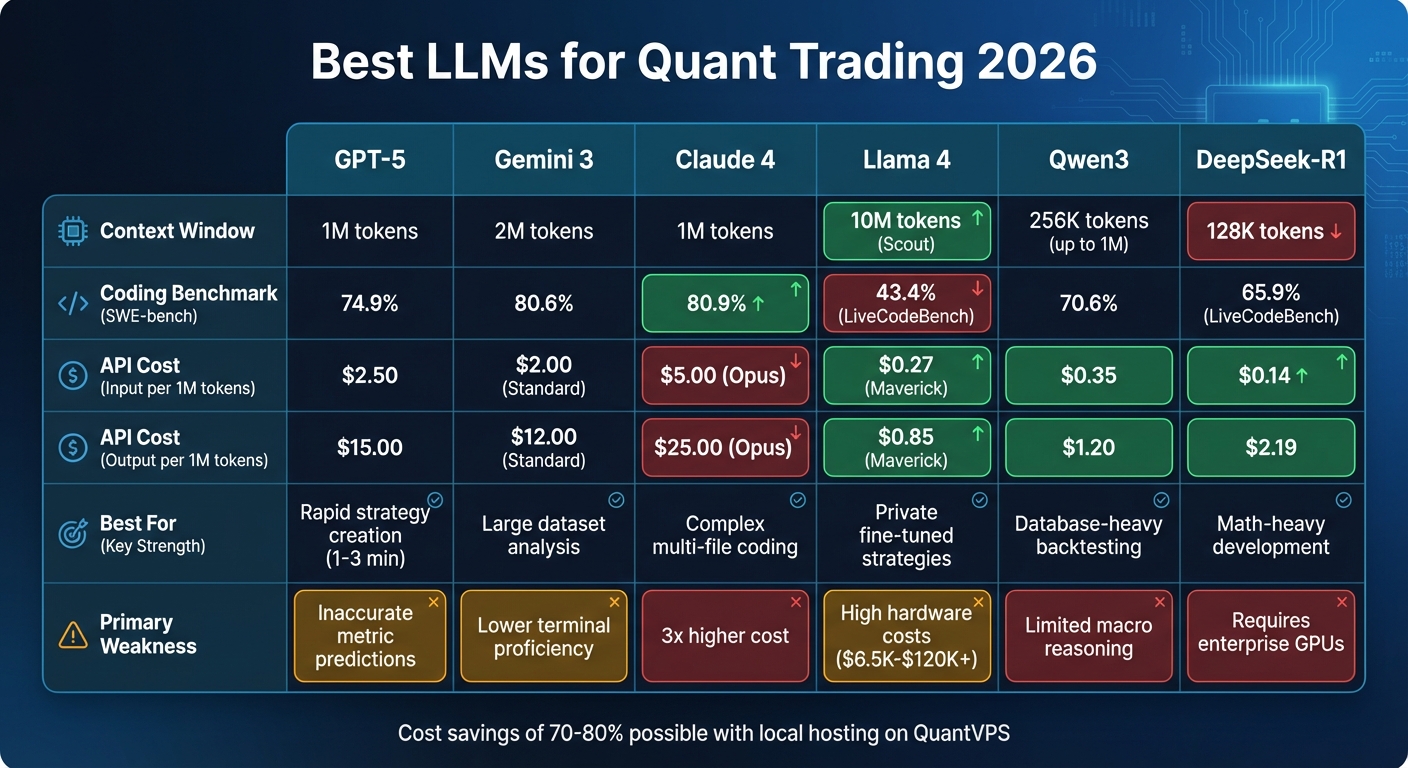
Each model comes with its own strengths and weaknesses, which can significantly impact how you approach building production trading systems. Let’s start with GPT-5, known for its speed. It can turn news into strategies in just 1–3 minutes and boasts a terminal coding proficiency of 77.3%. However, it struggles with accuracy in quantitative predictions if formulas aren’t explicitly defined.
"LLMs are confident guessers. Unless you pin down every formula, they will invent or approximate. That's dangerous in systematic trading." - QuantLabsNet
Claude 4 is a top performer for complex coding tasks, achieving the highest SWE-bench Verified score at 80.84%. It excels in multi-file architectural changes and repo-aware coding, thanks to its managed VM environment. The downside? It’s about three times more expensive than budget models and has a 5–10% failure rate when processing large 1,500-line prompts.
Gemini 3 stands out for its affordability and performance balance. With a cost-effective approach and a strong score of 77.1% on ARC-AGI-2, it’s perfect for analyzing large datasets with its 2M-token context window. However, it doesn’t quite match GPT-5’s terminal coding proficiency.
Llama 4 is all about control. Its open-weights design ensures complete data control, and its massive 10M-token context window is a game-changer for private, fine-tuned strategies. But the hardware costs are steep - ranging from $6,500 for dual RTX 4090s to over $120,000 for enterprise H100 clusters.
Qwen3 shines in database-heavy tasks, with an impressive 85.1% accuracy on SQL reasoning. It’s the go-to for backtesting a strategy but is less effective for broader macroeconomic reasoning.
Finally, DeepSeek-R1 is a budget-friendly option for quantitative tasks. At just $0.27 per 1M input tokens, it’s optimized for logic and numerical reasoning. However, running the full model requires enterprise-grade GPU clusters, though a more accessible 70B distilled variant is available.
| Model | Key Strength | Primary Weakness | Best Use Case |
|---|---|---|---|
| GPT-5 | Speed and terminal coding proficiency of 77.3% | Inaccurate metric predictions in quant work | Rapid iteration from news to strategy |
| Claude 4 | Highest SWE-bench score of 80.84% and superior code clarity | High cost and 5–10% failure on large prompts | Complex multi-file architecture |
| Gemini 3 | Best cost-to-performance ratio and 2M-token context | Lower terminal proficiency compared to GPT-5 | Long-context data analysis |
| Llama 4 | 10M-token context and complete data control | High upfront hardware costs of $6,500–$120,000+ | Private fine-tuned strategies |
| Qwen3 | SQL reasoning accuracy of 85.1% | Limited macroeconomic reasoning | Database-heavy backtesting |
| DeepSeek-R1 | Ultra-low cost of $0.27 per 1M tokens and strong quantitative reasoning | Requires enterprise GPUs for full model | Math-heavy strategy development |
These trade-offs highlight why many production teams are adopting model routing to cut costs by 40–60%. By assigning simpler tasks to budget-friendly models and reserving premium models for complex work, companies can optimize both performance and expenses.
"Your CFO stops questioning every autocomplete keystroke when the math works [on DeepSeek pricing]." - Augment Code
Additionally, combining these strategies with QuantVPS’s local hosting benefits can lead to massive savings. Firms processing millions of tokens daily report 70–80% cost reductions over three years, with inference latency dropping to 10–20 ms - significantly faster than the 200–800 ms delays typical of cloud APIs.
Conclusion
Choosing the right LLM for quant trading hinges on your specific trading workflow and priorities. If your goal is to transition from breaking news to a live strategy in under an hour, GPT-5.4 is a standout option. It delivers production-ready Python code in just 1–3 minutes per cycle, offering both speed and reliability. For more intricate, multi-step planning, Claude 4 shines with its ability to break down complex trading logic into structured and actionable code, though its cost is about three times higher than budget alternatives.
"The alpha is no longer in the code; it is in the prompt." – QuantLabsNet
When it comes to data-intensive research, Gemini 3 leads the pack with its massive 2M-token window. Meanwhile, Llama 4 offers unmatched control with its open-weights design, though it requires a significant hardware investment ranging from $6,500 to over $120,000. If speed in coding tasks is your priority, Qwen3 is an excellent choice for quickly developing trading algorithms. For math-heavy strategies, DeepSeek-R1 provides exceptional value at just $0.27 per 1M tokens.
Efficient model routing further enhances speed and cost-effectiveness. Paired with QuantVPS's robust local hosting, these gains create a powerful trading setup. Firms processing millions of tokens daily have reported drastically reduced operational costs and inference latency as low as 10–20 ms. Aligning the right model with your specific tasks ensures a faster, more cost-efficient quant trading system tailored to your needs.
FAQs
Which LLM is best for my trading workflow?
The ideal large language model (LLM) for your trading workflow depends on what you're trying to achieve. If you need a tool for coding, following detailed instructions, or handling long and intricate contexts, GPT-4.1 is a top choice. Its ability to produce precise code and streamline workflows makes it perfect for implementing complex trading strategies.
For tasks like real-time market analysis or generating trading signals, GPT-4o is another strong contender. However, for multi-step planning and seamless integration into broader trading systems, GPT-4.1 currently leads the way as the most advanced option available.
How do I keep LLM-generated trading code from making math errors?
To minimize math errors in trading code created by large language models (LLMs), adopt a deterministic approach. This means offloading all numerical calculations to a separate, verified server or computation engine. While the LLM can handle generating the code, the actual calculations should occur in a trusted system.
You can also validate the outputs by using tools such as symbolic computation libraries. This extra layer of verification helps ensure precision and reduces the chances of errors in trading algorithms.
Should I use one model or route tasks across multiple LLMs?
Routing tasks across several LLMs instead of depending on just one can bring several benefits. By assigning specific tasks - such as coding, research, or strategy creation - to the models best suited for them, you can improve efficiency, cut costs, and meet targeted requirements. This method also avoids putting all your trust in a single model, offering greater flexibility and reliability while aligning workflows with each model's strengths.