
XYZ100 is a perpetual futures contract on Hyperliquid that tracks a Nasdaq-100 style index of 100 of the largest non-financial companies listed in the US. It is deployed by trade.xyz as a HIP-3 market, never expires, offers up to 30x leverage and keeps trading through nights and weekends, with funding paid every hour to keep its price near the index (checked on 10 Oct 2026).
Key Points:
- What are Perpetual Futures? Contracts without expiration dates, kept aligned with market prices via funding rates.
- Why Hyperliquid? Offers up to 40x leverage on BTC and up to 30x on XYZ100, on-chain execution, and tools like Funding Comparison and History for better decision-making.
- Infrastructure Matters: Using Virtual Private Server (VPS) hosting minimizes latency, ensures uptime, and supports automated trading strategies.
- Risk Management: High leverage increases potential returns but also magnifies risks. Tools like stop-loss orders and proper position sizing are essential.
Trading Technology Infrastructure: The Role of VPS Hosting
Trading perpetual futures on platforms like Hyperliquid demands split-second decisions and flawless execution. With funding paid every hour and leverage of up to 30x on XYZ100, even a short delay can make or break a trade. Virtual Private Server (VPS) hosting runs trading software on a remote machine, and a crypto VPS keeps bots that trade Hyperliquid's crypto and equity perps running around the clock.
In trading environments like this, every millisecond matters. Take the XYZ US 100 Index perpetual: on 10 Oct 2026 its funding rate was about 0.005% per 8 hours, paid hourly at 0.000625% (Hyperliquid API), and its price keeps moving through nights and weekends when US stock markets are closed. For traders, having reliable infrastructure is just as crucial as their market strategies.
How VPS Hosting Enhances Trading
One of the biggest benefits of VPS hosting is ultra-low latency, which is critical for futures traders. A typical home internet connection may experience 50-200ms of latency when connecting to trading servers. By contrast, VPS solutions can achieve near-zero latency, giving traders the speed they need to execute trades on volatile assets like TSLA-USDC perps. In such high-leverage scenarios, even a minor price movement could trigger liquidations in seconds.
Another key advantage is continuous uptime. VPS hosting ensures that your trading operations run smoothly, even during local internet outages, power failures, or computer crashes. Stop-loss orders and automated strategies still depend on the platform, broker, network and market being available.
Additionally, dedicated resources make a huge difference during periods of high market activity. Shared hosting can slow down under heavy trading volumes, but VPS hosting provides exclusive CPU cores, RAM, and storage. This ensures consistent performance, even during volatile market spikes. Plus, it allows traders to access their platforms from anywhere with an internet connection, offering flexibility without sacrificing speed.
These features make VPS hosting a vital tool for traders understanding the complexities of high-leverage platforms like Hyperliquid.
XYZ US 100 Index Perpetual Futures: Key Features and Data
How the XYZ100-USDC Contract Works
trade.xyz describes XYZ100 as tracking "a modified market-capitalization-weighted index of 100 of the largest, most actively-traded, non-financial companies that are listed on a U.S. stock exchange." That is a Nasdaq-100 style index: like the Nasdaq-100, it leaves out financial companies, so it moves like a large-cap technology and growth benchmark.
The contract is a HIP-3 builder-deployed market, so trade.xyz runs its oracle and settings on Hyperliquid's order books. During the US cash session the oracle uses the spot index; outside it, the oracle uses dated index futures discounted to an implied spot value, and when no external price is available it follows the XYZ100 order book within set limits.
| Spec | XYZ100 (as published, checked on 10 Oct 2026) |
|---|---|
| Venue and deployer | Hyperliquid, HIP-3 market deployed by trade.xyz (shown as xyz:XYZ100) |
| Underlying | Nasdaq-100 style index of 100 large non-financial US-listed companies |
| Max leverage | 30x |
| Margin mode | Cross margin |
| Oracle | Spot index in the cash session; index futures discounted to spot outside it; internal order book pricing when no external price exists |
| External session hours | Sunday 6:00 PM to Friday 5:00 PM ET |
| Internal session rules | "Daily maintenance window applies from 5PM ET to 6PM ET, Monday to Thursday. Trading also follows futures holiday closures." |
| Weekend price limits | Mark price held within ±3.5% of a reference price, with 1 re-anchor allowed per direction |
| Funding | Quoted as an 8-hour rate, paid every hour at one eighth of it; funding rate multiplier 0.5 |
| Trading fees | Growth mode: tier 0 base rate 0.0090% taker and 0.0030% maker |
| Settlement | Cash-settled in USDC |
Sources: docs.trade.xyz (Specification Index, Equity Indices, Oracle Price, Discovery Bounds, Fees) and hyperliquid.gitbook.io (Funding, HIP-3), plus Hyperliquid's public API for the live leverage and funding values.
Order flow
Built for scalpers. Heatmaps on dedicated resources.
Order-flow heatmaps and DOM ladders run on dedicated CPU, memory and NVMe, so your charts keep responding during volatility.
See the dedicated hardware





From $29.99/mo · Windows or Linux
Equity Perpetual Futures on Hyperliquid
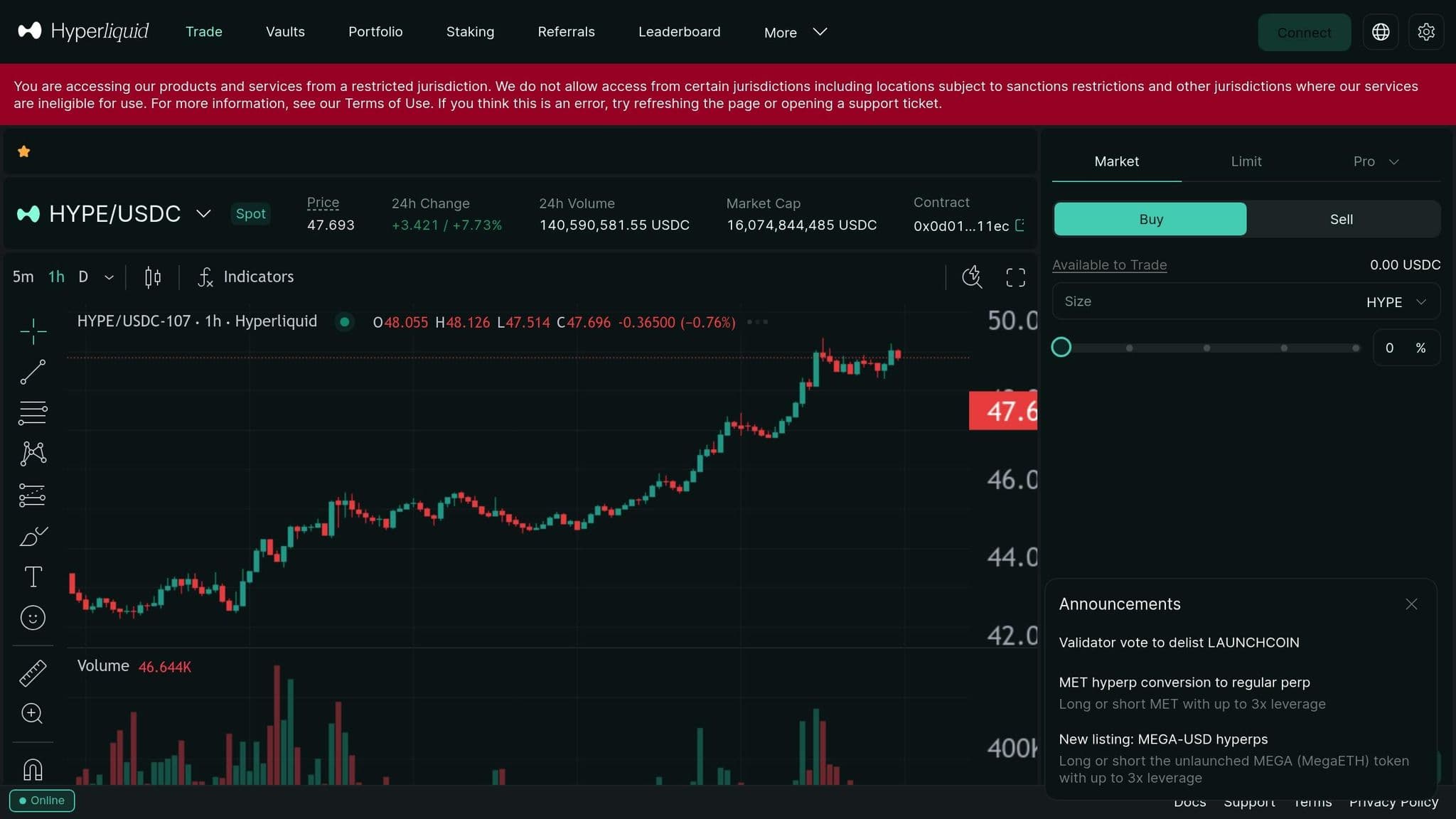
Hyperliquid has expanded its perpetual futures model to include equity perps, giving traders another way to engage with the market. These contracts allow users to speculate on price movements directly on-chain, without needing to own the actual asset. Similar to traditional stock futures, equity perps rely on a funding mechanism to track their underlying assets.
Key Equity Perps
One example is the TSLA perp from trade.xyz, which mirrors Tesla’s price movements with up to 20x leverage (checked on 10 Oct 2026). With Hyperliquid’s funding comparison tool, traders can easily spot favorable funding conditions, making it easier to optimize their positions.
Price Discovery and Launch Process
Equity and index perps like XYZ100 are not hyperps. They are HIP-3 builder-deployed markets: a deployer such as trade.xyz stakes 500,000 HYPE, defines the market and its oracle, and runs it on Hyperliquid's order books. Hyperps are a separate Hyperliquid product for pre-launch tokens that have no spot price yet.
A hyperp uses an 8-hour moving average of its own mark price in place of an external oracle, so funding pulls hard against strong moves in one direction. When the token lists for spot trading on a major exchange such as Binance, OKX or Bybit, the hyperp converts to a normal perp.
The 500,000 HYPE stake for HIP-3 deployers must stay in place for at least 183 days after a market launches, and validators can slash it for malicious market operation. That stake is what stands behind markets like XYZ100, so it pays to know who deployed a market before you trade it.
Trader Strategies for Perpetual Futures
On Hyperliquid, traders often take advantage of differences in funding rates within perpetual futures markets. A popular method is funding rate arbitrage, where traders position themselves to collect periodic funding payments from other market participants.
Funding Yield Strategies
In funding rate arbitrage, the key is keeping a close eye on funding rates at specific intervals. Traders aim to enter and exit positions based on real-time funding conditions, allowing them to earn income from funding payments while potentially benefiting from price movements.
Success with this approach requires a sharp focus on market trends and quick decision-making. At the same time, managing risk effectively is crucial, especially in markets prone to sudden volatility.
Risk Management and Best Practices
Trading perpetual futures with high leverage on platforms like Hyperliquid demands disciplined risk management. Take contracts like XYZ100-USDC and TSLA-USDC as examples - while leverage can amplify profits, it also increases risk significantly. With leverage as high as 30x on XYZ100 and 20x on TSLA, paired with volatile markets, traders face the possibility of rapid account liquidations if safeguards aren’t in place.
Managing Leverage and Liquidation Risks
When dealing with high-leverage markets, a solid risk management strategy is non-negotiable.
Position sizing is key. For instance, XYZ100 offers up to 30x leverage and TSLA up to 20x (trade.xyz, checked on 10 Oct 2026). Before entering any trade, it’s crucial to determine the maximum loss you’re willing to accept. A good rule of thumb is to limit risk to 2-3% of your total account value per trade, regardless of how much leverage is available.
Monitoring margins is critical, since funding is charged every hour. On 10 Oct 2026, XYZ100's rate was about 0.005% per 8 hours, but rates move with demand and add up over time. For traders holding positions over longer periods, these costs can become substantial, particularly when annualized funding rates exceed 10%.
Stop-loss and trailing stop orders are essential tools for limiting losses, but placement matters. Set stops too close, and you risk being forced out by normal market fluctuations. Set them too far, and they lose their effectiveness. Finding the right balance is crucial in high-leverage trading.
Keep a buffer above liquidation prices. Market gaps can unexpectedly trigger liquidations, so maintaining a cushion can help protect your positions.
Shorter timeframes can reduce exposure to funding costs. Instead of holding large positions through multiple funding periods, many traders opt for shorter-term strategies. This approach allows them to capitalize on price movements while avoiding the compounding costs of extended holding periods.
Uptime
99.999% uptime. Built for 24/7 trading reliability.
Your VPS runs in Tier IV datacenters with redundant power and network, monitored 24/7 on site.
See the uptime SLAFrom $29.99/mo · Windows or Linux
Using VPS Hosting for Risk Reduction
In addition to sound risk management practices, having reliable VPS hosting can make a significant difference, especially during periods of market volatility.
Consistent connectivity is a must for managing high-leverage trades. XYZ100 keeps trading through weekends, and a position opened at the full 30x can be liquidated by a move of under 2%, so automated alerts and exits need a server that stays online.
DDoS protection and automatic backups are invaluable during volatile periods. For instance, if funding rates spike or breaking news impacts equity perpetuals like TSLA-USDC, uninterrupted access to adjust or close positions is essential.
Global VPS access ensures stable connectivity from anywhere in the world. This is particularly useful for international traders using Hyperliquid’s decentralized platform, where latency and slippage can directly impact profitability.
Hyperliquid offers over 100 perpetual markets, so screen space helps monitor correlations across different positions.
Finally, the Windows Server 2025 environment supports popular trading tools and risk management software, making it easier to calculate position sizes and set up automated alerts.
Combining disciplined risk management with dependable VPS hosting creates a solid foundation for success in high-leverage trading. These tools and strategies work together to help traders understand the challenges of perpetual futures markets effectively.
Key Takeaways for Traders
For traders, several key insights stand out: spotting market opportunities, using leverage wisely, relying on solid technology, embracing automation, and maintaining strict risk management practices.
Hyperliquid's perpetual futures open doors to unique trading opportunities, especially when combined with strong technology and disciplined risk strategies. The platform offers early access to unlaunched tokens through "hyperps", enabling traders to engage in price discovery for up-and-coming assets.
Strategic leverage usage is a must. Hyperliquid provides tools like the Funding Comparison and Funding History features, which help traders manage leverage and keep track of funding costs effectively.
Dependable technology is non-negotiable: XYZ100 trades around the clock, so bots, alerts and stop orders need a machine that stays online when you are away.
Automation can significantly improve trading efficiency, especially for funding-rate strategies that need checking every hour.
Lastly, disciplined position sizing is critical: size each position on the dollar amount you can afford to lose, not on the 30x maximum. If you would rather trade with a firm's capital, our guide to funded accounts for crypto trading compares the prop firms that offer them.
FAQs
What makes perpetual futures on platforms like Hyperliquid different from traditional futures contracts?
Perpetual futures, often called perps, are a type of derivative contract that allows traders to speculate on asset prices without worrying about an expiration date. Unlike traditional futures, which come with fixed maturity dates, perps remain active indefinitely. To ensure their prices stay aligned with the underlying asset, they use periodic funding rate payments.
Platforms like Hyperliquid enhance the appeal of perpetual futures by offering features such as high leverage (up to 40x on BTC and 30x on XYZ100) and access to a broad selection of assets, including equities and indices. These advantages make perps a go-to option for traders looking for flexibility and opportunities across both crypto and traditional financial markets.
How does VPS hosting improve trading performance in high-leverage markets like those on Hyperliquid?
VPS hosting can play a key role in improving trading performance, especially in high-leverage markets. It provides low latency connections, which means orders are executed more quickly. This speed can help minimize slippage - an issue that’s particularly critical in volatile trading environments where every millisecond counts.
Another major advantage of VPS hosting is its 24/7 uptime and stability. Traders can keep their strategies running smoothly and ensure automated trading systems operate without interruptions. This is especially valuable in markets like those on Hyperliquid, where opportunities can appear at any moment. With a VPS, traders can stay ahead in dynamic, high-stakes trading landscapes.
What are the best strategies to manage risk when trading high-leverage perpetual futures on Hyperliquid?
Managing risk is an essential part of trading high-leverage perpetual futures on Hyperliquid. Here are some strategies to help you trade smarter and protect your capital:
- Set Stop-Loss Orders: A stop-loss order is your safety net. It automatically closes your position if the market moves against you, helping to cap potential losses before they spiral.
- Be Mindful of Leverage: While high leverage can amplify gains, it also magnifies losses. Stick to lower leverage levels, especially if you're just starting out, to better manage market swings.
- Diversify Your Trades: Don't put all your eggs in one basket. Spread your investments across different assets to reduce the risk of being overly reliant on a single market or index.
- Watch Funding Rates: Funding rates can add up, especially for long-term positions. Keep an eye on these trends to avoid letting high costs eat into your profits.
- Trade Within Your Means: Only use funds you can afford to lose. Never risk your entire account balance on a single trade - it's a recipe for unnecessary stress and potential losses.
By applying these strategies, you'll be better equipped to handle the challenges of trading high-leverage perpetual futures on Hyperliquid. While risks are inevitable, a thoughtful approach can make the journey much smoother.


