
Automated options trading means a program opens and closes options positions for you when your rules are met, instead of you clicking each order. You need a broker that accepts options orders through an API or a connected tool, a bot or platform that holds your rules, and a computer that stays on while the market is open. The rules must cover the exit and the maximum loss, not just the entry.
Key points:
- Brokers with options APIs include Interactive Brokers, Charles Schwab, tastytrade, TradeStation and Alpaca.
- No-code tools such as Option Alpha and TradersPost run options bots without programming; QuantConnect suits traders who code.
- Common automated strategies are covered calls, credit spreads, iron condors and 0DTE trades, each with precise entry and exit rules.
- Assignment, wide spreads and rejected orders are the main risks, so every bot needs a maximum loss and a kill switch.
Which Brokers Let You Automate Options Trading
Your bot can only trade where the broker accepts options orders by API. These five brokers do, at very different prices (checked on 25 Oct 2026):
| Broker | API type | Options support | Options cost |
|---|---|---|---|
| Interactive Brokers | TWS API (Python, Java, C++, C#), Web API (REST), FIX | Equity and index options through the same APIs as stocks and futures | $0.65 a contract on IBKR Pro at standard volume, $1.00 minimum per order |
| Charles Schwab | Schwab Trader API for individual developers (apply on developer.schwab.com) | Equity and index options from the account you use in thinkorswim | $0.65 a contract |
| tastytrade | Open API (REST/JSON) | Equities, options, futures, futures options and crypto, including complex orders (OTO, OCO, OTOCO) | $1 a contract to open ($10 maximum per leg), $0 to close |
| TradeStation | TradeStation API | Single-leg, multi-leg and index options | $0 to $0.80 a contract single-leg, $0 to $0.40 multi-leg, by monthly volume tier |
| Alpaca | Trading API (REST) with Python, .NET/C#, Go and Node SDKs | Single and multi-leg US equity and ETF options, paper and live; index options listed as coming soon | $0 commission for retail customers; regulatory fees may apply |
Source: interactivebrokers.com, schwab.com, tastytrade.com, tradestation.com and alpaca.markets, October 2026. Schwab Trader API details from developer.schwab.com, read 10 Oct 2026.
Interactive Brokers is the broadest choice if you code in Python; our Interactive Brokers API bot guide covers TWS vs IB Gateway and the daily restart. Alpaca is the simplest API to start with and charges no commission for retail customers. tastytrade caps the opening cost per leg, which matters for strategies that trade many contracts.
Schwab's Trader API requires an application: you register on developer.schwab.com and request access, and Schwab said most requests are reviewed within two business days when we checked on 10 Oct 2026.
Uptime
99.999% uptime. Built for 24/7 trading reliability.
Your VPS runs in Tier IV datacenters with redundant power and network, monitored 24/7 on site.
See the uptime SLA





From $29.99/mo · Windows or Linux
No-Code Tools vs Coding Your Own Bot
You do not have to write code to automate options. No-code tools hold your rules and send orders to a connected broker; coding gives you full control but more to maintain.
| Tool | How it works | Brokers for options | Price |
|---|---|---|---|
| Option Alpha | No-code options bots with backtesting; 50 bots and a $100k limit per bot | Free with TradeStation ($10k minimum balance), tastytrade or Tradier ($5k minimum balance); other brokers on paid plans | $99 a month billed annually or $149 monthly; $0 with a qualifying broker account |
| TradersPost | Sends alerts from indicators, strategies or bots straight to your broker; supports stock and index options | TradeStation, Alpaca, Interactive Brokers, tastytrade, Tradier | From $41.65 a month billed yearly (Starter, 1 asset class); all asset classes on Premium, $254.15 a month billed yearly |
| QuantConnect | Write strategies in code on the LEAN engine, backtest on its options data, then trade live | Interactive Brokers, tastytrade and Schwab (paper and live); TradeStation and Alpaca (live) | Free for backtesting; live trading from Quant Researcher at $84 a month |
Source: optionalpha.com, traderspost.io and quantconnect.com, October 2026.
Pick a no-code tool if your strategy fits standard building blocks (enter a spread at a set delta, close at a profit target). Write your own bot if you need custom data, your own pricing model or logic the tools cannot express, and budget time for error handling, logging and reconnects.
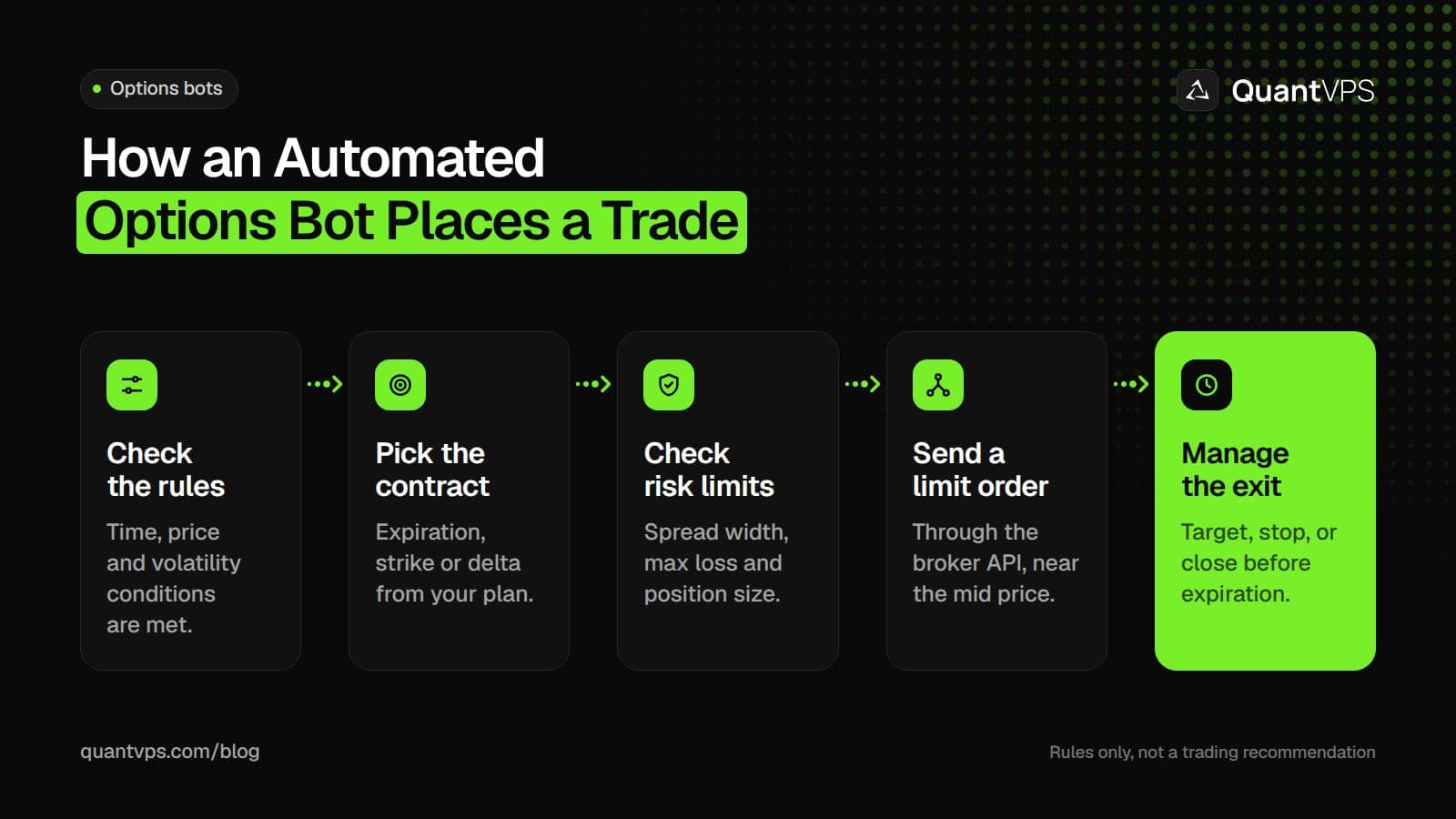
Every options bot needs a rule for each step, including the exit.
Common Automated Options Strategies and Their Rules
A bot follows rules literally, so each strategy needs every decision written down. These are the rules each common strategy needs, not a promise that any of them will make money.
| Strategy | Rules the bot needs |
|---|---|
| Covered calls | Which stock you hold, the call's expiration and strike (or delta), when to roll, and what to do if the call goes in the money near expiration |
| Credit spreads | Direction, short strike by delta or distance, spread width, minimum credit, profit target, stop loss, and how many days before expiration to close |
| Iron condors | Both short strikes, wing width, total credit, adjustment or stop rules for each side, and an exit date before expiration |
| 0DTE trades | Entry time window, strike selection, a hard stop, a time stop well before the close, and a daily loss limit |
An iron condor is two credit spreads at once, a call spread above the market and a put spread below it, so a bot has to manage both sides and decide what happens when only one is threatened. 0DTE options expire the same day, so prices move quickly and the bot must exit on time even if no other rule has triggered.
Whatever the strategy, use limit orders. Options often have wide bid-ask spreads, and a market order on a thin contract can fill far from the price your rules assumed.
Risks to Control in an Options Bot
- Assignment and early exercise: most US equity options are American style, so a short option can be assigned before expiration, especially when it is in the money or just before a dividend. A covered call can lose its shares; a spread can leave the bot holding stock it did not plan to own.
- Wide spreads: a strategy that backtests on mid prices can lose money live if it pays the full spread on every entry and exit.
- Order rejections: brokers reject orders for options approval level, buying power, a closed market or an invalid strike. The bot must read the rejection and stop, not retry in a loop.
- Legging risk: if a bot enters a spread as separate single-leg orders, one leg can fill without the other and leave an unhedged position. Send spreads as one multi-leg order where the broker supports it.
- Data gaps: stale quotes or a dropped connection can make the bot act on old prices.
Every bot needs a maximum loss per trade and per day that it checks before each order, and a kill switch: one command or button that cancels open orders, stops new entries and, if you choose, closes positions. Test both on a paper account before you go live.
Running an Options Bot Reliably
A bot only follows its rules while the computer it runs on is on and connected. A laptop that sleeps, restarts for updates or loses Wi-Fi in the middle of the session can leave positions with no exit running, which is the worst case for short options near expiration.
Run the bot on a server that stays on through market hours. A stock and options VPS keeps your bot and its broker connection online from the open to the close, and a thinkorswim VPS does the same for traders who manage options on Schwab's platform. Before you trust it with real money, let the bot run on a paper account for several full sessions and check its logs every day.
Order flow
Built for scalpers. Heatmaps on dedicated resources.
Order-flow heatmaps and DOM ladders run on dedicated CPU, memory and NVMe, so your charts keep responding during volatility.
See the dedicated hardwareFrom $29.99/mo · Windows or Linux
Testing an Options Bot Before It Goes Live
Options backtests are easy to flatter. Most historical options data gives end-of-day or minute quotes, so a backtest can assume fills at prices that were never really available. Treat the backtest as a filter for bad ideas, not proof of a good one.
- Price fills realistically: assume you pay part of the bid-ask spread on every leg, not the mid price.
- Include every cost: commissions per contract and per leg, plus regulatory fees, add up fast on four-leg strategies.
- Test the exits: check what the bot does when a short strike is breached, when the market gaps at the open and when the session ends with a position open.
- Paper trade on the same broker: Interactive Brokers, tastytrade, Schwab (paperMoney), TradeStation and Alpaca all offer paper or simulated trading, so the bot meets the same API and order rules it will use live.
- Force the failure cases: disconnect the network, send an order the broker will reject and trigger the kill switch, and confirm the bot stops cleanly each time.
Keep a log of every order the bot sends, every fill and every rejection. When live results drift from the backtest, the log shows whether the cause is the strategy, the fills or the bot itself.
How to Set Up Automated Options Trading
- Get options approval at your broker for the strategies you plan to run (spreads need a higher level than covered calls).
- Choose a tool or API from the tables above and connect it to a paper or simulated account.
- Write every rule: entry, contract selection, size, profit target, stop, time exit and maximum daily loss.
- Backtest, then paper trade for long enough to see different market conditions, including a fast-moving day.
- Go live small, on a server that stays on, with the kill switch ready.
FAQs
Can you automate options trading?
Yes. Brokers such as Interactive Brokers, Schwab, tastytrade, TradeStation and Alpaca accept options orders through their APIs, and tools like Option Alpha, TradersPost and QuantConnect connect to them so a bot can open and close positions by your rules.
What is the best platform for automated options trading?
For no-code bots, Option Alpha is built around options and is free with a qualifying TradeStation, tastytrade or Tradier account. For coding your own, Interactive Brokers and Alpaca have the most widely used APIs, and QuantConnect adds backtesting on options data.
Do options trading bots work?
A bot only executes your rules; it does not make a strategy profitable. It removes missed entries and late exits, but it also repeats a bad rule every time. Backtest, paper trade and set a maximum loss before you run one live.
How much money do I need to automate options trading?
The brokers above set low or no account minimums: Interactive Brokers has none and Alpaca has no funding minimum. Tools can add their own: Option Alpha is free with a TradeStation account holding $10k or a tastytrade or Tradier account holding $5k. Spreads and other defined-risk strategies usually need a margin account, and TradeStation, for example, requires $2,000 to trade on margin.
Does an options bot need to run all day?
Yes, while it has open positions or may open new ones. If the computer stops, the bot cannot manage exits, so most traders run bots on a server that stays on through market hours.


