When trading with Optimus Futures, understanding the fee structure is key to managing costs effectively. Here's a quick breakdown:
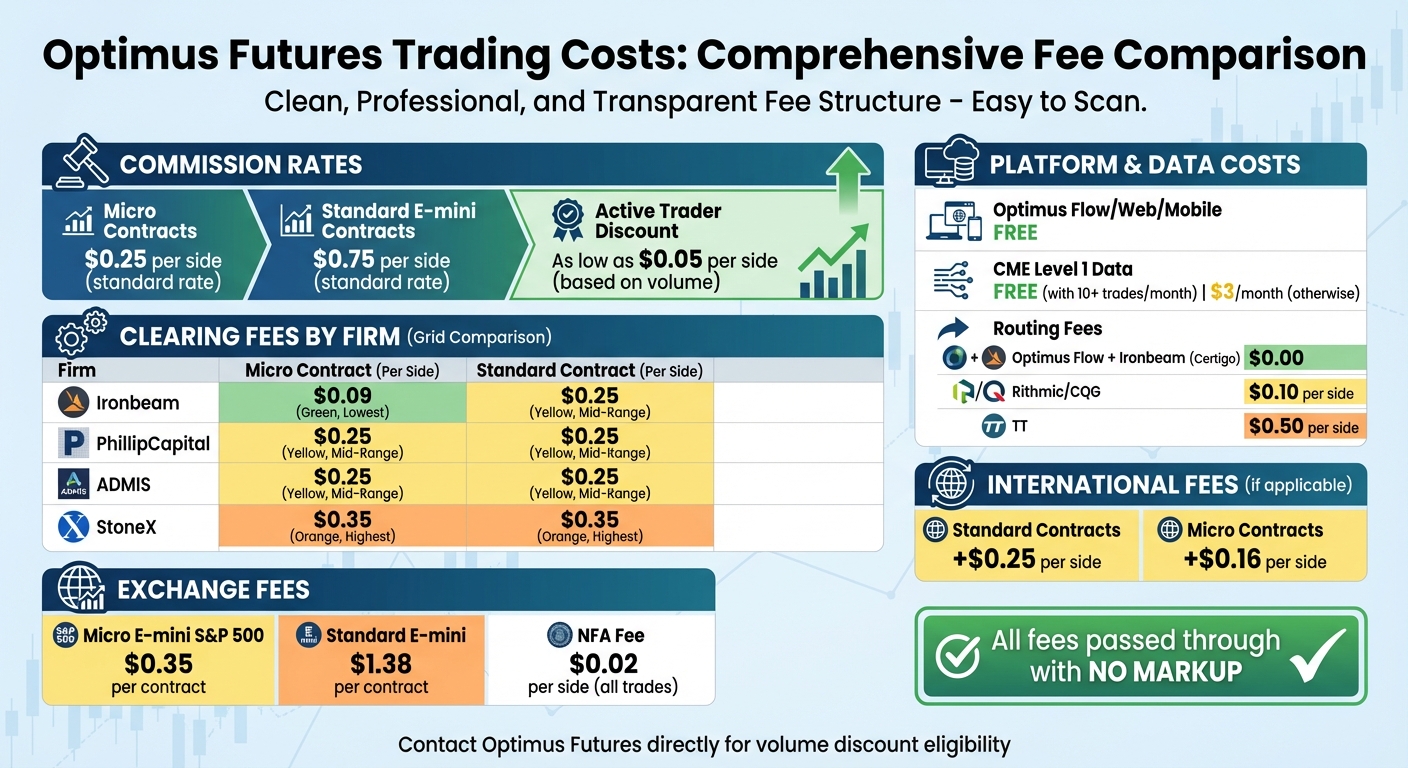
- Commissions: Starting at $0.25 per side for micro contracts and $0.75 for standard contracts. Active traders can access rates as low as $0.05 per side based on volume.
- Clearing Fees: Vary by clearing firm - Ironbeam charges $0.09 (micro) and $0.25 (standard) per side, while others like StoneX charge up to $0.35.
- Exchange Fees: Range from $0.35 for Micro E-mini S&P 500 contracts to $1.38 for standard E-mini contracts, plus a $0.02 NFA fee per side.
- Platform and Data: Optimus Flow is free, and CME Level 1 data is free with 10 trades/month; otherwise, it's $3/month. Routing fees depend on the data feed - free with Ironbeam, but Rithmic adds $0.10 per side, and TT adds $0.50.
- QuantVPS Hosting: Plans start at $59.99/month for basic setups, with discounts for annual billing.
Key Tip: Contact Optimus Futures directly to ensure you're eligible for volume discounts or reduced rates. For reliable trading performance, consider QuantVPS for low-latency hosting tailored to futures trading.
Optimus Futures Complete Fee Structure Breakdown by Contract Type
1. Optimus Futures Fee Structure
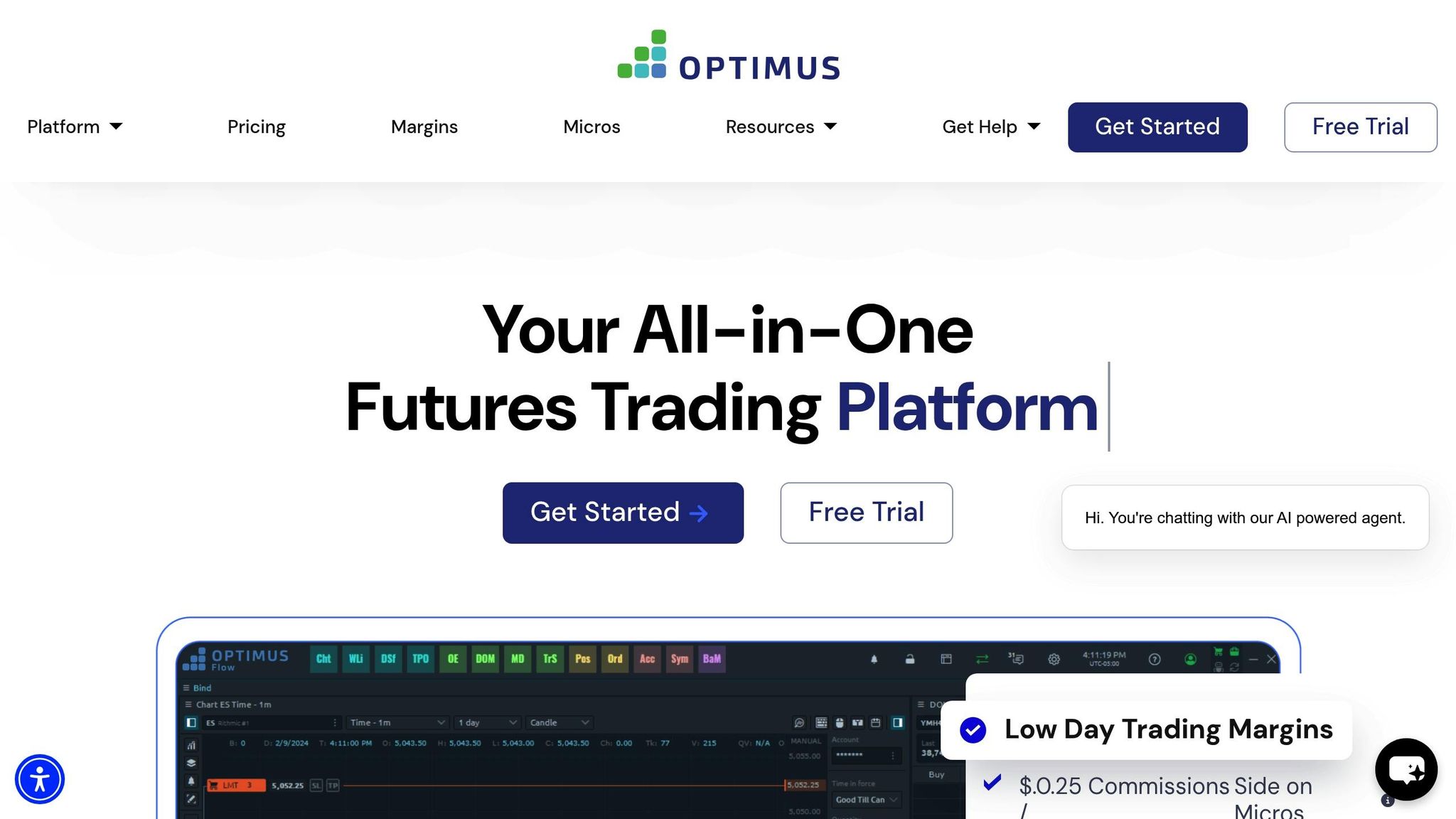
Fee Breakdown
Optimus Futures' commission structure starts at $0.25 per side for micro contracts and $0.75 per side for standard E-mini contracts. For active traders who meet specific volume requirements, rates can go as low as $0.05 per side, plus exchange fees. These reduced rates are available by contacting Optimus Futures directly. Clearing fees depend on the clearing firm: Ironbeam charges $0.09 per side for micro contracts and $0.25 per side for standard contracts. Other firms, like PhillipCapital and ADMIS, charge $0.25 per side, while StoneX charges $0.35 per side. Exchange fees range from $0.35 for Micro E-mini S&P 500 contracts to $1.38 for standard E-mini contracts, and there's an additional $0.02 NFA fee per side on every trade. Understanding these fees is crucial for managing trading costs effectively. In the next section, we'll explore platform and data costs that contribute to your overall expenses.
Platform and Data Costs
Optimus Futures provides access to its platforms - Optimus Flow, Web, and Mobile - at no charge. Additionally, CME Level 1 market data is free after completing 10 trades per month; otherwise, it costs $3 per month. Order routing fees vary based on the data feed you use: Optimus Flow with Ironbeam (Certigo) has no additional fee, while Rithmic and CQG add $0.10 per side, and TT adds $0.50 per side.
Cost Efficiency
All exchange, clearing, routing, and NFA fees are passed through without any markup, ensuring that traders can calculate their expenses with complete transparency. For international clients, there is an extra clearing fee of $0.25 per side on standard contracts and $0.16 per side on micro contracts. Traders should also be aware that holding positions beyond the session close or using lower day trading margins may result in higher commissions. To minimize costs, consider using platforms and data feeds that qualify for discounted rates. However, keep in mind that not all clients may meet the requirements for these discounts.
Trading futures costs more than commissions alone. Hidden charges, exchange fees, NFA fees, and per-contract commissions reduce profits. This guide breaks down what Optimus Futures charges in 2026: commission rates, platform fees, clearing costs, and margin requirements, so you know your real trading costs before placing orders.
Execution speed and order reliability matter as much as fee structure. Our Quant VPS provides low-latency connections and stable uptime, ensuring orders reach the market quickly and consistently so savings from understanding Optimus Futures fees don't get lost to slippage or missed fills.
Summary
- Futures trading costs are almost always higher than the headline commission rate suggests. A single round trip on a Micro E-mini S&P 500 contract at Optimus Futures, factoring in broker commission, clearing fees, CME exchange fees, and NFA regulatory charges, runs approximately $2.04 to $2.20, even though the advertised commission is just $0.25 per side. That means the broker commission accounts for less than 25% of the actual cost per trade.
- Volume has an outsized effect on total annual transaction costs. A trader executing 20 round trips per day across 48 trading weeks per year generates roughly 4,800 round trips annually, which adds up to more than $10,000 in all-in transaction costs on a single contract at $2.10 per round trip. Scaling to five contracts per trade pushes that figure past $50,000 per year, making the negotiated commission rate only one of several meaningful variables.
- Contract selection reshapes the cost math more than most traders expect. Bitcoin futures on CME carry an exchange fee of $6.00 per contract, while Micro Bitcoin drops to $2.50. Non-US traders face additional clearing fee surcharges on standard contracts that domestic traders never encounter, meaning the same broker can have meaningfully different effective costs depending on where the account holder is based.
- Platform fees act as fixed overhead that disproportionately affects lower-frequency traders. Some Optimus platforms bundle these at no additional cost, including Optimus Flow, which includes tools like Depth of Market trading and TPO charts that typically cost $100 to $150 per month on competing platforms. That embedded value changes the break-even calculation for traders who would otherwise pay for those tools separately.
- Competitive pricing at Optimus is real but contract-specific, not universal. On UK stock index futures at 10 contracts per trade, Optimus comes in at $7.50 compared to Interactive Brokers at $22.61, a substantial difference. On US micro e-mini contracts, both brokers sit at $2.50, while AvaFutures charges $5.30 for the same trade. The cost-winning broker depends entirely on what you trade and how often.
- DayTrading.com rated Optimus Futures 4.1 out of 5 stars, reflecting strong overall capability alongside a notable learning curve, particularly for traders new to professional-grade interfaces like DOM and TPO views. The broker is built for active, futures-focused traders rather than beginners or those who want a single account covering equities, options, and futures in one place.
- Trading VPS addresses the execution side of this equation by providing low-latency, co-located infrastructure that keeps automated strategies running consistently, so cost savings from understanding your full fee stack aren't quietly offset by slippage or missed fills caused by unreliable home connections.
Is Optimus Futures a Good Broker?
Optimus Futures is a strong broker for futures traders. It is registered with the NFA and CFTC-regulated, clears through established firms like Ironbeam, and has earned a good reputation among active traders for honest pricing and serious infrastructure. The question is whether it fits your trading style.
"Optimus Futures clears through established firms like Ironbeam, combining regulatory oversight with transparent pricing: a combination serious futures traders actively seek out." — Optimus Futures
🎯 Key Point: Optimus Futures holds NFA registration and operates under CFTC regulation, making it a trustworthy option in the futures brokerage space.
✅ Best Practice: Before committing to any futures broker, verify NFA registration and clearing firm credentials. Optimus Futures makes both transparent.

Run 24/7 while you sleep. Keep bots, platforms, and trade copiers online on a dedicated VPS.
Low-latency VPS hosting for your trading platform.
 CHINYC
 LON
LONFrom $29.99/mo


 CHI/CME futuresNYC/US marketsLON/FX EAs
 DUB/Polymarket
 AMS/EU FX
 FRA/Central EU
 TYO/APAC crypto
 Does Optimus Futures offer enough market depth for serious traders?
Optimus specializes in futures rather than serving all markets. It offers no stock trading, no ETFs, or vanilla options—a constraint that becomes a feature if futures are your primary market. According to the Optimus Futures Homepage, traders access 100-plus global futures markets spanning commodities, indices, currencies, bonds, and energy contracts. Most general brokers lack comparable depth in futures-specific tools, margin flexibility, or platform quality.
What the fee structure actually signals
Commissions at Optimus start at $0.25 per side on Micro contracts and $0.75 per side on E-minis, with volume discounts reaching $0.05 per side for high-frequency traders, as documented on the Optimus Futures Homepage. This tiered structure shows the broker was built for active traders. Volume discounts matter little for traders executing 10 contracts monthly but significantly impact those trading 500.
How does the platform subsidy lower your total trading cost?
Beyond commissions, Optimus Flow—the proprietary platform offered at no additional subscription cost—includes Depth of Market trading, TPO charts, and order flow tools that typically cost $100 to $150 monthly on competing platforms. This embedded value is measurable: for traders relying on these tools, the platform subsidy effectively lowers total trading costs beyond commission rates alone.
How does execution infrastructure affect costs beyond the commission rate?
Active traders running automated or high-frequency strategies often encounter execution reliability issues unrelated to fees. Home internet connections suffer from unpredictable delays and uptime problems that compound over hundreds of trades. Our trading VPS with co-located infrastructure reduces that unpredictability, maintaining steady execution during volatile sessions.
Who should look elsewhere?
Optimus is less appealing for beginners seeking basic guidance and traders wanting one account for futures, equities, and options. The professional interface—particularly DOM and TPO views—offers extensive information without a simplified beginner mode. Independent review site DayTrading.com rated Optimus Futures 4.1 out of 5 stars, acknowledging strong capability alongside a genuine learning curve. For experienced traders transitioning from retail platforms, that curve is short. For first-time futures traders, it is steep.
Which three factors determine whether Optimus is the right fit?
Three things determine if Optimus suits you: futures are your primary market, you trade enough to access lower commission levels, and you want professional tools without extra fees. If all three apply, Optimus is worth considering. The complete fee picture—including exchange fees, clearing costs, and data subscriptions—often reveals a gap between advertised rates and actual per-trade costs.
Optimus Futures Fees Full Breakdown for 2026
Optimus Futures keeps its fee structure straightforward. Trading costs are at the low end of the industry, with commissions starting as low as $0.05 per side for high-volume traders, according to the Optimus Futures Pricing Page. The all-in cost per trade combines broker commission, exchange fees, and routing fees—understanding each layer helps prevent end-of-month surprises.
"Trading costs start as low as $0.05 per side for high-volume traders — making Optimus Futures one of the most competitively priced brokers in the futures space." — Optimus Futures Pricing Page
| Fee Component | Description | Who Pays It |
|---|---|---|
| Broker Commission | Optimus Futures' cut per side | All traders |
| Exchange Fees | Charged by the futures exchange | All traders |
| Routing Fees | Order routing and execution costs | All traders |
🎯 Key Point: The all-in cost is not just the broker commission — it's the combined total of all three fee layers. Always calculate the full per-trade cost before comparing brokers.
⚠️ Warning: Ignoring exchange fees and routing fees is the most common mistake new futures traders make — these charges can significantly impact your bottom line if left unaccounted for.
 Optimus Futures Fees at a Glance (August 2026)
The table below shows Optimus Futures' fee structure across key products and account types.
| Asset/Fee Type | Fee Level | Fee Details |
|---|---|---|
| US stock index futures | Very low | $0.05–$0.25 per side depending on contracts traded. Non-US customers may face an additional clearing fee of $0.16 per side on micro contracts |
| Inactivity fee | Low | No inactivity fee |
The "no inactivity fee" difference matters significantly. Many brokers charge $10–$25 per month on dormant accounts, penalizing traders who step back during choppy markets. Optimus Futures eliminates that penalty entirely, preserving your capital while you await the right setup.
How Futures Commissions Stack Up Against Competitors
Optimus Futures charges $2.50 for 10 contracts on US micro e-mini stock index futures, matching Interactive Brokers and undercutting AvaFutures at $5.30.
| Broker | US Micro E-Mini Stock Index Futures | UK Stock Index Futures | German E-Mini Stock Index Futures |
|---|---|---|---|
| Optimus Futures | $2.50 | $7.50 | $7.50 |
| AvaFutures | $5.30 | N/A | $5.68 |
| Interactive Brokers | $2.50 | $22.61 | $9.28 |
Optimus Futures offers the best price on UK stock index futures at $7.50 for 10 contracts, compared to Interactive Brokers at $22.61. For active traders using international futures strategies, this price difference accumulates quickly across hundreds of trades per month.
Breaking Down the Full Cost Per Trade
Most fee comparisons stop at commission, missing the complete picture: broker commission, exchange fee, clearing fee, and order routing fee. According to Optimus Futures's published fee schedule, clearing fees run $0.09 per side for Micro Contracts and $0.25 per side for E-Mini and Standard Contracts on Ironbeam-cleared accounts. Order routing fees vary by platform: Rithmic and CQG at $0.10 per side, and TT at $0.50 per side. Your routing platform choice is a fee decision that compounds across every trade.
As you trade more often, the routing fee gap between Rithmic ($0.10) and TT ($0.50) per side significantly impacts your returns. Our Quant VPS keeps your platform connected and executing consistently, ensuring your per-side cost calculations reflect actual market conditions rather than execution delays.
Non-Trading Fees Where Optimus Futures Pulls Further Ahead
| Fee Type | Optimus Futures | AvaFutures | Interactive Brokers |
|---|---|---|---|
| Deposit fee | $0.00 | $0.00 | $0.00 |
| Withdrawal fee | $0.00 | $0.00 | $0.00 |
| Account fee | No | No | No |
| Inactivity fee | No | No | No |
| Conversion fee | 0.00% | 0.00% | 0.02% |
ACH deposits and withdrawals are free at Optimus Futures, though domestic and international wire withdrawals carry higher-than-average charges. Bitcoin futures follow the same commission structure as other futures products, with CME exchange fees at $6.00 per contract ($2.50 on Micro Bitcoin) and CFE fees at $1.25 per contract, making crypto futures cost-comparable to equity index futures.
Futures Commissions by Contract Type
| Contract Type | Optimus Futures Commission |
|---|---|
| US micro e-mini stock index futures | $0.05–$0.25 per side (non-US customers: add $0.16 clearing fee per side on micro contracts) |
| UK stock index futures | $0.75–$0.10 per side (non-US customers: add $0.25 clearing fee per side on standard contracts) |
| German e-mini stock index futures | $0.75–$0.10 per side (non-US customers: add $0.25 clearing fee per side on standard contracts) |
Non-US traders must pay an extra clearing fee: $0.16 per side on micro contracts and $0.25 per side on standard contracts. This increases your actual costs and should factor into your initial decision on contract volume.
What actually makes up your total cost per trade?
Stay online and closer to execution. Choose a VPS location for CME futures, New York markets, London FX, API trading, and more.
Host your platform near the market route that matters.
CHINYCLONFrom $29.99/mo
CHI/CME futuresNYC/US marketsLON/FX EAsDUB/PolymarketAMS/EU FXFRA/Central EUTYO/APAC cryptoEvery futures transaction at Optimus Futures incurs multiple charges beyond the broker commission: exchange fees (set by CME Group or the relevant exchange), NFA regulatory fees, clearing fees, and monthly subscription costs for platform and data access.
According to the Optimus Futures Pricing Page, broker commissions range from $0.25 per side on micro futures contracts to $0.75 per side on standard E-mini futures contracts, with high-volume traders negotiating rates as low as $0.05 per side. A scalper trading 50 round trips daily in E-mini S&P 500 contracts faces a different cost structure than a swing trader placing five micro trades per week.
The real cost stack: a worked example
Take one round trip on a Micro E-mini S&P 500 (MES) contract. At $0.25 per side, broker commission is $0.50 round trip. The Optimus Futures Trading Fees page shows clearing fees of $0.09 per side ($0.18 round trip), CME exchange fees of $0.41 per side, and NFA regulatory fees of $0.02 per side. A single round trip costs $2.04 to $2.20 total. The advertised $0.25 commission represents less than 25% of that total cost.
Scale this across 20 round trips per day, five days per week, for 48 trading weeks annually: roughly 4,800 round trips. At $2.10 all-in per round trip, that's $10,080 in annual transaction costs on a single contract. Five contracts per trade crosses $50,000 annually. Commission rates matter, but every layer in the stack compounds the impact.
What changes the economics most
The choice of contract changes the math faster than almost anything else. Bitcoin futures on CME carry an exchange fee of $6.00 per contract per trade, while Micro Bitcoin drops to $2.50. UK and German e-mini stock index futures carry broker commissions of $0.75 to $0.10 per side depending on volume, plus a $0.25 per side clearing surcharge for non-US customers on standard contracts.
Non-US traders need to run their own numbers because the clearing-fee difference adds a layer domestic traders never see. Platform and market data costs are also variables—some are bundled, while others carry monthly fees that act as fixed overhead regardless of trading volume, which changes the break-even calculation for lower-frequency traders.
Most traders focus on advertised commissions while overlooking service charges, clearing fees, and platform costs. The meaningful comparison is all-in cost for your specific contract, volume tier, and platform. For a trader running 10 micro e-mini stock index contracts per trade, Optimus costs $2.50 total (broker commission layer), matching Interactive Brokers at $2.50 and undercutting AvaFutures at $5.30, according to current fee comparison data. On UK stock index futures at the same size, Optimus at $7.50 significantly undercuts Interactive Brokers at $22.61.
The trader who benefits most from Optimus Futures' fee structure trades standard or micro US index futures at moderate-to-high frequency, uses a bundled platform, and qualifies for volume-tiered commission rates. For that profile, the all-in cost ranks among the lowest available. For a low-volume trader paying full commission rates, adding a standalone data subscription, and trading contracts with high exchange fees, the headline rate becomes secondary to the fixed and pass-through costs that dominate the total. Know your stack before committing to a broker.
Once you know your true cost per trade, the next question becomes whether your execution environment keeps pace with your optimized economics.
2. QuantVPS Hosting Plans for Optimus Traders
Connectivity and VPS Costs
For traders using Optimus Futures, having a reliable and fast hosting solution is just as critical as understanding fee structures. Smooth trade execution depends on robust, low-latency hosting, and that's precisely what QuantVPS delivers. Their VPS hosting services are tailored for futures trading and are fully compatible with popular platforms like NinjaTrader, MetaTrader, and TradeStation. This ensures your trading setup remains efficient and dependable.
QuantVPS offers several hosting plans to cater to different trading needs. If you have a simpler setup, their entry-level plans are a great fit. For those running complex, algorithm-driven strategies, their advanced plans provide enhanced computing power, memory, and storage to handle the workload effortlessly.
Every plan from QuantVPS comes with unmetered bandwidth, secure servers, and advanced connectivity. These features are designed to maintain high uptime and low latency - critical factors in fast-paced futures markets where even a small delay can make a big difference.
The fixed pricing structure of QuantVPS plans adds another layer of convenience by offering cost predictability. This allows traders to focus entirely on executing their strategies without the distraction of unexpected hosting costs or performance issues. Combined with the transparent fee structure previously discussed, this stability ensures a seamless trading experience.
Optimus Futures Honest Review 2025 – Best Platform for Futures Scalping & Custom Charts?
Pros and Cons
After examining the fee breakdowns and hosting details, let's weigh the benefits and challenges of using Optimus Futures' fee structure alongside QuantVPS hosting. Together, they offer a mix of transparent pricing, volume-based discounts, and predictable hosting costs.
Optimus Futures' pricing transparency stands out as a key benefit. The broker provides clear breakdowns without marking up pass-through fees from exchanges, clearing firms, or technology providers. This means you’ll know exactly where your money is going. Plus, active traders can take advantage of discounts ranging from $0.75 to $0.05 per side.
However, there are some caveats to consider. For instance, CME Level 1 data is free only under specific conditions. Free routing is exclusive to Optimus Flow with Ironbeam, while other data feeds come with extra costs between $0.10 and $0.50 per side. Additionally, commission rates may change, and discounted tiers aren’t automatically applied. To ensure you’re getting the best rates, it’s important to contact Optimus Futures directly to confirm eligibility and request any rate adjustments.
QuantVPS hosting complements this setup by offering fixed monthly pricing, eliminating surprises. Plans start at $59.99 per month for the VPS Lite (ideal for 1–2 charts) and go up to $299.99 per month for dedicated servers that can handle 7+ charts. Opting for annual billing reduces costs by 30%, bringing the VPS Lite plan down to $41.99 per month.
| Factor | Optimus Futures Fees | QuantVPS Hosting |
|---|---|---|
| Pricing Transparency | Clear breakdowns with no mark-ups on pass-through fees (ideal for budget-conscious traders) | Fixed monthly rates with no hidden charges (great for budget-conscious traders) |
| Scalability | Volume discounts from $0.75 to $0.05 per side, rewarding high-frequency trading | Plans scale from 4 to 16+ cores, accommodating both simple and complex strategies |
| Conditions | Free data requires at least 10 trades/month; free routing limited to specific data feeds | No trading volume requirements; service remains consistent regardless of trading activity |
| Cost Predictability | Costs vary based on volume, platform, and data feed choices | Fixed monthly costs with 30% savings available through annual billing |
These elements provide a comprehensive view of trading costs, helping you make more informed decisions tailored to your trading style and needs.
Conclusion
At Optimus Futures, only 20% of total trading costs are attributed to commissions, with the remaining expenses covering exchange, clearing, and NFA fees.
Your trading habits significantly influence how you can minimize costs. For beginners, there’s free access to Optimus Flow when paired with Ironbeam routing, along with reduced micro contract clearing fees - just $0.09 per side compared to the standard $0.25. Additionally, completing at least 10 trades per month ensures free CME Level 1 market data; otherwise, a $3 monthly fee applies. For more seasoned traders, reaching out to Optimus can unlock volume-based discounts, potentially lowering commissions from $0.75 to as little as $0.05 per side.
While managing fees is key, maintaining seamless connectivity is just as important. Reliable VPS hosting can simplify trading costs and enhance performance. QuantVPS offers plans starting at $59.99 per month (or $41.99/month with annual billing) for the Lite option, up to $299.99 per month for dedicated servers capable of handling seven or more charts. These fixed costs ensure no unexpected surprises, while the dependable uptime and ultra-low latency support accurate order execution and uninterrupted strategies.
FAQs
How can I qualify for discounts on volume-based commissions with Optimus Futures?
To access volume-based commission discounts, you must hit certain monthly trading volume benchmarks. These discounts can lower your cost per side to as little as $0.05, based on how much you trade.
Think you might qualify? Contact customer support to review your trading volume and check your eligibility. They’ll guide you through the process and help you make the most of these savings.
What are the extra costs for accessing real-time market data on Optimus Futures?
The price for real-time market data through Optimus Futures varies depending on the exchange and data provider. Monthly fees generally fall between $3.00 and $149.00, covering access to exchanges such as CME, ICE, CBOE, and international markets.
The exact cost depends on factors like whether you require professional or non-professional access and the specific exchanges you plan to trade on. Having a clear understanding of these charges can help you better manage your trading budget.
What are the advantages of using QuantVPS for futures trading?
When it comes to futures trading, QuantVPS offers some standout benefits that can make a real difference in your trading experience. With lightning-fast execution speeds and low-latency connections, you can act on market shifts in real time, giving you an edge in capturing opportunities as they unfold.
QuantVPS also prioritizes reliability and stability, minimizing the chances of downtime that could disrupt your trades. Together, these features create a seamless and efficient trading setup designed specifically to handle the fast-paced demands of futures trading.