Prop trading accounts let you trade ES and NQ futures contracts without risking personal funds. However, the number of contracts you can trade depends on the account size, firm-specific rules, and your performance. Here's a quick breakdown:
- Topstep: Gradual scaling based on account balance. A $150,000 account starts with 3 contracts and increases to 15 as profits grow.
- Earn2Trade: Uses a "Progression Ladder." Contract limits grow as you hit profit milestones. A $50,000 account starts with 2 contracts, scaling to 6 with $2,000 in profits.
- Leeloo Trading: Offers immediate access to full contract limits. A $150,000 account allows up to 17 contracts from the start but uses a trailing drawdown system.
Each firm has unique risk rules, such as daily loss limits, drawdowns, and scaling plans. Choose the one that aligns with your trading style and risk tolerance.
How Many ES and NQ Contracts Do Prop Firms Allow?
ES (E-mini S&P 500) and NQ (E-mini Nasdaq 100) contract limits depend on your account tier, the firm's position limits, and scaling or risk rules. Many prop firms advertise generous limits by tier: a $50,000 account might show 3–4 ES or NQ contracts, while a $100,000 account shows 10–12. These headline numbers are ceilings you rarely get access to on day one.
"A $50,000 account might show 3–4 ES or NQ contracts, while a $100,000 account shows 10–12 — but these are ceilings, not starting points." — NinjaTrader Position Limits
| Account Tier | Typical ES/NQ Contract Limit | Day One Access? |
|---|---|---|
| $50,000 | 3–4 contracts | Rarely |
| $100,000 | 10–12 contracts | Rarely |
| Scaled/Senior | Firm maximum | Conditional |
💡 Tip: Always check whether the advertised contract limit reflects your starting allocation or your maximum potential — these are almost never the same number.
⚠️ Warning: Treating headline contract limits as guaranteed day-one access is one of the most common and costly misconceptions new prop traders make.
 How does account size affect your actual contract capacity?
According to ClearEdge Trading's analysis of prop firm automation settings, a $50,000 evaluation account typically allows 2 ES contracts or 3 NQ contracts, meaning your instrument choice affects position capacity, not just risk profile. Capacity is shared across all open positions simultaneously. If you hold 2 ES and 1 NQ on a 3-contract account, you're at the limit until a position closes.
Standard Prop Firm Contract Caps by Account Size
The table below shows platform-level position limits for funded accounts. These represent total open position limits across all symbols combined.
| Account Size | Typical Max Full Contracts (ES / NQ) | Micro Equivalent (MES / MNQ) |
|---|---|---|
| $25,000 | 1 to 2 contracts | 10 to 20 micro contracts |
| $50,000 | 3 to 4 contracts | 30 to 40 micro contracts |
| $100,000 | 10 to 12 contracts | 100 to 120 micro contracts |
| $150,000 | 15 to 17 contracts | 150 to 170 micro contracts |
| $300,000 | 30+ contracts | 300+ micro contracts |
What is the scaling ladder nobody warns you about?
The failure point is usually not the contract cap itself, but the scaling ladder beneath it. Firms like Topstep and Earn2Trade restrict access to the full advertised limit until you build a profit cushion, often between $1,500 and $2,000 in closed gains on a $50,000 account. Exceeding the ladder limit before hitting that threshold causes instant account failure.
How does the gap between advertised balance and usable risk affect your trades?
A common pattern among traders is frustration with the gap between advertised balance and actual usable risk. On a $50,000 account, usable risk is typically around $2,000 total, not $50,000. NQ moves at $20 per point: three full NQ contracts losing 34 points generates a $2,040 loss, enough to breach the entire drawdown limit in a single trade.
The execution blueprint that actually works
The math is unforgiving. FundedNext's breakdown of how futures prop trading works confirms that most prop firms allow between 1 and 10 ES or NQ contracts depending on account size, but experienced traders know the advertised maximum is not the recommended starting point. Begin with 2 to 5 Micro contracts (MES or MNQ), risk no more than 1 to 2 percent of the actual trailing drawdown per trade, and scale into a single full ES or NQ contract only after building at least $3,000 in closed profits as a buffer. That buffer is the difference between surviving a bad week and losing the account.
Knowing the contract limits and understanding your actual trading capacity are two different things.
Why Your Contract Limit Is Not Your Actual Trading Capacity
Your contract limit is a ceiling the firm sets. Your actual trading capacity is set by mathematics—specifically by how many points of adverse movement your drawdown buffer can absorb before the account closes. One ES contract moves $50 per point. One NQ contract moves $20 per point. Those aren't abstract figures; they're the rate at which your drawdown buffer drains in real time.
"Your contract limit tells you what the firm allows. Your drawdown buffer tells you what the math permits. These are never the same number."
⚠️ Warning: Trading at your full contract limit without accounting for adverse point movement is one of the fastest ways to breach a funded account — even when your overall direction is correct.
💡 Tip: Before sizing any position, calculate your maximum adverse excursion in dollar terms. Divide your remaining drawdown buffer by the per-point dollar value of your instrument to find your true capacity — not the number the firm printed on your dashboard.
| Instrument | Per-Point Value | What It Means |
|---|---|---|
| ES (S&P 500 Futures) | $50 per point | A 10-point move against you = $500 drained |
| NQ (Nasdaq Futures) | $20 per point | A 10-point move against you = $200 drained |
🔑 Takeaway: Your contract limit and your real trading capacity are two entirely different numbers. The firm sets one — the math sets the other. Always trade the one that actually keeps your account alive.

Run 24/7 while you sleep. Keep bots, platforms, and trade copiers online on a dedicated VPS.
Low-latency VPS hosting for your trading platform.
 CHINYC
 LON
LONFrom $29.99/mo


 CHI/CME futuresNYC/US marketsLON/FX EAs
 DUB/Polymarket
 AMS/EU FX
 FRA/Central EU
 TYO/APAC crypto
 What does a $50K account actually protect?
The $50,000 label on a funded account is not usable capital. The drawdown threshold—often $2,000 to $2,500 on a standard $50K evaluation—is your true risk capital. Everything else is a display balance that creates a false sense of safety.
How quickly can real losses erase a $50K drawdown buffer?
Three NQ contracts losing 34 points produce $2,040 in losses, enough to breach a $2,000 drawdown buffer entirely. Thirty-four points on NQ is not catastrophic; it's a moderately bad morning. Two ES contracts dropping 20 points costs $2,000, which exhausts the entire buffer on many $50K accounts.
According to Trader's Second Brain's FTMO Futures Contract Limits Guide, a $50,000 evaluation account allows up to 10 mini contracts, but Sim-Funded capacity begins lower and scales only as end-of-day profit accumulates. The gap between permitted contracts and survivable contracts is widest when you are most vulnerable.
How micro contracts change the math
MES and MNQ contracts reduce per-point exposure by a factor of ten. One MES moves $5 per point. One MNQ moves $2 per point. A 34-point move against 3 MNQ contracts costs $204, not $2,040. At 3 MNQ, a 34-point loss consumes roughly 10% of a $2,000 buffer. At 3 NQ, it consumes 102%. Position sizing determines whether you trade next week.
A pattern among traders who fail evaluations is confusing contract permission with contract capacity. The firm says you can trade 3 NQ contracts. The math says your buffer survives approximately 33 points of adverse movement before the account closes. Those are two entirely different statements. ClearEdge Trading's Futures Contract Specifications guide notes that intraday margin requirements can be as low as $500 per contract, far below the notional value of $200,000 or more. This leverage is structurally designed to outpace a thin drawdown buffer if you let it.
The real question isn't how many contracts the firm allows you to hold, but how many contracts your remaining buffer distance can absorb. That number changes daily as you trade.
How Many ES or NQ Contracts Should You Trade in a Funded Account?
Your buffer distance sets the ceiling. Divide it by your actual risk per trade to figure out how many contracts you can responsibly trade — not the number your prop firm shows.
"Your buffer distance — not your prop firm's displayed limit — is the real ceiling that determines how many ES or NQ contracts you should be trading at any given time."
💡 Tip: Always calculate your maximum contract size yourself using your actual risk per trade. Never rely on the number your prop firm displays — it's not the same as what you can safely trade.
⚠️ Warning: Trading the maximum contracts your prop firm shows — without accounting for your real buffer distance — is one of the fastest ways to blow a funded account.
| Factor | What It Means |
|---|---|
| Buffer Distance | The true ceiling on how many contracts you can trade |
| Risk Per Trade | The amount you divide your buffer by to find your safe contract count |
| Prop Firm's Number | A displayed limit — not your responsible trading ceiling |
 What is the formula for calculating your true position size limit?
Start with what you have left to lose. If your trailing drawdown limit is $2,500 and your strategy uses a 10-point stop on NQ, each contract risks $200 per trade (10 points multiplied by $20 per point). Divide $2,500 by $200, and your absolute maximum is 12 contracts, but a smart approach caps single-trade risk at 10 to 15 percent of remaining buffer, which brings that scenario down to 1 contract, or 2 on a clean setup.
Why does your position size limit need to be recalculated every morning?
Take your available drawdown, multiply it by your maximum single-trade risk percentage (10 to 15 percent), then divide by the dollar value of your stop distance per contract. That result is your true position size limit, which should be recalculated every morning before the open, as your remaining buffer shrinks with each losing trade and your stop distance shifts with volatility.
Why instrument choice changes the entire equation
According to the Edgeful Blog's ES vs NQ Futures Comparison, NQ futures have about twice the volatility of ES futures. Two NQ contracts carry the same volatility load as four ES contracts, so if your drawdown buffer is smaller from earlier losses, that exposure can exceed your limit before your stop triggers.
Why do traders miscalculate risk when switching between instruments?
Traders often make mistakes by focusing on contract quantity rather than potential loss per point. Two ES contracts with a 10-point stop cost $1,000 (2 × $50/point × 10 points). Two NQ contracts with the same 10-point stop cost only $400 (2 × $20/point × 10 points), but NQ moves faster and further, so your stop gets hit more often and your average loss per trade increases despite the smaller per-point mathematics.
What does the funded account data actually suggest?
ClearEdge Trading's analysis of prop firm NQ futures automation settings reports that on a $50,000 funded account with a typical $2,500 trailing drawdown, staying within risk limits realistically limits traders to 1 to 2 NQ contracts. Most traders push back because the firm technically allows more, but permission and sound judgment aren't the same. Firms that allow 3 or 4 contracts are not covering your losses; they are simply not stopping you from making them.
Why does position sizing discipline matter more with automated strategies?
With automated strategies on funded accounts, position sizing discipline becomes critical because the system will not hesitate the way a human might. A dropped connection mid-trade can leave you holding an unhedged position with no exit logic active. Our trading VPS helps maintain consistent latency and uptime when margins are tight.
What benchmark ratio helps calibrate NQ contract sizing?
ClearEdge Trading's analysis of prop firm NQ futures automation settings suggests 1 NQ contract per $10,000 of account balance as a benchmark. This ratio aligns the contract's volatility exposure with your account's loss capacity. On a $50,000 account, that points toward 5 NQ contracts maximum, but only if your stop distance and drawdown math support it. If your stop is wide or your drawdown buffer is thin, you may land at 1 or 2 contracts regardless. The guideline serves as a ceiling check, not a starting point.
How does reverse-engineering contract count expose flawed sizing logic?
Available drawdown sets the maximum loss; maximum loss divided by dollar risk per contract sets the contract count, and the instrument's tick value determines how quickly that risk builds up. Traders who reverse-engineer this by starting with desired contract count and finding a stop to justify it are rationalizing positions, not sizing them. Funded accounts do not forgive that distinction.
The math is straightforward. What happens when your strategy pushes against those limits in real time is where most traders discover what their risk framework is made of.
Keep Your ES and NQ Strategy Running Within Your Risk Limits
Getting your position size right gets you to the starting line. What keeps you there is execution that never flinches, even when your internet drops at 9:32 AM during a volatile open. Most algo traders running ES or NQ strategies on a local machine underestimate how often connectivity issues, hardware restarts, or inconsistent uptime damage performance.
"Most algo traders running ES or NQ strategies on a local machine underestimate how often connectivity issues, hardware restarts, or inconsistent uptime hurt performance." — Quant VPS
🎯 Key Point: Position sizing is only half the equation. Flawless execution infrastructure protects your edge every session.
⚠️ Warning: A single dropped connection during a volatile open can leave you in an unplanned position you cannot exit cleanly, turning controlled risk into uncontrolled loss.
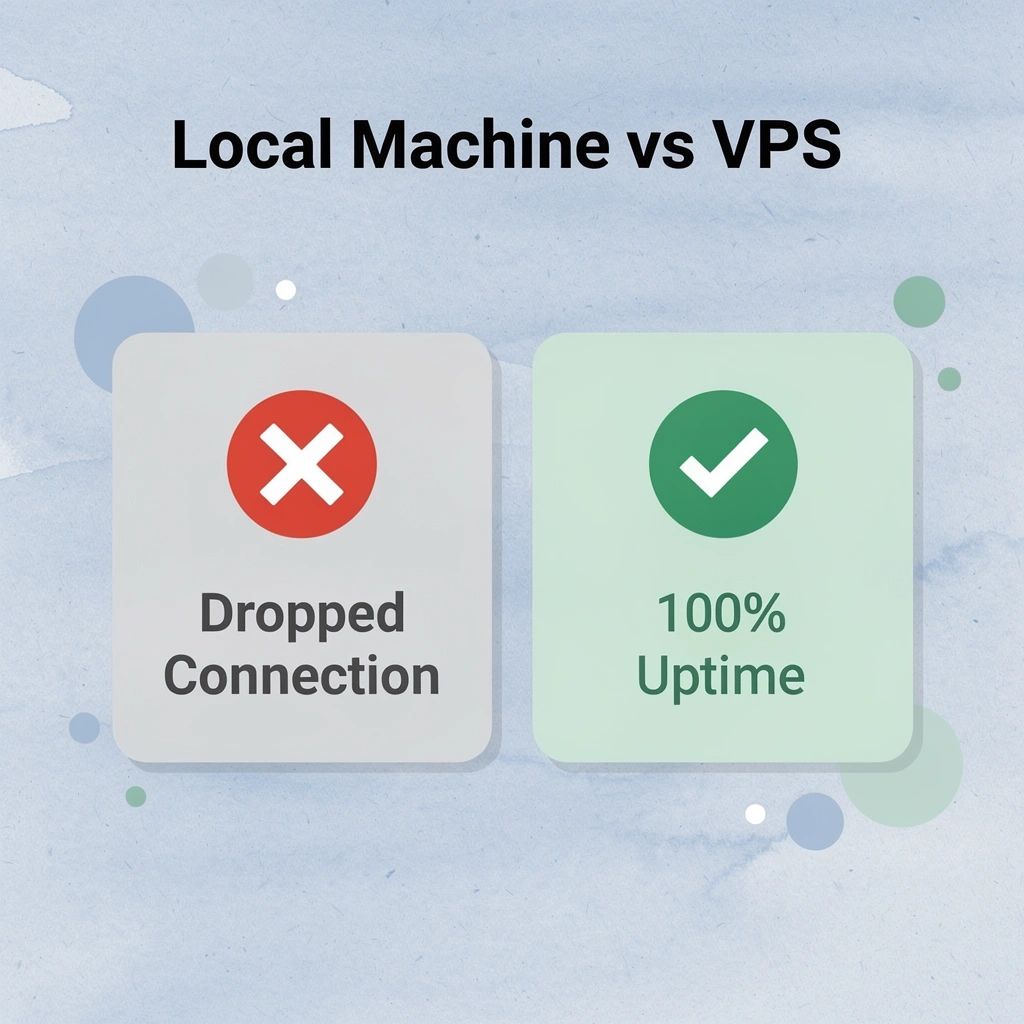 If you run an automated ES or NQ strategy on a funded account, consider a trading VPS from Quant VPS. With 1 ms latency, 100% uptime, and support for NinjaTrader, TradeStation, Sierra Chart, and more, our platform keeps your logic running continuously from a dedicated environment — so a local power outage or router reset does not become an unplanned position you cannot exit cleanly.
| Infrastructure Risk | Local Machine | Quant VPS |
|---|---|---|
| Latency | Variable/unpredictable | 1 ms |
| Uptime Guarantee | No guarantee | 100% |
| Power Outage Protection | ❌ Vulnerable | ✅ Protected |
| Router Reset Risk | ❌ High | ✅ Eliminated |
| Platform Support | Depends on setup | NinjaTrader, TradeStation, Sierra Chart & more |
💡 Tip: Running your ES or NQ strategy on a dedicated VPS environment means your automated logic never sleeps — even when you do.
🔑 Takeaway: Consistent uptime and ultra-low latency are not luxury features — they are non-negotiable requirements for any serious algo trader protecting a funded account.
Quick Comparison:
| Firm | Account Size | Starting Contracts | Max Contracts | Scaling Plan | Trailing Drawdown |
|---|---|---|---|---|---|
| Topstep | $150,000 | 3 | 15 | Gradual, profit-based | End-of-Day |
| Earn2Trade | $50,000 | 2 | 6 | Progression Ladder | End-of-Day |
| Leeloo Trading | $150,000 | 17 | 17 | None (full access) | Intraday |
The right choice depends on how much flexibility and risk management you need. Always align contract sizes with your trading plan to avoid overleveraging.
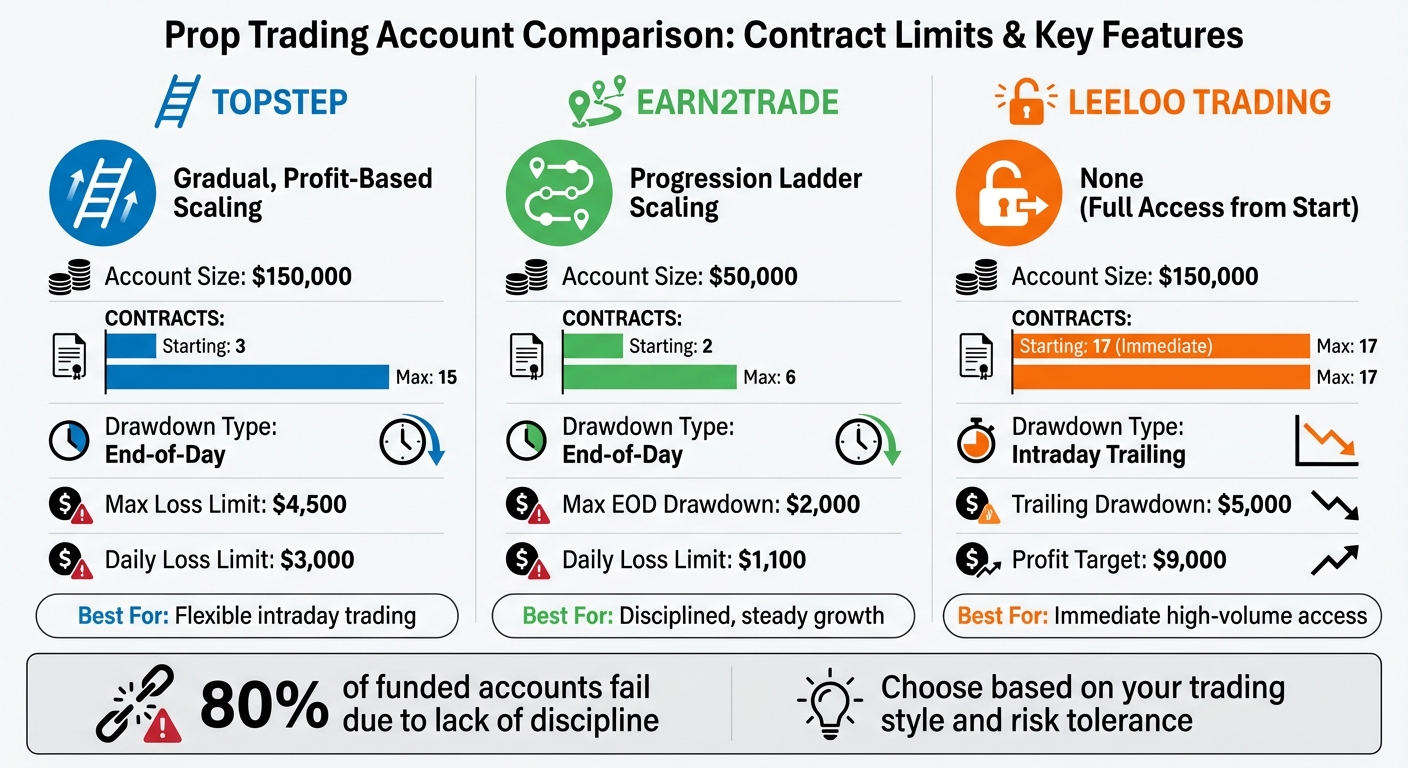
Prop Trading Firms Contract Limits Comparison: Topstep vs Earn2Trade vs Leeloo Trading
1. Topstep
Topstep offers three account options: $50,000, $100,000, and $150,000. The largest account allows trading up to 15 ES or NQ contracts, but this is unlocked gradually through a scaling plan.
Risk Limits
Each account size comes with specific risk limits:
Stay online and closer to execution. Choose a VPS location for CME futures, New York markets, London FX, API trading, and more.
Host your platform near the market route that matters.
CHINYCLONFrom $29.99/mo
CHI/CME futuresNYC/US marketsLON/FX EAsDUB/PolymarketAMS/EU FXFRA/Central EUTYO/APAC crypto- $50,000 account: Maximum Loss Limit of $2,000 and Daily Loss Limit of $1,000.
- $100,000 account: Maximum Loss Limit of $3,000 and Daily Loss Limit of $2,000.
- $150,000 account: Maximum Loss Limit of $4,500 and Daily Loss Limit of $3,000.
These limits apply to both realized and unrealized P&L. All positions must be closed by 3:10 PM CT or at market close. If you briefly exceed the contract limit (within 10 seconds), it won't result in penalties .
Scaling Plans
Topstep's scaling plan aligns contract allowances with your account balance. For Express Funded Accounts, contract limits are tied to the end-of-day balance. For example, in a $150,000 account:
- When the balance is between $150,000 and $151,499, the contract limit is 3 contracts.
- Once the balance reaches $154,500, the limit increases to 15 contracts.
Session profits update the next day, as limits refresh at 5:00 PM CT.
On TopstepX, a 10:1 ratio applies to Micro contracts - 15 standard contracts translate to 150 MES or MNQ contracts . However, third-party platforms like NinjaTrader or Tradovate count 1 Micro as 1 contract, which reduces the number of contracts you can trade .
2. Earn2Trade
Earn2Trade takes a different approach by using a Progression Ladder instead of traditional margin requirements. Unlike fixed margin systems used by other firms, this ladder adjusts contract limits based on your account balance and profit milestones, rewarding strong performance with greater trading capacity.
Risk Limits
Earn2Trade provides two main programs: Trader Career Path (TCP) and Gauntlet Mini. Each account size comes with its own set of risk parameters:
| Account Size | Daily Loss Limit | Max EOD Drawdown | Profit Target | Initial Contracts |
|---|---|---|---|---|
| $25,000 | $550 | $1,500 | $1,750 | 3 Contracts |
| $50,000 | $1,100 | $2,000 | $3,000 | 2 Contracts |
| $100,000 | $2,200 | $3,500 | $6,000 | 6 Contracts |
| $150,000 | $3,300 | $4,500 | $9,000 | 15 Contracts |
| $200,000 | $4,400 | $6,000 | $11,000 | 16-20 Contracts |
During evaluations, Earn2Trade uses an End-of-Day (EOD) trailing drawdown, which updates only at market close. Additionally, all positions must be closed by 3:50 PM CT. To maintain balance, the firm enforces a rule that no single trading day can account for more than 30% of the total profit.
This system naturally transitions into a profit-based scaling plan, where contract limits increase as you achieve specific profit levels.
Scaling Plans
The Progression Ladder ties contract limits directly to your profits. For example, with a $50,000 account, you start with 2 contracts. Reaching a $1,500 profit increases the limit to 4 contracts, and hitting $2,000 allows for 6 contracts.
For traders using Micro contracts, 10 MES or MNQ contracts are equivalent to 1 standard ES or NQ contract within the contract limit. The TCP program provides a clear progression path, starting from a $50,000 account and scaling up to $400,000, with a fixed drawdown at the top tier.
In 2024, Earn2Trade reported a 10.42% pass rate for its programs. Among the successful traders, 94.77% opted for LiveSim accounts over Live accounts.
3. Leeloo Trading

Leeloo Trading stands out from competitors like Topstep and Earn2Trade by offering traders immediate access to full buying power and a unique set of risk rules. Unlike other firms that require traders to hit profit milestones to unlock capacity, Leeloo allows full contract usage right from the start. Each account size comes with fixed contract limits, ensuring traders have access to the maximum allowed contracts within predefined risk parameters. This setup eliminates the need for gradual unlocking, which is common in other proprietary trading accounts.
Risk Limits
Leeloo employs a Rising Trailing Max Drawdown system, also known as the Auto Liquidate Threshold Value (ALTV). This system tracks the highest unrealized profit during a trade, adjusting the drawdown floor as profits increase. However, the floor remains fixed if the trade retraces. For instance, if your NQ position gains $2,000 but then pulls back significantly without being closed, your account could still hit the liquidation threshold - even if you initially had a sufficient buffer.
Another key rule is the 30% consistency requirement for Performance Accounts. This means no single trading day can account for more than 30% of your total profit when requesting a payout. Additionally, traders must close all standard ES and NQ positions 15 minutes before market close (4:45 PM ET). However, up to 3 micro contracts (MES/MNQ) can be held overnight without prior approval.
| Account Size | Max Contracts | Trailing Drawdown (ALTV) | Profit Target |
|---|---|---|---|
| $25,000 | 3 | $1,500 | $1,500 |
| $50,000 | 8 | $2,500 | $3,000 |
| $100,000 | 12 | $3,000 | $6,000 |
| $150,000 | 17 | $5,000 | $9,000 |
| $250,000 | 27 | $6,500 | $15,000 |
| $300,000 | 30 | $7,500 | $20,000 |
Scaling Plans
Leeloo offers two account types with different approaches to scaling. The Investor Account provides immediate access to the full contract limit, with no restrictions on scaling. On the other hand, the Accelerator Account follows a mandatory scaling plan. Traders in this account start with just 2 contracts and gradually increase their limits by hitting specific profit milestones.
In terms of payouts, traders keep 100% of their first $8,000 in profits. After that, profits are split 80/20 for the first year and shift to a 90/10 split thereafter. This payout structure adds flexibility and rewards long-term performance.
Pros and Cons
When evaluating the trading constraints of different proprietary firms, it's important to weigh their distinct advantages and drawbacks. Here's a closer look at how Topstep, Earn2Trade, and Leeloo Trading approach key aspects like contract limits, risk rules, and scaling methods.
Topstep stands out with its End-of-Day (EOD) updates, which provide traders more flexibility during volatile sessions. This feature helps reduce the risk of prematurely hitting the maximum loss. However, the mandatory scaling plan can feel limiting, as it initially caps traders at just 2 mini contracts on a $50,000 account.
Earn2Trade introduces a Progression Ladder that increases contract limits as traders achieve profit milestones. This setup rewards consistent performance and enforces discipline, but it may frustrate traders who prefer faster access to higher contract exposure, as the system requires a gradual, step-by-step progression.
Leeloo Trading, on the other hand, offers immediate access to full contract limits, skipping the gradual unlocking process entirely. While this provides upfront freedom, its risk management system includes an intraday trailing drawdown rule. This rule adjusts the liquidation threshold based on unrealized profits, which can lead to automatic liquidation if a profitable position experiences a sharp pullback - even if the trade remains viable overall.
Each firm's approach caters to different trading styles. Topstep's EOD drawdown is more forgiving for intraday traders seeking flexibility. Leeloo Trading appeals to those comfortable managing dynamic risks with greater initial freedom. Meanwhile, Earn2Trade's ladder system suits traders who value a methodical and disciplined path to scaling. These differences highlight the importance of matching a firm's features to your personal trading strategy and risk tolerance.
Conclusion
Our breakdown of Topstep, Earn2Trade, and Leeloo Trading highlights how each firm structures its contract limits and risk controls to cater to different trading approaches. Topstep’s End-of-Day updates offer more flexibility during volatile trading sessions, though its conservative scaling plan requires traders to start small. Earn2Trade’s Progression Ladder gradually increases contract limits for consistent traders, making it a solid choice for those who thrive on steady growth. On the other hand, Leeloo Trading provides immediate access to full contract limits but uses an intraday trailing drawdown, which calls for precise risk management.
Selecting the right funded account comes down to how well the firm’s rules align with your trading style and tolerance for risk. If you value flexibility within the trading day, an End-of-Day drawdown structure might suit you best. Alternatively, if you’re confident in managing real-time risk, immediate access to larger contract limits could be more appealing. Scaling plans, while sometimes restrictive, are designed to prevent overleveraging - something newer traders often struggle with.
Your contract size should always align with your risk management plan. With around 80% of funded accounts failing due to a lack of discipline, it’s better to choose an account size that keeps evaluation fees manageable rather than chasing high contract limits. Success in funded prop trading ultimately depends on finding a firm whose parameters fit your trading habits and risk tolerance.
FAQs
What determines how many ES and NQ contracts I can trade with a funded prop account?
The number of ES (E-mini S&P 500) and NQ (E-mini Nasdaq 100) contracts you can trade with a funded prop account depends on several factors. These include your account's buying power, margin requirements, risk limits, and the scaling plans established by the prop firm.
Margin requirements determine the minimum capital needed to hold a certain number of contracts. At the same time, risk limits - like maximum drawdowns - set boundaries on potential losses and directly affect how many contracts you can trade. On top of that, scaling plans allow traders to gradually increase their position sizes as they demonstrate steady performance and responsible risk management.
These elements work together to align trading activities with the firm's risk management rules, while still giving traders the opportunity to grow as they prove their abilities.
How do scaling plans work in funded prop trading accounts?
Scaling plans in funded prop trading accounts are all about helping traders grow their trading size responsibly. These plans let traders gradually access more contracts or increased buying power as they prove they can trade profitably and manage risk effectively.
For instance, some firms tie the number of contracts a trader can use to their daily performance, setting limits to keep things under control. Others follow milestone-based systems, where traders unlock additional trading capacity after hitting specific profit targets. The idea is simple: promote disciplined trading habits, reward consistent success, and keep risk in check.
What risk management strategies do funded prop trading firms use?
Funded prop trading firms rely on risk management strategies to safeguard their capital and protect traders' accounts. Some of the most common methods include:
- Daily loss limits: Caps on how much a trader can lose in a single day.
- Trailing drawdowns: These adjust dynamically as the account equity grows, limiting potential losses.
- Maximum risk per trade: Often set between 0.25% and 0.5% of the account balance, keeping individual trades under control.
These measures are designed to keep losses in check and ensure traders can continue operating without jeopardizing their accounts.
Firms also promote disciplined trading by enforcing strict rules. Traders are expected to avoid overtrading, stick to profit targets, and close positions by certain times to limit overnight exposure. By following these guidelines, traders build responsible habits, reduce unnecessary risks, and increase their chances of long-term success in funded accounts.