Summary
- Liquidity sweeps occur when price moves into zones where stop-losses and pending orders have accumulated, triggers those orders, and then reverses or continues based on broader market context. These zones form naturally at swing highs, swing lows, round numbers, and Fibonacci levels because traders follow similar rules, which causes order clusters to build at predictable areas. Large participants use the volume generated by those triggered orders to fill their own positions at scale, making the sweep a structural feature of how markets match large orders rather than targeted manipulation.
- The most common mistake traders make is treating every level break as a directional signal. Entering long on a resistance break or selling a support break is exactly what creates the liquidity that gets swept. Liquidity sweeps are identifiable across timeframes ranging from one minute to one month, meaning this dynamic plays out consistently at every scale from scalpers on short-term charts to swing traders watching monthly highs get pierced before major reversals.
- A liquidity sweep leaves a specific fingerprint that separates it from a genuine breakout. Price extends beyond a key level, triggers the orders sitting there, and then rejects sharply, leaving a wick or reversal candle as evidence. A genuine breakout closes beyond the level with momentum and builds continuation structure rather than reversing into the previous range. The practical test is watching what the price does after the level is breached, not at the moment it breaks.
- Waiting for confirmation after a sweep is what separates traders who use the move from traders who become the liquidity that gets swept. Entering the break itself is the trap. The sweep is often the setup, and the reaction to the sweep is where the actual trade lives. This distinction requires patience and the ability to read price behavior in real time rather than reacting to the initial break.
- Understanding the mechanics reframes the entire concept of institutional order flow. Large participants are not targeting individual stop-losses out of malice. They are solving a liquidity problem because executing a position worth hundreds of millions of dollars requires a counterparty at scale, and clustered retail orders at obvious levels provide exactly that. Recognizing this dynamic allows traders to position on the right side of those moves rather than contributing to the liquidity being absorbed.
- Liquidity sweep analysis requires tracking multiple timeframes simultaneously, and execution speed matters as much as pattern recognition when reacting to a wick forming in real time. A trading VPS addresses this by running platforms like MetaTrader and NinjaTrader on dedicated infrastructure with stable, low-latency broker connections, so indicators and order tools respond as they were designed to, rather than as a home internet connection allows.
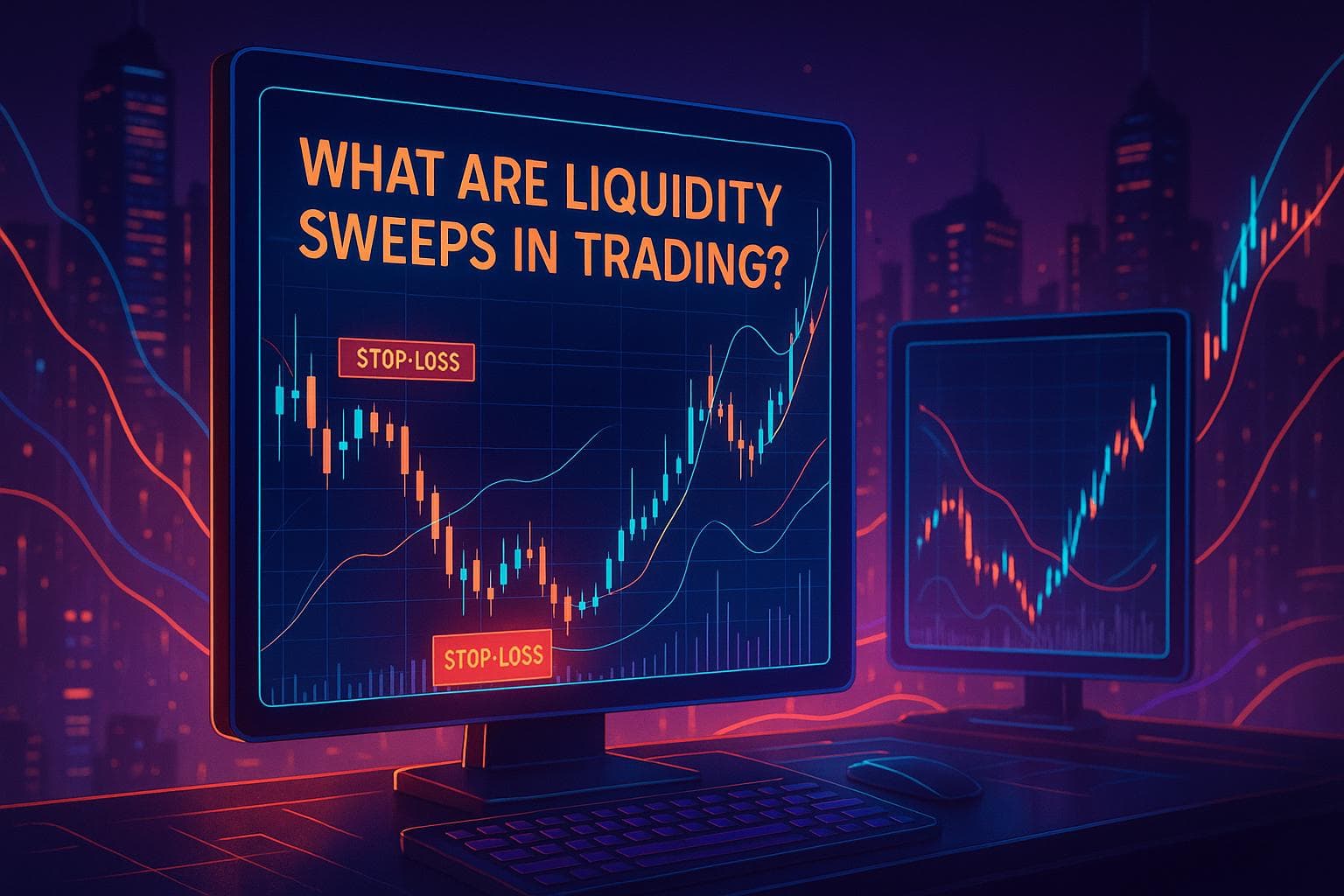
What Are Liquidity Sweeps in Trading?
Price breaks above resistance. You enter long, confident in the setup. Then, within minutes, the market reverses and runs straight through your stop-loss. By the time you close the position, the price is moving exactly where you expected it to go — without you in it. That experience is how a liquidity sweep works, and once you understand what is happening beneath that price action, you will never read a breakout the same way again.
"By the time you close the position, price is moving exactly where you expected it to go — just without you in it."
💡 Example: Imagine a textbook breakout above a key resistance level. Most traders enter long and place their stop-losses just below the breakout point — which is precisely what makes that zone a target.
⚠️ Warning: If a breakout feels too clean and obvious, it may be a liquidity sweep in disguise — engineered to trigger retail stop-losses before the real move begins.
A liquidity sweep happens when the price moves into a zone where stop-losses and pending orders have built up, triggers those orders, and then reverses or continues depending on what the broader market is doing. These zones form naturally because traders follow similar rules. The table below shows the most common order cluster zones that become sweep targets:
| Zone Type | Why Orders Cluster Here |
|---|---|
| Swing Highs & Lows | Traders place stops just beyond obvious turning points |
| Round Numbers | Psychological levels attract limit and stop orders |
| Consolidation Boundaries | Breakout traders stack entries at range edges |
| Fibonacci Levels | Widely used retracement targets concentrate orders |
When enough orders stack up in one place, that area becomes a target — because large participants need that liquidity to execute big positions without moving the price against themselves.
🎯 Key Point: Liquidity sweeps are not random market noise. They are a deliberate mechanism by which large players fill their positions by absorbing retail traders' stop-losses and pending orders.
🔑 Takeaway: Understanding where order clusters form is the first step to identifying when a move is a genuine breakout versus a calculated sweep and reversal.
What actually happens during a sweep
Price approaches a well-known level where retail traders place stop-losses and pending orders. Those orders trigger automatically, creating a volume burst that large participants exploit to fill positions at scale. Once liquidity is absorbed, the price either reverses sharply or continues, depending on broader order flow. The reversal leaves a wick or failed breakout candle; continuation builds new structure. Distinguishing between a liquidity sweep and a genuine break of structure is where real trading decisions emerge.
Most traders treat every level break as a directional signal: selling below support, buying above resistance. But that instinct creates the liquidity that gets swept. According to Flux Charts, liquidity sweeps are identifiable across timeframes ranging from 1 minute to 1 month, meaning this dynamic plays out at every market scale. Scalpers get stopped out on one-minute charts, while swing traders watch as monthly highs are pierced before major reversals. The structure remains consistent regardless of timeframe.
Sweep versus genuine breakout: the critical difference
A liquidity sweep leaves a specific fingerprint: price extends beyond a key level, triggers the orders sitting there, then rejects sharply, leaving a wick or reversal candle as evidence. A genuine breakout closes beyond the level with momentum and builds continuation structure. The practical test is watching what the price does after the level is breached. Traders who wait for the candle to close and reaction confirmation avoid entering on the break itself. The sweep is often the setup; the reaction to the sweep is the trade.
Large participants are not targeting your stop-loss out of malice—they are solving a liquidity problem. Executing a position worth hundreds of millions requires a counterparty willing to take the other side at scale, and clustered retail orders at obvious levels provide exactly that. You are not a victim of manipulation. You are observing how markets match large orders, and once you see it that way, you can position on the right side of those moves rather than becoming the liquidity that gets swept.
Once you understand what a sweep is and why it happens, the next question becomes harder and more interesting: how do you spot one before it completes?
How to spot a liquidity sweep
Traders identify liquidity sweeps by examining several structural clues rather than relying on a single signal.
Common characteristics include:
- Price approaching a well-defined swing high or swing low.
- A brief move beyond that level that triggers stop-losses or breakout orders.
- An increase in volume or volatility as liquidity is absorbed.
- A rejection candle or a long wick shows the price could not sustain the breakout.
- A close back inside the previous trading range, or confirmation from the following candle.
The strongest setups usually occur where several liquidity pools overlap, such as a previous swing high that also aligns with a psychological round number or major resistance level.

Your trading computer. In the cloud.
Connect and control your trading strategies from any device, anywhere in the world, through secure remote desktop, while execution remains on QuantVPS.
From $29.99/mo · Windows or Linux · 8 datacenters
0.52ms to CME from our Chicago nodes.


 NinjaTrader
 MetaTrader
 TradingView
 Tradovate
 Rithmic
 Sierra Chart
 Bookmap
 Quantower
How Liquidity Sweeps Work
The Process Behind a Liquidity Sweep
Liquidity sweeps typically unfold in three distinct phases. First, liquidity builds up at key technical levels where stop-loss orders are clustered. These zones often form just beyond obvious support and resistance levels, round numbers, or prior swing highs and lows.
Next, a large market participant - like an institutional trader or an algorithm - identifies these liquidity pools and executes significant orders to push the price through these levels, absorbing the available liquidity. This action forces the price to move quickly as the market seeks enough counter orders to balance out the transaction.
Finally, the cascade effect takes over. As the price breaks through the targeted level, stop-loss orders are triggered, turning into market orders that fuel the movement further. This creates a feedback loop, where each triggered stop accelerates the price movement, often driving it much farther than the initial large order alone could have.
Timing is crucial to the effectiveness of a liquidity sweep. Institutional traders often initiate these moves during low-volume periods, such as the Asian trading session in forex or pre-market hours in futures. These quieter periods have less liquidity to absorb large orders, which amplifies the sweep's impact. Understanding these stages sheds light on the mechanics and terminology behind liquidity sweeps.
Key Terms in Liquidity Sweeps
To grasp liquidity sweeps, it’s essential to understand a few key terms:
- Stop-loss hunting: This refers to the strategy of targeting areas where stop-loss orders are concentrated, exploiting them for liquidity.
- Liquidity pools: These are clusters of pending orders at specific price levels, often formed because many traders use similar technical strategies and place their stops in similar areas. The larger the pool, the more dramatic the price movement when it’s swept.
- Slippage: This happens when your order is executed at a different price than expected, often during liquidity sweeps when available orders at your desired price are consumed before your trade is processed. In forex, slippage during major sweeps can reach 10-20 pips, while in futures, it can span several ticks.
- False breakouts: These occur when the price appears to break a significant level, triggering stops and giving the illusion of a real breakout. However, after the liquidity is consumed, the price often reverses sharply, trapping traders who acted on the breakout signal.
- Order flow: This refers to the real-time sequence of buy and sell orders in the market. Analyzing order flow can help traders differentiate between genuine breakouts driven by sustained pressure and temporary sweeps.
Examples of Liquidity Sweeps
The dynamics of liquidity sweeps play out across various markets. For instance, in currency trading, pairs like EUR/USD often experience sweeps near psychological levels such as 1.1000 or 1.0500. Retail traders frequently place stops around these levels, making them prime targets. These sweeps are particularly common during the London session, when institutional trading activity increases.
In the futures market, the E-mini S&P 500 (ES) contract frequently sees sweeps during overnight trading. For example, when the price nears a previous day’s high or low, algorithms often push through these levels to trigger stops before reversing. These moves can span 15-25 points in just minutes, offering opportunities for traders who are prepared.
Earnings announcements also create fertile ground for liquidity sweeps in individual stocks. Before major tech companies release quarterly results, options market makers often sweep liquidity in the underlying stock to hedge their positions. This activity can cause stocks to move 2-3% in either direction ahead of the actual announcement.
In the crude oil futures market, liquidity sweeps are common around inventory data releases. Large energy traders often sweep stops near previous session highs and lows as the release approaches. These movements frequently reverse sharply once the data is released, creating volatile conditions that can catch traders off guard.
Finally, central bank announcements often trigger dramatic liquidity sweeps in forex markets. For example, in the minutes leading up to Federal Reserve decisions, institutional algorithms sweep stops on major pairs like USD/JPY or GBP/USD. Interestingly, the initial sweep direction is often misleading, as the true market reaction unfolds only after the details of the announcement are revealed.
How Liquidity Sweeps Affect Markets
Market Behavior During Liquidity Sweeps
Liquidity sweeps leave a noticeable imprint on market behavior. When a sweep occurs, volatility spikes as large orders are absorbed almost instantaneously. This sudden surge can throw automated trading systems off balance, often triggering a domino effect that amplifies the price movement.
One defining feature of liquidity sweeps is their rapid acceleration followed by an immediate reversal. Unlike the gradual momentum seen in typical breakouts, sweeps produce sharp, vertical price jumps within seconds. For instance, in forex markets, major currency pairs can experience dramatic price swings in a matter of moments. Similarly, stock indices may undergo abrupt shifts, disrupting normal trading patterns. These quick movements also distort typical volume trends.
During a sweep, volume patterns become unpredictable. Traditional volume analysis loses its reliability because the increased activity often stems from forced liquidations and stop-loss triggers rather than genuine market sentiment. This creates temporary imbalances that usually resolve once the sweep concludes, echoing the cascade effect mentioned earlier.
Market depth also takes a hit. As liquidity across price levels is consumed, the order book thins out. This thinning means even small orders can cause outsized price changes, creating a feedback loop that amplifies the sweep’s impact.
Retail vs. Institutional Perspectives
The effects of liquidity sweeps differ greatly depending on who’s trading. Retail traders often bear the brunt of these events. Their stop-loss orders are frequently targeted, and they face challenges with timing, often entering trades at the worst moment - just as the price reverses. Slippage exacerbates their losses, and smaller account sizes make it harder to withstand the drawdowns caused by these volatile moves.
On the other hand, institutional traders tend to see liquidity sweeps as opportunities. They can use sweeps to execute large trades efficiently, triggering stop-loss orders to create temporary sell-offs and accumulate positions at better prices. With access to advanced technology and extensive market data, institutions are better equipped to spot potential sweeps early. Their sophisticated algorithms can identify liquidity pools and adjust strategies accordingly, whether to initiate a sweep or capitalize on the resulting price movements.
Algorithmic trading systems play a dual role. They can both initiate and respond to liquidity sweeps. These systems analyze market data and execute trades in milliseconds, giving them a significant edge in volatile conditions. However, they’re not without risks, as competing algorithms or sudden market changes can disrupt their performance.
Pros and Cons of Liquidity Sweeps
The advantages and drawbacks of liquidity sweeps vary depending on the type of market participant and their trading approach.
| Participant Type | Advantages | Disadvantages |
|---|---|---|
| Retail Traders | Potential for profit if positioned correctly; offers insights into market dynamics | Susceptible to stop-loss hunting; significant slippage and poor timing often lead to losses |
| Institutional Traders | Efficient execution of large orders; ability to accumulate positions at better prices; benefits from advanced tools and data | Risk of regulatory scrutiny; higher transaction costs during volatile periods |
| Algorithmic Systems | Quick reaction to sweep signals; ability to both initiate and exploit sweeps; operates without emotional bias | Vulnerable to competing algorithms and sudden market shifts; high infrastructure costs; risk of cascading failures |
Liquidity sweeps bring both challenges and opportunities to the market ecosystem. On one hand, they enable the execution of large trades that might otherwise be difficult to complete efficiently. They also contribute to price discovery by revealing underlying supply and demand levels. On the other hand, these events can shake confidence among smaller traders, potentially reducing retail participation and overall market liquidity during normal conditions. The unpredictability of sweeps complicates risk management, making traditional stop-loss strategies less effective.
From a regulatory standpoint, liquidity sweeps occupy a murky space. While they’re generally considered legitimate trading tactics, excessive or manipulative use can draw the attention of regulators. For institutional players and market makers, the challenge lies in balancing efficient order execution with maintaining fair and orderly markets. Understanding how liquidity sweeps work is crucial for developing trading strategies that align with individual goals and risk tolerances.
What Is A Liquidity Sweep In Trading, And How Can You Use It? [Complete Guide!]
Tools and Strategies for Identifying Liquidity Sweeps
Building on earlier discussions about market behavior, let’s dive into the tools and strategies that can help you spot liquidity sweeps as they unfold in real time.
Key Tools for Spotting Liquidity Sweeps
Once you've identified liquidity zones, certain tools can give you the edge in detecting sweeps before they fully play out:
- Order flow indicators: These track real-time buying and selling pressure, helping you spot large orders being absorbed at specific price levels. A sudden spike in cumulative delta (net buy/sell pressure) followed by a sharp reversal often signals a liquidity sweep in action.
- Market depth analysis: By examining Level II data, you can see the structure of the order book, including where significant liquidity pools are located. Price levels with high concentrations of stop-loss or pending orders often become sweep targets. Look for imbalances in the order book that hint at an impending move.
- Volume profile tools: These tools show where trading activity is concentrated over time, using horizontal histograms to display volume at different price levels. High-volume nodes often act as magnets for liquidity sweeps, while low-volume areas suggest potential rapid price movement. The point of control (the price level with the most volume) is a frequent target for these moves.
- Time and sales data: This provides a detailed view of individual trades as they happen. During a liquidity sweep, you’ll notice rapid transactions moving in one direction and then reversing sharply. The size and speed of these trades can help you differentiate between a genuine breakout and a sweep designed to trigger stop-losses.
- Footprint charts: These combine price action and volume data at each price level, showing where large orders are executed. During a sweep, these charts typically reveal heavy volume at the peak of the move, followed by immediate selling pressure.
Strategies to Use Liquidity Sweeps
Trading liquidity sweeps effectively requires a solid understanding of market dynamics and precise execution. Here are some strategies to consider:
- Fade strategy: This involves taking positions opposite the sweep’s direction once the move shows signs of exhaustion, such as decreasing volume or candlestick reversals. Timing is critical - enter too early, and you risk getting caught in the sweep.
- Stop-loss hunting anticipation: By identifying likely stop-loss clusters, such as around psychological price levels (e.g., $100 or $50) or previous swing highs/lows, you can position yourself to benefit from the sweep. These areas often attract retail traders’ stops, making them prime targets.
- Breakout confirmation strategy: Instead of reacting to the initial move, this approach involves waiting to see if the breakout sustains momentum. Genuine breakouts are supported by strong volume and follow-through, while sweeps tend to reverse quickly.
- Liquidity pool targeting: Focus on areas where institutional traders are likely to place large orders, such as around key technical levels, earnings releases, or major economic announcements. These zones often see heightened volatility as large orders hit the market.
Risk management is essential when trading these volatile events. Use tight stop-losses and adjust your position size to account for the increased risk. Avoid placing stops at obvious levels where sweeps are likely to occur. Instead, consider time-based stops or volatility-adjusted stops that adapt to changing conditions.
To execute these strategies effectively, having access to a low-latency trading setup is crucial.
Stay online and closer to execution. Choose a VPS location for CME futures, New York markets, London FX, API trading, and more.
8 datacenters help your platforms keep running day and night without depending on your home PC.
From $29.99/mo · Windows or Linux · 8 datacenters
0.52ms to CME from our Chicago nodes.

Why Low-Latency Infrastructure Matters
Liquidity sweeps happen in the blink of an eye, often within milliseconds. Without a fast connection, you risk delayed entries, poor fill prices, or missed opportunities altogether. For example, a 100-200 millisecond delay can lead to several pips of slippage in forex or significant point differences in stock indices during volatile conditions.
QuantVPS’s ultra-low latency infrastructure solves this timing challenge by offering 0-1ms connections directly to major trading venues. This speed advantage can be the difference between capitalizing on a sweep reversal or suffering slippage. A 1ms connection versus a 50ms one might not sound like much, but in high-speed trading, it’s a game-changer.
High-frequency trading firms and institutional players already operate with similar low-latency setups, so retail traders need comparable tools to remain competitive. QuantVPS provides dedicated resources, ensuring consistent performance even when running multiple indicators and analysis tools simultaneously - critical during liquidity sweeps when every second counts.
For those trading international markets, the global accessibility of QuantVPS ensures consistent low-latency performance, whether you're monitoring EUR/USD during London hours or S&P 500 futures overnight. This reliability ensures you’re always ready to act, no matter where or when the sweep occurs.
Finally, compatibility with popular platforms like NinjaTrader, MetaTrader, and TradeStation means you can use your preferred tools without worrying about performance hiccups. These platforms often demand significant processing power, especially when running advanced analyses like order flow or market depth. QuantVPS ensures your system stays responsive, even during peak volatility.
Technical Requirements for Effective Trading
When it comes to trading, milliseconds can make all the difference. To stay competitive, your trading infrastructure must handle rapid price changes, execute orders instantly, and remain stable - even during periods of intense market volatility.
Why High-Speed VPS Hosting Matters
For institutional traders, speed is everything. Sub-millisecond connections allow for immediate action, which is where QuantVPS excels. With 0-1ms ultra-low latency connections to major trading venues, traders gain the split-second advantage needed to navigate liquidity sweeps. These events, often triggered around key support levels, can impact your entry price if there's even a slight delay.
QuantVPS also guarantees 100% uptime, ensuring your system is always operational during critical market moments. In high-stakes trading, where liquidity sweeps can happen in an instant, downtime is not an option. Protections like DDoS prevention and automatic backups further safeguard your operations. Losing finely tuned trading setups - such as order flow indicators or volume profile configurations - due to hardware failure can be devastating. With automatic backups, your data and settings remain secure and easily restorable.
Another key advantage is global connectivity, which complements the speed and reliability of the service.
Global Access and Dedicated Resources
For U.S.-based traders, accessing international markets consistently and with low latency is essential. For instance, the London forex session overlaps with early morning Eastern Time, while Asian markets operate during the U.S. night. A typical home setup often struggles to maintain the low-latency connections required for seamless trading across these time zones.
QuantVPS solves this with 24/7, low-latency performance across key financial hubs. Whether you're tracking EUR/USD during London hours or monitoring Nikkei futures overnight, dependable connectivity ensures your strategies remain on point.
Dedicated resources further enhance performance. Unlike shared hosting, QuantVPS allocates CPU cores, RAM, and storage exclusively for your trading activities. For example, the VPS Pro plan includes 6 CPU cores and 16GB of RAM - ample power for running multiple tools like order flow indicators, market depth analysis, and real-time charting simultaneously, even during volatile periods.
High-performance NVMe storage takes things a step further by speeding up access to critical market data. This allows for quicker analysis of historical volume profiles and order flow data, giving you an edge in fast-moving markets.
Optimizing Trading Platforms with QuantVPS
Beyond speed and global access, platform optimization is crucial for executing liquidity sweep strategies effectively. QuantVPS supports popular trading platforms like NinjaTrader, MetaTrader, and TradeStation, eliminating many technical hurdles.
Take NinjaTrader, for example. Its advanced tools, such as Market Analyzer and SuperDOM, are vital for spotting liquidity sweep opportunities. These tools perform seamlessly on QuantVPS thanks to its dedicated processing power and stable connections.
MetaTrader also benefits from the robust infrastructure. Custom indicators for volume analysis and market depth run smoothly, with the VPS Pro plan's 16GB of RAM ensuring calculations remain fast and chart updates responsive - no more bottlenecks caused by limited memory on standard setups.
For those who need to monitor multiple markets simultaneously, the VPS Ultra plan supports up to four screens. This feature is especially valuable for liquidity sweep trading, where tracking multiple timeframes and data sources can make or break your strategy. With dedicated displays for different tools, you can react faster and reduce the risk of missing key signals.
QuantVPS also offers full root access, giving you complete control over your trading environment. This flexibility allows you to install specialized software or configure system settings tailored to advanced liquidity detection tools - something restricted hosting services often can't provide.
Finally, the use of Windows Server 2022 adds a layer of security and stability. This enterprise-grade operating system is designed for continuous automated trading, minimizing the risk of interruptions. Real-time system monitoring further ensures smooth performance. If your CPU or memory usage spikes during a major news event, instant alerts let you take action before it impacts your trades.
In short, QuantVPS provides the speed, reliability, and flexibility needed to thrive in the fast-paced world of liquidity sweep trading.
Key Takeaways on Liquidity Sweeps
Liquidity sweeps - where large orders drain liquidity and trigger stop-losses - are events every trader should understand. These sudden clearouts at specific price levels often cause brief price spikes or dips, creating both opportunities and challenges.
For savvy traders, liquidity sweeps represent predictable patterns that can be used to enter positions with precision. When prices unexpectedly break through a clear support or resistance level and then quickly reverse, you’re likely observing a liquidity sweep. Recognizing this transforms what might seem like erratic market behavior into actionable trading opportunities.
Spotting these events requires split-second timing. Tools like order flow indicators, market depth analysis, and volume profile tools are essential, but they only work effectively with powerful, low-latency infrastructure. In fast-moving markets, having this technological advantage is critical.
Your trading setup must be built to match the speed of these events. Ultra-low latency connections (0-1ms) eliminate delays, ensuring you can act immediately when a liquidity sweep occurs - especially during major news events or at key technical levels. Services like QuantVPS provide the necessary infrastructure to keep you ahead of the curve.
However, speed alone isn’t enough. Managing the volatility that comes with liquidity sweeps is just as important. These events can be highly profitable, but they also carry significant risk. Proper position sizing and a clear understanding of whether you’re dealing with a genuine breakout or a temporary liquidity grab are essential for success.
Above all, consistency matters when trading liquidity sweeps. You don’t need to catch every single one. Instead, focus on having the right tools, infrastructure, and knowledge to capitalize on the most promising opportunities. Combining market insight, fast technology, and disciplined execution gives you a sustainable edge.
For successful traders, liquidity sweeps aren’t mysteries - they’re mechanical functions of the market. Leveraging dedicated resources, like QuantVPS’s VPS Pro plan with 6 CPU cores and 16GB RAM, allows you to run multiple trading tools simultaneously and execute trades with unmatched speed.
FAQs
How can retail traders minimize risks from liquidity sweeps in the market?
Retail traders can minimize the risks associated with liquidity sweeps by adopting effective risk management practices. For example, placing stop-loss orders just beyond key liquidity zones can help shield against losses triggered by sudden market moves designed to exploit these areas.
It’s also wise to steer clear of initiating trades directly within well-known liquidity zones - places where stop-loss orders tend to cluster. These areas often attract the attention of larger market players. Instead, traders should rely on tools like volume analysis, order flow indicators, or market depth charts to confirm trade entries and identify more secure opportunities.
By blending these strategies with a disciplined mindset, traders can safeguard their capital and better handle the complexities of liquidity sweeps.
How can you tell the difference between a real market breakout and a liquidity sweep?
A true market breakout is characterized by high trading volume and a consistent price movement that pushes beyond critical levels. What often follows is a retest of the breakout level, confirming its strength, and then continued movement in the same direction.
On the flip side, a liquidity sweep tends to involve brief and sudden price movements past support or resistance levels. These moves are typically designed to trigger stop-losses or draw out liquidity. They often reverse quickly, show minimal volume, and leave noticeable wicks or spikes on the price chart. Being able to spot these patterns can help traders steer clear of false signals and refine their trading strategies.
Why is having low-latency infrastructure essential for trading during liquidity sweeps?
Low-latency infrastructure plays a crucial role in trading by enabling faster order execution. This speed reduces slippage, ensuring traders can seize short-lived opportunities during liquidity sweeps. In high-stakes scenarios, even minor delays can result in missed trades or less favorable pricing.
By cutting down the time needed to process and execute trades, low-latency systems help traders optimize their profit potential while managing risks. This becomes especially critical during significant market movements or when institutional activity causes rapid price shifts.