Gaps in commodity futures records, missing contract roll data, or inconsistent tick data can ruin months of research before you place a single trade. This article covers what historical futures data is, why data quality matters for quantitative analysis and algorithmic trading, and how accessing accurate continuous contract data sharpens your competitive edge.
"Inconsistent tick data and missing contract roll data can invalidate an entire backtest — making data quality the single most critical variable before any strategy goes live."
🔑 Takeaway: Even the most sophisticated trading algorithm is only as reliable as the underlying data quality feeding it.

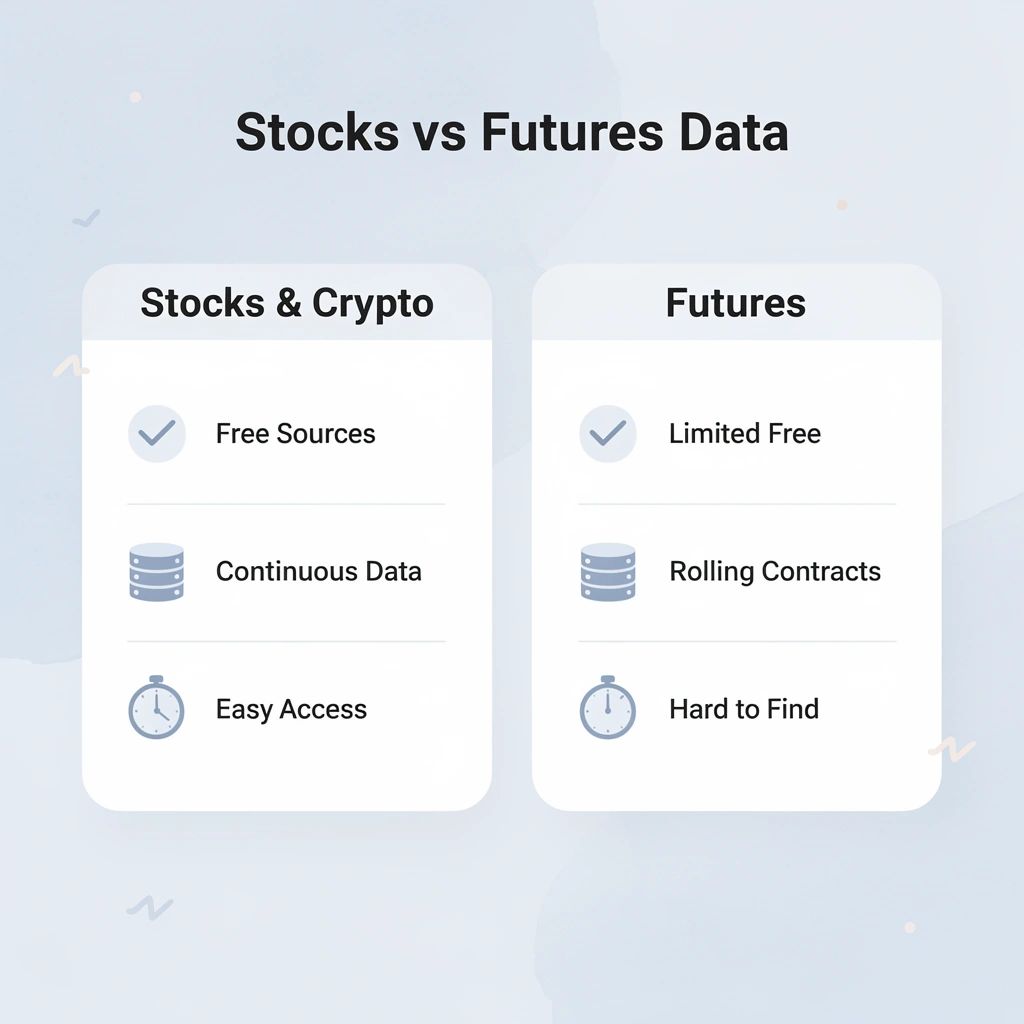
If you've ever tried to backtest a futures trading strategy, you've probably hit the same wall: good historical data is hard to find, expensive, or full of gaps. Stocks and crypto have plenty of free data providers, but futures — with their rolling contracts, expirations, and fragmented exchanges — require specialized treatment.
⚠️ Warning: Don't assume a data source that works for equities will handle futures contracts correctly. Roll adjustments and expiration gaps require specialized handling that most general-purpose providers don't offer.
You don't need a Bloomberg terminal to get started. Depending on what you're building — a quick backtest, a serious systematic strategy, or a research paper — there's a data source that fits your budget. Here's a breakdown of where to look, what you'll get, and what to watch out for.
| Data Source Type | Best For | Cost | Watch Out For |
|---|---|---|---|
| Free Exchange Data | Quick backtests | $0 | Gaps, no roll adjustment |
| Academic Databases | Research papers | Low/Free | Limited asset coverage |
| Paid Data Vendors | Systematic strategies | $$–$$$ | Subscription lock-in |
| Broker-Provided Data | Platform-native testing | $0–Low | Broker-specific formatting |
💡 Tip: Start with a free or low-cost source to validate your strategy concept before committing to a premium data subscription — you'll save both time and money.
🎯 Key Point: The right data source depends entirely on your use case — there is no single best option for every trader or researcher.
 What infrastructure do you need to process historical futures data?
Running analysis on clean futures price history requires consistent computing power. QuantVPS provides virtual private server solutions built for traders who need stable, always-on environments to process large datasets, run backtests across multiple asset classes, and execute strategies without interruption. Whether working with end-of-day futures data or high-frequency tick records, our QuantVPS infrastructure transforms raw historical market data into trading decisions.
Summary
- Gaps in historical futures data are not just inconvenient; they are costly. Missing contract roll data, inconsistent tick records, or incomplete price histories can silently corrupt a backtest, leading traders to draw false conclusions from months of research before a single trade is placed.
- Data quality matters more than data quantity in quantitative analysis. A backtest built on clean, well-structured continuous contract data will consistently outperform one built on a larger but inconsistent dataset, because errors compound across every calculation that depends on accurate price history.
- Continuous contract data is one of the most frequently mishandled inputs in algorithmic trading. Contract roll adjustments, if applied inconsistently, introduce artificial price jumps that distort momentum signals, volatility calculations, and mean-reversion models across entire backtesting periods.
- Free and low-cost historical futures data sources are a reasonable starting point for validating a strategy concept. The practical approach is to begin with free sources during early development, then invest in higher-quality data as a strategy matures and the cost of errors grows larger relative to expected returns.
- The real expense of poor data is not the subscription fee a trader avoids by using a free source. It is the time spent debugging a backtest that was quietly producing wrong results from the beginning, a cost that scales with strategy complexity and the number of asset classes involved.
- Processing large historical datasets and running backtests across multiple contract expirations requires consistent, uninterrupted computing power, and QuantVPS addresses this by providing virtual private server infrastructure built specifically for the continuous computation demands of systematic futures trading.
Why Futures Data Is Trickier Than It Looks
Before diving into sources, it helps to understand why futures data is uniquely annoying:
- Contracts expire. Unlike a stock, a futures contract has a limited life. To build a useful long-term price series, you need to "roll" between contracts, and different providers do this differently (back-adjusted, ratio-adjusted, or unadjusted).
- Continuous vs. individual contracts. Some providers give you raw individual contract data (for example, ESZ25, ESH26) and leave the rolling to you. Others provide a pre-built continuous series, which is more convenient but obscures assumptions you should understand.
- Exchange fragmentation. Futures trade across CME, ICE, Eurex, and others, so no single free source covers everything well. "Free" data that isn't roll-adjusted correctly can sabotage a backtest.
Types of Futures Data You Might Need
Not all use cases need the same data. Broadly:
- End-of-day (EOD) data includes daily open, high, low, close, volume, and open interest. This works well for swing strategies, portfolio-level backtests, and long-horizon research.
- Intraday data (minute or hourly bars) is essential for day-trading strategies or anything sensitive to intraday volatility.
- Tick data: every trade. This is necessary for market-microstructure research or high-frequency work, and almost never free.
- Continuous vs. individual contracts: Continuous series are easier to backtest; individual contracts are more accurate for rolls, spreads, or expiration effects.
Free Options
TurtleTrader (turtletrader.com/hpd)
A relic of the classic trend-following era, but still genuinely useful. It offers free daily historical futures data going back to the 1970s for most major US contracts — corn, crude oil, gold, T-bonds, currencies, and more — delivered in plain-text files that drop straight into a spreadsheet or backtesting tool.
- Pros: Long history, zero cost, simple format.
- Cons: Daily bars only, dated presentation, no intraday or tick data.
Investing.com
Offers free daily historical data for most major futures contracts through its website, downloadable as CSV.
- Pros: Easy to use, broad coverage, no signup friction for basic downloads.
- Cons: Continuous-contract construction isn't always transparent; not built for serious quant work.
Yahoo Finance / Stooq
Both offer free daily data on the most liquid continuous futures contracts (ES, CL, GC, NQ, etc.).
- Pros: Familiar, easy to script against with libraries like yfinance.
- Cons: Limited futures coverage, roll methodology is often unclear or undocumented, occasional data quality issues.
Exchange Websites (CME, ICE)
Exchanges themselves often publish free settlement data or limited historical samples.
- Pros: Authoritative, straight from the source.
- Cons: Usually shallow history, clunky to download in bulk.

Your trading computer. In the cloud.
Connect and control your trading strategies from any device, anywhere in the world, through secure remote desktop, while execution remains on QuantVPS.
From $29.99/mo · Windows or Linux · 8 datacenters
0.52ms to CME from our Chicago nodes.


 NinjaTrader
 MetaTrader
 TradingView
 Tradovate
 Rithmic
 Sierra Chart
 Bookmap
 Quantower
Cheap, Retail-Friendly Options
Firstrate Data
A popular choice among retail quants. It provides intraday bars (1-minute through 1-hour) and daily bars for roughly 130 of the most actively traded futures contracts, with data going back to 2007. It offers both individual contract data and a continuous, roll-adjusted series designed for long-timeframe backtesting.
- Pros: Good intraday coverage at a reasonable price, both raw and continuous series available.
- Cons: History only goes back to 2007, doesn't cover less-liquid or niche contracts.
EODData
A budget subscription service for end-of-day futures data.
- Pros: Cheap, straightforward.
- Cons: Some users report missing chunks of data and inconsistent quality control, so it's worth spot-checking a sample before committing to a subscription.
Barchart.com
Offers a free tier with delayed or limited data, plus paid tiers with deeper futures coverage.
- Pros: Reputable, decent free tier for casual use.
- Cons: Full historical depth requires a paid plan.
Higher-Quality (Still Not Bloomberg-Priced) Options
Norgate Data
Frequently recommended in trading communities for its curated, survivorship-bias-free data covering US, Australian, and Canadian equities alongside a solid range of futures markets. It's been recognized by Technical Analysis of Stocks & Commodities magazine as a top-rated end-of-day data provider in recent years.
- Pros: High data quality, actively maintained, good reputation among serious backtesters.
- Cons: Paid subscription, more than a casual user typically needs.
CSI Data (Unfair Advantage)
Often called the "gold standard" for historical futures data in trading forums. It's been around for decades and is known for depth and accuracy.
- Pros: Extremely reliable, deep historical coverage.
- Cons: The software feels like it's from another era, and the price reflects the quality — this isn't a free option.
IQFeed / Kinetick
Real-time and historical data feeds aimed at active traders rather than pure backtesters.
- Pros: Reliable, low-latency, good for combining live trading with historical analysis.
- Cons: Priced more for traders than researchers, so overkill if you just need a backtest dataset.
Quick Comparison
⚠️ Warning: Free data sources work well for daily end-of-day data, but clean, continuous, roll-adjusted futures series for backtesting require paid providers. Gaps and roll artifacts in free data can quietly wreck a backtest — often without any obvious error signal.
"Gaps and roll artifacts in free data can quietly wreck a backtest — making paid, roll-adjusted data an essential investment for serious futures traders."
| Source | Cost | Resolution | History Depth | Best For |
| TurtleTrader | Free | Daily | 1970s+ | Long-term daily backtests |
| Investing.com | Free | Daily | Varies | Casual research |
| Yahoo/Stooq | Free | Daily | Varies | Quick scripting |
| Firstrate Data | Cheap | Intraday + Daily | 2007+ | Retail quant backtesting |
| EODData | Cheap | Daily | Varies | Budget EOD needs (verify quality first) |
| Norgate Data | Mid | Daily | Deep | Serious systematic strategies |
| CSI Data | Higher | Daily+ | Deep | Professional-grade backtesting |
| IQFeed/Kinetick | Higher | Intraday/Real-time | Varies | Active trading + historical combo |
🔑 Takeaway: Never underestimate the cost of bad data — a single roll artifact or price gap can silently corrupt your entire backtesting strategy, making paid providers a critical investment for serious traders.
💡 Tip: Before committing to any backtesting framework, always audit your data source for roll continuity and gap-free pricing — your results are only as reliable as the underlying data quality.
 How to Access CME Historical Futures Prices
Getting your hands on historical futures data from the Chicago Mercantile Exchange (CME) involves choosing the right method that fits your trading goals. CME offers multiple options, each with its own features and pricing structure.
Direct Access via CME DataMine
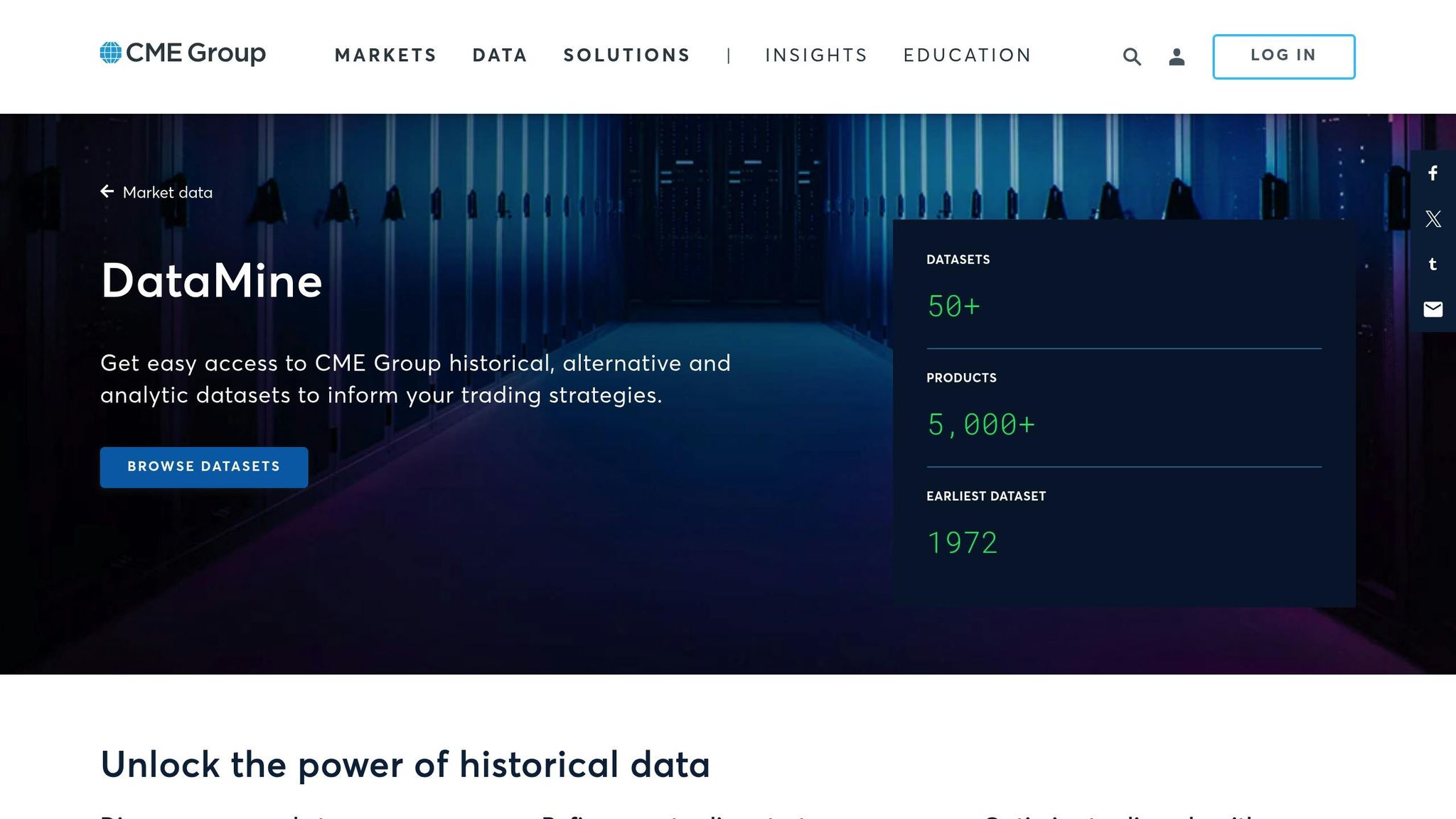
CME DataMine is the official platform for accessing historical futures prices across major asset classes. As the exchange’s primary data source, it provides highly accurate and comprehensive datasets tailored for trading and analysis. The platform operates on a subscription model, with costs varying based on the specific data sets and depth of information you need.
When using CME DataMine, you’ll notice the data is formatted to align with U.S. standards. For instance, dates are displayed in the MM/DD/YYYY format, prices include appropriate decimal points (e.g., $1,234.56), and volume figures are separated by commas for clarity.
Third-Party Platforms for Data Access
If you’re looking for flexibility, third-party platforms and licensed distributors are great alternatives. These services often provide additional features and competitive pricing. They offer subscription-based access to real-time, delayed, and end-of-day data, along with tools that enhance usability. When choosing a third-party provider, consider factors like geographical coverage, supported asset classes, and user-friendly interfaces to ensure the service meets your specific needs.
For example, cloud-based platforms like Google Cloud Platform deliver cost-effective solutions with 10-minute delayed data and simplified access to market depth. This type of delayed data can be particularly useful for backtesting and developing trading strategies.
Data Formatting and Structure
Regardless of the access method you choose, understanding the data’s format is essential for smooth integration into your trading systems. CME historical data is typically available in formats like CSV, JSON, or binary.
The data adheres to U.S. conventions: dates are in MM/DD/YYYY format, timestamps are in Central Time (CT), prices are displayed with precise decimals, and volumes are comma-separated. Contract symbols follow CME’s standardized naming system, which includes expiration months and years for easy identification.
Data files generally include key metrics like open, high, low, close, settlement prices, volume, open interest, and timestamps. Some files may also include bid/ask spreads and detailed trade records. Familiarity with these formats ensures a seamless experience when integrating data into your trading platforms or analysis tools, making backtesting and strategy development more efficient.
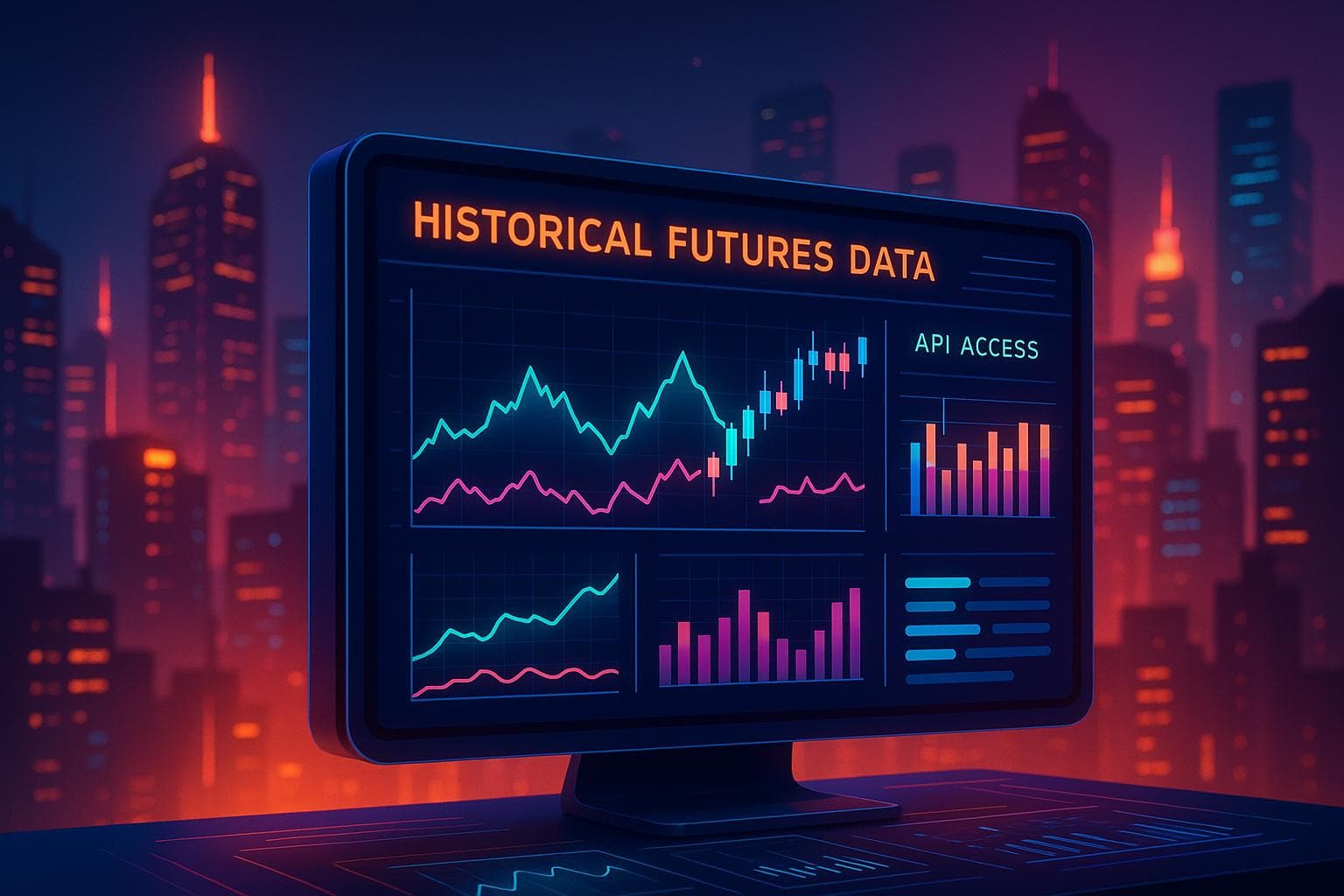
API Access for CME Historical Data
APIs streamline the process of retrieving CME historical data by automating access to real-time futures pricing. This integration eliminates the hassle of manual downloads and enables seamless connections with trading platforms, backtesting systems, and custom analytics tools.
Available APIs for CME Data
The CME Group offers official APIs that grant access to both historical and real-time market data. These APIs require secure authentication, typically through API keys, and deliver data in widely-used formats like JSON and XML. This ensures compatibility with various programming languages and trading platforms. These tools work alongside other data access methods previously discussed.
In addition to CME's own APIs, licensed market data vendors provide access to CME historical data as part of their broader offerings. These services often aggregate data from multiple exchanges, presenting it in consistent formats and sometimes including built-in analytics to enhance usability.
API Integration Basics
Getting started with API integration involves setting up secure authentication. This typically includes registering an API key and using token-based authentication, with automated token refresh to ensure uninterrupted data access.
APIs generally follow standard HTTP request protocols, allowing users to specify parameters like contract symbols, date ranges, and data granularity. The returned data includes essential market details such as open, high, low, and close prices, along with volume, open interest, and settlement figures - all formatted according to U.S. conventions.
To ensure smooth operation, it's critical to implement robust error handling. Techniques like exponential backoff and detailed logging can help manage issues such as rate limits, invalid requests, or data gaps.
When working with U.S.-based trading systems, it's also important to configure settings that align with local trading practices.
U.S.-Specific API Setup
For trading systems operating in the U.S., time zone alignment is a key consideration. CME data is provided in Central Time (CT), reflecting the Chicago-based exchange's location. Many APIs include options to convert timestamps to other time zones, such as Eastern Time (ET), to match regional market hours.
Traders should also account for CME-specific market session schedules, including unique holiday observances that may affect data availability. Planning API requests around these schedules can help avoid disruptions.
Regulatory compliance is another important factor. Data usage must adhere to strict guidelines, including restrictions on redistribution and requirements for proper attribution. Keeping detailed audit trails and ensuring compliance with reporting standards is essential.
Finally, optimizing API connections can improve performance. For example, choosing endpoints closer to U.S.-based data centers can reduce latency, especially during periods of high data traffic. This is particularly critical for traders working with time-sensitive data.
Stay online and closer to execution. Choose a VPS location for CME futures, New York markets, London FX, API trading, and more.
8 datacenters help your platforms keep running day and night without depending on your home PC.
From $29.99/mo · Windows or Linux · 8 datacenters
0.52ms to CME from our Chicago nodes.

Using QuantVPS for CME Data Access and Trading
When it comes to seamless CME data access and time-sensitive trading, having a reliable hosting solution is non-negotiable. QuantVPS offers tailored virtual private server (VPS) solutions designed specifically for futures and forex traders. Let’s take a closer look at how QuantVPS can enhance your CME data trading experience.
QuantVPS Features for Traders
QuantVPS is built for speed and reliability, delivering ultra-low latency connectivity with response times as fast as 0-1ms. This makes it ideal for handling large volumes of CME historical data or executing real-time API calls. With a 100% uptime guarantee, your trading algorithms and data collection processes stay uninterrupted.
The platform integrates easily with popular trading platforms like NinjaTrader, MetaTrader, and TradeStation, allowing you to incorporate CME data feeds directly into your existing setup. Each VPS runs on Windows Server 2022, providing a familiar and stable environment for most trading applications.
Additional features include DDoS protection and automatic backups to safeguard your data and configurations. Full root access is also provided, giving you complete control to customize your trading environment for specific CME data processing needs.
With global accessibility and real-time system monitoring, you can manage your CME data collection and trading systems from anywhere, all while keeping tabs on server performance during high-intensity operations.
QuantVPS Plans Comparison
QuantVPS offers four distinct plans, each designed to meet different trading and data processing requirements:
| Plan | Monthly Price | CPU Cores | RAM | Storage | Network | Monitors | Best For |
|---|---|---|---|---|---|---|---|
| VPS Lite | $59.00 | 4 cores | 8GB | 70GB NVMe | 1Gbps+ | None | Basic CME access |
| VPS Pro | $99.00 | 6 cores | 16GB | 150GB NVMe | 1Gbps+ | Up to 2 | Moderate API usage |
| VPS Ultra | $199.00 | 24 cores | 64GB | 500GB NVMe | 1Gbps+ | Up to 4 | Intensive data processing |
| Dedicated Server | $299.00 | 16+ cores | 128GB | 2TB+ NVMe | 10Gbps+ | Up to 6 | Enterprise-level operations |
All plans come with unmetered bandwidth, a critical feature for downloading large CME historical datasets or maintaining continuous real-time API connections.
Why Choose QuantVPS for CME Data?
QuantVPS stands out with its high-performance NVMe storage, ensuring quick access to CME datasets - perfect for backtesting and executing algorithmic strategies that rely on historical data patterns.
Its robust network and dedicated resources ensure smooth API connections and efficient data processing. With speeds of 1Gbps+ (or 10Gbps+ for dedicated servers), you can manage multiple CME contracts simultaneously without any slowdowns. Higher-tier plans also support multiple monitors, making it easier to analyze CME data across several screens while running backtests or monitoring live trades.
QuantVPS provides the tools and infrastructure you need to stay ahead in CME trading, whether you're handling basic data access or running enterprise-level operations.
Using CME Historical Data for Trading Strategies
CME historical data forms the backbone of strategy creation and risk-free testing, especially when paired with QuantVPS's high-performance infrastructure.
Backtesting with CME Data
Backtesting lets you turn historical CME data into actionable insights by simulating how a trading strategy would have performed in the past. To do this right, you need clean, accurate data and enough computational power to handle multiple scenarios at once.
When selecting CME contract data, make sure it includes roll dates and contract specifications to reflect the market accurately. The dataset should cover open, high, low, and close prices, along with trading volume, in your preferred timeframe - whether that's tick-by-tick, minute-by-minute, hourly, or daily intervals.
Adjustments for contract rollovers are often necessary, especially in futures markets where contracts expire frequently. Using methods like back-adjustment ensures price continuity across contract transitions, making your backtesting results more reliable.
QuantVPS enhances backtesting by speeding up processing and increasing algorithm efficiency. This is particularly valuable when testing strategies across various timeframes or running Monte Carlo simulations.
Platforms like NinjaTrader and TradeStation integrate easily with QuantVPS, allowing you to import CME historical data and conduct in-depth strategy tests. These platforms factor in real-world variables like transaction costs, slippage, and market conditions, giving you a more realistic view of your strategy's potential.
To evaluate performance, go beyond basic profit and loss metrics. Look at risk-adjusted returns, such as the Sharpe ratio, maximum drawdowns, and win-rate consistency in different market conditions. The depth of CME data enables you to test strategies under diverse scenarios, including high volatility, trending markets, or sideways movements.
These backtesting insights are the building blocks for creating finely-tuned, algorithm-driven strategies.
Algorithmic Strategy Development
Developing algorithmic trading strategies combines market analysis, statistical methods, and precise coding. QuantVPS provides the computational power needed to develop and test intricate algorithms that work with real-time market data.
The process often starts with forming a hypothesis based on market patterns. For example, you might notice seasonal trends in natural gas prices or sharp moves in response to economic news. CME historical data allows you to quantify these observations and test their reliability.
Next, you'll define entry and exit rules using tools like technical indicators, fundamental data, or statistical models. Common approaches include mean reversion for range-bound markets, momentum strategies for trending conditions, or arbitrage opportunities between related CME contracts.
Risk management is critical when moving from backtesting to live trading. Your algorithm should include rules for position sizing, stop-loss levels, and correlation checks to avoid overexposure to similar market movements. Historical data can help fine-tune these parameters by showing how different risk management strategies performed in past market cycles.
QuantVPS's multi-monitor setup is especially useful during strategy development. It allows you to track code execution, monitor live market data feeds, and analyze performance metrics all at once. Root access also lets you install specialized trading libraries for advanced functionality.
Before going live, paper trading acts as a crucial intermediary step. Most trading platforms supported by QuantVPS offer simulated environments where your algorithm can process real-time CME data without financial risk. This phase can reveal issues like data feed interruptions or execution delays that backtesting might overlook.
Compliance and U.S. Trading Rules
When transitioning from development to execution, it's essential to understand U.S. trading rules and compliance requirements.
The Commodity Futures Trading Commission (CFTC) regulates futures markets and requires detailed record-keeping of trading activities. With QuantVPS, you can maintain comprehensive logs of trading decisions, data sources, and algorithm updates. The platform’s automatic backup feature ensures these records are secure and ready for regulatory review.
While Pattern Day Trading (PDT) rules don’t apply to futures, position limits exist for certain CME contracts. Large traders must report positions exceeding specific thresholds, so your algorithm should monitor positions to stay compliant. Historical data can help determine optimal position sizes that maximize returns while adhering to these limits.
Futures trading also offers tax advantages under Section 1256, but this requires meticulous transaction records. These tax benefits make CME futures appealing for algorithmic strategies, but keeping accurate logs is non-negotiable.
Additionally, CME contracts are quoted differently depending on the product. For instance, crude oil prices are in dollars per barrel, natural gas in dollars per million BTU, and agricultural products in cents per bushel or pound. Your algorithm needs to account for these unit differences when processing data and calculating positions.
CME products often trade nearly 24 hours a day through the Globex platform. Algorithms hosted on QuantVPS can capitalize on these extended hours, but they must also factor in varying liquidity and volatility during overnight sessions compared to regular trading hours.
Conclusion
Let’s revisit some key insights: CME historical data forms the backbone of successful futures trading strategies, offering the essential information needed to design, test, and refine trading approaches. Whether you're working on backtesting algorithms, spotting market trends, or building predictive models, having access to detailed historical price data transforms raw numbers into actionable strategies.
Profitable trading relies on a solid infrastructure that supports backtesting, algorithm development, and seamless live execution. However, the effectiveness of this process depends heavily on the strength of the systems that power it.
Key Takeaways
- CME historical data provides critical advantages for futures traders. Accurate historical prices allow traders to backtest strategies under various market conditions, while recognizing patterns can uncover seasonal trends and recurring behaviors. Historical volatility analysis sharpens risk assessments, and predictive models improve with access to comprehensive datasets.
- Optimized infrastructure, like QuantVPS, ensures effective strategy execution by bridging the gap between historical data analysis and live trading. With ultra-low latency connectivity, traders can ensure that the performance observed during backtesting translates smoothly to live markets.
- Round-the-clock operation keeps trading algorithms and data processes running seamlessly throughout CME’s extended trading hours.
- Advanced hardware is vital for handling large datasets. QuantVPS servers, powered by AMD EPYC processors and high-speed DDR4/5 RAM, excel at managing complex backtesting and simulations, making them ideal for testing strategies across multiple timeframes or running advanced algorithmic models.
- Integration with top trading platforms simplifies workflows, enabling traders to move effortlessly from data analysis to live execution within a unified environment.
FAQs
What are the benefits of using CME DataMine for accessing historical futures prices?
CME DataMine is a cloud-based, self-service platform that gives users direct access to CME Group's historical futures data. By bypassing third-party platforms, it ensures a reliable and accurate source of information, offering a level of consistency that traders and analysts can trust.
The platform features an intuitive interface, making it simple to query, share, and manage data. It’s also designed to help users save both time and money, making it a practical choice for those focused on backtesting, strategy development, or automated trading systems.
How can I keep my API integration with CME historical data compliant with U.S. trading regulations?
To comply with U.S. trading regulations when using CME historical data through an API, it's crucial to adhere to CME's guidelines on how the data is used and shared. These rules are in place to ensure the correct and lawful management of market data.
Equally important is safeguarding data security. This means incorporating measures such as encryption, robust authentication protocols, and regularly updating API keys. You should also set up clear access controls, follow proper data handling practices, and conduct regular audits. These steps not only protect sensitive trading information but also help ensure you meet regulatory standards.
What should I look for when selecting a QuantVPS plan for my trading strategy?
When choosing a QuantVPS plan, it's essential to think about a few key factors. First, look at the server location - you'll want it as close as possible to your broker's data center to keep latency to a minimum. Next, check the hardware specifications, like CPU and RAM, to ensure they can handle the demands of your trading software and strategies. Also, pay attention to plan features, including network speed, uptime reliability, and customer support, to make sure your trading runs smoothly without interruptions.
QuantVPS offers several plans tailored for traders, including options specifically designed for low-latency, automated futures trading. Pricing starts at $69.99 per month, giving you access to the performance and dependability needed to execute your strategies efficiently.