
When the CME futures market opens at 5:00 PM CT every Sunday, it sets the stage for the financial week. This session allows traders to react to weekend developments in E-mini S&P 500 (/ES) and Gold (/GC) futures. Key highlights:
- Opening Time: 5:00 PM CT (6:00 PM ET, 4:00 PM MT, 3:00 PM PT).
- Daily Maintenance Break: 4:00 PM - 5:00 PM CT before Sunday open.
- Gold Futures: High volume (~27 million ounces daily), sensitive to geopolitical events and USD strength.
- E-mini Futures: Actively traded, reflecting market sentiment after the weekend.
Preparation is critical - ensure platform connectivity, set up limit orders during the pre-open phase, and manage risk early due to lower liquidity and wider spreads. Sunday trading offers a chance to position yourself ahead of Monday’s market, making it a key session for informed strategies.
CME Futures Sunday Opening Times
The CME futures market starts its trading week at 5:00 p.m. Central Time (CT) every Sunday, covering both E-mini and Gold contracts. This schedule applies to major equity index futures and precious metals, giving traders a consistent start to react to weekend news. Trading then continues nearly 24 hours a day through Friday at 4:00 p.m. CT. Below, we’ll break down the opening times and key details for E-mini and Gold futures.
E-mini Futures Opening Time
E-mini S&P 500 (/ES) and Nasdaq-100 (/NQ) futures open at 5:00 p.m. CT on Sunday - 6:00 p.m. ET, 4:00 p.m. MT, and 3:00 p.m. PT. The E-mini S&P 500 is one of the most actively traded futures contracts in the world, with a minimum tick size of 0.25 index points, valued at $12.50 per contract. If you’re outside the Central Time zone, you’ll need to adjust your trading schedule accordingly.
Before the official opening, there’s a "Pre-open" period where traders can place, modify, or cancel orders, though no trades are executed until the market officially opens. This allows you to set up your strategy in advance without prematurely entering trades.
Gold Futures Opening Time
Gold futures (/GC) also open at 5:00 p.m. CT on Sunday - 6:00 p.m. ET, 4:00 p.m. MT, and 3:00 p.m. PT. With a minimum tick size of 0.10 per troy ounce, valued at $10.00 per contract, gold futures see massive trading volumes, averaging about 27 million ounces daily - approximately 30 times the volume of the SPDR Gold ETF.
This opening session is especially reactive to weekend geopolitical and economic events. Gold prices often shift rapidly due to factors like Central Bank policies, fluctuations in the US Dollar Index, or major global developments. As CME Group explains:
Nearly 24-hour access enables you to act, not wait, as major events (Brexit, U.S. elections) unfold.
Daily Maintenance Break
Before the Sunday open, the market undergoes a 60-minute maintenance break from 4:00 p.m. to 5:00 p.m. CT (5:00 p.m. to 6:00 p.m. ET). During this time, the market recalibrates by updating profit and loss statements and recalculating overnight margin requirements. No trades are matched during this period, so automated trading systems should account for the downtime.
| Market Session | Central Time (CT) | Eastern Time (ET) | Pacific Time (PT) |
|---|---|---|---|
| Sunday Opening | 5:00 PM | 6:00 PM | 3:00 PM |
| Daily Maintenance Break | 4:00 PM - 5:00 PM | 5:00 PM - 6:00 PM | 2:00 PM - 3:00 PM |
| Friday Closing | 4:00 PM | 5:00 PM | 2:00 PM |
It’s important to ensure your account equity meets the overnight margin requirements before the 4:00 p.m. CT maintenance break, as these requirements may differ from intraday levels. Additionally, "Day" orders are typically canceled at the close before the maintenance break, so if you’re using "Good 'til Canceled" (GTC) orders, double-check their status during the pre-open phase.
Preparing Your Trading Setup for Sunday Open
The time leading up to the 5:00 p.m. CT Sunday open is your chance to ensure everything in your trading setup is running smoothly. Think of this pre-open phase as a trial run - it’s where you confirm your platform, data feeds, and order routing are ready to go. This preparation can be the difference between seizing a trading opportunity and missing out entirely. Start by checking your connectivity and the performance of your data feed.
Platform Connectivity and Latency
Log into your trading platform at least 30 minutes before the Sunday open to confirm your connection and address any potential issues. If you're working from a home setup, you might notice higher latency due to your internet service provider's routing.
This setup supports popular futures platforms like NinjaTrader, Sierra Chart, TradeStation, Quantower, and Tradovate, as well as data feeds such as Rithmic and CQG. During this pre-open period, place a test limit order to confirm your platform is properly connected to CME Globex.
Automated Setup and Pre-Open Configuration
Once your connection is stable, focus on configuring your automated systems for uninterrupted operation. Automated trading systems need to stay active through the Sunday open, as home setups are prone to disruptions like computer shutdowns or internet outages.
Their network includes a 1Gbps connection with 10Gbps burst capability and advanced DDoS protection.
Use the pre-open phase to queue your automated orders for execution when the market opens at 5:00 p.m. CT. Be sure to adjust your risk settings to account for the lower volume and wider spreads typical of Sunday sessions, as slippage can be more noticeable in thinly traded markets.
Order flow
Built for scalpers. Heatmaps on dedicated resources.
Order-flow heatmaps and DOM ladders run on dedicated CPU, memory and NVMe, so your charts keep responding during volatility.
Explore the hardware







From $29.99/mo · Windows or Linux
Trading Strategies for Sunday Opening Sessions
The Sunday market open at 5:00 p.m. CT provides a distinct opportunity to respond to weekend events that may influence trading. Success here requires a mix of preparation and adaptability, as liquidity tends to build gradually during the evening session.
Analyzing Weekend News and Setting Direction
Before diving into trades, examine key events from the weekend. Gold futures, for example, are highly responsive to geopolitical developments. As CME Group explains, "Financial crises and elections create financial uncertainty and in turn, impact demand for and the price of gold". Keep an eye out for international conflicts, political shifts, or central bank announcements that might have unfolded while the markets were closed.
The US Dollar Index (DXY) is another critical tool for understanding gold's potential direction. Since gold is priced in dollars, it often moves inversely to the dollar's strength. A stronger US Dollar usually puts downward pressure on gold prices. For those trading E-mini futures, review recent macroeconomic data, such as Non-Farm Payrolls (released the first Friday of each month), CPI reports (typically mid-month), or any Federal Reserve announcements from the prior week.
To gain additional insights, check CME Group's "Metals Update" and "Metals Commentary Videos", which provide expert market analysis ahead of the Sunday session. Another valuable resource is the CME Group Volatility Index (CVOL) for gold, which measures 30-day implied volatility and offers clues about whether the market expects calm or turbulence. Once you’ve gauged the market’s direction, adjust your order strategy to align with these expectations.
Placing Limit Orders and Managing Risk
Position your limit orders during the Pre-open phase, which begins 10–15 minutes before the market officially opens at 5:00 p.m. CT. Keep in mind that actual order matching only starts at the open. This approach ensures your orders are ready to go as soon as trading begins.
Risk management is key in these early hours. Set stop-loss orders immediately after entering trades. Sunday sessions often feature lower trading volumes and wider spreads compared to weekdays, increasing the risk of slippage. Pay close attention to early market activity; if spreads remain wide after 5:15 p.m. CT, it may be wise to scale down your position size.
Scaling Into Breakouts After Volume Increases
Once initial risk controls are in place, look for breakout opportunities. After 6:00 p.m. CT, trading volume typically picks up, making this a better time to scale into breakout trades. While the Pre-open phase is useful for placing initial orders, true price discovery happens once continuous trading begins, as market participants digest the weekend’s news.
Use the Volatility Term Structure Tool to compare current implied volatility with last week’s levels. Elevated volatility combined with a clear directional move can signal a strong opportunity to add to your positions.
Gold’s physical settlement process ensures that contract prices stay closely aligned with the cash market, which helps to minimize slippage during high-volume breakouts. Keep monitoring the US Dollar Index to confirm that currency movements align with your breakout strategy. For E-mini futures, watch for consistency across related index futures. For example, if the S&P 500 E-mini is breaking out but Nasdaq-100 futures are lagging, that divergence might suggest a false move worth avoiding.
Sunday evening marks a critical moment for futures traders worldwide. At 6:00 PM Eastern Time, the CME Group reopens electronic trading for major contracts including S&P 500, crude oil, gold, and currency pairs. Weekend news and geopolitical developments often create significant price gaps and volatility that can define the entire trading week. Missing this opening window means potentially sitting out major market movements when positioning matters most.
Successful futures trading at market open demands flawless execution speed and uninterrupted connectivity. Power outages, internet disruptions, and computer failures can derail even the best-planned strategies during these crucial moments.
Table of Contents
- What Time Does CME Futures Open on Sunday?
- Why Sunday Evening Matters for Futures Traders
Summary
- The Sunday evening CME futures opening at 6:00 PM Eastern Time creates a distinct trading environment shaped by 60 hours of accumulated weekend news and significantly lower liquidity than regular sessions. Crude oil futures can show 3-tick spreads on Sunday nights versus 1-tick spreads during peak Wednesday trading, fundamentally changing which strategies remain viable and where to place stops.
- Time zone placement determines whether traders can participate with full cognitive capacity or are fighting exhaustion. A Los Angeles trader faces a convenient 3:00 PM local start while London-based participants must stay alert until 11:00 PM, and Tokyo traders wake to markets already open for hours. This isn't a scheduling preference but a structural advantage that reshapes who can effectively interpret Sunday volatility.
- The first hour after reopening functions as market recalibration rather than chaos, as futures contracts adjust to geopolitical tensions, central bank statements, and supply disruptions that accumulated over the weekend. How markets respond to these developments reveals current sentiment more reliably than chart patterns, rewarding traders who observe initial reactions before taking positions.
- Preparation separates effective Sunday traders from those simply showing up to react. Before 6:00 PM ET, successful participants have already reviewed economic calendars, identified support and resistance levels from Friday's close, and determined which overnight developments genuinely shift their thesis versus which are noise.
- Home internet connections introduce variable latency and occasional dropouts that compress execution windows during Sunday evening volume spikes. A two-second delay during gap retracement transforms planned entries into chasing price into unfavorable territory, turning timing advantages into missed opportunities when infrastructure can't match strategy requirements.
What Time Does CME Futures Open on Sunday?
CME futures markets open at 6:00 PM Eastern Time on Sunday evening. According to tastytrade, this applies to major contracts such as the E-mini S&P 500, crude oil, and gold futures. In other time zones: 11:00 PM GMT (London) or 9:00 AM AEST Monday (Sydney).
Key Point: CME futures provide nearly 24-hour trading access, starting Sunday evening and running through Friday afternoon with only brief maintenance windows.
"CME futures markets operate nearly 24 hours a day, 6 days a week, providing global access to major commodity and financial contracts." (CME Group)
| Time Zone | Sunday Opening | Local Day |
|---|---|---|
| Eastern (ET) | 6:00 PM | Sunday |
| GMT (London) | 11:00 PM | Sunday |
| AEST (Sydney) | 9:00 AM | Monday |
Takeaway: The Sunday 6:00 PM ET opening allows traders to immediately react to weekend news and global events that occurred while traditional markets were closed.
How does the Sunday evening opening align with global markets?
The Sunday evening opening aligns with the Asian trading session, allowing global markets to respond to weekend developments before European and American traders wake up Monday morning. Political events, natural disasters, or economic announcements occurring Saturday or Sunday can move prices significantly during those first few hours.
Traders who wait until Monday morning often find themselves reacting to moves that already happened, entering positions after initial volatility has passed or reversed.
What happens during holiday weeks and schedule changes?
AMP Futures confirms the 6:00 PM ET Sunday opening in their holiday trading schedules, noting this timing remains consistent except during major U.S. holidays like New Year's Day or Thanksgiving.
During holiday weeks, the CME publishes adjusted schedules that may delay Sunday openings or close markets early on Friday. Missing these calendar changes risks trades placed when markets are closed or executed during thin holiday liquidity, when spreads widen and slippage increases.
How do you convert 600 PM ET across major trading centers?
Converting 6:00 PM ET requires precision across time zones. London traders see 11:00 PM GMT (standard time) or 10:00 PM BST (daylight saving). Sydney traders face 9:00 AM AEST (standard time) or 10:00 AM during daylight saving. Tokyo maintains 8:00 AM JST year-round, with no daylight saving adjustments.
Why do manual trading setups create friction for global strategies?
Manual trading from your home computer works initially, but as strategies become time-sensitive and you trade multiple contracts across sessions, problems emerge. You're confined to your desk during specific hours, at risk of losing your connection during critical moments, and unable to execute trades while traveling or during local outages.
Our trading VPS runs your platform continuously in a data center with backup power and fiber connections, executing your strategies regardless of your location or availability.
Uptime
99.999% uptime. Built for 24/7 trading reliability.
Your VPS runs in Tier IV datacenters with redundant power and network, monitored 24/7 on site.
See the uptime SLAFrom $29.99/mo · Windows or Linux
Exceptions and Holiday Adjustments
The standard 6:00 PM ET opening shifts during U.S. federal holidays. New Year's Day, Memorial Day, Independence Day, Labor Day, Thanksgiving, and Christmas trigger modified schedules: sometimes closing entirely, other times delaying Sunday evening openings by several hours or skipping to Monday morning. The CME publishes these schedules months in advance, but checking them is easy to overlook when focused on chart analysis and position sizing.
What most traders miss is that the Sunday opening isn't about being present when markets open. It's about being positioned before the crowd reacts.
Why Sunday Evening Matters for Futures Traders
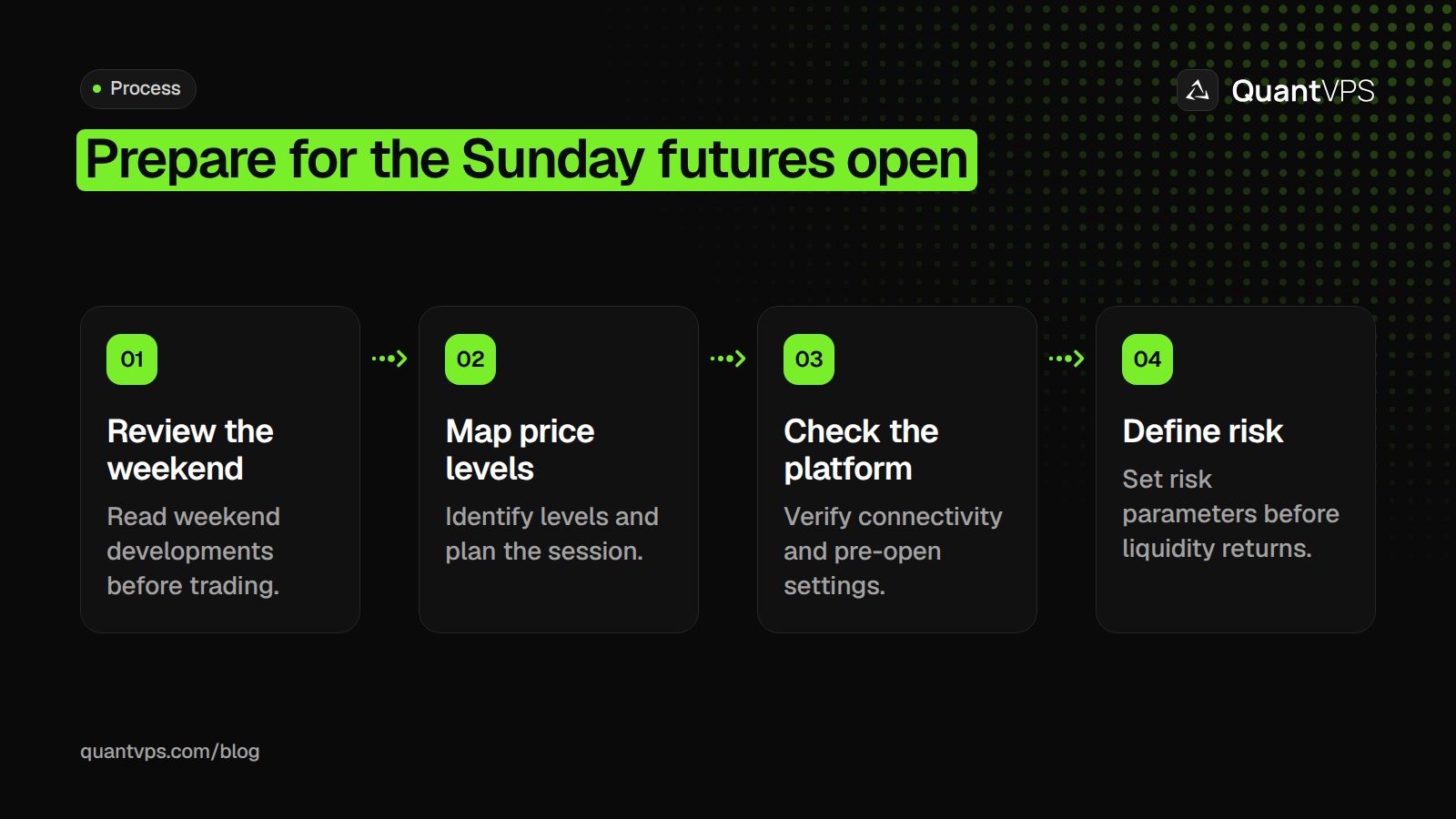
Being positioned before the crowd reacts means understanding that the Sunday evening session creates a distinct trading environment where preparation outweighs speed. Successful traders here aren't the fastest clickers; they've already mapped their levels, identified their risk parameters, and decided what weekend developments matter before liquidity returns.
Key Point: Sunday evening futures trading is not about reactive speed. It's about strategic positioning based on pre-market preparation and weekend analysis.
"Preparation outweighs speed in Sunday evening futures sessions, where successful traders have already mapped their levels and identified risk parameters before liquidity returns." (Market Analysis Insight)
 Warning: Traders who rely on speed alone during Sunday evening sessions often miss the strategic advantage that comes from thorough weekend preparation and pre-positioned analysis.
Low Liquidity Creates Different Rules
When futures markets reopen Sunday evening at 6:00 PM ET, according to NinjaTrader, fewer participants are active than during regular hours. Institutional trading desks operate with skeleton crews, computer systems run in weekend mode, and individual traders dominate early volume. This produces wider bid-ask spreads and more extreme price swings than trading on a Tuesday afternoon.
What impact do wider spreads have on strategy selection?
A crude oil futures contract might show a 3-tick spread on Sunday night versus a 1-tick spread during peak Wednesday trading. This difference affects how you enter positions, where you place stops, and whether certain strategies are viable. Scalping becomes expensive, while swing setups become more attractive.
Volatility Emerges from Information Gaps
Weekend news doesn't wait for market hours. Geopolitical tensions escalate, central bank officials make unexpected statements, and supply chain disruptions emerge. By Sunday evening, traders face a 60-hour information backlog that regular market participants haven't yet priced in. The first hour of trading often sees sharp moves as futures contracts adjust to reality.
Smart traders use Sunday evenings to watch how markets interpret weekend developments rather than immediately taking positions. Does a hawkish Fed comment from Saturday move rate-sensitive contracts, or does the market shrug? That reaction reveals more about current sentiment than any chart pattern.
The Strategic Advantage Lives in Preparation
Most traders react to Sunday evening charts without preparation. Effective traders review economic calendars for the week ahead, identify key support and resistance levels from Friday's close, and distinguish real thesis shifts from noise.
Trading infrastructure matters significantly. Standard home internet and consumer-grade hardware create Sunday evening reconnection risks: missed fills, delayed data feeds, execution gaps.
Time Zones Reshape Opportunity Windows
Your location determines whether Sunday evening trading feels accessible or exhausting. A trader in Los Angeles faces a 3:00 PM local start time, perfectly aligned with the afternoon focus. Someone in London must stay alert until 11:00 PM. Tokyo-based traders wake up Monday morning to markets already open for hours. These differences fundamentally determine which traders can participate effectively in the Sunday session and who are fighting their biology.
The question isn't whether you can physically be present at market open, but whether you can be present with full mental capacity, ready to interpret price action and execute decisions that matter. A trader forcing themselves awake at 2:00 AM to catch the open is already compromised before the first tick prints.
But what happens when your preparation meets reality, and the infrastructure you're relying on cannot keep pace with the execution speed that Sunday volatility demands?
Conclusion
The Sunday 5:00 p.m. CT CME open provides a valuable opportunity for traders in E-mini and Gold markets, with trading running almost continuously until Friday at 4:00 p.m. CT. This session marks the first chance for global price discovery after the weekend, which is especially relevant given that Gold futures account for the daily trade of approximately 27 million ounces.
Keep in mind the 60-minute maintenance break from 4:00 to 5:00 p.m. CT, which updates margins and P&L.
When planning your trading strategy, consider the distinct dynamics of Sunday sessions. Gold prices often react swiftly to political or economic events from the weekend, while E-mini futures mirror shifts in market sentiment that developed while U.S. equity markets were closed. It’s also wise to track the US Dollar Index alongside your Gold positions and review key economic reports, such as CPI or Non-Farm Payrolls, released in the prior week. Integrating these factors into your broader strategy can help you make the most of early market activity.
The Sunday open gives you a head start on the Monday market, underscoring the need for precise risk management and a strong focus on liquid futures contracts.
FAQs
What steps can traders take to prepare for the Sunday CME futures market open?
The CME futures market kicks off every Sunday at 5:00 p.m. Central Time (CT) and runs continuously until the Friday close at 4:00 p.m. CT. To stay on top of things, double-check the opening time and consult the CME holiday calendar for any potential schedule changes. Setting reminders and enabling platform alerts a few minutes before the market opens can help ensure you're ready.
Before Sunday evening, make sure your trading platform is properly connected to CME Globex and confirm you have enough margin for the contracts you plan to trade, such as E-mini S&P 500 or Gold futures. Take a moment to review contract details - Gold futures, for instance, are available in standard (100 oz), E-mini (50 oz), and Micro (10 oz) sizes - so you can adjust your position sizes accordingly. It’s also wise to conduct a quick pre-market check by reviewing key economic news, technical levels, or any updates that could impact early trading. Placing limit or stop orders ahead of the open can help you capture potential market moves while keeping your risk under control.
By confirming the schedule, prepping your platform, and performing a pre-market review, you’ll be set to tackle the Sunday CME futures session with a clear and organized plan.
What impacts Gold futures during the Sunday evening trading session?
Gold futures on the CME kick off every Sunday evening at 5:00 p.m. Central Time (CT) or 6:00 p.m. Eastern Time (ET). The opening moments can be quite active, often marked by lower liquidity, which sometimes leads to sharper price swings as traders set their positions for the week ahead.
A variety of factors shape Gold futures during this session. Each contract represents 100 troy ounces of gold, priced in U.S. dollars per ounce, and movements tend to align closely with the spot gold market. Key influences include global events tied to inflation expectations, geopolitical developments, the strength of the U.S. dollar, and actions by central banks. These elements can trigger noticeable price shifts shortly after trading begins.
It enables traders around the world to react to overnight updates from Asian and European markets, which can further influence Sunday evening prices. A solid grasp of these factors is essential for effectively navigating Gold futures as the trading week unfolds.
Why is it important to check platform connectivity before the Sunday futures market opens?
Ensuring a dependable connection to the trading platform is crucial when trading CME futures like E-mini and Gold contracts, especially during the Sunday market open at 5:00 p.m. CT (6:00 p.m. ET). A stable, low-latency connection lets traders access live price quotes, execute orders swiftly, and react to the early market activity, which often influences the trading week ahead. Without this, traders could miss critical price changes or encounter slippage.
Sunday's market open also kicks off the daily mark-to-market process. This process recalculates margin requirements and updates profit-and-loss figures. A reliable connection ensures traders have accurate account information, helping them manage risks, avoid surprise margin calls, and confidently implement their trading strategies.


