
The forex market is open 24 hours a day, five days a week: for most retail traders from Sunday at 5pm ET to Friday at 5pm ET. Trading moves through four sessions, Sydney, Tokyo, London and New York, and the busiest stretch is the London and New York overlap from 8am to 12pm ET. Session times shift by an hour when clocks change, so check them again in late October, early November and March.
Key points (checked on 10 Oct 2026):
- Week: OANDA US quotes forex from "Sunday at 17:05" to "Friday 16:59 (New York time)", with a six-minute break each day.
- Sessions: each one follows the local working day, roughly 8am to 5pm in Sydney, Tokyo, London and New York.
- Busiest window: London and New York, 8am to 12pm ET. Sales desks in the UK and the US handle about 38% and 19% of all FX trading (BIS, April 2025).
- Clock changes: the UK goes back on 25 Oct 2026, the US on 1 Nov 2026. In the week between, the overlap runs 8am to 1pm ET.
Forex Market Hours at a Glance (ET, GMT, SGT)
The table below gives each session in Eastern Time (ET), Greenwich Mean Time (GMT) and Singapore Time (SGT) for the northern winter, which runs from 1 Nov 2026 to 14 Mar 2027. The windows come from capital.com's forex market hours page, checked on 10 Oct 2026. Other brokers publish windows that differ by an hour or so, because a session is a convention, not an exchange timetable.
| Session | ET (EST) | GMT | SGT |
|---|---|---|---|
| Sydney | 4pm to 1am | 21:00 to 06:00 | 5am to 2pm |
| Tokyo | 6pm to 3am | 23:00 to 08:00 | 7am to 4pm |
| London | 3am to 12pm | 08:00 to 17:00 | 4pm to 1am |
| New York | 8am to 5pm | 13:00 to 22:00 | 9pm to 6am |
In the northern summer (UK on BST, US on EDT, Sydney on standard time), London and New York sit one hour earlier in GMT, Sydney one hour later, and Tokyo stays put:
| Session | ET (EDT) | GMT (UTC) | SGT |
|---|---|---|---|
| Sydney | 6pm to 3am | 22:00 to 07:00 | 6am to 3pm |
| Tokyo | 7pm to 4am | 23:00 to 08:00 | 7am to 4pm |
| London | 3am to 12pm | 07:00 to 16:00 | 3pm to 12am |
| New York | 8am to 5pm | 12:00 to 21:00 | 8pm to 5am |
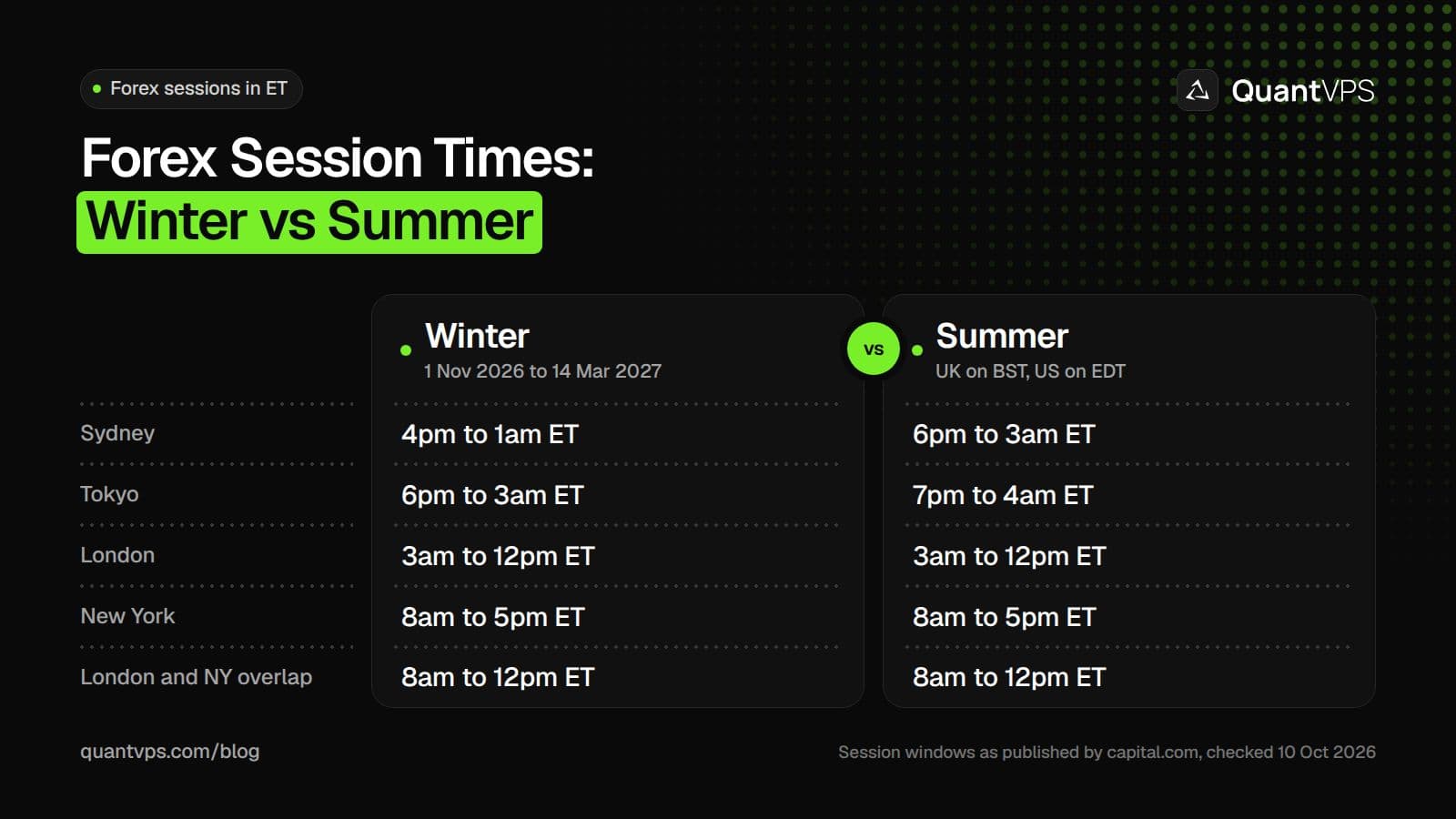
In Eastern Time, the Asian sessions move with the clock changes while London and New York stay put.
Uptime
99.999% uptime. Built for 24/7 trading reliability.
Your VPS runs in Tier IV datacenters with redundant power and network, monitored 24/7 on site.
See the uptime SLA





From $29.99/mo · Windows or Linux
The Four Forex Trading Sessions
The four sessions are named after the financial centres that lead trading in each part of the day. Babypips describes them as "loosely based on the local 'work day' of traders working in those cities." Here is what each session is known for.
- Sydney session: opens the trading week on Monday morning in Australia. It is the quietest of the four and matters most for the Australian and New Zealand dollars.
- Tokyo session: the main Asian session. The Japanese yen is on one side of 16.8% of all FX trades (BIS, April 2025), and yen pairs are most active here.
- London session: the largest. Sales desks in the UK handled about 38% of global FX turnover in April 2025, more than any other country, according to the BIS Triennial Survey.
- New York session: second by size, with about 19% of turnover. The US dollar is on one side of 89.2% of all trades, so US data moves almost every pair.
Singapore and Hong Kong also sit in the Asian part of the day. The BIS puts Singapore at 11.8% of FX trading and Hong Kong at 7.0%, which is why the Asian session is busier than the Sydney and Tokyo names alone suggest.
Session Overlaps and Liquidity
Overlaps are the hours when two sessions are open at once, and they carry the most trading. The London and New York overlap, 8am to 12pm ET, joins the two centres that together handle more than half of all FX turnover (38% plus 19%, BIS April 2025).
| Overlap | Winter (ET) | Summer (ET) | Pairs most affected |
|---|---|---|---|
| Sydney and Tokyo | 6pm to 1am | 7pm to 3am | AUD/JPY, AUD/USD, NZD/USD, USD/JPY |
| Tokyo and London | None (Tokyo closes as London opens) | 3am to 4am | EUR/JPY, GBP/JPY |
| London and New York | 8am to 12pm | 8am to 12pm | EUR/USD, GBP/USD, USD/CHF, USD/CAD |
More activity usually means tighter spreads and less slippage, as Babypips' forex market hours guide puts it. The quiet stretch is the late New York afternoon into the Sydney open, when only one session is trading.
Daylight Saving Changes and the Gap Weeks
Daylight saving moves the sessions because the UK, the US and Australia change their clocks on different dates, and Japan and Singapore don't change at all. For a few weeks each year the gap between London and New York is four hours instead of five.
| Change | Date | Source |
|---|---|---|
| Sydney clocks forward (AEDT) | Sun 4 Oct 2026 | NSW Government |
| UK clocks back to GMT | Sun 25 Oct 2026 | GOV.UK |
| US clocks back to EST | Sun 1 Nov 2026 | NIST |
| US clocks forward to EDT | Sun 14 Mar 2027 | Second Sunday in March (NIST rule) |
| UK clocks forward to BST | Sun 28 Mar 2027 | GOV.UK |
| Sydney clocks back (AEST) | Sun 4 Apr 2027 | NSW Government |
Two gap weeks follow from these dates, all checked on 10 Oct 2026:
- 25 Oct to 1 Nov 2026: London is back on GMT but New York is still on EDT. London runs 4am to 1pm ET and the overlap with New York runs 8am to 1pm ET.
- 14 Mar to 28 Mar 2027: New York has moved to EDT but London is still on GMT. The overlap is again 8am to 1pm ET.
Tokyo (JST, UTC+9) and Singapore (SGT, UTC+8) have no clock change in 2026, so their sessions only move in ET and GMT terms when the other centres change.
Locations
Trade beside your market. 8 datacenters, 3 continents.
Pick the location closest to what you trade, not to where you live.
Compare locationsFrom $29.99/mo · Windows or Linux
Best Times to Trade Each Major Pair
The best time to trade a pair is usually when the home centres of both its currencies are open. Babypips gives the rule with two examples: AUD/JPY sees "a higher trading volume when both Sydney and Tokyo sessions are open," and EUR/USD when London and New York are both open. Applied to the majors, in winter ET:
| Pair | Home sessions | When both are open (winter, ET) |
|---|---|---|
| EUR/USD | London and New York | 8am to 12pm |
| GBP/USD | London and New York | 8am to 12pm |
| USD/CHF | London and New York | 8am to 12pm |
| USD/CAD | New York (Toronto shares ET) | 8am to 5pm, busiest 8am to 12pm |
| USD/JPY | Tokyo and New York | No overlap: Tokyo 6pm to 3am, New York 8am to 5pm |
| AUD/USD, NZD/USD | Sydney and New York | Sydney and Tokyo from 4pm, New York from 8am |
| AUD/JPY | Sydney and Tokyo | 6pm to 1am |
| EUR/JPY, GBP/JPY | London and Tokyo | London open, 3am |
These windows tell you when a pair is most liquid, not when it will move your way. Check the economic calendar too: scheduled data from either country can move a pair hard outside its usual window.
Weekend Open and Close
Retail forex opens on Sunday at about 5pm ET and closes on Friday at about 5pm ET. OANDA US, for example, says its "forex instruments open on Sunday at 17:05 and close for the week on Friday 16:59 (New York time)", with a break from 16:59 to 17:05 every day (OANDA hours of operation, checked on 10 Oct 2026).
- Interbank close: CME Group lists the EBS spot FX market as closing Friday at 17:00 ET, with a daily trade date roll at 17:00 ET (CME Group trading hours).
- In GMT and SGT: 5pm ET on Sunday is 22:00 GMT (6am Monday SGT) in winter and 21:00 GMT (5am Monday SGT) in summer.
- While closed: OANDA says you "cannot close existing positions or open new positions" but can place or modify orders.
- The Sunday gap: prices "may significantly change or 'gap' when the market resumes trading", and a stop can fill at a worse price than you set.
Holidays such as Christmas and New Year shorten the week, and each broker publishes its own holiday schedule. Your broker's hours are the ones that count for your account.
Running EAs Across Sessions
An Expert Advisor that trades several sessions needs two things: session times that follow the clock changes, and a terminal that stays on around the clock. A common mistake is writing session hours in broker server time, which is set by each broker's trade server and can shift when clocks change.
- Use GMT for session filters. In MetaTrader, TimeCurrent() returns the trade server's time. TimeGMT() returns GMT, "calculated taking into account the DST switch" on the terminal's computer.
- Backtest with care. The MQL5 Reference notes that "during testing in the strategy tester, TimeGMT() is always equal to TimeTradeServer() simulated server time," so GMT-based filters need an offset input when you test.
- Read the broker's sessions. SymbolInfoSessionTrade() returns the start and end of each trading session for a symbol and day of the week.
- Mark the gap weeks. Hard-code nothing that assumes London and New York are always five hours apart.
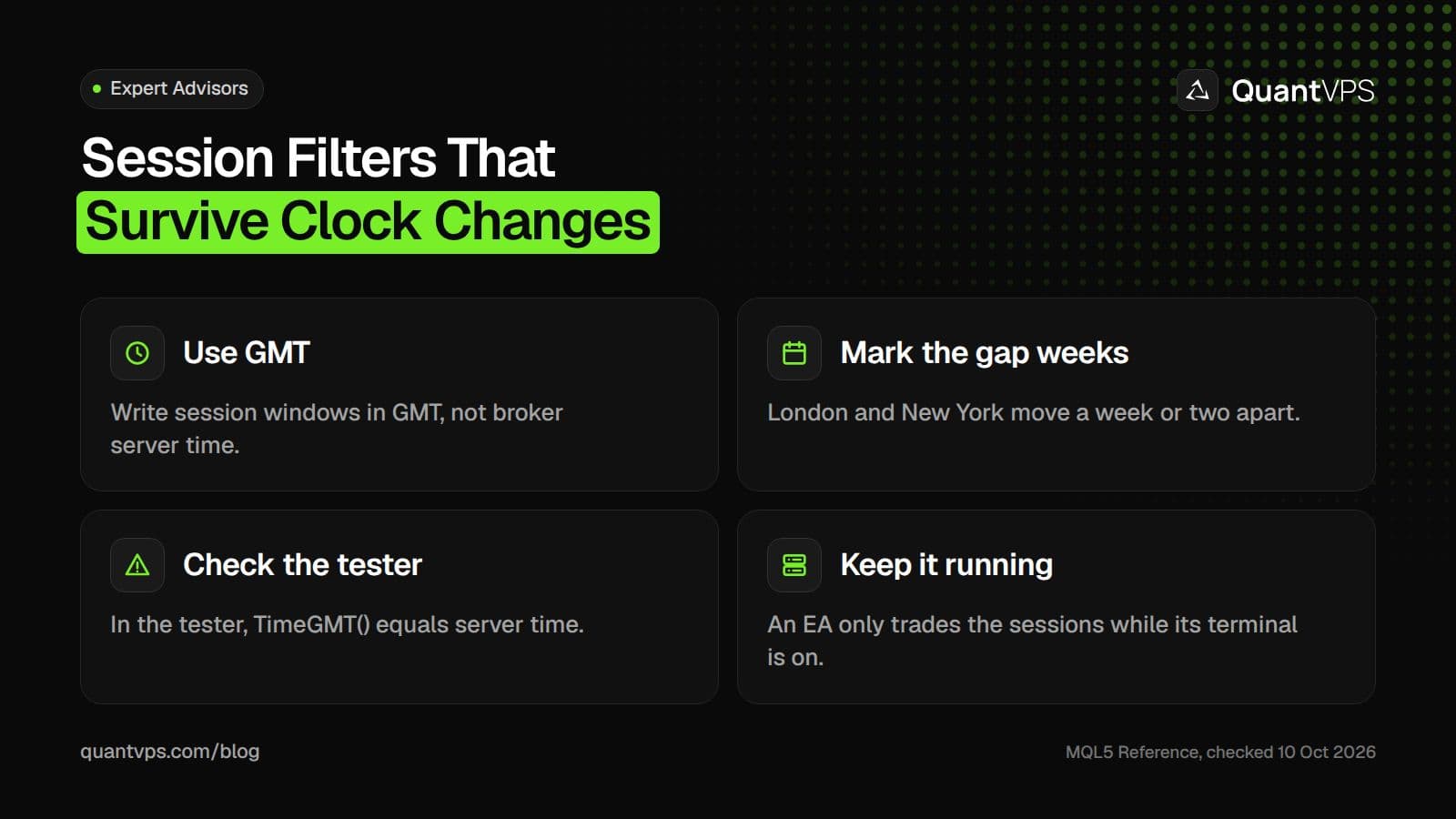
Clock changes break EAs that hard-code session hours in server time.
A home PC that sleeps or restarts misses whole sessions. A forex VPS keeps MetaTrader running 24/5 in New York (NY4) or London (LD4), close to the trade servers most forex brokers use. It runs with 99.999% uptime. If you run MT4 or MT5 terminals for several accounts, a MetaTrader VPS holds them all on one Windows server.
FAQs
Order flow
Built for scalpers. Heatmaps on dedicated resources.
Order-flow heatmaps and DOM ladders run on dedicated CPU, memory and NVMe, so your charts keep responding during volatility.
See the dedicated hardwareFrom $29.99/mo · Windows or Linux
Is the forex market open 24 hours?
Yes, from Sunday evening to Friday evening New York time. One session is always open on weekdays, and most brokers pause for a few minutes around 5pm ET each day. OANDA US, for example, closes all forex instruments from 16:59 to 17:05 New York time.
What time does the forex market open on Sunday?
Most retail brokers open forex at about 5pm ET on Sunday, which is 22:00 GMT in winter and 21:00 GMT in summer. OANDA US opens at 17:05 New York time (checked on 10 Oct 2026). Check your own broker's hours, because they can differ by a few minutes.
What is the best time to trade forex?
For most major pairs, the London and New York overlap from 8am to 12pm ET. Sales desks in the UK and the US handle more than half of FX turnover between them (about 38% and 19%, BIS, April 2025). For yen and Australian dollar pairs, the Sydney and Tokyo overlap matters more.
Do forex sessions change with daylight saving?
Yes. The UK, the US and Australia change their clocks on different dates, so sessions shift in ET and GMT. Between 25 Oct and 1 Nov 2026, and between 14 Mar and 28 Mar 2027, London and New York are only four hours apart, and their overlap runs 8am to 1pm ET.
Is forex open on weekends?
No. Retail forex closes on Friday at about 5pm ET and reopens on Sunday at about 5pm ET. Prices can gap at the Sunday open, so a stop loss may fill at a worse price than you set.


