
If you're a trader deciding between Tradezella and TraderSync, here's the key takeaway: Tradezella focuses on structured journaling, backtesting and trader education, while TraderSync emphasizes market replay, Level II data and its Cypher AI coach. Both now include AI (Zella AI credits on every Tradezella plan, Cypher messages on every TraderSync plan), and annual plans start at $26 a month for Tradezella and $22.46 a month for TraderSync (checked on 10 Oct 2026).
Key Highlights:
- Tradezella: Prioritizes trader psychology, education (Zella University), and user-friendly tools, with Zella AI credits, AI agents on Pro and Ultra, and 1-second chart backtesting.
- TraderSync: Excels in AI-driven analytics (Cypher assistant), extensive broker integration, and precise market replay (250ms tick data on Elite plan).
Pricing Overview:
- Tradezella: Starts at $26/month (Essential, annual billing) or $35 monthly. Pro is $44/month annually ($59 monthly) and Ultra $74/month annually ($99 monthly).
- TraderSync: Starts at $22.46/month (Pro, annual billing) or $29.95 monthly. The Elite plan at $59.96/month annually ($79.95 monthly) offers the most Cypher messages and 250ms replay.
Quick Comparison:
| Feature | Tradezella | TraderSync |
|---|---|---|
| Focus | Education, psychology, journaling | AI insights, analytics, automation |
| Broker Support | 500+ brokers and platforms | 700+ brokers |
| Backtesting | 1-second charts; automated AI backtests on Pro and Ultra | 250ms tick, Level II data |
| AI Features | Zella AI (500 to 3,000 credits/month) | Cypher assistant (5 to 60 messages/day) |
| Pricing (Annual) | $26 to $74/month | $22.46 to $59.96/month |
| Free Trial | None listed | 7 days |
Prices checked on 10 Oct 2026 on tradezella.com/pricing and tradersync.com/pricing.
Choose Tradezella if you value simplicity, education, and structured journaling. Opt for TraderSync if you need advanced analytics, AI tools, and broader broker connectivity.
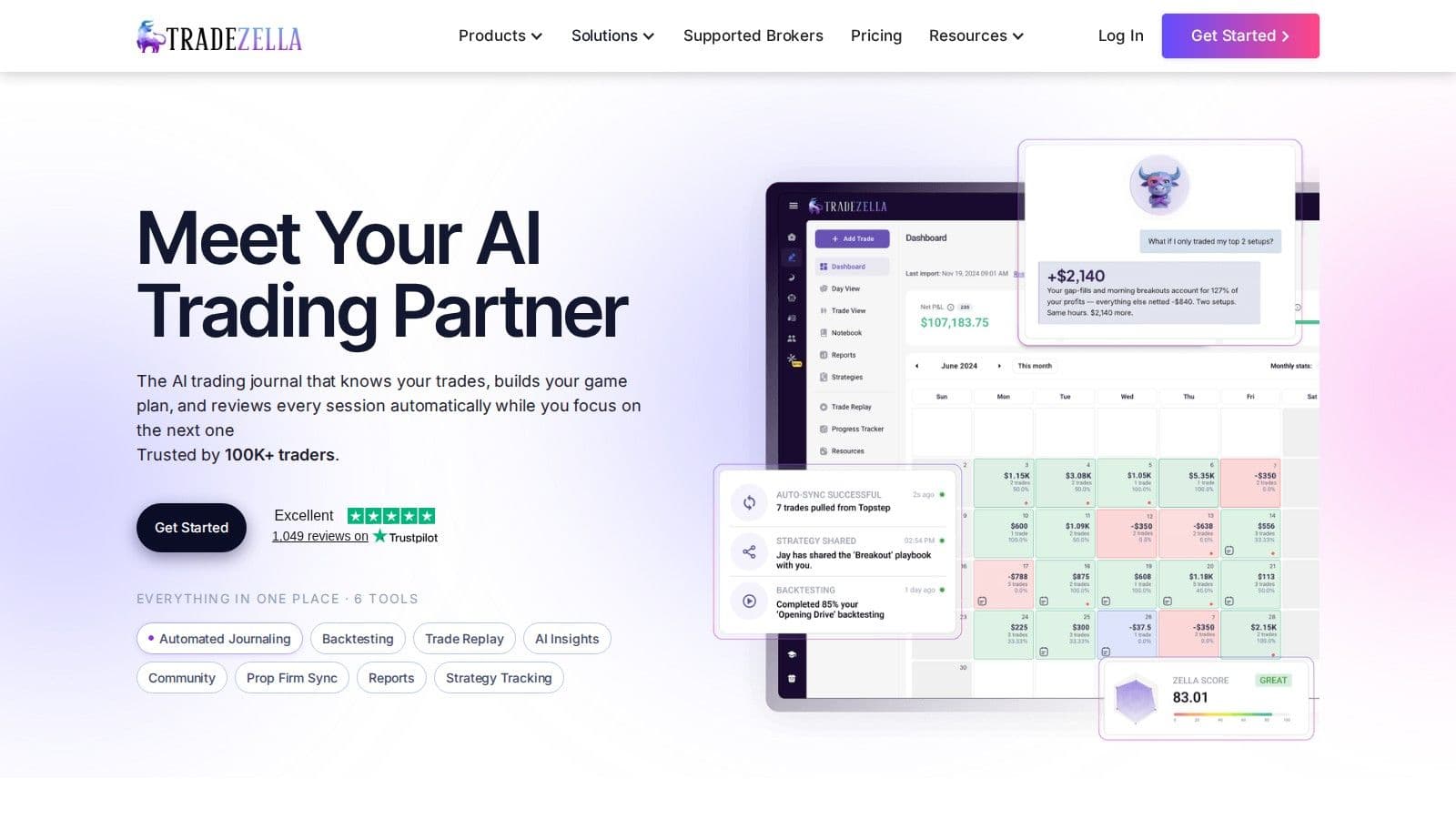
Feature Comparison
Both platforms handle trade logging, analytics, and strategy testing, but each takes a distinct approach. Understanding these differences can help you decide which one aligns better with your trading style and technical needs.
Trade Logging and Automation
Broker Integration and Connectivity
Tradezella says it connects with 500+ brokers and trading platforms. U.S. brokers include Interactive Brokers, Charles Schwab (which absorbed TD Ameritrade), Robinhood, Tradovate, TradeStation, and TopstepX. It also supports platforms such as MetaTrader 4 and 5, NinjaTrader, cTrader, DXtrade, TradeLocker and TradingView paper trading, and crypto exchanges like Bybit and Coinbase. For unsupported brokers, you can upload trades via CSV files.
TraderSync, on the other hand, says it connects with over 700 brokers and trading platforms and offers strong automation features, including autosync.
Asset Class Support
Tradezella supports a wide variety of asset classes, including stocks, options, futures, forex, and cryptocurrencies. While TraderSync's extensive broker integration implies broad asset class support, specific details aren’t clearly outlined.
Data Entry Methods
Both platforms offer multiple ways to log trades: manual input, CSV uploads, and automated API integration. Tradezella’s automation enriches sessions with price data, execution points, charts, and key metrics. Meanwhile, TraderSync focuses on data import and processing, making it ideal for traders managing high volumes of trades.
Performance Analytics
After logging trades, the platforms diverge in how they analyze performance.
Analytics Approach and Depth
Tradezella’s reports provide interactive charts that make it easy to uncover key metrics, with 300+ drilled-down reports. Zella AI adds a monthly and weekly AI review report, and Pro and Ultra include AI agents such as a Trade Auto-Tagger and Session Review agent.
"TradeZella, in contrast, focuses on clarity and usability. Reports are visual, interactive, and easy to filter. You can instantly see things like your most profitable setups, biggest mistakes, win rate by tag, and performance by trade duration or session. Everything is designed to help you find insights faster without needing to build custom spreadsheets or dig through dozens of filters."
– TradeZella Team
TraderSync uses its AI-powered analytics engine, Cypher, to deliver deeper insights. It also highlights patterns like $12,340 in losses from trades that didn’t follow the trading plan or tendencies to hold trades longer than planned.
Uptime
99.999% uptime. Built for 24/7 trading reliability.
Your VPS runs in Tier IV datacenters with redundant power and network, monitored 24/7 on site.
See the uptime SLA







From $29.99/mo · Windows or Linux
Customization and Reporting
Both platforms offer customizable dashboards. Tradezella boasts over 50 specialized reports, while TraderSync provides more than 20 widgets with advanced filters.
Trade Replay and Strategy Backtesting
The platforms also differ in how they simulate market behavior and test strategies.
Data Granularity and Simulation Quality
Tradezella delivers tick-by-tick data with second-level replays and up to 10 years of historical data. It has processed over 100,000 backtest sessions and supports market, limit, and stop orders with automatic position sizing based on your risk parameters.
TraderSync offers market replay with 250ms ticks and includes Level II data for U.S. stocks, options, and futures, along with Time & Sales data. It’s known for its speed, loading market data in under a second. A journal records your trades; FX Replay's practice workflow is a separate option for replaying market sessions.
Strategy Development Tools
Tradezella integrates backtesting with its journaling system, offering multi-timeframe analysis, a "Go-To" function to revisit key moments, and economic calendar integration. It also includes a Mentor Mode for collaborative reviews.
"After extensively testing TradeZella's backtesting feature, we think it's one of the best tools for manual strategy testing."
– Learnforexwithdapo
TraderSync adds features like Playlists for focused chart practice and custom screeners to target specific market conditions, making backtesting more intuitive.
Performance Analysis Integration
Tradezella treats backtesting results as live trades, offering detailed analytics such as profit/loss, win rate, drawdown, and equity curve visualization. TraderSync’s AI coach, Cypher, provides "What-If" scenarios and detailed strategy reports, helping traders refine their strategies by identifying areas for improvement.
| Feature | Tradezella | TraderSync |
|---|---|---|
| Data Granularity | Tick-by-tick, seconds timeframe | 250ms ticks, Level II data |
| Historical Data | Up to 10 years | Real historical data |
| Order Types | Market, limit, stop orders with auto-sizing | Realistic simulation |
| AI Integration | Zella AI credits, AI agents on Pro and Ultra | Cypher AI coach with interactive queries |
| Unique Features | Mentor Mode, drag & adjust SL/TP | Level II backtesting, fastest simulator |
Tradezella offers user-friendly interface, integrated analytics, and journaling features. Meanwhile, TraderSync caters to traders seeking advanced AI-driven insights and detailed market data. These unique strengths make each platform appealing to different types of traders, depending on their priorities and trading infrastructure.
Pricing and Plans
Tradezella and TraderSync cater to different types of traders with their unique pricing structures. Knowing these options can help you decide which platform aligns best with your trading style and goals.
Tradezella Pricing
Tradezella offers three plans with about 25% off for annual billing (checked on 10 Oct 2026). Essential costs $35 per month or $26 per month billed annually ($315 per year), Pro costs $59 per month or $44 per month annually ($531 per year), and Ultra costs $99 per month or $74 per month annually ($891 per year).
Essential includes 1 active trading account, 500 Zella AI credits a month, manual backtesting of up to 10 strategies on 1-second charts and automated journaling, but no trade replay. Pro raises this to 50 active accounts, 1,500 AI credits, AI agents, 10 automated AI backtests a month and unlimited trade replays. Ultra adds unlimited accounts, 3,000 AI credits, 100 automated AI backtests and priority support.
Every plan includes Tradezella’s core journaling tools, its reports, manual backtesting and Zella University for educational resources.
TraderSync Pricing
TraderSync employs a three-tier pricing system, with 25% off on annual plans (checked on 10 Oct 2026).
- Pro Plan: Costs $29.95 per month or $22.46 per month annually (billed at $269.52 per year). It includes 5 accounts, the strategy checker, market replay with 1-minute tick precision for stocks, futures, crypto and forex, and five daily messages with the Cypher AI assistant.
- Premium Plan: Priced at $49.95 per month or $37.46 per month annually (billed at $449.52 per year). It offers unlimited accounts, unlimited strategy creations, 1-second tick precision for market replay and 15 daily Cypher messages.
- Elite Plan: Costs $79.95 per month or $59.96 per month annually (billed at $719.52 per year). Subscribers get unlimited accounts, 250ms tick precision for market replay with Level II and Time & Sales, 60 daily Cypher messages, and support for all assets including options.
TraderSync also offers a 7-day free trial on every plan, allowing users to explore the platform before committing. This trial is especially useful for traders who want to evaluate its AI-driven features and functionality.
Which Platform Offers Better Value?
Deciding between these platforms depends on your trading experience and priorities.
For beginner traders, TraderSync’s Pro Plan at $22.46 per month annually is the cheapest entry point and now covers 5 accounts, though market replay is limited to 1-minute precision. Tradezella’s Essential Plan at $26 per month annually costs slightly more and includes AI credits and educational resources, but only 1 active account and no trade replay.
Active traders will find both platforms competitive in the mid-tier range. TraderSync’s Premium Plan at $37.46 per month annually is cheaper than Tradezella’s Pro Plan at $44 per month annually. Both now include AI: TraderSync through the Cypher assistant and coach, Tradezella through Zella AI credits and agents, while Tradezella also emphasizes journaling and mentoring.
For professional traders and scalpers, Tradezella’s Ultra Plan at $74 per month annually offers unlimited accounts, the most AI credits and 100 automated AI backtests a month. TraderSync’s Elite Plan at $59.96 per month annually adds 250ms tick replay with Level II data and the most Cypher messages, which suits scalpers who review fast-moving trades.
TraderSync’s free trial makes it easier to test the platform before committing, while Tradezella’s plans differ mainly in account limits, AI capacity, automated backtesting and trade replay.
| Plan comparison | Tradezella Essential | Tradezella Pro | Tradezella Ultra | TraderSync Pro | TraderSync Premium | TraderSync Elite |
|---|---|---|---|---|---|---|
| Annual price | $26/month | $44/month | $74/month | $22.46/month | $37.46/month | $59.96/month |
| Monthly price | $35/month | $59/month | $99/month | $29.95/month | $49.95/month | $79.95/month |
| Free trial | None listed | None listed | None listed | 7 days | 7 days | 7 days |
| Accounts | 1 active | Up to 50 active | Unlimited | 5 | Unlimited | Unlimited |
| AI | 500 Zella AI credits/month | 1,500 credits + agents | 3,000 credits + agents | 5 Cypher messages/day | 15 messages/day | 60 messages/day |
| Replay | No trade replay | 1-second trade replay | 1-second trade replay | 1-minute market replay | 1-second market replay | 250ms market replay |
Prices and plan limits checked on 10 Oct 2026 on each company's pricing page.
Ultimately, the choice boils down to whether you value Tradezella’s journaling, backtesting and education or TraderSync’s market replay precision and Cypher coaching at higher tiers.
Pros and Cons
Both platforms bring unique strengths and challenges to the table, catering to different trading approaches and experience levels. Here’s a closer look at what each offers, based on their features and pricing.
Tradezella: Pros and Cons
What Tradezella Does Well
Tradezella offers an easy-to-navigate interface, and many users praise its simplicity and effectiveness. The platform’s Zella University is a valuable resource, helping traders track their performance while sharpening their trading skills.
"TradeZella strikes a great balance between powerful functionality and being intuitive to use." – Maverick Trading
Another highlight? Its plans share the same core journaling and reporting, with differences mainly in account limits, AI capacity and replay. Automated journaling is another plus, minimizing manual errors and providing detailed reports to help refine trading strategies.
Order flow
Built for scalpers. Heatmaps on dedicated resources.
Order-flow heatmaps and DOM ladders run on dedicated CPU, memory and NVMe, so your charts keep responding during volatility.
See the dedicated hardwareFrom $29.99/mo · Windows or Linux
Where Tradezella Falls Short
For beginners, the advanced features might feel overwhelming. Mobile access is also a sticking point, as some users report issues with the mobile-optimized web version. Price-wise, its subscription costs may discourage newer traders, and the entry Essential plan has no trade replay.
TraderSync: Pros and Cons
What TraderSync Does Well
TraderSync shines with its broker support, connecting with over 700 brokers and trading platforms, making it a versatile choice for traders working across various asset classes. Its AI-powered Cypher assistant and coach provide personalized insights, feedback, and pattern recognition. Plus, the platform offers a 7-day trial.
The Market Replay feature, available in the Elite plan, is another standout. It delivers precision up to 250ms ticks and includes Level II data, offering traders a detailed view of market conditions and decision-making.
Where TraderSync Falls Short
The tiered pricing can be steep, especially for those wanting the most AI messages and 250ms replay. For instance, the Elite plan costs $79.95 per month (or $59.96 per month when billed annually), which might be too high for casual traders. Manual trade entry can also be slow for those handling high volumes of trades. After the trial, there’s no free version available, which could be a drawback for budget-conscious traders.
Comparison Table
| Aspect | Tradezella | TraderSync |
|---|---|---|
| User Interface | Intuitive, beginner-friendly | Modern and well-designed |
| Pricing (Annual) | $26 to $74/month | $22.46 to $59.96/month |
| Free Trial | None listed | 7 days |
| Broker Support | 500+ brokers and platforms, plus CSV upload | 700+ brokers and platforms |
| AI Features | Zella AI credits on every plan, agents on Pro and Ultra | Cypher assistant with tiered access |
| Mobile Access | Mobile-optimized web (with some issues) | Available via web, iOS, and Android apps |
| Educational Tools | Zella University | Tutorials and Cypher AI coaching |
| Best For | Traders wanting straightforward tools | Data-focused traders seeking advanced AI |
Choosing between these platforms depends on what suits your trading style best. Tradezella offers a more structured, education-led experience, while TraderSync caters to those who value precise market replay and Cypher coaching.
Integration with Trading Infrastructure
VPS hosting helps increase the performance of Tradezella and TraderSync by offering a stable, high-performance trading environment. The effectiveness of a trading journal hinges on receiving precise, real-time data from your trading platforms.
VPS Hosting for Better Operations
Running your primary trading platforms - like MetaTrader, NinjaTrader, or TradeStation - on a high-performance VPS ensures smooth data flow to your journaling platform. This reliable data transmission is the backbone for the detailed analytics and trade replays that Tradezella and TraderSync provide.
This level of reliability ensures your trading platforms stay operational, consistently feeding accurate data to your journaling tools.
This infrastructure advantage becomes even more apparent when you consider that TraderSync supports over 700 brokers and trading platforms. Similarly, Tradezella benefits from VPS connectivity with platforms like MetaTrader and TradingView. These features make VPS hosting an indispensable tool for traders seeking reliability and precision. If the strategy also receives TradingView alerts, a VPS for TradingView webhooks can host its execution bridge, while the journal records the resulting trades separately.
Practical Tips for Integration
To get the most out of VPS hosting, consider these integration tips:
- Host your trading platforms on a nearby VPS: Choose a VPS located close to major exchanges, and set up automatic data syncing between the VPS and your trading journal. This reduces data gaps caused by local outages.
- Prioritize security: Use VPS features like DDoS protection, advanced firewalls, and secure access protocols to safeguard your trading operations.
- Ensure uninterrupted automated trading: VPS hosting eliminates common risks like power outages, unstable home Wi-Fi, and high latency from local ISPs. This ensures that Expert Advisors or trading bots operate continuously, recording every trade without interruption.
- Optimize VPS performance: Monitor your VPS regularly and keep it streamlined by limiting installed software. For optimal performance, aim for 4–8 GB of RAM and SSD storage.
The real advantage comes when your VPS-hosted trading setup delivers uninterrupted, clean data to your journal. This allows you to track trades, analyze performance, and fine-tune strategies from anywhere, ensuring the reliability that professional trading demands.
Conclusion
Key Takeaways
When comparing Tradezella and TraderSync, it’s clear they serve different trading needs, each offering distinct tools and features. Tradezella focuses on in-depth analysis and strategy refinement. Features like the Zella Score for performance tracking, a playbook for strategy organization, and comprehensive backtesting (included in all plans) make it a strong choice for traders aiming to improve systematically. Its detailed reporting breaks down performance by strategy, setup, mistakes, and timing, with interactive reports that allow users to analyze individual trades closely.
On the other hand, TraderSync emphasizes data logging and AI-powered insights. Its standout tools include the Cypher Assistant and Coach, with message limits depending on the plan (5 for Pro, 15 for Premium, and 60 for Elite). The platform also offers market replay, from 1-minute ticks on the Pro plan to 250ms ticks on the Elite plan, making it a powerful option for traders who rely on precision and AI-driven feedback.
The platforms also differ in their educational resources. Tradezella’s Zella University focuses on using data to enhance trading performance while addressing mindset and process development. In contrast, TraderSync provides tutorials primarily aimed at helping users navigate its tools effectively.
Final Recommendation
Choose Tradezella if your priority is building and refining trading strategies while gaining deeper insights into your performance. With features like its playbook builder, detailed behavioral tracking, and comprehensive backtesting, Tradezella is particularly appealing to swing and position traders who value systematic, long-term growth.
Alternatively, opt for TraderSync if you’re drawn to AI-driven insights and precise market replay. These tools are especially useful for active day traders and scalpers. TraderSync's Pro plan, priced at $22.46 per month (annual billing), offers 5 Cypher messages a day and 1-minute tick precision, making it a good starting point for beginners. However, those seeking more tools for strategy development might lean toward Tradezella’s Essential plan.
Both platforms perform best when paired with reliable VPS hosting to ensure uninterrupted data flow, which is critical for optimal performance. Ultimately, your trading style, whether focused on strategic insights or precise replay, should guide your decision.
FAQs
How do the educational resources of Tradezella and TraderSync compare?
Tradezella offers a variety of educational resources aimed at helping traders sharpen their skills. These include detailed manuals, step-by-step guides, webinars, training videos, and a comprehensive learning platform packed with trading strategies. It's an ideal option for those who want to expand their knowledge and improve their trading techniques.
In contrast, TraderSync focuses on platform-specific tutorials, providing video guides that explain how to use its tools, such as trade management and portfolio tracking. While these tutorials are useful for understanding the platform, they don't match the depth or breadth of Tradezella's educational materials.
In summary, Tradezella excels with its extensive and structured learning resources, while TraderSync is more about offering practical guidance for its platform features.
How does TraderSync's AI analytics improve trading decisions compared to Tradezella?
TraderSync's AI, supported by tools like Cypher, functions as a personal trading coach. It identifies patterns, delivers detailed insights, and offers real-time feedback to help traders make better decisions. What sets it apart is its ability to dig deeper, analyzing the reasons behind trading behaviors and providing actionable suggestions for improvement.
Tradezella now has its own AI too: Zella AI comes with monthly credits on every plan (500, 1,500 or 3,000) and produces weekly and monthly review reports, and Pro and Ultra add AI agents. TraderSync's Cypher focuses on coaching and pattern recognition, while Zella AI is built around reviewing sessions and tagging trades, so test both on your own trade history.
Which platform is better for active day traders?
Neither journal is built for high-frequency trading; both suit active day traders who review dozens of trades a day. TraderSync is the better fit if you want precise replay: its Elite plan replays the market in 250ms ticks with Level II and Time & Sales data.
Tradezella suits day traders who want structured journaling, playbooks and backtesting with AI review reports, and its Pro plan covers up to 50 active accounts, useful if you trade several prop firm accounts.


