
If you're deciding between Apex Trader Funding and Tradeify, the choice depends on your trading style and priorities. Here's the quick breakdown:
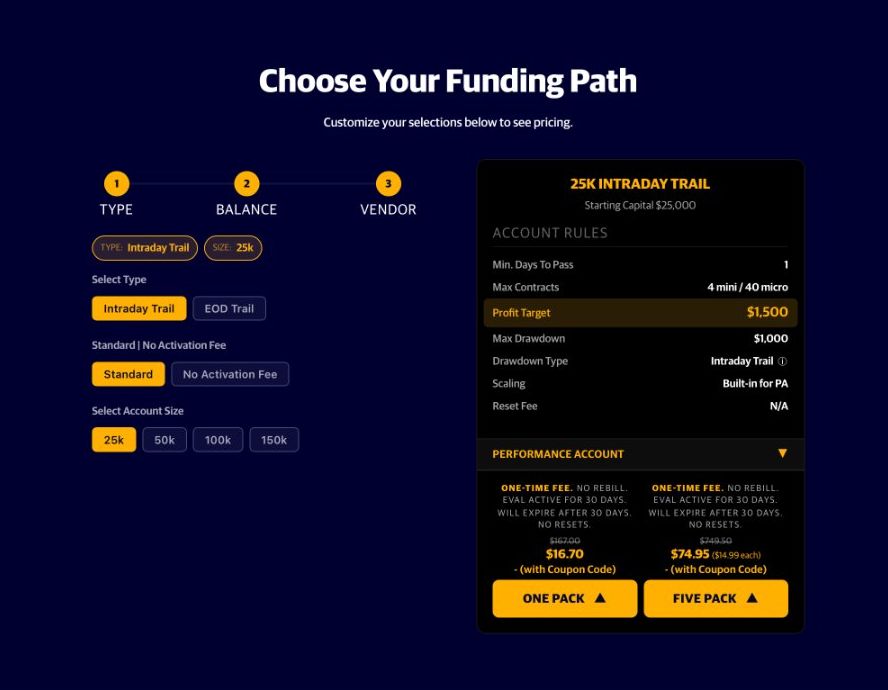
Source: apextraderfunding.com, October 2026
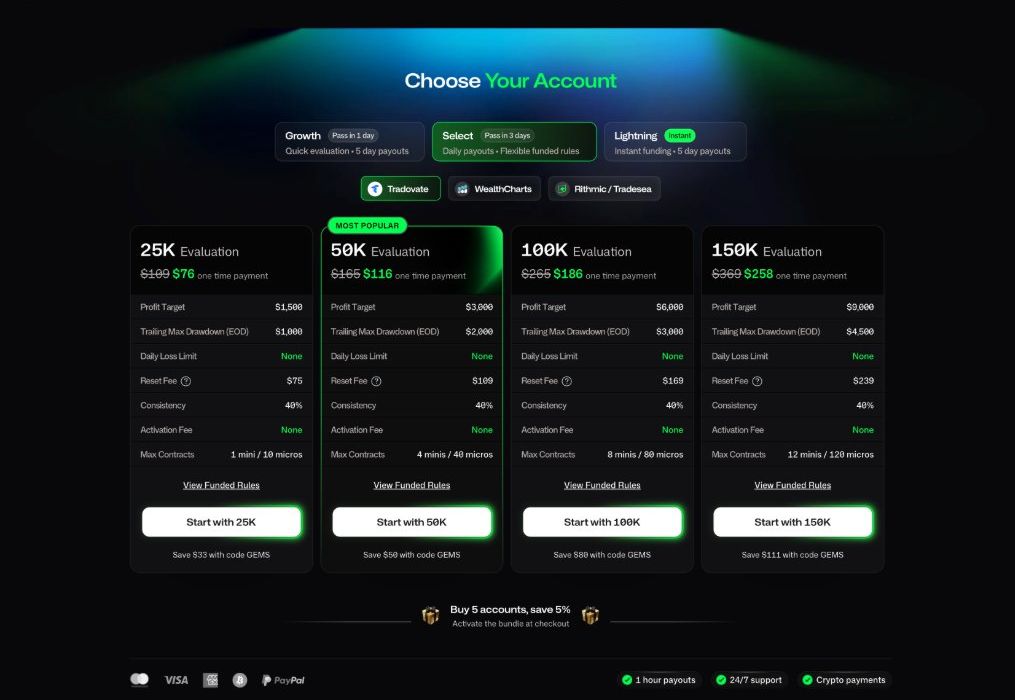
Source: tradeify.co, October 2026
- Apex Trader Funding: Established in 2021, it's ideal for traders managing multiple accounts. Apex offers up to 20 Performance Accounts, a 100% payout split on approved payouts, and a choice of end-of-day or intraday trailing drawdown. However, it charges a one-time activation fee, caps each payout, limits each account to six payouts, and applies a 50% consistency rule.
- Tradeify: Launched in 2024, it focuses on speed and simplicity. With no activation fees, faster evaluations (some in 1 day), and an end-of-day trailing drawdown, Tradeify caters to traders who want quicker payouts (within 24 hours). It offers a flat 90% profit split but has stricter consistency rules during evaluations and a smaller account limit (up to 5 accounts).
Quick Comparison
| Feature | Apex Trader Funding | Tradeify |
|---|---|---|
| Profit Split | 100% of approved payouts | 90/10 on sim funded (80/20 in Elite Live) |
| Drawdown Type | Your choice: EOD or Intraday Trailing | End-of-Day (EOD) |
| Payouts | After 5 qualifying trading days, up to weekly, max 6 per account | Select Flex every 5 winning days; Select Daily daily; Lightning by profit goal |
| Activation Fee | One-time PA Activation Fee | $0 on all current plans |
| Minimum Days to Pass | None (can pass in 1 day) | Select 3 days; Growth 1 day; Lightning instant |
| Max Funded Accounts | 20 | 5 |
Apex offers scalability and flexibility for experienced traders, while Tradeify is better for fast payouts and cost-efficient accounts. Choose the one that aligns with your trading goals.
Apex Trader Funding Overview
Apex Trader Funding uses a straightforward single-phase evaluation model designed to make the funding process more efficient. Traders must meet a profit target while following specific risk rules; there is no minimum number of days to pass, and each payout requires at least 5 qualifying trading days. Account sizes range from $25,000 to $150,000. For instance, a $50,000 account requires $3,000 in profits, while a $150,000 account requires $9,000.
The firm's drawdown system is built on precise technical guidelines. Apex lets traders choose between an end-of-day trailing drawdown and an intraday trailing drawdown that moves in real time with the peak balance. On a $50,000 account the drawdown is $2,000; if the account peaks at $51,000, the threshold rises from $48,000 to $49,000. Apex's current lineup does not include a Static account.
Apex ensures compatibility with various trading platforms. Accounts are sold on three platforms - Rithmic, Tradovate and WealthCharts - and cannot be switched after purchase. Traders gain access to over 40 futures markets, including CME, CBOT, COMEX, and NYMEX, covering everything from equity indices to micro-crypto futures. Level 1 market data is included; DOM data is an extra paid add-on (it expires monthly on Rithmic and must be cancelled manually on Tradovate or WealthCharts).
Key Features and Offerings
Apex's profit-sharing model is particularly appealing. Traders receive 100% of each approved payout. This is especially useful for traders managing multiple accounts, as they can run up to 20 Performance Accounts at once. Apex also allows the use of futures trade copiers, enabling traders to replicate successful strategies across accounts.
Apex's Intraday Trailing evaluations have no daily loss limit, but EOD evaluations ($500 to $2,000 by size) and all Performance Accounts have one that pauses trading for the session. Evaluation contract limits are 4 (25K), 6 (50K), 8 (100K) and 12 (150K) contracts, and Performance Accounts scale up in steps as the end-of-day balance grows.
Apex charges a one-time evaluation fee that varies by account size and type and gives 30 days of access; it does not renew. Discount codes are frequently available. After passing, traders pay a one-time Performance Account activation fee within 7 days; there are no monthly PA fees. Apex has no resets - a failed evaluation must be replaced by buying a new one.
Payouts follow a structured process: each request needs at least 5 trading days that meet a minimum daily profit, and no single profitable day can be 50% or more of profit earned since the last payout. Requests start at $500, are capped by account size, and each account can receive at most six payouts. Traders must keep the safety net - the drawdown amount plus $100 - for the life of the account.
The table below highlights the main advantages and drawbacks of Apex Trader Funding.
Uptime
99.999% uptime. Built for 24/7 trading reliability.
Your VPS runs in Tier IV datacenters with redundant power and network, monitored 24/7 on site.
See the uptime SLA







From $29.99/mo · Windows or Linux
Pros and Cons
| Pros | Cons |
|---|---|
| 100% payout split on approved payouts | Each payout is capped and an account gets at most six payouts |
| Choice of EOD or intraday trailing drawdown | EOD accounts and all PAs have a daily loss limit that pauses trading |
| Manage up to 20 Performance Accounts | , |
| No minimum trading days in the evaluation | 50% consistency rule on payouts |
| One-time fees, no monthly billing | No resets - a failed evaluation must be repurchased |
| Rithmic, Tradovate and WealthCharts options | Platform cannot be changed after purchase |
"Apex Trader Funding stands out for its accessibility, structured rules, and educational value." – Darrell Martin, Founder and CEO, Apex Trader Funding
Tradeify Overview
Tradeify is all about speed and simplicity. They’ve streamlined their process with a single-phase evaluation requiring traders to hit a 6% profit target. Profit goals depend on the account size, and there's a three-day evaluation period that enforces a consistency rule - ensuring no single day contributes excessively toward the profit target.
One standout feature is their end-of-day (EOD) trailing drawdown. Unlike real-time drawdowns that adjust during the trading day, Tradeify calculates the drawdown limit based on the highest closing balance at the end of each session (5:00 PM ET). For example, a $50,000 account starts with a $2,000 drawdown, which only adjusts upward with end-of-day balances. This approach is more forgiving compared to Apex's real-time model.
Tradeify's success speaks for itself: they’ve paid out over $110 million to more than 80,000 traders and boast from over 1,900 reviews. Payouts are processed quickly - most requests are completed in 60 minutes to 24 hours.
"The best affordable futures prop firm going into 2026 is Tradeify. By eliminating the Activation Fee and utilizing a trader-friendly EOD Drawdown, Tradeify offers the best Total Cost of Funding." – Brett Simba, CEO of Tradeify
On top of their quick payouts and stellar reviews, Tradeify offers flexible funding models designed to cater to trader preferences.
Key Features and Offerings
Tradeify’s Select Flex model has funding options. After passing the evaluation, traders can choose between two funding options:
- Select Flex: Offers a 5-day payout cycle with no daily loss limits.
- Select Daily: Allows daily payouts but includes structured daily loss limits.
Another major perk? No activation fees once you pass the evaluation - this sets Tradeify apart from competitors that often charge hefty activation fees. Monthly evaluation costs are also competitive:
- $50,000 account: $165 one-time (Select) or $145 one-time (Growth)
- $100,000 account: $265 one-time (Select) or $255 one-time (Growth)
- $150,000 account: $369 one-time (Select or Growth)
Tradeify supports Tradovate, NinjaTrader and TradingView on Tradovate, Tradesea, Quantower, Sierra Chart and R|Trader on Rithmic, and WealthCharts, and offers a 90/10 profit split starting from day one. For those looking to skip evaluations, the Lightning Funded option lets traders bypass the process for a one-time fee ($345 to $796), with a 90% payout split. However, this path comes with progressive consistency rules (20%, 25%, then 30%). If your permitted setup sends TradingView alerts through a desktop bridge, a VPS for TradingView alerts can keep that bridge online while your local computer is off.
After three payouts on a single account (or 10 payouts in total), traders become eligible for Tradeify Elite Live, which pays an 80/20 split. These options, combined with competitive pricing and flexible features, make Tradeify a streamlined choice for futures traders.
Pros and Cons
| Pros | Cons |
|---|---|
| No activation fees on Select and Growth plans | Stricter consistency rules on Lightning Funded accounts (20–30% progressive) |
| End-of-day trailing drawdown is less restrictive than real-time models | Daily payout path requires a profit buffer before withdrawals |
| Fast payouts (often within 60 minutes to 24 hours) | Limited to futures trading (no Forex or crypto CFDs) |
| Flexible payout options (Flex vs. Daily) after passing evaluation | Minimum five winning days required for Flex payouts |
| Tier 1 news trading is allowed without restrictions | Micro-scalping rule requires 50% of trades or profits from positions held over 10 seconds |
| 90/10 profit split from day one | Positions must be closed by 4:45 PM ET daily |
"Tradeify Select stands apart from other prop firm evaluations with one critical differentiator: you don't choose your funded account structure until after you pass." – Save On Prop Firms
Side-by-Side Comparison
Comparison Table
Both Apex Trader Funding and Tradeify have competitive pricing and profit-sharing models, though they approach these differently. Apex pays 100% of each approved payout on its current Performance Accounts. Tradeify, on the other hand, offers a flat 90% profit split across all account types. Activation fees also differ - Apex charges a one-time PA activation fee after passing the evaluation, while no current Tradeify plan has an activation fee.
| Feature | Apex Trader Funding | Tradeify |
|---|---|---|
| Evaluation Fee ($50k) | One-time fee (discount codes common) | $145 Growth / $165 Select (one-time, list price) |
| Activation Fee | One-time PA Activation Fee | $0 |
| Profit Split | 100% of approved payouts | 90/10 |
| Drawdown Type | EOD or Intraday Trailing | End-of-Day (EOD) Trailing |
| Daily Loss Limit | EOD evals and all PAs: soft DLL; Intraday evals: none | None on Select eval and Select Flex; soft DLL on Select Daily, Growth, Lightning |
| Payout Frequency | Every 5 qualifying days, up to weekly, max 6 per PA | Flex: every 5 winning days; Daily: daily |
| Max Accounts | Up to 20 PAs | Up to 5 funded accounts |
| Scaling Plan | Built-in, based on EOD balance | Progressive (milestone-based) |
Apex has no minimum days to pass an evaluation and requires at least 5 qualifying trading days for each payout. Tradeify offers faster options: Growth accounts can pass in just 1 day, Select accounts in 3 days, and Lightning accounts provide instant funding. For traders managing multiple accounts, Apex supports up to 20 accounts with copy trading, while Tradeify limits users to 5 simulated funded accounts.
This table outlines the key differences, which are further clarified in each firm's trading rules.
Trading Rules and Flexibility
Apex enforces a 50% consistency rule for payouts, meaning no single profitable day can account for 50% or more of profit earned since the last payout. Tradeify’s consistency rules vary by account type. Select accounts start with a 40% rule during evaluation, which drops to 0% once funded. Growth and Lightning accounts maintain rules ranging from 20% to 35%.
Both firms allow news trading but caution against volatility during Tier 1 events. Neither permits overnight or weekend positions; Tradeify requires all trades to be closed by 4:45 PM ET. Apex's Intraday Trailing evaluations have no daily loss limit, but its EOD evaluations and all Performance Accounts do; Tradeify's Select evaluation and Select Flex plan have none. However, other Tradeify plans have a "Soft Breach" mechanism that halts trading for the day if violated. Apex's built-in scaling raises the contract limit in steps as the end-of-day balance grows. Tradeify employs a progressive scaling system, increasing contract limits as traders hit profit milestones.
Next, let’s explore the platforms and data feeds that set these firms apart.
Order flow
Built for scalpers. Heatmaps on dedicated resources.
Order-flow heatmaps and DOM ladders run on dedicated CPU, memory and NVMe, so your charts keep responding during volatility.
Explore the hardwareFrom $29.99/mo · Windows or Linux
Platforms and Data Feeds
Compare the available trading platforms. Apex accounts are sold on Rithmic, Tradovate or WealthCharts. Tradeify, meanwhile, offers Tradovate, NinjaTrader and TradingView (Tradovate), Tradesea, Quantower, Sierra Chart and R|Trader (Rithmic), and WealthCharts. Both include Level 1 CME data; Tradeify offers Tradovate, Rithmic and WealthCharts connections.
"Apex is ideal for dedicated futures traders... If your strategy uses NinjaTrader or depends on Rithmic's data feed, Apex is practically built for you." – Ngan Pham, Senior Financial Analyst, H2T Funding
This is especially important for those managing multiple accounts or engaging in high-frequency trading, where every millisecond can make a difference.
Strengths and Weaknesses
Let’s break down the key strengths and weaknesses of each firm based on the comparisons made earlier.
Strengths of Each Firm
Apex Trader Funding shines for flexibility and scalability. For starters, its Intraday Trailing evaluations have no daily loss limit. Another standout feature is the payout split: traders receive 100% of each approved payout. Apex also supports up to 20 Performance Accounts with copy-trading functionality, giving traders plenty of room to scale. Its intraday trailing drawdown adjusts based on peak unrealized profits, adding another layer of flexibility. With over $600 million paid out, Apex has built strong credibility in the industry.
Tradeify, on the other hand, is all about speed and affordability. Payouts are processed on-demand, typically within 24–48 hours, which is ideal for traders who value quick access to their earnings. The firm eliminates activation fees for its Growth and Select accounts, significantly lowering the cost of entry. Its end-of-day (EOD) drawdown model provides a safety net by allowing unrealized profits to fluctuate without tightening risk limits. For those who want to skip the evaluation phase, Lightning accounts offer instant funding for a one-time fee between $345 and $796. With and being named the "Highest Rated Prop Firm" by Prop Firm Match in 2025, Tradeify has quickly earned a solid reputation.
While these strengths highlight what each firm does well, it’s also important to consider their limitations.
Weaknesses of Each Firm
Apex’s main drawback lies in its fee structure. Traders pay a one-time activation fee after passing, which adds to the cost of funding. Additionally, Apex enforces a 50% consistency rule for payouts - no single profitable day can be 50% or more of profit earned since the last payout - and each account can receive at most six capped payouts. This rule can penalize traders who have exceptionally profitable days, as it requires them to spread earnings across multiple sessions. Another limitation is the safety net requirement, which equals the drawdown limit plus $100 and must be kept for the life of the account.
Tradeify’s biggest limitation is its payout buffer requirement. For instance, to withdraw from a $50,000 "Select Daily" account, traders need a balance of at least $52,100, which restricts access to profits until this threshold is met. The firm also has stricter consistency rules during the evaluation phase - Select accounts enforce a 40% rule, while Lightning accounts gradually tighten from 20% to 30%. Daily loss limits (typically $1,000–$1,250 on a $50,000 account) further restrict aggressive trading styles and can halt trading for the day if exceeded. Lastly, as a newer firm founded in 2024 with approximately $10 million in total payouts, Tradeify doesn’t yet have the long-term track record that Apex boasts.
Which Prop Firm Is Best?
Final Recommendation
Choosing the best prop firm depends entirely on your trading approach and what matters most to you.
Apex Trader Funding offers aggressive scalpers who thrive on flexibility. Its Intraday Trailing evaluations have no daily loss limit. Plus, Apex is one of the best prop firms for copy trading, supporting up to 20 Performance Accounts, making it a great fit for high-volume traders. Since 2022, Apex has paid out over $676 million, showcasing its strong appeal for those who trade at scale.
On the other hand, Tradeify is a better fit for day or swing traders who value affordability and quick payouts. Its End-of-Day (EOD) drawdown model on Select and Growth accounts allows trades to ride out intraday volatility without penalty. With $0 activation fees, Tradeify makes it easy to start earning fast. Its reputation is further cemented by and being named the "Highest Rated Prop Firm" by Prop Firm Match in 2025.
Beyond choosing the right firm, having a reliable trading setup is just as important. Execution, especially during evaluations or live trading, relies on a strong VPS (Virtual Private Server). Both Apex and Tradeify support platforms like NinjaTrader and Tradovate, which demand ultra-low latency and constant uptime. This setup keeps your trades running smoothly, even if your local internet or power goes out.
When scaling up with Apex or focusing on fast payouts with Tradeify, combining the right firm with a VPS gives you the technical advantage needed to excel in competitive trading environment.
FAQs
Which drawdown type is safer for my strategy?
The type of drawdown that's "safer" really comes down to your personal risk tolerance and how you approach trading. Tradeify uses an End-of-Day (EOD) trailing drawdown. This means losses are calculated only at the end of the trading day, giving you more breathing room during intraday trading.
Apex Trader Funding offers both: an end-of-day trailing drawdown or a live (intraday) trailing drawdown. This method tracks losses in real-time, which can feel more restrictive and might result in your account being terminated sooner if there are sharp intraday fluctuations.
How do the consistency rules affect payouts?
Consistency rules play a key role in helping traders maintain steady performance, directly affecting their eligibility for payouts. Take Apex Trader Funding's 50% consistency rule as an example: no single profitable day can be 50% or more of the profit earned since the last approved payout. Additionally, these rules often include requirements like completing a minimum number of trading days. By setting these standards, traders are encouraged to adopt disciplined, steady trading habits instead of relying on risky, one-off gains.
What’s the true all-in cost to get paid?
The total cost of getting paid varies depending on the prop firm you choose. For instance, Apex Trader Funding offers its lowest account for about $39.20 with an 80% discount. However, when you factor in evaluation and activation fees, the total comes to roughly $329. On the other hand, Tradeify's cheapest account is the $25K Growth evaluation at $99 one-time, with no activation fee. These amounts can differ based on the type of account and associated fees.


